Bitcoin surged 4.38% to $106,274 and gold rallied nearly 2% to $4,085 as the U.S. Senate voted 60-40 to advance legislation ending the 40-day government shutdown.
Major institutions forecast gold reaching $4,200-$5,000 by 2026 (Goldman Sachs $5,055, Bank of America $5,000, UBS $4,700 upside scenario).
When it comes to Bitcoin price predictions, experts say BTC may potentially test $180,000-$200,000 in 2025.
Why Bitcoin and gold prices are going up today? Let's check current technical analysis
Bitcoin (BTC) price surged
above $106,000 and gold (XAU) jumped nearly 2% today (Monday), November 10,
2025, as the U.S. Senate voted 60-40 to advance legislation ending the longest
government shutdown in American history. The dual rally reflects dollar
weakness and improved risk sentiment as eight Democratic senators agreed to a
GOP funding deal, marking the 15th attempt by Senate Majority Leader John Thune
to secure bipartisan support.
I am looking in this article for an answer to why
Bitcoin and gold are surging today. I also provide a technical analysis of the
BTC/USDT and XAU/USD charts, based on more than ten years of experience as an
analyst and active retail investor.
The political
resolution triggered sharp improvements across crypto markets.
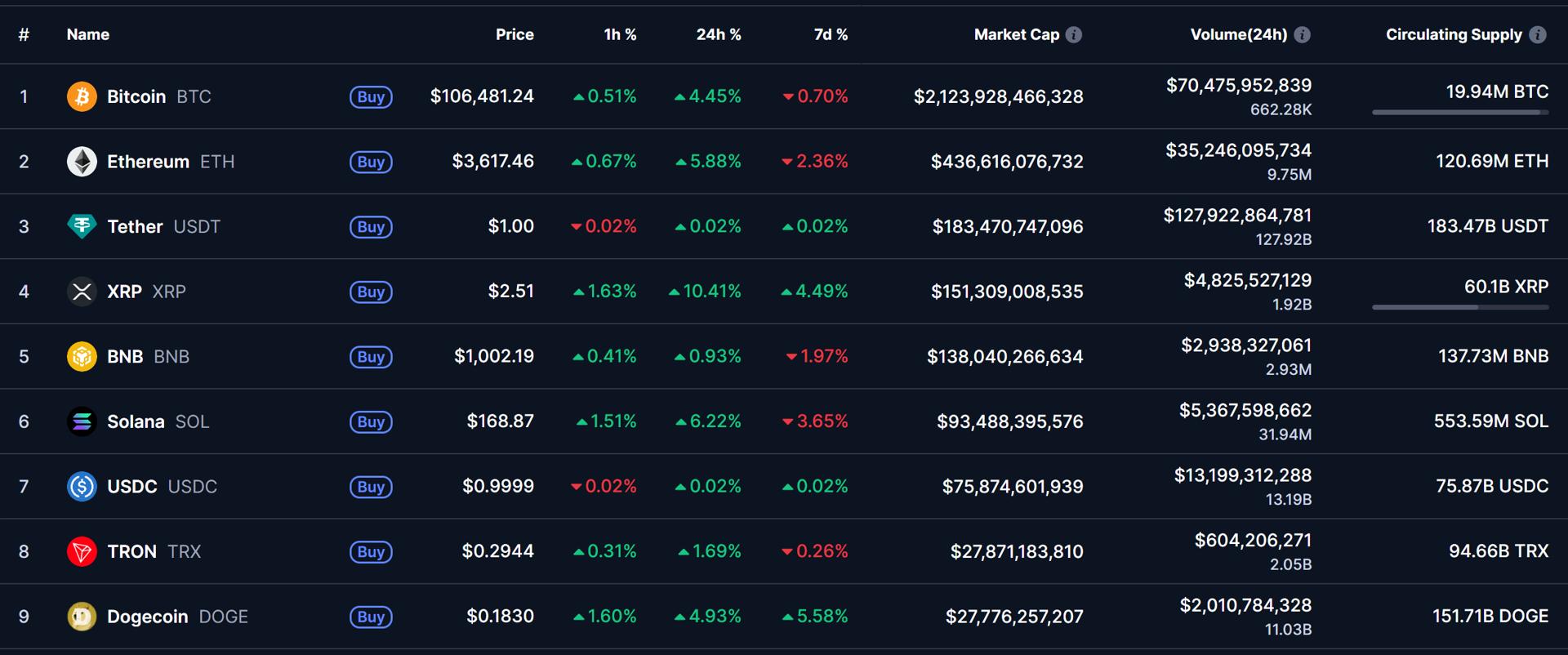
Ethereum surged over 7% to trade above $3,600, while XRP and Solana both
advanced approximately 6%. Total cryptocurrency market capitalization added
$156 billion in 24 hours, climbing to $3.57 trillion as long positions flooded
back into the market. Bitcoin open interest increased by nearly $700 million,
signaling aggressive position-building by traders anticipating further upside.
Markets
reacted swiftly to the temporal correlation between legislative advancement and
price movements. The Senate vote occurred Sunday, November 9, immediately
sparking the crypto rebound after weeks of suppressed sentiment due to
political gridlock and broader macroeconomic uncertainty. Bitcoin had tumbled
into bear market territory last week, falling over 20% from its October record
high of $126,080. The cryptocurrency remains more than 15% below that peak but
has recovered strongly from recent lows near $100,000.
Crypto prices are up today. Source: CoinMarketCapc.om
Joel
Kruger, crypto strategist at LMAX, noted: "The crypto market enters the
week on a solid footing, with Bitcoin closing last week above its 50-week
moving average and reaffirming the broader uptrend that has defined much of
this year. The mid-week dip we discussed proved to be another buying
opportunity rather than the start of any meaningful correction, with price
support at key technical levels attracting renewed demand across digital
assets."
Why Gold Price Is Going Up
Today?
Gold prices
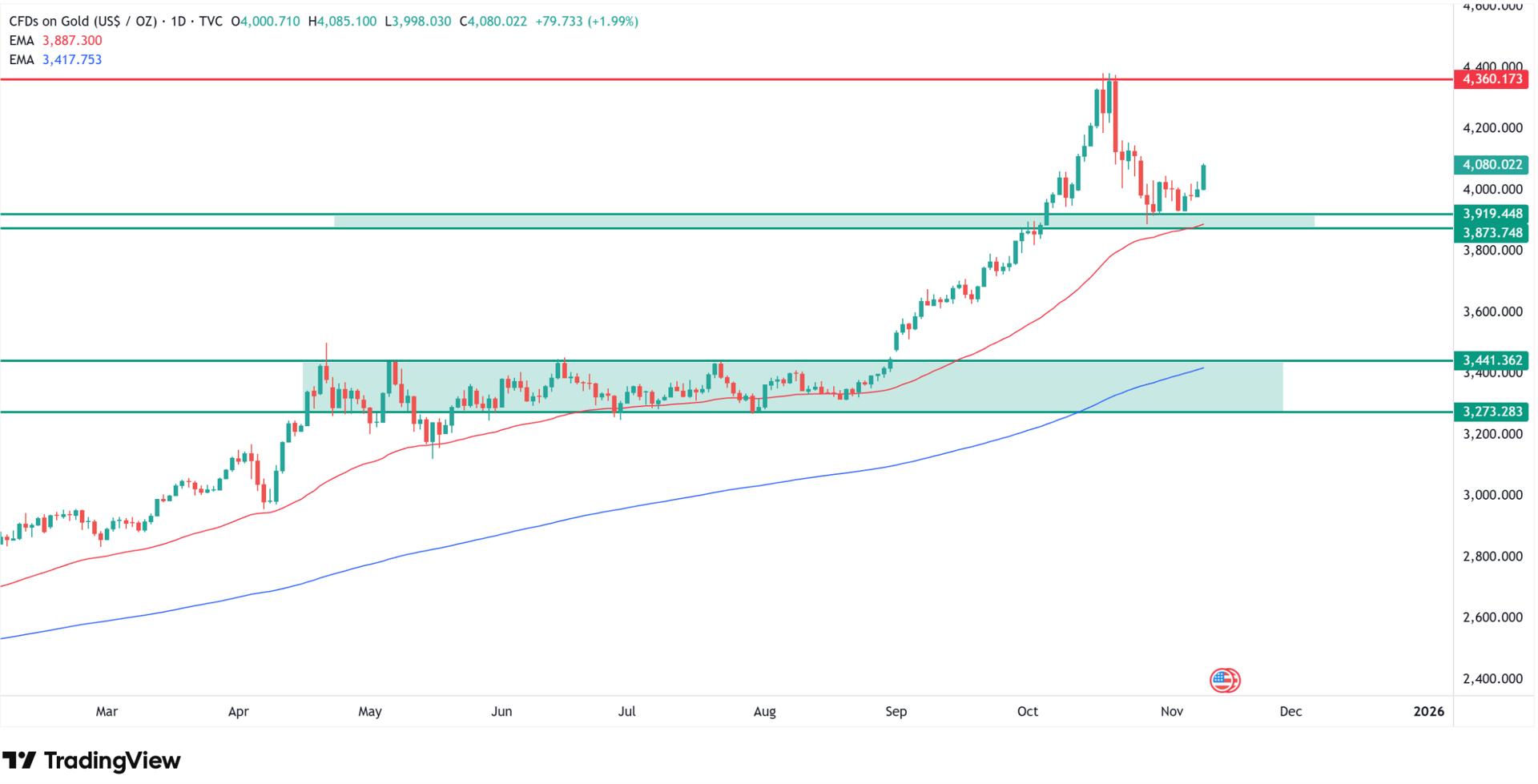
rallied nearly 2% on Monday, rebounding almost $80 per ounce to reach $4,085 as
the Senate shutdown vote pressured the U.S. dollar. According to my technical
analysis of the gold chart, XAU/USD is capitalizing on support just below the
$4,000 level, additionally reinforced by the 50-day exponential moving average,
and now has room to appreciate toward the historical highs tested in October
around $4,400 per ounce.
The only
scenario that would contradict this bullish outlook would be a breakdown of
current support, which would open the path to deeper correction toward the
$3,400 level where the 200 EMA also runs.
The dual
rally in both Bitcoin and gold represents a rare market phenomenon
where traditional safe havens and risk assets advance simultaneously. This
reflects the unique dynamics of the shutdown resolution, removing political
uncertainty (boosting risk assets) while simultaneously weakening the dollar
(supporting safe havens).
Why gold is going up today? Source: tradingview.com
Chris
Turner, ING analyst, observed: "Risk assets have been helped over the
weekend by news that a group of moderate Democrat senators are softening their
stance on the US government shutdown. There is still a long way to go here, but
we should know over the next couple of days whether the current compromise bill
has legs."
FX markets
responded by pushing the risk-sensitive Australian dollar close to 0.5% higher,
while USD/JPY climbed over 154 as the yen served as funding currency for risk
trades. Turner explained: "While some might argue that the end of the
shutdown could be a risk-on, dollar-negative impulse for the FX markets, its
impact may be more mixed."
The dollar
weakness stems from the shutdown resolution enabling federal spending
to resume, potentially increasing fiscal concerns that traditionally support
gold. Additionally, political stability allows the Federal Reserve to maintain
its dovish trajectory, with December rate cut probability still above 64%.
Lower rates reduce the opportunity cost of holding non-yielding gold while
typically weakening the dollar—a double benefit for precious metals.
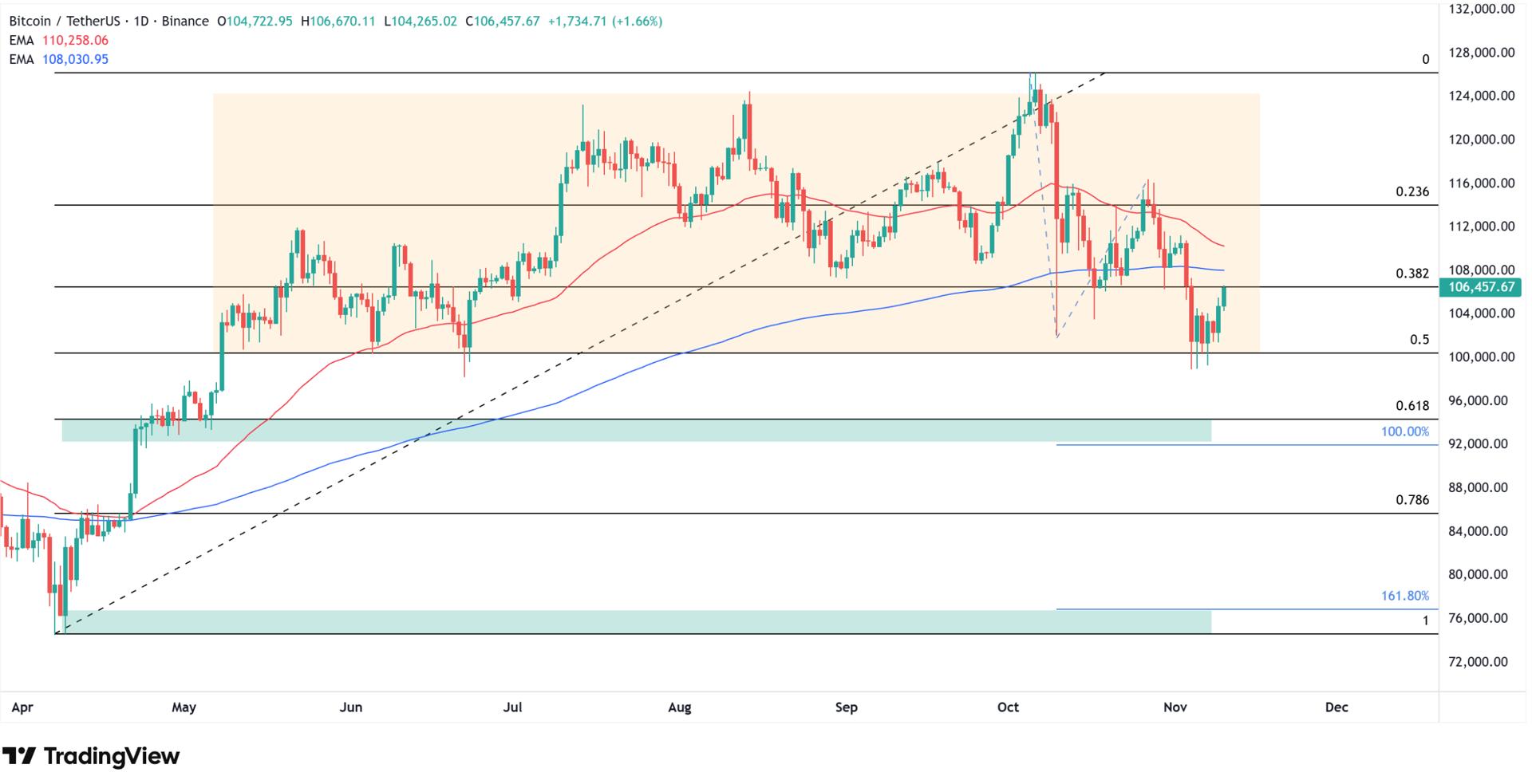
According
to my technical analysis, Bitcoin's price is rising 1.7% on Monday and testing
session highs at $106,670 on Binance exchange, adding to Sunday's gains and
producing a 4% advance over the past 24 hours. As visible on the chart, price
is bouncing from the lower boundary of the consolidation drawn continuously
since May, coinciding
with psychological support at $100,000 and the 50% Fibonacci retracement.
Currently,
price is stalling at the resistance zone around 106,000-108,000 dollars,
supported by the 38.2% Fibonacci retracement and 200 EMA. From my analysis,
this zone may determine the future direction within the current consolidation
pattern.
If Bitcoin
breaks above the grid of 50 and 200 EMAs and current resistance, it will open
the path to retesting the October all-time high around $126,000. If it fails to
overcome this resistance, risk increases for a move back below $100,000, falling
ultimately to $74,000. The cryptocurrency is currently trading at
$106,403.31, still below its 50-day moving average of $112,050 but showing
strong recovery momentum.
Joel Kruger
emphasized: "Momentum has since spilled over into Ethereum and the broader
altcoin complex, reinforcing the view that the market remains well-anchored
within a strong medium-term bullish structure. This resilience comes against a
macro backdrop that is once again turning supportive."
What Happens Next?
The Senate
bill now moves to a full floor vote in coming days, followed by House
consideration. Market observers assign high probability to passage, with
prediction market Myriad showing over 90% chance the government closure ends
before November 15—up from 37% just 24 hours earlier.
For Bitcoin,
according to my technical analysis, breaking decisively above the
106,000-108,000 resistance zone would open the path toward retesting October's
$126,000 all-time high. Failure to overcome this resistance increases the risk
of retreat below $100,000, though most analysts view the technical and
fundamental backdrop as supportive.
Gold faces resistance at historical
highs around $4,400 per ounce. According to my analysis, support is holding at
the critical $4,000 level reinforced by the 50 EMA. Dollar weakness from
resumed government spending and Fed dovishness should provide tailwinds for
further precious metals appreciation.
Turner
cautioned: "If last week's 100.36 high in DXY is to prove significant, it
should not really be making it back above the 99.90/100.00 area now." This
suggests dollar downside may be limited, potentially capping gold's immediate
upside while still supporting the broader bullish trend.
The coming
48 hours in Congress will determine whether the shutdown compromise "has
legs," with markets positioned for positive resolution but prepared for
continued volatility if the deal falters.
Before you leave, I encourage you to also check my earlier analyses and forecasts on gold and Bitcoin:
Bitcoin is
surging 4.38% to $106,274 on Monday, November 10, 2025, primarily due to the
U.S. Senate's 60-40 vote advancing legislation to end the historic 40-day
government shutdown. The cryptocurrency bounced from support at the
psychological $100,000 level after eight Democratic senators agreed to a GOP
funding deal, removing political uncertainty that had weighed on risk assets.
Why is gold rising today?
Gold
rallied nearly 2% on Monday, rebounding almost $80 per ounce to reach $4,085,
as the Senate shutdown vote pressured the U.S. dollar. The precious metal is
benefiting from dollar weakness stemming from expectations that resumed
government spending will increase fiscal concerns, while political stability
allows the Federal Reserve to maintain its dovish trajectory with December rate
cut probability above 64%.
What is Bitcoin price
prediction for November 2025?
Bitcoin
price forecasts for November 2025 vary significantly across analysts. Changelly
predicts Bitcoin could reach $129,042 by November 13, representing a 26% gain
from current levels. CoinCodex forecasts BTC will rise 4.48% to $127,142 by
November 17 if it reaches upper price targets, with technical indicators
currently showing bearish sentiment despite the recent rally.
What is gold price
prediction for 2025-2026?
Major
institutions forecast gold between $4,200-$5,000 per ounce by late 2026. UBS
projects gold reaching $4,200 as the next baseline target, with an upside
scenario of $4,700 by Q1 2026 if geopolitical risks intensify. Goldman Sachs
forecasts $5,055 by Q4 2026, while Bank of America targets $5,000 (averaging
$4,400 for the full year). ING expects more conservative near-term targets of
$4,000 for Q4 2025 and $4,100 for Q1 2026, with further upside through 2026.
How high can Bitcoin go?
Industry
experts project Bitcoin could reach $180,000-$200,000 during 2025, according to
forecasts compiled by CNBC. Youwei Yang, chief economist at Bit Mining,
predicts Bitcoin's price will range between $180,000 and $190,000 in 2025,
though he warns of potential corrections to around $80,000 during market
shocks.
What are the risks to
Bitcoin and gold rallies?
For
Bitcoin, primary risks include failure to break above the $106,000-$108,000
resistance zone (which would increase probability of retreat below $100,000),
Federal Reserve speakers signaling slower pace of rate cuts (December cut
probability has dropped to 64%), and potential for corrections to $80,000
during major market shocks according to analyst warnings.
Bitcoin (BTC) price surged
above $106,000 and gold (XAU) jumped nearly 2% today (Monday), November 10,
2025, as the U.S. Senate voted 60-40 to advance legislation ending the longest
government shutdown in American history. The dual rally reflects dollar
weakness and improved risk sentiment as eight Democratic senators agreed to a
GOP funding deal, marking the 15th attempt by Senate Majority Leader John Thune
to secure bipartisan support.
I am looking in this article for an answer to why
Bitcoin and gold are surging today. I also provide a technical analysis of the
BTC/USDT and XAU/USD charts, based on more than ten years of experience as an
analyst and active retail investor.
The political
resolution triggered sharp improvements across crypto markets.
Ethereum surged over 7% to trade above $3,600, while XRP and Solana both
advanced approximately 6%. Total cryptocurrency market capitalization added
$156 billion in 24 hours, climbing to $3.57 trillion as long positions flooded
back into the market. Bitcoin open interest increased by nearly $700 million,
signaling aggressive position-building by traders anticipating further upside.
Markets
reacted swiftly to the temporal correlation between legislative advancement and
price movements. The Senate vote occurred Sunday, November 9, immediately
sparking the crypto rebound after weeks of suppressed sentiment due to
political gridlock and broader macroeconomic uncertainty. Bitcoin had tumbled
into bear market territory last week, falling over 20% from its October record
high of $126,080. The cryptocurrency remains more than 15% below that peak but
has recovered strongly from recent lows near $100,000.
Crypto prices are up today. Source: CoinMarketCapc.om
Joel
Kruger, crypto strategist at LMAX, noted: "The crypto market enters the
week on a solid footing, with Bitcoin closing last week above its 50-week
moving average and reaffirming the broader uptrend that has defined much of
this year. The mid-week dip we discussed proved to be another buying
opportunity rather than the start of any meaningful correction, with price
support at key technical levels attracting renewed demand across digital
assets."
Why Gold Price Is Going Up
Today?
Gold prices
rallied nearly 2% on Monday, rebounding almost $80 per ounce to reach $4,085 as
the Senate shutdown vote pressured the U.S. dollar. According to my technical
analysis of the gold chart, XAU/USD is capitalizing on support just below the
$4,000 level, additionally reinforced by the 50-day exponential moving average,
and now has room to appreciate toward the historical highs tested in October
around $4,400 per ounce.
The only
scenario that would contradict this bullish outlook would be a breakdown of
current support, which would open the path to deeper correction toward the
$3,400 level where the 200 EMA also runs.
The dual
rally in both Bitcoin and gold represents a rare market phenomenon
where traditional safe havens and risk assets advance simultaneously. This
reflects the unique dynamics of the shutdown resolution, removing political
uncertainty (boosting risk assets) while simultaneously weakening the dollar
(supporting safe havens).
Why gold is going up today? Source: tradingview.com
Chris
Turner, ING analyst, observed: "Risk assets have been helped over the
weekend by news that a group of moderate Democrat senators are softening their
stance on the US government shutdown. There is still a long way to go here, but
we should know over the next couple of days whether the current compromise bill
has legs."
FX markets
responded by pushing the risk-sensitive Australian dollar close to 0.5% higher,
while USD/JPY climbed over 154 as the yen served as funding currency for risk
trades. Turner explained: "While some might argue that the end of the
shutdown could be a risk-on, dollar-negative impulse for the FX markets, its
impact may be more mixed."
The dollar
weakness stems from the shutdown resolution enabling federal spending
to resume, potentially increasing fiscal concerns that traditionally support
gold. Additionally, political stability allows the Federal Reserve to maintain
its dovish trajectory, with December rate cut probability still above 64%.
Lower rates reduce the opportunity cost of holding non-yielding gold while
typically weakening the dollar—a double benefit for precious metals.
According
to my technical analysis, Bitcoin's price is rising 1.7% on Monday and testing
session highs at $106,670 on Binance exchange, adding to Sunday's gains and
producing a 4% advance over the past 24 hours. As visible on the chart, price
is bouncing from the lower boundary of the consolidation drawn continuously
since May, coinciding
with psychological support at $100,000 and the 50% Fibonacci retracement.
Currently,
price is stalling at the resistance zone around 106,000-108,000 dollars,
supported by the 38.2% Fibonacci retracement and 200 EMA. From my analysis,
this zone may determine the future direction within the current consolidation
pattern.
If Bitcoin
breaks above the grid of 50 and 200 EMAs and current resistance, it will open
the path to retesting the October all-time high around $126,000. If it fails to
overcome this resistance, risk increases for a move back below $100,000, falling
ultimately to $74,000. The cryptocurrency is currently trading at
$106,403.31, still below its 50-day moving average of $112,050 but showing
strong recovery momentum.
Joel Kruger
emphasized: "Momentum has since spilled over into Ethereum and the broader
altcoin complex, reinforcing the view that the market remains well-anchored
within a strong medium-term bullish structure. This resilience comes against a
macro backdrop that is once again turning supportive."
What Happens Next?
The Senate
bill now moves to a full floor vote in coming days, followed by House
consideration. Market observers assign high probability to passage, with
prediction market Myriad showing over 90% chance the government closure ends
before November 15—up from 37% just 24 hours earlier.
For Bitcoin,
according to my technical analysis, breaking decisively above the
106,000-108,000 resistance zone would open the path toward retesting October's
$126,000 all-time high. Failure to overcome this resistance increases the risk
of retreat below $100,000, though most analysts view the technical and
fundamental backdrop as supportive.
Gold faces resistance at historical
highs around $4,400 per ounce. According to my analysis, support is holding at
the critical $4,000 level reinforced by the 50 EMA. Dollar weakness from
resumed government spending and Fed dovishness should provide tailwinds for
further precious metals appreciation.
Turner
cautioned: "If last week's 100.36 high in DXY is to prove significant, it
should not really be making it back above the 99.90/100.00 area now." This
suggests dollar downside may be limited, potentially capping gold's immediate
upside while still supporting the broader bullish trend.
The coming
48 hours in Congress will determine whether the shutdown compromise "has
legs," with markets positioned for positive resolution but prepared for
continued volatility if the deal falters.
Before you leave, I encourage you to also check my earlier analyses and forecasts on gold and Bitcoin:
Bitcoin is
surging 4.38% to $106,274 on Monday, November 10, 2025, primarily due to the
U.S. Senate's 60-40 vote advancing legislation to end the historic 40-day
government shutdown. The cryptocurrency bounced from support at the
psychological $100,000 level after eight Democratic senators agreed to a GOP
funding deal, removing political uncertainty that had weighed on risk assets.
Why is gold rising today?
Gold
rallied nearly 2% on Monday, rebounding almost $80 per ounce to reach $4,085,
as the Senate shutdown vote pressured the U.S. dollar. The precious metal is
benefiting from dollar weakness stemming from expectations that resumed
government spending will increase fiscal concerns, while political stability
allows the Federal Reserve to maintain its dovish trajectory with December rate
cut probability above 64%.
What is Bitcoin price
prediction for November 2025?
Bitcoin
price forecasts for November 2025 vary significantly across analysts. Changelly
predicts Bitcoin could reach $129,042 by November 13, representing a 26% gain
from current levels. CoinCodex forecasts BTC will rise 4.48% to $127,142 by
November 17 if it reaches upper price targets, with technical indicators
currently showing bearish sentiment despite the recent rally.
What is gold price
prediction for 2025-2026?
Major
institutions forecast gold between $4,200-$5,000 per ounce by late 2026. UBS
projects gold reaching $4,200 as the next baseline target, with an upside
scenario of $4,700 by Q1 2026 if geopolitical risks intensify. Goldman Sachs
forecasts $5,055 by Q4 2026, while Bank of America targets $5,000 (averaging
$4,400 for the full year). ING expects more conservative near-term targets of
$4,000 for Q4 2025 and $4,100 for Q1 2026, with further upside through 2026.
How high can Bitcoin go?
Industry
experts project Bitcoin could reach $180,000-$200,000 during 2025, according to
forecasts compiled by CNBC. Youwei Yang, chief economist at Bit Mining,
predicts Bitcoin's price will range between $180,000 and $190,000 in 2025,
though he warns of potential corrections to around $80,000 during market
shocks.
What are the risks to
Bitcoin and gold rallies?
For
Bitcoin, primary risks include failure to break above the $106,000-$108,000
resistance zone (which would increase probability of retreat below $100,000),
Federal Reserve speakers signaling slower pace of rate cuts (December cut
probability has dropped to 64%), and potential for corrections to $80,000
during major market shocks according to analyst warnings.
Damian Chmiel is a Senior Analyst & Editor at Finance Magnates with more than 15 years of experience in the CFD and online trading industry. Active as both a trader and journalist since 2010, he focuses on broker coverage, fintech innovation, and regulatory developments across Europe, the Middle East, and Asia.
His work includes interviews with C-level leaders at major brokerages and fintech platforms, as well as co-authoring Finance Magnates’ quarterly industry benchmarking reports. Damian’s reporting is data-driven, market-aware, and grounded in direct industry engagement. His analysis and commentary have also been cited by external media outlets, including Investing.com, Binance, The Asset, Stockhead, and Dispatch.
Education:
MA in Finance and Accounting, Cracow University of Economics
Why Is Dogecoin Going Up Today? DOGE Price Prediction Shows 25% Upside Potential
Featured Videos
XTB Adds Overnight US Stock Trading; Nasdaq Ventures Invests in One Trading
XTB Adds Overnight US Stock Trading; Nasdaq Ventures Invests in One Trading
XTB Adds Overnight US Stock Trading; Nasdaq Ventures Invests in One Trading
XTB Adds Overnight US Stock Trading; Nasdaq Ventures Invests in One Trading
Today’s financial news recap covers XTB expands overnight US stock trading, Fortrade reports higher revenue, Nasdaq backs One Trading, and Vest Labs raises 13 million dollars.
Finance Magnates Daily Recap brings you the latest news from forex and CFD brokers, fintech, payments, cryptocurrency, digital assets, trading platforms, financial regulation and global markets.
Get the key company news, executive moves, deals, regulatory updates and market developments of the day, in just a few minutes. New episodes published every weekday.
Read more: https://www.financemagnates.com
#FinanceMagnates #ForexNews #FintechNews
Today’s financial news recap covers XTB expands overnight US stock trading, Fortrade reports higher revenue, Nasdaq backs One Trading, and Vest Labs raises 13 million dollars.
Finance Magnates Daily Recap brings you the latest news from forex and CFD brokers, fintech, payments, cryptocurrency, digital assets, trading platforms, financial regulation and global markets.
Get the key company news, executive moves, deals, regulatory updates and market developments of the day, in just a few minutes. New episodes published every weekday.
Read more: https://www.financemagnates.com
#FinanceMagnates #ForexNews #FintechNews
Today’s financial news recap covers XTB expands overnight US stock trading, Fortrade reports higher revenue, Nasdaq backs One Trading, and Vest Labs raises 13 million dollars.
Finance Magnates Daily Recap brings you the latest news from forex and CFD brokers, fintech, payments, cryptocurrency, digital assets, trading platforms, financial regulation and global markets.
Get the key company news, executive moves, deals, regulatory updates and market developments of the day, in just a few minutes. New episodes published every weekday.
Read more: https://www.financemagnates.com
#FinanceMagnates #ForexNews #FintechNews
Today’s financial news recap covers XTB expands overnight US stock trading, Fortrade reports higher revenue, Nasdaq backs One Trading, and Vest Labs raises 13 million dollars.
Finance Magnates Daily Recap brings you the latest news from forex and CFD brokers, fintech, payments, cryptocurrency, digital assets, trading platforms, financial regulation and global markets.
Get the key company news, executive moves, deals, regulatory updates and market developments of the day, in just a few minutes. New episodes published every weekday.
Read more: https://www.financemagnates.com
#FinanceMagnates #ForexNews #FintechNews
CMC Founder Downplays Volatility Hit; Devexperts Names CEO
CMC Founder Downplays Volatility Hit; Devexperts Names CEO
CMC Founder Downplays Volatility Hit; Devexperts Names CEO
CMC Founder Downplays Volatility Hit; Devexperts Names CEO
CMC Founder Downplays Volatility Hit; Devexperts Names CEO
CMC Founder Downplays Volatility Hit; Devexperts Names CEO
Today’s financial news recap covers low volatility pressures brokers, Devexperts names a new CEO, Saxo cuts onboarding time, and OKX reaches a 25 billion dollar valuation.
Finance Magnates Daily Recap brings you the latest news from forex and CFD brokers, fintech, payments, cryptocurrency, digital assets, trading platforms, financial regulation and global markets.
Get the key company news, executive moves, deals, regulatory updates and market developments of the day, in just a few minutes. New episodes published every weekday.
Read more: https://www.financemagnates.com
#FinanceMagnates #ForexNews #FintechNews
Today’s financial news recap covers low volatility pressures brokers, Devexperts names a new CEO, Saxo cuts onboarding time, and OKX reaches a 25 billion dollar valuation.
Finance Magnates Daily Recap brings you the latest news from forex and CFD brokers, fintech, payments, cryptocurrency, digital assets, trading platforms, financial regulation and global markets.
Get the key company news, executive moves, deals, regulatory updates and market developments of the day, in just a few minutes. New episodes published every weekday.
Read more: https://www.financemagnates.com
#FinanceMagnates #ForexNews #FintechNews
Today’s financial news recap covers low volatility pressures brokers, Devexperts names a new CEO, Saxo cuts onboarding time, and OKX reaches a 25 billion dollar valuation.
Finance Magnates Daily Recap brings you the latest news from forex and CFD brokers, fintech, payments, cryptocurrency, digital assets, trading platforms, financial regulation and global markets.
Get the key company news, executive moves, deals, regulatory updates and market developments of the day, in just a few minutes. New episodes published every weekday.
Read more: https://www.financemagnates.com
#FinanceMagnates #ForexNews #FintechNews
Today’s financial news recap covers low volatility pressures brokers, Devexperts names a new CEO, Saxo cuts onboarding time, and OKX reaches a 25 billion dollar valuation.
Finance Magnates Daily Recap brings you the latest news from forex and CFD brokers, fintech, payments, cryptocurrency, digital assets, trading platforms, financial regulation and global markets.
Get the key company news, executive moves, deals, regulatory updates and market developments of the day, in just a few minutes. New episodes published every weekday.
Read more: https://www.financemagnates.com
#FinanceMagnates #ForexNews #FintechNews
Today’s financial news recap covers low volatility pressures brokers, Devexperts names a new CEO, Saxo cuts onboarding time, and OKX reaches a 25 billion dollar valuation.
Finance Magnates Daily Recap brings you the latest news from forex and CFD brokers, fintech, payments, cryptocurrency, digital assets, trading platforms, financial regulation and global markets.
Get the key company news, executive moves, deals, regulatory updates and market developments of the day, in just a few minutes. New episodes published every weekday.
Read more: https://www.financemagnates.com
#FinanceMagnates #ForexNews #FintechNews
Today’s financial news recap covers low volatility pressures brokers, Devexperts names a new CEO, Saxo cuts onboarding time, and OKX reaches a 25 billion dollar valuation.
Finance Magnates Daily Recap brings you the latest news from forex and CFD brokers, fintech, payments, cryptocurrency, digital assets, trading platforms, financial regulation and global markets.
Get the key company news, executive moves, deals, regulatory updates and market developments of the day, in just a few minutes. New episodes published every weekday.
Read more: https://www.financemagnates.com
#FinanceMagnates #ForexNews #FintechNews
Today’s financial news recap covers Trade Nation buys FXCM's UK client book, Trading 212 reports higher revenue, the CFTC's move to allow perpetual index futures.
Finance Magnates Daily Recap brings you the latest news from forex and CFD brokers, fintech, payments, cryptocurrency, digital assets, trading platforms, financial regulation and global markets.
Get the key company news, executive moves, deals, regulatory updates and market developments of the day, in just a few minutes. New episodes published every weekday.
Read more: https://www.financemagnates.com
#FinanceMagnates #ForexNews #FintechNews
Today’s financial news recap covers Trade Nation buys FXCM's UK client book, Trading 212 reports higher revenue, the CFTC's move to allow perpetual index futures.
Finance Magnates Daily Recap brings you the latest news from forex and CFD brokers, fintech, payments, cryptocurrency, digital assets, trading platforms, financial regulation and global markets.
Get the key company news, executive moves, deals, regulatory updates and market developments of the day, in just a few minutes. New episodes published every weekday.
Read more: https://www.financemagnates.com
#FinanceMagnates #ForexNews #FintechNews
Today’s financial news recap covers Trade Nation buys FXCM's UK client book, Trading 212 reports higher revenue, the CFTC's move to allow perpetual index futures.
Finance Magnates Daily Recap brings you the latest news from forex and CFD brokers, fintech, payments, cryptocurrency, digital assets, trading platforms, financial regulation and global markets.
Get the key company news, executive moves, deals, regulatory updates and market developments of the day, in just a few minutes. New episodes published every weekday.
Read more: https://www.financemagnates.com
#FinanceMagnates #ForexNews #FintechNews
Today’s financial news recap covers Trade Nation buys FXCM's UK client book, Trading 212 reports higher revenue, the CFTC's move to allow perpetual index futures.
Finance Magnates Daily Recap brings you the latest news from forex and CFD brokers, fintech, payments, cryptocurrency, digital assets, trading platforms, financial regulation and global markets.
Get the key company news, executive moves, deals, regulatory updates and market developments of the day, in just a few minutes. New episodes published every weekday.
Read more: https://www.financemagnates.com
#FinanceMagnates #ForexNews #FintechNews
Today’s financial news recap covers Trade Nation buys FXCM's UK client book, Trading 212 reports higher revenue, the CFTC's move to allow perpetual index futures.
Finance Magnates Daily Recap brings you the latest news from forex and CFD brokers, fintech, payments, cryptocurrency, digital assets, trading platforms, financial regulation and global markets.
Get the key company news, executive moves, deals, regulatory updates and market developments of the day, in just a few minutes. New episodes published every weekday.
Read more: https://www.financemagnates.com
#FinanceMagnates #ForexNews #FintechNews
Today’s financial news recap covers Trade Nation buys FXCM's UK client book, Trading 212 reports higher revenue, the CFTC's move to allow perpetual index futures.
Finance Magnates Daily Recap brings you the latest news from forex and CFD brokers, fintech, payments, cryptocurrency, digital assets, trading platforms, financial regulation and global markets.
Get the key company news, executive moves, deals, regulatory updates and market developments of the day, in just a few minutes. New episodes published every weekday.
Read more: https://www.financemagnates.com
#FinanceMagnates #ForexNews #FintechNews
Your career isn’t a linear path.
Your career isn’t a linear path.
Your career isn’t a linear path.
Your career isn’t a linear path.
Your career isn’t a linear path.
Your career isn’t a linear path.
Roles change. Career goals change. Sometimes you want a completely new challenge.
But the skills and knowledge you build along the way can stay with you and give you something to build on.
For Jeff Patterson, that continued growth is key to long-term career development.
You bring the skills. FM Academy helps you build the knowledge.
#FMAcademy #FinanceMagnates #FinanceCareers #ProfessionalDevelopment #Fintech
Roles change. Career goals change. Sometimes you want a completely new challenge.
But the skills and knowledge you build along the way can stay with you and give you something to build on.
For Jeff Patterson, that continued growth is key to long-term career development.
You bring the skills. FM Academy helps you build the knowledge.
#FMAcademy #FinanceMagnates #FinanceCareers #ProfessionalDevelopment #Fintech
Roles change. Career goals change. Sometimes you want a completely new challenge.
But the skills and knowledge you build along the way can stay with you and give you something to build on.
For Jeff Patterson, that continued growth is key to long-term career development.
You bring the skills. FM Academy helps you build the knowledge.
#FMAcademy #FinanceMagnates #FinanceCareers #ProfessionalDevelopment #Fintech
Roles change. Career goals change. Sometimes you want a completely new challenge.
But the skills and knowledge you build along the way can stay with you and give you something to build on.
For Jeff Patterson, that continued growth is key to long-term career development.
You bring the skills. FM Academy helps you build the knowledge.
#FMAcademy #FinanceMagnates #FinanceCareers #ProfessionalDevelopment #Fintech
Roles change. Career goals change. Sometimes you want a completely new challenge.
But the skills and knowledge you build along the way can stay with you and give you something to build on.
For Jeff Patterson, that continued growth is key to long-term career development.
You bring the skills. FM Academy helps you build the knowledge.
#FMAcademy #FinanceMagnates #FinanceCareers #ProfessionalDevelopment #Fintech
Roles change. Career goals change. Sometimes you want a completely new challenge.
But the skills and knowledge you build along the way can stay with you and give you something to build on.
For Jeff Patterson, that continued growth is key to long-term career development.
You bring the skills. FM Academy helps you build the knowledge.
#FMAcademy #FinanceMagnates #FinanceCareers #ProfessionalDevelopment #Fintech
IG Group Tech Chiefs Exit; Pepperstone Revenue Grows
IG Group Tech Chiefs Exit; Pepperstone Revenue Grows
IG Group Tech Chiefs Exit; Pepperstone Revenue Grows
IG Group Tech Chiefs Exit; Pepperstone Revenue Grows
IG Group Tech Chiefs Exit; Pepperstone Revenue Grows
IG Group Tech Chiefs Exit; Pepperstone Revenue Grows
Today’s financial news recap covers IG Group loses two technology chiefs, Pepperstone reports double-digit growth, and eToro backs a euro stablecoin.
Finance Magnates Daily Recap brings you the latest news from forex and CFD brokers, fintech, payments, cryptocurrency, digital assets, trading platforms, financial regulation and global markets.
Get the key company news, executive moves, deals, regulatory updates and market developments of the day, in just a few minutes. New episodes published every weekday.
Read more: https://www.financemagnates.com
#FinanceMagnates #ForexNews #FintechNews
Today’s financial news recap covers IG Group loses two technology chiefs, Pepperstone reports double-digit growth, and eToro backs a euro stablecoin.
Finance Magnates Daily Recap brings you the latest news from forex and CFD brokers, fintech, payments, cryptocurrency, digital assets, trading platforms, financial regulation and global markets.
Get the key company news, executive moves, deals, regulatory updates and market developments of the day, in just a few minutes. New episodes published every weekday.
Read more: https://www.financemagnates.com
#FinanceMagnates #ForexNews #FintechNews
Today’s financial news recap covers IG Group loses two technology chiefs, Pepperstone reports double-digit growth, and eToro backs a euro stablecoin.
Finance Magnates Daily Recap brings you the latest news from forex and CFD brokers, fintech, payments, cryptocurrency, digital assets, trading platforms, financial regulation and global markets.
Get the key company news, executive moves, deals, regulatory updates and market developments of the day, in just a few minutes. New episodes published every weekday.
Read more: https://www.financemagnates.com
#FinanceMagnates #ForexNews #FintechNews
Today’s financial news recap covers IG Group loses two technology chiefs, Pepperstone reports double-digit growth, and eToro backs a euro stablecoin.
Finance Magnates Daily Recap brings you the latest news from forex and CFD brokers, fintech, payments, cryptocurrency, digital assets, trading platforms, financial regulation and global markets.
Get the key company news, executive moves, deals, regulatory updates and market developments of the day, in just a few minutes. New episodes published every weekday.
Read more: https://www.financemagnates.com
#FinanceMagnates #ForexNews #FintechNews
Today’s financial news recap covers IG Group loses two technology chiefs, Pepperstone reports double-digit growth, and eToro backs a euro stablecoin.
Finance Magnates Daily Recap brings you the latest news from forex and CFD brokers, fintech, payments, cryptocurrency, digital assets, trading platforms, financial regulation and global markets.
Get the key company news, executive moves, deals, regulatory updates and market developments of the day, in just a few minutes. New episodes published every weekday.
Read more: https://www.financemagnates.com
#FinanceMagnates #ForexNews #FintechNews
Today’s financial news recap covers IG Group loses two technology chiefs, Pepperstone reports double-digit growth, and eToro backs a euro stablecoin.
Finance Magnates Daily Recap brings you the latest news from forex and CFD brokers, fintech, payments, cryptocurrency, digital assets, trading platforms, financial regulation and global markets.
Get the key company news, executive moves, deals, regulatory updates and market developments of the day, in just a few minutes. New episodes published every weekday.
Read more: https://www.financemagnates.com
#FinanceMagnates #ForexNews #FintechNews