The cryptocurrency market crashed on Wednesday, with Bitcoin breaking below $100,000 psychological support for the first time since June.
Ethereum plunges 16% over 48 hours, followed by strong selloffs on the XRP and DOGE charts.
The AI bubble contagion, institutional outflows from bitcoin ETFs and a leverage cascade are among the main drivers behind the sell-off in the crypto market.
Why crypto is falling today? Check the newest technical analysis of BTC, ETH, DOGE and XRP charts
The
cryptocurrency market crashed for a second consecutive day today (Wednesday), 5
November 2025, losing over $1 trillion in market capitalization since early
October as Bitcoin, Ethereum, XRP and Dogecoin prices led a broad-based
selloff.
The entire
crypto ecosystem is experiencing dynamic declines with Ethereum at $3,303 (after
-16% two-day crash), Bitcoin testing $100,000 psychological support, and major
altcoins extending losses as institutional investors rotate out of digital
assets.
In this
article, I examine why crypto is going down and conduct a technical analysis of
the BTC/USDT, XRP/USDT, ETH/USDT and DOGE/USDT charts, based on more than 10
years of experience as a cryptocurrency investor and analyst.
Why Crypto Is Going Down Today?
Fed, AI Bubble, and Whale Selling
Federal
Reserve Chairman Jerome Powell's hawkish remarks downplaying December rate cuts
created the initial catalyst for crypto's collapse. The probability of a
December cut collapsed from 96% before Powell's press conference to just 69.3%
afterward, dampening expectations for looser financial conditions that
typically support cryptocurrency prices.
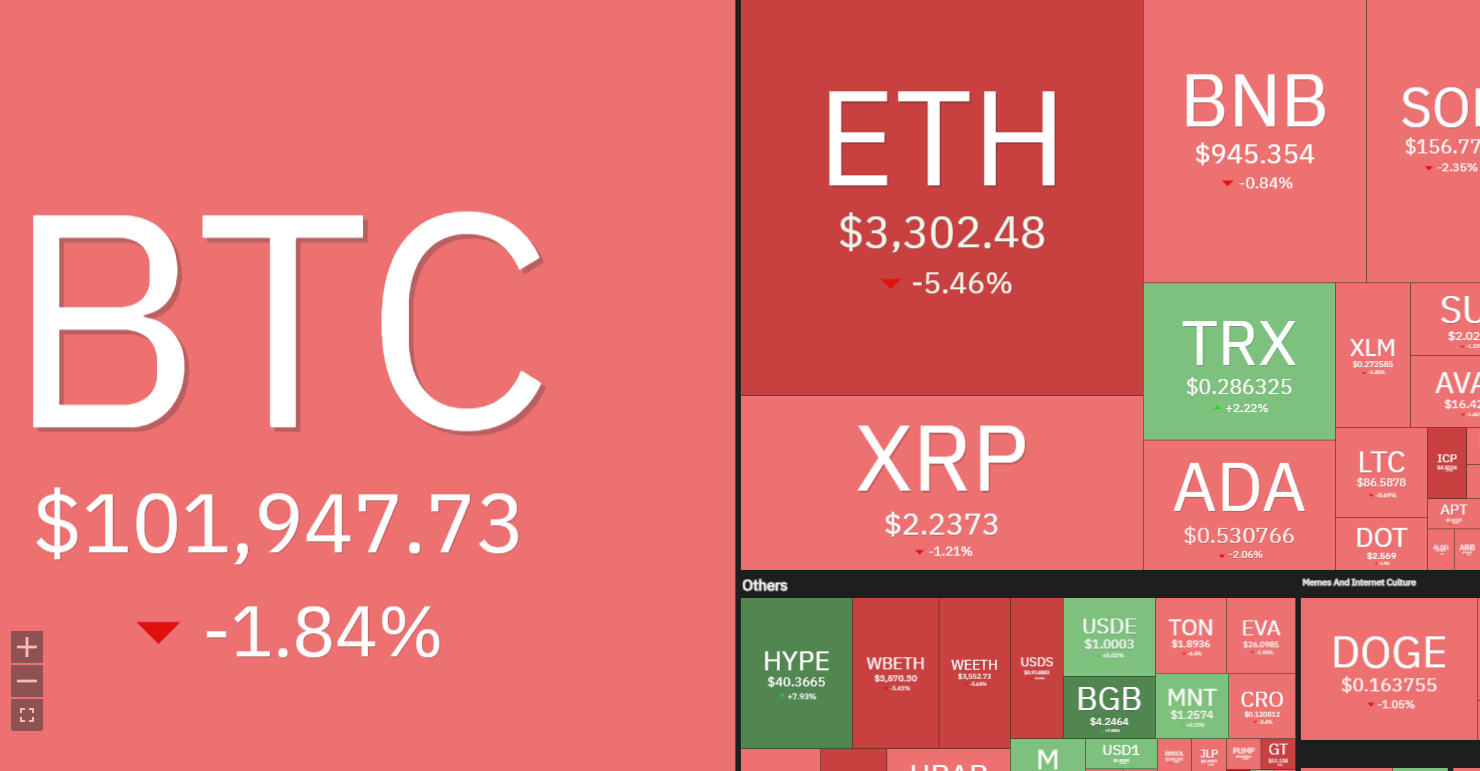
Source: Coin360
Paul Howard
from Wincent explained the market dynamics: "Cryptocurrency prices
continued to slide and were pushed lower by a lack of positive macro news.
There appears to be a big skew of selling on a major exchange which would back
up the on-chain analysis indicating this is old BTC whale selling pressure.
Dumping billions gradually into the ecosystem over the course of the last few
days is not panic selling."
The
cryptocurrency collapse coincides with a broader tech selloff. Palantir dropped
8% despite beating earnings on valuation concerns, while Nvidia shed 4% losing
$200 billion in market capitalization. The Nasdaq fell 2% and the S&P 500
declined 1.2%, reflecting growing worries about AI-driven stock valuations.
Institutional
investors pulled $1.15 billion from Bitcoin ETFs last week, led by BlackRock,
ARK Invest, and Fidelity. This exodus signals a significant shift in sentiment
as traditional financial institutions that drove Bitcoin's rally to $126,000 in
early October are now reducing exposure amid Federal Reserve uncertainty and AI
bubble concerns.
Ethereum 16% Two-Day Crash
Breaks 200-Day EMA
According
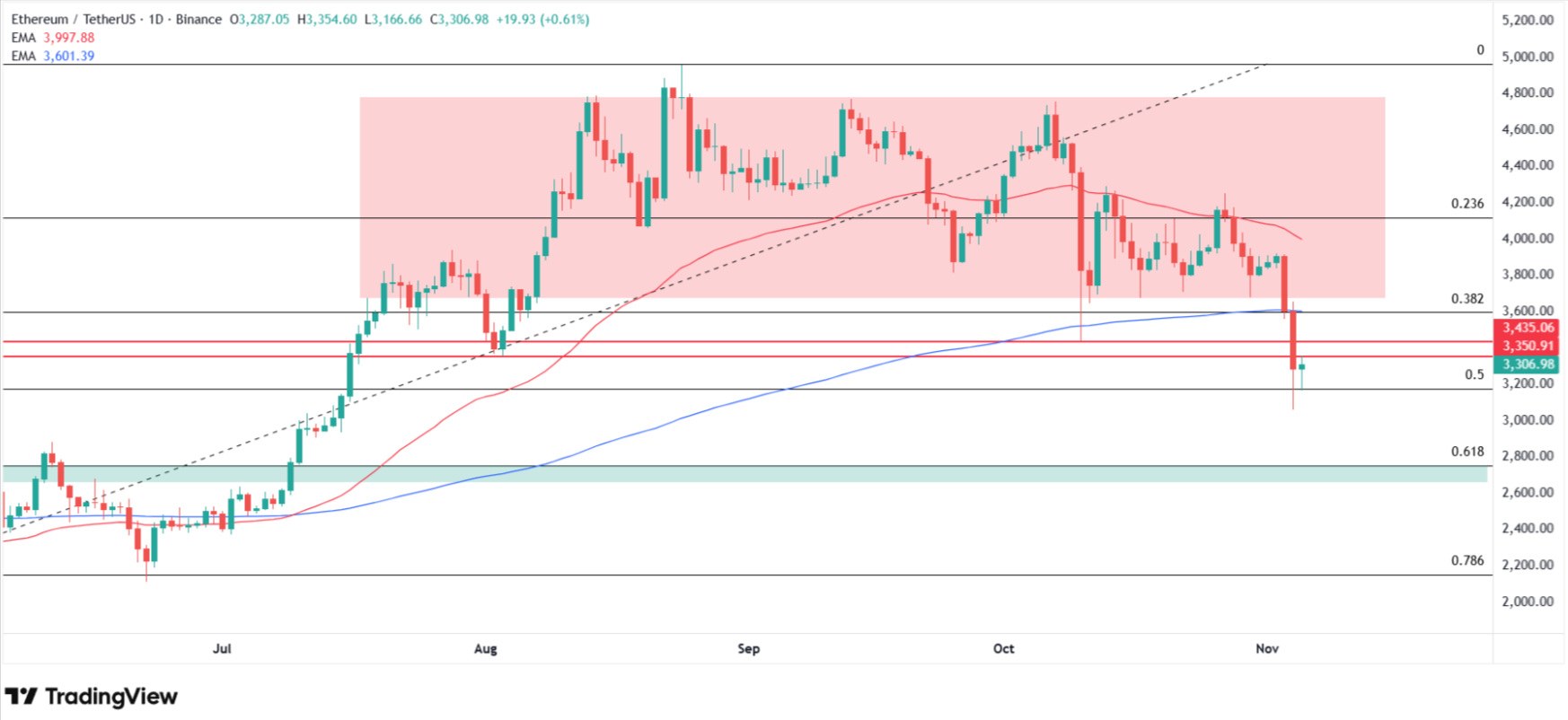
to my technical analysis, the price of Ethereum (ETH) has experienced two days
of dynamic declines in a row, losing approximately 16% within 48 hours. For the
chart situation, this is a very large change, and from my technical analysis,
these declines from the first part of the week fully hand power to the bears,
changing the trend currently to downward.
Most
significantly, we went below the 200-day exponential moving average (200 EMA),
simultaneously breaking out of the consolidation range drawn since July, and
also went below the zone of August lows, leaving behind a series of very
important supports which are now resistance.
Why Ethereum price is going down today? Source: Tradingview.com
ETH prices
stopped at this moment at the last line of bullish defense, the 50% Fibonacci
retracement drawn from April lows to the highs. This level falls around $3,175.
If it is broken, Ethereum will continue its decline toward the 61.8% Fibonacci
retracement and the range of local May and June highs between $2,760 and $2,650.
At this
moment, bears have the advantage in the market, so further depreciation cannot
be ruled out either, and the target level or range, according to my forecasts,
is the April minimums at the $2,380 level. This means ETH could fall from
current levels by as much as 60%.
Bitcoin Price Tests $100K
After 8% Two-Day Plunge
The price
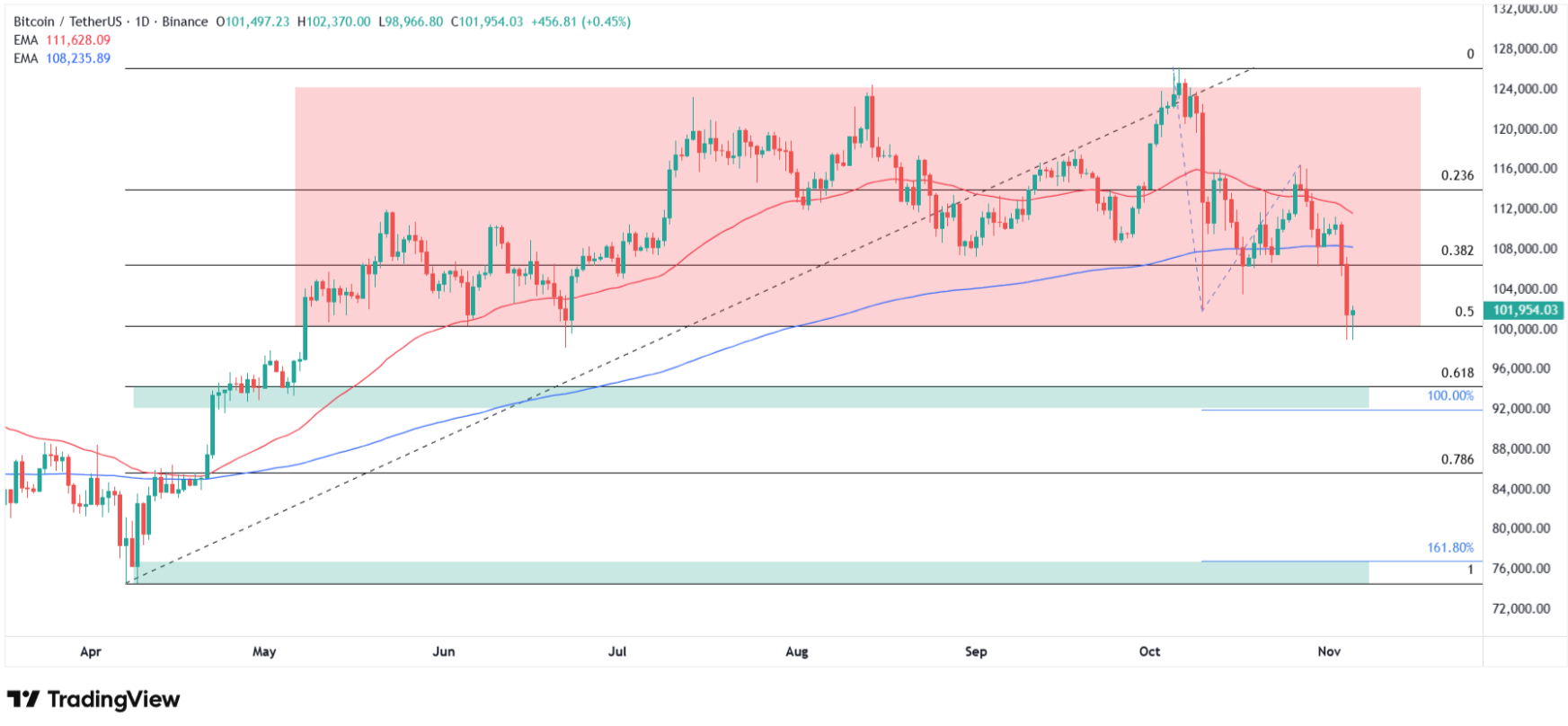
of Bitcoin (BTC), like other major cryptocurrencies discussed by me in this
analysis, has two days of dynamic declines behind it, during which it lost a
total of 8% in value, and prices stopped only at the height of the
psychological $100,000 level last tested in June. Today Bitcoin is trying to
violate this level for the second day in a row.
Bulls are
trying to defend for now. If it is broken, however, it opens the road to a much
stronger downward correction. We will officially exit the consolidation range
drawn from May, and moving below the 200-day exponential moving average (200
EMA) only confirms that now bears are in the lead.
I identify
the first zone of declines around the levels of $92,000 and $94,000, where
Fibonacci extension and retracement levels coincide, with the target zone of
declines around $74,000 and $76,000, the April lows where the 161.8% Fibonacci
extension also falls.
Why Bitcoin price is going down today? Source: Tradingview.com
Joel
Kruger, strategist at LMAX, also provided important context: "A sustained
move under the 50-week could extend the pullback toward the top of the cloud
near $95,000, where we would expect strong support and the formation of a
higher low before the next leg higher to fresh record highs. The key takeaway:
this remains a healthy correction within an ongoing bull market, not a bearish
shift."
XRP’s Death Cross Looms at
$2.30 Support
The XRP is
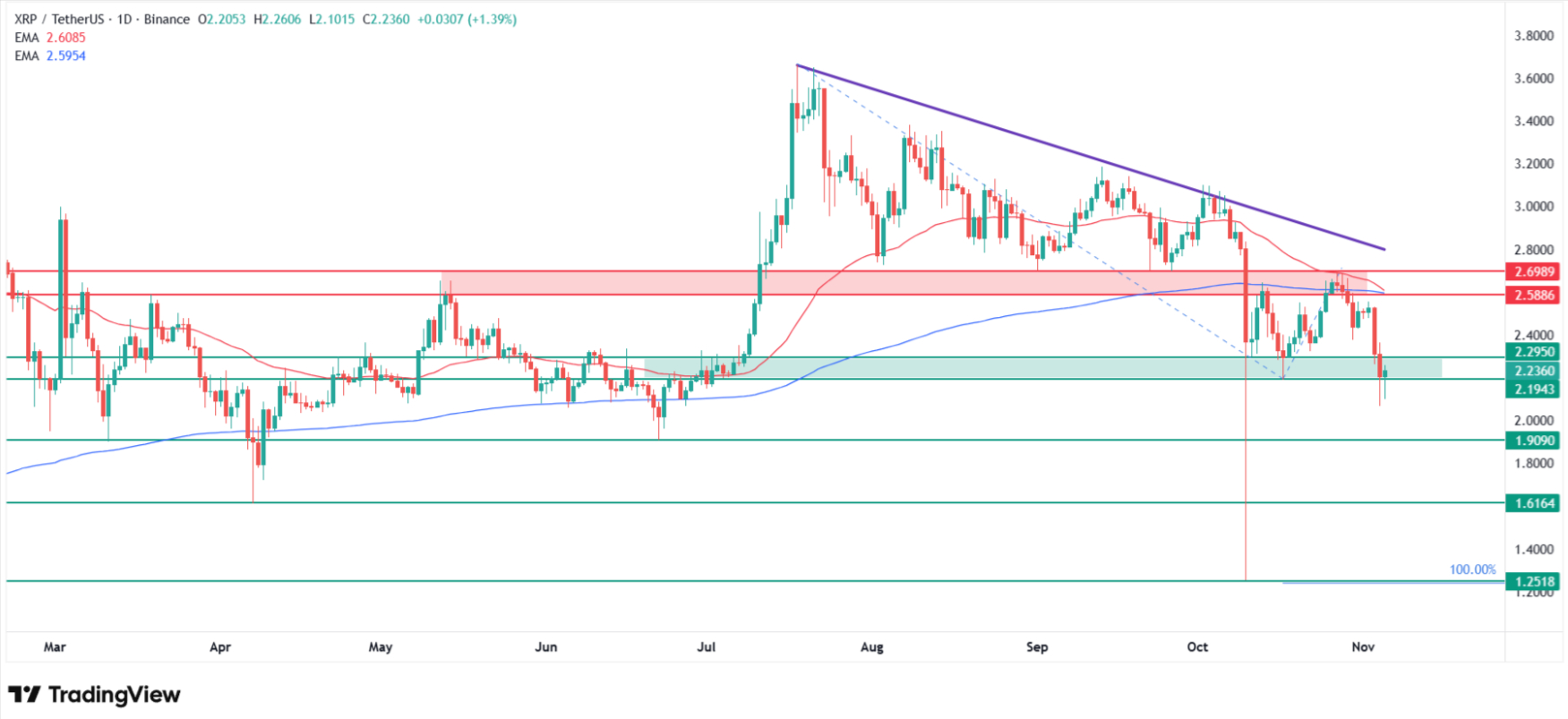
managing best for now compared to other leading cryptocurrencies, maintaining
local support levels and trading still in the $2.20-$2.30 zone coinciding with
July lows.
This
doesn't change the fact, however, that prices broke out at the beginning of
October from a wedge or triangle formation and are currently consolidating at
lower levels below the 50 and 200 EMA which are very close to drawing a death
cross, a crossover which, according to technical analysis enthusiasts like me,
is a strong sell signal.
If the
current support doesn't hold, we face a decline below the round $2.00 level,
including toward $1.90, June lows. The next target decline level is $1.61 at
April minimums, and the ultimate level is $1.25, the level last observed in
November 2024 coinciding with intraday lows from October 10 when the market
briefly collapsed, as well as my XRP price decline forecast based on Fibonacci
extensions.
Why XRP price is going down today? Source: Tradingview.com
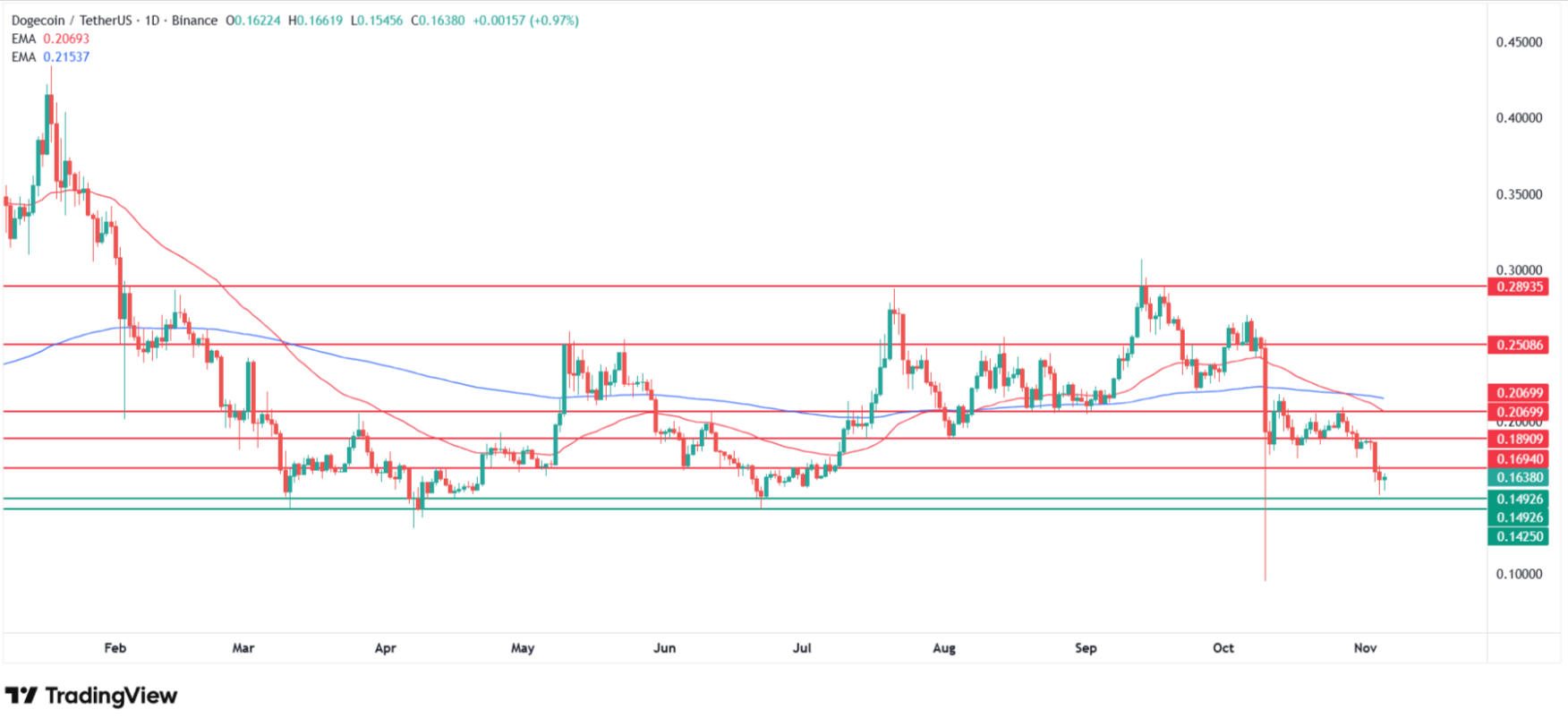
Dogecoin Also Sees Death
Cross, Forms at Channel Bottom
Although
Dogecoin (DOGE) chart clearly shows it has lost and cut itself off from its
September highs by several cents, in broader terms we actually remain in the
same consolidation drawn since February. Its lower limit, which we are
currently witnessing, falls just above the 14-cent level, while the top is at
just under 29 cents.
The last
hours of declines caused some local supports to turn into resistance, and at
this moment, only the lower limit of the sideways channel last tested in June
stands before us. What's more significant, however, is we're moving below the
50 and 200 MA which have already formed a death cross formation, the very
strong sell signal mentioned earlier by me.
If the
current support doesn't hold and we exit this consolidation, Dogecoin could
pave the road to stronger declines and a retest of levels last observed in
August 2024 below the 8-cent level.
Why Dogecoin price is going down today? Source: Tradingview.com
Crypto Price Analysis, FAQ
Why is crypto crashing
today?
Cryptocurrency
market lost over $1 trillion since October 6 peak with Bitcoin breaking
$100,000 for first time since June (-5% daily to $100,893), Ethereum crashing
-16% over 48 hours to $3,303, triggered by Federal Reserve Powell walking back
December cuts (probability 96% to 69.3%), AI bubble concerns spreading from
tech selloff (Nasdaq -2%, Nvidia -4%), institutional exodus (Bitcoin ETF
outflows $1.15B) and. leverage cascade ($1.78B liquidations affecting 441,867
traders).
Will Bitcoin go below
$90,000?
Yes, it may.
According to my technical analysis, Bitcoin breaking $100,000 opens path to
first target $92,000-$94,000 (Fibonacci extension/retracement zone coinciding
with April-May lows), ultimate target $74,000-$76,000 (April minimums + 161.8%
Fibonacci extension).
Why are Ethereum and
altcoins falling harder than Bitcoin?
According
to my analysis, Ethereum down -16% over 48 hours breaking below 200-day EMA and
consolidation range from July, bears now in control with potential 60% decline
to $2,380 April lows if 50% Fibonacci support $3,175 breaks, XRP death cross
forming between 50/200 MA at $2.30 support, Dogecoin death cross completed
testing channel bottom 14 cents, altcoins exhibiting 1.5-2x Bitcoin beta
amplification typical during market weakness.
Is this a crypto bear
market?
In my
opnion, yes. Bears warning Peter Schiff "losses staggering surpassing
dot-com bubble," CredibleCrypto "most severe bear market in Bitcoin's
history," $1 trillion market cap loss, institutional exodus $1.15B ETF
outflows, 2018 parallel (October weak, November brutal preceded -37% crash).
Before you go, please also check my previous (and more bullish) crypto price predictions:
The
cryptocurrency market crashed for a second consecutive day today (Wednesday), 5
November 2025, losing over $1 trillion in market capitalization since early
October as Bitcoin, Ethereum, XRP and Dogecoin prices led a broad-based
selloff.
The entire
crypto ecosystem is experiencing dynamic declines with Ethereum at $3,303 (after
-16% two-day crash), Bitcoin testing $100,000 psychological support, and major
altcoins extending losses as institutional investors rotate out of digital
assets.
In this
article, I examine why crypto is going down and conduct a technical analysis of
the BTC/USDT, XRP/USDT, ETH/USDT and DOGE/USDT charts, based on more than 10
years of experience as a cryptocurrency investor and analyst.
Why Crypto Is Going Down Today?
Fed, AI Bubble, and Whale Selling
Federal
Reserve Chairman Jerome Powell's hawkish remarks downplaying December rate cuts
created the initial catalyst for crypto's collapse. The probability of a
December cut collapsed from 96% before Powell's press conference to just 69.3%
afterward, dampening expectations for looser financial conditions that
typically support cryptocurrency prices.
Source: Coin360
Paul Howard
from Wincent explained the market dynamics: "Cryptocurrency prices
continued to slide and were pushed lower by a lack of positive macro news.
There appears to be a big skew of selling on a major exchange which would back
up the on-chain analysis indicating this is old BTC whale selling pressure.
Dumping billions gradually into the ecosystem over the course of the last few
days is not panic selling."
The
cryptocurrency collapse coincides with a broader tech selloff. Palantir dropped
8% despite beating earnings on valuation concerns, while Nvidia shed 4% losing
$200 billion in market capitalization. The Nasdaq fell 2% and the S&P 500
declined 1.2%, reflecting growing worries about AI-driven stock valuations.
Institutional
investors pulled $1.15 billion from Bitcoin ETFs last week, led by BlackRock,
ARK Invest, and Fidelity. This exodus signals a significant shift in sentiment
as traditional financial institutions that drove Bitcoin's rally to $126,000 in
early October are now reducing exposure amid Federal Reserve uncertainty and AI
bubble concerns.
Ethereum 16% Two-Day Crash
Breaks 200-Day EMA
According
to my technical analysis, the price of Ethereum (ETH) has experienced two days
of dynamic declines in a row, losing approximately 16% within 48 hours. For the
chart situation, this is a very large change, and from my technical analysis,
these declines from the first part of the week fully hand power to the bears,
changing the trend currently to downward.
Most
significantly, we went below the 200-day exponential moving average (200 EMA),
simultaneously breaking out of the consolidation range drawn since July, and
also went below the zone of August lows, leaving behind a series of very
important supports which are now resistance.
Why Ethereum price is going down today? Source: Tradingview.com
ETH prices
stopped at this moment at the last line of bullish defense, the 50% Fibonacci
retracement drawn from April lows to the highs. This level falls around $3,175.
If it is broken, Ethereum will continue its decline toward the 61.8% Fibonacci
retracement and the range of local May and June highs between $2,760 and $2,650.
At this
moment, bears have the advantage in the market, so further depreciation cannot
be ruled out either, and the target level or range, according to my forecasts,
is the April minimums at the $2,380 level. This means ETH could fall from
current levels by as much as 60%.
Bitcoin Price Tests $100K
After 8% Two-Day Plunge
The price
of Bitcoin (BTC), like other major cryptocurrencies discussed by me in this
analysis, has two days of dynamic declines behind it, during which it lost a
total of 8% in value, and prices stopped only at the height of the
psychological $100,000 level last tested in June. Today Bitcoin is trying to
violate this level for the second day in a row.
Bulls are
trying to defend for now. If it is broken, however, it opens the road to a much
stronger downward correction. We will officially exit the consolidation range
drawn from May, and moving below the 200-day exponential moving average (200
EMA) only confirms that now bears are in the lead.
I identify
the first zone of declines around the levels of $92,000 and $94,000, where
Fibonacci extension and retracement levels coincide, with the target zone of
declines around $74,000 and $76,000, the April lows where the 161.8% Fibonacci
extension also falls.
Why Bitcoin price is going down today? Source: Tradingview.com
Joel
Kruger, strategist at LMAX, also provided important context: "A sustained
move under the 50-week could extend the pullback toward the top of the cloud
near $95,000, where we would expect strong support and the formation of a
higher low before the next leg higher to fresh record highs. The key takeaway:
this remains a healthy correction within an ongoing bull market, not a bearish
shift."
XRP’s Death Cross Looms at
$2.30 Support
The XRP is
managing best for now compared to other leading cryptocurrencies, maintaining
local support levels and trading still in the $2.20-$2.30 zone coinciding with
July lows.
This
doesn't change the fact, however, that prices broke out at the beginning of
October from a wedge or triangle formation and are currently consolidating at
lower levels below the 50 and 200 EMA which are very close to drawing a death
cross, a crossover which, according to technical analysis enthusiasts like me,
is a strong sell signal.
If the
current support doesn't hold, we face a decline below the round $2.00 level,
including toward $1.90, June lows. The next target decline level is $1.61 at
April minimums, and the ultimate level is $1.25, the level last observed in
November 2024 coinciding with intraday lows from October 10 when the market
briefly collapsed, as well as my XRP price decline forecast based on Fibonacci
extensions.
Why XRP price is going down today? Source: Tradingview.com
Dogecoin Also Sees Death
Cross, Forms at Channel Bottom
Although
Dogecoin (DOGE) chart clearly shows it has lost and cut itself off from its
September highs by several cents, in broader terms we actually remain in the
same consolidation drawn since February. Its lower limit, which we are
currently witnessing, falls just above the 14-cent level, while the top is at
just under 29 cents.
The last
hours of declines caused some local supports to turn into resistance, and at
this moment, only the lower limit of the sideways channel last tested in June
stands before us. What's more significant, however, is we're moving below the
50 and 200 MA which have already formed a death cross formation, the very
strong sell signal mentioned earlier by me.
If the
current support doesn't hold and we exit this consolidation, Dogecoin could
pave the road to stronger declines and a retest of levels last observed in
August 2024 below the 8-cent level.
Why Dogecoin price is going down today? Source: Tradingview.com
Crypto Price Analysis, FAQ
Why is crypto crashing
today?
Cryptocurrency
market lost over $1 trillion since October 6 peak with Bitcoin breaking
$100,000 for first time since June (-5% daily to $100,893), Ethereum crashing
-16% over 48 hours to $3,303, triggered by Federal Reserve Powell walking back
December cuts (probability 96% to 69.3%), AI bubble concerns spreading from
tech selloff (Nasdaq -2%, Nvidia -4%), institutional exodus (Bitcoin ETF
outflows $1.15B) and. leverage cascade ($1.78B liquidations affecting 441,867
traders).
Will Bitcoin go below
$90,000?
Yes, it may.
According to my technical analysis, Bitcoin breaking $100,000 opens path to
first target $92,000-$94,000 (Fibonacci extension/retracement zone coinciding
with April-May lows), ultimate target $74,000-$76,000 (April minimums + 161.8%
Fibonacci extension).
Why are Ethereum and
altcoins falling harder than Bitcoin?
According
to my analysis, Ethereum down -16% over 48 hours breaking below 200-day EMA and
consolidation range from July, bears now in control with potential 60% decline
to $2,380 April lows if 50% Fibonacci support $3,175 breaks, XRP death cross
forming between 50/200 MA at $2.30 support, Dogecoin death cross completed
testing channel bottom 14 cents, altcoins exhibiting 1.5-2x Bitcoin beta
amplification typical during market weakness.
Is this a crypto bear
market?
In my
opnion, yes. Bears warning Peter Schiff "losses staggering surpassing
dot-com bubble," CredibleCrypto "most severe bear market in Bitcoin's
history," $1 trillion market cap loss, institutional exodus $1.15B ETF
outflows, 2018 parallel (October weak, November brutal preceded -37% crash).
Before you go, please also check my previous (and more bullish) crypto price predictions:
Damian Chmiel is a Senior Analyst & Editor at Finance Magnates with more than 15 years of experience in the CFD and online trading industry. Active as both a trader and journalist since 2010, he focuses on broker coverage, fintech innovation, and regulatory developments across Europe, the Middle East, and Asia.
His work includes interviews with C-level leaders at major brokerages and fintech platforms, as well as co-authoring Finance Magnates’ quarterly industry benchmarking reports. Damian’s reporting is data-driven, market-aware, and grounded in direct industry engagement. His analysis and commentary have also been cited by external media outlets, including Investing.com, Binance, The Asset, Stockhead, and Dispatch.
Education:
MA in Finance and Accounting, Cracow University of Economics
Why Is XRP Surging? XRP Price Prediction 2026 and How High Can It Go
CMC Markets’ Artur Delijergijevs on Metals Demand, Volatility, & Stable Execution
CMC Markets’ Artur Delijergijevs on Metals Demand, Volatility, & Stable Execution
In this exclusive Executive Interview, Finance Magnates speaks with Artur Delijergijevs, Head of Systematic Market Making at CMC Markets, about the current state of metals demand and market volatility.
Delijergijevs offers a desk-level view on:
- Metals Demand: Why metals are seeing the strongest demand from both retail and institutional clients right now.
- The Safe-Haven Debate: Questioning whether gold still fits the classic safe-haven definition given large daily price movements.
- Volatile Market Prep: How a market-making desk prepares its systems and pricing for stressed market conditions and high-impact economic events.
- Hybrid Execution: Why the best execution model combines electronic speed with human relationship support, especially during volatility.
- AI in Workflow: Where CMC Markets is integrating machine learning for risk management and pricing, and the limitations of AI during stressed markets.
- Dubai's Role: The strategic importance of Dubai’s location for covering global trading sessions across Asia, Europe, and the US.
Watch to understand how CMC Markets maintains stable pricing and reliable execution quality in high-volatility environments.
#CMCmarkets #forex #metals #gold #trading #volatility #MarketMaking #iFXDubai #FinanceMagnates #Finance #Fintech #Execution #AlgorithmicTrading #RiskManagement
In this exclusive Executive Interview, Finance Magnates speaks with Artur Delijergijevs, Head of Systematic Market Making at CMC Markets, about the current state of metals demand and market volatility.
Delijergijevs offers a desk-level view on:
- Metals Demand: Why metals are seeing the strongest demand from both retail and institutional clients right now.
- The Safe-Haven Debate: Questioning whether gold still fits the classic safe-haven definition given large daily price movements.
- Volatile Market Prep: How a market-making desk prepares its systems and pricing for stressed market conditions and high-impact economic events.
- Hybrid Execution: Why the best execution model combines electronic speed with human relationship support, especially during volatility.
- AI in Workflow: Where CMC Markets is integrating machine learning for risk management and pricing, and the limitations of AI during stressed markets.
- Dubai's Role: The strategic importance of Dubai’s location for covering global trading sessions across Asia, Europe, and the US.
Watch to understand how CMC Markets maintains stable pricing and reliable execution quality in high-volatility environments.
#CMCmarkets #forex #metals #gold #trading #volatility #MarketMaking #iFXDubai #FinanceMagnates #Finance #Fintech #Execution #AlgorithmicTrading #RiskManagement
Finance Magnates Awards 2026 – Nominations Now Open
Finance Magnates Awards 2026 – Nominations Now Open
The Finance Magnates Awards 2026 nominations are now open. 🏆
From fintech innovators to leading brokers, this is where the finance industry celebrates its biggest achievements.
Winners will be announced at the Cyprus Gala Dinner on November 6, 2026.
Nominate your brand now.
https://awards.financemagnates.com/?utm_source=linkedin&utm_medium=video&utm_campaign=nominations-open
#FMAwards #FinanceMagnates #FintechAwards #Fintech #FinanceIndustry
The Finance Magnates Awards 2026 nominations are now open. 🏆
From fintech innovators to leading brokers, this is where the finance industry celebrates its biggest achievements.
Winners will be announced at the Cyprus Gala Dinner on November 6, 2026.
Nominate your brand now.
https://awards.financemagnates.com/?utm_source=linkedin&utm_medium=video&utm_campaign=nominations-open
#FMAwards #FinanceMagnates #FintechAwards #Fintech #FinanceIndustry
Finance Magnates Awards 2026 | Nominations Now Open 🏆#Fintech #FMAwards #TradingIndustry
Finance Magnates Awards 2026 | Nominations Now Open 🏆#Fintech #FMAwards #TradingIndustry
Lights on. Cameras ready. 🎬
Finance Magnates Awards 2026 nominations are now open. 🏆
#FMAwards #FinanceMagnates #FintechAwards #Fintech
Lights on. Cameras ready. 🎬
Finance Magnates Awards 2026 nominations are now open. 🏆
#FMAwards #FinanceMagnates #FintechAwards #Fintech
Exness sees trust as the key theme for growth in MENA Trading Growth for 2026
Exness sees trust as the key theme for growth in MENA Trading Growth for 2026
Mohammad Amer, Regional Commercial Director at Exness, sits down to discuss the booming MENA financial trading market. Find out why Dubai is key to the company's growth strategy, how a mobile-first generation is changing expectations, and why trust will be the defining theme for traders in 2026.
In this interview, you'll learn:
* Why Dubai and the MENA region are critical growth markets for fintech and online trading.
* How Exness is addressing the demands of mobile-first, younger traders through engineering, platform stability, and transparent conditions.
* The essential role local talent plays in providing a culturally relevant and compliant user experience.
* Mohammad Amer's outlook on the future of the online trading industry and why stronger controls and systems are necessary.
* Why "trust" isn't just a brand value, but has commercial value—and why he predicts 2026 will be the "Year of Trust."
Key Takeaways:
➡️ The MENA region is rapidly shaping global financial markets.
➡️ New traders expect stability, precise execution, and transparency.
➡️ Local expertise is key to regulatory compliance and user experience.
➡️ Future success belongs to firms capable of meeting rising standards across regulation and platform consistency.
Read the full article at: https://www.financemagnates.com/thought-leadership/exness-sees-trust-as-the-key-theme-for-growth-in-mena-trading-growth-for-2026/
#Exness #MENA #Trading #FinTech #Dubai #OnlineTrading #FinanceMagnates #MohammadAmer #Trust #MobileTrading
Mohammad Amer, Regional Commercial Director at Exness, sits down to discuss the booming MENA financial trading market. Find out why Dubai is key to the company's growth strategy, how a mobile-first generation is changing expectations, and why trust will be the defining theme for traders in 2026.
In this interview, you'll learn:
* Why Dubai and the MENA region are critical growth markets for fintech and online trading.
* How Exness is addressing the demands of mobile-first, younger traders through engineering, platform stability, and transparent conditions.
* The essential role local talent plays in providing a culturally relevant and compliant user experience.
* Mohammad Amer's outlook on the future of the online trading industry and why stronger controls and systems are necessary.
* Why "trust" isn't just a brand value, but has commercial value—and why he predicts 2026 will be the "Year of Trust."
Key Takeaways:
➡️ The MENA region is rapidly shaping global financial markets.
➡️ New traders expect stability, precise execution, and transparency.
➡️ Local expertise is key to regulatory compliance and user experience.
➡️ Future success belongs to firms capable of meeting rising standards across regulation and platform consistency.
Read the full article at: https://www.financemagnates.com/thought-leadership/exness-sees-trust-as-the-key-theme-for-growth-in-mena-trading-growth-for-2026/
#Exness #MENA #Trading #FinTech #Dubai #OnlineTrading #FinanceMagnates #MohammadAmer #Trust #MobileTrading
Paytiko CEO Razi Salih on Why Payment Orchestration is a MUST-HAVE for Brokers in 2026
Paytiko CEO Razi Salih on Why Payment Orchestration is a MUST-HAVE for Brokers in 2026
At iFX Expo Dubai, Finance Magnates spoke with Razi Salih, CEO at Paytiko, about the evolution of the payments ecosystem and why payment orchestration has shifted from an option to a necessity for brokers, prop firms, and exchanges.
Mr. Salih explains how global expansion, the need for deep localisation, and the sheer number of new payment methods, from instant banking to stablecoins, are driving this critical infrastructure shift.
#PaymentOrchestration #Fintech #Brokerage #TradingPayments #RaziSalih #Paytiko #iFXExpoDubai #Stablecoins #AIinFintech
At iFX Expo Dubai, Finance Magnates spoke with Razi Salih, CEO at Paytiko, about the evolution of the payments ecosystem and why payment orchestration has shifted from an option to a necessity for brokers, prop firms, and exchanges.
Mr. Salih explains how global expansion, the need for deep localisation, and the sheer number of new payment methods, from instant banking to stablecoins, are driving this critical infrastructure shift.
#PaymentOrchestration #Fintech #Brokerage #TradingPayments #RaziSalih #Paytiko #iFXExpoDubai #Stablecoins #AIinFintech