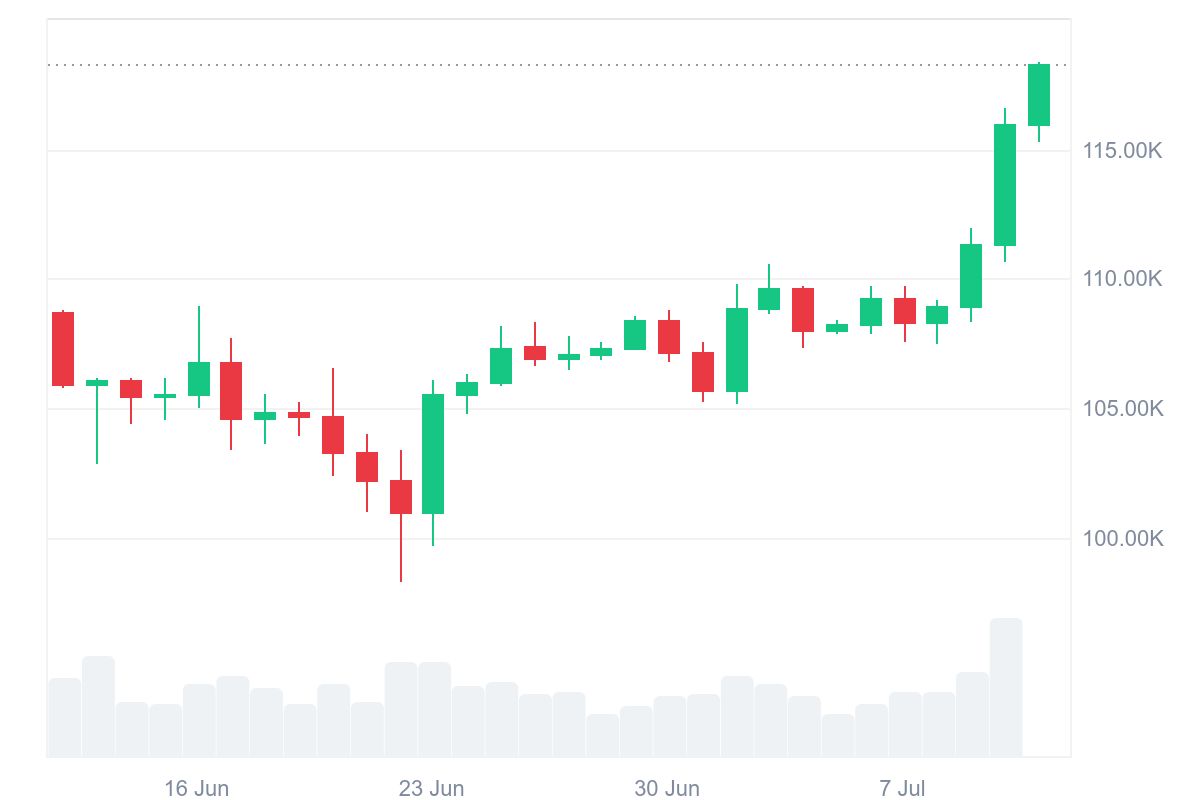
The Bitcoin price remains in bullish momentum, trading near the new all-time high of $118,000.
Popular author Ric Edelman continues pushing for unprecedented crypto allocations while institutional adoption accelerates.
In the background, the newest Bitcoin price predictions suggest sustained bullish momentum toward historic highs by 2030.
The Bitcoin
(BTC) price has entered a price discovery phase following its three-day march
two new record highs, currently trading at approximately $117,600 as of Friday,
July 11, 2025. This represents a solid 6% gain in the past 24 hours, with the
cryptocurrency demonstrating remarkable stability amid broader financial market
uncertainty.
The current
Bitcoin news landscape is dominated by unprecedented institutional
adoption, record inflows to ETF instruments and liquidations of short
positions. Moreover, the most up-to-date Bitcoin price predictions for 2025 and
beyond suggest that the crypto may soon break through psychological barriers
and jumb by more than 300% to exceed $500,000 by 2030.
Bitcoin Price Today Holds
Strong Near $118K
Bitcoin
price today reflects a market in fundamental transformation, with the
cryptocurrency demonstrating institutional-grade resilience despite
geopolitical tensions and traditional market volatility. The digital asset has
maintained its position well above the crucial $100,000 psychological milestone
since June.
For one
Bitcoin, the current price across major exchanges hovers around $117,600 at the
time of writing, with the asset moving into the price discovery zone as
institutional players establish long-term positions.
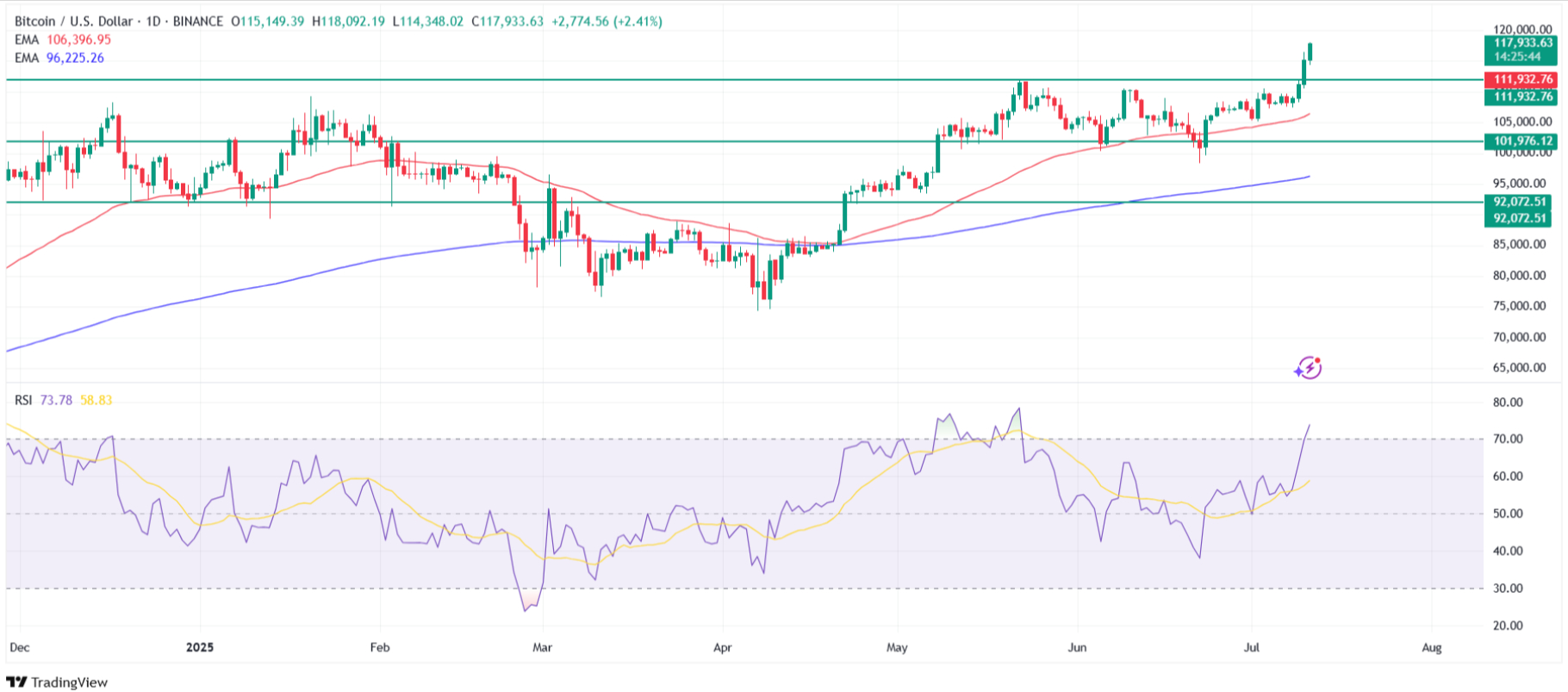
BTC/USDT price today. Source: Tradingview.com
Recent
price action shows Bitcoin trading with heightened volatility compared
to previous cycles, with technical indicators suggesting continued
institutional accumulation. The MACD indicator displays strengthening momentum,
indicating growing buying pressure from sophisticated investors who view any
dips as strategic entry points.
Trading
data reveals substantial
institutional engagement, with Bitcoin ETFs experiencing consistent inflows
and corporate treasuries continuing to add Bitcoin to their balance sheets. Bitcoin
and Ethereum (ETH) ETFs recorded the second-largest day of inflows on record,
according to data from Farside Investments.
Based on my
technical analysis, Bitcoin has finally broken out decisively from the
consolidation range that had been forming since mid-May, confined between
$100,000 and $112,000. As
I noted in my earlier reports, a move above this resistance zone was
essential for BTC to enter a true price discovery phase, navigating uncharted
territory.
So far, it
has done just that, testing $118,092 as a new ATH on Binance. What’s next? By
nature, price discovery phases are difficult to analyze. In my view, a healthy
move would be a pullback toward $112,000 to test it as a new support level
(following the principle of role reversal), before continuing its upward trend.
However, if market hype kicks in, the rally could accelerate rapidly and push
prices significantly higher.
The RSI
indicates that Bitcoin is currently in overbought territory. That said, if BTC wants to continue its climb, it may well ignore this signal, eBspecially given that the latest analyst forecasts are highly bullish.
Bitcoin Price Prediction
Outlook Suggests Massive Upside
The Bitcoin
price prediction landscape presents overwhelmingly bullish signals as
the cryptocurrency navigates through its institutional adoption phase.
However,
renowned financial advisor Ric Edelman, who accurately predicted Bitcoin's
institutional breakthrough last year, suggests the cryptocurrency may be
approaching the beginning of its most significant price appreciation cycle. His
analysis indicates Bitcoin has been building institutional foundations, and the
next major move could align with revolutionary portfolio allocation shifts.
Edelman
was a guest of Natalie Brunell’s Coin Stories where he talked about 6 myths
about Bitcoin, price projections and portfolio allocations:
“I’m
actually pretty conservative. A lot of other folks say $1 million by 2030,”
commented Edelman. “Michael Saylor says $5 million. But not too many others
share their math. I do pretty openly. I’ll tell you very quickly and easily how
I get there. If you take a look at the world’s global assets, the total value
of everything, the value of stocks, bonds, real estate, gold, oil, commodities,
you name it, add up the total value of everything, it’s about $800 trillion.”
If all the
current asset holders were to allocate just 1% of their portfolios to Bitcoin,
the resulting capital flow could reach $8 trillion. According to this
reasoning, such a shift in investment would drive Bitcoin’s price to
approximately $500,000, Edelman predicts.
Long-term
price predictions from Edelman and other analysts suggest:
Edelman's conservative target:
Bitcoin reaching $500,000 by 2030
Michael Saylor's
projection: $5 million per Bitcoin
The ongoing
evolution of traditional investment strategies continues to be a
primary driver of Bitcoin price sentiment and market dynamics. Recent
developments indicate financial advisors are actively pursuing unprecedented
crypto allocations that could fundamentally alter Bitcoin's market
capitalization.
Edelman also
released a new research urging financial advisors to allocate 10% to 40%
of client portfolios to cryptocurrency, with Bitcoin representing the largest
component. The advisor emphasized that crypto's maturation from speculative
asset to mainstream investment vehicle supports these dramatic
allocation increases.
These
allocation discussions involve replacing traditional bond holdings with
crypto assets and recognizing Bitcoin's role as a portfolio diversifier.
Financial expert analysis suggests that if advisors obtain the institutional
buy-in they're seeking, massive capital flows could materialize
within months rather than years.
The
traditional 60/40 portfolio model faces fundamental obsolescence due
to increased life expectancy and the need for higher-return assets, with crypto
filling the gap left by underperforming bonds.
Bitcoin Long-term Price
Projections and Market Outlook
Extended
Bitcoin price prediction models present consistently bullish scenarios based
on institutional adoption and global asset allocation trends. Edelman's
mathematical approach suggests Bitcoin could reach minimum prices of $500,000
by 2030 based purely on 1% global portfolio allocation.
More
aggressive projections from industry leaders like Michael
Saylor suggest even higher targets, with some forecasting Bitcoin
reaching $5 million per coin by the end of the decade. These
predictions assume continued growth in institutional adoption and favorable
regulatory environments.
Scenario analysis indicates:
Bullish case: Widespread advisor adoption
and 10–40% portfolio allocations could drive prices toward $500,000–$1,000,000
range by 2030
Base case: Continued institutional
accumulation with gradual appreciation to $300,000–$500,000 range
over 5–6 years
Conservative case: Steady adoption maintaining
current trajectory toward $200,000–$300,000 levels
The Bitcoin
price currently reflects a market in institutional equilibrium, balancing
traditional investment paradigms against revolutionary portfolio allocation
strategies. At almost $118,000, Bitcoin maintains critical psychological
support levels while awaiting catalysts that could drive the next significant
price movement.
Key factors
to monitor include financial advisor adoption timelines, regulatory
developments, and broader institutional investment sentiment. The combination
of reduced volatility and institutional buying suggests a period of strategic
accumulation before the next major trend emerges.
Market
participants should focus on portfolio allocation announcements from
major financial advisory firms and any developments in crypto-friendly
legislation, as these factors will likely determine Bitcoin's medium-term price
trajectory. The cryptocurrency's ability to maintain current support levels
while institutional clarity emerges will be crucial for sustained
price appreciation toward Edelman's $500,000 target.
The Bitcoin
(BTC) price has entered a price discovery phase following its three-day march
two new record highs, currently trading at approximately $117,600 as of Friday,
July 11, 2025. This represents a solid 6% gain in the past 24 hours, with the
cryptocurrency demonstrating remarkable stability amid broader financial market
uncertainty.
The current
Bitcoin news landscape is dominated by unprecedented institutional
adoption, record inflows to ETF instruments and liquidations of short
positions. Moreover, the most up-to-date Bitcoin price predictions for 2025 and
beyond suggest that the crypto may soon break through psychological barriers
and jumb by more than 300% to exceed $500,000 by 2030.
Bitcoin Price Today Holds
Strong Near $118K
Bitcoin
price today reflects a market in fundamental transformation, with the
cryptocurrency demonstrating institutional-grade resilience despite
geopolitical tensions and traditional market volatility. The digital asset has
maintained its position well above the crucial $100,000 psychological milestone
since June.
For one
Bitcoin, the current price across major exchanges hovers around $117,600 at the
time of writing, with the asset moving into the price discovery zone as
institutional players establish long-term positions.
BTC/USDT price today. Source: Tradingview.com
Recent
price action shows Bitcoin trading with heightened volatility compared
to previous cycles, with technical indicators suggesting continued
institutional accumulation. The MACD indicator displays strengthening momentum,
indicating growing buying pressure from sophisticated investors who view any
dips as strategic entry points.
Trading
data reveals substantial
institutional engagement, with Bitcoin ETFs experiencing consistent inflows
and corporate treasuries continuing to add Bitcoin to their balance sheets. Bitcoin
and Ethereum (ETH) ETFs recorded the second-largest day of inflows on record,
according to data from Farside Investments.
Based on my
technical analysis, Bitcoin has finally broken out decisively from the
consolidation range that had been forming since mid-May, confined between
$100,000 and $112,000. As
I noted in my earlier reports, a move above this resistance zone was
essential for BTC to enter a true price discovery phase, navigating uncharted
territory.
So far, it
has done just that, testing $118,092 as a new ATH on Binance. What’s next? By
nature, price discovery phases are difficult to analyze. In my view, a healthy
move would be a pullback toward $112,000 to test it as a new support level
(following the principle of role reversal), before continuing its upward trend.
However, if market hype kicks in, the rally could accelerate rapidly and push
prices significantly higher.
The RSI
indicates that Bitcoin is currently in overbought territory. That said, if BTC wants to continue its climb, it may well ignore this signal, eBspecially given that the latest analyst forecasts are highly bullish.
Bitcoin Price Prediction
Outlook Suggests Massive Upside
The Bitcoin
price prediction landscape presents overwhelmingly bullish signals as
the cryptocurrency navigates through its institutional adoption phase.
However,
renowned financial advisor Ric Edelman, who accurately predicted Bitcoin's
institutional breakthrough last year, suggests the cryptocurrency may be
approaching the beginning of its most significant price appreciation cycle. His
analysis indicates Bitcoin has been building institutional foundations, and the
next major move could align with revolutionary portfolio allocation shifts.
Edelman
was a guest of Natalie Brunell’s Coin Stories where he talked about 6 myths
about Bitcoin, price projections and portfolio allocations:
“I’m
actually pretty conservative. A lot of other folks say $1 million by 2030,”
commented Edelman. “Michael Saylor says $5 million. But not too many others
share their math. I do pretty openly. I’ll tell you very quickly and easily how
I get there. If you take a look at the world’s global assets, the total value
of everything, the value of stocks, bonds, real estate, gold, oil, commodities,
you name it, add up the total value of everything, it’s about $800 trillion.”
If all the
current asset holders were to allocate just 1% of their portfolios to Bitcoin,
the resulting capital flow could reach $8 trillion. According to this
reasoning, such a shift in investment would drive Bitcoin’s price to
approximately $500,000, Edelman predicts.
Long-term
price predictions from Edelman and other analysts suggest:
Edelman's conservative target:
Bitcoin reaching $500,000 by 2030
Michael Saylor's
projection: $5 million per Bitcoin
The ongoing
evolution of traditional investment strategies continues to be a
primary driver of Bitcoin price sentiment and market dynamics. Recent
developments indicate financial advisors are actively pursuing unprecedented
crypto allocations that could fundamentally alter Bitcoin's market
capitalization.
Edelman also
released a new research urging financial advisors to allocate 10% to 40%
of client portfolios to cryptocurrency, with Bitcoin representing the largest
component. The advisor emphasized that crypto's maturation from speculative
asset to mainstream investment vehicle supports these dramatic
allocation increases.
These
allocation discussions involve replacing traditional bond holdings with
crypto assets and recognizing Bitcoin's role as a portfolio diversifier.
Financial expert analysis suggests that if advisors obtain the institutional
buy-in they're seeking, massive capital flows could materialize
within months rather than years.
The
traditional 60/40 portfolio model faces fundamental obsolescence due
to increased life expectancy and the need for higher-return assets, with crypto
filling the gap left by underperforming bonds.
Bitcoin Long-term Price
Projections and Market Outlook
Extended
Bitcoin price prediction models present consistently bullish scenarios based
on institutional adoption and global asset allocation trends. Edelman's
mathematical approach suggests Bitcoin could reach minimum prices of $500,000
by 2030 based purely on 1% global portfolio allocation.
More
aggressive projections from industry leaders like Michael
Saylor suggest even higher targets, with some forecasting Bitcoin
reaching $5 million per coin by the end of the decade. These
predictions assume continued growth in institutional adoption and favorable
regulatory environments.
Scenario analysis indicates:
Bullish case: Widespread advisor adoption
and 10–40% portfolio allocations could drive prices toward $500,000–$1,000,000
range by 2030
Base case: Continued institutional
accumulation with gradual appreciation to $300,000–$500,000 range
over 5–6 years
Conservative case: Steady adoption maintaining
current trajectory toward $200,000–$300,000 levels
The Bitcoin
price currently reflects a market in institutional equilibrium, balancing
traditional investment paradigms against revolutionary portfolio allocation
strategies. At almost $118,000, Bitcoin maintains critical psychological
support levels while awaiting catalysts that could drive the next significant
price movement.
Key factors
to monitor include financial advisor adoption timelines, regulatory
developments, and broader institutional investment sentiment. The combination
of reduced volatility and institutional buying suggests a period of strategic
accumulation before the next major trend emerges.
Market
participants should focus on portfolio allocation announcements from
major financial advisory firms and any developments in crypto-friendly
legislation, as these factors will likely determine Bitcoin's medium-term price
trajectory. The cryptocurrency's ability to maintain current support levels
while institutional clarity emerges will be crucial for sustained
price appreciation toward Edelman's $500,000 target.
Damian Chmiel is a Senior Analyst & Editor at Finance Magnates with more than 15 years of experience in the CFD and online trading industry. Active as both a trader and journalist since 2010, he focuses on broker coverage, fintech innovation, and regulatory developments across Europe, the Middle East, and Asia.
His work includes interviews with C-level leaders at major brokerages and fintech platforms, as well as co-authoring Finance Magnates’ quarterly industry benchmarking reports. Damian’s reporting is data-driven, market-aware, and grounded in direct industry engagement. His analysis and commentary have also been cited by external media outlets, including Investing.com, Binance, The Asset, Stockhead, and Dispatch.
Education:
MA in Finance and Accounting, Cracow University of Economics
Inside the Prediction Markets: $1.6B Institutional Inflow Meets a Federal Crackdown
Featured Videos
FP Markets Winner Spotlight 🏆 | Global Broker of the Year 2025 #Trading #Broker #Innovation #Shorts
FP Markets Winner Spotlight 🏆 | Global Broker of the Year 2025 #Trading #Broker #Innovation #Shorts
FP Markets Winner Spotlight 🏆 | Global Broker of the Year 2025 #Trading #Broker #Innovation #Shorts
FP Markets Winner Spotlight 🏆 | Global Broker of the Year 2025 #Trading #Broker #Innovation #Shorts
FP Markets takes the spotlight as Global Broker of the Year 2025 at the Finance Magnates Awards.
Martin Stoilov, Head of Client Experience, shares that trust, innovation, and people played a key role in the company’s success, supported by a strong foundation of integrity and client-centricity.
Following this milestone, FP Markets continues to focus on growth, technology investment, and its core values of transparency and excellence.
👉 Be part of FM Awards 2026: https://awards.financemagnates.com/#nominate
FP Markets takes the spotlight as Global Broker of the Year 2025 at the Finance Magnates Awards.
Martin Stoilov, Head of Client Experience, shares that trust, innovation, and people played a key role in the company’s success, supported by a strong foundation of integrity and client-centricity.
Following this milestone, FP Markets continues to focus on growth, technology investment, and its core values of transparency and excellence.
👉 Be part of FM Awards 2026: https://awards.financemagnates.com/#nominate
FP Markets takes the spotlight as Global Broker of the Year 2025 at the Finance Magnates Awards.
Martin Stoilov, Head of Client Experience, shares that trust, innovation, and people played a key role in the company’s success, supported by a strong foundation of integrity and client-centricity.
Following this milestone, FP Markets continues to focus on growth, technology investment, and its core values of transparency and excellence.
👉 Be part of FM Awards 2026: https://awards.financemagnates.com/#nominate
FP Markets takes the spotlight as Global Broker of the Year 2025 at the Finance Magnates Awards.
Martin Stoilov, Head of Client Experience, shares that trust, innovation, and people played a key role in the company’s success, supported by a strong foundation of integrity and client-centricity.
Following this milestone, FP Markets continues to focus on growth, technology investment, and its core values of transparency and excellence.
👉 Be part of FM Awards 2026: https://awards.financemagnates.com/#nominate
In this video, we review @HolaPrimeMarketsOfficial, a multi-asset forex and CFDs broker offering different account types, trading platforms, and flexible trading conditions.
We cover the broker’s overall offering, including account options, trading environment, platforms like MT4 and MT5, and additional services such as managed accounts and fast withdrawals.
Watch the full video to see if Hola Prime Markets fits your trading needs.
📣 Stay up to date with the latest in finance and trading. Follow Finance Magnates for industry news, insights, and global event coverage.
Connect with us:
🔗 LinkedIn: /financemagnates
👍 Facebook: /financemagnates
📸 Instagram: https://www.instagram.com/financemagnates
🐦 X: https://x.com/financemagnates
🎥 TikTok: https://www.tiktok.com/tag/financemagnates
▶️ YouTube: /@financemagnates_official
#HolaPrime #ForexBroker #CFDTrading #FinanceMagnates #Trading #Forex #BrokerReview
In this video, we review @HolaPrimeMarketsOfficial, a multi-asset forex and CFDs broker offering different account types, trading platforms, and flexible trading conditions.
We cover the broker’s overall offering, including account options, trading environment, platforms like MT4 and MT5, and additional services such as managed accounts and fast withdrawals.
Watch the full video to see if Hola Prime Markets fits your trading needs.
📣 Stay up to date with the latest in finance and trading. Follow Finance Magnates for industry news, insights, and global event coverage.
Connect with us:
🔗 LinkedIn: /financemagnates
👍 Facebook: /financemagnates
📸 Instagram: https://www.instagram.com/financemagnates
🐦 X: https://x.com/financemagnates
🎥 TikTok: https://www.tiktok.com/tag/financemagnates
▶️ YouTube: /@financemagnates_official
#HolaPrime #ForexBroker #CFDTrading #FinanceMagnates #Trading #Forex #BrokerReview
In this video, we review @HolaPrimeMarketsOfficial, a multi-asset forex and CFDs broker offering different account types, trading platforms, and flexible trading conditions.
We cover the broker’s overall offering, including account options, trading environment, platforms like MT4 and MT5, and additional services such as managed accounts and fast withdrawals.
Watch the full video to see if Hola Prime Markets fits your trading needs.
📣 Stay up to date with the latest in finance and trading. Follow Finance Magnates for industry news, insights, and global event coverage.
Connect with us:
🔗 LinkedIn: /financemagnates
👍 Facebook: /financemagnates
📸 Instagram: https://www.instagram.com/financemagnates
🐦 X: https://x.com/financemagnates
🎥 TikTok: https://www.tiktok.com/tag/financemagnates
▶️ YouTube: /@financemagnates_official
#HolaPrime #ForexBroker #CFDTrading #FinanceMagnates #Trading #Forex #BrokerReview
In this video, we review @HolaPrimeMarketsOfficial, a multi-asset forex and CFDs broker offering different account types, trading platforms, and flexible trading conditions.
We cover the broker’s overall offering, including account options, trading environment, platforms like MT4 and MT5, and additional services such as managed accounts and fast withdrawals.
Watch the full video to see if Hola Prime Markets fits your trading needs.
📣 Stay up to date with the latest in finance and trading. Follow Finance Magnates for industry news, insights, and global event coverage.
Connect with us:
🔗 LinkedIn: /financemagnates
👍 Facebook: /financemagnates
📸 Instagram: https://www.instagram.com/financemagnates
🐦 X: https://x.com/financemagnates
🎥 TikTok: https://www.tiktok.com/tag/financemagnates
▶️ YouTube: /@financemagnates_official
#HolaPrime #ForexBroker #CFDTrading #FinanceMagnates #Trading #Forex #BrokerReview
In this video, we review @HolaPrimeMarketsOfficial, a multi-asset forex and CFDs broker offering different account types, trading platforms, and flexible trading conditions.
We cover the broker’s overall offering, including account options, trading environment, platforms like MT4 and MT5, and additional services such as managed accounts and fast withdrawals.
Watch the full video to see if Hola Prime Markets fits your trading needs.
📣 Stay up to date with the latest in finance and trading. Follow Finance Magnates for industry news, insights, and global event coverage.
Connect with us:
🔗 LinkedIn: /financemagnates
👍 Facebook: /financemagnates
📸 Instagram: https://www.instagram.com/financemagnates
🐦 X: https://x.com/financemagnates
🎥 TikTok: https://www.tiktok.com/tag/financemagnates
▶️ YouTube: /@financemagnates_official
#HolaPrime #ForexBroker #CFDTrading #FinanceMagnates #Trading #Forex #BrokerReview
In this video, we review @HolaPrimeMarketsOfficial, a multi-asset forex and CFDs broker offering different account types, trading platforms, and flexible trading conditions.
We cover the broker’s overall offering, including account options, trading environment, platforms like MT4 and MT5, and additional services such as managed accounts and fast withdrawals.
Watch the full video to see if Hola Prime Markets fits your trading needs.
📣 Stay up to date with the latest in finance and trading. Follow Finance Magnates for industry news, insights, and global event coverage.
Connect with us:
🔗 LinkedIn: /financemagnates
👍 Facebook: /financemagnates
📸 Instagram: https://www.instagram.com/financemagnates
🐦 X: https://x.com/financemagnates
🎥 TikTok: https://www.tiktok.com/tag/financemagnates
▶️ YouTube: /@financemagnates_official
#HolaPrime #ForexBroker #CFDTrading #FinanceMagnates #Trading #Forex #BrokerReview
Hola Prime Review: What You Need to Know | Full Breakdown by Finance Magnates
Hola Prime Review: What You Need to Know | Full Breakdown by Finance Magnates
Hola Prime Review: What You Need to Know | Full Breakdown by Finance Magnates
Hola Prime Review: What You Need to Know | Full Breakdown by Finance Magnates
Hola Prime Review: What You Need to Know | Full Breakdown by Finance Magnates
Hola Prime Review: What You Need to Know | Full Breakdown by Finance Magnates
In this video, we review @HolaPrime_Global, a proprietary trading firm offering evaluation programs and performance-based payouts in simulated market environments.
We cover how the challenge model works, including account types, profit splits (up to 95%), trading rules, and what it takes to reach a funded account. You’ll also learn about available platforms like MT4, MT5, cTrader, and more, along with insights into payouts, support, and trading conditions.
Watch the full video to see if Hola Prime fits your trading style.
📣 Stay up to date with the latest in finance and trading. Follow Finance Magnates for industry news, insights, and global event coverage.
Connect with us:
🔗 LinkedIn: /financemagnates
👍 Facebook: /financemagnates
📸 Instagram: https://www.instagram.com/financemagnates
🐦 X: https://x.com/financemagnates
🎥 TikTok: https://www.tiktok.com/tag/financemagnates
▶️ YouTube: /@financemagnates_official
#HolaPrime #PropFirm #Trading #FinanceMagnates #Forex #FuturesTrading #TradingReview #PropFirmReview
In this video, we review @HolaPrime_Global, a proprietary trading firm offering evaluation programs and performance-based payouts in simulated market environments.
We cover how the challenge model works, including account types, profit splits (up to 95%), trading rules, and what it takes to reach a funded account. You’ll also learn about available platforms like MT4, MT5, cTrader, and more, along with insights into payouts, support, and trading conditions.
Watch the full video to see if Hola Prime fits your trading style.
📣 Stay up to date with the latest in finance and trading. Follow Finance Magnates for industry news, insights, and global event coverage.
Connect with us:
🔗 LinkedIn: /financemagnates
👍 Facebook: /financemagnates
📸 Instagram: https://www.instagram.com/financemagnates
🐦 X: https://x.com/financemagnates
🎥 TikTok: https://www.tiktok.com/tag/financemagnates
▶️ YouTube: /@financemagnates_official
#HolaPrime #PropFirm #Trading #FinanceMagnates #Forex #FuturesTrading #TradingReview #PropFirmReview
In this video, we review @HolaPrime_Global, a proprietary trading firm offering evaluation programs and performance-based payouts in simulated market environments.
We cover how the challenge model works, including account types, profit splits (up to 95%), trading rules, and what it takes to reach a funded account. You’ll also learn about available platforms like MT4, MT5, cTrader, and more, along with insights into payouts, support, and trading conditions.
Watch the full video to see if Hola Prime fits your trading style.
📣 Stay up to date with the latest in finance and trading. Follow Finance Magnates for industry news, insights, and global event coverage.
Connect with us:
🔗 LinkedIn: /financemagnates
👍 Facebook: /financemagnates
📸 Instagram: https://www.instagram.com/financemagnates
🐦 X: https://x.com/financemagnates
🎥 TikTok: https://www.tiktok.com/tag/financemagnates
▶️ YouTube: /@financemagnates_official
#HolaPrime #PropFirm #Trading #FinanceMagnates #Forex #FuturesTrading #TradingReview #PropFirmReview
In this video, we review @HolaPrime_Global, a proprietary trading firm offering evaluation programs and performance-based payouts in simulated market environments.
We cover how the challenge model works, including account types, profit splits (up to 95%), trading rules, and what it takes to reach a funded account. You’ll also learn about available platforms like MT4, MT5, cTrader, and more, along with insights into payouts, support, and trading conditions.
Watch the full video to see if Hola Prime fits your trading style.
📣 Stay up to date with the latest in finance and trading. Follow Finance Magnates for industry news, insights, and global event coverage.
Connect with us:
🔗 LinkedIn: /financemagnates
👍 Facebook: /financemagnates
📸 Instagram: https://www.instagram.com/financemagnates
🐦 X: https://x.com/financemagnates
🎥 TikTok: https://www.tiktok.com/tag/financemagnates
▶️ YouTube: /@financemagnates_official
#HolaPrime #PropFirm #Trading #FinanceMagnates #Forex #FuturesTrading #TradingReview #PropFirmReview
In this video, we review @HolaPrime_Global, a proprietary trading firm offering evaluation programs and performance-based payouts in simulated market environments.
We cover how the challenge model works, including account types, profit splits (up to 95%), trading rules, and what it takes to reach a funded account. You’ll also learn about available platforms like MT4, MT5, cTrader, and more, along with insights into payouts, support, and trading conditions.
Watch the full video to see if Hola Prime fits your trading style.
📣 Stay up to date with the latest in finance and trading. Follow Finance Magnates for industry news, insights, and global event coverage.
Connect with us:
🔗 LinkedIn: /financemagnates
👍 Facebook: /financemagnates
📸 Instagram: https://www.instagram.com/financemagnates
🐦 X: https://x.com/financemagnates
🎥 TikTok: https://www.tiktok.com/tag/financemagnates
▶️ YouTube: /@financemagnates_official
#HolaPrime #PropFirm #Trading #FinanceMagnates #Forex #FuturesTrading #TradingReview #PropFirmReview
In this video, we review @HolaPrime_Global, a proprietary trading firm offering evaluation programs and performance-based payouts in simulated market environments.
We cover how the challenge model works, including account types, profit splits (up to 95%), trading rules, and what it takes to reach a funded account. You’ll also learn about available platforms like MT4, MT5, cTrader, and more, along with insights into payouts, support, and trading conditions.
Watch the full video to see if Hola Prime fits your trading style.
📣 Stay up to date with the latest in finance and trading. Follow Finance Magnates for industry news, insights, and global event coverage.
Connect with us:
🔗 LinkedIn: /financemagnates
👍 Facebook: /financemagnates
📸 Instagram: https://www.instagram.com/financemagnates
🐦 X: https://x.com/financemagnates
🎥 TikTok: https://www.tiktok.com/tag/financemagnates
▶️ YouTube: /@financemagnates_official
#HolaPrime #PropFirm #Trading #FinanceMagnates #Forex #FuturesTrading #TradingReview #PropFirmReview
Axi Winner Spotlight 🏆 | Global Most Innovative Broker 2025 #Innovation #Trading #Fintech #Broker
Axi Winner Spotlight 🏆 | Global Most Innovative Broker 2025 #Innovation #Trading #Fintech #Broker
Axi Winner Spotlight 🏆 | Global Most Innovative Broker 2025 #Innovation #Trading #Fintech #Broker
Axi Winner Spotlight 🏆 | Global Most Innovative Broker 2025 #Innovation #Trading #Fintech #Broker
Axi Winner Spotlight 🏆 | Global Most Innovative Broker 2025 #Innovation #Trading #Fintech #Broker
Axi Winner Spotlight 🏆 | Global Most Innovative Broker 2025 #Innovation #Trading #Fintech #Broker
Axi takes the spotlight at the Finance Magnates Awards, winning Global Most Innovative Broker 2025.
Olivia Xenofontos and Ivanna Openko share how the team will feel: proud, motivated, and ready to keep delivering.
They also describe the night as well-organized, focused, and enjoyable for all.
👉 Be part of FM Awards 2026.
Axi takes the spotlight at the Finance Magnates Awards, winning Global Most Innovative Broker 2025.
Olivia Xenofontos and Ivanna Openko share how the team will feel: proud, motivated, and ready to keep delivering.
They also describe the night as well-organized, focused, and enjoyable for all.
👉 Be part of FM Awards 2026.
Axi takes the spotlight at the Finance Magnates Awards, winning Global Most Innovative Broker 2025.
Olivia Xenofontos and Ivanna Openko share how the team will feel: proud, motivated, and ready to keep delivering.
They also describe the night as well-organized, focused, and enjoyable for all.
👉 Be part of FM Awards 2026.
Axi takes the spotlight at the Finance Magnates Awards, winning Global Most Innovative Broker 2025.
Olivia Xenofontos and Ivanna Openko share how the team will feel: proud, motivated, and ready to keep delivering.
They also describe the night as well-organized, focused, and enjoyable for all.
👉 Be part of FM Awards 2026.
Axi takes the spotlight at the Finance Magnates Awards, winning Global Most Innovative Broker 2025.
Olivia Xenofontos and Ivanna Openko share how the team will feel: proud, motivated, and ready to keep delivering.
They also describe the night as well-organized, focused, and enjoyable for all.
👉 Be part of FM Awards 2026.
Axi takes the spotlight at the Finance Magnates Awards, winning Global Most Innovative Broker 2025.
Olivia Xenofontos and Ivanna Openko share how the team will feel: proud, motivated, and ready to keep delivering.
They also describe the night as well-organized, focused, and enjoyable for all.
👉 Be part of FM Awards 2026.
Recognition that matters.
Built on transparency.
Driven by the industry.
The Finance Magnates Awards 2026.
Nominations are now open.
🔗 https://awards.financemagnates.com/?utm_source=SM&utm_medium=social&utm_campaign=recognition-matters
Recognition that matters.
Built on transparency.
Driven by the industry.
The Finance Magnates Awards 2026.
Nominations are now open.
🔗 https://awards.financemagnates.com/?utm_source=SM&utm_medium=social&utm_campaign=recognition-matters
Recognition that matters.
Built on transparency.
Driven by the industry.
The Finance Magnates Awards 2026.
Nominations are now open.
🔗 https://awards.financemagnates.com/?utm_source=SM&utm_medium=social&utm_campaign=recognition-matters
Recognition that matters.
Built on transparency.
Driven by the industry.
The Finance Magnates Awards 2026.
Nominations are now open.
🔗 https://awards.financemagnates.com/?utm_source=SM&utm_medium=social&utm_campaign=recognition-matters
Recognition that matters.
Built on transparency.
Driven by the industry.
The Finance Magnates Awards 2026.
Nominations are now open.
🔗 https://awards.financemagnates.com/?utm_source=SM&utm_medium=social&utm_campaign=recognition-matters
Recognition that matters.
Built on transparency.
Driven by the industry.
The Finance Magnates Awards 2026.
Nominations are now open.
🔗 https://awards.financemagnates.com/?utm_source=SM&utm_medium=social&utm_campaign=recognition-matters