Morgan Stanley raises its oil price forecasts, citing heightened geopolitical risk.
This morning, Israel killed two successors to Hezbollah's slain leader.
Geopolitical
tensions in the Middle East have caused oil prices to experience their
strongest gains since March 2023. This week, prices tested two-month highs. Analysts believe that if the conflict escalates, the upward trend may continue.
Notably,
Israeli Prime Minister Benjamin Netanyahu stated that airstrikes killed two
successors to Hezbollah's slain leader. The country is expanding its offensive
against the Iran-backed group, with ground operations extending into southern
Lebanon.
Will Oil Prices Return to $100 per Barrel?
Although
projections of oil prices jumping back to the psychological barrier of $100 per
barrel, last seen in 2022, currently seem distant, analysts are beginning to
raise their forecasts for the end of this year.
Morgan
Stanley recently raised its Brent price forecast for Q4 2024 to $80 per barrel
from $75, citing heightened geopolitical risks. Brent crude prices have already
tested such high levels this week, while US WTI crude has so far stopped at around
$78.
Morgan Stanley raised its Brent value forecast to $80 a barrel (from $75) for This autumn 2024https://t.co/0hejq852Z3
Morgan Stanley has bumped its forecast for Brent crude oil in the final quarter of 2024 to $80 / Barrel up from its previous forecast of $75 MS cite heighten... pic.twitter.com/gBiI328fzf
However, Tuesday's session brought a temporary easing of sentiment in the oil market, as
concerns about the Middle East conflict outweighed stronger worries about
global demand.
Oil Prices
Fell over 4% on Tuesday
Brent crude
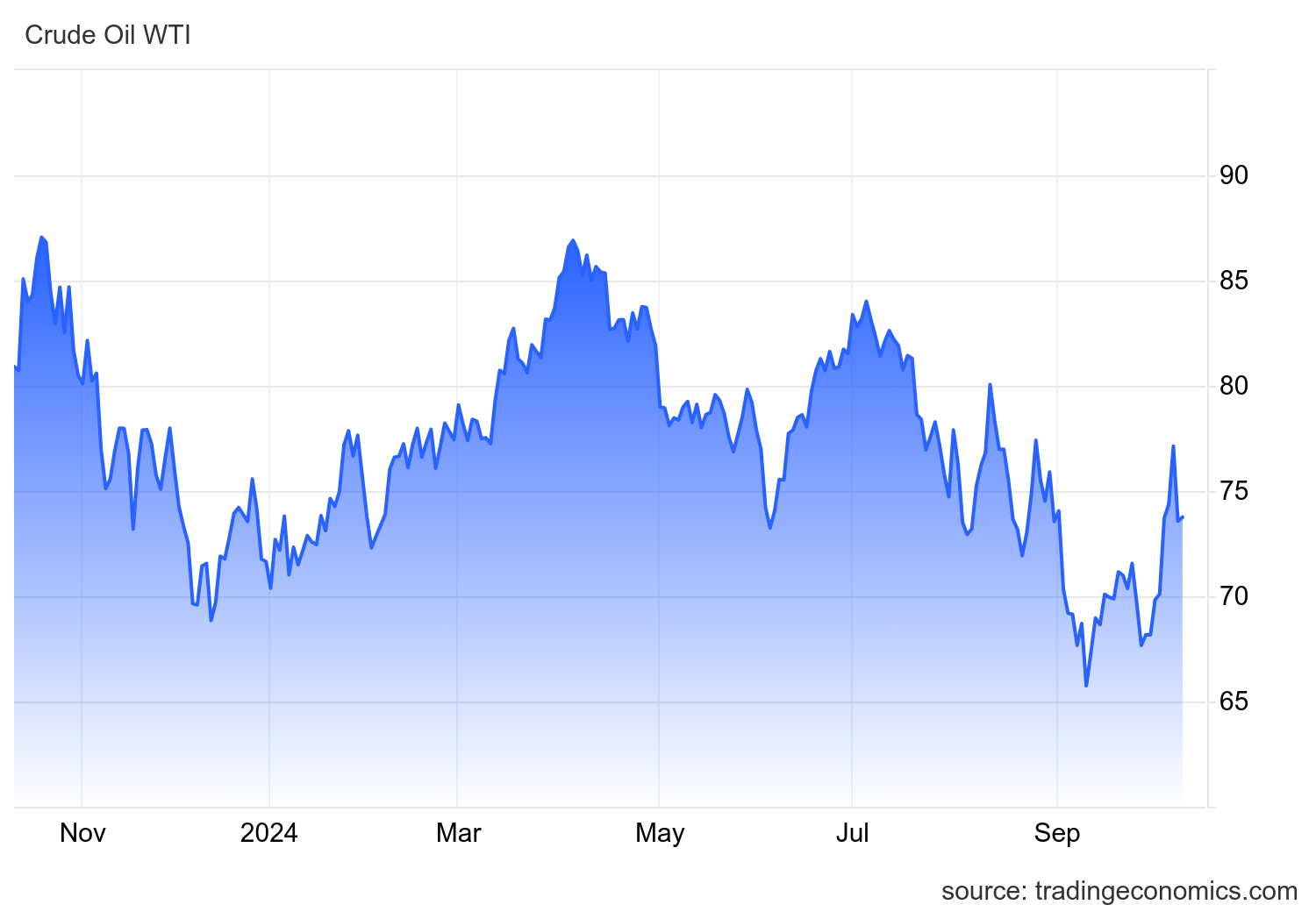
futures fell 4.2% to $78.25 a barrel, while US WTI crude dropped 4.1% to $74.80
per barrel. The decline comes after both benchmarks surged nearly 9% last week.
The retreat
in oil prices reflects a complex interplay of factors influencing the market.
While heightened tensions in the Middle East have raised concerns about
potential supply disruptions, these fears have been tempered by the absence of
actual production interruptions thus far.
Crude oil prices. Source: Tradingeconomics.com
“Oil
can keep ascending only for so long purely based on perceptions and not actual
supply disruption,” noted analysts at oil brokerage PMV. “The
geopolitical risk premium has an obscure and unforeseeable expiry date.”
Adding to
the downward pressure, China's return from its Golden Week holiday brought
disappointment as authorities refrained from announcing new economic stimulus
measures. This has reignited worries about oil demand in the world's
second-largest economy.
“Without
policy support, an economic slowdown could keep China's oil demand subdued in
the short to medium term,” Warren Patterson from ING added.
The fact
that the war premium in the oil market disappeared one day doesn't mean it
won't reappear the next, especially since it doesn't look like we're
approaching any resolution to the conflict.
Israel
Claims Elimination of Hezbollah Leader's Successors
Israeli
Prime Minister Benjamin Netanyahu announced today (Wednesday) that airstrikes
had killed two successors to Hezbollah's recently slain leader, Hassan
Nasrallah, as Israel intensified its ground offensive in southern Lebanon.
“We've
degraded Hezbollah's capabilities. We took out thousands of terrorists,
including Nasrallah himself and Nasrallah's replacement, and the replacement of
the replacement,” Netanyahu declared in a video statement. However, the
prime minister did not identify the alleged successors by name.
Israeli
Defense Minister Yoav Gallant suggested that Hashem Safieddine, widely
considered Nasrallah's likely successor, had “probably been
eliminated.” Military spokesman Daniel Hagari later stated that
Safieddine's status was being verified after an airstrike on Hezbollah's
intelligence headquarters last week.
BREAKING: It's just been confirmed that Hashem Sadieddine, Nasrallah’s successor and soon-to-be leader of Hezbollah, was killed in last week’s strike in Beirut.
While the world is busy vilifying Israel, Israel is busy protecting the world against the real terror and people who… pic.twitter.com/OGG5QRiNBE
The claims
come as Israel deployed a fourth army division into southern Lebanon, expanding
its ground operations against Hezbollah. The Israeli military reported that
airstrikes over the past 24 hours had killed at least 50 Hezbollah fighters,
including six sector commanders and regional officials.
The
conflict has escalated dramatically in recent weeks. Israel bombed
Hezbollah strongholds in Beirut's southern suburbs and Hezbollah launched
rocket attacks on northern Israeli cities, including Haifa.
As the
violence intensifies, concerns are growing about a wider regional conflict.
Iran, a key backer of both Hezbollah and Hamas, has warned Israel against
retaliatory strikes on Iranian territory following recent missile exchanges.
The ongoing
hostilities have resulted in over 1,000 deaths in Lebanon and displaced more
than a million people in the past two weeks. Israel maintains that its
objective is to secure its northern border and allow the return of thousands of
displaced residents.
Geopolitical
tensions in the Middle East have caused oil prices to experience their
strongest gains since March 2023. This week, prices tested two-month highs. Analysts believe that if the conflict escalates, the upward trend may continue.
Notably,
Israeli Prime Minister Benjamin Netanyahu stated that airstrikes killed two
successors to Hezbollah's slain leader. The country is expanding its offensive
against the Iran-backed group, with ground operations extending into southern
Lebanon.
Will Oil Prices Return to $100 per Barrel?
Although
projections of oil prices jumping back to the psychological barrier of $100 per
barrel, last seen in 2022, currently seem distant, analysts are beginning to
raise their forecasts for the end of this year.
Morgan
Stanley recently raised its Brent price forecast for Q4 2024 to $80 per barrel
from $75, citing heightened geopolitical risks. Brent crude prices have already
tested such high levels this week, while US WTI crude has so far stopped at around
$78.
Morgan Stanley raised its Brent value forecast to $80 a barrel (from $75) for This autumn 2024https://t.co/0hejq852Z3
Morgan Stanley has bumped its forecast for Brent crude oil in the final quarter of 2024 to $80 / Barrel up from its previous forecast of $75 MS cite heighten... pic.twitter.com/gBiI328fzf
However, Tuesday's session brought a temporary easing of sentiment in the oil market, as
concerns about the Middle East conflict outweighed stronger worries about
global demand.
Oil Prices
Fell over 4% on Tuesday
Brent crude
futures fell 4.2% to $78.25 a barrel, while US WTI crude dropped 4.1% to $74.80
per barrel. The decline comes after both benchmarks surged nearly 9% last week.
The retreat
in oil prices reflects a complex interplay of factors influencing the market.
While heightened tensions in the Middle East have raised concerns about
potential supply disruptions, these fears have been tempered by the absence of
actual production interruptions thus far.
Crude oil prices. Source: Tradingeconomics.com
“Oil
can keep ascending only for so long purely based on perceptions and not actual
supply disruption,” noted analysts at oil brokerage PMV. “The
geopolitical risk premium has an obscure and unforeseeable expiry date.”
Adding to
the downward pressure, China's return from its Golden Week holiday brought
disappointment as authorities refrained from announcing new economic stimulus
measures. This has reignited worries about oil demand in the world's
second-largest economy.
“Without
policy support, an economic slowdown could keep China's oil demand subdued in
the short to medium term,” Warren Patterson from ING added.
The fact
that the war premium in the oil market disappeared one day doesn't mean it
won't reappear the next, especially since it doesn't look like we're
approaching any resolution to the conflict.
Israel
Claims Elimination of Hezbollah Leader's Successors
Israeli
Prime Minister Benjamin Netanyahu announced today (Wednesday) that airstrikes
had killed two successors to Hezbollah's recently slain leader, Hassan
Nasrallah, as Israel intensified its ground offensive in southern Lebanon.
“We've
degraded Hezbollah's capabilities. We took out thousands of terrorists,
including Nasrallah himself and Nasrallah's replacement, and the replacement of
the replacement,” Netanyahu declared in a video statement. However, the
prime minister did not identify the alleged successors by name.
Israeli
Defense Minister Yoav Gallant suggested that Hashem Safieddine, widely
considered Nasrallah's likely successor, had “probably been
eliminated.” Military spokesman Daniel Hagari later stated that
Safieddine's status was being verified after an airstrike on Hezbollah's
intelligence headquarters last week.
BREAKING: It's just been confirmed that Hashem Sadieddine, Nasrallah’s successor and soon-to-be leader of Hezbollah, was killed in last week’s strike in Beirut.
While the world is busy vilifying Israel, Israel is busy protecting the world against the real terror and people who… pic.twitter.com/OGG5QRiNBE
The claims
come as Israel deployed a fourth army division into southern Lebanon, expanding
its ground operations against Hezbollah. The Israeli military reported that
airstrikes over the past 24 hours had killed at least 50 Hezbollah fighters,
including six sector commanders and regional officials.
The
conflict has escalated dramatically in recent weeks. Israel bombed
Hezbollah strongholds in Beirut's southern suburbs and Hezbollah launched
rocket attacks on northern Israeli cities, including Haifa.
As the
violence intensifies, concerns are growing about a wider regional conflict.
Iran, a key backer of both Hezbollah and Hamas, has warned Israel against
retaliatory strikes on Iranian territory following recent missile exchanges.
The ongoing
hostilities have resulted in over 1,000 deaths in Lebanon and displaced more
than a million people in the past two weeks. Israel maintains that its
objective is to secure its northern border and allow the return of thousands of
displaced residents.
Damian Chmiel is a Senior Analyst & Editor at Finance Magnates with more than 15 years of experience in the CFD and online trading industry. Active as both a trader and journalist since 2010, he focuses on broker coverage, fintech innovation, and regulatory developments across Europe, the Middle East, and Asia.
His work includes interviews with C-level leaders at major brokerages and fintech platforms, as well as co-authoring Finance Magnates’ quarterly industry benchmarking reports. Damian’s reporting is data-driven, market-aware, and grounded in direct industry engagement. His analysis and commentary have also been cited by external media outlets, including Investing.com, Binance, The Asset, Stockhead, and Dispatch.
Education:
MA in Finance and Accounting, Cracow University of Economics
Inside the Prediction Markets: $1.6B Institutional Inflow Meets a Federal Crackdown
Featured Videos
FP Markets Winner Spotlight 🏆 | Global Broker of the Year 2025 #Trading #Broker #Innovation #Shorts
FP Markets Winner Spotlight 🏆 | Global Broker of the Year 2025 #Trading #Broker #Innovation #Shorts
FP Markets Winner Spotlight 🏆 | Global Broker of the Year 2025 #Trading #Broker #Innovation #Shorts
FP Markets Winner Spotlight 🏆 | Global Broker of the Year 2025 #Trading #Broker #Innovation #Shorts
FP Markets takes the spotlight as Global Broker of the Year 2025 at the Finance Magnates Awards.
Martin Stoilov, Head of Client Experience, shares that trust, innovation, and people played a key role in the company’s success, supported by a strong foundation of integrity and client-centricity.
Following this milestone, FP Markets continues to focus on growth, technology investment, and its core values of transparency and excellence.
👉 Be part of FM Awards 2026: https://awards.financemagnates.com/#nominate
FP Markets takes the spotlight as Global Broker of the Year 2025 at the Finance Magnates Awards.
Martin Stoilov, Head of Client Experience, shares that trust, innovation, and people played a key role in the company’s success, supported by a strong foundation of integrity and client-centricity.
Following this milestone, FP Markets continues to focus on growth, technology investment, and its core values of transparency and excellence.
👉 Be part of FM Awards 2026: https://awards.financemagnates.com/#nominate
FP Markets takes the spotlight as Global Broker of the Year 2025 at the Finance Magnates Awards.
Martin Stoilov, Head of Client Experience, shares that trust, innovation, and people played a key role in the company’s success, supported by a strong foundation of integrity and client-centricity.
Following this milestone, FP Markets continues to focus on growth, technology investment, and its core values of transparency and excellence.
👉 Be part of FM Awards 2026: https://awards.financemagnates.com/#nominate
FP Markets takes the spotlight as Global Broker of the Year 2025 at the Finance Magnates Awards.
Martin Stoilov, Head of Client Experience, shares that trust, innovation, and people played a key role in the company’s success, supported by a strong foundation of integrity and client-centricity.
Following this milestone, FP Markets continues to focus on growth, technology investment, and its core values of transparency and excellence.
👉 Be part of FM Awards 2026: https://awards.financemagnates.com/#nominate
In this video, we review @HolaPrimeMarketsOfficial, a multi-asset forex and CFDs broker offering different account types, trading platforms, and flexible trading conditions.
We cover the broker’s overall offering, including account options, trading environment, platforms like MT4 and MT5, and additional services such as managed accounts and fast withdrawals.
Watch the full video to see if Hola Prime Markets fits your trading needs.
📣 Stay up to date with the latest in finance and trading. Follow Finance Magnates for industry news, insights, and global event coverage.
Connect with us:
🔗 LinkedIn: /financemagnates
👍 Facebook: /financemagnates
📸 Instagram: https://www.instagram.com/financemagnates
🐦 X: https://x.com/financemagnates
🎥 TikTok: https://www.tiktok.com/tag/financemagnates
▶️ YouTube: /@financemagnates_official
#HolaPrime #ForexBroker #CFDTrading #FinanceMagnates #Trading #Forex #BrokerReview
In this video, we review @HolaPrimeMarketsOfficial, a multi-asset forex and CFDs broker offering different account types, trading platforms, and flexible trading conditions.
We cover the broker’s overall offering, including account options, trading environment, platforms like MT4 and MT5, and additional services such as managed accounts and fast withdrawals.
Watch the full video to see if Hola Prime Markets fits your trading needs.
📣 Stay up to date with the latest in finance and trading. Follow Finance Magnates for industry news, insights, and global event coverage.
Connect with us:
🔗 LinkedIn: /financemagnates
👍 Facebook: /financemagnates
📸 Instagram: https://www.instagram.com/financemagnates
🐦 X: https://x.com/financemagnates
🎥 TikTok: https://www.tiktok.com/tag/financemagnates
▶️ YouTube: /@financemagnates_official
#HolaPrime #ForexBroker #CFDTrading #FinanceMagnates #Trading #Forex #BrokerReview
In this video, we review @HolaPrimeMarketsOfficial, a multi-asset forex and CFDs broker offering different account types, trading platforms, and flexible trading conditions.
We cover the broker’s overall offering, including account options, trading environment, platforms like MT4 and MT5, and additional services such as managed accounts and fast withdrawals.
Watch the full video to see if Hola Prime Markets fits your trading needs.
📣 Stay up to date with the latest in finance and trading. Follow Finance Magnates for industry news, insights, and global event coverage.
Connect with us:
🔗 LinkedIn: /financemagnates
👍 Facebook: /financemagnates
📸 Instagram: https://www.instagram.com/financemagnates
🐦 X: https://x.com/financemagnates
🎥 TikTok: https://www.tiktok.com/tag/financemagnates
▶️ YouTube: /@financemagnates_official
#HolaPrime #ForexBroker #CFDTrading #FinanceMagnates #Trading #Forex #BrokerReview
In this video, we review @HolaPrimeMarketsOfficial, a multi-asset forex and CFDs broker offering different account types, trading platforms, and flexible trading conditions.
We cover the broker’s overall offering, including account options, trading environment, platforms like MT4 and MT5, and additional services such as managed accounts and fast withdrawals.
Watch the full video to see if Hola Prime Markets fits your trading needs.
📣 Stay up to date with the latest in finance and trading. Follow Finance Magnates for industry news, insights, and global event coverage.
Connect with us:
🔗 LinkedIn: /financemagnates
👍 Facebook: /financemagnates
📸 Instagram: https://www.instagram.com/financemagnates
🐦 X: https://x.com/financemagnates
🎥 TikTok: https://www.tiktok.com/tag/financemagnates
▶️ YouTube: /@financemagnates_official
#HolaPrime #ForexBroker #CFDTrading #FinanceMagnates #Trading #Forex #BrokerReview
In this video, we review @HolaPrimeMarketsOfficial, a multi-asset forex and CFDs broker offering different account types, trading platforms, and flexible trading conditions.
We cover the broker’s overall offering, including account options, trading environment, platforms like MT4 and MT5, and additional services such as managed accounts and fast withdrawals.
Watch the full video to see if Hola Prime Markets fits your trading needs.
📣 Stay up to date with the latest in finance and trading. Follow Finance Magnates for industry news, insights, and global event coverage.
Connect with us:
🔗 LinkedIn: /financemagnates
👍 Facebook: /financemagnates
📸 Instagram: https://www.instagram.com/financemagnates
🐦 X: https://x.com/financemagnates
🎥 TikTok: https://www.tiktok.com/tag/financemagnates
▶️ YouTube: /@financemagnates_official
#HolaPrime #ForexBroker #CFDTrading #FinanceMagnates #Trading #Forex #BrokerReview
In this video, we review @HolaPrimeMarketsOfficial, a multi-asset forex and CFDs broker offering different account types, trading platforms, and flexible trading conditions.
We cover the broker’s overall offering, including account options, trading environment, platforms like MT4 and MT5, and additional services such as managed accounts and fast withdrawals.
Watch the full video to see if Hola Prime Markets fits your trading needs.
📣 Stay up to date with the latest in finance and trading. Follow Finance Magnates for industry news, insights, and global event coverage.
Connect with us:
🔗 LinkedIn: /financemagnates
👍 Facebook: /financemagnates
📸 Instagram: https://www.instagram.com/financemagnates
🐦 X: https://x.com/financemagnates
🎥 TikTok: https://www.tiktok.com/tag/financemagnates
▶️ YouTube: /@financemagnates_official
#HolaPrime #ForexBroker #CFDTrading #FinanceMagnates #Trading #Forex #BrokerReview
Hola Prime Review: What You Need to Know | Full Breakdown by Finance Magnates
Hola Prime Review: What You Need to Know | Full Breakdown by Finance Magnates
Hola Prime Review: What You Need to Know | Full Breakdown by Finance Magnates
Hola Prime Review: What You Need to Know | Full Breakdown by Finance Magnates
Hola Prime Review: What You Need to Know | Full Breakdown by Finance Magnates
Hola Prime Review: What You Need to Know | Full Breakdown by Finance Magnates
In this video, we review @HolaPrime_Global, a proprietary trading firm offering evaluation programs and performance-based payouts in simulated market environments.
We cover how the challenge model works, including account types, profit splits (up to 95%), trading rules, and what it takes to reach a funded account. You’ll also learn about available platforms like MT4, MT5, cTrader, and more, along with insights into payouts, support, and trading conditions.
Watch the full video to see if Hola Prime fits your trading style.
📣 Stay up to date with the latest in finance and trading. Follow Finance Magnates for industry news, insights, and global event coverage.
Connect with us:
🔗 LinkedIn: /financemagnates
👍 Facebook: /financemagnates
📸 Instagram: https://www.instagram.com/financemagnates
🐦 X: https://x.com/financemagnates
🎥 TikTok: https://www.tiktok.com/tag/financemagnates
▶️ YouTube: /@financemagnates_official
#HolaPrime #PropFirm #Trading #FinanceMagnates #Forex #FuturesTrading #TradingReview #PropFirmReview
In this video, we review @HolaPrime_Global, a proprietary trading firm offering evaluation programs and performance-based payouts in simulated market environments.
We cover how the challenge model works, including account types, profit splits (up to 95%), trading rules, and what it takes to reach a funded account. You’ll also learn about available platforms like MT4, MT5, cTrader, and more, along with insights into payouts, support, and trading conditions.
Watch the full video to see if Hola Prime fits your trading style.
📣 Stay up to date with the latest in finance and trading. Follow Finance Magnates for industry news, insights, and global event coverage.
Connect with us:
🔗 LinkedIn: /financemagnates
👍 Facebook: /financemagnates
📸 Instagram: https://www.instagram.com/financemagnates
🐦 X: https://x.com/financemagnates
🎥 TikTok: https://www.tiktok.com/tag/financemagnates
▶️ YouTube: /@financemagnates_official
#HolaPrime #PropFirm #Trading #FinanceMagnates #Forex #FuturesTrading #TradingReview #PropFirmReview
In this video, we review @HolaPrime_Global, a proprietary trading firm offering evaluation programs and performance-based payouts in simulated market environments.
We cover how the challenge model works, including account types, profit splits (up to 95%), trading rules, and what it takes to reach a funded account. You’ll also learn about available platforms like MT4, MT5, cTrader, and more, along with insights into payouts, support, and trading conditions.
Watch the full video to see if Hola Prime fits your trading style.
📣 Stay up to date with the latest in finance and trading. Follow Finance Magnates for industry news, insights, and global event coverage.
Connect with us:
🔗 LinkedIn: /financemagnates
👍 Facebook: /financemagnates
📸 Instagram: https://www.instagram.com/financemagnates
🐦 X: https://x.com/financemagnates
🎥 TikTok: https://www.tiktok.com/tag/financemagnates
▶️ YouTube: /@financemagnates_official
#HolaPrime #PropFirm #Trading #FinanceMagnates #Forex #FuturesTrading #TradingReview #PropFirmReview
In this video, we review @HolaPrime_Global, a proprietary trading firm offering evaluation programs and performance-based payouts in simulated market environments.
We cover how the challenge model works, including account types, profit splits (up to 95%), trading rules, and what it takes to reach a funded account. You’ll also learn about available platforms like MT4, MT5, cTrader, and more, along with insights into payouts, support, and trading conditions.
Watch the full video to see if Hola Prime fits your trading style.
📣 Stay up to date with the latest in finance and trading. Follow Finance Magnates for industry news, insights, and global event coverage.
Connect with us:
🔗 LinkedIn: /financemagnates
👍 Facebook: /financemagnates
📸 Instagram: https://www.instagram.com/financemagnates
🐦 X: https://x.com/financemagnates
🎥 TikTok: https://www.tiktok.com/tag/financemagnates
▶️ YouTube: /@financemagnates_official
#HolaPrime #PropFirm #Trading #FinanceMagnates #Forex #FuturesTrading #TradingReview #PropFirmReview
In this video, we review @HolaPrime_Global, a proprietary trading firm offering evaluation programs and performance-based payouts in simulated market environments.
We cover how the challenge model works, including account types, profit splits (up to 95%), trading rules, and what it takes to reach a funded account. You’ll also learn about available platforms like MT4, MT5, cTrader, and more, along with insights into payouts, support, and trading conditions.
Watch the full video to see if Hola Prime fits your trading style.
📣 Stay up to date with the latest in finance and trading. Follow Finance Magnates for industry news, insights, and global event coverage.
Connect with us:
🔗 LinkedIn: /financemagnates
👍 Facebook: /financemagnates
📸 Instagram: https://www.instagram.com/financemagnates
🐦 X: https://x.com/financemagnates
🎥 TikTok: https://www.tiktok.com/tag/financemagnates
▶️ YouTube: /@financemagnates_official
#HolaPrime #PropFirm #Trading #FinanceMagnates #Forex #FuturesTrading #TradingReview #PropFirmReview
In this video, we review @HolaPrime_Global, a proprietary trading firm offering evaluation programs and performance-based payouts in simulated market environments.
We cover how the challenge model works, including account types, profit splits (up to 95%), trading rules, and what it takes to reach a funded account. You’ll also learn about available platforms like MT4, MT5, cTrader, and more, along with insights into payouts, support, and trading conditions.
Watch the full video to see if Hola Prime fits your trading style.
📣 Stay up to date with the latest in finance and trading. Follow Finance Magnates for industry news, insights, and global event coverage.
Connect with us:
🔗 LinkedIn: /financemagnates
👍 Facebook: /financemagnates
📸 Instagram: https://www.instagram.com/financemagnates
🐦 X: https://x.com/financemagnates
🎥 TikTok: https://www.tiktok.com/tag/financemagnates
▶️ YouTube: /@financemagnates_official
#HolaPrime #PropFirm #Trading #FinanceMagnates #Forex #FuturesTrading #TradingReview #PropFirmReview
Axi Winner Spotlight 🏆 | Global Most Innovative Broker 2025 #Innovation #Trading #Fintech #Broker
Axi Winner Spotlight 🏆 | Global Most Innovative Broker 2025 #Innovation #Trading #Fintech #Broker
Axi Winner Spotlight 🏆 | Global Most Innovative Broker 2025 #Innovation #Trading #Fintech #Broker
Axi Winner Spotlight 🏆 | Global Most Innovative Broker 2025 #Innovation #Trading #Fintech #Broker
Axi Winner Spotlight 🏆 | Global Most Innovative Broker 2025 #Innovation #Trading #Fintech #Broker
Axi Winner Spotlight 🏆 | Global Most Innovative Broker 2025 #Innovation #Trading #Fintech #Broker
Axi takes the spotlight at the Finance Magnates Awards, winning Global Most Innovative Broker 2025.
Olivia Xenofontos and Ivanna Openko share how the team will feel: proud, motivated, and ready to keep delivering.
They also describe the night as well-organized, focused, and enjoyable for all.
👉 Be part of FM Awards 2026.
Axi takes the spotlight at the Finance Magnates Awards, winning Global Most Innovative Broker 2025.
Olivia Xenofontos and Ivanna Openko share how the team will feel: proud, motivated, and ready to keep delivering.
They also describe the night as well-organized, focused, and enjoyable for all.
👉 Be part of FM Awards 2026.
Axi takes the spotlight at the Finance Magnates Awards, winning Global Most Innovative Broker 2025.
Olivia Xenofontos and Ivanna Openko share how the team will feel: proud, motivated, and ready to keep delivering.
They also describe the night as well-organized, focused, and enjoyable for all.
👉 Be part of FM Awards 2026.
Axi takes the spotlight at the Finance Magnates Awards, winning Global Most Innovative Broker 2025.
Olivia Xenofontos and Ivanna Openko share how the team will feel: proud, motivated, and ready to keep delivering.
They also describe the night as well-organized, focused, and enjoyable for all.
👉 Be part of FM Awards 2026.
Axi takes the spotlight at the Finance Magnates Awards, winning Global Most Innovative Broker 2025.
Olivia Xenofontos and Ivanna Openko share how the team will feel: proud, motivated, and ready to keep delivering.
They also describe the night as well-organized, focused, and enjoyable for all.
👉 Be part of FM Awards 2026.
Axi takes the spotlight at the Finance Magnates Awards, winning Global Most Innovative Broker 2025.
Olivia Xenofontos and Ivanna Openko share how the team will feel: proud, motivated, and ready to keep delivering.
They also describe the night as well-organized, focused, and enjoyable for all.
👉 Be part of FM Awards 2026.
Recognition that matters.
Built on transparency.
Driven by the industry.
The Finance Magnates Awards 2026.
Nominations are now open.
🔗 https://awards.financemagnates.com/?utm_source=SM&utm_medium=social&utm_campaign=recognition-matters
Recognition that matters.
Built on transparency.
Driven by the industry.
The Finance Magnates Awards 2026.
Nominations are now open.
🔗 https://awards.financemagnates.com/?utm_source=SM&utm_medium=social&utm_campaign=recognition-matters
Recognition that matters.
Built on transparency.
Driven by the industry.
The Finance Magnates Awards 2026.
Nominations are now open.
🔗 https://awards.financemagnates.com/?utm_source=SM&utm_medium=social&utm_campaign=recognition-matters
Recognition that matters.
Built on transparency.
Driven by the industry.
The Finance Magnates Awards 2026.
Nominations are now open.
🔗 https://awards.financemagnates.com/?utm_source=SM&utm_medium=social&utm_campaign=recognition-matters
Recognition that matters.
Built on transparency.
Driven by the industry.
The Finance Magnates Awards 2026.
Nominations are now open.
🔗 https://awards.financemagnates.com/?utm_source=SM&utm_medium=social&utm_campaign=recognition-matters
Recognition that matters.
Built on transparency.
Driven by the industry.
The Finance Magnates Awards 2026.
Nominations are now open.
🔗 https://awards.financemagnates.com/?utm_source=SM&utm_medium=social&utm_campaign=recognition-matters