Bitcoin starts September 2025 at $108,253 after 6.5% August decline, testing historically weakest month with average -3.77% losses since 2013.
Technical breakdown shows key support breached at $109K-$111K levels, with analysts targeting potential $100K test during Red September cycle.
Whale accumulation hits record high at 19,130 addresses despite seasonal headwinds, while ETF outflows of $751M signal institutional caution.
Let's check the newest Bitcoin price prediction. Will BTC fall this month?
The
question "How low can Bitcoin go in September 2025?" has
taken on urgent relevance as the cryptocurrency enters its historically weakest
month trading today, Monday, 1 September 2025, at $108,253, down 0.49% from
yesterday and marking a concerning 6.5% August decline.
Why is
Bitcoin going down as September begins reflects both seasonal patterns and
technical breakdowns that suggest further weakness ahead. However, my technical
analysis suggests that the declines will be limited, and expert Bitcoin price
predictions for the short and medium term indicate a relatively quick rebound
toward all-time highs (ATH).
Bitcoin September 2025:
Current Price Action
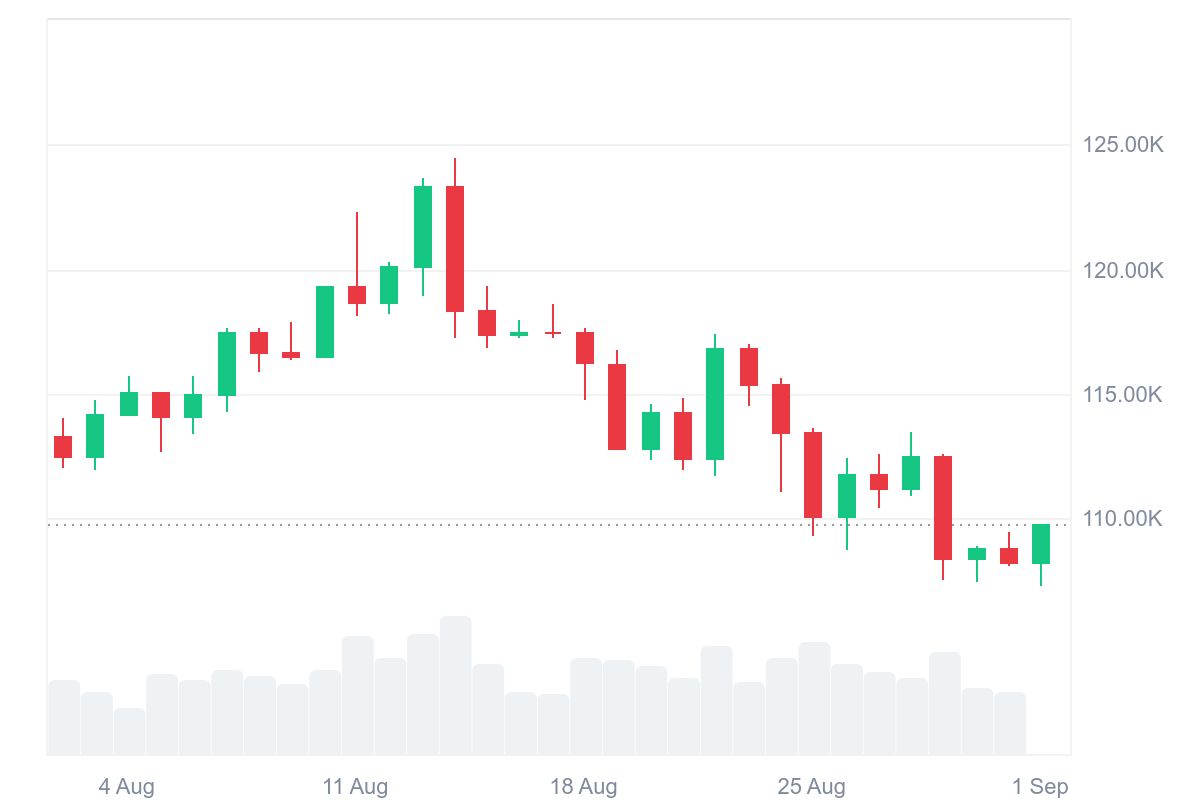
Bitcoin (BTC) begins September at a critical juncture, having broken its four-month
winning streak with August's 6.5% decline while US-listed spot ETFs
hemorrhaged $751 million in outflows. The cryptocurrency now trades near
$108,000, approximately 13% below its August all-time high of $124,533.
Key
Bitcoin metrics for September 1, 2025:
Current
price: $108,253
Monthly start: Down 0.49% from August
31
August performance: -6.5% (first red month
since April)
ETF
outflows: $751 million in August
Whale addresses (100+ BTC): Record high 19,130
The price
action reflects growing concern about Bitcoin's ability to maintain support
levels as the month progresses.
Bitcoin price today. Source: CoinMarketCap.
Red September: Historical
Patterns Spell Trouble
September's Brutal Track
Record
Bitcoin
price predictions September 2025 must account for the month's devastating
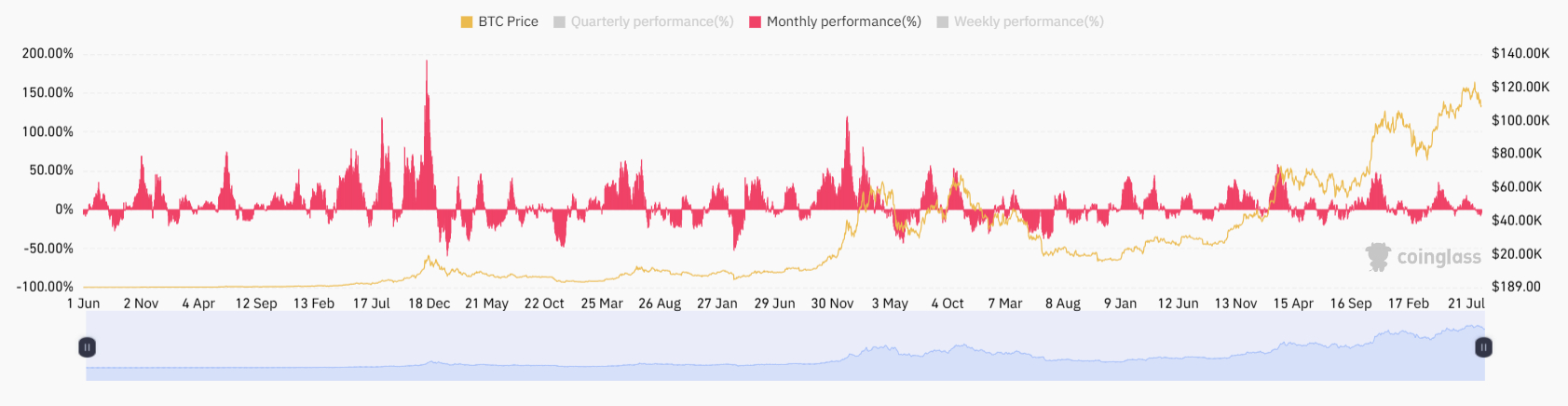
historical performance. Since 2013, Bitcoin has posted average returns of
-3.77% in September, closing red in 8 of the past 12 years. This
"Red September" phenomenon mirrors broader market patterns, with the
S&P 500 averaging -1.20% returns in September since 1928.
Yuri Berg
from FinchTrade explains the mechanics: "Many investment funds close
their fiscal year in September, divesting losing positions for tax reasons, and
rebalancing their portfolios". The structural selling pressure creates
a self-reinforcing downward spiral as traders anticipate weakness.
September is the one of the worst months for Bitcoin price action. Source: CoinGlass
Based on my
comprehensive technical analysis, Friday's nearly 4% decline broke Bitcoin out
of its two-month consolidation that had kept prices near historical maximums.
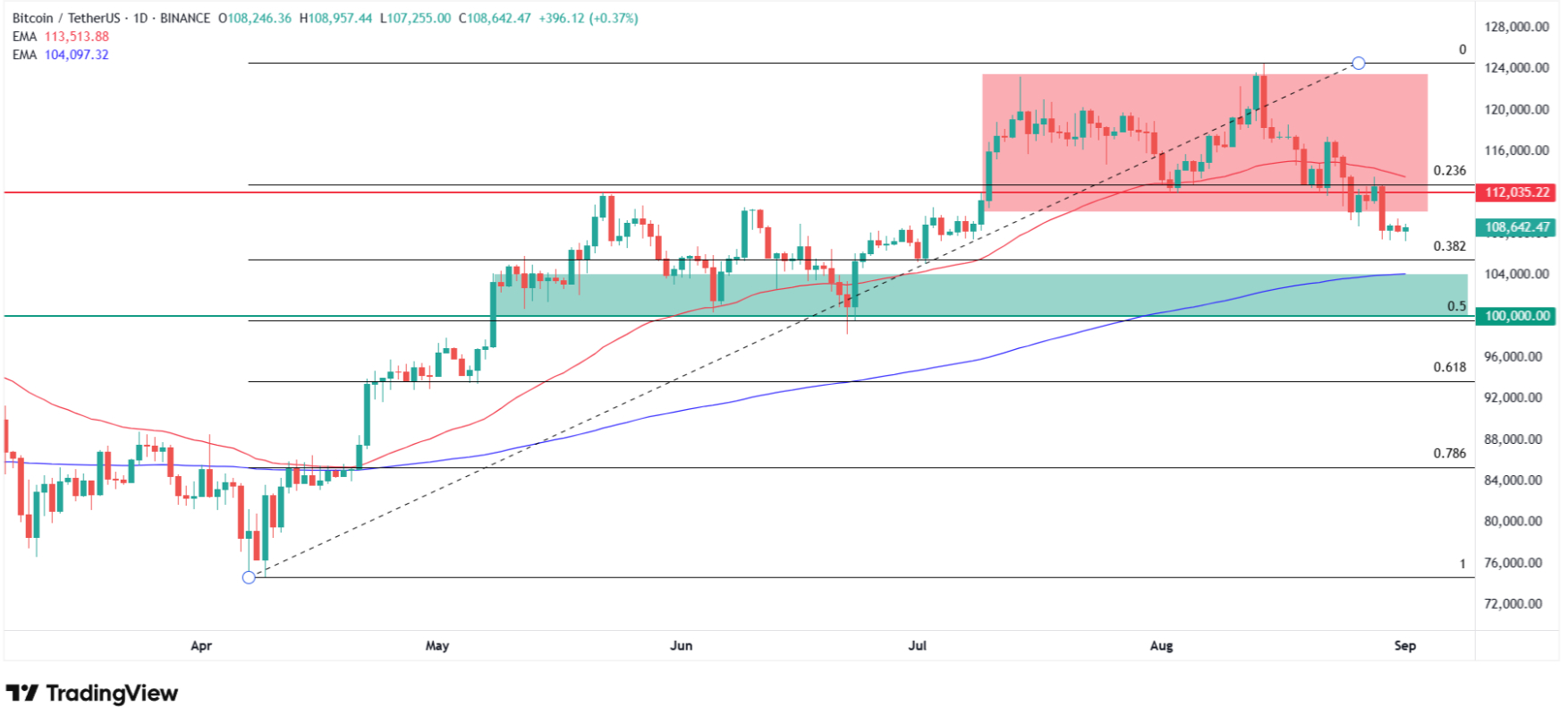
The cryptocurrency has now broken through legal support around $107,500, which
coincides with the lowest levels in nearly two months.
The
critical support zone begins at $104,000, precisely at the 200-day moving
average (200 MA). This support extends down to the psychological $100,000
level, where significant buy orders have accumulated. This zone is further
reinforced by the 50% Fibonacci retracement measured from the April uptrend to
August's historical maximum near $125,000.
If asked
how low Bitcoin can fall in September 2025, from current levels it would be
maximum 8% decline to exactly $100,000, in my opnions. The analysis doesn't
anticipate a stronger correction, and all downward movements will be treated as
reaccumulation opportunities and buying chances at more attractive prices.
Despite the
bearish setup, "hidden bullish divergence" appears on
Bitcoin's RSI, suggesting "the market is not as weak as the price
chart suggests". Analyst ZYN projects Bitcoin could reach "a
fresh all-time high above $124,500 within the next 4–6 weeks" based
on these technical patterns.
How low can Bitcoin go? Technical analysis. Source: Tradingview.com
Institutional Dynamics:
Mixed Signals
Record Whale Accumulation Despite Weakness - A remarkable development shows whale
addresses holding 100+ BTC reached a record high of 19,130, surpassing even the
2017 peak. This accumulation pattern suggests sophisticated investors are
buying the dip despite retail capitulation.
ETF Outflows Signal Institutional Caution - Conversely, $751 million in ETF outflows during
August indicates institutional uncertainty. The divergence between whale
accumulation and ETF selling suggests different time horizons and risk
appetites among large holders.
Fed Policy Creates Macro Tailwind - Currency traders are turning bearish on the
dollar with expectations for Fed rate cuts creating potential upside
catalysts. The 52-week correlation between Bitcoin and the Dollar Index has
weakened to -0.25, its lowest level in two years, suggesting Bitcoin could
benefit from dollar weakness.
September 2025 Bitcoin Price
Predictions: Expert Consensus
Bearish Scenarios Dominate
Changelly's
Bitcoin price predictions September 2025 show potential volatility with a
minimum target of $108,802 and maximum of $124,283. However,
most technical analysts lean bearish given the seasonal headwinds and broken
support levels.
Binance's
forecast projects September ending around $108,332, suggesting
limited upside potential.
The September
Effect stems from multiple converging factors:
Portfolio
rebalancing by institutional investors
Tax loss harvesting before
fiscal year-end
Reduced
summer liquidity creating volatility
Psychological selling based
on historical patterns
Technical Momentum
Breakdown
Key
momentum indicators have turned decisively bearish:
MACD
histogram dropped below zero
RSI shows oversold
conditions below 30
Moving
average structure confirms downtrend
FAQ: Bitcoin September
2025 Outlook
How low can Bitcoin
realistically go in September 2025?
My technical
analysis suggests $100K-$101K as primary support, though some projections see
potential for deeper correction to mid-$90Ks.
Will Bitcoin break the Red
September pattern in 2025?
Mixed
signals, whale accumulation and Fed policy support bulls, while technical
breakdowns and ETF outflows favor bears.
What would trigger a
September rally instead of decline?
Federal
Reserve dovishness, dollar weakness, and institutional re-entry above $113.5K
resistance could flip sentiment.
Is September selling just
a self-fulfilling prophecy?
Partly, but
structural factors like portfolio rebalancing and reduced liquidity create
genuine seasonal headwinds.
The
question "How low can Bitcoin go in September 2025?" has
taken on urgent relevance as the cryptocurrency enters its historically weakest
month trading today, Monday, 1 September 2025, at $108,253, down 0.49% from
yesterday and marking a concerning 6.5% August decline.
Why is
Bitcoin going down as September begins reflects both seasonal patterns and
technical breakdowns that suggest further weakness ahead. However, my technical
analysis suggests that the declines will be limited, and expert Bitcoin price
predictions for the short and medium term indicate a relatively quick rebound
toward all-time highs (ATH).
Bitcoin September 2025:
Current Price Action
Bitcoin (BTC) begins September at a critical juncture, having broken its four-month
winning streak with August's 6.5% decline while US-listed spot ETFs
hemorrhaged $751 million in outflows. The cryptocurrency now trades near
$108,000, approximately 13% below its August all-time high of $124,533.
Key
Bitcoin metrics for September 1, 2025:
Current
price: $108,253
Monthly start: Down 0.49% from August
31
August performance: -6.5% (first red month
since April)
ETF
outflows: $751 million in August
Whale addresses (100+ BTC): Record high 19,130
The price
action reflects growing concern about Bitcoin's ability to maintain support
levels as the month progresses.
Bitcoin price today. Source: CoinMarketCap.
Red September: Historical
Patterns Spell Trouble
September's Brutal Track
Record
Bitcoin
price predictions September 2025 must account for the month's devastating
historical performance. Since 2013, Bitcoin has posted average returns of
-3.77% in September, closing red in 8 of the past 12 years. This
"Red September" phenomenon mirrors broader market patterns, with the
S&P 500 averaging -1.20% returns in September since 1928.
Yuri Berg
from FinchTrade explains the mechanics: "Many investment funds close
their fiscal year in September, divesting losing positions for tax reasons, and
rebalancing their portfolios". The structural selling pressure creates
a self-reinforcing downward spiral as traders anticipate weakness.
September is the one of the worst months for Bitcoin price action. Source: CoinGlass
Based on my
comprehensive technical analysis, Friday's nearly 4% decline broke Bitcoin out
of its two-month consolidation that had kept prices near historical maximums.
The cryptocurrency has now broken through legal support around $107,500, which
coincides with the lowest levels in nearly two months.
The
critical support zone begins at $104,000, precisely at the 200-day moving
average (200 MA). This support extends down to the psychological $100,000
level, where significant buy orders have accumulated. This zone is further
reinforced by the 50% Fibonacci retracement measured from the April uptrend to
August's historical maximum near $125,000.
If asked
how low Bitcoin can fall in September 2025, from current levels it would be
maximum 8% decline to exactly $100,000, in my opnions. The analysis doesn't
anticipate a stronger correction, and all downward movements will be treated as
reaccumulation opportunities and buying chances at more attractive prices.
Despite the
bearish setup, "hidden bullish divergence" appears on
Bitcoin's RSI, suggesting "the market is not as weak as the price
chart suggests". Analyst ZYN projects Bitcoin could reach "a
fresh all-time high above $124,500 within the next 4–6 weeks" based
on these technical patterns.
How low can Bitcoin go? Technical analysis. Source: Tradingview.com
Institutional Dynamics:
Mixed Signals
Record Whale Accumulation Despite Weakness - A remarkable development shows whale
addresses holding 100+ BTC reached a record high of 19,130, surpassing even the
2017 peak. This accumulation pattern suggests sophisticated investors are
buying the dip despite retail capitulation.
ETF Outflows Signal Institutional Caution - Conversely, $751 million in ETF outflows during
August indicates institutional uncertainty. The divergence between whale
accumulation and ETF selling suggests different time horizons and risk
appetites among large holders.
Fed Policy Creates Macro Tailwind - Currency traders are turning bearish on the
dollar with expectations for Fed rate cuts creating potential upside
catalysts. The 52-week correlation between Bitcoin and the Dollar Index has
weakened to -0.25, its lowest level in two years, suggesting Bitcoin could
benefit from dollar weakness.
September 2025 Bitcoin Price
Predictions: Expert Consensus
Bearish Scenarios Dominate
Changelly's
Bitcoin price predictions September 2025 show potential volatility with a
minimum target of $108,802 and maximum of $124,283. However,
most technical analysts lean bearish given the seasonal headwinds and broken
support levels.
Binance's
forecast projects September ending around $108,332, suggesting
limited upside potential.
Damian Chmiel is a Senior Analyst & Editor at Finance Magnates with more than 15 years of experience in the CFD and online trading industry. Active as both a trader and journalist since 2010, he focuses on broker coverage, fintech innovation, and regulatory developments across Europe, the Middle East, and Asia.
His work includes interviews with C-level leaders at major brokerages and fintech platforms, as well as co-authoring Finance Magnates’ quarterly industry benchmarking reports. Damian’s reporting is data-driven, market-aware, and grounded in direct industry engagement. His analysis and commentary have also been cited by external media outlets, including Investing.com, Binance, The Asset, Stockhead, and Dispatch.
Education:
MA in Finance and Accounting, Cracow University of Economics
Inside the Prediction Markets: $1.6B Institutional Inflow Meets a Federal Crackdown
Featured Videos
FP Markets Winner Spotlight 🏆 | Global Broker of the Year 2025 #Trading #Broker #Innovation #Shorts
FP Markets Winner Spotlight 🏆 | Global Broker of the Year 2025 #Trading #Broker #Innovation #Shorts
FP Markets Winner Spotlight 🏆 | Global Broker of the Year 2025 #Trading #Broker #Innovation #Shorts
FP Markets Winner Spotlight 🏆 | Global Broker of the Year 2025 #Trading #Broker #Innovation #Shorts
FP Markets takes the spotlight as Global Broker of the Year 2025 at the Finance Magnates Awards.
Martin Stoilov, Head of Client Experience, shares that trust, innovation, and people played a key role in the company’s success, supported by a strong foundation of integrity and client-centricity.
Following this milestone, FP Markets continues to focus on growth, technology investment, and its core values of transparency and excellence.
👉 Be part of FM Awards 2026: https://awards.financemagnates.com/#nominate
FP Markets takes the spotlight as Global Broker of the Year 2025 at the Finance Magnates Awards.
Martin Stoilov, Head of Client Experience, shares that trust, innovation, and people played a key role in the company’s success, supported by a strong foundation of integrity and client-centricity.
Following this milestone, FP Markets continues to focus on growth, technology investment, and its core values of transparency and excellence.
👉 Be part of FM Awards 2026: https://awards.financemagnates.com/#nominate
FP Markets takes the spotlight as Global Broker of the Year 2025 at the Finance Magnates Awards.
Martin Stoilov, Head of Client Experience, shares that trust, innovation, and people played a key role in the company’s success, supported by a strong foundation of integrity and client-centricity.
Following this milestone, FP Markets continues to focus on growth, technology investment, and its core values of transparency and excellence.
👉 Be part of FM Awards 2026: https://awards.financemagnates.com/#nominate
FP Markets takes the spotlight as Global Broker of the Year 2025 at the Finance Magnates Awards.
Martin Stoilov, Head of Client Experience, shares that trust, innovation, and people played a key role in the company’s success, supported by a strong foundation of integrity and client-centricity.
Following this milestone, FP Markets continues to focus on growth, technology investment, and its core values of transparency and excellence.
👉 Be part of FM Awards 2026: https://awards.financemagnates.com/#nominate
In this video, we review @HolaPrimeMarketsOfficial, a multi-asset forex and CFDs broker offering different account types, trading platforms, and flexible trading conditions.
We cover the broker’s overall offering, including account options, trading environment, platforms like MT4 and MT5, and additional services such as managed accounts and fast withdrawals.
Watch the full video to see if Hola Prime Markets fits your trading needs.
📣 Stay up to date with the latest in finance and trading. Follow Finance Magnates for industry news, insights, and global event coverage.
Connect with us:
🔗 LinkedIn: /financemagnates
👍 Facebook: /financemagnates
📸 Instagram: https://www.instagram.com/financemagnates
🐦 X: https://x.com/financemagnates
🎥 TikTok: https://www.tiktok.com/tag/financemagnates
▶️ YouTube: /@financemagnates_official
#HolaPrime #ForexBroker #CFDTrading #FinanceMagnates #Trading #Forex #BrokerReview
In this video, we review @HolaPrimeMarketsOfficial, a multi-asset forex and CFDs broker offering different account types, trading platforms, and flexible trading conditions.
We cover the broker’s overall offering, including account options, trading environment, platforms like MT4 and MT5, and additional services such as managed accounts and fast withdrawals.
Watch the full video to see if Hola Prime Markets fits your trading needs.
📣 Stay up to date with the latest in finance and trading. Follow Finance Magnates for industry news, insights, and global event coverage.
Connect with us:
🔗 LinkedIn: /financemagnates
👍 Facebook: /financemagnates
📸 Instagram: https://www.instagram.com/financemagnates
🐦 X: https://x.com/financemagnates
🎥 TikTok: https://www.tiktok.com/tag/financemagnates
▶️ YouTube: /@financemagnates_official
#HolaPrime #ForexBroker #CFDTrading #FinanceMagnates #Trading #Forex #BrokerReview
In this video, we review @HolaPrimeMarketsOfficial, a multi-asset forex and CFDs broker offering different account types, trading platforms, and flexible trading conditions.
We cover the broker’s overall offering, including account options, trading environment, platforms like MT4 and MT5, and additional services such as managed accounts and fast withdrawals.
Watch the full video to see if Hola Prime Markets fits your trading needs.
📣 Stay up to date with the latest in finance and trading. Follow Finance Magnates for industry news, insights, and global event coverage.
Connect with us:
🔗 LinkedIn: /financemagnates
👍 Facebook: /financemagnates
📸 Instagram: https://www.instagram.com/financemagnates
🐦 X: https://x.com/financemagnates
🎥 TikTok: https://www.tiktok.com/tag/financemagnates
▶️ YouTube: /@financemagnates_official
#HolaPrime #ForexBroker #CFDTrading #FinanceMagnates #Trading #Forex #BrokerReview
In this video, we review @HolaPrimeMarketsOfficial, a multi-asset forex and CFDs broker offering different account types, trading platforms, and flexible trading conditions.
We cover the broker’s overall offering, including account options, trading environment, platforms like MT4 and MT5, and additional services such as managed accounts and fast withdrawals.
Watch the full video to see if Hola Prime Markets fits your trading needs.
📣 Stay up to date with the latest in finance and trading. Follow Finance Magnates for industry news, insights, and global event coverage.
Connect with us:
🔗 LinkedIn: /financemagnates
👍 Facebook: /financemagnates
📸 Instagram: https://www.instagram.com/financemagnates
🐦 X: https://x.com/financemagnates
🎥 TikTok: https://www.tiktok.com/tag/financemagnates
▶️ YouTube: /@financemagnates_official
#HolaPrime #ForexBroker #CFDTrading #FinanceMagnates #Trading #Forex #BrokerReview
In this video, we review @HolaPrimeMarketsOfficial, a multi-asset forex and CFDs broker offering different account types, trading platforms, and flexible trading conditions.
We cover the broker’s overall offering, including account options, trading environment, platforms like MT4 and MT5, and additional services such as managed accounts and fast withdrawals.
Watch the full video to see if Hola Prime Markets fits your trading needs.
📣 Stay up to date with the latest in finance and trading. Follow Finance Magnates for industry news, insights, and global event coverage.
Connect with us:
🔗 LinkedIn: /financemagnates
👍 Facebook: /financemagnates
📸 Instagram: https://www.instagram.com/financemagnates
🐦 X: https://x.com/financemagnates
🎥 TikTok: https://www.tiktok.com/tag/financemagnates
▶️ YouTube: /@financemagnates_official
#HolaPrime #ForexBroker #CFDTrading #FinanceMagnates #Trading #Forex #BrokerReview
In this video, we review @HolaPrimeMarketsOfficial, a multi-asset forex and CFDs broker offering different account types, trading platforms, and flexible trading conditions.
We cover the broker’s overall offering, including account options, trading environment, platforms like MT4 and MT5, and additional services such as managed accounts and fast withdrawals.
Watch the full video to see if Hola Prime Markets fits your trading needs.
📣 Stay up to date with the latest in finance and trading. Follow Finance Magnates for industry news, insights, and global event coverage.
Connect with us:
🔗 LinkedIn: /financemagnates
👍 Facebook: /financemagnates
📸 Instagram: https://www.instagram.com/financemagnates
🐦 X: https://x.com/financemagnates
🎥 TikTok: https://www.tiktok.com/tag/financemagnates
▶️ YouTube: /@financemagnates_official
#HolaPrime #ForexBroker #CFDTrading #FinanceMagnates #Trading #Forex #BrokerReview
Hola Prime Review: What You Need to Know | Full Breakdown by Finance Magnates
Hola Prime Review: What You Need to Know | Full Breakdown by Finance Magnates
Hola Prime Review: What You Need to Know | Full Breakdown by Finance Magnates
Hola Prime Review: What You Need to Know | Full Breakdown by Finance Magnates
Hola Prime Review: What You Need to Know | Full Breakdown by Finance Magnates
Hola Prime Review: What You Need to Know | Full Breakdown by Finance Magnates
In this video, we review @HolaPrime_Global, a proprietary trading firm offering evaluation programs and performance-based payouts in simulated market environments.
We cover how the challenge model works, including account types, profit splits (up to 95%), trading rules, and what it takes to reach a funded account. You’ll also learn about available platforms like MT4, MT5, cTrader, and more, along with insights into payouts, support, and trading conditions.
Watch the full video to see if Hola Prime fits your trading style.
📣 Stay up to date with the latest in finance and trading. Follow Finance Magnates for industry news, insights, and global event coverage.
Connect with us:
🔗 LinkedIn: /financemagnates
👍 Facebook: /financemagnates
📸 Instagram: https://www.instagram.com/financemagnates
🐦 X: https://x.com/financemagnates
🎥 TikTok: https://www.tiktok.com/tag/financemagnates
▶️ YouTube: /@financemagnates_official
#HolaPrime #PropFirm #Trading #FinanceMagnates #Forex #FuturesTrading #TradingReview #PropFirmReview
In this video, we review @HolaPrime_Global, a proprietary trading firm offering evaluation programs and performance-based payouts in simulated market environments.
We cover how the challenge model works, including account types, profit splits (up to 95%), trading rules, and what it takes to reach a funded account. You’ll also learn about available platforms like MT4, MT5, cTrader, and more, along with insights into payouts, support, and trading conditions.
Watch the full video to see if Hola Prime fits your trading style.
📣 Stay up to date with the latest in finance and trading. Follow Finance Magnates for industry news, insights, and global event coverage.
Connect with us:
🔗 LinkedIn: /financemagnates
👍 Facebook: /financemagnates
📸 Instagram: https://www.instagram.com/financemagnates
🐦 X: https://x.com/financemagnates
🎥 TikTok: https://www.tiktok.com/tag/financemagnates
▶️ YouTube: /@financemagnates_official
#HolaPrime #PropFirm #Trading #FinanceMagnates #Forex #FuturesTrading #TradingReview #PropFirmReview
In this video, we review @HolaPrime_Global, a proprietary trading firm offering evaluation programs and performance-based payouts in simulated market environments.
We cover how the challenge model works, including account types, profit splits (up to 95%), trading rules, and what it takes to reach a funded account. You’ll also learn about available platforms like MT4, MT5, cTrader, and more, along with insights into payouts, support, and trading conditions.
Watch the full video to see if Hola Prime fits your trading style.
📣 Stay up to date with the latest in finance and trading. Follow Finance Magnates for industry news, insights, and global event coverage.
Connect with us:
🔗 LinkedIn: /financemagnates
👍 Facebook: /financemagnates
📸 Instagram: https://www.instagram.com/financemagnates
🐦 X: https://x.com/financemagnates
🎥 TikTok: https://www.tiktok.com/tag/financemagnates
▶️ YouTube: /@financemagnates_official
#HolaPrime #PropFirm #Trading #FinanceMagnates #Forex #FuturesTrading #TradingReview #PropFirmReview
In this video, we review @HolaPrime_Global, a proprietary trading firm offering evaluation programs and performance-based payouts in simulated market environments.
We cover how the challenge model works, including account types, profit splits (up to 95%), trading rules, and what it takes to reach a funded account. You’ll also learn about available platforms like MT4, MT5, cTrader, and more, along with insights into payouts, support, and trading conditions.
Watch the full video to see if Hola Prime fits your trading style.
📣 Stay up to date with the latest in finance and trading. Follow Finance Magnates for industry news, insights, and global event coverage.
Connect with us:
🔗 LinkedIn: /financemagnates
👍 Facebook: /financemagnates
📸 Instagram: https://www.instagram.com/financemagnates
🐦 X: https://x.com/financemagnates
🎥 TikTok: https://www.tiktok.com/tag/financemagnates
▶️ YouTube: /@financemagnates_official
#HolaPrime #PropFirm #Trading #FinanceMagnates #Forex #FuturesTrading #TradingReview #PropFirmReview
In this video, we review @HolaPrime_Global, a proprietary trading firm offering evaluation programs and performance-based payouts in simulated market environments.
We cover how the challenge model works, including account types, profit splits (up to 95%), trading rules, and what it takes to reach a funded account. You’ll also learn about available platforms like MT4, MT5, cTrader, and more, along with insights into payouts, support, and trading conditions.
Watch the full video to see if Hola Prime fits your trading style.
📣 Stay up to date with the latest in finance and trading. Follow Finance Magnates for industry news, insights, and global event coverage.
Connect with us:
🔗 LinkedIn: /financemagnates
👍 Facebook: /financemagnates
📸 Instagram: https://www.instagram.com/financemagnates
🐦 X: https://x.com/financemagnates
🎥 TikTok: https://www.tiktok.com/tag/financemagnates
▶️ YouTube: /@financemagnates_official
#HolaPrime #PropFirm #Trading #FinanceMagnates #Forex #FuturesTrading #TradingReview #PropFirmReview
In this video, we review @HolaPrime_Global, a proprietary trading firm offering evaluation programs and performance-based payouts in simulated market environments.
We cover how the challenge model works, including account types, profit splits (up to 95%), trading rules, and what it takes to reach a funded account. You’ll also learn about available platforms like MT4, MT5, cTrader, and more, along with insights into payouts, support, and trading conditions.
Watch the full video to see if Hola Prime fits your trading style.
📣 Stay up to date with the latest in finance and trading. Follow Finance Magnates for industry news, insights, and global event coverage.
Connect with us:
🔗 LinkedIn: /financemagnates
👍 Facebook: /financemagnates
📸 Instagram: https://www.instagram.com/financemagnates
🐦 X: https://x.com/financemagnates
🎥 TikTok: https://www.tiktok.com/tag/financemagnates
▶️ YouTube: /@financemagnates_official
#HolaPrime #PropFirm #Trading #FinanceMagnates #Forex #FuturesTrading #TradingReview #PropFirmReview
Axi Winner Spotlight 🏆 | Global Most Innovative Broker 2025 #Innovation #Trading #Fintech #Broker
Axi Winner Spotlight 🏆 | Global Most Innovative Broker 2025 #Innovation #Trading #Fintech #Broker
Axi Winner Spotlight 🏆 | Global Most Innovative Broker 2025 #Innovation #Trading #Fintech #Broker
Axi Winner Spotlight 🏆 | Global Most Innovative Broker 2025 #Innovation #Trading #Fintech #Broker
Axi Winner Spotlight 🏆 | Global Most Innovative Broker 2025 #Innovation #Trading #Fintech #Broker
Axi Winner Spotlight 🏆 | Global Most Innovative Broker 2025 #Innovation #Trading #Fintech #Broker
Axi takes the spotlight at the Finance Magnates Awards, winning Global Most Innovative Broker 2025.
Olivia Xenofontos and Ivanna Openko share how the team will feel: proud, motivated, and ready to keep delivering.
They also describe the night as well-organized, focused, and enjoyable for all.
👉 Be part of FM Awards 2026.
Axi takes the spotlight at the Finance Magnates Awards, winning Global Most Innovative Broker 2025.
Olivia Xenofontos and Ivanna Openko share how the team will feel: proud, motivated, and ready to keep delivering.
They also describe the night as well-organized, focused, and enjoyable for all.
👉 Be part of FM Awards 2026.
Axi takes the spotlight at the Finance Magnates Awards, winning Global Most Innovative Broker 2025.
Olivia Xenofontos and Ivanna Openko share how the team will feel: proud, motivated, and ready to keep delivering.
They also describe the night as well-organized, focused, and enjoyable for all.
👉 Be part of FM Awards 2026.
Axi takes the spotlight at the Finance Magnates Awards, winning Global Most Innovative Broker 2025.
Olivia Xenofontos and Ivanna Openko share how the team will feel: proud, motivated, and ready to keep delivering.
They also describe the night as well-organized, focused, and enjoyable for all.
👉 Be part of FM Awards 2026.
Axi takes the spotlight at the Finance Magnates Awards, winning Global Most Innovative Broker 2025.
Olivia Xenofontos and Ivanna Openko share how the team will feel: proud, motivated, and ready to keep delivering.
They also describe the night as well-organized, focused, and enjoyable for all.
👉 Be part of FM Awards 2026.
Axi takes the spotlight at the Finance Magnates Awards, winning Global Most Innovative Broker 2025.
Olivia Xenofontos and Ivanna Openko share how the team will feel: proud, motivated, and ready to keep delivering.
They also describe the night as well-organized, focused, and enjoyable for all.
👉 Be part of FM Awards 2026.
Recognition that matters.
Built on transparency.
Driven by the industry.
The Finance Magnates Awards 2026.
Nominations are now open.
🔗 https://awards.financemagnates.com/?utm_source=SM&utm_medium=social&utm_campaign=recognition-matters
Recognition that matters.
Built on transparency.
Driven by the industry.
The Finance Magnates Awards 2026.
Nominations are now open.
🔗 https://awards.financemagnates.com/?utm_source=SM&utm_medium=social&utm_campaign=recognition-matters
Recognition that matters.
Built on transparency.
Driven by the industry.
The Finance Magnates Awards 2026.
Nominations are now open.
🔗 https://awards.financemagnates.com/?utm_source=SM&utm_medium=social&utm_campaign=recognition-matters
Recognition that matters.
Built on transparency.
Driven by the industry.
The Finance Magnates Awards 2026.
Nominations are now open.
🔗 https://awards.financemagnates.com/?utm_source=SM&utm_medium=social&utm_campaign=recognition-matters
Recognition that matters.
Built on transparency.
Driven by the industry.
The Finance Magnates Awards 2026.
Nominations are now open.
🔗 https://awards.financemagnates.com/?utm_source=SM&utm_medium=social&utm_campaign=recognition-matters
Recognition that matters.
Built on transparency.
Driven by the industry.
The Finance Magnates Awards 2026.
Nominations are now open.
🔗 https://awards.financemagnates.com/?utm_source=SM&utm_medium=social&utm_campaign=recognition-matters