
How Low Can Bitcoin Go? BTC Sees Best Rally in 10 Months, But -30% Forecast Still on the Table

Thursday, 26/02/2026 | 07:51 GMT by Damian Chmiel
  • Bitcoin is trading at $68,164 on Thursday, February 26, 2026, extending Wednesday's 6.04% surge, the second-best session since May 2025.
  • Despite the impressive rally, Bitcoin remains trapped in the same $60,000-$72,000 consolidation range, sitting 46% below its October all-time high.
  • The primary bearish BTC price prediction stays unchanged at $50,000 (August 2024 lows).
Bitcoin token laying on the candle chart with red downard arrow next to it
Let's check the newest Bitcoin price prediction. Will BTC fall this month?

Bitcoin (BTC) price is trading at $68,164 on Thursday, February 26, 2026, extending Wednesday's extraordinary 6% surge, the second-best single session in 10 months, as a confluence of Trump's State of the Union address, a $323 million short squeeze, and $257.7 million in ETF inflows triggered one of the sharpest relief rallies of the year.

Despite the fireworks, from a technical perspective very little has changed: Bitcoin remains trapped in the same $60,000-$72,000 consolidation, sitting roughly 50% below its October all-time high of $126,080.

How low can Bitcoin go from here? My next bearish target remains at $50,000.

Why Bitcoin Surged 6% on Wednesday?

Wednesday's 6.04% rally, pushing Bitcoin from $64,074 to $67,947 by midnight UTC, with intraday highs touching $69,192, was the strongest single session since May 2025. Only February 6's extraordinary +12% bounce, which corrected a 14% crash and rebounded from October 2024 lows, was stronger this year.

Five distinct catalysts converged to trigger the move.

  1. Trump's State of the Union address dominated the narrative, with the president highlighting cooling inflation and record-low mortgage rates, boosting risk appetite across the Nasdaq and S&P 500 simultaneously. The broader crypto market surged 6% to $2.42 trillion in a single session.
  2. A $323 million short squeeze was the mechanical engine beneath the rally. As Bitcoin pushed above key levels, leveraged short positions were forcibly liquidated in a feedback loop that amplified the move, with total trading volume hitting $50.58 billion in 24 hours.
  3. ETF institutional buying provided structural support rather than just speculation. US spot Bitcoin ETFs posted $257.7 million in inflows on Tuesday, the largest single-day total since early February, snapping weeks of daily redemptions. This "smart money" accumulating near $65,000-$66,000 while the Fear & Greed Index sat in extreme fear represents the kind of divergence that often precedes short-term relief rallies.
  4. Viral lawsuit allegations added fuel to the fire. A lawsuit filed against Gain Street on February 24 alleged a recurring "10 AM smash" manipulation pattern that had artificially suppressed prices during North American morning sessions. The exposure of this alleged scheme coincided with that pattern disappearing, contributing to the aggressive buying.
  5. Bitcoin fell below its estimated average miner production cost of $66,000 for the first time since late 2022, a zone that "often aligns with late-stage selling and price stabilization" historically, triggering contrarian accumulation.

A significant $10.5 billion options expiry on Friday adds another layer of complexity, with potential outcomes hinging on Bitcoin's ability to maintain above $70,000.

Bitcoin Technical Analysis: Same Consolidation, Still Bearish

From my technical perspective, Wednesday's 6% surge changes very little about the structural picture.

Bitcoin remains trapped in the same consolidation range it has occupied for weeks: lower boundary at $60,000-$62,000, upper boundary extending to $70,000-$72,000. Thursday's $68,164 price sits squarely in the middle of this range, not at support, not at resistance, providing no decisive signal in either direction.

The overall picture remains strongly bearish. Bitcoin is stuck at medium-term lows, approximately 50% below the all-time highs it tested back in October. That's not a consolidation before a new rally, that's a 50% retracement that has failed to show meaningful recovery for months.

I want to be transparent about how my scenario has evolved. My earliest bearish forecast from November called for a drop to $74,000, that was correct. I then anticipated a bounce from that level back toward the highs, but the expected recovery never materialized as Bitcoin kept falling through $74K, $70K, and ultimately to $62K territory. I adjusted accordingly.
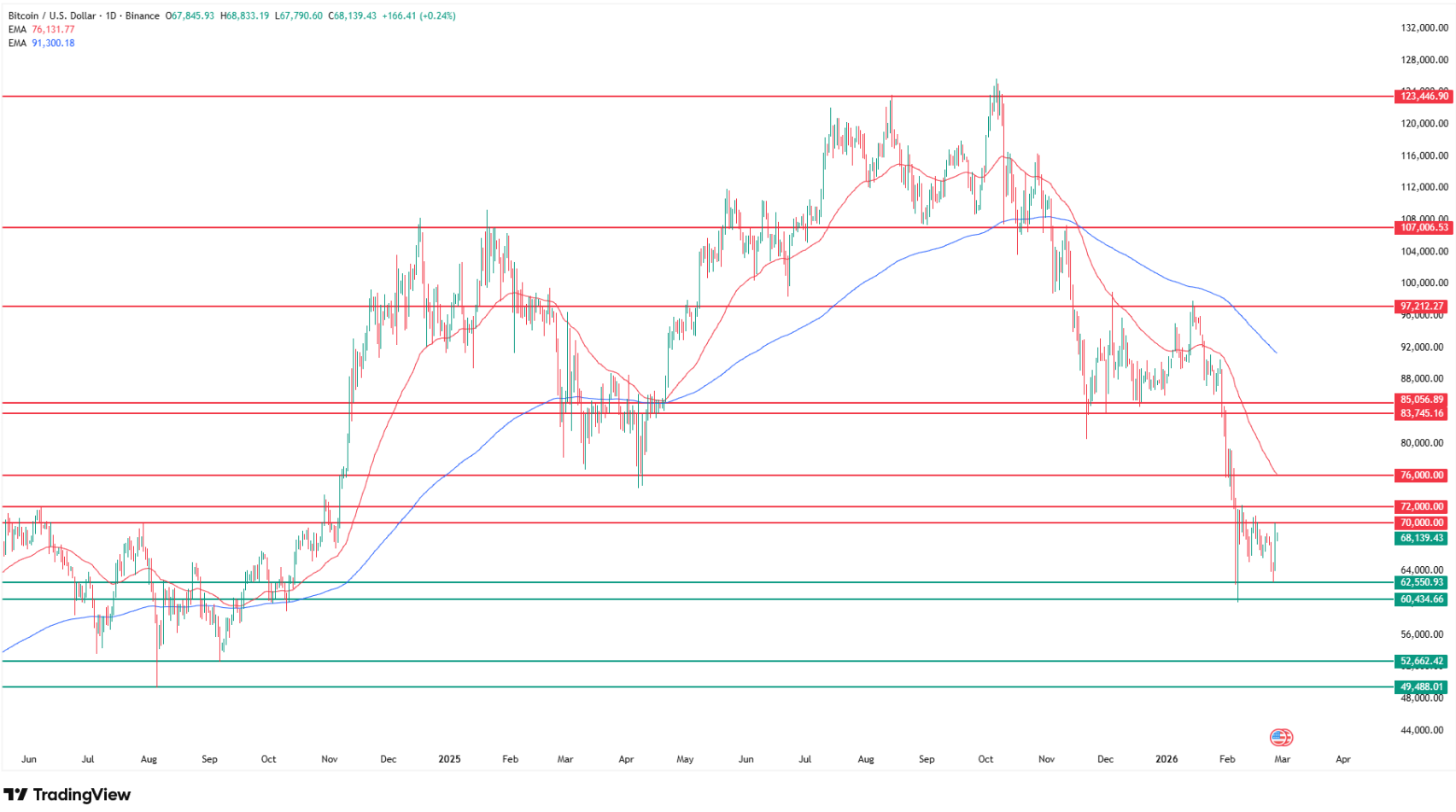
Bitcoin technical analysis. Source: Tradingview.com

My current primary bearish target is $50,000, the August 2024 lows, which represents approximately 30% further downside from current $68,164. In a range scenario, I also reference $50,000-$52,000 as the 2024 lows zone where I would expect more serious accumulation.

The only scenario that would change my bearish stance is a sustained return above $76,000, which coincides with April 2025 lows and the 50-day EMA. Until Bitcoin reclaims that level, every rally, including Wednesday's impressive 6% session, is a relief bounce within a downtrend, not a reversal.

For the long-term bull case around institutional adoption and Eric Trump's $1 million prediction, we simply need to see that level reclaimed first.

The $60,000 Line: Between Relief and Capitulation

James Harris, CEO at Tesseract Group, identifies the critical battleground with precision: "Bitcoin is backtesting the February panic lows in the $60K-$63K range, and that zone matters for both psychological and structural reasons." He notes that "on-chain data suggests there has been meaningful accumulation in this area, with buyers stepping in to absorb selling pressure."

The bull scenario, as Harris describes it: "A low-volume retest of these lows followed by a recovery toward the $67K region, which would signal that supply is drying up rather than accelerating." Thursday's bounce to $68,164 technically fits this pattern—but sustaining it is the challenge.

The bear scenario is more concerning. Harris warns that "the risk sits just below $60K," where "a decisive break would likely trigger stop-outs, margin calls and liquidation-driven selling into already thin liquidity." He emphasizes that despite leverage declining since earlier in the month, "sentiment remains fragile. In a low-confidence environment like this, it doesn't take much to turn a controlled decline into a cascade, particularly when aggressive dip buyers are scarce."

Level

Significance

$76,000

Bull invalidation: 50 EMA + April 2025 lows

$72,000

Upper consolidation ceiling

$70,000

Psychological resistance, options expiry battleground

$68,164

Current price (Feb 26)

$67,000

Harris: "recovery toward $67K signals supply drying up"

$60,000-$62,000

Critical support, lower consolidation boundary

$54,000

Harris: "October 2024 correction lows support"

$50,000-$52,000

Primary bearish target, August 2024 lows

$40,000

Howard's extreme: "more constructive base may form here"

How Low Can Bitcoin Go? Retail Has Left the Building

Paul Howard, Senior Director at Wincent, offers the most structurally bearish framework, one that goes beyond price levels to diagnose what's fundamentally changed in this cycle.

"The lack of adherence to traditional technical indicators has been notable," Howard observes. "With prices retracing nearly 50% from the $126K high and key support levels clustered around $60K, the probability of a break below that level now appears higher than a sustained defence of it."

His central thesis is sobering: "We are entering a broader period of consolidation, a 'winter chill' phase for digital assets." The reason? "While the underlying ecosystem remains strong and institutional engagement is at an all-time high, the retail capital that historically fuelled prior cycle momentum has rotated into AI and commodities."

Howard's ultimate base scenario is more bearish than my own: "A more constructive base may form closer to the $40,000 level rather than from a sustained rebound at $60,000." He adds that "sentiment and positioning could become materially more compelling as we approach the $40,000 region. By that stage, institutional products and capital flows may be better positioned to support a more structured and durable reversal in the market cycle."

Bitcoin Price Analysis, FAQ

How low can Bitcoin go in 2026?

My primary bearish target is $50,000, representing 30% downside from current $68,164. The ultra-bearish range is $50,000-$52,000 (2024 lows zone). James Harris (Tesseract Group) identifies $54,000 as "the next meaningful structural support" if $60,000 breaks, calling that level "the October 2024 correction lows". Paul Howard (Wincent) suggests "a more constructive base may form closer to $40,000 rather than from a sustained rebound at $60,000," citing retail capital rotation into AI and commodities as a structural shift.

Is $50,000 Bitcoin realistic?

It aligns with multiple analytical frameworks. Paul Howard notes "the probability of a break below $60,000 now appears higher than a sustained defense of it". James Harris warns "a decisive break below $60K would likely trigger stop-outs, margin calls and liquidation-driven selling." Bitcoin ETF total AUM has fallen 30.5% since start of 2026 ($117B to $81.3B), while Fear & Greed Index sits in "extreme fear".

Should I buy Bitcoin now?

Bitcoin at $68,164 sits in the middle of a $60,000-$72,000 consolidation range, 46% below its $126,080 all-time high. Wednesday's $257.7 million ETF inflow shows institutional accumulation at lower prices, but total ETF AUM is down 30.5% since January.

Bitcoin (BTC) price is trading at $68,164 on Thursday, February 26, 2026, extending Wednesday's extraordinary 6% surge, the second-best single session in 10 months, as a confluence of Trump's State of the Union address, a $323 million short squeeze, and $257.7 million in ETF inflows triggered one of the sharpest relief rallies of the year.

Despite the fireworks, from a technical perspective very little has changed: Bitcoin remains trapped in the same $60,000-$72,000 consolidation, sitting roughly 50% below its October all-time high of $126,080.

How low can Bitcoin go from here? My next bearish target remains at $50,000.

Why Bitcoin Surged 6% on Wednesday?

Wednesday's 6.04% rally, pushing Bitcoin from $64,074 to $67,947 by midnight UTC, with intraday highs touching $69,192, was the strongest single session since May 2025. Only February 6's extraordinary +12% bounce, which corrected a 14% crash and rebounded from October 2024 lows, was stronger this year.

Five distinct catalysts converged to trigger the move.

  1. Trump's State of the Union address dominated the narrative, with the president highlighting cooling inflation and record-low mortgage rates, boosting risk appetite across the Nasdaq and S&P 500 simultaneously. The broader crypto market surged 6% to $2.42 trillion in a single session.
  2. A $323 million short squeeze was the mechanical engine beneath the rally. As Bitcoin pushed above key levels, leveraged short positions were forcibly liquidated in a feedback loop that amplified the move, with total trading volume hitting $50.58 billion in 24 hours.
  3. ETF institutional buying provided structural support rather than just speculation. US spot Bitcoin ETFs posted $257.7 million in inflows on Tuesday, the largest single-day total since early February, snapping weeks of daily redemptions. This "smart money" accumulating near $65,000-$66,000 while the Fear & Greed Index sat in extreme fear represents the kind of divergence that often precedes short-term relief rallies.
  4. Viral lawsuit allegations added fuel to the fire. A lawsuit filed against Gain Street on February 24 alleged a recurring "10 AM smash" manipulation pattern that had artificially suppressed prices during North American morning sessions. The exposure of this alleged scheme coincided with that pattern disappearing, contributing to the aggressive buying.
  5. Bitcoin fell below its estimated average miner production cost of $66,000 for the first time since late 2022, a zone that "often aligns with late-stage selling and price stabilization" historically, triggering contrarian accumulation.

A significant $10.5 billion options expiry on Friday adds another layer of complexity, with potential outcomes hinging on Bitcoin's ability to maintain above $70,000.

Bitcoin Technical Analysis: Same Consolidation, Still Bearish

From my technical perspective, Wednesday's 6% surge changes very little about the structural picture.

Bitcoin remains trapped in the same consolidation range it has occupied for weeks: lower boundary at $60,000-$62,000, upper boundary extending to $70,000-$72,000. Thursday's $68,164 price sits squarely in the middle of this range, not at support, not at resistance, providing no decisive signal in either direction.

The overall picture remains strongly bearish. Bitcoin is stuck at medium-term lows, approximately 50% below the all-time highs it tested back in October. That's not a consolidation before a new rally, that's a 50% retracement that has failed to show meaningful recovery for months.

I want to be transparent about how my scenario has evolved. My earliest bearish forecast from November called for a drop to $74,000, that was correct. I then anticipated a bounce from that level back toward the highs, but the expected recovery never materialized as Bitcoin kept falling through $74K, $70K, and ultimately to $62K territory. I adjusted accordingly.

Bitcoin technical analysis. Source: Tradingview.com

My current primary bearish target is $50,000, the August 2024 lows, which represents approximately 30% further downside from current $68,164. In a range scenario, I also reference $50,000-$52,000 as the 2024 lows zone where I would expect more serious accumulation.

The only scenario that would change my bearish stance is a sustained return above $76,000, which coincides with April 2025 lows and the 50-day EMA. Until Bitcoin reclaims that level, every rally, including Wednesday's impressive 6% session, is a relief bounce within a downtrend, not a reversal.

For the long-term bull case around institutional adoption and Eric Trump's $1 million prediction, we simply need to see that level reclaimed first.

The $60,000 Line: Between Relief and Capitulation

James Harris, CEO at Tesseract Group, identifies the critical battleground with precision: "Bitcoin is backtesting the February panic lows in the $60K-$63K range, and that zone matters for both psychological and structural reasons." He notes that "on-chain data suggests there has been meaningful accumulation in this area, with buyers stepping in to absorb selling pressure."

The bull scenario, as Harris describes it: "A low-volume retest of these lows followed by a recovery toward the $67K region, which would signal that supply is drying up rather than accelerating." Thursday's bounce to $68,164 technically fits this pattern—but sustaining it is the challenge.

The bear scenario is more concerning. Harris warns that "the risk sits just below $60K," where "a decisive break would likely trigger stop-outs, margin calls and liquidation-driven selling into already thin liquidity." He emphasizes that despite leverage declining since earlier in the month, "sentiment remains fragile. In a low-confidence environment like this, it doesn't take much to turn a controlled decline into a cascade, particularly when aggressive dip buyers are scarce."

Level

Significance

$76,000

Bull invalidation: 50 EMA + April 2025 lows

$72,000

Upper consolidation ceiling

$70,000

Psychological resistance, options expiry battleground

$68,164

Current price (Feb 26)

$67,000

Harris: "recovery toward $67K signals supply drying up"

$60,000-$62,000

Critical support, lower consolidation boundary

$54,000

Harris: "October 2024 correction lows support"

$50,000-$52,000

Primary bearish target, August 2024 lows

$40,000

Howard's extreme: "more constructive base may form here"

How Low Can Bitcoin Go? Retail Has Left the Building

Paul Howard, Senior Director at Wincent, offers the most structurally bearish framework, one that goes beyond price levels to diagnose what's fundamentally changed in this cycle.

"The lack of adherence to traditional technical indicators has been notable," Howard observes. "With prices retracing nearly 50% from the $126K high and key support levels clustered around $60K, the probability of a break below that level now appears higher than a sustained defence of it."

His central thesis is sobering: "We are entering a broader period of consolidation, a 'winter chill' phase for digital assets." The reason? "While the underlying ecosystem remains strong and institutional engagement is at an all-time high, the retail capital that historically fuelled prior cycle momentum has rotated into AI and commodities."

Howard's ultimate base scenario is more bearish than my own: "A more constructive base may form closer to the $40,000 level rather than from a sustained rebound at $60,000." He adds that "sentiment and positioning could become materially more compelling as we approach the $40,000 region. By that stage, institutional products and capital flows may be better positioned to support a more structured and durable reversal in the market cycle."

Bitcoin Price Analysis, FAQ

How low can Bitcoin go in 2026?

My primary bearish target is $50,000, representing 30% downside from current $68,164. The ultra-bearish range is $50,000-$52,000 (2024 lows zone). James Harris (Tesseract Group) identifies $54,000 as "the next meaningful structural support" if $60,000 breaks, calling that level "the October 2024 correction lows". Paul Howard (Wincent) suggests "a more constructive base may form closer to $40,000 rather than from a sustained rebound at $60,000," citing retail capital rotation into AI and commodities as a structural shift.

Is $50,000 Bitcoin realistic?

It aligns with multiple analytical frameworks. Paul Howard notes "the probability of a break below $60,000 now appears higher than a sustained defense of it". James Harris warns "a decisive break below $60K would likely trigger stop-outs, margin calls and liquidation-driven selling." Bitcoin ETF total AUM has fallen 30.5% since start of 2026 ($117B to $81.3B), while Fear & Greed Index sits in "extreme fear".

Should I buy Bitcoin now?

Bitcoin at $68,164 sits in the middle of a $60,000-$72,000 consolidation range, 46% below its $126,080 all-time high. Wednesday's $257.7 million ETF inflow shows institutional accumulation at lower prices, but total ETF AUM is down 30.5% since January.

About the Author: Damian Chmiel
Damian Chmiel
  • 3282 Articles
  • 102 Followers
About the Author: Damian Chmiel
Damian's adventure with financial markets began at the Cracow University of Economics, where he obtained his MA in finance and accounting. Starting from the retail trader perspective, he collaborated with brokerage houses and financial portals in Poland as an independent editor and content manager. His adventure with Finance Magnates began in 2016, where he is working as a business intelligence analyst.
  • 3282 Articles
  • 102 Followers

More from the Author

Trending

!"#$%&'()*+,-./0123456789:;<=>?@ABCDEFGHIJKLMNOPQRSTUVWXYZ[\]^_`abcdefghijklmnopqrstuvwxyz{|} !"#$%&'()*+,-./0123456789:;<=>?@ABCDEFGHIJKLMNOPQRSTUVWXYZ[\]^_`abcdefghijklmnopqrstuvwxyz{|}