Analyst Titan of Crypto forecasts Bitcoin could hit $137K by Q3 2025, fueled by U.S. Treasury liquidity injections.
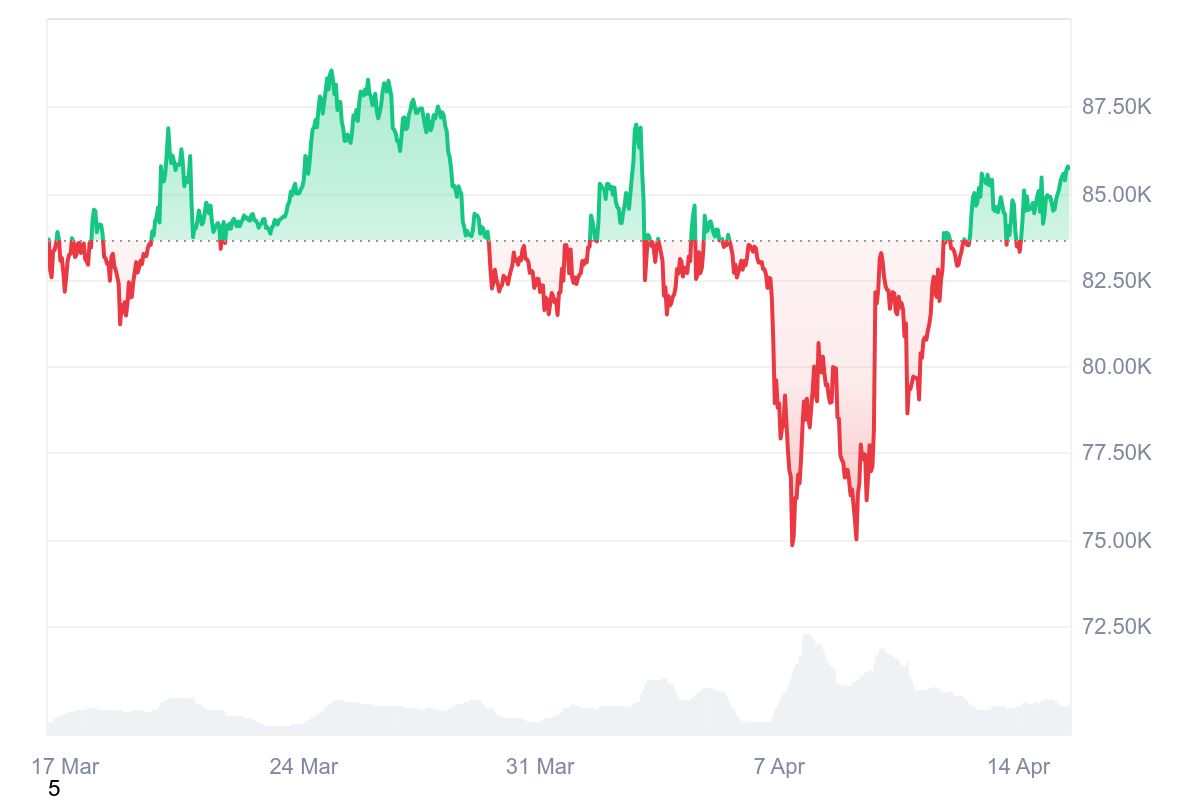
As of today, BTC price is up by 1,3%, moving above $85,000 and 200-day exponential moving average.
ETF inflows, and bullish patterns counter tariff fears, with most 2025 BTC predictions optimistic.
Bitcoin’s
price (BTC) as of today (Wednesday), April 16, 2025, hovers around $85,962,
recovering from a dip below $80,000 last week. The crypto community is abuzz
over a bold prediction from analyst Titan of Crypto: Bitcoin could surge to
$137,000 by Q3 2025, driven by massive liquidity injections from the U.S.
Treasury.
In this guide,
we’ll unpack Titan of Crypto’s bullish outlook, explore the forces lifting
crypto in 2025, and answer the most important questions. How high can Bitcoin
go? What’s fueling this rally? And how should retail investors position
themselves?
Bitcoin Price Is Going Up
Today
During
Tuesday’s session, Bitcoin’s price is up about 1.3%, reaching an intraday high
of $86,000, one of the highest levels in April.
As a
result, Bitcoin’s total market capitalization rises to over $1.7 trillion, with
a 24-hour trading volume of $28.7 billion.
Bitcoin price today. Source: CoinMarketCap
However,
one analyst on X (formerly Twitter) claims Bitcoin’s price could soon be much
higher.
Why Will Bitcoin Soar?
Titan of Crypto’s $137,000 BTC Prediction
Titan of
Crypto’s forecast, shared in an April 13, 2025, X post, is grounded in
technical and macroeconomic analysis. The analyst predicts Bitcoin could hit
$137,000 by July–August 2025, citing a bullish pennant pattern and U.S.
Treasury liquidity injections.
“Bitcoin
$137,000 in the Cards? BTC has formed a bull pennant on the daily chart. If it
plays out, a new ATH could be reached,” Titan of Crypto wrote.
#Bitcoin $137,000 in the Cards? 🚀#BTC has formed a bull pennant on the daily chart. If it plays out, a new ATH could be reached — right against current market sentiment.
Liquidity Surge: Macroeconomic analyst “Tomas
on Markets” highlights the U.S. Treasury’s injection of $500 billion into
markets since February 2025, drawing down its Treasury General Account
(TGA) from $842 billion to $342 billion. This boosts net Federal Reserve
liquidity to $6.3 trillion, with projections of $6.6 trillion by August if
debt ceiling talks extend. “This liquidity surge could lift speculative
assets like Bitcoin,” Tomas commented on X.
📈 Fed liquidity is rising
Net Federal Reserve Liquidity has increased by around $500bn since February.
It's not really having any positive impact on risk asset prices with everything else going on.
Historical Correlation: Financial analyst Lyn Alden’s
research shows Bitcoin moves in line with global liquidity 83% of the time
over 12 months, outperforming assets like the S&P 500 and gold. Past
TGA drawdowns in 2022 and 2023 fueled BTC rallies, and a projected $600 billion
boost by Q3 2025 could do the same.
Technical Breakout: Titan of Crypto’s chart
analysis identifies a bullish pennant on Bitcoin’s daily chart, signaling
a potential breakout. If BTC clears resistance at the 200-day exponential
moving average (EMA) near $90,000, it could target $137,000, a 60% jump
from current levels.
Market Resilience: Despite tariff concerns,
apparent exemptions have eased U.S. Treasury yields, reducing pressure on
risk assets.
Why Is Bitcoin Going Up in
2025? Liquidity, ETFs, and More
Bitcoin’s
rally isn’t just hype—it’s driven by a confluence of macroeconomic and
crypto-specific factors. Here’s a breakdown of the forces propelling BTC, with
insights for retail investors:
U.S. Treasury Liquidity
Injections
The
Treasury’s TGA drawdown is a game-changer. By releasing $500 billion since
February, the government has flooded markets with cash, boosting liquidity to
$6.3 trillion.
“The TGA
balance dropping to $342 billion means more cash in the system,” Tomas
explained. With another $600 billion expected by Q3, Bitcoin—historically tied
to liquidity—could see a massive tailwind. Retail investors should note that
past drawdowns in 2022 and 2023 sparked BTC rallies of 50%+.
ETF Inflows and
Institutional Adoption
Bitcoin
ETFs are a major driver. Self-directed retail investors account for 80% of ETF
flows, while institutions like MicroStrategy continue stockpiling BTC.
“Expected
ETF inflows of $70B+ in 2025 could push Bitcoin to $200,000,” Bernstein
analysts predicted. For retail investors, ETFs offer a low-risk way to gain
exposure without holding BTC directly.
Post-Halving Supply Shock
The April
2024 halving cut mining rewards to 3.125 BTC, tightening supply. Historically,
halvings precede bull runs (e.g., 2020’s 600% surge).
Crypto’s
resilience is evident in order books. “On Binance, buy-side liquidity for
BTC/USDT is 10x higher than sell-side,” noted Dr Kirill Kretov,
Senior Automation Expert at CoinPanel. Large players are moving
BTC to cold storage, signaling confidence.
How High Can Bitcoin Go? Bitcoin
Price Chart Technical Analysis
Based on my
technical analysis, Bitcoin has been stuck in a deadlock since late February.
Neither buyers nor sellers can decide which direction to take, and two key
moving averages have converged.
I’m
referring to the 50-day exponential moving average (50 EMA), marked in red, and
the 200-day EMA, marked in blue. The price is currently trading at their level,
indicating the market has reached a balance within a consolidation range
between resistance at $87,400 (local highs from March) and support at $78,000
(lows from last month and late February).
If
Bitcoin’s price breaks above the yellow-highlighted sideways channel, it faces
significant resistance in the $90,000–$92,000 zone, defined by lows from
November to February. Only a move above this level would make me bullish on the
BTC/USD chart again. The resistances I currently identify are:
$87,400
– upper consolidation boundary
$90,000–$92,000 – resistance
zone from late 2024/early 2025 lows
$100,000
– psychological level
$102,300 – local highs tested
in December and early January
$108,000 – all-time high from
December 2024, which also capped gains in January 2025
If Bitcoin
breaks below the current consolidation, the first support lies at $74,500.
Personally, I wouldn’t expect a sharper decline beyond the $66,000–$68,000
zone, where October 2024 lows are located. The main support levels are:
$78,000
– lower consolidation boundary
$74,500
– April lows
$72,000 – highs from May and
June 2024
$68,000
– highs tested in July 2024
$66,000 – October 2024 lows,
after which the rally to new all-time highs began in 2025
Bitcoin price support and
resistance zones table
Support Levels
Description
Resistance Levels
Description
$78,000
Lower
boundary of the current consolidation range, tested in March and late
February 2025.
$87,400
Upper
boundary of the consolidation range, marked by local highs from March 2025.
$74,500
April
2025 lows, acting as a near-term support level below the consolidation.
$90,000–$92,000
Resistance
zone defined by lows from November 2024 to February 2025, a critical hurdle
for bullish momentum.
$72,000
Highs
from May and June 2024, providing deeper support if selling pressure
increases.
$100,000
Psychological
level, likely to attract attention and potential selling pressure.
$68,000
Highs
tested in July 2024, a significant level from mid-2024 price action.
$102,300
Local
highs tested in December 2024 and early January 2025, a key barrier to new
highs.
$66,000
October
2024 lows, the starting point for the rally to new all-time highs in 2025.
$108,000
All-time
high from December 2024, which capped gains in January 2025.
Why Bitcoin Might Stall?
Not
everyone is all-in on the $137,000 call. Bearish risks include:
Debt Ceiling Deadlock: If Congress resolves the debt
ceiling early, TGA drawdowns could slow, capping liquidity at $6.3
trillion. “No liquidity, no rally,” Tomas warned.
Tariff Risks: While exemptions help,
renewed trade wars could spike yields and crush risk assets.
Technical Resistance: Failing to break the 200-day
EMA for long could trap BTC below $85,000, delaying the rally.
“Prediction that Bitcoin breaking through $137,000 by late summer may be overlooking critical dynamics playing out beneath the surface,” thinks Kretov. “We are in a period of extreme uncertainty with escalating geopolitical tensions, global economic fragility, and a pervasive risk-off sentiment. Gold, not Bitcoin, has resumed its role as a safe-haven asset in this climate.”
Still,
bulls dominate. The April 2024 halving, ETF momentum, and liquidity injections
create a strong case. Below is a table of bullish Bitcoin price predictions for
2025:
Bitcoin Price Prediction 2025 Table
Source
2025 Price Prediction
Key Drivers
Titan of Crypto
$137,000
TGA
liquidity ($600B+), bullish pennant, EMA breakout.
These
forecasts hinge on liquidity, regulatory clarity, and Bitcoin’s scarcity. While
bears see tariff and macro risks, bulls argue that 2025’s unique catalysts could
push BTC to new highs.
“We are likely to
continue seeing dramatic but meaningless moves, 10% drops overnight and 15%
rebounds over weekends. It’s all noise. The market lacks conviction, and high
emotional sensitivity fuels volatility,” adds Kretov. “Even traditional markets are behaving like memecoins. In that context, why expect Bitcoin to be any different?”
Bitcoin Price Prediction,
FAQ
How High Will Bitcoin
Climb?
Titan of
Crypto’s $137,000 call—a 60% jump from $85,838—rests on liquidity and
technicals. “If it plays out, a new ATH could be reached,” the analyst said.
Historically, BTC rallies 50%–600% post-halving, so $137,000 is plausible,
though $100K–$120K is a safer bet for Q2.
How Much Will 1 Bitcoin Be
Worth in 2025?
Predictions
range from $137,000 (Titan of Crypto) to $250,000 (Standard Chartered).
“Putting price and time together is tough,” Tomas noted. Liquidity, ETFs, and
halving effects favor bulls, but tariff risks could cap gains—expect swings.
What If I Bought $1 of
Bitcoin 10 Years Ago?
In April
2015, BTC averaged $250. A $1 investment bought 0.004 BTC. At $85,838, that’s
$343—a 343x return. If BTC hits $137,000, your $1 becomes $548, outpacing most
assets. Even at $100,000, it’s $400, showcasing BTC’s long-term potential.
Is It Worth Having $100 in
Bitcoin?
Yes, for
risk-tolerant investors. At $85,838, $100 buys 0.001165 BTC. If BTC hits
$137,000, that’s $159; at $200,000, it’s $233. “There’s going to be decent
volatility, a lot of trading opportunities,” Kretov said. $100 is a low-stakes
entry, but brace for dips.
Should I Buy Bitcoin Now?
Tes, but Titan
of Crypto’s view isn’t guaranteed. “Let’s see if the price can break to the
upside,” they cautioned. If you’re long-term focused, buying on dips near
$80,000–$82,000 could pay off, given historical rebounds (e.g., 2023’s 150%
surge).
Is Bitcoin Still “Digital
Gold”?
“Bitcoin
moves with global liquidity,” Lyn Alden’s research shows, reinforcing its
speculative appeal. While gold shines in crises, BTC’s 21 million coin cap and
halving-driven scarcity make it a compelling hedge—monitor liquidity trends to
gauge its role.
Bitcoin’s
price (BTC) as of today (Wednesday), April 16, 2025, hovers around $85,962,
recovering from a dip below $80,000 last week. The crypto community is abuzz
over a bold prediction from analyst Titan of Crypto: Bitcoin could surge to
$137,000 by Q3 2025, driven by massive liquidity injections from the U.S.
Treasury.
In this guide,
we’ll unpack Titan of Crypto’s bullish outlook, explore the forces lifting
crypto in 2025, and answer the most important questions. How high can Bitcoin
go? What’s fueling this rally? And how should retail investors position
themselves?
Bitcoin Price Is Going Up
Today
During
Tuesday’s session, Bitcoin’s price is up about 1.3%, reaching an intraday high
of $86,000, one of the highest levels in April.
As a
result, Bitcoin’s total market capitalization rises to over $1.7 trillion, with
a 24-hour trading volume of $28.7 billion.
Bitcoin price today. Source: CoinMarketCap
However,
one analyst on X (formerly Twitter) claims Bitcoin’s price could soon be much
higher.
Why Will Bitcoin Soar?
Titan of Crypto’s $137,000 BTC Prediction
Titan of
Crypto’s forecast, shared in an April 13, 2025, X post, is grounded in
technical and macroeconomic analysis. The analyst predicts Bitcoin could hit
$137,000 by July–August 2025, citing a bullish pennant pattern and U.S.
Treasury liquidity injections.
“Bitcoin
$137,000 in the Cards? BTC has formed a bull pennant on the daily chart. If it
plays out, a new ATH could be reached,” Titan of Crypto wrote.
#Bitcoin $137,000 in the Cards? 🚀#BTC has formed a bull pennant on the daily chart. If it plays out, a new ATH could be reached — right against current market sentiment.
Liquidity Surge: Macroeconomic analyst “Tomas
on Markets” highlights the U.S. Treasury’s injection of $500 billion into
markets since February 2025, drawing down its Treasury General Account
(TGA) from $842 billion to $342 billion. This boosts net Federal Reserve
liquidity to $6.3 trillion, with projections of $6.6 trillion by August if
debt ceiling talks extend. “This liquidity surge could lift speculative
assets like Bitcoin,” Tomas commented on X.
📈 Fed liquidity is rising
Net Federal Reserve Liquidity has increased by around $500bn since February.
It's not really having any positive impact on risk asset prices with everything else going on.
Historical Correlation: Financial analyst Lyn Alden’s
research shows Bitcoin moves in line with global liquidity 83% of the time
over 12 months, outperforming assets like the S&P 500 and gold. Past
TGA drawdowns in 2022 and 2023 fueled BTC rallies, and a projected $600 billion
boost by Q3 2025 could do the same.
Technical Breakout: Titan of Crypto’s chart
analysis identifies a bullish pennant on Bitcoin’s daily chart, signaling
a potential breakout. If BTC clears resistance at the 200-day exponential
moving average (EMA) near $90,000, it could target $137,000, a 60% jump
from current levels.
Market Resilience: Despite tariff concerns,
apparent exemptions have eased U.S. Treasury yields, reducing pressure on
risk assets.
Why Is Bitcoin Going Up in
2025? Liquidity, ETFs, and More
Bitcoin’s
rally isn’t just hype—it’s driven by a confluence of macroeconomic and
crypto-specific factors. Here’s a breakdown of the forces propelling BTC, with
insights for retail investors:
U.S. Treasury Liquidity
Injections
The
Treasury’s TGA drawdown is a game-changer. By releasing $500 billion since
February, the government has flooded markets with cash, boosting liquidity to
$6.3 trillion.
“The TGA
balance dropping to $342 billion means more cash in the system,” Tomas
explained. With another $600 billion expected by Q3, Bitcoin—historically tied
to liquidity—could see a massive tailwind. Retail investors should note that
past drawdowns in 2022 and 2023 sparked BTC rallies of 50%+.
ETF Inflows and
Institutional Adoption
Bitcoin
ETFs are a major driver. Self-directed retail investors account for 80% of ETF
flows, while institutions like MicroStrategy continue stockpiling BTC.
“Expected
ETF inflows of $70B+ in 2025 could push Bitcoin to $200,000,” Bernstein
analysts predicted. For retail investors, ETFs offer a low-risk way to gain
exposure without holding BTC directly.
Post-Halving Supply Shock
The April
2024 halving cut mining rewards to 3.125 BTC, tightening supply. Historically,
halvings precede bull runs (e.g., 2020’s 600% surge).
Crypto’s
resilience is evident in order books. “On Binance, buy-side liquidity for
BTC/USDT is 10x higher than sell-side,” noted Dr Kirill Kretov,
Senior Automation Expert at CoinPanel. Large players are moving
BTC to cold storage, signaling confidence.
How High Can Bitcoin Go? Bitcoin
Price Chart Technical Analysis
Based on my
technical analysis, Bitcoin has been stuck in a deadlock since late February.
Neither buyers nor sellers can decide which direction to take, and two key
moving averages have converged.
I’m
referring to the 50-day exponential moving average (50 EMA), marked in red, and
the 200-day EMA, marked in blue. The price is currently trading at their level,
indicating the market has reached a balance within a consolidation range
between resistance at $87,400 (local highs from March) and support at $78,000
(lows from last month and late February).
If
Bitcoin’s price breaks above the yellow-highlighted sideways channel, it faces
significant resistance in the $90,000–$92,000 zone, defined by lows from
November to February. Only a move above this level would make me bullish on the
BTC/USD chart again. The resistances I currently identify are:
$87,400
– upper consolidation boundary
$90,000–$92,000 – resistance
zone from late 2024/early 2025 lows
$100,000
– psychological level
$102,300 – local highs tested
in December and early January
$108,000 – all-time high from
December 2024, which also capped gains in January 2025
If Bitcoin
breaks below the current consolidation, the first support lies at $74,500.
Personally, I wouldn’t expect a sharper decline beyond the $66,000–$68,000
zone, where October 2024 lows are located. The main support levels are:
$78,000
– lower consolidation boundary
$74,500
– April lows
$72,000 – highs from May and
June 2024
$68,000
– highs tested in July 2024
$66,000 – October 2024 lows,
after which the rally to new all-time highs began in 2025
Bitcoin price support and
resistance zones table
Support Levels
Description
Resistance Levels
Description
$78,000
Lower
boundary of the current consolidation range, tested in March and late
February 2025.
$87,400
Upper
boundary of the consolidation range, marked by local highs from March 2025.
$74,500
April
2025 lows, acting as a near-term support level below the consolidation.
$90,000–$92,000
Resistance
zone defined by lows from November 2024 to February 2025, a critical hurdle
for bullish momentum.
$72,000
Highs
from May and June 2024, providing deeper support if selling pressure
increases.
$100,000
Psychological
level, likely to attract attention and potential selling pressure.
$68,000
Highs
tested in July 2024, a significant level from mid-2024 price action.
$102,300
Local
highs tested in December 2024 and early January 2025, a key barrier to new
highs.
$66,000
October
2024 lows, the starting point for the rally to new all-time highs in 2025.
$108,000
All-time
high from December 2024, which capped gains in January 2025.
Why Bitcoin Might Stall?
Not
everyone is all-in on the $137,000 call. Bearish risks include:
Debt Ceiling Deadlock: If Congress resolves the debt
ceiling early, TGA drawdowns could slow, capping liquidity at $6.3
trillion. “No liquidity, no rally,” Tomas warned.
Tariff Risks: While exemptions help,
renewed trade wars could spike yields and crush risk assets.
Technical Resistance: Failing to break the 200-day
EMA for long could trap BTC below $85,000, delaying the rally.
“Prediction that Bitcoin breaking through $137,000 by late summer may be overlooking critical dynamics playing out beneath the surface,” thinks Kretov. “We are in a period of extreme uncertainty with escalating geopolitical tensions, global economic fragility, and a pervasive risk-off sentiment. Gold, not Bitcoin, has resumed its role as a safe-haven asset in this climate.”
Still,
bulls dominate. The April 2024 halving, ETF momentum, and liquidity injections
create a strong case. Below is a table of bullish Bitcoin price predictions for
2025:
Bitcoin Price Prediction 2025 Table
Source
2025 Price Prediction
Key Drivers
Titan of Crypto
$137,000
TGA
liquidity ($600B+), bullish pennant, EMA breakout.
These
forecasts hinge on liquidity, regulatory clarity, and Bitcoin’s scarcity. While
bears see tariff and macro risks, bulls argue that 2025’s unique catalysts could
push BTC to new highs.
“We are likely to
continue seeing dramatic but meaningless moves, 10% drops overnight and 15%
rebounds over weekends. It’s all noise. The market lacks conviction, and high
emotional sensitivity fuels volatility,” adds Kretov. “Even traditional markets are behaving like memecoins. In that context, why expect Bitcoin to be any different?”
Bitcoin Price Prediction,
FAQ
How High Will Bitcoin
Climb?
Titan of
Crypto’s $137,000 call—a 60% jump from $85,838—rests on liquidity and
technicals. “If it plays out, a new ATH could be reached,” the analyst said.
Historically, BTC rallies 50%–600% post-halving, so $137,000 is plausible,
though $100K–$120K is a safer bet for Q2.
How Much Will 1 Bitcoin Be
Worth in 2025?
Predictions
range from $137,000 (Titan of Crypto) to $250,000 (Standard Chartered).
“Putting price and time together is tough,” Tomas noted. Liquidity, ETFs, and
halving effects favor bulls, but tariff risks could cap gains—expect swings.
What If I Bought $1 of
Bitcoin 10 Years Ago?
In April
2015, BTC averaged $250. A $1 investment bought 0.004 BTC. At $85,838, that’s
$343—a 343x return. If BTC hits $137,000, your $1 becomes $548, outpacing most
assets. Even at $100,000, it’s $400, showcasing BTC’s long-term potential.
Is It Worth Having $100 in
Bitcoin?
Yes, for
risk-tolerant investors. At $85,838, $100 buys 0.001165 BTC. If BTC hits
$137,000, that’s $159; at $200,000, it’s $233. “There’s going to be decent
volatility, a lot of trading opportunities,” Kretov said. $100 is a low-stakes
entry, but brace for dips.
Should I Buy Bitcoin Now?
Tes, but Titan
of Crypto’s view isn’t guaranteed. “Let’s see if the price can break to the
upside,” they cautioned. If you’re long-term focused, buying on dips near
$80,000–$82,000 could pay off, given historical rebounds (e.g., 2023’s 150%
surge).
Is Bitcoin Still “Digital
Gold”?
“Bitcoin
moves with global liquidity,” Lyn Alden’s research shows, reinforcing its
speculative appeal. While gold shines in crises, BTC’s 21 million coin cap and
halving-driven scarcity make it a compelling hedge—monitor liquidity trends to
gauge its role.
Damian Chmiel is a Senior Analyst & Editor at Finance Magnates with more than 15 years of experience in the CFD and online trading industry. Active as both a trader and journalist since 2010, he focuses on broker coverage, fintech innovation, and regulatory developments across Europe, the Middle East, and Asia.
His work includes interviews with C-level leaders at major brokerages and fintech platforms, as well as co-authoring Finance Magnates’ quarterly industry benchmarking reports. Damian’s reporting is data-driven, market-aware, and grounded in direct industry engagement. His analysis and commentary have also been cited by external media outlets, including Investing.com, Binance, The Asset, Stockhead, and Dispatch.
Education:
MA in Finance and Accounting, Cracow University of Economics
Inside the Prediction Markets: $1.6B Institutional Inflow Meets a Federal Crackdown
Featured Videos
FP Markets Winner Spotlight 🏆 | Global Broker of the Year 2025 #Trading #Broker #Innovation #Shorts
FP Markets Winner Spotlight 🏆 | Global Broker of the Year 2025 #Trading #Broker #Innovation #Shorts
FP Markets Winner Spotlight 🏆 | Global Broker of the Year 2025 #Trading #Broker #Innovation #Shorts
FP Markets Winner Spotlight 🏆 | Global Broker of the Year 2025 #Trading #Broker #Innovation #Shorts
FP Markets takes the spotlight as Global Broker of the Year 2025 at the Finance Magnates Awards.
Martin Stoilov, Head of Client Experience, shares that trust, innovation, and people played a key role in the company’s success, supported by a strong foundation of integrity and client-centricity.
Following this milestone, FP Markets continues to focus on growth, technology investment, and its core values of transparency and excellence.
👉 Be part of FM Awards 2026: https://awards.financemagnates.com/#nominate
FP Markets takes the spotlight as Global Broker of the Year 2025 at the Finance Magnates Awards.
Martin Stoilov, Head of Client Experience, shares that trust, innovation, and people played a key role in the company’s success, supported by a strong foundation of integrity and client-centricity.
Following this milestone, FP Markets continues to focus on growth, technology investment, and its core values of transparency and excellence.
👉 Be part of FM Awards 2026: https://awards.financemagnates.com/#nominate
FP Markets takes the spotlight as Global Broker of the Year 2025 at the Finance Magnates Awards.
Martin Stoilov, Head of Client Experience, shares that trust, innovation, and people played a key role in the company’s success, supported by a strong foundation of integrity and client-centricity.
Following this milestone, FP Markets continues to focus on growth, technology investment, and its core values of transparency and excellence.
👉 Be part of FM Awards 2026: https://awards.financemagnates.com/#nominate
FP Markets takes the spotlight as Global Broker of the Year 2025 at the Finance Magnates Awards.
Martin Stoilov, Head of Client Experience, shares that trust, innovation, and people played a key role in the company’s success, supported by a strong foundation of integrity and client-centricity.
Following this milestone, FP Markets continues to focus on growth, technology investment, and its core values of transparency and excellence.
👉 Be part of FM Awards 2026: https://awards.financemagnates.com/#nominate
In this video, we review @HolaPrimeMarketsOfficial, a multi-asset forex and CFDs broker offering different account types, trading platforms, and flexible trading conditions.
We cover the broker’s overall offering, including account options, trading environment, platforms like MT4 and MT5, and additional services such as managed accounts and fast withdrawals.
Watch the full video to see if Hola Prime Markets fits your trading needs.
📣 Stay up to date with the latest in finance and trading. Follow Finance Magnates for industry news, insights, and global event coverage.
Connect with us:
🔗 LinkedIn: /financemagnates
👍 Facebook: /financemagnates
📸 Instagram: https://www.instagram.com/financemagnates
🐦 X: https://x.com/financemagnates
🎥 TikTok: https://www.tiktok.com/tag/financemagnates
▶️ YouTube: /@financemagnates_official
#HolaPrime #ForexBroker #CFDTrading #FinanceMagnates #Trading #Forex #BrokerReview
In this video, we review @HolaPrimeMarketsOfficial, a multi-asset forex and CFDs broker offering different account types, trading platforms, and flexible trading conditions.
We cover the broker’s overall offering, including account options, trading environment, platforms like MT4 and MT5, and additional services such as managed accounts and fast withdrawals.
Watch the full video to see if Hola Prime Markets fits your trading needs.
📣 Stay up to date with the latest in finance and trading. Follow Finance Magnates for industry news, insights, and global event coverage.
Connect with us:
🔗 LinkedIn: /financemagnates
👍 Facebook: /financemagnates
📸 Instagram: https://www.instagram.com/financemagnates
🐦 X: https://x.com/financemagnates
🎥 TikTok: https://www.tiktok.com/tag/financemagnates
▶️ YouTube: /@financemagnates_official
#HolaPrime #ForexBroker #CFDTrading #FinanceMagnates #Trading #Forex #BrokerReview
In this video, we review @HolaPrimeMarketsOfficial, a multi-asset forex and CFDs broker offering different account types, trading platforms, and flexible trading conditions.
We cover the broker’s overall offering, including account options, trading environment, platforms like MT4 and MT5, and additional services such as managed accounts and fast withdrawals.
Watch the full video to see if Hola Prime Markets fits your trading needs.
📣 Stay up to date with the latest in finance and trading. Follow Finance Magnates for industry news, insights, and global event coverage.
Connect with us:
🔗 LinkedIn: /financemagnates
👍 Facebook: /financemagnates
📸 Instagram: https://www.instagram.com/financemagnates
🐦 X: https://x.com/financemagnates
🎥 TikTok: https://www.tiktok.com/tag/financemagnates
▶️ YouTube: /@financemagnates_official
#HolaPrime #ForexBroker #CFDTrading #FinanceMagnates #Trading #Forex #BrokerReview
In this video, we review @HolaPrimeMarketsOfficial, a multi-asset forex and CFDs broker offering different account types, trading platforms, and flexible trading conditions.
We cover the broker’s overall offering, including account options, trading environment, platforms like MT4 and MT5, and additional services such as managed accounts and fast withdrawals.
Watch the full video to see if Hola Prime Markets fits your trading needs.
📣 Stay up to date with the latest in finance and trading. Follow Finance Magnates for industry news, insights, and global event coverage.
Connect with us:
🔗 LinkedIn: /financemagnates
👍 Facebook: /financemagnates
📸 Instagram: https://www.instagram.com/financemagnates
🐦 X: https://x.com/financemagnates
🎥 TikTok: https://www.tiktok.com/tag/financemagnates
▶️ YouTube: /@financemagnates_official
#HolaPrime #ForexBroker #CFDTrading #FinanceMagnates #Trading #Forex #BrokerReview
In this video, we review @HolaPrimeMarketsOfficial, a multi-asset forex and CFDs broker offering different account types, trading platforms, and flexible trading conditions.
We cover the broker’s overall offering, including account options, trading environment, platforms like MT4 and MT5, and additional services such as managed accounts and fast withdrawals.
Watch the full video to see if Hola Prime Markets fits your trading needs.
📣 Stay up to date with the latest in finance and trading. Follow Finance Magnates for industry news, insights, and global event coverage.
Connect with us:
🔗 LinkedIn: /financemagnates
👍 Facebook: /financemagnates
📸 Instagram: https://www.instagram.com/financemagnates
🐦 X: https://x.com/financemagnates
🎥 TikTok: https://www.tiktok.com/tag/financemagnates
▶️ YouTube: /@financemagnates_official
#HolaPrime #ForexBroker #CFDTrading #FinanceMagnates #Trading #Forex #BrokerReview
In this video, we review @HolaPrimeMarketsOfficial, a multi-asset forex and CFDs broker offering different account types, trading platforms, and flexible trading conditions.
We cover the broker’s overall offering, including account options, trading environment, platforms like MT4 and MT5, and additional services such as managed accounts and fast withdrawals.
Watch the full video to see if Hola Prime Markets fits your trading needs.
📣 Stay up to date with the latest in finance and trading. Follow Finance Magnates for industry news, insights, and global event coverage.
Connect with us:
🔗 LinkedIn: /financemagnates
👍 Facebook: /financemagnates
📸 Instagram: https://www.instagram.com/financemagnates
🐦 X: https://x.com/financemagnates
🎥 TikTok: https://www.tiktok.com/tag/financemagnates
▶️ YouTube: /@financemagnates_official
#HolaPrime #ForexBroker #CFDTrading #FinanceMagnates #Trading #Forex #BrokerReview
Hola Prime Review: What You Need to Know | Full Breakdown by Finance Magnates
Hola Prime Review: What You Need to Know | Full Breakdown by Finance Magnates
Hola Prime Review: What You Need to Know | Full Breakdown by Finance Magnates
Hola Prime Review: What You Need to Know | Full Breakdown by Finance Magnates
Hola Prime Review: What You Need to Know | Full Breakdown by Finance Magnates
Hola Prime Review: What You Need to Know | Full Breakdown by Finance Magnates
In this video, we review @HolaPrime_Global, a proprietary trading firm offering evaluation programs and performance-based payouts in simulated market environments.
We cover how the challenge model works, including account types, profit splits (up to 95%), trading rules, and what it takes to reach a funded account. You’ll also learn about available platforms like MT4, MT5, cTrader, and more, along with insights into payouts, support, and trading conditions.
Watch the full video to see if Hola Prime fits your trading style.
📣 Stay up to date with the latest in finance and trading. Follow Finance Magnates for industry news, insights, and global event coverage.
Connect with us:
🔗 LinkedIn: /financemagnates
👍 Facebook: /financemagnates
📸 Instagram: https://www.instagram.com/financemagnates
🐦 X: https://x.com/financemagnates
🎥 TikTok: https://www.tiktok.com/tag/financemagnates
▶️ YouTube: /@financemagnates_official
#HolaPrime #PropFirm #Trading #FinanceMagnates #Forex #FuturesTrading #TradingReview #PropFirmReview
In this video, we review @HolaPrime_Global, a proprietary trading firm offering evaluation programs and performance-based payouts in simulated market environments.
We cover how the challenge model works, including account types, profit splits (up to 95%), trading rules, and what it takes to reach a funded account. You’ll also learn about available platforms like MT4, MT5, cTrader, and more, along with insights into payouts, support, and trading conditions.
Watch the full video to see if Hola Prime fits your trading style.
📣 Stay up to date with the latest in finance and trading. Follow Finance Magnates for industry news, insights, and global event coverage.
Connect with us:
🔗 LinkedIn: /financemagnates
👍 Facebook: /financemagnates
📸 Instagram: https://www.instagram.com/financemagnates
🐦 X: https://x.com/financemagnates
🎥 TikTok: https://www.tiktok.com/tag/financemagnates
▶️ YouTube: /@financemagnates_official
#HolaPrime #PropFirm #Trading #FinanceMagnates #Forex #FuturesTrading #TradingReview #PropFirmReview
In this video, we review @HolaPrime_Global, a proprietary trading firm offering evaluation programs and performance-based payouts in simulated market environments.
We cover how the challenge model works, including account types, profit splits (up to 95%), trading rules, and what it takes to reach a funded account. You’ll also learn about available platforms like MT4, MT5, cTrader, and more, along with insights into payouts, support, and trading conditions.
Watch the full video to see if Hola Prime fits your trading style.
📣 Stay up to date with the latest in finance and trading. Follow Finance Magnates for industry news, insights, and global event coverage.
Connect with us:
🔗 LinkedIn: /financemagnates
👍 Facebook: /financemagnates
📸 Instagram: https://www.instagram.com/financemagnates
🐦 X: https://x.com/financemagnates
🎥 TikTok: https://www.tiktok.com/tag/financemagnates
▶️ YouTube: /@financemagnates_official
#HolaPrime #PropFirm #Trading #FinanceMagnates #Forex #FuturesTrading #TradingReview #PropFirmReview
In this video, we review @HolaPrime_Global, a proprietary trading firm offering evaluation programs and performance-based payouts in simulated market environments.
We cover how the challenge model works, including account types, profit splits (up to 95%), trading rules, and what it takes to reach a funded account. You’ll also learn about available platforms like MT4, MT5, cTrader, and more, along with insights into payouts, support, and trading conditions.
Watch the full video to see if Hola Prime fits your trading style.
📣 Stay up to date with the latest in finance and trading. Follow Finance Magnates for industry news, insights, and global event coverage.
Connect with us:
🔗 LinkedIn: /financemagnates
👍 Facebook: /financemagnates
📸 Instagram: https://www.instagram.com/financemagnates
🐦 X: https://x.com/financemagnates
🎥 TikTok: https://www.tiktok.com/tag/financemagnates
▶️ YouTube: /@financemagnates_official
#HolaPrime #PropFirm #Trading #FinanceMagnates #Forex #FuturesTrading #TradingReview #PropFirmReview
In this video, we review @HolaPrime_Global, a proprietary trading firm offering evaluation programs and performance-based payouts in simulated market environments.
We cover how the challenge model works, including account types, profit splits (up to 95%), trading rules, and what it takes to reach a funded account. You’ll also learn about available platforms like MT4, MT5, cTrader, and more, along with insights into payouts, support, and trading conditions.
Watch the full video to see if Hola Prime fits your trading style.
📣 Stay up to date with the latest in finance and trading. Follow Finance Magnates for industry news, insights, and global event coverage.
Connect with us:
🔗 LinkedIn: /financemagnates
👍 Facebook: /financemagnates
📸 Instagram: https://www.instagram.com/financemagnates
🐦 X: https://x.com/financemagnates
🎥 TikTok: https://www.tiktok.com/tag/financemagnates
▶️ YouTube: /@financemagnates_official
#HolaPrime #PropFirm #Trading #FinanceMagnates #Forex #FuturesTrading #TradingReview #PropFirmReview
In this video, we review @HolaPrime_Global, a proprietary trading firm offering evaluation programs and performance-based payouts in simulated market environments.
We cover how the challenge model works, including account types, profit splits (up to 95%), trading rules, and what it takes to reach a funded account. You’ll also learn about available platforms like MT4, MT5, cTrader, and more, along with insights into payouts, support, and trading conditions.
Watch the full video to see if Hola Prime fits your trading style.
📣 Stay up to date with the latest in finance and trading. Follow Finance Magnates for industry news, insights, and global event coverage.
Connect with us:
🔗 LinkedIn: /financemagnates
👍 Facebook: /financemagnates
📸 Instagram: https://www.instagram.com/financemagnates
🐦 X: https://x.com/financemagnates
🎥 TikTok: https://www.tiktok.com/tag/financemagnates
▶️ YouTube: /@financemagnates_official
#HolaPrime #PropFirm #Trading #FinanceMagnates #Forex #FuturesTrading #TradingReview #PropFirmReview
Axi Winner Spotlight 🏆 | Global Most Innovative Broker 2025 #Innovation #Trading #Fintech #Broker
Axi Winner Spotlight 🏆 | Global Most Innovative Broker 2025 #Innovation #Trading #Fintech #Broker
Axi Winner Spotlight 🏆 | Global Most Innovative Broker 2025 #Innovation #Trading #Fintech #Broker
Axi Winner Spotlight 🏆 | Global Most Innovative Broker 2025 #Innovation #Trading #Fintech #Broker
Axi Winner Spotlight 🏆 | Global Most Innovative Broker 2025 #Innovation #Trading #Fintech #Broker
Axi Winner Spotlight 🏆 | Global Most Innovative Broker 2025 #Innovation #Trading #Fintech #Broker
Axi takes the spotlight at the Finance Magnates Awards, winning Global Most Innovative Broker 2025.
Olivia Xenofontos and Ivanna Openko share how the team will feel: proud, motivated, and ready to keep delivering.
They also describe the night as well-organized, focused, and enjoyable for all.
👉 Be part of FM Awards 2026.
Axi takes the spotlight at the Finance Magnates Awards, winning Global Most Innovative Broker 2025.
Olivia Xenofontos and Ivanna Openko share how the team will feel: proud, motivated, and ready to keep delivering.
They also describe the night as well-organized, focused, and enjoyable for all.
👉 Be part of FM Awards 2026.
Axi takes the spotlight at the Finance Magnates Awards, winning Global Most Innovative Broker 2025.
Olivia Xenofontos and Ivanna Openko share how the team will feel: proud, motivated, and ready to keep delivering.
They also describe the night as well-organized, focused, and enjoyable for all.
👉 Be part of FM Awards 2026.
Axi takes the spotlight at the Finance Magnates Awards, winning Global Most Innovative Broker 2025.
Olivia Xenofontos and Ivanna Openko share how the team will feel: proud, motivated, and ready to keep delivering.
They also describe the night as well-organized, focused, and enjoyable for all.
👉 Be part of FM Awards 2026.
Axi takes the spotlight at the Finance Magnates Awards, winning Global Most Innovative Broker 2025.
Olivia Xenofontos and Ivanna Openko share how the team will feel: proud, motivated, and ready to keep delivering.
They also describe the night as well-organized, focused, and enjoyable for all.
👉 Be part of FM Awards 2026.
Axi takes the spotlight at the Finance Magnates Awards, winning Global Most Innovative Broker 2025.
Olivia Xenofontos and Ivanna Openko share how the team will feel: proud, motivated, and ready to keep delivering.
They also describe the night as well-organized, focused, and enjoyable for all.
👉 Be part of FM Awards 2026.
Recognition that matters.
Built on transparency.
Driven by the industry.
The Finance Magnates Awards 2026.
Nominations are now open.
🔗 https://awards.financemagnates.com/?utm_source=SM&utm_medium=social&utm_campaign=recognition-matters
Recognition that matters.
Built on transparency.
Driven by the industry.
The Finance Magnates Awards 2026.
Nominations are now open.
🔗 https://awards.financemagnates.com/?utm_source=SM&utm_medium=social&utm_campaign=recognition-matters
Recognition that matters.
Built on transparency.
Driven by the industry.
The Finance Magnates Awards 2026.
Nominations are now open.
🔗 https://awards.financemagnates.com/?utm_source=SM&utm_medium=social&utm_campaign=recognition-matters
Recognition that matters.
Built on transparency.
Driven by the industry.
The Finance Magnates Awards 2026.
Nominations are now open.
🔗 https://awards.financemagnates.com/?utm_source=SM&utm_medium=social&utm_campaign=recognition-matters
Recognition that matters.
Built on transparency.
Driven by the industry.
The Finance Magnates Awards 2026.
Nominations are now open.
🔗 https://awards.financemagnates.com/?utm_source=SM&utm_medium=social&utm_campaign=recognition-matters
Recognition that matters.
Built on transparency.
Driven by the industry.
The Finance Magnates Awards 2026.
Nominations are now open.
🔗 https://awards.financemagnates.com/?utm_source=SM&utm_medium=social&utm_campaign=recognition-matters