Meme coin climbs 15% over two days as golden cross pattern emerges, whale accumulation reaches $200 million.
DOGE now trades above 25 cents for the first time in weeks, with technical analysts eyeing almost 50 cents as the next target if the breakout holds.
Dogecoin price predictions suggest the possibility of a 90% increase.
How high can Dogecoin go? Let's check the newest DOGE price prediction
Dogecoin price
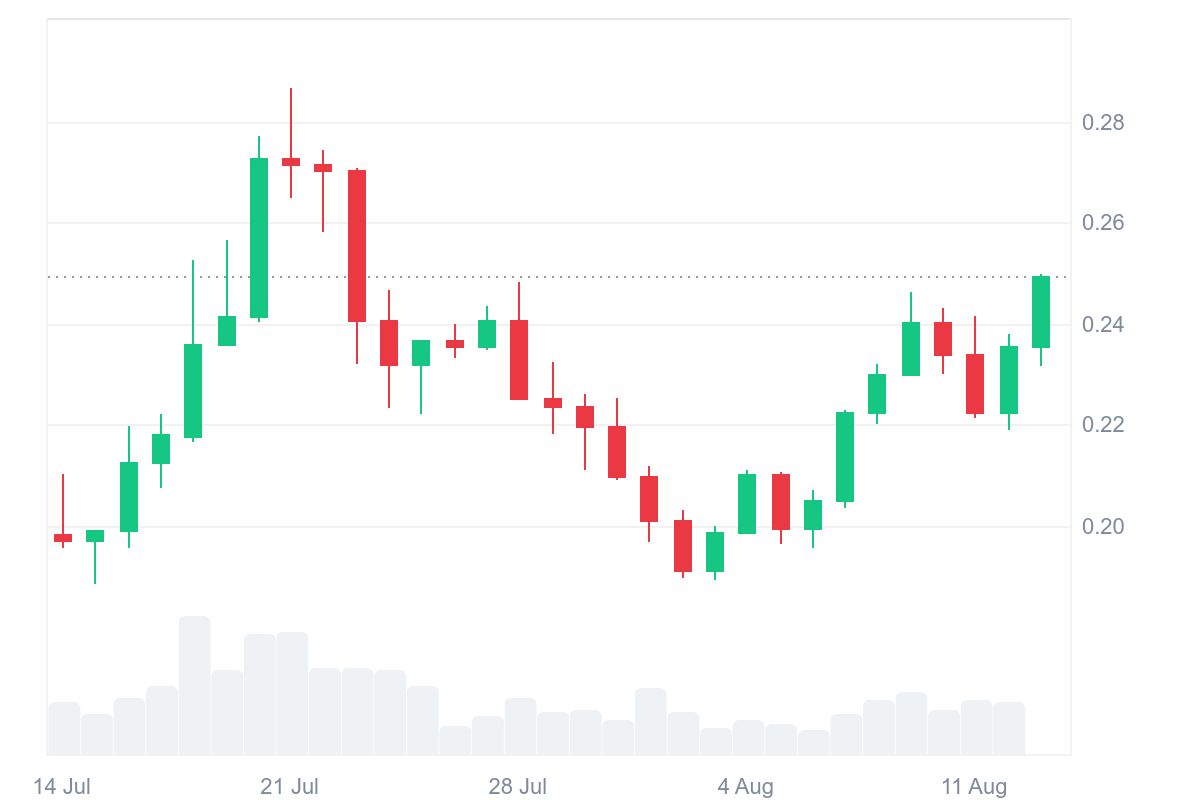
(DOGE) jumped another 5.3% today (Wednesday, 13 August, 2025), capping a
two-day 15% rally that's pushed the meme cryptocurrency to its highest levels
in roughly a month. The token traded at $0.2493 Wednesday morning, marking
a 32% rebound from early August lows.
The latest
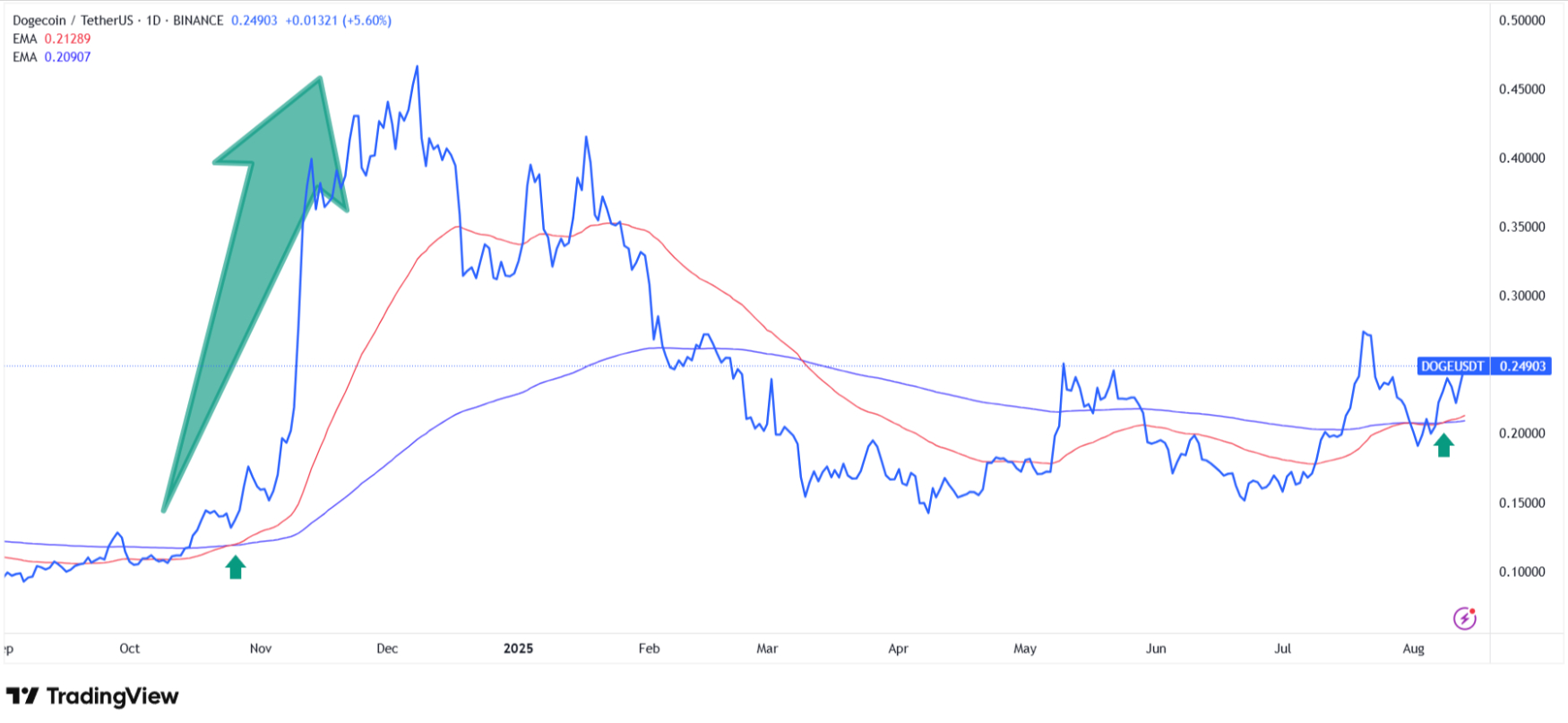
surge came as DOGE formed what traders call a golden cross – a
technical pattern that occurs when a security's 50-day moving average
climbs above its 200-day average. This crossover happened for the first time
since November 2024, when Dogecoin went on to gain more than 130% over
the following four weeks.
Why Dogecoin Price Is
Surging? Whale Money Flows In
Tuesday's
session saw typical meme coin drama. DOGE rallied from $0.221 to a
session high of $0.238 during afternoon trading before profit-taking knocked it
back to $0.233 by the close. The final hour brought a 1.3% decline as
some traders cashed in on the day's gains.
However, the
buying pressure helped DOGE break through the psychologically
important 25-cent level on Wednesday. Technical analysts note
this round number had been acting as resistance, but the golden cross formation
could provide the momentum needed for further gains.
Dogecoin price today. Source: CoinMarketCap
Dogecoin Technical
Analysis And Golden Cross
The golden
cross carries mixed reliability across different markets, but DOGE
has historically responded well to the signal. Beyond the November 2024
surge, the pattern preceded a 25% four-week rally in late 2023. Most
dramatically, a golden cross in November 2020 kicked off a four-month bull
run that saw Dogecoin rocket over 1,000%.
According
to my technical analysis, the DOGE chart currently points to the 25-cent
area as a critical test. If buyers can hold above this level, the
next target sits around 28 cents – near July's local highs where
the token previously stalled.
The broader
crypto market's mixed signals haven't dampened enthusiasm for DOGE
specifically. Trading volumes have remained elevated above the 24-hour
average of 387.7 million tokens, suggesting sustained interest from both retail
and institutional participants.
The 50 EMA is crossing above the 200 EMA, forming the well-known golden cross pattern
For now,
support appears solid at $0.232 and $0.220, levels that held during Tuesday's
session. Resistance waits at $0.238, where sellers emerged to cap the day's
rally.
Dogecoin to the Moon? DOGE
Price Prediction Hints at Near-$0.50 Potential
Although
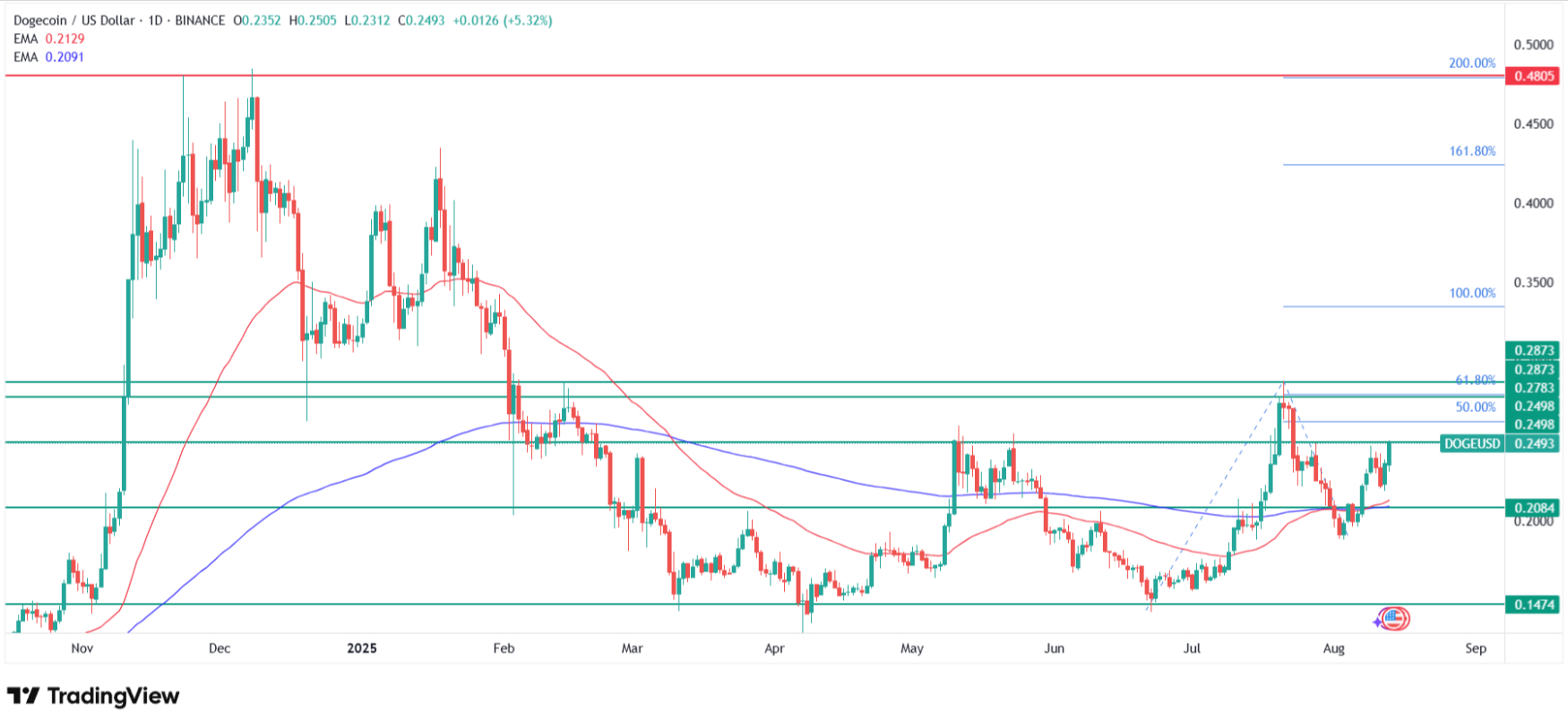
DOGE is currently capped by the 25-cent level, Fibonacci extensions indicate
several potential upside targets if the price breaks out from current
resistance and the July highs near 28 cents. A key zone is the 161.8 percent
extension at 42 cents, which aligns with this year’s peaks. The ultimate target
is 48 cents, nearly $0.50, corresponding to the highs from November and
December 2025.
Dogecoin price prediction after the bullish golden cross technical pattern. Source: Tradingview.com
Forecast tied to broader market
sentiment and meme-coin resurgence
Crypto
Patel (via CoinGape)
$2.00
Based on accumulation zones and
rising DOGE ETF optimism
Javon
Marks (crypto analyst)
$2.28
Forecast suggests potential 10×
rally based on cyclical patterns
Dogecoin News FAQ
Does Dogecoin Really Have
a Future?
Dogecoin’s
future depends on a mix of factors: market adoption, utility, community
support, and overall crypto market trends. While it started as a meme coin, it
has maintained a strong presence thanks to its active user base and frequent
mentions from high-profile figures like Elon Musk. If more businesses accept
DOGE as payment and blockchain upgrades improve its speed and cost efficiency,
it could remain a relevant cryptocurrency for years to come.
Will Dogecoin Reach $10?
A $10
Dogecoin would require an enormous market capitalization, making it a very
unlikely short-term target under current conditions. Such a price could only be
possible in an extremely bullish, global-scale crypto adoption scenario. Most
analysts see $10 as a distant possibility, not a realistic projection for the
next few years.
What Will Doge Be Worth in
2025?
Analyst
forecasts for Dogecoin in 2025 vary widely. Conservative predictions place it
between $0.30 and $0.50, driven by technical patterns and current adoption
rates. More aggressive forecasts, tied to market hype or major adoption
breakthroughs, see potential moves toward $1 or higher. The most likely range
in 2025, according to recent market sentiment, is around $0.40–$0.50.
Will Dogecoin Go up to $1?
Reaching $1
is a more realistic target than $10, and several analysts believe it could
happen in the next bull cycle if trading volumes and investor interest remain
strong. Breaking past key resistance levels (such as $0.25, $0.28, and $0.42) would
be crucial steps toward the $1 milestone. However, sustained growth would
require broader crypto market strength and ongoing investor confidence.
Dogecoin price
(DOGE) jumped another 5.3% today (Wednesday, 13 August, 2025), capping a
two-day 15% rally that's pushed the meme cryptocurrency to its highest levels
in roughly a month. The token traded at $0.2493 Wednesday morning, marking
a 32% rebound from early August lows.
The latest
surge came as DOGE formed what traders call a golden cross – a
technical pattern that occurs when a security's 50-day moving average
climbs above its 200-day average. This crossover happened for the first time
since November 2024, when Dogecoin went on to gain more than 130% over
the following four weeks.
Why Dogecoin Price Is
Surging? Whale Money Flows In
Tuesday's
session saw typical meme coin drama. DOGE rallied from $0.221 to a
session high of $0.238 during afternoon trading before profit-taking knocked it
back to $0.233 by the close. The final hour brought a 1.3% decline as
some traders cashed in on the day's gains.
However, the
buying pressure helped DOGE break through the psychologically
important 25-cent level on Wednesday. Technical analysts note
this round number had been acting as resistance, but the golden cross formation
could provide the momentum needed for further gains.
Dogecoin price today. Source: CoinMarketCap
Dogecoin Technical
Analysis And Golden Cross
The golden
cross carries mixed reliability across different markets, but DOGE
has historically responded well to the signal. Beyond the November 2024
surge, the pattern preceded a 25% four-week rally in late 2023. Most
dramatically, a golden cross in November 2020 kicked off a four-month bull
run that saw Dogecoin rocket over 1,000%.
According
to my technical analysis, the DOGE chart currently points to the 25-cent
area as a critical test. If buyers can hold above this level, the
next target sits around 28 cents – near July's local highs where
the token previously stalled.
The broader
crypto market's mixed signals haven't dampened enthusiasm for DOGE
specifically. Trading volumes have remained elevated above the 24-hour
average of 387.7 million tokens, suggesting sustained interest from both retail
and institutional participants.
The 50 EMA is crossing above the 200 EMA, forming the well-known golden cross pattern
For now,
support appears solid at $0.232 and $0.220, levels that held during Tuesday's
session. Resistance waits at $0.238, where sellers emerged to cap the day's
rally.
Dogecoin to the Moon? DOGE
Price Prediction Hints at Near-$0.50 Potential
Although
DOGE is currently capped by the 25-cent level, Fibonacci extensions indicate
several potential upside targets if the price breaks out from current
resistance and the July highs near 28 cents. A key zone is the 161.8 percent
extension at 42 cents, which aligns with this year’s peaks. The ultimate target
is 48 cents, nearly $0.50, corresponding to the highs from November and
December 2025.
Dogecoin price prediction after the bullish golden cross technical pattern. Source: Tradingview.com
Forecast tied to broader market
sentiment and meme-coin resurgence
Crypto
Patel (via CoinGape)
$2.00
Based on accumulation zones and
rising DOGE ETF optimism
Javon
Marks (crypto analyst)
$2.28
Forecast suggests potential 10×
rally based on cyclical patterns
Dogecoin News FAQ
Does Dogecoin Really Have
a Future?
Dogecoin’s
future depends on a mix of factors: market adoption, utility, community
support, and overall crypto market trends. While it started as a meme coin, it
has maintained a strong presence thanks to its active user base and frequent
mentions from high-profile figures like Elon Musk. If more businesses accept
DOGE as payment and blockchain upgrades improve its speed and cost efficiency,
it could remain a relevant cryptocurrency for years to come.
Will Dogecoin Reach $10?
A $10
Dogecoin would require an enormous market capitalization, making it a very
unlikely short-term target under current conditions. Such a price could only be
possible in an extremely bullish, global-scale crypto adoption scenario. Most
analysts see $10 as a distant possibility, not a realistic projection for the
next few years.
What Will Doge Be Worth in
2025?
Analyst
forecasts for Dogecoin in 2025 vary widely. Conservative predictions place it
between $0.30 and $0.50, driven by technical patterns and current adoption
rates. More aggressive forecasts, tied to market hype or major adoption
breakthroughs, see potential moves toward $1 or higher. The most likely range
in 2025, according to recent market sentiment, is around $0.40–$0.50.
Will Dogecoin Go up to $1?
Reaching $1
is a more realistic target than $10, and several analysts believe it could
happen in the next bull cycle if trading volumes and investor interest remain
strong. Breaking past key resistance levels (such as $0.25, $0.28, and $0.42) would
be crucial steps toward the $1 milestone. However, sustained growth would
require broader crypto market strength and ongoing investor confidence.
Damian Chmiel is a Senior Analyst & Editor at Finance Magnates with more than 15 years of experience in the CFD and online trading industry. Active as both a trader and journalist since 2010, he focuses on broker coverage, fintech innovation, and regulatory developments across Europe, the Middle East, and Asia.
His work includes interviews with C-level leaders at major brokerages and fintech platforms, as well as co-authoring Finance Magnates’ quarterly industry benchmarking reports. Damian’s reporting is data-driven, market-aware, and grounded in direct industry engagement. His analysis and commentary have also been cited by external media outlets, including Investing.com, Binance, The Asset, Stockhead, and Dispatch.
Education:
MA in Finance and Accounting, Cracow University of Economics
Inside the Prediction Markets: $1.6B Institutional Inflow Meets a Federal Crackdown
Featured Videos
FP Markets Winner Spotlight 🏆 | Global Broker of the Year 2025 #Trading #Broker #Innovation #Shorts
FP Markets Winner Spotlight 🏆 | Global Broker of the Year 2025 #Trading #Broker #Innovation #Shorts
FP Markets Winner Spotlight 🏆 | Global Broker of the Year 2025 #Trading #Broker #Innovation #Shorts
FP Markets Winner Spotlight 🏆 | Global Broker of the Year 2025 #Trading #Broker #Innovation #Shorts
FP Markets takes the spotlight as Global Broker of the Year 2025 at the Finance Magnates Awards.
Martin Stoilov, Head of Client Experience, shares that trust, innovation, and people played a key role in the company’s success, supported by a strong foundation of integrity and client-centricity.
Following this milestone, FP Markets continues to focus on growth, technology investment, and its core values of transparency and excellence.
👉 Be part of FM Awards 2026: https://awards.financemagnates.com/#nominate
FP Markets takes the spotlight as Global Broker of the Year 2025 at the Finance Magnates Awards.
Martin Stoilov, Head of Client Experience, shares that trust, innovation, and people played a key role in the company’s success, supported by a strong foundation of integrity and client-centricity.
Following this milestone, FP Markets continues to focus on growth, technology investment, and its core values of transparency and excellence.
👉 Be part of FM Awards 2026: https://awards.financemagnates.com/#nominate
FP Markets takes the spotlight as Global Broker of the Year 2025 at the Finance Magnates Awards.
Martin Stoilov, Head of Client Experience, shares that trust, innovation, and people played a key role in the company’s success, supported by a strong foundation of integrity and client-centricity.
Following this milestone, FP Markets continues to focus on growth, technology investment, and its core values of transparency and excellence.
👉 Be part of FM Awards 2026: https://awards.financemagnates.com/#nominate
FP Markets takes the spotlight as Global Broker of the Year 2025 at the Finance Magnates Awards.
Martin Stoilov, Head of Client Experience, shares that trust, innovation, and people played a key role in the company’s success, supported by a strong foundation of integrity and client-centricity.
Following this milestone, FP Markets continues to focus on growth, technology investment, and its core values of transparency and excellence.
👉 Be part of FM Awards 2026: https://awards.financemagnates.com/#nominate
In this video, we review @HolaPrimeMarketsOfficial, a multi-asset forex and CFDs broker offering different account types, trading platforms, and flexible trading conditions.
We cover the broker’s overall offering, including account options, trading environment, platforms like MT4 and MT5, and additional services such as managed accounts and fast withdrawals.
Watch the full video to see if Hola Prime Markets fits your trading needs.
📣 Stay up to date with the latest in finance and trading. Follow Finance Magnates for industry news, insights, and global event coverage.
Connect with us:
🔗 LinkedIn: /financemagnates
👍 Facebook: /financemagnates
📸 Instagram: https://www.instagram.com/financemagnates
🐦 X: https://x.com/financemagnates
🎥 TikTok: https://www.tiktok.com/tag/financemagnates
▶️ YouTube: /@financemagnates_official
#HolaPrime #ForexBroker #CFDTrading #FinanceMagnates #Trading #Forex #BrokerReview
In this video, we review @HolaPrimeMarketsOfficial, a multi-asset forex and CFDs broker offering different account types, trading platforms, and flexible trading conditions.
We cover the broker’s overall offering, including account options, trading environment, platforms like MT4 and MT5, and additional services such as managed accounts and fast withdrawals.
Watch the full video to see if Hola Prime Markets fits your trading needs.
📣 Stay up to date with the latest in finance and trading. Follow Finance Magnates for industry news, insights, and global event coverage.
Connect with us:
🔗 LinkedIn: /financemagnates
👍 Facebook: /financemagnates
📸 Instagram: https://www.instagram.com/financemagnates
🐦 X: https://x.com/financemagnates
🎥 TikTok: https://www.tiktok.com/tag/financemagnates
▶️ YouTube: /@financemagnates_official
#HolaPrime #ForexBroker #CFDTrading #FinanceMagnates #Trading #Forex #BrokerReview
In this video, we review @HolaPrimeMarketsOfficial, a multi-asset forex and CFDs broker offering different account types, trading platforms, and flexible trading conditions.
We cover the broker’s overall offering, including account options, trading environment, platforms like MT4 and MT5, and additional services such as managed accounts and fast withdrawals.
Watch the full video to see if Hola Prime Markets fits your trading needs.
📣 Stay up to date with the latest in finance and trading. Follow Finance Magnates for industry news, insights, and global event coverage.
Connect with us:
🔗 LinkedIn: /financemagnates
👍 Facebook: /financemagnates
📸 Instagram: https://www.instagram.com/financemagnates
🐦 X: https://x.com/financemagnates
🎥 TikTok: https://www.tiktok.com/tag/financemagnates
▶️ YouTube: /@financemagnates_official
#HolaPrime #ForexBroker #CFDTrading #FinanceMagnates #Trading #Forex #BrokerReview
In this video, we review @HolaPrimeMarketsOfficial, a multi-asset forex and CFDs broker offering different account types, trading platforms, and flexible trading conditions.
We cover the broker’s overall offering, including account options, trading environment, platforms like MT4 and MT5, and additional services such as managed accounts and fast withdrawals.
Watch the full video to see if Hola Prime Markets fits your trading needs.
📣 Stay up to date with the latest in finance and trading. Follow Finance Magnates for industry news, insights, and global event coverage.
Connect with us:
🔗 LinkedIn: /financemagnates
👍 Facebook: /financemagnates
📸 Instagram: https://www.instagram.com/financemagnates
🐦 X: https://x.com/financemagnates
🎥 TikTok: https://www.tiktok.com/tag/financemagnates
▶️ YouTube: /@financemagnates_official
#HolaPrime #ForexBroker #CFDTrading #FinanceMagnates #Trading #Forex #BrokerReview
In this video, we review @HolaPrimeMarketsOfficial, a multi-asset forex and CFDs broker offering different account types, trading platforms, and flexible trading conditions.
We cover the broker’s overall offering, including account options, trading environment, platforms like MT4 and MT5, and additional services such as managed accounts and fast withdrawals.
Watch the full video to see if Hola Prime Markets fits your trading needs.
📣 Stay up to date with the latest in finance and trading. Follow Finance Magnates for industry news, insights, and global event coverage.
Connect with us:
🔗 LinkedIn: /financemagnates
👍 Facebook: /financemagnates
📸 Instagram: https://www.instagram.com/financemagnates
🐦 X: https://x.com/financemagnates
🎥 TikTok: https://www.tiktok.com/tag/financemagnates
▶️ YouTube: /@financemagnates_official
#HolaPrime #ForexBroker #CFDTrading #FinanceMagnates #Trading #Forex #BrokerReview
In this video, we review @HolaPrimeMarketsOfficial, a multi-asset forex and CFDs broker offering different account types, trading platforms, and flexible trading conditions.
We cover the broker’s overall offering, including account options, trading environment, platforms like MT4 and MT5, and additional services such as managed accounts and fast withdrawals.
Watch the full video to see if Hola Prime Markets fits your trading needs.
📣 Stay up to date with the latest in finance and trading. Follow Finance Magnates for industry news, insights, and global event coverage.
Connect with us:
🔗 LinkedIn: /financemagnates
👍 Facebook: /financemagnates
📸 Instagram: https://www.instagram.com/financemagnates
🐦 X: https://x.com/financemagnates
🎥 TikTok: https://www.tiktok.com/tag/financemagnates
▶️ YouTube: /@financemagnates_official
#HolaPrime #ForexBroker #CFDTrading #FinanceMagnates #Trading #Forex #BrokerReview
Hola Prime Review: What You Need to Know | Full Breakdown by Finance Magnates
Hola Prime Review: What You Need to Know | Full Breakdown by Finance Magnates
Hola Prime Review: What You Need to Know | Full Breakdown by Finance Magnates
Hola Prime Review: What You Need to Know | Full Breakdown by Finance Magnates
Hola Prime Review: What You Need to Know | Full Breakdown by Finance Magnates
Hola Prime Review: What You Need to Know | Full Breakdown by Finance Magnates
In this video, we review @HolaPrime_Global, a proprietary trading firm offering evaluation programs and performance-based payouts in simulated market environments.
We cover how the challenge model works, including account types, profit splits (up to 95%), trading rules, and what it takes to reach a funded account. You’ll also learn about available platforms like MT4, MT5, cTrader, and more, along with insights into payouts, support, and trading conditions.
Watch the full video to see if Hola Prime fits your trading style.
📣 Stay up to date with the latest in finance and trading. Follow Finance Magnates for industry news, insights, and global event coverage.
Connect with us:
🔗 LinkedIn: /financemagnates
👍 Facebook: /financemagnates
📸 Instagram: https://www.instagram.com/financemagnates
🐦 X: https://x.com/financemagnates
🎥 TikTok: https://www.tiktok.com/tag/financemagnates
▶️ YouTube: /@financemagnates_official
#HolaPrime #PropFirm #Trading #FinanceMagnates #Forex #FuturesTrading #TradingReview #PropFirmReview
In this video, we review @HolaPrime_Global, a proprietary trading firm offering evaluation programs and performance-based payouts in simulated market environments.
We cover how the challenge model works, including account types, profit splits (up to 95%), trading rules, and what it takes to reach a funded account. You’ll also learn about available platforms like MT4, MT5, cTrader, and more, along with insights into payouts, support, and trading conditions.
Watch the full video to see if Hola Prime fits your trading style.
📣 Stay up to date with the latest in finance and trading. Follow Finance Magnates for industry news, insights, and global event coverage.
Connect with us:
🔗 LinkedIn: /financemagnates
👍 Facebook: /financemagnates
📸 Instagram: https://www.instagram.com/financemagnates
🐦 X: https://x.com/financemagnates
🎥 TikTok: https://www.tiktok.com/tag/financemagnates
▶️ YouTube: /@financemagnates_official
#HolaPrime #PropFirm #Trading #FinanceMagnates #Forex #FuturesTrading #TradingReview #PropFirmReview
In this video, we review @HolaPrime_Global, a proprietary trading firm offering evaluation programs and performance-based payouts in simulated market environments.
We cover how the challenge model works, including account types, profit splits (up to 95%), trading rules, and what it takes to reach a funded account. You’ll also learn about available platforms like MT4, MT5, cTrader, and more, along with insights into payouts, support, and trading conditions.
Watch the full video to see if Hola Prime fits your trading style.
📣 Stay up to date with the latest in finance and trading. Follow Finance Magnates for industry news, insights, and global event coverage.
Connect with us:
🔗 LinkedIn: /financemagnates
👍 Facebook: /financemagnates
📸 Instagram: https://www.instagram.com/financemagnates
🐦 X: https://x.com/financemagnates
🎥 TikTok: https://www.tiktok.com/tag/financemagnates
▶️ YouTube: /@financemagnates_official
#HolaPrime #PropFirm #Trading #FinanceMagnates #Forex #FuturesTrading #TradingReview #PropFirmReview
In this video, we review @HolaPrime_Global, a proprietary trading firm offering evaluation programs and performance-based payouts in simulated market environments.
We cover how the challenge model works, including account types, profit splits (up to 95%), trading rules, and what it takes to reach a funded account. You’ll also learn about available platforms like MT4, MT5, cTrader, and more, along with insights into payouts, support, and trading conditions.
Watch the full video to see if Hola Prime fits your trading style.
📣 Stay up to date with the latest in finance and trading. Follow Finance Magnates for industry news, insights, and global event coverage.
Connect with us:
🔗 LinkedIn: /financemagnates
👍 Facebook: /financemagnates
📸 Instagram: https://www.instagram.com/financemagnates
🐦 X: https://x.com/financemagnates
🎥 TikTok: https://www.tiktok.com/tag/financemagnates
▶️ YouTube: /@financemagnates_official
#HolaPrime #PropFirm #Trading #FinanceMagnates #Forex #FuturesTrading #TradingReview #PropFirmReview
In this video, we review @HolaPrime_Global, a proprietary trading firm offering evaluation programs and performance-based payouts in simulated market environments.
We cover how the challenge model works, including account types, profit splits (up to 95%), trading rules, and what it takes to reach a funded account. You’ll also learn about available platforms like MT4, MT5, cTrader, and more, along with insights into payouts, support, and trading conditions.
Watch the full video to see if Hola Prime fits your trading style.
📣 Stay up to date with the latest in finance and trading. Follow Finance Magnates for industry news, insights, and global event coverage.
Connect with us:
🔗 LinkedIn: /financemagnates
👍 Facebook: /financemagnates
📸 Instagram: https://www.instagram.com/financemagnates
🐦 X: https://x.com/financemagnates
🎥 TikTok: https://www.tiktok.com/tag/financemagnates
▶️ YouTube: /@financemagnates_official
#HolaPrime #PropFirm #Trading #FinanceMagnates #Forex #FuturesTrading #TradingReview #PropFirmReview
In this video, we review @HolaPrime_Global, a proprietary trading firm offering evaluation programs and performance-based payouts in simulated market environments.
We cover how the challenge model works, including account types, profit splits (up to 95%), trading rules, and what it takes to reach a funded account. You’ll also learn about available platforms like MT4, MT5, cTrader, and more, along with insights into payouts, support, and trading conditions.
Watch the full video to see if Hola Prime fits your trading style.
📣 Stay up to date with the latest in finance and trading. Follow Finance Magnates for industry news, insights, and global event coverage.
Connect with us:
🔗 LinkedIn: /financemagnates
👍 Facebook: /financemagnates
📸 Instagram: https://www.instagram.com/financemagnates
🐦 X: https://x.com/financemagnates
🎥 TikTok: https://www.tiktok.com/tag/financemagnates
▶️ YouTube: /@financemagnates_official
#HolaPrime #PropFirm #Trading #FinanceMagnates #Forex #FuturesTrading #TradingReview #PropFirmReview
Axi Winner Spotlight 🏆 | Global Most Innovative Broker 2025 #Innovation #Trading #Fintech #Broker
Axi Winner Spotlight 🏆 | Global Most Innovative Broker 2025 #Innovation #Trading #Fintech #Broker
Axi Winner Spotlight 🏆 | Global Most Innovative Broker 2025 #Innovation #Trading #Fintech #Broker
Axi Winner Spotlight 🏆 | Global Most Innovative Broker 2025 #Innovation #Trading #Fintech #Broker
Axi Winner Spotlight 🏆 | Global Most Innovative Broker 2025 #Innovation #Trading #Fintech #Broker
Axi Winner Spotlight 🏆 | Global Most Innovative Broker 2025 #Innovation #Trading #Fintech #Broker
Axi takes the spotlight at the Finance Magnates Awards, winning Global Most Innovative Broker 2025.
Olivia Xenofontos and Ivanna Openko share how the team will feel: proud, motivated, and ready to keep delivering.
They also describe the night as well-organized, focused, and enjoyable for all.
👉 Be part of FM Awards 2026.
Axi takes the spotlight at the Finance Magnates Awards, winning Global Most Innovative Broker 2025.
Olivia Xenofontos and Ivanna Openko share how the team will feel: proud, motivated, and ready to keep delivering.
They also describe the night as well-organized, focused, and enjoyable for all.
👉 Be part of FM Awards 2026.
Axi takes the spotlight at the Finance Magnates Awards, winning Global Most Innovative Broker 2025.
Olivia Xenofontos and Ivanna Openko share how the team will feel: proud, motivated, and ready to keep delivering.
They also describe the night as well-organized, focused, and enjoyable for all.
👉 Be part of FM Awards 2026.
Axi takes the spotlight at the Finance Magnates Awards, winning Global Most Innovative Broker 2025.
Olivia Xenofontos and Ivanna Openko share how the team will feel: proud, motivated, and ready to keep delivering.
They also describe the night as well-organized, focused, and enjoyable for all.
👉 Be part of FM Awards 2026.
Axi takes the spotlight at the Finance Magnates Awards, winning Global Most Innovative Broker 2025.
Olivia Xenofontos and Ivanna Openko share how the team will feel: proud, motivated, and ready to keep delivering.
They also describe the night as well-organized, focused, and enjoyable for all.
👉 Be part of FM Awards 2026.
Axi takes the spotlight at the Finance Magnates Awards, winning Global Most Innovative Broker 2025.
Olivia Xenofontos and Ivanna Openko share how the team will feel: proud, motivated, and ready to keep delivering.
They also describe the night as well-organized, focused, and enjoyable for all.
👉 Be part of FM Awards 2026.
Recognition that matters.
Built on transparency.
Driven by the industry.
The Finance Magnates Awards 2026.
Nominations are now open.
🔗 https://awards.financemagnates.com/?utm_source=SM&utm_medium=social&utm_campaign=recognition-matters
Recognition that matters.
Built on transparency.
Driven by the industry.
The Finance Magnates Awards 2026.
Nominations are now open.
🔗 https://awards.financemagnates.com/?utm_source=SM&utm_medium=social&utm_campaign=recognition-matters
Recognition that matters.
Built on transparency.
Driven by the industry.
The Finance Magnates Awards 2026.
Nominations are now open.
🔗 https://awards.financemagnates.com/?utm_source=SM&utm_medium=social&utm_campaign=recognition-matters
Recognition that matters.
Built on transparency.
Driven by the industry.
The Finance Magnates Awards 2026.
Nominations are now open.
🔗 https://awards.financemagnates.com/?utm_source=SM&utm_medium=social&utm_campaign=recognition-matters
Recognition that matters.
Built on transparency.
Driven by the industry.
The Finance Magnates Awards 2026.
Nominations are now open.
🔗 https://awards.financemagnates.com/?utm_source=SM&utm_medium=social&utm_campaign=recognition-matters
Recognition that matters.
Built on transparency.
Driven by the industry.
The Finance Magnates Awards 2026.
Nominations are now open.
🔗 https://awards.financemagnates.com/?utm_source=SM&utm_medium=social&utm_campaign=recognition-matters