Bitcoin
price prediction remains one of the most searched topics in the cryptocurrency
market as BTC price trades near elevated levels despite recent
volatility. Bitcoin’s price has pulled back from its latest all-time-high price
above $120,000, but the broader market cycle still looks bullish thanks to
institutional adoption, ETF inflows and improving macro sentiment.
Market
participants are watching technical analysis signals, on-chain metrics and
expert forecasts from figures such as Tom Lee and Cathie Wood to predict Bitcoin’s
value in 2025, 2026, 2030 and beyond.
In this
in-depth article, I examine how much Bitcoin may cost in the coming years and
review the latest price forecasts for BTC.
Current State of Bitcoin
and BTC Price Movements
Bitcoin’s
recent price shows that Bitcoin’s price movements have shifted
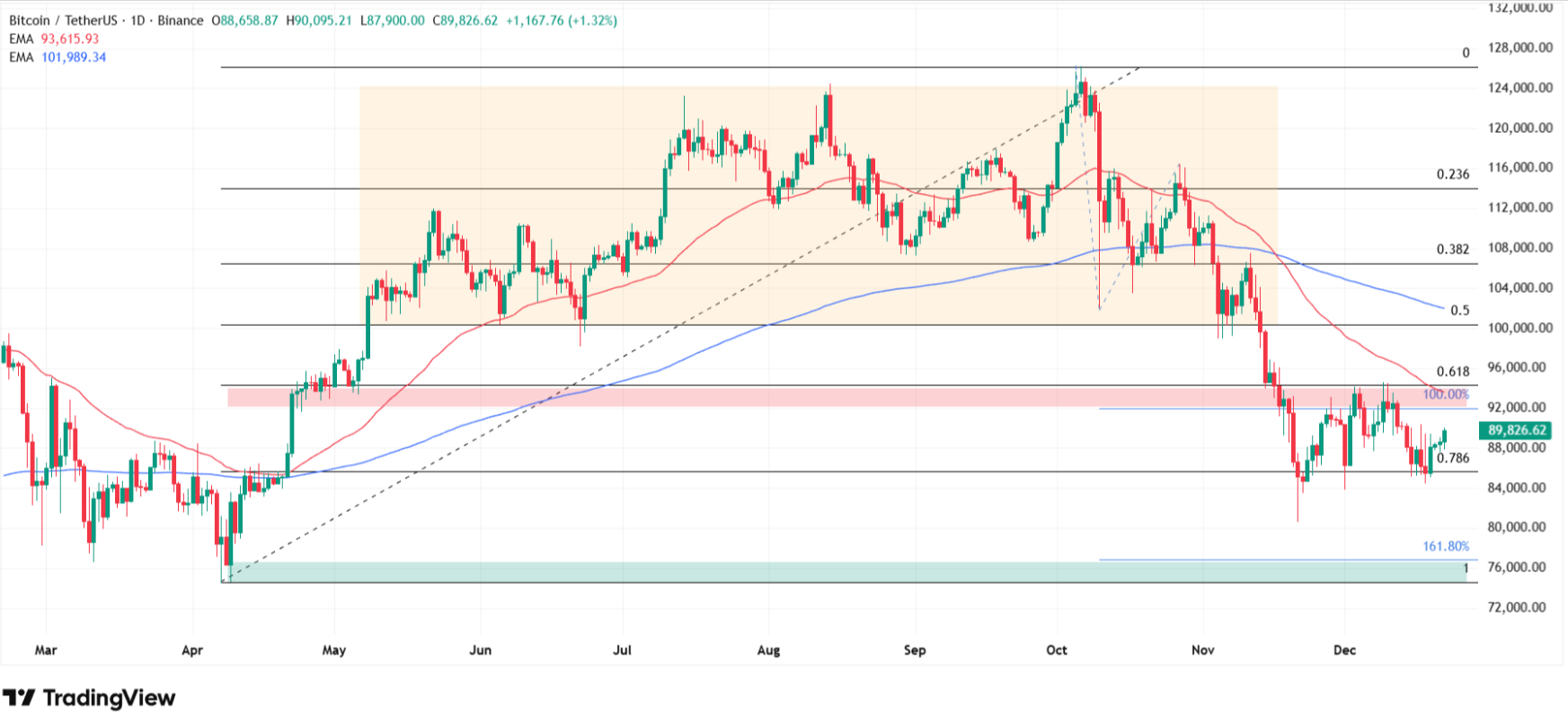
from a sharp November drawdown into a quieter repair phase. After dropping
roughly 29% from its 2025 high near $126,000 the spot price has been
consolidating around the high‑$80,000 area on major venues, with daily ranges
typically between roughly $88,000 and $90,000 . This consolidation comes after
a 17% decline in November, which fit the historical pattern of sharp pullbacks
even within structurally bullish phases of the cryptocurrency market.
From a
market microstructure perspective, trading volumes have cooled from the
extremes seen around the all‑time‑high price but remain robust relative to
prior cycles. The current state of Bitcoin is one where long‑term holders
continue to dominate supply, while short‑term speculators have largely flushed
out during the correction, leaving a more resilient holder base. That
configuration typically sets the stage for future price movements skewed to the
upside, provided macro conditions do not deteriorate dramatically.
Technical
analysis tools like the moving average, relative strength index and
moving average convergence divergence remain central to any Bitcoin price
prediction framework. On the daily chart, BTC trades below its 50‑day moving
average and long‑term trend levels such as the 200‑day.
Momentum
indicators are more balanced than they were at the peak. The relative strength
index has cooled from overbought territory and now hovers around neutral
levels, showing that neither extreme bullish nor extreme bearish pressure
dominates the current Bitcoin market. At the same time, MACD on multi‑day
timeframes is close to a potential bullish crossover, which, if confirmed,
would support a scenario in which Bitcoin continues its gradual recovery rather
than sliding into a full bear market.
One of the
core questions traders ask is why Bitcoin’s recent price is
trending higher again after the November washout. The simplest answer combines
macro, structural and sentiment drivers that align to push the price of Bitcoin
upward in the last 24 hours and over recent sessions.
On the
macro side, rising expectations of future Federal Reserve rate cuts have
revived risk appetite across global markets, lifting equities, gold and crypto
in tandem. Historically, easier monetary policy enhances the appeal of scarce,
non‑yielding assets, and Bitcoin as a store of value has increasingly been
traded alongside growth and tech plays in this environment. That improved
backdrop helps explain why Bitcoin continues to bounce on dips and why btc
could retest key resistance levels sooner than many bears expect.
Structural Demand: ETFs
and Institutional Adoption
Corporate
and institutional adoption is equally important. Public companies holding Bitcoin
on their balance sheets have surged to around 172, up roughly 38% in just one
quarter, while corporate treasuries and funds are acquiring approximately 1,755
BTC per day against a mining supply of about 900 BTC per day. In other words,
institutional adoption is absorbing more than the entire new supply of Bitcoin,
and that imbalance is a key reason Bitcoin’s price movements remain biased
upward even during phases of elevated volatility.
Sentiment and On‑Chain Behavior
Market
sentiment has shifted from capitulation to cautious optimism. After a string of
red candles in November, the market is now seeing more green days, even if
price action remains rangebound in the short term. On‑chain data shows large
holders (“whales”) have reduced aggressive selling, while long‑term wallets are
distributing at a measured pace rather than dumping into weakness, which
supports a more sustainable price action profile. This pattern aligns with
previous cycles where Bitcoin saw a “quiet” accumulation phase before the next
leg in the market cycle.
Key Support and Resistance
Levels for BTC
To predict Bitcoin
and understand where the price could move next, traders focus on important
support and resistance levels derived from both horizontal price history and
fib retracements.
Table: Important Support
and Resistance Levels
Level Type
Approximate Zone
Rationale
Immediate support
High $80,000s
Recent
rebound zone after November selloff and December retests
Deeper support
Low $80,000s
Critical
December floor where buyers aggressively stepped in
Initial resistance
Round $90,000 area
Psychological
barrier and recent intraday rejection zone
Mid‑range resistance
Low–mid $90,000s
Region
near key short‑term moving average and prior consolidation
Major resistance
Above $100,000
Area
where sellers previously defended ahead of the all‑time‑high price
If BTC can
break and hold above the 90,000–95,000 band, the technical picture improves
significantly, opening up a path for Bitcoin to reach the six‑figure area again
in this market cycle. Conversely, a loss of the low‑80,000 support could invite a deeper retrace toward
earlier breakout levels, which would force a reassessment of short‑term bullish
price forecasts.
Bitcoin Price Prediction
2025: Base, Bullish and Bearish Views
Price
prediction is always probabilistic, but by 2025 the interplay of ETF flows and
institutional adoption creates a framework within which Bitcoin’s price could
trade.
Base Case Price Prediction
2025
In a base
case, Bitcoin price prediction 2025 envisions BTC trading well above the
average btc price of previous cycles, supported by:
Strong but not euphoric
institutional adoption through ETFs and direct holdings.
Gradual normalization of
monetary policy that still leaves real yields relatively low.
Continued narrative of Bitcoin
as a store of value and digital collateral in the broader cryptocurrency
market.
Under this
scenario, the average price of Bitcoin through 2025 could remain in a high five‑
or low six‑figure band, with significant price swings driven by recurring bouts
of volatility rather than a completed supercycle. Forecasts for 2025 in this
camp usually see Bitcoin’s price history printing new highs but not necessarily
reaching the most extreme long‑term targets.
Bullish Price Forecasts
and Tom Lee’s View
Bullish
predictions are anchored by high‑profile calls from analysts like Tom
Lee. Lee has argued that, based on his market cycle logic and rising
adoption curve, Bitcoin could reach the mid‑six‑figure range in 2025, with
individual forecasts projecting levels around $250,000 per coin in a strong
risk‑on environment. In this bullish price scenario:
ETF inflows remain persistent
as more institutions allocate small portfolio slices to BTC.
Retail participation returns
during new all‑time‑high price breakouts, fueling momentum.
The supply of Bitcoin available
on exchanges shrinks as long‑term investors move coins to cold storage.
This is the
version of the future where bullish price forecasts, media coverage and
reflexive optimism feed on each other, and where Bitcoin’s value climbs far
faster than underlying user and transaction growth alone would justify.
Bearish Price Prediction
2025
A sober Bitcoin
price prediction 2025 also needs a bearish path. In this
variant:
Regulatory shocks, macro stress
or ETF outflows could trigger a full‑blown bear market.
The price of BTC may revisit
prior cycle highs or even dip below them, echoing the 2018–2022 pattern.
Crypto‑specific risks—such as
large exchange failures or security breaches—might undermine investor
confidence temporarily.
Even then,
many long‑term models still place the average price well above pre‑2020 levels,
simply because the base of institutional holders and infrastructure is now much
deeper than in earlier cycles. For investors trying to predict Bitcoin, this
“bear within a secular bull” view is critical: the long‑term Bitcoin prediction
can remain intact even with severe short‑term drawdowns.
BTC could consolidate any gains
achieved in 2025, with the average BTC price for 2026 potentially higher
but less explosive.
The Bitcoin market becomes more
driven by fundamentals—on‑chain settlement, derivative markets and credit
overlays—than purely by speculative flows.
Technical analysis hits a more
mature phase where classic indicators like moving averages and resistance
levels interact with ETF flows and institutional order books.
2030, Cathie Wood and the
Store‑of‑Value Thesis
Looking out
to 2030, Cathie Wood and ARK Invest frame Bitcoin as a
cornerstone of the digital assets stack. Their models envision scenarios where Bitcoin’s
price reflects its role as:
A primary hedge in portfolios
alongside or even instead of gold.
A settlement layer for high‑value
transactions in the Bitcoin blockchain economy.
Collateral in emerging on‑chain
credit markets and institutional DeFi rails.
In ARK’s
more optimistic cases, Bitcoin could reach seven‑figure territory by 2030,
while more conservative paths still see substantial appreciation from current
levels. From a structural perspective, those forecasts assume that Bitcoin will
reach deeper penetration in institutional portfolios and perhaps even in
sovereign reserves.
Bitcoin Price Prediction
Table: Expert Forecasts
Expert/Institution
2025 Target
2026 Target
2030 Target
2040-2050 Target
Tom Lee (Fundstrat)
$250,000
Not specified
$2-3 million
Not specified
Cathie Wood (ARK Invest)
$200,000-$250,000
Not specified
$1M
(base), $2.4M (bull), $500K (bear)
Not specified
ActivBTC Report
$220,000 (12-month)
$250,000
$500,000
Not specified
Standard Chartered
$200,000
Not specified
Not specified
Not specified
VanEck (Matthew Sigel)
Not specified
Not specified
Not specified
$3 million by 2050
Michael Saylor
Not specified
Not specified
Not specified
$21 million by 2046
MEXC Technical Analysis
$108,000 by December
Not specified
Not specified
Not specified
Binance Consensus
$85,000-$135,000 range
Not specified
Not specified
Not specified
Should You Buy Bitcoin
Now?
From an
investor’s perspective, the decision to buy Bitcoin today hinges on time
horizon, risk tolerance and belief in the long‑term thesis. On one hand, BTC is
still below its 2025 all‑time‑high price, offering a potential discount for
those who see current levels as just another stop in a much larger uptrend.
Historical
analogs suggest that buying during consolidation phases - when market sentiment
is mixed but fundamentals are strong -has generally produced better long‑term
outcomes than chasing parabolic moves at the top of the cycle.
On the
other hand, the same volatility that creates opportunity also creates risk.
Even in a structurally bullish environment, Bitcoin would not be Bitcoin
without the possibility of sharp drawdowns and unexpected macro or regulatory
shocks. Any realistic Bitcoin price prediction for 2025, 2030 or beyond must
therefore incorporate both the upside of adoption and the downside of
uncertainty.
For
investors, that means sizing positions carefully, respecting important support
and resistance levels on the daily chart, and understanding that even though Bitcoin
continues to mature, the crypto market remains one of the most volatile arenas
in global finance.
The platform also integrates tokenized U.S. stocks and ETFs,
giving global investors on-chain access with minimal capital. Bitget TradFi
unifies crypto, spot, futures, and CFDs on one system, targeting growing retail
and CFD markets.
FAQ: Bitcoin Price
Prediction and Digital Currencies
What is the Bitcoin price
forecast through 2030?
The Bitcoin
price forecast varies widely by analyst, but most bullish scenarios see BTC
reaching between $200,000 and $500,000 by 2030. Tom Lee projects Bitcoin could
hit 2-3 million in the longer term, while Cathie Wood of ARK Invest maintains
her 1 million 2030 target with bear case
at $500,000. The adoption of Bitcoin by institutions, impact of Bitcoin
halvings and Bitcoin's role among digital currencies as a store of value drive
these long-term projections.
Should I buy
and sell Bitcoin now or hold long-term?
Whether you
buy and sell Bitcoin tactically or hold depends on your time horizon and risk
tolerance. Recent Bitcoin price action shows consolidation around 89,850 ,
roughly 29% below the 2025 high, which historically has been a decent
accumulation zone. Bitcoin may experience more volatility during trading hours
as macro events unfold, but btc is expected to trend higher over multi-year
periods given structural demand from ETFs and corporate treasuries.
Will we see Bitcoin
reach new all-time highs soon?
Many
analysts believe we will see Bitcoin establish a new all-time high before 2025
ends. Technical analysis suggests Bitcoin has entered a consolidation phase
rather than a full bear market, with Tom Lee's models indicating BTC could
reach 250,000 by year-end under favorable conditions. Cathie Wood of ARK Invest
foresees Bitcoin continuing its upward trajectory driven by scarcity, network
effects and expanding institutional adoption across the cryptocurrency market.
What about Ethereum and
altcoin predictions?
Ethereum is
currently trading at $3,045 and analysts project ETH could reach 10,000-12,000 by
end of 2025 as Layer 2 adoption accelerates. Tom Lee sees Ethereum following Bitcoin's
growth trajectory with significant upside potential, while the broader digital
currencies market benefits from improving infrastructure and regulatory
clarity. The relative performance between Bitcoin and Ethereum often signals
risk appetite across the crypto market.
What are
realistic Bitcoin price predictions for 2040 and 2050?
Ultra-long-term
forecasts for 2040 and 2050 range from conservative estimates around 500,000 to
aggressive targets exceeding 3 million per coin. VanEck projects Bitcoin could reach
3 million by 2050, while Michael Saylor's models extend to 21 million by the
mid-2040s under maximum adoption scenarios. These 2040 and 2050 projections
assume Bitcoin maintains its first-mover advantage among digital currencies and
captures substantial market share from traditional store-of-value assets like
gold.
How do Bitcoin
halvings affect price predictions?
Bitcoin
halvings reduce the mining reward by 50% every four years, creating supply
shocks that historically precede major bull markets. The April 2024 halving cut
issuance to roughly 900 BTC daily while corporate demand exceeds 1,755 BTC
daily, creating structural scarcity. This supply-demand imbalance is why
analysts expect btc is expected to appreciate substantially over the 12-24
months following halving events, supporting bullish Bitcoin price forecast
models through 2025-2026.
Bitcoin
price prediction remains one of the most searched topics in the cryptocurrency
market as BTC price trades near elevated levels despite recent
volatility. Bitcoin’s price has pulled back from its latest all-time-high price
above $120,000, but the broader market cycle still looks bullish thanks to
institutional adoption, ETF inflows and improving macro sentiment.
Market
participants are watching technical analysis signals, on-chain metrics and
expert forecasts from figures such as Tom Lee and Cathie Wood to predict Bitcoin’s
value in 2025, 2026, 2030 and beyond.
In this
in-depth article, I examine how much Bitcoin may cost in the coming years and
review the latest price forecasts for BTC.
Current State of Bitcoin
and BTC Price Movements
Bitcoin’s
recent price shows that Bitcoin’s price movements have shifted
from a sharp November drawdown into a quieter repair phase. After dropping
roughly 29% from its 2025 high near $126,000 the spot price has been
consolidating around the high‑$80,000 area on major venues, with daily ranges
typically between roughly $88,000 and $90,000 . This consolidation comes after
a 17% decline in November, which fit the historical pattern of sharp pullbacks
even within structurally bullish phases of the cryptocurrency market.
From a
market microstructure perspective, trading volumes have cooled from the
extremes seen around the all‑time‑high price but remain robust relative to
prior cycles. The current state of Bitcoin is one where long‑term holders
continue to dominate supply, while short‑term speculators have largely flushed
out during the correction, leaving a more resilient holder base. That
configuration typically sets the stage for future price movements skewed to the
upside, provided macro conditions do not deteriorate dramatically.
Technical
analysis tools like the moving average, relative strength index and
moving average convergence divergence remain central to any Bitcoin price
prediction framework. On the daily chart, BTC trades below its 50‑day moving
average and long‑term trend levels such as the 200‑day.
Momentum
indicators are more balanced than they were at the peak. The relative strength
index has cooled from overbought territory and now hovers around neutral
levels, showing that neither extreme bullish nor extreme bearish pressure
dominates the current Bitcoin market. At the same time, MACD on multi‑day
timeframes is close to a potential bullish crossover, which, if confirmed,
would support a scenario in which Bitcoin continues its gradual recovery rather
than sliding into a full bear market.
One of the
core questions traders ask is why Bitcoin’s recent price is
trending higher again after the November washout. The simplest answer combines
macro, structural and sentiment drivers that align to push the price of Bitcoin
upward in the last 24 hours and over recent sessions.
On the
macro side, rising expectations of future Federal Reserve rate cuts have
revived risk appetite across global markets, lifting equities, gold and crypto
in tandem. Historically, easier monetary policy enhances the appeal of scarce,
non‑yielding assets, and Bitcoin as a store of value has increasingly been
traded alongside growth and tech plays in this environment. That improved
backdrop helps explain why Bitcoin continues to bounce on dips and why btc
could retest key resistance levels sooner than many bears expect.
Structural Demand: ETFs
and Institutional Adoption
Corporate
and institutional adoption is equally important. Public companies holding Bitcoin
on their balance sheets have surged to around 172, up roughly 38% in just one
quarter, while corporate treasuries and funds are acquiring approximately 1,755
BTC per day against a mining supply of about 900 BTC per day. In other words,
institutional adoption is absorbing more than the entire new supply of Bitcoin,
and that imbalance is a key reason Bitcoin’s price movements remain biased
upward even during phases of elevated volatility.
Sentiment and On‑Chain Behavior
Market
sentiment has shifted from capitulation to cautious optimism. After a string of
red candles in November, the market is now seeing more green days, even if
price action remains rangebound in the short term. On‑chain data shows large
holders (“whales”) have reduced aggressive selling, while long‑term wallets are
distributing at a measured pace rather than dumping into weakness, which
supports a more sustainable price action profile. This pattern aligns with
previous cycles where Bitcoin saw a “quiet” accumulation phase before the next
leg in the market cycle.
Key Support and Resistance
Levels for BTC
To predict Bitcoin
and understand where the price could move next, traders focus on important
support and resistance levels derived from both horizontal price history and
fib retracements.
Table: Important Support
and Resistance Levels
Level Type
Approximate Zone
Rationale
Immediate support
High $80,000s
Recent
rebound zone after November selloff and December retests
Deeper support
Low $80,000s
Critical
December floor where buyers aggressively stepped in
Initial resistance
Round $90,000 area
Psychological
barrier and recent intraday rejection zone
Mid‑range resistance
Low–mid $90,000s
Region
near key short‑term moving average and prior consolidation
Major resistance
Above $100,000
Area
where sellers previously defended ahead of the all‑time‑high price
If BTC can
break and hold above the 90,000–95,000 band, the technical picture improves
significantly, opening up a path for Bitcoin to reach the six‑figure area again
in this market cycle. Conversely, a loss of the low‑80,000 support could invite a deeper retrace toward
earlier breakout levels, which would force a reassessment of short‑term bullish
price forecasts.
Bitcoin Price Prediction
2025: Base, Bullish and Bearish Views
Price
prediction is always probabilistic, but by 2025 the interplay of ETF flows and
institutional adoption creates a framework within which Bitcoin’s price could
trade.
Base Case Price Prediction
2025
In a base
case, Bitcoin price prediction 2025 envisions BTC trading well above the
average btc price of previous cycles, supported by:
Strong but not euphoric
institutional adoption through ETFs and direct holdings.
Gradual normalization of
monetary policy that still leaves real yields relatively low.
Continued narrative of Bitcoin
as a store of value and digital collateral in the broader cryptocurrency
market.
Under this
scenario, the average price of Bitcoin through 2025 could remain in a high five‑
or low six‑figure band, with significant price swings driven by recurring bouts
of volatility rather than a completed supercycle. Forecasts for 2025 in this
camp usually see Bitcoin’s price history printing new highs but not necessarily
reaching the most extreme long‑term targets.
Bullish Price Forecasts
and Tom Lee’s View
Bullish
predictions are anchored by high‑profile calls from analysts like Tom
Lee. Lee has argued that, based on his market cycle logic and rising
adoption curve, Bitcoin could reach the mid‑six‑figure range in 2025, with
individual forecasts projecting levels around $250,000 per coin in a strong
risk‑on environment. In this bullish price scenario:
ETF inflows remain persistent
as more institutions allocate small portfolio slices to BTC.
Retail participation returns
during new all‑time‑high price breakouts, fueling momentum.
The supply of Bitcoin available
on exchanges shrinks as long‑term investors move coins to cold storage.
This is the
version of the future where bullish price forecasts, media coverage and
reflexive optimism feed on each other, and where Bitcoin’s value climbs far
faster than underlying user and transaction growth alone would justify.
Bearish Price Prediction
2025
A sober Bitcoin
price prediction 2025 also needs a bearish path. In this
variant:
Regulatory shocks, macro stress
or ETF outflows could trigger a full‑blown bear market.
The price of BTC may revisit
prior cycle highs or even dip below them, echoing the 2018–2022 pattern.
Crypto‑specific risks—such as
large exchange failures or security breaches—might undermine investor
confidence temporarily.
Even then,
many long‑term models still place the average price well above pre‑2020 levels,
simply because the base of institutional holders and infrastructure is now much
deeper than in earlier cycles. For investors trying to predict Bitcoin, this
“bear within a secular bull” view is critical: the long‑term Bitcoin prediction
can remain intact even with severe short‑term drawdowns.
BTC could consolidate any gains
achieved in 2025, with the average BTC price for 2026 potentially higher
but less explosive.
The Bitcoin market becomes more
driven by fundamentals—on‑chain settlement, derivative markets and credit
overlays—than purely by speculative flows.
Technical analysis hits a more
mature phase where classic indicators like moving averages and resistance
levels interact with ETF flows and institutional order books.
2030, Cathie Wood and the
Store‑of‑Value Thesis
Looking out
to 2030, Cathie Wood and ARK Invest frame Bitcoin as a
cornerstone of the digital assets stack. Their models envision scenarios where Bitcoin’s
price reflects its role as:
A primary hedge in portfolios
alongside or even instead of gold.
A settlement layer for high‑value
transactions in the Bitcoin blockchain economy.
Collateral in emerging on‑chain
credit markets and institutional DeFi rails.
In ARK’s
more optimistic cases, Bitcoin could reach seven‑figure territory by 2030,
while more conservative paths still see substantial appreciation from current
levels. From a structural perspective, those forecasts assume that Bitcoin will
reach deeper penetration in institutional portfolios and perhaps even in
sovereign reserves.
Bitcoin Price Prediction
Table: Expert Forecasts
Expert/Institution
2025 Target
2026 Target
2030 Target
2040-2050 Target
Tom Lee (Fundstrat)
$250,000
Not specified
$2-3 million
Not specified
Cathie Wood (ARK Invest)
$200,000-$250,000
Not specified
$1M
(base), $2.4M (bull), $500K (bear)
Not specified
ActivBTC Report
$220,000 (12-month)
$250,000
$500,000
Not specified
Standard Chartered
$200,000
Not specified
Not specified
Not specified
VanEck (Matthew Sigel)
Not specified
Not specified
Not specified
$3 million by 2050
Michael Saylor
Not specified
Not specified
Not specified
$21 million by 2046
MEXC Technical Analysis
$108,000 by December
Not specified
Not specified
Not specified
Binance Consensus
$85,000-$135,000 range
Not specified
Not specified
Not specified
Should You Buy Bitcoin
Now?
From an
investor’s perspective, the decision to buy Bitcoin today hinges on time
horizon, risk tolerance and belief in the long‑term thesis. On one hand, BTC is
still below its 2025 all‑time‑high price, offering a potential discount for
those who see current levels as just another stop in a much larger uptrend.
Historical
analogs suggest that buying during consolidation phases - when market sentiment
is mixed but fundamentals are strong -has generally produced better long‑term
outcomes than chasing parabolic moves at the top of the cycle.
On the
other hand, the same volatility that creates opportunity also creates risk.
Even in a structurally bullish environment, Bitcoin would not be Bitcoin
without the possibility of sharp drawdowns and unexpected macro or regulatory
shocks. Any realistic Bitcoin price prediction for 2025, 2030 or beyond must
therefore incorporate both the upside of adoption and the downside of
uncertainty.
For
investors, that means sizing positions carefully, respecting important support
and resistance levels on the daily chart, and understanding that even though Bitcoin
continues to mature, the crypto market remains one of the most volatile arenas
in global finance.
The platform also integrates tokenized U.S. stocks and ETFs,
giving global investors on-chain access with minimal capital. Bitget TradFi
unifies crypto, spot, futures, and CFDs on one system, targeting growing retail
and CFD markets.
FAQ: Bitcoin Price
Prediction and Digital Currencies
What is the Bitcoin price
forecast through 2030?
The Bitcoin
price forecast varies widely by analyst, but most bullish scenarios see BTC
reaching between $200,000 and $500,000 by 2030. Tom Lee projects Bitcoin could
hit 2-3 million in the longer term, while Cathie Wood of ARK Invest maintains
her 1 million 2030 target with bear case
at $500,000. The adoption of Bitcoin by institutions, impact of Bitcoin
halvings and Bitcoin's role among digital currencies as a store of value drive
these long-term projections.
Should I buy
and sell Bitcoin now or hold long-term?
Whether you
buy and sell Bitcoin tactically or hold depends on your time horizon and risk
tolerance. Recent Bitcoin price action shows consolidation around 89,850 ,
roughly 29% below the 2025 high, which historically has been a decent
accumulation zone. Bitcoin may experience more volatility during trading hours
as macro events unfold, but btc is expected to trend higher over multi-year
periods given structural demand from ETFs and corporate treasuries.
Will we see Bitcoin
reach new all-time highs soon?
Many
analysts believe we will see Bitcoin establish a new all-time high before 2025
ends. Technical analysis suggests Bitcoin has entered a consolidation phase
rather than a full bear market, with Tom Lee's models indicating BTC could
reach 250,000 by year-end under favorable conditions. Cathie Wood of ARK Invest
foresees Bitcoin continuing its upward trajectory driven by scarcity, network
effects and expanding institutional adoption across the cryptocurrency market.
What about Ethereum and
altcoin predictions?
Ethereum is
currently trading at $3,045 and analysts project ETH could reach 10,000-12,000 by
end of 2025 as Layer 2 adoption accelerates. Tom Lee sees Ethereum following Bitcoin's
growth trajectory with significant upside potential, while the broader digital
currencies market benefits from improving infrastructure and regulatory
clarity. The relative performance between Bitcoin and Ethereum often signals
risk appetite across the crypto market.
What are
realistic Bitcoin price predictions for 2040 and 2050?
Ultra-long-term
forecasts for 2040 and 2050 range from conservative estimates around 500,000 to
aggressive targets exceeding 3 million per coin. VanEck projects Bitcoin could reach
3 million by 2050, while Michael Saylor's models extend to 21 million by the
mid-2040s under maximum adoption scenarios. These 2040 and 2050 projections
assume Bitcoin maintains its first-mover advantage among digital currencies and
captures substantial market share from traditional store-of-value assets like
gold.
How do Bitcoin
halvings affect price predictions?
Bitcoin
halvings reduce the mining reward by 50% every four years, creating supply
shocks that historically precede major bull markets. The April 2024 halving cut
issuance to roughly 900 BTC daily while corporate demand exceeds 1,755 BTC
daily, creating structural scarcity. This supply-demand imbalance is why
analysts expect btc is expected to appreciate substantially over the 12-24
months following halving events, supporting bullish Bitcoin price forecast
models through 2025-2026.
Damian Chmiel is a Senior Analyst & Editor at Finance Magnates with more than 15 years of experience in the CFD and online trading industry. Active as both a trader and journalist since 2010, he focuses on broker coverage, fintech innovation, and regulatory developments across Europe, the Middle East, and Asia.
His work includes interviews with C-level leaders at major brokerages and fintech platforms, as well as co-authoring Finance Magnates’ quarterly industry benchmarking reports. Damian’s reporting is data-driven, market-aware, and grounded in direct industry engagement. His analysis and commentary have also been cited by external media outlets, including Investing.com, Binance, The Asset, Stockhead, and Dispatch.
Education:
MA in Finance and Accounting, Cracow University of Economics
Inside the Prediction Markets: $1.6B Institutional Inflow Meets a Federal Crackdown
Featured Videos
FP Markets Winner Spotlight 🏆 | Global Broker of the Year 2025 #Trading #Broker #Innovation #Shorts
FP Markets Winner Spotlight 🏆 | Global Broker of the Year 2025 #Trading #Broker #Innovation #Shorts
FP Markets Winner Spotlight 🏆 | Global Broker of the Year 2025 #Trading #Broker #Innovation #Shorts
FP Markets Winner Spotlight 🏆 | Global Broker of the Year 2025 #Trading #Broker #Innovation #Shorts
FP Markets takes the spotlight as Global Broker of the Year 2025 at the Finance Magnates Awards.
Martin Stoilov, Head of Client Experience, shares that trust, innovation, and people played a key role in the company’s success, supported by a strong foundation of integrity and client-centricity.
Following this milestone, FP Markets continues to focus on growth, technology investment, and its core values of transparency and excellence.
👉 Be part of FM Awards 2026: https://awards.financemagnates.com/#nominate
FP Markets takes the spotlight as Global Broker of the Year 2025 at the Finance Magnates Awards.
Martin Stoilov, Head of Client Experience, shares that trust, innovation, and people played a key role in the company’s success, supported by a strong foundation of integrity and client-centricity.
Following this milestone, FP Markets continues to focus on growth, technology investment, and its core values of transparency and excellence.
👉 Be part of FM Awards 2026: https://awards.financemagnates.com/#nominate
FP Markets takes the spotlight as Global Broker of the Year 2025 at the Finance Magnates Awards.
Martin Stoilov, Head of Client Experience, shares that trust, innovation, and people played a key role in the company’s success, supported by a strong foundation of integrity and client-centricity.
Following this milestone, FP Markets continues to focus on growth, technology investment, and its core values of transparency and excellence.
👉 Be part of FM Awards 2026: https://awards.financemagnates.com/#nominate
FP Markets takes the spotlight as Global Broker of the Year 2025 at the Finance Magnates Awards.
Martin Stoilov, Head of Client Experience, shares that trust, innovation, and people played a key role in the company’s success, supported by a strong foundation of integrity and client-centricity.
Following this milestone, FP Markets continues to focus on growth, technology investment, and its core values of transparency and excellence.
👉 Be part of FM Awards 2026: https://awards.financemagnates.com/#nominate
In this video, we review @HolaPrimeMarketsOfficial, a multi-asset forex and CFDs broker offering different account types, trading platforms, and flexible trading conditions.
We cover the broker’s overall offering, including account options, trading environment, platforms like MT4 and MT5, and additional services such as managed accounts and fast withdrawals.
Watch the full video to see if Hola Prime Markets fits your trading needs.
📣 Stay up to date with the latest in finance and trading. Follow Finance Magnates for industry news, insights, and global event coverage.
Connect with us:
🔗 LinkedIn: /financemagnates
👍 Facebook: /financemagnates
📸 Instagram: https://www.instagram.com/financemagnates
🐦 X: https://x.com/financemagnates
🎥 TikTok: https://www.tiktok.com/tag/financemagnates
▶️ YouTube: /@financemagnates_official
#HolaPrime #ForexBroker #CFDTrading #FinanceMagnates #Trading #Forex #BrokerReview
In this video, we review @HolaPrimeMarketsOfficial, a multi-asset forex and CFDs broker offering different account types, trading platforms, and flexible trading conditions.
We cover the broker’s overall offering, including account options, trading environment, platforms like MT4 and MT5, and additional services such as managed accounts and fast withdrawals.
Watch the full video to see if Hola Prime Markets fits your trading needs.
📣 Stay up to date with the latest in finance and trading. Follow Finance Magnates for industry news, insights, and global event coverage.
Connect with us:
🔗 LinkedIn: /financemagnates
👍 Facebook: /financemagnates
📸 Instagram: https://www.instagram.com/financemagnates
🐦 X: https://x.com/financemagnates
🎥 TikTok: https://www.tiktok.com/tag/financemagnates
▶️ YouTube: /@financemagnates_official
#HolaPrime #ForexBroker #CFDTrading #FinanceMagnates #Trading #Forex #BrokerReview
In this video, we review @HolaPrimeMarketsOfficial, a multi-asset forex and CFDs broker offering different account types, trading platforms, and flexible trading conditions.
We cover the broker’s overall offering, including account options, trading environment, platforms like MT4 and MT5, and additional services such as managed accounts and fast withdrawals.
Watch the full video to see if Hola Prime Markets fits your trading needs.
📣 Stay up to date with the latest in finance and trading. Follow Finance Magnates for industry news, insights, and global event coverage.
Connect with us:
🔗 LinkedIn: /financemagnates
👍 Facebook: /financemagnates
📸 Instagram: https://www.instagram.com/financemagnates
🐦 X: https://x.com/financemagnates
🎥 TikTok: https://www.tiktok.com/tag/financemagnates
▶️ YouTube: /@financemagnates_official
#HolaPrime #ForexBroker #CFDTrading #FinanceMagnates #Trading #Forex #BrokerReview
In this video, we review @HolaPrimeMarketsOfficial, a multi-asset forex and CFDs broker offering different account types, trading platforms, and flexible trading conditions.
We cover the broker’s overall offering, including account options, trading environment, platforms like MT4 and MT5, and additional services such as managed accounts and fast withdrawals.
Watch the full video to see if Hola Prime Markets fits your trading needs.
📣 Stay up to date with the latest in finance and trading. Follow Finance Magnates for industry news, insights, and global event coverage.
Connect with us:
🔗 LinkedIn: /financemagnates
👍 Facebook: /financemagnates
📸 Instagram: https://www.instagram.com/financemagnates
🐦 X: https://x.com/financemagnates
🎥 TikTok: https://www.tiktok.com/tag/financemagnates
▶️ YouTube: /@financemagnates_official
#HolaPrime #ForexBroker #CFDTrading #FinanceMagnates #Trading #Forex #BrokerReview
In this video, we review @HolaPrimeMarketsOfficial, a multi-asset forex and CFDs broker offering different account types, trading platforms, and flexible trading conditions.
We cover the broker’s overall offering, including account options, trading environment, platforms like MT4 and MT5, and additional services such as managed accounts and fast withdrawals.
Watch the full video to see if Hola Prime Markets fits your trading needs.
📣 Stay up to date with the latest in finance and trading. Follow Finance Magnates for industry news, insights, and global event coverage.
Connect with us:
🔗 LinkedIn: /financemagnates
👍 Facebook: /financemagnates
📸 Instagram: https://www.instagram.com/financemagnates
🐦 X: https://x.com/financemagnates
🎥 TikTok: https://www.tiktok.com/tag/financemagnates
▶️ YouTube: /@financemagnates_official
#HolaPrime #ForexBroker #CFDTrading #FinanceMagnates #Trading #Forex #BrokerReview
In this video, we review @HolaPrimeMarketsOfficial, a multi-asset forex and CFDs broker offering different account types, trading platforms, and flexible trading conditions.
We cover the broker’s overall offering, including account options, trading environment, platforms like MT4 and MT5, and additional services such as managed accounts and fast withdrawals.
Watch the full video to see if Hola Prime Markets fits your trading needs.
📣 Stay up to date with the latest in finance and trading. Follow Finance Magnates for industry news, insights, and global event coverage.
Connect with us:
🔗 LinkedIn: /financemagnates
👍 Facebook: /financemagnates
📸 Instagram: https://www.instagram.com/financemagnates
🐦 X: https://x.com/financemagnates
🎥 TikTok: https://www.tiktok.com/tag/financemagnates
▶️ YouTube: /@financemagnates_official
#HolaPrime #ForexBroker #CFDTrading #FinanceMagnates #Trading #Forex #BrokerReview
Hola Prime Review: What You Need to Know | Full Breakdown by Finance Magnates
Hola Prime Review: What You Need to Know | Full Breakdown by Finance Magnates
Hola Prime Review: What You Need to Know | Full Breakdown by Finance Magnates
Hola Prime Review: What You Need to Know | Full Breakdown by Finance Magnates
Hola Prime Review: What You Need to Know | Full Breakdown by Finance Magnates
Hola Prime Review: What You Need to Know | Full Breakdown by Finance Magnates
In this video, we review @HolaPrime_Global, a proprietary trading firm offering evaluation programs and performance-based payouts in simulated market environments.
We cover how the challenge model works, including account types, profit splits (up to 95%), trading rules, and what it takes to reach a funded account. You’ll also learn about available platforms like MT4, MT5, cTrader, and more, along with insights into payouts, support, and trading conditions.
Watch the full video to see if Hola Prime fits your trading style.
📣 Stay up to date with the latest in finance and trading. Follow Finance Magnates for industry news, insights, and global event coverage.
Connect with us:
🔗 LinkedIn: /financemagnates
👍 Facebook: /financemagnates
📸 Instagram: https://www.instagram.com/financemagnates
🐦 X: https://x.com/financemagnates
🎥 TikTok: https://www.tiktok.com/tag/financemagnates
▶️ YouTube: /@financemagnates_official
#HolaPrime #PropFirm #Trading #FinanceMagnates #Forex #FuturesTrading #TradingReview #PropFirmReview
In this video, we review @HolaPrime_Global, a proprietary trading firm offering evaluation programs and performance-based payouts in simulated market environments.
We cover how the challenge model works, including account types, profit splits (up to 95%), trading rules, and what it takes to reach a funded account. You’ll also learn about available platforms like MT4, MT5, cTrader, and more, along with insights into payouts, support, and trading conditions.
Watch the full video to see if Hola Prime fits your trading style.
📣 Stay up to date with the latest in finance and trading. Follow Finance Magnates for industry news, insights, and global event coverage.
Connect with us:
🔗 LinkedIn: /financemagnates
👍 Facebook: /financemagnates
📸 Instagram: https://www.instagram.com/financemagnates
🐦 X: https://x.com/financemagnates
🎥 TikTok: https://www.tiktok.com/tag/financemagnates
▶️ YouTube: /@financemagnates_official
#HolaPrime #PropFirm #Trading #FinanceMagnates #Forex #FuturesTrading #TradingReview #PropFirmReview
In this video, we review @HolaPrime_Global, a proprietary trading firm offering evaluation programs and performance-based payouts in simulated market environments.
We cover how the challenge model works, including account types, profit splits (up to 95%), trading rules, and what it takes to reach a funded account. You’ll also learn about available platforms like MT4, MT5, cTrader, and more, along with insights into payouts, support, and trading conditions.
Watch the full video to see if Hola Prime fits your trading style.
📣 Stay up to date with the latest in finance and trading. Follow Finance Magnates for industry news, insights, and global event coverage.
Connect with us:
🔗 LinkedIn: /financemagnates
👍 Facebook: /financemagnates
📸 Instagram: https://www.instagram.com/financemagnates
🐦 X: https://x.com/financemagnates
🎥 TikTok: https://www.tiktok.com/tag/financemagnates
▶️ YouTube: /@financemagnates_official
#HolaPrime #PropFirm #Trading #FinanceMagnates #Forex #FuturesTrading #TradingReview #PropFirmReview
In this video, we review @HolaPrime_Global, a proprietary trading firm offering evaluation programs and performance-based payouts in simulated market environments.
We cover how the challenge model works, including account types, profit splits (up to 95%), trading rules, and what it takes to reach a funded account. You’ll also learn about available platforms like MT4, MT5, cTrader, and more, along with insights into payouts, support, and trading conditions.
Watch the full video to see if Hola Prime fits your trading style.
📣 Stay up to date with the latest in finance and trading. Follow Finance Magnates for industry news, insights, and global event coverage.
Connect with us:
🔗 LinkedIn: /financemagnates
👍 Facebook: /financemagnates
📸 Instagram: https://www.instagram.com/financemagnates
🐦 X: https://x.com/financemagnates
🎥 TikTok: https://www.tiktok.com/tag/financemagnates
▶️ YouTube: /@financemagnates_official
#HolaPrime #PropFirm #Trading #FinanceMagnates #Forex #FuturesTrading #TradingReview #PropFirmReview
In this video, we review @HolaPrime_Global, a proprietary trading firm offering evaluation programs and performance-based payouts in simulated market environments.
We cover how the challenge model works, including account types, profit splits (up to 95%), trading rules, and what it takes to reach a funded account. You’ll also learn about available platforms like MT4, MT5, cTrader, and more, along with insights into payouts, support, and trading conditions.
Watch the full video to see if Hola Prime fits your trading style.
📣 Stay up to date with the latest in finance and trading. Follow Finance Magnates for industry news, insights, and global event coverage.
Connect with us:
🔗 LinkedIn: /financemagnates
👍 Facebook: /financemagnates
📸 Instagram: https://www.instagram.com/financemagnates
🐦 X: https://x.com/financemagnates
🎥 TikTok: https://www.tiktok.com/tag/financemagnates
▶️ YouTube: /@financemagnates_official
#HolaPrime #PropFirm #Trading #FinanceMagnates #Forex #FuturesTrading #TradingReview #PropFirmReview
In this video, we review @HolaPrime_Global, a proprietary trading firm offering evaluation programs and performance-based payouts in simulated market environments.
We cover how the challenge model works, including account types, profit splits (up to 95%), trading rules, and what it takes to reach a funded account. You’ll also learn about available platforms like MT4, MT5, cTrader, and more, along with insights into payouts, support, and trading conditions.
Watch the full video to see if Hola Prime fits your trading style.
📣 Stay up to date with the latest in finance and trading. Follow Finance Magnates for industry news, insights, and global event coverage.
Connect with us:
🔗 LinkedIn: /financemagnates
👍 Facebook: /financemagnates
📸 Instagram: https://www.instagram.com/financemagnates
🐦 X: https://x.com/financemagnates
🎥 TikTok: https://www.tiktok.com/tag/financemagnates
▶️ YouTube: /@financemagnates_official
#HolaPrime #PropFirm #Trading #FinanceMagnates #Forex #FuturesTrading #TradingReview #PropFirmReview
Axi Winner Spotlight 🏆 | Global Most Innovative Broker 2025 #Innovation #Trading #Fintech #Broker
Axi Winner Spotlight 🏆 | Global Most Innovative Broker 2025 #Innovation #Trading #Fintech #Broker
Axi Winner Spotlight 🏆 | Global Most Innovative Broker 2025 #Innovation #Trading #Fintech #Broker
Axi Winner Spotlight 🏆 | Global Most Innovative Broker 2025 #Innovation #Trading #Fintech #Broker
Axi Winner Spotlight 🏆 | Global Most Innovative Broker 2025 #Innovation #Trading #Fintech #Broker
Axi Winner Spotlight 🏆 | Global Most Innovative Broker 2025 #Innovation #Trading #Fintech #Broker
Axi takes the spotlight at the Finance Magnates Awards, winning Global Most Innovative Broker 2025.
Olivia Xenofontos and Ivanna Openko share how the team will feel: proud, motivated, and ready to keep delivering.
They also describe the night as well-organized, focused, and enjoyable for all.
👉 Be part of FM Awards 2026.
Axi takes the spotlight at the Finance Magnates Awards, winning Global Most Innovative Broker 2025.
Olivia Xenofontos and Ivanna Openko share how the team will feel: proud, motivated, and ready to keep delivering.
They also describe the night as well-organized, focused, and enjoyable for all.
👉 Be part of FM Awards 2026.
Axi takes the spotlight at the Finance Magnates Awards, winning Global Most Innovative Broker 2025.
Olivia Xenofontos and Ivanna Openko share how the team will feel: proud, motivated, and ready to keep delivering.
They also describe the night as well-organized, focused, and enjoyable for all.
👉 Be part of FM Awards 2026.
Axi takes the spotlight at the Finance Magnates Awards, winning Global Most Innovative Broker 2025.
Olivia Xenofontos and Ivanna Openko share how the team will feel: proud, motivated, and ready to keep delivering.
They also describe the night as well-organized, focused, and enjoyable for all.
👉 Be part of FM Awards 2026.
Axi takes the spotlight at the Finance Magnates Awards, winning Global Most Innovative Broker 2025.
Olivia Xenofontos and Ivanna Openko share how the team will feel: proud, motivated, and ready to keep delivering.
They also describe the night as well-organized, focused, and enjoyable for all.
👉 Be part of FM Awards 2026.
Axi takes the spotlight at the Finance Magnates Awards, winning Global Most Innovative Broker 2025.
Olivia Xenofontos and Ivanna Openko share how the team will feel: proud, motivated, and ready to keep delivering.
They also describe the night as well-organized, focused, and enjoyable for all.
👉 Be part of FM Awards 2026.
Recognition that matters.
Built on transparency.
Driven by the industry.
The Finance Magnates Awards 2026.
Nominations are now open.
🔗 https://awards.financemagnates.com/?utm_source=SM&utm_medium=social&utm_campaign=recognition-matters
Recognition that matters.
Built on transparency.
Driven by the industry.
The Finance Magnates Awards 2026.
Nominations are now open.
🔗 https://awards.financemagnates.com/?utm_source=SM&utm_medium=social&utm_campaign=recognition-matters
Recognition that matters.
Built on transparency.
Driven by the industry.
The Finance Magnates Awards 2026.
Nominations are now open.
🔗 https://awards.financemagnates.com/?utm_source=SM&utm_medium=social&utm_campaign=recognition-matters
Recognition that matters.
Built on transparency.
Driven by the industry.
The Finance Magnates Awards 2026.
Nominations are now open.
🔗 https://awards.financemagnates.com/?utm_source=SM&utm_medium=social&utm_campaign=recognition-matters
Recognition that matters.
Built on transparency.
Driven by the industry.
The Finance Magnates Awards 2026.
Nominations are now open.
🔗 https://awards.financemagnates.com/?utm_source=SM&utm_medium=social&utm_campaign=recognition-matters
Recognition that matters.
Built on transparency.
Driven by the industry.
The Finance Magnates Awards 2026.
Nominations are now open.
🔗 https://awards.financemagnates.com/?utm_source=SM&utm_medium=social&utm_campaign=recognition-matters