Bitcoin's high-flying rally stalls amid profit-taking pressure and Federal Reserve uncertainty.
Since the August all-time high, the price has fallen 7.5% to this week’s lows, testing levels below $115,000.
However, technical analysis and the latest Bitcoin price predictions suggest that bulls remain strong and confident.
Why is crypto going down today? Let's check current Bitcoin, Ethereum, XRP and Dogecoin prices
Bitcoin's (BTC)
price spectacular run to record highs above $124,000 has hit turbulence, with
the world's largest cryptocurrency now trading around $115,000, a drop of
roughly 7% from its peak just weeks ago. This pullback isn't happening in
isolation. The entire crypto market is wrestling with a perfect storm of
profit-taking, leverage cleanup, and Fed policy uncertainty that's testing even
the most bullish investors.
Massive Liquidations
Signal Overleveraged Positions
The crypto
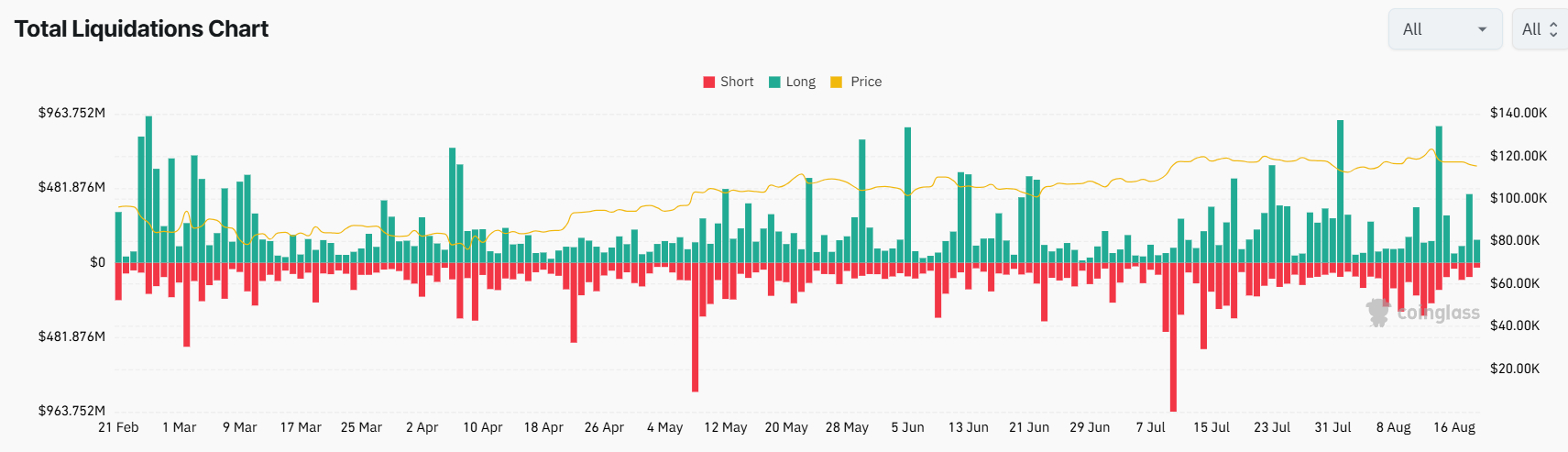
market witnessed brutal liquidations totaling over $1 billion in recent days,
with $270 million wiped out in a single session. Long positions, bets
that prices would rise, accounted for the vast majority of these losses,
with 95% of liquidations coming from bullish trades.
This tells
a clear story. Traders had become dangerously overleveraged, betting big on
continued price gains. When Bitcoin stumbled, these positions got crushed in
cascade-style liquidations that pushed prices down further. The pain was
particularly acute in Ethereum, which saw $170 million in liquidations,
while Bitcoin contributed $104 million to the carnage.
Massive liquidations of long positions. Source: CoinGlass.com
Market
watchers note this wasn't just random selling. Nick Forster from Derive.xyz
called it "a reset of short-term positioning rather than a structural
shift". But when you have this much leverage in the system, even small
price moves can trigger massive unwinding events.
Why Bitcoin Price Is Going
Down? Profit-Taking Hits Critical Levels
One of the
biggest headwinds Bitcoin faces right now is simple math. Most Bitcoin holders
are sitting pretty with substantial gains, and that creates natural selling
pressure. Bitcoin's Market Value to Realized Value (MVRV) ratio currently
stands at 21%, meaning the average investor who bought Bitcoin over the
past year is comfortably in profit.
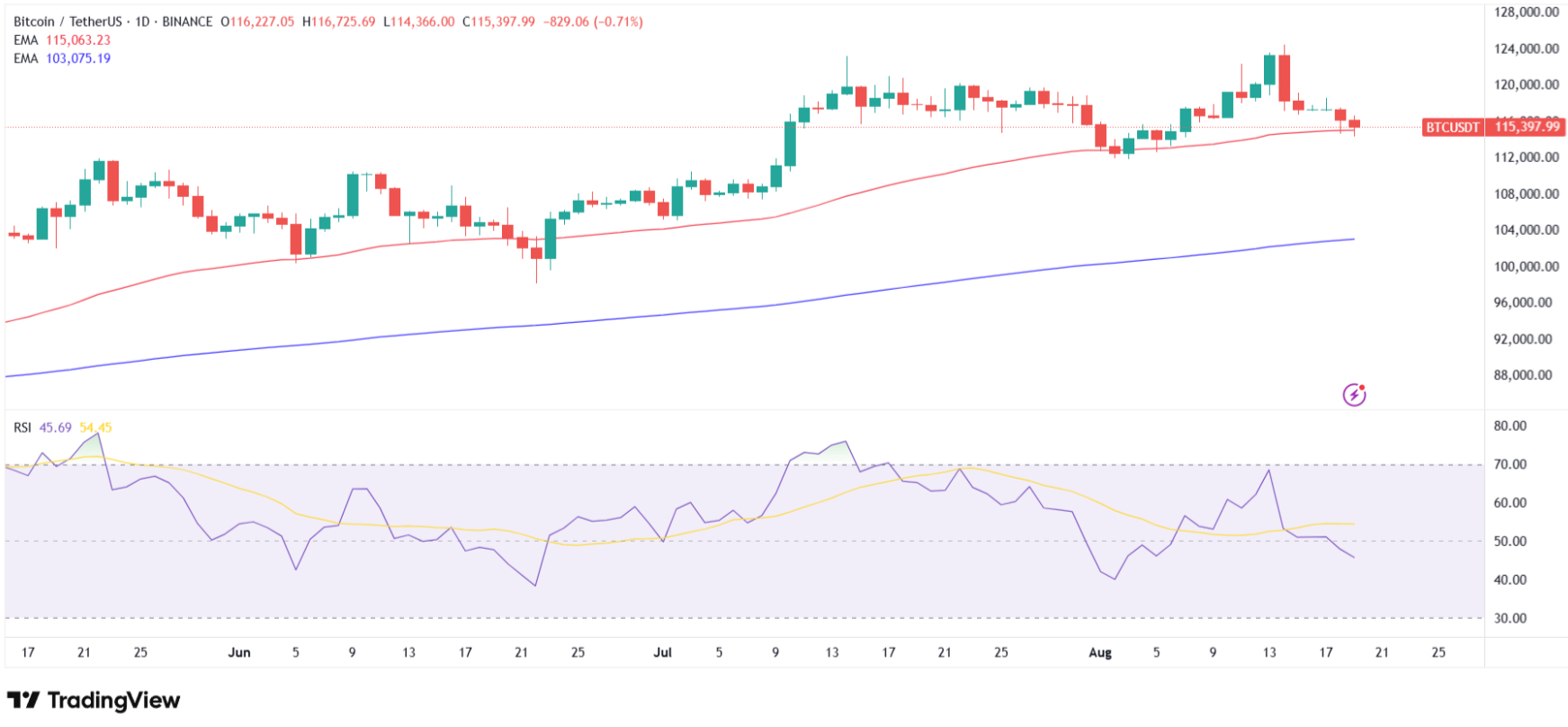
RSI hit the oversold zone for the first time in more than a month. Source: Tradingview.com
Glassnode
data shows Bitcoin just completed its third major wave of profit-taking in
the current bull cycle. These waves typically create cooling-off periods where
prices consolidate before potentially moving higher. But they also mark points
where market momentum can shift if new buyers don't step in to absorb the
selling pressure.
Fed Policy Uncertainty
Rattles Risk Assets
Perhaps the
biggest cloud hanging over Bitcoin is Federal Reserve policy. Markets spent
months pricing in aggressive rate cuts, only to see those hopes fade as
inflation data came in mixed and employment numbers showed resilience.
Polymarket
odds of no Fed rate cut in September jumped from 12% to 26% in
just days, reflecting this recalibration. While most economists still expect a
quarter-point cut at the September 17 meeting, the certainty that existed
earlier has evaporated.
This
matters enormously for Bitcoin. Lower interest rates typically boost risk
assets like crypto by making them relatively more attractive compared to safe
bonds. When rate cut expectations fade, it removes a key pillar supporting
Bitcoin's recent rally.
Jerome
Powell's upcoming speech at Jackson Hole on Friday has become the market's next
major focus point. Traders are looking for any hints about Fed thinking, but
many analysts expect Powell to keep his cards close to his chest.
Technical Analysis Shows
BTC Upside Potential
Although
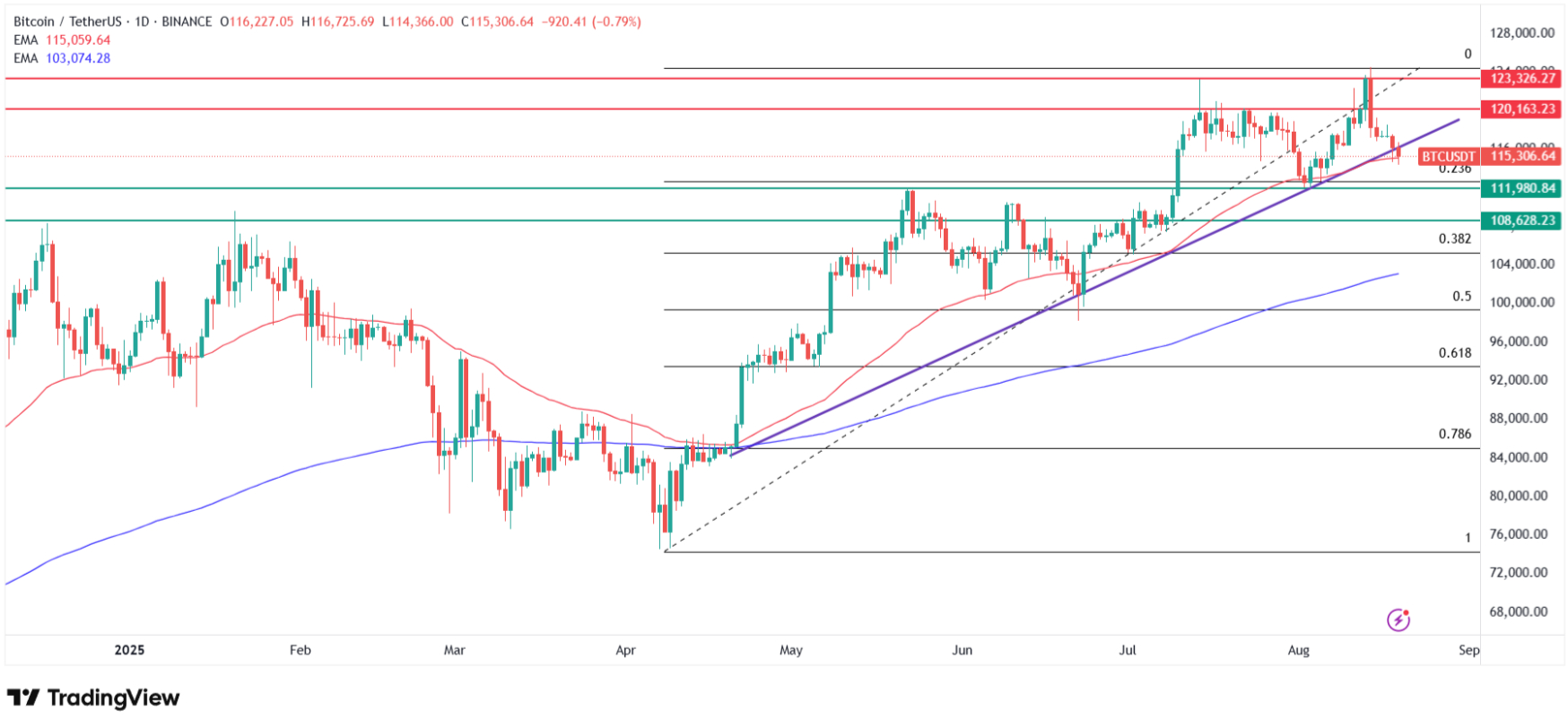
the BTC price on my technical analysis chart is crossing the trendline drawn
since mid-April, the outlook remains mostly bullish. The key factor is the 50
EMA, which has been protecting bulls from declines for the past four months and
has not yet been broken. Even if a breakout occurs, there is an immediate
strong support zone around $112,000, reinforced by the 23.6% Fibonacci
retracement.
Everything
above this zone can be seen as a buyback opportunity, with potential for
another move toward resistance at $120,000 and $124,000. Moreover, the 200 EMA
is positioned near $103,000, forming, together with the $100,000 level, a broad
base for reaccumulation. Only a drop below this range would shift my outlook, and
likely that of many investors, toward a bearish scenario.
Bitcoin to USDT technical analysis on a daily chart. Source: Tradingview.com
Interestingly,
the Nasdaq shows an almost identical profile, with 61 stocks above their
200-day averages and 49 below their 50-day averages. This parallel
movement suggests crypto isn't facing unique problems but rather participating
in broader market caution.
The
predictions range from relatively conservative targets around $130,000 to
ambitious projections exceeding $400,000. What's particularly interesting is
that most of these forecasts were made before Bitcoin's recent surge to
$124,000, suggesting that many analysts still see room for further gains.
On the more
bullish end, Michael Saylor from MicroStrategy continues advocating
for Bitcoin as a superior store of value, with long-term targets reaching
$500,000. Similarly, Cathie Wood from ARK Invest maintains her
$400,000 prediction by 2026, driven by institutional adoption and blockchain
technology advancement.
Ethereum, XRP and Solana
Provide Mixed Signals
The altcoin
market offers conflicting signals about Bitcoin's direction. On one hand, Bitcoin's
dominance has dropped to 59% from over 65% earlier this year, suggesting
money is rotating into alternative cryptocurrencies—typically a sign of healthy
risk appetite.
Ethereum
has led this rotation, surging toward $4,600 and approaching its all-time high
near $4,870. Other major altcoins like XRP and Solana have also shown strength
at times, indicating the crypto ecosystem remains vibrant despite Bitcoin's
struggles.
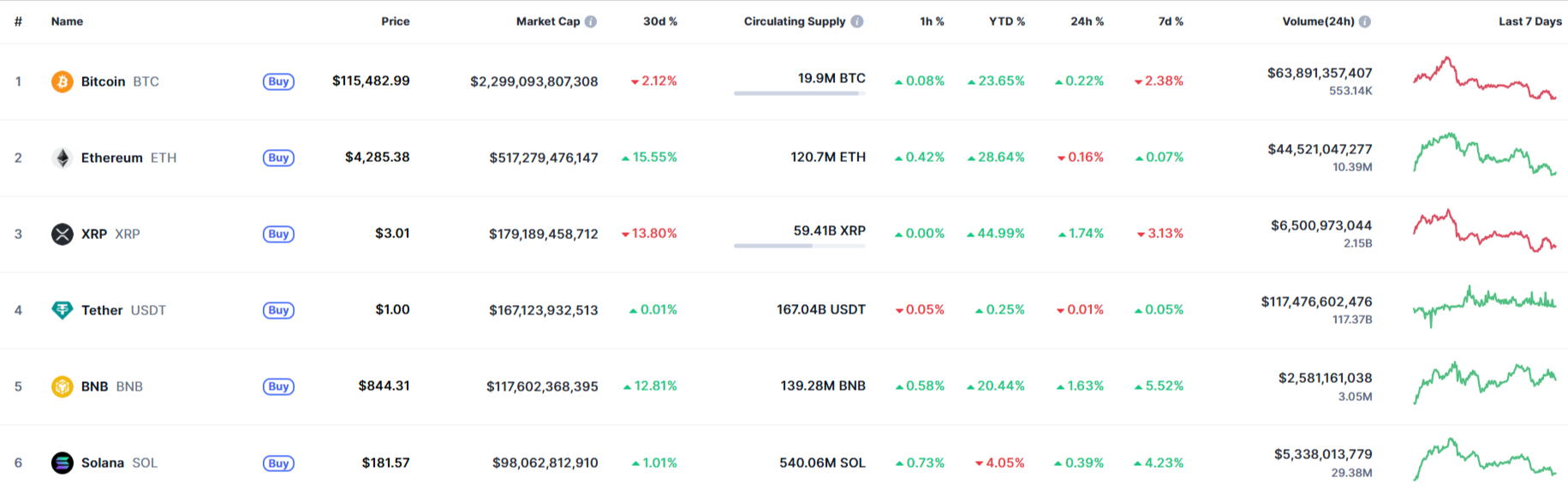
Source: CoinMarketCap.com
But this
rotation cuts both ways. When Bitcoin dominance falls during uncertain times,
it can signal that the market lacks a clear directional bias. Investors spread
their bets rather than concentrating on the market leader, which can create
more volatility overall.
What Happens Next?
Bitcoin's
next moves likely depend on three key factors. First, whether Powell's Jackson
Hole speech provides clarity on Fed policy direction. Second, how much
additional leverage needs to be unwound from the system. And third, whether
institutional buyers continue stepping in to absorb selling pressure.
The current
environment feels more like a healthy correction than a fundamental shift in
Bitcoin's trajectory. Profit-taking after massive gains is normal market
behavior. Leverage cleanup, while painful, ultimately creates more sustainable
price action. And Fed uncertainty should resolve one way or another in coming
weeks.
Bitcoin News FAQ
How Much Will $1 Bitcoin
Be Worth in 2025?
Based on
current expert predictions, one Bitcoin could be worth between $100,000 to
$150,000 by the end of 2025. Conservative Wall Street estimates from JPMorgan
and Goldman Sachs suggest targets around $130,000-$150,000, while crypto
analysts like Alex Krüger predict $140,000 depending on Federal Reserve policy
changes. Given Bitcoin's current price of $115,000, this represents modest
upside potential, though the wide range reflects the cryptocurrency's inherent
volatility.
Why Is Bitcoin Falling?
Bitcoin's
decline from its $124,000 all-time high results from a perfect storm of
factors. Massive leverage liquidations totaling over $270 million hit the
market, with 95% being bullish positions that got crushed. Profit-taking
pressure intensified as Bitcoin's MVRV ratio reached 21%, meaning most holders
are sitting on substantial gains. Additionally, Federal Reserve uncertainty
grew as rate cut expectations for September weakened, removing a key pillar
supporting Bitcoin's rally.
Will BTC Rise Again?
Most
indicators suggest Bitcoin will eventually recover, though the timeline remains
uncertain. Whale accumulation continues with large holders adding over 218,000
BTC since March, while institutional demand from ETFs and corporate treasuries
stays strong. Historical patterns show Bitcoin typically recovers from
technical corrections, and long-term moving averages still indicate a bullish
trend. However, short-term momentum has clearly shifted negative, requiring
time to rebuild.
Should I Sell BTC Now?
The
decision depends entirely on your risk tolerance and investment timeline.
Institutional investors continue accumulating during this dip, suggesting smart
money sees opportunity rather than danger. However, the high MVRV ratio
indicates many investors may take profits, and technical indicators show
continued weakness. Market leverage cleanup could cause more volatility before
conditions stabilize. Never invest more than you can afford to lose.
Will Crypto Go Back Up?
The broader
cryptocurrency market shows mixed but generally positive signals. Altcoin
strength continues as money rotates into Ethereum, XRP, and other major
cryptocurrencies, while total crypto market cap remains near all-time highs
despite Bitcoin's pullback. Institutional adoption keeps growing with new ETF
products and corporate investments. However, the market faces headwinds from
Fed policy uncertainty and technical selling pressure, with recovery timing
dependent on resolving these uncertainties.
Bitcoin's (BTC)
price spectacular run to record highs above $124,000 has hit turbulence, with
the world's largest cryptocurrency now trading around $115,000, a drop of
roughly 7% from its peak just weeks ago. This pullback isn't happening in
isolation. The entire crypto market is wrestling with a perfect storm of
profit-taking, leverage cleanup, and Fed policy uncertainty that's testing even
the most bullish investors.
Massive Liquidations
Signal Overleveraged Positions
The crypto
market witnessed brutal liquidations totaling over $1 billion in recent days,
with $270 million wiped out in a single session. Long positions, bets
that prices would rise, accounted for the vast majority of these losses,
with 95% of liquidations coming from bullish trades.
This tells
a clear story. Traders had become dangerously overleveraged, betting big on
continued price gains. When Bitcoin stumbled, these positions got crushed in
cascade-style liquidations that pushed prices down further. The pain was
particularly acute in Ethereum, which saw $170 million in liquidations,
while Bitcoin contributed $104 million to the carnage.
Massive liquidations of long positions. Source: CoinGlass.com
Market
watchers note this wasn't just random selling. Nick Forster from Derive.xyz
called it "a reset of short-term positioning rather than a structural
shift". But when you have this much leverage in the system, even small
price moves can trigger massive unwinding events.
Why Bitcoin Price Is Going
Down? Profit-Taking Hits Critical Levels
One of the
biggest headwinds Bitcoin faces right now is simple math. Most Bitcoin holders
are sitting pretty with substantial gains, and that creates natural selling
pressure. Bitcoin's Market Value to Realized Value (MVRV) ratio currently
stands at 21%, meaning the average investor who bought Bitcoin over the
past year is comfortably in profit.
RSI hit the oversold zone for the first time in more than a month. Source: Tradingview.com
Glassnode
data shows Bitcoin just completed its third major wave of profit-taking in
the current bull cycle. These waves typically create cooling-off periods where
prices consolidate before potentially moving higher. But they also mark points
where market momentum can shift if new buyers don't step in to absorb the
selling pressure.
Fed Policy Uncertainty
Rattles Risk Assets
Perhaps the
biggest cloud hanging over Bitcoin is Federal Reserve policy. Markets spent
months pricing in aggressive rate cuts, only to see those hopes fade as
inflation data came in mixed and employment numbers showed resilience.
Polymarket
odds of no Fed rate cut in September jumped from 12% to 26% in
just days, reflecting this recalibration. While most economists still expect a
quarter-point cut at the September 17 meeting, the certainty that existed
earlier has evaporated.
This
matters enormously for Bitcoin. Lower interest rates typically boost risk
assets like crypto by making them relatively more attractive compared to safe
bonds. When rate cut expectations fade, it removes a key pillar supporting
Bitcoin's recent rally.
Jerome
Powell's upcoming speech at Jackson Hole on Friday has become the market's next
major focus point. Traders are looking for any hints about Fed thinking, but
many analysts expect Powell to keep his cards close to his chest.
Technical Analysis Shows
BTC Upside Potential
Although
the BTC price on my technical analysis chart is crossing the trendline drawn
since mid-April, the outlook remains mostly bullish. The key factor is the 50
EMA, which has been protecting bulls from declines for the past four months and
has not yet been broken. Even if a breakout occurs, there is an immediate
strong support zone around $112,000, reinforced by the 23.6% Fibonacci
retracement.
Everything
above this zone can be seen as a buyback opportunity, with potential for
another move toward resistance at $120,000 and $124,000. Moreover, the 200 EMA
is positioned near $103,000, forming, together with the $100,000 level, a broad
base for reaccumulation. Only a drop below this range would shift my outlook, and
likely that of many investors, toward a bearish scenario.
Bitcoin to USDT technical analysis on a daily chart. Source: Tradingview.com
Interestingly,
the Nasdaq shows an almost identical profile, with 61 stocks above their
200-day averages and 49 below their 50-day averages. This parallel
movement suggests crypto isn't facing unique problems but rather participating
in broader market caution.
The
predictions range from relatively conservative targets around $130,000 to
ambitious projections exceeding $400,000. What's particularly interesting is
that most of these forecasts were made before Bitcoin's recent surge to
$124,000, suggesting that many analysts still see room for further gains.
On the more
bullish end, Michael Saylor from MicroStrategy continues advocating
for Bitcoin as a superior store of value, with long-term targets reaching
$500,000. Similarly, Cathie Wood from ARK Invest maintains her
$400,000 prediction by 2026, driven by institutional adoption and blockchain
technology advancement.
Ethereum, XRP and Solana
Provide Mixed Signals
The altcoin
market offers conflicting signals about Bitcoin's direction. On one hand, Bitcoin's
dominance has dropped to 59% from over 65% earlier this year, suggesting
money is rotating into alternative cryptocurrencies—typically a sign of healthy
risk appetite.
Ethereum
has led this rotation, surging toward $4,600 and approaching its all-time high
near $4,870. Other major altcoins like XRP and Solana have also shown strength
at times, indicating the crypto ecosystem remains vibrant despite Bitcoin's
struggles.
Source: CoinMarketCap.com
But this
rotation cuts both ways. When Bitcoin dominance falls during uncertain times,
it can signal that the market lacks a clear directional bias. Investors spread
their bets rather than concentrating on the market leader, which can create
more volatility overall.
What Happens Next?
Bitcoin's
next moves likely depend on three key factors. First, whether Powell's Jackson
Hole speech provides clarity on Fed policy direction. Second, how much
additional leverage needs to be unwound from the system. And third, whether
institutional buyers continue stepping in to absorb selling pressure.
The current
environment feels more like a healthy correction than a fundamental shift in
Bitcoin's trajectory. Profit-taking after massive gains is normal market
behavior. Leverage cleanup, while painful, ultimately creates more sustainable
price action. And Fed uncertainty should resolve one way or another in coming
weeks.
Bitcoin News FAQ
How Much Will $1 Bitcoin
Be Worth in 2025?
Based on
current expert predictions, one Bitcoin could be worth between $100,000 to
$150,000 by the end of 2025. Conservative Wall Street estimates from JPMorgan
and Goldman Sachs suggest targets around $130,000-$150,000, while crypto
analysts like Alex Krüger predict $140,000 depending on Federal Reserve policy
changes. Given Bitcoin's current price of $115,000, this represents modest
upside potential, though the wide range reflects the cryptocurrency's inherent
volatility.
Why Is Bitcoin Falling?
Bitcoin's
decline from its $124,000 all-time high results from a perfect storm of
factors. Massive leverage liquidations totaling over $270 million hit the
market, with 95% being bullish positions that got crushed. Profit-taking
pressure intensified as Bitcoin's MVRV ratio reached 21%, meaning most holders
are sitting on substantial gains. Additionally, Federal Reserve uncertainty
grew as rate cut expectations for September weakened, removing a key pillar
supporting Bitcoin's rally.
Will BTC Rise Again?
Most
indicators suggest Bitcoin will eventually recover, though the timeline remains
uncertain. Whale accumulation continues with large holders adding over 218,000
BTC since March, while institutional demand from ETFs and corporate treasuries
stays strong. Historical patterns show Bitcoin typically recovers from
technical corrections, and long-term moving averages still indicate a bullish
trend. However, short-term momentum has clearly shifted negative, requiring
time to rebuild.
Should I Sell BTC Now?
The
decision depends entirely on your risk tolerance and investment timeline.
Institutional investors continue accumulating during this dip, suggesting smart
money sees opportunity rather than danger. However, the high MVRV ratio
indicates many investors may take profits, and technical indicators show
continued weakness. Market leverage cleanup could cause more volatility before
conditions stabilize. Never invest more than you can afford to lose.
Will Crypto Go Back Up?
The broader
cryptocurrency market shows mixed but generally positive signals. Altcoin
strength continues as money rotates into Ethereum, XRP, and other major
cryptocurrencies, while total crypto market cap remains near all-time highs
despite Bitcoin's pullback. Institutional adoption keeps growing with new ETF
products and corporate investments. However, the market faces headwinds from
Fed policy uncertainty and technical selling pressure, with recovery timing
dependent on resolving these uncertainties.
Damian Chmiel is a Senior Analyst & Editor at Finance Magnates with more than 15 years of experience in the CFD and online trading industry. Active as both a trader and journalist since 2010, he focuses on broker coverage, fintech innovation, and regulatory developments across Europe, the Middle East, and Asia.
His work includes interviews with C-level leaders at major brokerages and fintech platforms, as well as co-authoring Finance Magnates’ quarterly industry benchmarking reports. Damian’s reporting is data-driven, market-aware, and grounded in direct industry engagement. His analysis and commentary have also been cited by external media outlets, including Investing.com, Binance, The Asset, Stockhead, and Dispatch.
Education:
MA in Finance and Accounting, Cracow University of Economics
Inside the Prediction Markets: $1.6B Institutional Inflow Meets a Federal Crackdown
Featured Videos
FP Markets Winner Spotlight 🏆 | Global Broker of the Year 2025 #Trading #Broker #Innovation #Shorts
FP Markets Winner Spotlight 🏆 | Global Broker of the Year 2025 #Trading #Broker #Innovation #Shorts
FP Markets Winner Spotlight 🏆 | Global Broker of the Year 2025 #Trading #Broker #Innovation #Shorts
FP Markets Winner Spotlight 🏆 | Global Broker of the Year 2025 #Trading #Broker #Innovation #Shorts
FP Markets takes the spotlight as Global Broker of the Year 2025 at the Finance Magnates Awards.
Martin Stoilov, Head of Client Experience, shares that trust, innovation, and people played a key role in the company’s success, supported by a strong foundation of integrity and client-centricity.
Following this milestone, FP Markets continues to focus on growth, technology investment, and its core values of transparency and excellence.
👉 Be part of FM Awards 2026: https://awards.financemagnates.com/#nominate
FP Markets takes the spotlight as Global Broker of the Year 2025 at the Finance Magnates Awards.
Martin Stoilov, Head of Client Experience, shares that trust, innovation, and people played a key role in the company’s success, supported by a strong foundation of integrity and client-centricity.
Following this milestone, FP Markets continues to focus on growth, technology investment, and its core values of transparency and excellence.
👉 Be part of FM Awards 2026: https://awards.financemagnates.com/#nominate
FP Markets takes the spotlight as Global Broker of the Year 2025 at the Finance Magnates Awards.
Martin Stoilov, Head of Client Experience, shares that trust, innovation, and people played a key role in the company’s success, supported by a strong foundation of integrity and client-centricity.
Following this milestone, FP Markets continues to focus on growth, technology investment, and its core values of transparency and excellence.
👉 Be part of FM Awards 2026: https://awards.financemagnates.com/#nominate
FP Markets takes the spotlight as Global Broker of the Year 2025 at the Finance Magnates Awards.
Martin Stoilov, Head of Client Experience, shares that trust, innovation, and people played a key role in the company’s success, supported by a strong foundation of integrity and client-centricity.
Following this milestone, FP Markets continues to focus on growth, technology investment, and its core values of transparency and excellence.
👉 Be part of FM Awards 2026: https://awards.financemagnates.com/#nominate
In this video, we review @HolaPrimeMarketsOfficial, a multi-asset forex and CFDs broker offering different account types, trading platforms, and flexible trading conditions.
We cover the broker’s overall offering, including account options, trading environment, platforms like MT4 and MT5, and additional services such as managed accounts and fast withdrawals.
Watch the full video to see if Hola Prime Markets fits your trading needs.
📣 Stay up to date with the latest in finance and trading. Follow Finance Magnates for industry news, insights, and global event coverage.
Connect with us:
🔗 LinkedIn: /financemagnates
👍 Facebook: /financemagnates
📸 Instagram: https://www.instagram.com/financemagnates
🐦 X: https://x.com/financemagnates
🎥 TikTok: https://www.tiktok.com/tag/financemagnates
▶️ YouTube: /@financemagnates_official
#HolaPrime #ForexBroker #CFDTrading #FinanceMagnates #Trading #Forex #BrokerReview
In this video, we review @HolaPrimeMarketsOfficial, a multi-asset forex and CFDs broker offering different account types, trading platforms, and flexible trading conditions.
We cover the broker’s overall offering, including account options, trading environment, platforms like MT4 and MT5, and additional services such as managed accounts and fast withdrawals.
Watch the full video to see if Hola Prime Markets fits your trading needs.
📣 Stay up to date with the latest in finance and trading. Follow Finance Magnates for industry news, insights, and global event coverage.
Connect with us:
🔗 LinkedIn: /financemagnates
👍 Facebook: /financemagnates
📸 Instagram: https://www.instagram.com/financemagnates
🐦 X: https://x.com/financemagnates
🎥 TikTok: https://www.tiktok.com/tag/financemagnates
▶️ YouTube: /@financemagnates_official
#HolaPrime #ForexBroker #CFDTrading #FinanceMagnates #Trading #Forex #BrokerReview
In this video, we review @HolaPrimeMarketsOfficial, a multi-asset forex and CFDs broker offering different account types, trading platforms, and flexible trading conditions.
We cover the broker’s overall offering, including account options, trading environment, platforms like MT4 and MT5, and additional services such as managed accounts and fast withdrawals.
Watch the full video to see if Hola Prime Markets fits your trading needs.
📣 Stay up to date with the latest in finance and trading. Follow Finance Magnates for industry news, insights, and global event coverage.
Connect with us:
🔗 LinkedIn: /financemagnates
👍 Facebook: /financemagnates
📸 Instagram: https://www.instagram.com/financemagnates
🐦 X: https://x.com/financemagnates
🎥 TikTok: https://www.tiktok.com/tag/financemagnates
▶️ YouTube: /@financemagnates_official
#HolaPrime #ForexBroker #CFDTrading #FinanceMagnates #Trading #Forex #BrokerReview
In this video, we review @HolaPrimeMarketsOfficial, a multi-asset forex and CFDs broker offering different account types, trading platforms, and flexible trading conditions.
We cover the broker’s overall offering, including account options, trading environment, platforms like MT4 and MT5, and additional services such as managed accounts and fast withdrawals.
Watch the full video to see if Hola Prime Markets fits your trading needs.
📣 Stay up to date with the latest in finance and trading. Follow Finance Magnates for industry news, insights, and global event coverage.
Connect with us:
🔗 LinkedIn: /financemagnates
👍 Facebook: /financemagnates
📸 Instagram: https://www.instagram.com/financemagnates
🐦 X: https://x.com/financemagnates
🎥 TikTok: https://www.tiktok.com/tag/financemagnates
▶️ YouTube: /@financemagnates_official
#HolaPrime #ForexBroker #CFDTrading #FinanceMagnates #Trading #Forex #BrokerReview
In this video, we review @HolaPrimeMarketsOfficial, a multi-asset forex and CFDs broker offering different account types, trading platforms, and flexible trading conditions.
We cover the broker’s overall offering, including account options, trading environment, platforms like MT4 and MT5, and additional services such as managed accounts and fast withdrawals.
Watch the full video to see if Hola Prime Markets fits your trading needs.
📣 Stay up to date with the latest in finance and trading. Follow Finance Magnates for industry news, insights, and global event coverage.
Connect with us:
🔗 LinkedIn: /financemagnates
👍 Facebook: /financemagnates
📸 Instagram: https://www.instagram.com/financemagnates
🐦 X: https://x.com/financemagnates
🎥 TikTok: https://www.tiktok.com/tag/financemagnates
▶️ YouTube: /@financemagnates_official
#HolaPrime #ForexBroker #CFDTrading #FinanceMagnates #Trading #Forex #BrokerReview
In this video, we review @HolaPrimeMarketsOfficial, a multi-asset forex and CFDs broker offering different account types, trading platforms, and flexible trading conditions.
We cover the broker’s overall offering, including account options, trading environment, platforms like MT4 and MT5, and additional services such as managed accounts and fast withdrawals.
Watch the full video to see if Hola Prime Markets fits your trading needs.
📣 Stay up to date with the latest in finance and trading. Follow Finance Magnates for industry news, insights, and global event coverage.
Connect with us:
🔗 LinkedIn: /financemagnates
👍 Facebook: /financemagnates
📸 Instagram: https://www.instagram.com/financemagnates
🐦 X: https://x.com/financemagnates
🎥 TikTok: https://www.tiktok.com/tag/financemagnates
▶️ YouTube: /@financemagnates_official
#HolaPrime #ForexBroker #CFDTrading #FinanceMagnates #Trading #Forex #BrokerReview
Hola Prime Review: What You Need to Know | Full Breakdown by Finance Magnates
Hola Prime Review: What You Need to Know | Full Breakdown by Finance Magnates
Hola Prime Review: What You Need to Know | Full Breakdown by Finance Magnates
Hola Prime Review: What You Need to Know | Full Breakdown by Finance Magnates
Hola Prime Review: What You Need to Know | Full Breakdown by Finance Magnates
Hola Prime Review: What You Need to Know | Full Breakdown by Finance Magnates
In this video, we review @HolaPrime_Global, a proprietary trading firm offering evaluation programs and performance-based payouts in simulated market environments.
We cover how the challenge model works, including account types, profit splits (up to 95%), trading rules, and what it takes to reach a funded account. You’ll also learn about available platforms like MT4, MT5, cTrader, and more, along with insights into payouts, support, and trading conditions.
Watch the full video to see if Hola Prime fits your trading style.
📣 Stay up to date with the latest in finance and trading. Follow Finance Magnates for industry news, insights, and global event coverage.
Connect with us:
🔗 LinkedIn: /financemagnates
👍 Facebook: /financemagnates
📸 Instagram: https://www.instagram.com/financemagnates
🐦 X: https://x.com/financemagnates
🎥 TikTok: https://www.tiktok.com/tag/financemagnates
▶️ YouTube: /@financemagnates_official
#HolaPrime #PropFirm #Trading #FinanceMagnates #Forex #FuturesTrading #TradingReview #PropFirmReview
In this video, we review @HolaPrime_Global, a proprietary trading firm offering evaluation programs and performance-based payouts in simulated market environments.
We cover how the challenge model works, including account types, profit splits (up to 95%), trading rules, and what it takes to reach a funded account. You’ll also learn about available platforms like MT4, MT5, cTrader, and more, along with insights into payouts, support, and trading conditions.
Watch the full video to see if Hola Prime fits your trading style.
📣 Stay up to date with the latest in finance and trading. Follow Finance Magnates for industry news, insights, and global event coverage.
Connect with us:
🔗 LinkedIn: /financemagnates
👍 Facebook: /financemagnates
📸 Instagram: https://www.instagram.com/financemagnates
🐦 X: https://x.com/financemagnates
🎥 TikTok: https://www.tiktok.com/tag/financemagnates
▶️ YouTube: /@financemagnates_official
#HolaPrime #PropFirm #Trading #FinanceMagnates #Forex #FuturesTrading #TradingReview #PropFirmReview
In this video, we review @HolaPrime_Global, a proprietary trading firm offering evaluation programs and performance-based payouts in simulated market environments.
We cover how the challenge model works, including account types, profit splits (up to 95%), trading rules, and what it takes to reach a funded account. You’ll also learn about available platforms like MT4, MT5, cTrader, and more, along with insights into payouts, support, and trading conditions.
Watch the full video to see if Hola Prime fits your trading style.
📣 Stay up to date with the latest in finance and trading. Follow Finance Magnates for industry news, insights, and global event coverage.
Connect with us:
🔗 LinkedIn: /financemagnates
👍 Facebook: /financemagnates
📸 Instagram: https://www.instagram.com/financemagnates
🐦 X: https://x.com/financemagnates
🎥 TikTok: https://www.tiktok.com/tag/financemagnates
▶️ YouTube: /@financemagnates_official
#HolaPrime #PropFirm #Trading #FinanceMagnates #Forex #FuturesTrading #TradingReview #PropFirmReview
In this video, we review @HolaPrime_Global, a proprietary trading firm offering evaluation programs and performance-based payouts in simulated market environments.
We cover how the challenge model works, including account types, profit splits (up to 95%), trading rules, and what it takes to reach a funded account. You’ll also learn about available platforms like MT4, MT5, cTrader, and more, along with insights into payouts, support, and trading conditions.
Watch the full video to see if Hola Prime fits your trading style.
📣 Stay up to date with the latest in finance and trading. Follow Finance Magnates for industry news, insights, and global event coverage.
Connect with us:
🔗 LinkedIn: /financemagnates
👍 Facebook: /financemagnates
📸 Instagram: https://www.instagram.com/financemagnates
🐦 X: https://x.com/financemagnates
🎥 TikTok: https://www.tiktok.com/tag/financemagnates
▶️ YouTube: /@financemagnates_official
#HolaPrime #PropFirm #Trading #FinanceMagnates #Forex #FuturesTrading #TradingReview #PropFirmReview
In this video, we review @HolaPrime_Global, a proprietary trading firm offering evaluation programs and performance-based payouts in simulated market environments.
We cover how the challenge model works, including account types, profit splits (up to 95%), trading rules, and what it takes to reach a funded account. You’ll also learn about available platforms like MT4, MT5, cTrader, and more, along with insights into payouts, support, and trading conditions.
Watch the full video to see if Hola Prime fits your trading style.
📣 Stay up to date with the latest in finance and trading. Follow Finance Magnates for industry news, insights, and global event coverage.
Connect with us:
🔗 LinkedIn: /financemagnates
👍 Facebook: /financemagnates
📸 Instagram: https://www.instagram.com/financemagnates
🐦 X: https://x.com/financemagnates
🎥 TikTok: https://www.tiktok.com/tag/financemagnates
▶️ YouTube: /@financemagnates_official
#HolaPrime #PropFirm #Trading #FinanceMagnates #Forex #FuturesTrading #TradingReview #PropFirmReview
In this video, we review @HolaPrime_Global, a proprietary trading firm offering evaluation programs and performance-based payouts in simulated market environments.
We cover how the challenge model works, including account types, profit splits (up to 95%), trading rules, and what it takes to reach a funded account. You’ll also learn about available platforms like MT4, MT5, cTrader, and more, along with insights into payouts, support, and trading conditions.
Watch the full video to see if Hola Prime fits your trading style.
📣 Stay up to date with the latest in finance and trading. Follow Finance Magnates for industry news, insights, and global event coverage.
Connect with us:
🔗 LinkedIn: /financemagnates
👍 Facebook: /financemagnates
📸 Instagram: https://www.instagram.com/financemagnates
🐦 X: https://x.com/financemagnates
🎥 TikTok: https://www.tiktok.com/tag/financemagnates
▶️ YouTube: /@financemagnates_official
#HolaPrime #PropFirm #Trading #FinanceMagnates #Forex #FuturesTrading #TradingReview #PropFirmReview
Axi Winner Spotlight 🏆 | Global Most Innovative Broker 2025 #Innovation #Trading #Fintech #Broker
Axi Winner Spotlight 🏆 | Global Most Innovative Broker 2025 #Innovation #Trading #Fintech #Broker
Axi Winner Spotlight 🏆 | Global Most Innovative Broker 2025 #Innovation #Trading #Fintech #Broker
Axi Winner Spotlight 🏆 | Global Most Innovative Broker 2025 #Innovation #Trading #Fintech #Broker
Axi Winner Spotlight 🏆 | Global Most Innovative Broker 2025 #Innovation #Trading #Fintech #Broker
Axi Winner Spotlight 🏆 | Global Most Innovative Broker 2025 #Innovation #Trading #Fintech #Broker
Axi takes the spotlight at the Finance Magnates Awards, winning Global Most Innovative Broker 2025.
Olivia Xenofontos and Ivanna Openko share how the team will feel: proud, motivated, and ready to keep delivering.
They also describe the night as well-organized, focused, and enjoyable for all.
👉 Be part of FM Awards 2026.
Axi takes the spotlight at the Finance Magnates Awards, winning Global Most Innovative Broker 2025.
Olivia Xenofontos and Ivanna Openko share how the team will feel: proud, motivated, and ready to keep delivering.
They also describe the night as well-organized, focused, and enjoyable for all.
👉 Be part of FM Awards 2026.
Axi takes the spotlight at the Finance Magnates Awards, winning Global Most Innovative Broker 2025.
Olivia Xenofontos and Ivanna Openko share how the team will feel: proud, motivated, and ready to keep delivering.
They also describe the night as well-organized, focused, and enjoyable for all.
👉 Be part of FM Awards 2026.
Axi takes the spotlight at the Finance Magnates Awards, winning Global Most Innovative Broker 2025.
Olivia Xenofontos and Ivanna Openko share how the team will feel: proud, motivated, and ready to keep delivering.
They also describe the night as well-organized, focused, and enjoyable for all.
👉 Be part of FM Awards 2026.
Axi takes the spotlight at the Finance Magnates Awards, winning Global Most Innovative Broker 2025.
Olivia Xenofontos and Ivanna Openko share how the team will feel: proud, motivated, and ready to keep delivering.
They also describe the night as well-organized, focused, and enjoyable for all.
👉 Be part of FM Awards 2026.
Axi takes the spotlight at the Finance Magnates Awards, winning Global Most Innovative Broker 2025.
Olivia Xenofontos and Ivanna Openko share how the team will feel: proud, motivated, and ready to keep delivering.
They also describe the night as well-organized, focused, and enjoyable for all.
👉 Be part of FM Awards 2026.
Recognition that matters.
Built on transparency.
Driven by the industry.
The Finance Magnates Awards 2026.
Nominations are now open.
🔗 https://awards.financemagnates.com/?utm_source=SM&utm_medium=social&utm_campaign=recognition-matters
Recognition that matters.
Built on transparency.
Driven by the industry.
The Finance Magnates Awards 2026.
Nominations are now open.
🔗 https://awards.financemagnates.com/?utm_source=SM&utm_medium=social&utm_campaign=recognition-matters
Recognition that matters.
Built on transparency.
Driven by the industry.
The Finance Magnates Awards 2026.
Nominations are now open.
🔗 https://awards.financemagnates.com/?utm_source=SM&utm_medium=social&utm_campaign=recognition-matters
Recognition that matters.
Built on transparency.
Driven by the industry.
The Finance Magnates Awards 2026.
Nominations are now open.
🔗 https://awards.financemagnates.com/?utm_source=SM&utm_medium=social&utm_campaign=recognition-matters
Recognition that matters.
Built on transparency.
Driven by the industry.
The Finance Magnates Awards 2026.
Nominations are now open.
🔗 https://awards.financemagnates.com/?utm_source=SM&utm_medium=social&utm_campaign=recognition-matters
Recognition that matters.
Built on transparency.
Driven by the industry.
The Finance Magnates Awards 2026.
Nominations are now open.
🔗 https://awards.financemagnates.com/?utm_source=SM&utm_medium=social&utm_campaign=recognition-matters