Financial and Business News

Analysts Say $200 Oil Is Possible - Prediction Markets Show It’s Not Probable

Monday, 30/03/2026 | 10:57 GMT by Tanya Chepkova
  • Analysts model how prices could react under disruption, while markets assign probabilities to those scenarios.
  • Event contracts imply that even severe supply shocks are not currently seen as the central outcome.
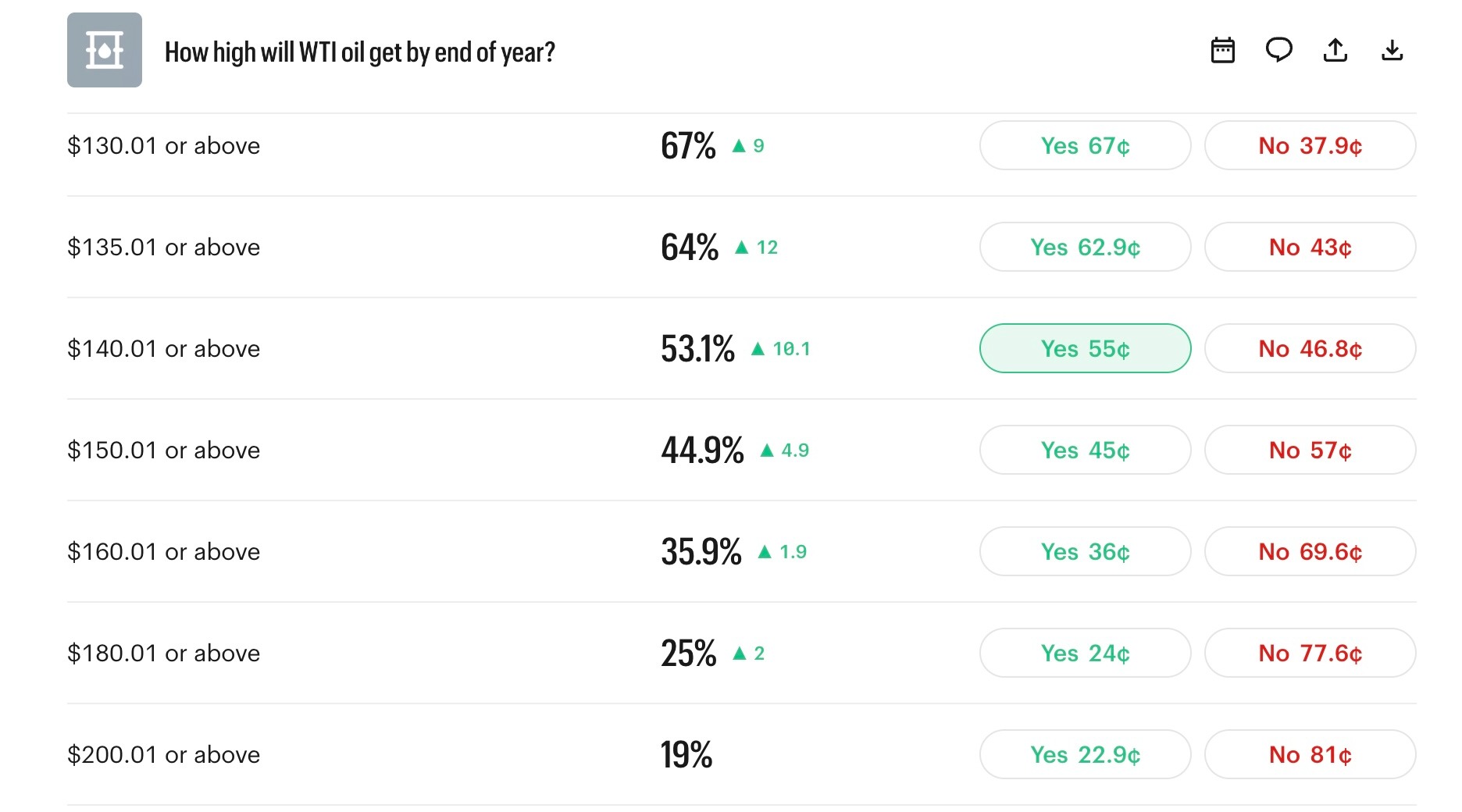
How high will WTI oil get by end of year? Source: Kalshi

Wall Street analysts are outlining scenarios in which oil prices could reach $200 per barrel if geopolitical tensions escalate. Prediction markets, however, imply a relatively low probability of that outcome.

Singapore Summit: Meet the largest APAC brokers you know (and those you still don't!)

This gap highlights how different tools assess risk: analysts focus on scenario outcomes, while prediction markets assign probabilities to those scenarios.

Analyst Forecasts Focus on Tail Risks

Several research teams have outlined how oil prices could react to a disruption in global supply, particularly through the Strait of Hormuz. Most estimates point to a range of around $150 or higher if the disruption persists. The $200 level is generally described as an extreme outcome at the upper end of that scenario, rather than a base-case forecast.

Macquarie analysts noted that prices could rise significantly under sustained disruption, while JPMorgan and Wood Mackenzie outlined similar ranges tied to supply constraints and demand response.

These forecasts describe how the market could behave under stress, rather than assigning a probability to those outcomes.

Markets Price a Lower Probability

Prediction markets take a different approach by assigning probabilities to outcomes. On Polymarket, a contract for oil reaching $200 by July is trading at around 14 cents, implying a 14% probability.

On Kalshi, a similar contract for year-end pricing implies roughly a 19% probability. In both cases, markets indicate that a price spike is possible but not the central expectation.

A Different Type of Signal

For brokers and institutional investors, the divergence highlights how prediction markets can complement traditional analysis. They provide a probability-based signal that can be used alongside analyst forecasts, particularly in situations where outcomes depend on uncertain geopolitical developments.

At the same time, these signals have limitations. Market pricing depends on participation, liquidity and positioning, which can affect how accurately probabilities reflect broader expectations.

Using the Signal

Prediction markets are better suited to assessing the likelihood of an event than estimating precise price levels during periods of stress. For market participants, the practical use is to compare scenario-based forecasts with probability-based pricing and adjust risk assumptions accordingly.


Wall Street analysts are outlining scenarios in which oil prices could reach $200 per barrel if geopolitical tensions escalate. Prediction markets, however, imply a relatively low probability of that outcome.

Singapore Summit: Meet the largest APAC brokers you know (and those you still don't!)

This gap highlights how different tools assess risk: analysts focus on scenario outcomes, while prediction markets assign probabilities to those scenarios.

Analyst Forecasts Focus on Tail Risks

Several research teams have outlined how oil prices could react to a disruption in global supply, particularly through the Strait of Hormuz. Most estimates point to a range of around $150 or higher if the disruption persists. The $200 level is generally described as an extreme outcome at the upper end of that scenario, rather than a base-case forecast.

Macquarie analysts noted that prices could rise significantly under sustained disruption, while JPMorgan and Wood Mackenzie outlined similar ranges tied to supply constraints and demand response.

These forecasts describe how the market could behave under stress, rather than assigning a probability to those outcomes.

Markets Price a Lower Probability

Prediction markets take a different approach by assigning probabilities to outcomes. On Polymarket, a contract for oil reaching $200 by July is trading at around 14 cents, implying a 14% probability.

On Kalshi, a similar contract for year-end pricing implies roughly a 19% probability. In both cases, markets indicate that a price spike is possible but not the central expectation.

A Different Type of Signal

For brokers and institutional investors, the divergence highlights how prediction markets can complement traditional analysis. They provide a probability-based signal that can be used alongside analyst forecasts, particularly in situations where outcomes depend on uncertain geopolitical developments.

At the same time, these signals have limitations. Market pricing depends on participation, liquidity and positioning, which can affect how accurately probabilities reflect broader expectations.

Using the Signal

Prediction markets are better suited to assessing the likelihood of an event than estimating precise price levels during periods of stress. For market participants, the practical use is to compare scenario-based forecasts with probability-based pricing and adjust risk assumptions accordingly.
About the Author: Tanya Chepkova
Tanya Chepkova
  • 141 Articles
Tanya Chepkova is a News Editor at Finance Magnates with more than 16 years of experience in financial journalism, covering forex, crypto, and digital asset markets. Her work spans daily industry reporting and data-driven, long-form explainers focused on market structure, trading models, and regulatory shifts. Before joining Finance Magnates, she led the editorial team of a cryptocurrency-focused media outlet for six years. Her reporting combines analytical depth with clear storytelling, with particular attention to how structural changes in trading, stablecoin infrastructure, and emerging products such as prediction markets reshape the broader financial ecosystem. She covers global developments and provides additional insight into CIS markets. Areas of Coverage: Crypto and digital asset markets Prediction markets Stablecoins and cross-border payments Industry analysis and long-form explainers

More from the Author

Trending