Why Is Gold Crashing? How Low Can XAU/USD Chart Go and Gold Price Prediction 2026

Thursday, 19/03/2026 | 11:13 GMT by Damian Chmiel
  • Gold has lost approximately 6% in two sessions, dropping from above $5,000 to $4,700 per ounce.
  • Technical analysis shows the $4,550 and $4,360 supports are now directly in play, with the 200-day EMA at $4,200 as the critical bull/bear dividing line.
  • Bloomberg's Mike McGlone updates his bearish gold price prediction.
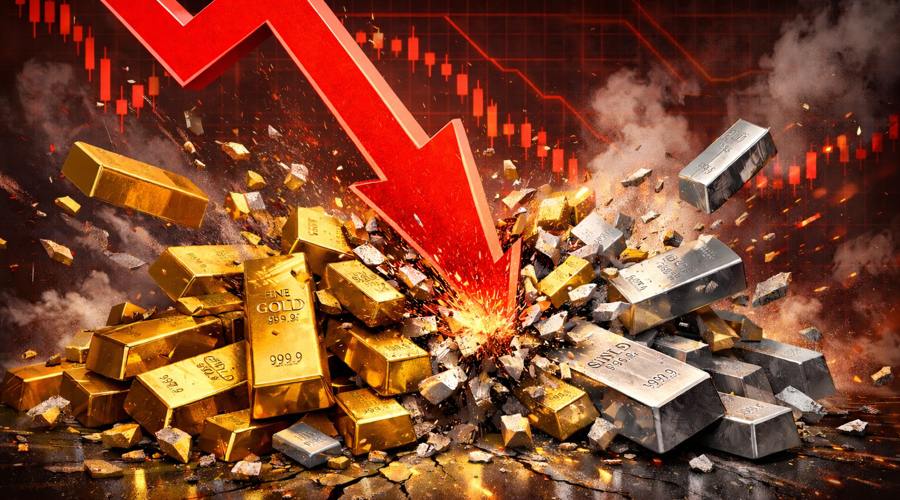
Red downward arrow crashing into gold and silver bars, symbolizing a steep price drop
Why gold price and silver price are falling today? Let's check XAU and XAG charts

Gold price is in freefall. After spending the better part of 2026 consolidating near all-time highs above $5,000, the yellow metal has lost approximately 6% in two consecutive sessions, crashing through the psychologically critical $5,000 barrier on Wednesday and extending the decline to $4,700 per ounce on Thursday, March 19, 2026, the lowest price since early February.

In this article, I will break down the technical analysis of the XAU/USD, examine the mechanics behind this week's crash, and present the key gold price predictions for 2026 , including where the real floor is if the selling continues. Based on my 15 years of experience as an analyst and retail investor, here is what I am watching.

Follow me on X for real-time gold market analysis: @ChmielDk

Why Gold Is Crashing? The Fed Pulled the Rug

Wednesday's FOMC decision was a hold, as expected - Polymarket had it at over 90% probability and the market was fully prepared for no rate movement. What the market was not prepared for was the hawkish tone of the dot plot. The Fed trimmed its 2026 rate cut projections from two cuts to one, citing hotter-than-expected producer inflation - February's PPI came in at +0.7%, well above consensus - and signalled that the Strait of Hormuz-driven oil spike is creating inflation persistence that prevents easing.

The 10-year Treasury yield jumped to 4.2%, the Dollar Index climbed toward 99.9, and gold - a non-yielding asset whose entire bull thesis rested on falling real yields and a weakening dollar - repriced accordingly.

As Dilin Wu, Research Strategist at Pepperstone, frames it: "This sharp decline in gold reflects a confluence of factors - large-scale risk asset liquidations, a hawkish shift in Fed expectations, and a stronger dollar." Crucially, he views this as "a pricing logic adjustment rather than a reversal of the long-term trend."

The technical break below the 50-day MA near $4,978 and below the $5,000 round level triggered momentum selling and profit-taking from a crowded long, amplifying what was already a fundamental repricing.

The irony noted by my earlier gold analysis remains fully applicable: gold is being sold during an active Middle East conflict precisely because the oil shock from that conflict is now hurting gold's prospects by reigniting inflation and forcing the Fed to stay hawkish. Higher oil means higher inflation means higher-for-longer rates means gold suffers despite the geopolitical backdrop that should theoretically support it.

Bloomberg Intelligence's Mike McGlone identified this paradox earlier this week: "Gold's best year in 2025 since 1979 - unequalled in a relatively low-inflation environment - looks prescient ahead of 2026's closure of the Strait of Hormuz, with peak-price inklings.

The surge to multiyear extremes vs. most moving averages and broad commodities may suggest the store of value has shifted to a speculative risk asset." That framing - gold as speculative risk asset rather than pure safe haven - is the most bearish structural argument currently circulating, and the two-day crash gives it uncomfortable credibility.

Gold Technical Analysis: The Levels That Matter Now

As my technical analysis shows, gold's two-day, 6% decline has materially changed the chart structure. The consolidation near the all-time highs that I described in Tuesday's analysis has been broken to the downside, and the move has opened up a sequence of support targets that were previously theoretical but are now directly in play.

The first support I am watching is $4,550 - the late 2025 historical highs that marked the peak before the January blow-off to $5,600. This was an area of significant buying last year and should attract some demand on the first test. Below that, $4,360 is the next meaningful level, representing a prior consolidation zone and Fibonacci retracement target.

The level that matters most on my entire gold chart is the 200-day EMA at approximately $4,200. That is the boundary separating a bull trend from a bear trend, and gold has not traded below it since late 2023. A sustained break below $4,200 would be a genuinely significant technical event. It would open the path toward $3,500 per ounce - the lows from which the current near-uninterrupted rally to $5,600 began. From Thursday's $4,700, that scenario implies a further decline of over 25% and would represent the most severe gold correction since the 2022 Fed tightening cycle.
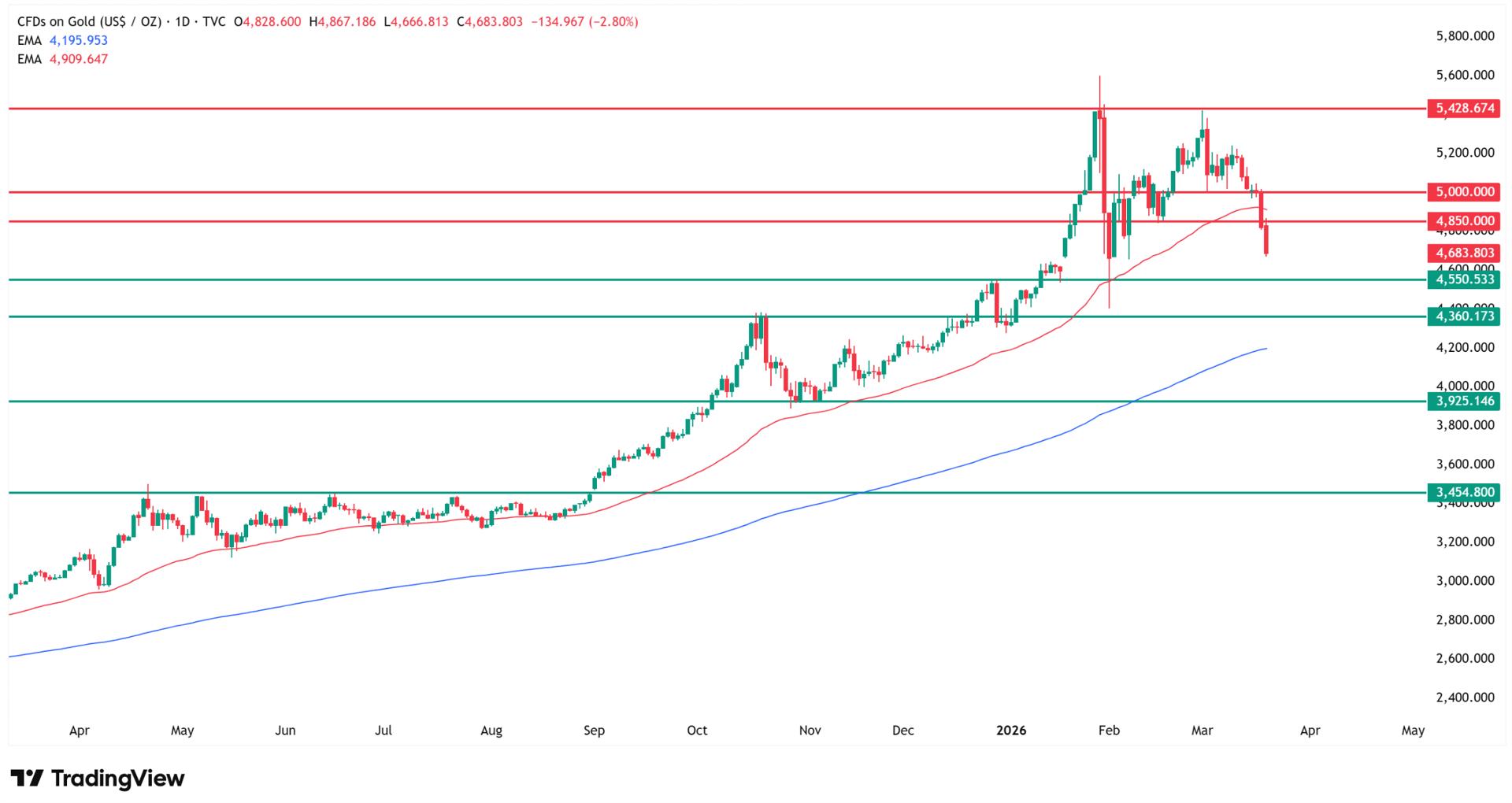
Why gold price is going down today? Source: Tradingview.com

Analyst @Kb__Officiall had been maintaining a bearish gold bias since last week, targeting $4,650 as the primary downside target while watching for a potential retracement to $5,080 before the next leg lower - a level that has now been blown past entirely.

His framework, which generated 12,100 views, is playing out faster than even he anticipated.

Level

Type

Notes

$5,600

All-time high (Jan 2026)

Gold -16% from here

$5,000

Broken psychological support

Lost Wednesday, now resistance

$4,700

Current price (Mar 19)

-6% in two sessions, 6-week low

$4,550

First bear target

Late 2025 historical highs

$4,360

Second bear target

Prior consolidation zone

$4,200

200-day EMA (bull/bear line)

Last below here: late 2023

$3,500

Extreme bear target

2025 rally starting point, -25%+

Silver Is Falling Harder Than Gold

As my earlier silver analysis warned, silver amplifies gold's moves in both directions - and Thursday's session is proving that rule. Silver has fallen more sharply than gold in percentage terms, and according to the Saxo Bank commodities report from Ole Hansen, "silver may face a deeper retracement" due to its "higher sensitivity to economic growth and industrial demand, combined with rising concerns that energy-driven inflation will dent global activity."

The crowded speculative positions that built up during the January $121 spike are still being unwound, and the broader risk-off tone is accelerating exits.

My silver chart from Tuesday remains valid: the $80 support and 50 EMA are the immediate battleground. A break below $70 - the lower consolidation boundary - activates the path toward the 200-day MA at $60 and ultimately the October 2025 historical highs at $54.

Dilin Wu of Pepperstone adds that copper is also trading lower and "adding to growth worries" - when industrial metals fall in unison, it signals that the market is pricing in genuine demand destruction, not just a monetary policy adjustment.

Gold Price Predictions 2026: The Full Range

The 6% two-day decline has not materially shifted the major institutional forecasts, which were built on year-end rather than near-term targets. However, the technical damage done to the chart warrants a full reassessment of the downside scenarios.

Source

Gold Target 2026

Notes

My chart (extreme bear)

$3,500

If 200 EMA at $4,200 breaks, -25%+

My chart (bear targets)

$4,360 then $4,200

Sequential support levels

@Kb__Officiall

$4,650

Weekly downside target

World Gold Council

+5-15% from current

$4,935-$5,405 scenario

JP Morgan

$5,000 (Q4 2026)

Central bank buying thesis

Goldman Sachs

$6,000

Dollar weakness, rate cuts

Robert Kiyosaki

$35,000

One year post "bubble bust"

FAQ

Why is gold crashing today, March 19, 2026?

Gold is falling for the second consecutive session after Wednesday's Federal Reserve decision delivered a hawkish hold: rates were kept at 3.5%-3.75% while the dot plot was revised to show only one rate cut in all of 2026, down from two. Hotter-than-expected February PPI at +0.7% pushed Treasury yields to 4.2% and the dollar toward 99.9, both direct headwinds for non-yielding gold.

How low can gold go in 2026?

As shown on my chart, the sequential downside targets are $4,550 (late 2025 historical highs), then $4,360 (prior consolidation), and then the 200-day EMA at $4,200 - the critical bull/bear dividing line. A sustained break below $4,200 opens the path toward $3,500, the starting point of the entire 2025-2026 rally, representing a decline of over 25% from Thursday's $4,700. @Kb__Officiall targets $4,650 as the near-term downside with potential for further weakness, while Mike McGlone warns that gold may have shifted from safe-haven to speculative risk asset.

Is the gold bull market over?

Not according to the institutional consensus. JP Morgan maintains its $5,000 Q4 2026 target, Goldman Sachs holds its $6,000 forecast, and Dilin Wu of Pepperstone describes the current decline as "a pricing logic adjustment rather than a reversal of the long-term trend." The structural supports - central bank buying, US fiscal deficits, and geopolitical risk - remain intact.

What is the gold price prediction for 2026?

The institutional range runs from the World Gold Council's conservative 5-15% upside scenario from current levels to Goldman Sachs' $6,000 target and Robert Kiyosaki's extraordinary $35,000 post-bubble-bust forecast. JP Morgan's base case of $5,000 by Q4 2026 is the most credible near-term institutional target. On the bear side, my chart's $3,500 extreme scenario and @Kb__Officiall's $4,650 near-term target represent the downside framework.

Gold price is in freefall. After spending the better part of 2026 consolidating near all-time highs above $5,000, the yellow metal has lost approximately 6% in two consecutive sessions, crashing through the psychologically critical $5,000 barrier on Wednesday and extending the decline to $4,700 per ounce on Thursday, March 19, 2026, the lowest price since early February.

In this article, I will break down the technical analysis of the XAU/USD, examine the mechanics behind this week's crash, and present the key gold price predictions for 2026 , including where the real floor is if the selling continues. Based on my 15 years of experience as an analyst and retail investor, here is what I am watching.

Follow me on X for real-time gold market analysis: @ChmielDk

Why Gold Is Crashing? The Fed Pulled the Rug

Wednesday's FOMC decision was a hold, as expected - Polymarket had it at over 90% probability and the market was fully prepared for no rate movement. What the market was not prepared for was the hawkish tone of the dot plot. The Fed trimmed its 2026 rate cut projections from two cuts to one, citing hotter-than-expected producer inflation - February's PPI came in at +0.7%, well above consensus - and signalled that the Strait of Hormuz-driven oil spike is creating inflation persistence that prevents easing.

The 10-year Treasury yield jumped to 4.2%, the Dollar Index climbed toward 99.9, and gold - a non-yielding asset whose entire bull thesis rested on falling real yields and a weakening dollar - repriced accordingly.

As Dilin Wu, Research Strategist at Pepperstone, frames it: "This sharp decline in gold reflects a confluence of factors - large-scale risk asset liquidations, a hawkish shift in Fed expectations, and a stronger dollar." Crucially, he views this as "a pricing logic adjustment rather than a reversal of the long-term trend."

The technical break below the 50-day MA near $4,978 and below the $5,000 round level triggered momentum selling and profit-taking from a crowded long, amplifying what was already a fundamental repricing.

The irony noted by my earlier gold analysis remains fully applicable: gold is being sold during an active Middle East conflict precisely because the oil shock from that conflict is now hurting gold's prospects by reigniting inflation and forcing the Fed to stay hawkish. Higher oil means higher inflation means higher-for-longer rates means gold suffers despite the geopolitical backdrop that should theoretically support it.

Bloomberg Intelligence's Mike McGlone identified this paradox earlier this week: "Gold's best year in 2025 since 1979 - unequalled in a relatively low-inflation environment - looks prescient ahead of 2026's closure of the Strait of Hormuz, with peak-price inklings.

The surge to multiyear extremes vs. most moving averages and broad commodities may suggest the store of value has shifted to a speculative risk asset." That framing - gold as speculative risk asset rather than pure safe haven - is the most bearish structural argument currently circulating, and the two-day crash gives it uncomfortable credibility.

Gold Technical Analysis: The Levels That Matter Now

As my technical analysis shows, gold's two-day, 6% decline has materially changed the chart structure. The consolidation near the all-time highs that I described in Tuesday's analysis has been broken to the downside, and the move has opened up a sequence of support targets that were previously theoretical but are now directly in play.

The first support I am watching is $4,550 - the late 2025 historical highs that marked the peak before the January blow-off to $5,600. This was an area of significant buying last year and should attract some demand on the first test. Below that, $4,360 is the next meaningful level, representing a prior consolidation zone and Fibonacci retracement target.

The level that matters most on my entire gold chart is the 200-day EMA at approximately $4,200. That is the boundary separating a bull trend from a bear trend, and gold has not traded below it since late 2023. A sustained break below $4,200 would be a genuinely significant technical event. It would open the path toward $3,500 per ounce - the lows from which the current near-uninterrupted rally to $5,600 began. From Thursday's $4,700, that scenario implies a further decline of over 25% and would represent the most severe gold correction since the 2022 Fed tightening cycle.

Why gold price is going down today? Source: Tradingview.com

Analyst @Kb__Officiall had been maintaining a bearish gold bias since last week, targeting $4,650 as the primary downside target while watching for a potential retracement to $5,080 before the next leg lower - a level that has now been blown past entirely.

His framework, which generated 12,100 views, is playing out faster than even he anticipated.

Level

Type

Notes

$5,600

All-time high (Jan 2026)

Gold -16% from here

$5,000

Broken psychological support

Lost Wednesday, now resistance

$4,700

Current price (Mar 19)

-6% in two sessions, 6-week low

$4,550

First bear target

Late 2025 historical highs

$4,360

Second bear target

Prior consolidation zone

$4,200

200-day EMA (bull/bear line)

Last below here: late 2023

$3,500

Extreme bear target

2025 rally starting point, -25%+

Silver Is Falling Harder Than Gold

As my earlier silver analysis warned, silver amplifies gold's moves in both directions - and Thursday's session is proving that rule. Silver has fallen more sharply than gold in percentage terms, and according to the Saxo Bank commodities report from Ole Hansen, "silver may face a deeper retracement" due to its "higher sensitivity to economic growth and industrial demand, combined with rising concerns that energy-driven inflation will dent global activity."

The crowded speculative positions that built up during the January $121 spike are still being unwound, and the broader risk-off tone is accelerating exits.

My silver chart from Tuesday remains valid: the $80 support and 50 EMA are the immediate battleground. A break below $70 - the lower consolidation boundary - activates the path toward the 200-day MA at $60 and ultimately the October 2025 historical highs at $54.

Dilin Wu of Pepperstone adds that copper is also trading lower and "adding to growth worries" - when industrial metals fall in unison, it signals that the market is pricing in genuine demand destruction, not just a monetary policy adjustment.

Gold Price Predictions 2026: The Full Range

The 6% two-day decline has not materially shifted the major institutional forecasts, which were built on year-end rather than near-term targets. However, the technical damage done to the chart warrants a full reassessment of the downside scenarios.

Source

Gold Target 2026

Notes

My chart (extreme bear)

$3,500

If 200 EMA at $4,200 breaks, -25%+

My chart (bear targets)

$4,360 then $4,200

Sequential support levels

@Kb__Officiall

$4,650

Weekly downside target

World Gold Council

+5-15% from current

$4,935-$5,405 scenario

JP Morgan

$5,000 (Q4 2026)

Central bank buying thesis

Goldman Sachs

$6,000

Dollar weakness, rate cuts

Robert Kiyosaki

$35,000

One year post "bubble bust"

FAQ

Why is gold crashing today, March 19, 2026?

Gold is falling for the second consecutive session after Wednesday's Federal Reserve decision delivered a hawkish hold: rates were kept at 3.5%-3.75% while the dot plot was revised to show only one rate cut in all of 2026, down from two. Hotter-than-expected February PPI at +0.7% pushed Treasury yields to 4.2% and the dollar toward 99.9, both direct headwinds for non-yielding gold.

How low can gold go in 2026?

As shown on my chart, the sequential downside targets are $4,550 (late 2025 historical highs), then $4,360 (prior consolidation), and then the 200-day EMA at $4,200 - the critical bull/bear dividing line. A sustained break below $4,200 opens the path toward $3,500, the starting point of the entire 2025-2026 rally, representing a decline of over 25% from Thursday's $4,700. @Kb__Officiall targets $4,650 as the near-term downside with potential for further weakness, while Mike McGlone warns that gold may have shifted from safe-haven to speculative risk asset.

Is the gold bull market over?

Not according to the institutional consensus. JP Morgan maintains its $5,000 Q4 2026 target, Goldman Sachs holds its $6,000 forecast, and Dilin Wu of Pepperstone describes the current decline as "a pricing logic adjustment rather than a reversal of the long-term trend." The structural supports - central bank buying, US fiscal deficits, and geopolitical risk - remain intact.

What is the gold price prediction for 2026?

The institutional range runs from the World Gold Council's conservative 5-15% upside scenario from current levels to Goldman Sachs' $6,000 target and Robert Kiyosaki's extraordinary $35,000 post-bubble-bust forecast. JP Morgan's base case of $5,000 by Q4 2026 is the most credible near-term institutional target. On the bear side, my chart's $3,500 extreme scenario and @Kb__Officiall's $4,650 near-term target represent the downside framework.

About the Author: Damian Chmiel
Damian Chmiel
  • 3348 Articles
  • 105 Followers
About the Author: Damian Chmiel
Damian Chmiel is a Senior Analyst & Editor at Finance Magnates with more than 15 years of experience in the CFD and online trading industry. Active as both a trader and journalist since 2010, he focuses on broker coverage, fintech innovation, and regulatory developments across Europe, the Middle East, and Asia. His work includes interviews with C-level leaders at major brokerages and fintech platforms, as well as co-authoring Finance Magnates’ quarterly industry benchmarking reports. Damian’s reporting is data-driven, market-aware, and grounded in direct industry engagement. His analysis and commentary have also been cited by external media outlets, including Investing.com, Binance, The Asset, Stockhead, and Dispatch. Education: MA in Finance and Accounting, Cracow University of Economics
  • 3348 Articles
  • 105 Followers

More from the Author

Trending

!"#$%&'()*+,-./0123456789:;<=>?@ABCDEFGHIJKLMNOPQRSTUVWXYZ[\]^_`abcdefghijklmnopqrstuvwxyz{|} !"#$%&'()*+,-./0123456789:;<=>?@ABCDEFGHIJKLMNOPQRSTUVWXYZ[\]^_`abcdefghijklmnopqrstuvwxyz{|}