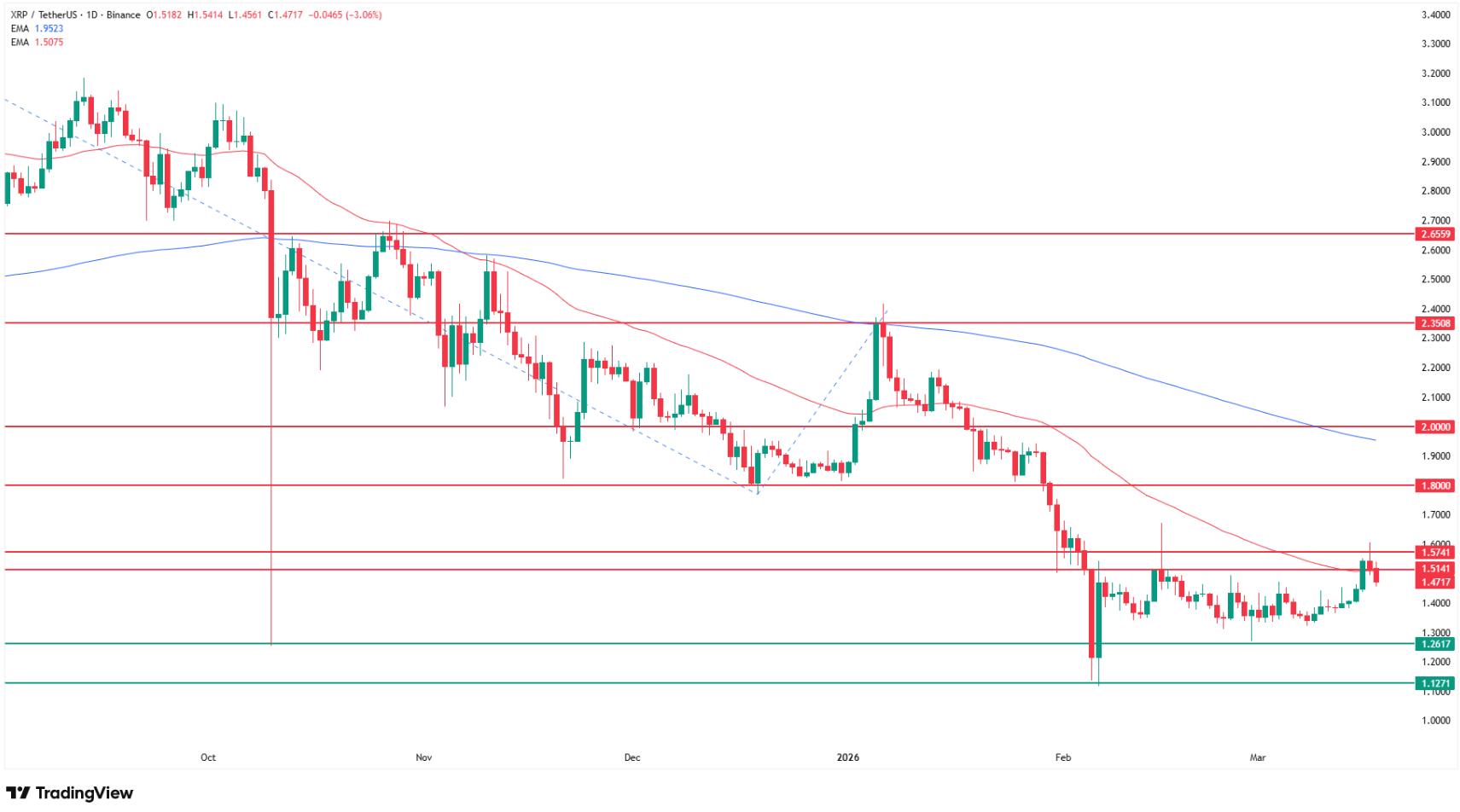
XRP tested $1.60 on Tuesday, March 17, before a bearish pin bar rejection at the top of the six-week consolidation sent it 3.3% lower today.
Technical analysis identifies this as a classic swing trade signal pointing toward a potential 23% decline from current levels.
However, XRP price predictions for 2026 span from $5 to $1,000.
What is the current XRP price today? Let's check the technical analysis and the price predictions
XRP price had
its moment on Tuesday. It climbed to $1.60 per coin, the highest
price since February 15, and for a few hours it looked like the six-week
consolidation was finally breaking upward. Then the sellers arrived. By the end
of Tuesday's session, XRP had given back the gains and closed down 1.6%.
Wednesday,
March 18, brought a further 3.3% decline. On the chart, the result
is a textbook bearish pin bar forming precisely at the upper
boundary of the range that has defined XRP since late January.
In this
article, I will break down the technical analysis of the XRP/USDT chart,
examine what the Fed decision means for the token today, and compile the most
significant XRP price predictions for 2026: from the measured to the
extraordinary. Based on my over 15 years of experience as an analyst and retail
investor, here is what I am watching.
Follow
me on X for real-time crypto market analysis: @ChmielDk.
Why XRP Is Falling Today? The
Pin Bar Signal
The price
action on Tuesday and Wednesday is telling a clear technical story. XRP
tested $1.60 - the upper boundary of the consolidation range
that has been in place for over a month and a half - and was immediately and
forcefully rejected.
The
resulting bearish pin bar on the daily chart is one of the cleaner reversal
signals I have seen on this chart in 2026. It mirrors what happened
approximately a month ago at the same level, when an identical rejection sent
XRP back toward the lower boundary. The pattern is repeating.
That
rejection also has a macro component. Paul Howard, Senior Director at Wincent,
frames the broader environment precisely ahead of today's Fed decision:
"The macro pendulum is swinging towards a rising inflationary environment,
thus slimming the chance of rate cuts."
He notes
that Polymarket assigned over 90% probability to rates staying
unchanged at Wednesday's meeting - and crucially, adds that "certainty
helps those borrowing dollars to invest," making the hold itself broadly
positive for crypto pricing even without a cut.
The issue
for XRP specifically is that a hold without dovish language leaves the dollar
firm and rate cut expectations subdued, which removes one of the key tailwinds
that lifted XRP from its February lows toward $1.60.
XRP Price Technical
Analysis: Targeting the Lower Boundary
To
invalidate this bearish scenario, XRP needs to do two things on my chart: break
above $1.60 and hold above the 50-day MA on a closing basis. That has
not happened. Every attempt at the upper boundary - both a month ago and again
this week - has been sold. The pattern of lower-high formations remains intact.
If XRP does
break higher convincingly, the next resistance levels are $1.80 (the
November-December 2025 lows that acted as a floor during that period) and
ultimately $2.00 - a level that is not only a round
psychological number but also where the 200-day EMA is
running.
Why XRP price is going down today? Source: Tradingview.com
The 200 EMA
is the level that separates the downtrend from a genuine trend reversal. XRP
has been trading below it continuously since November 2025. Until that changes,
every rally is a counter-trend move operating against the primary direction of
the market.
Level
Type
Notes
$2.00
200 EMA / bull-bear line
Below
since Nov 2025, ultimate bull test
$1.80
Key resistance
Nov-Dec
2025 lows, prior floor
$1.65-$1.70
Zone 1 (EGRAG)
Breakout trigger level
$1.60
Upper consolidation / rejection
Bearish
pin bar formed here Tuesday
$1.43
Current price (Mar 18)
-3.3% Wednesday
$1.26
Lower target 1
Oct 2025 flash crash lows
$1.13
Lower target 2
Feb 2026 lows, -23% from current
XRP Price Forecasts
EGRAG Crypto: Zone 1 Is
the Trigger, Zone 2 Is the Prize
One of the
most followed XRP technical analysts on X, EGRAG Crypto, published a detailed
chart analysis today that maps the exact zone my own chart identifies as
critical. He sees an ascending triangle forming under Zone 1 at
$1.65-$1.70, characterised by higher lows building buying pressure against
a flat resistance ceiling - "classic breakout fuel" in his framing.
#XRP - #BTC Structure vs Trigger: #XRP Not Confirmed, #XRP/#BTC Holding & #BTC EMA Battle Begins
His
probability breakdown is worth noting directly: he assigns a 65%
probability to a break above Zone 1 supported by momentum compression,
and a 35% probability to a rejection or fakeout, particularly if
the Clarity Act is postponed.
The
catalyst he identifies for Zone 1 is precisely the same regulatory story that
Paul Howard flagged: "Clarity Act unlocks breakout above Zone 1." But
he is equally clear that Zone 1 alone is not enough - to breach Zone 2
at $2.60+, XRP needs "institutional flows and ETF-style exposure, BTC
stability or dominance drop, and sustained weekly closes above
$1.85-$2.00." His summary is elegant: "Triangle = Pressure. Zone 1 =
Trigger. Zone 2 = Expansion."
XRP Price Predictions
2026: From $5 to $1,000
The
forecast range for XRP in 2026 spans a remarkable spectrum, and it is worth
presenting both the technically grounded and the community-driven extremes
honestly.
Okay people. Here is the exact path for #XRP in 2026. We are in a five wave broadening pattern. Wave C is finished and we are about to start wave D to $5. Next will be a correction to $0.78 before a move up to $27. pic.twitter.com/Ca0XJiui75
Archie_XRPL represents
the XRP Army's community consensus with characteristic confidence: "$10
minimum, $100 realistic, $1,000 if the stars align." The $10 target
requires roughly a 600% rally from current levels. The $100 target would put
XRP's market cap above Bitcoin's current valuation.
The $1,000
scenario would make XRP the largest financial asset on the planet by a wide
margin - a scenario that requires both the full $200 trillion tokenization
thesis materialising on the XRP Ledger and a simultaneous collapse in every
competing asset.
XRP Army prediction for 2026🚨
$10 minimum, $100 realistic, $1,000 if the stars align.
The
institutional consensus sits considerably lower. Standard Chartered's Geoffrey
Kendrick maintains an $8.00 target for 2026 contingent on Clarity Act passage
and XRP ETF approval. 21Shares' base case of $2.45 remains the most credible
near-term institutional forecast.
The gap
between the community's $100-$1,000 and the institutions' $2.45-$8.00 is itself
the story of where XRP sits in 2026 - a token with extraordinary structural
potential and an equally extraordinary distance between current reality and
bull case fantasy.
XRP formed
a bearish pin bar rejection at the $1.60 upper consolidation boundary on
Tuesday March 17, the same level that rejected the rally approximately one
month earlier, and is falling 3.3% on Wednesday March 18 in a classic
swing-trade reversion toward the lower range boundary.
How low can XRP go in the
near term?
As shown on
my chart, the swing trade target from the bearish pin bar rejection is
the lower consolidation boundary at $1.13-$1.26 - defined by
the October 2025 flash crash lows ($1.26) and the February 2026 lows just below
$1.13. That represents approximately 23% downside from
Wednesday's price and would push XRP to its lowest level since November 2024.
The bear scenario is invalidated by a sustained daily close above $1.60 and the
50-day MA.
How high can XRP go in
2026?
EGRAG
Crypto's ascending triangle maps the immediate path: Zone 1 at $1.65-$1.70 is
the breakout trigger (65% probability), with Zone 2 at $2.60+ requiring
institutional ETF flows and BTC stability. My chart shows $1.80 and then the
200-day MA at $2.00 as the key levels above the consolidation.
Standard Chartered's $8.00 remains the institutional bull case target
contingent on Clarity Act passage, while CryptoBull2020's Elliott Wave analysis
projects $27 as the Wave E target after a correction to $0.78.
What is the XRP price
prediction for the rest of 2026?
The range
runs from 21Shares' base case of $2.45 to the community
consensus of $10-$100, with the structural differentiator being Clarity Act
passage and XRP ETF approval. EGRAG Crypto's Zone 2 at $2.60+ is the most
technically grounded near-term bull target. CryptoBull2020's $5 Wave D target
and Standard Chartered's $8.00 represent the institutional-to-optimistic middle
ground. The previous XRP
price analysis targeting $315 via the tokenization thesis requires the XRP Ledger
capturing a proportional share of the $200 trillion tokenized asset market - a
multi-year scenario rather than a 2026 price target.
XRP price had
its moment on Tuesday. It climbed to $1.60 per coin, the highest
price since February 15, and for a few hours it looked like the six-week
consolidation was finally breaking upward. Then the sellers arrived. By the end
of Tuesday's session, XRP had given back the gains and closed down 1.6%.
Wednesday,
March 18, brought a further 3.3% decline. On the chart, the result
is a textbook bearish pin bar forming precisely at the upper
boundary of the range that has defined XRP since late January.
In this
article, I will break down the technical analysis of the XRP/USDT chart,
examine what the Fed decision means for the token today, and compile the most
significant XRP price predictions for 2026: from the measured to the
extraordinary. Based on my over 15 years of experience as an analyst and retail
investor, here is what I am watching.
Follow
me on X for real-time crypto market analysis: @ChmielDk.
Why XRP Is Falling Today? The
Pin Bar Signal
The price
action on Tuesday and Wednesday is telling a clear technical story. XRP
tested $1.60 - the upper boundary of the consolidation range
that has been in place for over a month and a half - and was immediately and
forcefully rejected.
The
resulting bearish pin bar on the daily chart is one of the cleaner reversal
signals I have seen on this chart in 2026. It mirrors what happened
approximately a month ago at the same level, when an identical rejection sent
XRP back toward the lower boundary. The pattern is repeating.
That
rejection also has a macro component. Paul Howard, Senior Director at Wincent,
frames the broader environment precisely ahead of today's Fed decision:
"The macro pendulum is swinging towards a rising inflationary environment,
thus slimming the chance of rate cuts."
He notes
that Polymarket assigned over 90% probability to rates staying
unchanged at Wednesday's meeting - and crucially, adds that "certainty
helps those borrowing dollars to invest," making the hold itself broadly
positive for crypto pricing even without a cut.
The issue
for XRP specifically is that a hold without dovish language leaves the dollar
firm and rate cut expectations subdued, which removes one of the key tailwinds
that lifted XRP from its February lows toward $1.60.
XRP Price Technical
Analysis: Targeting the Lower Boundary
To
invalidate this bearish scenario, XRP needs to do two things on my chart: break
above $1.60 and hold above the 50-day MA on a closing basis. That has
not happened. Every attempt at the upper boundary - both a month ago and again
this week - has been sold. The pattern of lower-high formations remains intact.
If XRP does
break higher convincingly, the next resistance levels are $1.80 (the
November-December 2025 lows that acted as a floor during that period) and
ultimately $2.00 - a level that is not only a round
psychological number but also where the 200-day EMA is
running.
Why XRP price is going down today? Source: Tradingview.com
The 200 EMA
is the level that separates the downtrend from a genuine trend reversal. XRP
has been trading below it continuously since November 2025. Until that changes,
every rally is a counter-trend move operating against the primary direction of
the market.
Level
Type
Notes
$2.00
200 EMA / bull-bear line
Below
since Nov 2025, ultimate bull test
$1.80
Key resistance
Nov-Dec
2025 lows, prior floor
$1.65-$1.70
Zone 1 (EGRAG)
Breakout trigger level
$1.60
Upper consolidation / rejection
Bearish
pin bar formed here Tuesday
$1.43
Current price (Mar 18)
-3.3% Wednesday
$1.26
Lower target 1
Oct 2025 flash crash lows
$1.13
Lower target 2
Feb 2026 lows, -23% from current
XRP Price Forecasts
EGRAG Crypto: Zone 1 Is
the Trigger, Zone 2 Is the Prize
One of the
most followed XRP technical analysts on X, EGRAG Crypto, published a detailed
chart analysis today that maps the exact zone my own chart identifies as
critical. He sees an ascending triangle forming under Zone 1 at
$1.65-$1.70, characterised by higher lows building buying pressure against
a flat resistance ceiling - "classic breakout fuel" in his framing.
#XRP - #BTC Structure vs Trigger: #XRP Not Confirmed, #XRP/#BTC Holding & #BTC EMA Battle Begins
His
probability breakdown is worth noting directly: he assigns a 65%
probability to a break above Zone 1 supported by momentum compression,
and a 35% probability to a rejection or fakeout, particularly if
the Clarity Act is postponed.
The
catalyst he identifies for Zone 1 is precisely the same regulatory story that
Paul Howard flagged: "Clarity Act unlocks breakout above Zone 1." But
he is equally clear that Zone 1 alone is not enough - to breach Zone 2
at $2.60+, XRP needs "institutional flows and ETF-style exposure, BTC
stability or dominance drop, and sustained weekly closes above
$1.85-$2.00." His summary is elegant: "Triangle = Pressure. Zone 1 =
Trigger. Zone 2 = Expansion."
XRP Price Predictions
2026: From $5 to $1,000
The
forecast range for XRP in 2026 spans a remarkable spectrum, and it is worth
presenting both the technically grounded and the community-driven extremes
honestly.
Okay people. Here is the exact path for #XRP in 2026. We are in a five wave broadening pattern. Wave C is finished and we are about to start wave D to $5. Next will be a correction to $0.78 before a move up to $27. pic.twitter.com/Ca0XJiui75
Archie_XRPL represents
the XRP Army's community consensus with characteristic confidence: "$10
minimum, $100 realistic, $1,000 if the stars align." The $10 target
requires roughly a 600% rally from current levels. The $100 target would put
XRP's market cap above Bitcoin's current valuation.
The $1,000
scenario would make XRP the largest financial asset on the planet by a wide
margin - a scenario that requires both the full $200 trillion tokenization
thesis materialising on the XRP Ledger and a simultaneous collapse in every
competing asset.
XRP Army prediction for 2026🚨
$10 minimum, $100 realistic, $1,000 if the stars align.
The
institutional consensus sits considerably lower. Standard Chartered's Geoffrey
Kendrick maintains an $8.00 target for 2026 contingent on Clarity Act passage
and XRP ETF approval. 21Shares' base case of $2.45 remains the most credible
near-term institutional forecast.
The gap
between the community's $100-$1,000 and the institutions' $2.45-$8.00 is itself
the story of where XRP sits in 2026 - a token with extraordinary structural
potential and an equally extraordinary distance between current reality and
bull case fantasy.
XRP formed
a bearish pin bar rejection at the $1.60 upper consolidation boundary on
Tuesday March 17, the same level that rejected the rally approximately one
month earlier, and is falling 3.3% on Wednesday March 18 in a classic
swing-trade reversion toward the lower range boundary.
How low can XRP go in the
near term?
As shown on
my chart, the swing trade target from the bearish pin bar rejection is
the lower consolidation boundary at $1.13-$1.26 - defined by
the October 2025 flash crash lows ($1.26) and the February 2026 lows just below
$1.13. That represents approximately 23% downside from
Wednesday's price and would push XRP to its lowest level since November 2024.
The bear scenario is invalidated by a sustained daily close above $1.60 and the
50-day MA.
How high can XRP go in
2026?
EGRAG
Crypto's ascending triangle maps the immediate path: Zone 1 at $1.65-$1.70 is
the breakout trigger (65% probability), with Zone 2 at $2.60+ requiring
institutional ETF flows and BTC stability. My chart shows $1.80 and then the
200-day MA at $2.00 as the key levels above the consolidation.
Standard Chartered's $8.00 remains the institutional bull case target
contingent on Clarity Act passage, while CryptoBull2020's Elliott Wave analysis
projects $27 as the Wave E target after a correction to $0.78.
What is the XRP price
prediction for the rest of 2026?
The range
runs from 21Shares' base case of $2.45 to the community
consensus of $10-$100, with the structural differentiator being Clarity Act
passage and XRP ETF approval. EGRAG Crypto's Zone 2 at $2.60+ is the most
technically grounded near-term bull target. CryptoBull2020's $5 Wave D target
and Standard Chartered's $8.00 represent the institutional-to-optimistic middle
ground. The previous XRP
price analysis targeting $315 via the tokenization thesis requires the XRP Ledger
capturing a proportional share of the $200 trillion tokenized asset market - a
multi-year scenario rather than a 2026 price target.
Damian Chmiel is a Senior Analyst & Editor at Finance Magnates with more than 15 years of experience in the CFD and online trading industry. Active as both a trader and journalist since 2010, he focuses on broker coverage, fintech innovation, and regulatory developments across Europe, the Middle East, and Asia.
His work includes interviews with C-level leaders at major brokerages and fintech platforms, as well as co-authoring Finance Magnates’ quarterly industry benchmarking reports. Damian’s reporting is data-driven, market-aware, and grounded in direct industry engagement. His analysis and commentary have also been cited by external media outlets, including Investing.com, Binance, The Asset, Stockhead, and Dispatch.
Education:
MA in Finance and Accounting, Cracow University of Economics
Exness sees trust as the key theme for growth in MENA Trading Growth for 2026
Exness sees trust as the key theme for growth in MENA Trading Growth for 2026
Exness sees trust as the key theme for growth in MENA Trading Growth for 2026
Exness sees trust as the key theme for growth in MENA Trading Growth for 2026
Exness sees trust as the key theme for growth in MENA Trading Growth for 2026
Exness sees trust as the key theme for growth in MENA Trading Growth for 2026
Mohammad Amer, Regional Commercial Director at Exness, sits down to discuss the booming MENA financial trading market. Find out why Dubai is key to the company's growth strategy, how a mobile-first generation is changing expectations, and why trust will be the defining theme for traders in 2026.
In this interview, you'll learn:
* Why Dubai and the MENA region are critical growth markets for fintech and online trading.
* How Exness is addressing the demands of mobile-first, younger traders through engineering, platform stability, and transparent conditions.
* The essential role local talent plays in providing a culturally relevant and compliant user experience.
* Mohammad Amer's outlook on the future of the online trading industry and why stronger controls and systems are necessary.
* Why "trust" isn't just a brand value, but has commercial value—and why he predicts 2026 will be the "Year of Trust."
Key Takeaways:
➡️ The MENA region is rapidly shaping global financial markets.
➡️ New traders expect stability, precise execution, and transparency.
➡️ Local expertise is key to regulatory compliance and user experience.
➡️ Future success belongs to firms capable of meeting rising standards across regulation and platform consistency.
Read the full article at: https://www.financemagnates.com/thought-leadership/exness-sees-trust-as-the-key-theme-for-growth-in-mena-trading-growth-for-2026/
#Exness #MENA #Trading #FinTech #Dubai #OnlineTrading #FinanceMagnates #MohammadAmer #Trust #MobileTrading
Mohammad Amer, Regional Commercial Director at Exness, sits down to discuss the booming MENA financial trading market. Find out why Dubai is key to the company's growth strategy, how a mobile-first generation is changing expectations, and why trust will be the defining theme for traders in 2026.
In this interview, you'll learn:
* Why Dubai and the MENA region are critical growth markets for fintech and online trading.
* How Exness is addressing the demands of mobile-first, younger traders through engineering, platform stability, and transparent conditions.
* The essential role local talent plays in providing a culturally relevant and compliant user experience.
* Mohammad Amer's outlook on the future of the online trading industry and why stronger controls and systems are necessary.
* Why "trust" isn't just a brand value, but has commercial value—and why he predicts 2026 will be the "Year of Trust."
Key Takeaways:
➡️ The MENA region is rapidly shaping global financial markets.
➡️ New traders expect stability, precise execution, and transparency.
➡️ Local expertise is key to regulatory compliance and user experience.
➡️ Future success belongs to firms capable of meeting rising standards across regulation and platform consistency.
Read the full article at: https://www.financemagnates.com/thought-leadership/exness-sees-trust-as-the-key-theme-for-growth-in-mena-trading-growth-for-2026/
#Exness #MENA #Trading #FinTech #Dubai #OnlineTrading #FinanceMagnates #MohammadAmer #Trust #MobileTrading
Mohammad Amer, Regional Commercial Director at Exness, sits down to discuss the booming MENA financial trading market. Find out why Dubai is key to the company's growth strategy, how a mobile-first generation is changing expectations, and why trust will be the defining theme for traders in 2026.
In this interview, you'll learn:
* Why Dubai and the MENA region are critical growth markets for fintech and online trading.
* How Exness is addressing the demands of mobile-first, younger traders through engineering, platform stability, and transparent conditions.
* The essential role local talent plays in providing a culturally relevant and compliant user experience.
* Mohammad Amer's outlook on the future of the online trading industry and why stronger controls and systems are necessary.
* Why "trust" isn't just a brand value, but has commercial value—and why he predicts 2026 will be the "Year of Trust."
Key Takeaways:
➡️ The MENA region is rapidly shaping global financial markets.
➡️ New traders expect stability, precise execution, and transparency.
➡️ Local expertise is key to regulatory compliance and user experience.
➡️ Future success belongs to firms capable of meeting rising standards across regulation and platform consistency.
Read the full article at: https://www.financemagnates.com/thought-leadership/exness-sees-trust-as-the-key-theme-for-growth-in-mena-trading-growth-for-2026/
#Exness #MENA #Trading #FinTech #Dubai #OnlineTrading #FinanceMagnates #MohammadAmer #Trust #MobileTrading
Mohammad Amer, Regional Commercial Director at Exness, sits down to discuss the booming MENA financial trading market. Find out why Dubai is key to the company's growth strategy, how a mobile-first generation is changing expectations, and why trust will be the defining theme for traders in 2026.
In this interview, you'll learn:
* Why Dubai and the MENA region are critical growth markets for fintech and online trading.
* How Exness is addressing the demands of mobile-first, younger traders through engineering, platform stability, and transparent conditions.
* The essential role local talent plays in providing a culturally relevant and compliant user experience.
* Mohammad Amer's outlook on the future of the online trading industry and why stronger controls and systems are necessary.
* Why "trust" isn't just a brand value, but has commercial value—and why he predicts 2026 will be the "Year of Trust."
Key Takeaways:
➡️ The MENA region is rapidly shaping global financial markets.
➡️ New traders expect stability, precise execution, and transparency.
➡️ Local expertise is key to regulatory compliance and user experience.
➡️ Future success belongs to firms capable of meeting rising standards across regulation and platform consistency.
Read the full article at: https://www.financemagnates.com/thought-leadership/exness-sees-trust-as-the-key-theme-for-growth-in-mena-trading-growth-for-2026/
#Exness #MENA #Trading #FinTech #Dubai #OnlineTrading #FinanceMagnates #MohammadAmer #Trust #MobileTrading
Mohammad Amer, Regional Commercial Director at Exness, sits down to discuss the booming MENA financial trading market. Find out why Dubai is key to the company's growth strategy, how a mobile-first generation is changing expectations, and why trust will be the defining theme for traders in 2026.
In this interview, you'll learn:
* Why Dubai and the MENA region are critical growth markets for fintech and online trading.
* How Exness is addressing the demands of mobile-first, younger traders through engineering, platform stability, and transparent conditions.
* The essential role local talent plays in providing a culturally relevant and compliant user experience.
* Mohammad Amer's outlook on the future of the online trading industry and why stronger controls and systems are necessary.
* Why "trust" isn't just a brand value, but has commercial value—and why he predicts 2026 will be the "Year of Trust."
Key Takeaways:
➡️ The MENA region is rapidly shaping global financial markets.
➡️ New traders expect stability, precise execution, and transparency.
➡️ Local expertise is key to regulatory compliance and user experience.
➡️ Future success belongs to firms capable of meeting rising standards across regulation and platform consistency.
Read the full article at: https://www.financemagnates.com/thought-leadership/exness-sees-trust-as-the-key-theme-for-growth-in-mena-trading-growth-for-2026/
#Exness #MENA #Trading #FinTech #Dubai #OnlineTrading #FinanceMagnates #MohammadAmer #Trust #MobileTrading
Mohammad Amer, Regional Commercial Director at Exness, sits down to discuss the booming MENA financial trading market. Find out why Dubai is key to the company's growth strategy, how a mobile-first generation is changing expectations, and why trust will be the defining theme for traders in 2026.
In this interview, you'll learn:
* Why Dubai and the MENA region are critical growth markets for fintech and online trading.
* How Exness is addressing the demands of mobile-first, younger traders through engineering, platform stability, and transparent conditions.
* The essential role local talent plays in providing a culturally relevant and compliant user experience.
* Mohammad Amer's outlook on the future of the online trading industry and why stronger controls and systems are necessary.
* Why "trust" isn't just a brand value, but has commercial value—and why he predicts 2026 will be the "Year of Trust."
Key Takeaways:
➡️ The MENA region is rapidly shaping global financial markets.
➡️ New traders expect stability, precise execution, and transparency.
➡️ Local expertise is key to regulatory compliance and user experience.
➡️ Future success belongs to firms capable of meeting rising standards across regulation and platform consistency.
Read the full article at: https://www.financemagnates.com/thought-leadership/exness-sees-trust-as-the-key-theme-for-growth-in-mena-trading-growth-for-2026/
#Exness #MENA #Trading #FinTech #Dubai #OnlineTrading #FinanceMagnates #MohammadAmer #Trust #MobileTrading
Paytiko CEO Razi Salih on Why Payment Orchestration is a MUST-HAVE for Brokers in 2026
Paytiko CEO Razi Salih on Why Payment Orchestration is a MUST-HAVE for Brokers in 2026
Paytiko CEO Razi Salih on Why Payment Orchestration is a MUST-HAVE for Brokers in 2026
Paytiko CEO Razi Salih on Why Payment Orchestration is a MUST-HAVE for Brokers in 2026
Paytiko CEO Razi Salih on Why Payment Orchestration is a MUST-HAVE for Brokers in 2026
Paytiko CEO Razi Salih on Why Payment Orchestration is a MUST-HAVE for Brokers in 2026
At iFX Expo Dubai, Finance Magnates spoke with Razi Salih, CEO at Paytiko, about the evolution of the payments ecosystem and why payment orchestration has shifted from an option to a necessity for brokers, prop firms, and exchanges.
Mr. Salih explains how global expansion, the need for deep localisation, and the sheer number of new payment methods, from instant banking to stablecoins, are driving this critical infrastructure shift.
#PaymentOrchestration #Fintech #Brokerage #TradingPayments #RaziSalih #Paytiko #iFXExpoDubai #Stablecoins #AIinFintech
At iFX Expo Dubai, Finance Magnates spoke with Razi Salih, CEO at Paytiko, about the evolution of the payments ecosystem and why payment orchestration has shifted from an option to a necessity for brokers, prop firms, and exchanges.
Mr. Salih explains how global expansion, the need for deep localisation, and the sheer number of new payment methods, from instant banking to stablecoins, are driving this critical infrastructure shift.
#PaymentOrchestration #Fintech #Brokerage #TradingPayments #RaziSalih #Paytiko #iFXExpoDubai #Stablecoins #AIinFintech
At iFX Expo Dubai, Finance Magnates spoke with Razi Salih, CEO at Paytiko, about the evolution of the payments ecosystem and why payment orchestration has shifted from an option to a necessity for brokers, prop firms, and exchanges.
Mr. Salih explains how global expansion, the need for deep localisation, and the sheer number of new payment methods, from instant banking to stablecoins, are driving this critical infrastructure shift.
#PaymentOrchestration #Fintech #Brokerage #TradingPayments #RaziSalih #Paytiko #iFXExpoDubai #Stablecoins #AIinFintech
At iFX Expo Dubai, Finance Magnates spoke with Razi Salih, CEO at Paytiko, about the evolution of the payments ecosystem and why payment orchestration has shifted from an option to a necessity for brokers, prop firms, and exchanges.
Mr. Salih explains how global expansion, the need for deep localisation, and the sheer number of new payment methods, from instant banking to stablecoins, are driving this critical infrastructure shift.
#PaymentOrchestration #Fintech #Brokerage #TradingPayments #RaziSalih #Paytiko #iFXExpoDubai #Stablecoins #AIinFintech
At iFX Expo Dubai, Finance Magnates spoke with Razi Salih, CEO at Paytiko, about the evolution of the payments ecosystem and why payment orchestration has shifted from an option to a necessity for brokers, prop firms, and exchanges.
Mr. Salih explains how global expansion, the need for deep localisation, and the sheer number of new payment methods, from instant banking to stablecoins, are driving this critical infrastructure shift.
#PaymentOrchestration #Fintech #Brokerage #TradingPayments #RaziSalih #Paytiko #iFXExpoDubai #Stablecoins #AIinFintech
At iFX Expo Dubai, Finance Magnates spoke with Razi Salih, CEO at Paytiko, about the evolution of the payments ecosystem and why payment orchestration has shifted from an option to a necessity for brokers, prop firms, and exchanges.
Mr. Salih explains how global expansion, the need for deep localisation, and the sheer number of new payment methods, from instant banking to stablecoins, are driving this critical infrastructure shift.
#PaymentOrchestration #Fintech #Brokerage #TradingPayments #RaziSalih #Paytiko #iFXExpoDubai #Stablecoins #AIinFintech
Altima CTO Sunil Jadhav: Solving Data Fragmentation & Lag for Brokers & Prop Firms
Altima CTO Sunil Jadhav: Solving Data Fragmentation & Lag for Brokers & Prop Firms
Altima CTO Sunil Jadhav: Solving Data Fragmentation & Lag for Brokers & Prop Firms
Altima CTO Sunil Jadhav: Solving Data Fragmentation & Lag for Brokers & Prop Firms
Altima CTO Sunil Jadhav: Solving Data Fragmentation & Lag for Brokers & Prop Firms
Altima CTO Sunil Jadhav: Solving Data Fragmentation & Lag for Brokers & Prop Firms
Altima CTO Sunil Jadhav sits down with Finance Magnates to discuss the core technology challenges facing CFD brokers and proprietary trading firms today.
Jadhav explains how the industry's reliance on batch processing and fragmented systems (where CRMs, risk tools, and trading platforms operate with separate 'sources of truth') leads to delayed data and inconsistent operational decisions. He argues that real-time event processing is essential for managing fast-moving trading activity and risk.
Learn how Altima's unified, event-driven architecture, connecting Altima CRM, Altima Prop, IB systems, and risk management through a single backbone, is designed to provide synchronous data and better operational coordination for modern brokerage and prop firm stacks.
Key Topics:
- Broker and Prop Firm Data Challenges
- The problem of delayed data processing (batch processing vs. real-time events)
- Fragmented systems and conflicting data sources
- Altima's unified, event-driven solution architecture
- The concept of a "risk-aware CRM"
- Built-in risk management in Altima Prop
#Altima #financemagnates #iFXDubai #FinTech #BrokerTech #PropFirm #CFDBroker #TradingTechnology #RealTimeData #RiskManagement #CRM #FinancialMarkets #EventDrivenArchitecture
Altima CTO Sunil Jadhav sits down with Finance Magnates to discuss the core technology challenges facing CFD brokers and proprietary trading firms today.
Jadhav explains how the industry's reliance on batch processing and fragmented systems (where CRMs, risk tools, and trading platforms operate with separate 'sources of truth') leads to delayed data and inconsistent operational decisions. He argues that real-time event processing is essential for managing fast-moving trading activity and risk.
Learn how Altima's unified, event-driven architecture, connecting Altima CRM, Altima Prop, IB systems, and risk management through a single backbone, is designed to provide synchronous data and better operational coordination for modern brokerage and prop firm stacks.
Key Topics:
- Broker and Prop Firm Data Challenges
- The problem of delayed data processing (batch processing vs. real-time events)
- Fragmented systems and conflicting data sources
- Altima's unified, event-driven solution architecture
- The concept of a "risk-aware CRM"
- Built-in risk management in Altima Prop
#Altima #financemagnates #iFXDubai #FinTech #BrokerTech #PropFirm #CFDBroker #TradingTechnology #RealTimeData #RiskManagement #CRM #FinancialMarkets #EventDrivenArchitecture
Altima CTO Sunil Jadhav sits down with Finance Magnates to discuss the core technology challenges facing CFD brokers and proprietary trading firms today.
Jadhav explains how the industry's reliance on batch processing and fragmented systems (where CRMs, risk tools, and trading platforms operate with separate 'sources of truth') leads to delayed data and inconsistent operational decisions. He argues that real-time event processing is essential for managing fast-moving trading activity and risk.
Learn how Altima's unified, event-driven architecture, connecting Altima CRM, Altima Prop, IB systems, and risk management through a single backbone, is designed to provide synchronous data and better operational coordination for modern brokerage and prop firm stacks.
Key Topics:
- Broker and Prop Firm Data Challenges
- The problem of delayed data processing (batch processing vs. real-time events)
- Fragmented systems and conflicting data sources
- Altima's unified, event-driven solution architecture
- The concept of a "risk-aware CRM"
- Built-in risk management in Altima Prop
#Altima #financemagnates #iFXDubai #FinTech #BrokerTech #PropFirm #CFDBroker #TradingTechnology #RealTimeData #RiskManagement #CRM #FinancialMarkets #EventDrivenArchitecture
Altima CTO Sunil Jadhav sits down with Finance Magnates to discuss the core technology challenges facing CFD brokers and proprietary trading firms today.
Jadhav explains how the industry's reliance on batch processing and fragmented systems (where CRMs, risk tools, and trading platforms operate with separate 'sources of truth') leads to delayed data and inconsistent operational decisions. He argues that real-time event processing is essential for managing fast-moving trading activity and risk.
Learn how Altima's unified, event-driven architecture, connecting Altima CRM, Altima Prop, IB systems, and risk management through a single backbone, is designed to provide synchronous data and better operational coordination for modern brokerage and prop firm stacks.
Key Topics:
- Broker and Prop Firm Data Challenges
- The problem of delayed data processing (batch processing vs. real-time events)
- Fragmented systems and conflicting data sources
- Altima's unified, event-driven solution architecture
- The concept of a "risk-aware CRM"
- Built-in risk management in Altima Prop
#Altima #financemagnates #iFXDubai #FinTech #BrokerTech #PropFirm #CFDBroker #TradingTechnology #RealTimeData #RiskManagement #CRM #FinancialMarkets #EventDrivenArchitecture
Altima CTO Sunil Jadhav sits down with Finance Magnates to discuss the core technology challenges facing CFD brokers and proprietary trading firms today.
Jadhav explains how the industry's reliance on batch processing and fragmented systems (where CRMs, risk tools, and trading platforms operate with separate 'sources of truth') leads to delayed data and inconsistent operational decisions. He argues that real-time event processing is essential for managing fast-moving trading activity and risk.
Learn how Altima's unified, event-driven architecture, connecting Altima CRM, Altima Prop, IB systems, and risk management through a single backbone, is designed to provide synchronous data and better operational coordination for modern brokerage and prop firm stacks.
Key Topics:
- Broker and Prop Firm Data Challenges
- The problem of delayed data processing (batch processing vs. real-time events)
- Fragmented systems and conflicting data sources
- Altima's unified, event-driven solution architecture
- The concept of a "risk-aware CRM"
- Built-in risk management in Altima Prop
#Altima #financemagnates #iFXDubai #FinTech #BrokerTech #PropFirm #CFDBroker #TradingTechnology #RealTimeData #RiskManagement #CRM #FinancialMarkets #EventDrivenArchitecture
Altima CTO Sunil Jadhav sits down with Finance Magnates to discuss the core technology challenges facing CFD brokers and proprietary trading firms today.
Jadhav explains how the industry's reliance on batch processing and fragmented systems (where CRMs, risk tools, and trading platforms operate with separate 'sources of truth') leads to delayed data and inconsistent operational decisions. He argues that real-time event processing is essential for managing fast-moving trading activity and risk.
Learn how Altima's unified, event-driven architecture, connecting Altima CRM, Altima Prop, IB systems, and risk management through a single backbone, is designed to provide synchronous data and better operational coordination for modern brokerage and prop firm stacks.
Key Topics:
- Broker and Prop Firm Data Challenges
- The problem of delayed data processing (batch processing vs. real-time events)
- Fragmented systems and conflicting data sources
- Altima's unified, event-driven solution architecture
- The concept of a "risk-aware CRM"
- Built-in risk management in Altima Prop
#Altima #financemagnates #iFXDubai #FinTech #BrokerTech #PropFirm #CFDBroker #TradingTechnology #RealTimeData #RiskManagement #CRM #FinancialMarkets #EventDrivenArchitecture
Why Brokers Choose Modular Platforms: Scale Trade on Fast Launch & 'Control Without Complexity'
Why Brokers Choose Modular Platforms: Scale Trade on Fast Launch & 'Control Without Complexity'
Why Brokers Choose Modular Platforms: Scale Trade on Fast Launch & 'Control Without Complexity'
Why Brokers Choose Modular Platforms: Scale Trade on Fast Launch & 'Control Without Complexity'
Why Brokers Choose Modular Platforms: Scale Trade on Fast Launch & 'Control Without Complexity'
Why Brokers Choose Modular Platforms: Scale Trade on Fast Launch & 'Control Without Complexity'
At iFX Dubai, Scale Trade CEO Arutyun Iskandaryan and Senior Sales Manager Daniel Kovalenko break down why brokerages are ditching the "build-it-yourself" approach for modular, self-hosted trading platforms like ST Trader. @scaletrade2101
Discover what the fastest route to market looks like for new and established brokers seeking control without complexity.
In this executive interview, you'll learn:
- Why the demand for multi-asset trading and tighter regulation is forcing brokers to adopt flexible, scalable platforms.
- How Scale Trade ensures fast launch (1-2 weeks) and seamless migration without operational downtime.
- The key regional differences driving platform requirements (Compliance in Europe, Mobile in Asia, Payments in the Middle East).
- Scale Trade's four major trends shaping broker technology, including the role of AI in risk management.
Scale Trade's ready-made, self-hosted ecosystem delivers everything a broker needs—from price feeds and risk management to flexible liquidity, allowing them to focus on business growth, not becoming a software company.
#financemagnates #ScaleTrade #BrokerTechnology #TradingPlatform #FinTech #ModularPlatform #STTrader #GoToMarket
At iFX Dubai, Scale Trade CEO Arutyun Iskandaryan and Senior Sales Manager Daniel Kovalenko break down why brokerages are ditching the "build-it-yourself" approach for modular, self-hosted trading platforms like ST Trader. @scaletrade2101
Discover what the fastest route to market looks like for new and established brokers seeking control without complexity.
In this executive interview, you'll learn:
- Why the demand for multi-asset trading and tighter regulation is forcing brokers to adopt flexible, scalable platforms.
- How Scale Trade ensures fast launch (1-2 weeks) and seamless migration without operational downtime.
- The key regional differences driving platform requirements (Compliance in Europe, Mobile in Asia, Payments in the Middle East).
- Scale Trade's four major trends shaping broker technology, including the role of AI in risk management.
Scale Trade's ready-made, self-hosted ecosystem delivers everything a broker needs—from price feeds and risk management to flexible liquidity, allowing them to focus on business growth, not becoming a software company.
#financemagnates #ScaleTrade #BrokerTechnology #TradingPlatform #FinTech #ModularPlatform #STTrader #GoToMarket
At iFX Dubai, Scale Trade CEO Arutyun Iskandaryan and Senior Sales Manager Daniel Kovalenko break down why brokerages are ditching the "build-it-yourself" approach for modular, self-hosted trading platforms like ST Trader. @scaletrade2101
Discover what the fastest route to market looks like for new and established brokers seeking control without complexity.
In this executive interview, you'll learn:
- Why the demand for multi-asset trading and tighter regulation is forcing brokers to adopt flexible, scalable platforms.
- How Scale Trade ensures fast launch (1-2 weeks) and seamless migration without operational downtime.
- The key regional differences driving platform requirements (Compliance in Europe, Mobile in Asia, Payments in the Middle East).
- Scale Trade's four major trends shaping broker technology, including the role of AI in risk management.
Scale Trade's ready-made, self-hosted ecosystem delivers everything a broker needs—from price feeds and risk management to flexible liquidity, allowing them to focus on business growth, not becoming a software company.
#financemagnates #ScaleTrade #BrokerTechnology #TradingPlatform #FinTech #ModularPlatform #STTrader #GoToMarket
At iFX Dubai, Scale Trade CEO Arutyun Iskandaryan and Senior Sales Manager Daniel Kovalenko break down why brokerages are ditching the "build-it-yourself" approach for modular, self-hosted trading platforms like ST Trader. @scaletrade2101
Discover what the fastest route to market looks like for new and established brokers seeking control without complexity.
In this executive interview, you'll learn:
- Why the demand for multi-asset trading and tighter regulation is forcing brokers to adopt flexible, scalable platforms.
- How Scale Trade ensures fast launch (1-2 weeks) and seamless migration without operational downtime.
- The key regional differences driving platform requirements (Compliance in Europe, Mobile in Asia, Payments in the Middle East).
- Scale Trade's four major trends shaping broker technology, including the role of AI in risk management.
Scale Trade's ready-made, self-hosted ecosystem delivers everything a broker needs—from price feeds and risk management to flexible liquidity, allowing them to focus on business growth, not becoming a software company.
#financemagnates #ScaleTrade #BrokerTechnology #TradingPlatform #FinTech #ModularPlatform #STTrader #GoToMarket
At iFX Dubai, Scale Trade CEO Arutyun Iskandaryan and Senior Sales Manager Daniel Kovalenko break down why brokerages are ditching the "build-it-yourself" approach for modular, self-hosted trading platforms like ST Trader. @scaletrade2101
Discover what the fastest route to market looks like for new and established brokers seeking control without complexity.
In this executive interview, you'll learn:
- Why the demand for multi-asset trading and tighter regulation is forcing brokers to adopt flexible, scalable platforms.
- How Scale Trade ensures fast launch (1-2 weeks) and seamless migration without operational downtime.
- The key regional differences driving platform requirements (Compliance in Europe, Mobile in Asia, Payments in the Middle East).
- Scale Trade's four major trends shaping broker technology, including the role of AI in risk management.
Scale Trade's ready-made, self-hosted ecosystem delivers everything a broker needs—from price feeds and risk management to flexible liquidity, allowing them to focus on business growth, not becoming a software company.
#financemagnates #ScaleTrade #BrokerTechnology #TradingPlatform #FinTech #ModularPlatform #STTrader #GoToMarket
At iFX Dubai, Scale Trade CEO Arutyun Iskandaryan and Senior Sales Manager Daniel Kovalenko break down why brokerages are ditching the "build-it-yourself" approach for modular, self-hosted trading platforms like ST Trader. @scaletrade2101
Discover what the fastest route to market looks like for new and established brokers seeking control without complexity.
In this executive interview, you'll learn:
- Why the demand for multi-asset trading and tighter regulation is forcing brokers to adopt flexible, scalable platforms.
- How Scale Trade ensures fast launch (1-2 weeks) and seamless migration without operational downtime.
- The key regional differences driving platform requirements (Compliance in Europe, Mobile in Asia, Payments in the Middle East).
- Scale Trade's four major trends shaping broker technology, including the role of AI in risk management.
Scale Trade's ready-made, self-hosted ecosystem delivers everything a broker needs—from price feeds and risk management to flexible liquidity, allowing them to focus on business growth, not becoming a software company.
#financemagnates #ScaleTrade #BrokerTechnology #TradingPlatform #FinTech #ModularPlatform #STTrader #GoToMarket