Despite historically thriving in high-interest environments, hedge funds are adjusting strategies due to expected lower rates.
Lower interest rates challenge hedge funds like post-2008. Generative AI could offer a competitive edge.
Hedge funds have a strong historical record of
outperformance when it comes to navigating the volatility of high-interest and
high-inflation-rate environments—but as a long-awaited Federal Reserve
monetary policy switch looms, are institutions sufficiently prepared to
navigate interest rate cuts?
Recent weeks have seen hedge funds make more cautious moves
on Wall Street, despite more strategists raising their targets for the S&P
500 Index.
Decreasing their long-short gross leverage, Goldman Sachs
data shows that many hedge funds spent June 2024 actively lowering their
exposure to the market at their highest collective rates since March 2022.
The slowdown suggests institutional investors are unsure
about current market moves. While there were early hopes for Fed rate cuts by
March 2024, stronger-than-expected CPI data delayed this.
Forecasts now suggest rate cuts might start in September.
Persistent delays and a shift in monetary policy have made markets more
volatile, which usually benefits skilled hedge funds. However, the current
situation seems different.
High Rates Mean High Institutional Performance
We can look to the past to assess how lower rates typically
impact hedge funds. In the wake of the 2008 financial crisis, the switch to a
dovish monetary policy made it more challenging for hedge funds to generate
alpha as near-zero interest rates impacted the discovery of new asset prices.
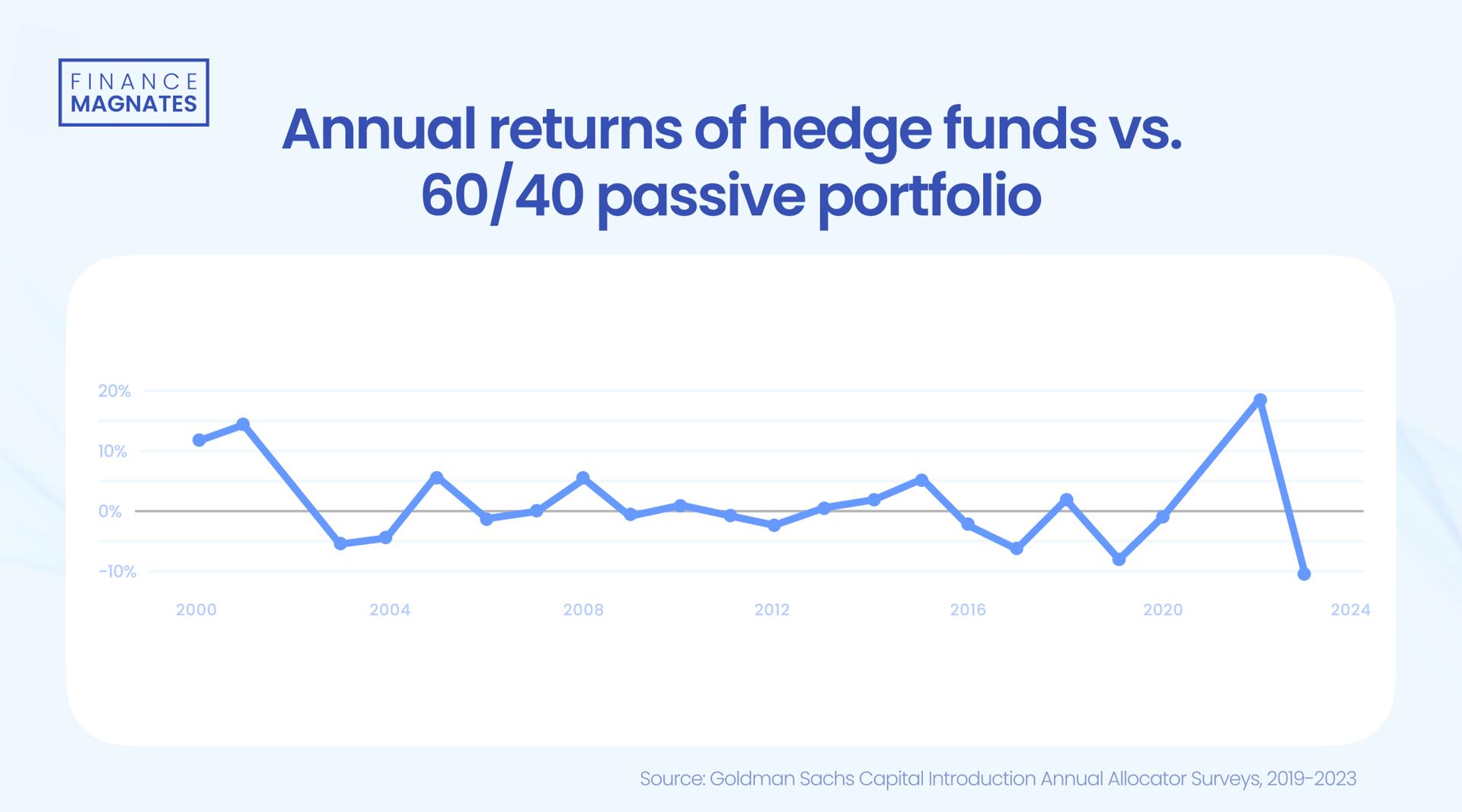
Using the Albourne Hedge Fund Index as a benchmark, hedge
fund alpha generation dropped to its lowest levels as the Fed introduced
historically low interest rates between the financial crisis and the COVID-19 pandemic,
briefly dipping below 0% in 2019.
Fed Roadmap: How Many Rate Cuts Are on the Horizon? ✂️
This morning on The Call @ Hedgeye, Macro analyst Josh Steiner @HedgeyeFIG and Hedgeye CEO @KeithMcCullough discussed the market's anticipation of three rate cuts this year—and the potential for the Federal Reserve to extend… pic.twitter.com/iVErE16mSI
Hedge funds have thrived in recent years due to high
interest rates and inflation, leading to exceptional profits. This trend
continued into 2024 despite delays in interest rate cuts.
However, with a potential shift to a dovish monetary policy
approaching, hedge funds are becoming more cautious. This might signal a return
of challenges for generating alpha, suggesting that hedge funds may need to
become more savvy in spotting investment opportunities.
According to an AIMA survey, as many as 86% of hedge funds
have provided their staff with access to generative AI tools, making the
upcoming Federal Reserve rate cuts a major test for the proficiency of the
technology.
Our midweek market note is available (link below): "What the Cut?" discussing the rate cut action in Canada, likely European cut tomorrow, and action from the Fed in months to come.
Crucially, generative AI can offer next-generation
predictive models that analyze extensive datasets to craft actionable insights
for hedge funds to act on.
The sheer volume of data that artificial intelligence can
curate ranges from historical prices, trading volumes, economic indicators, and
a hefty level of unstructured data to inform market decisions.
Generative AI uses natural language processing (NLP) to
analyze online conversations about stocks, industries, and commodities to gauge
sentiment. It can also leverage alternative data sources, such as satellite
imagery, credit card transactions, and website traffic, to develop advanced
trading strategies and potentially outperform cautious hedge funds.
For instance, Man AHL and Two Sigma use machine learning to
identify patterns in satellite images related to economic activity. To
effectively utilize these AI and ML insights, hedge funds can benefit from
services like 26 Dgrees Global Markets, which provide direct market access and
global coverage.
Preparing for Low Rates
Hedge funds have struggled with lower interest rates and
calmer markets, with the 2010s' underperformance still remembered. However, the
investing landscape has evolved since the 2008 downturn, with access to more
diverse data sources.
Ambitious hedge funds could benefit from this, and the rise
of generative AI—capable of sentiment analysis and using satellite imagery for
economic data—might signal the start of a major shift in finance.
Hedge funds have a strong historical record of
outperformance when it comes to navigating the volatility of high-interest and
high-inflation-rate environments—but as a long-awaited Federal Reserve
monetary policy switch looms, are institutions sufficiently prepared to
navigate interest rate cuts?
Recent weeks have seen hedge funds make more cautious moves
on Wall Street, despite more strategists raising their targets for the S&P
500 Index.
Decreasing their long-short gross leverage, Goldman Sachs
data shows that many hedge funds spent June 2024 actively lowering their
exposure to the market at their highest collective rates since March 2022.
The slowdown suggests institutional investors are unsure
about current market moves. While there were early hopes for Fed rate cuts by
March 2024, stronger-than-expected CPI data delayed this.
Forecasts now suggest rate cuts might start in September.
Persistent delays and a shift in monetary policy have made markets more
volatile, which usually benefits skilled hedge funds. However, the current
situation seems different.
High Rates Mean High Institutional Performance
We can look to the past to assess how lower rates typically
impact hedge funds. In the wake of the 2008 financial crisis, the switch to a
dovish monetary policy made it more challenging for hedge funds to generate
alpha as near-zero interest rates impacted the discovery of new asset prices.
Using the Albourne Hedge Fund Index as a benchmark, hedge
fund alpha generation dropped to its lowest levels as the Fed introduced
historically low interest rates between the financial crisis and the COVID-19 pandemic,
briefly dipping below 0% in 2019.
Fed Roadmap: How Many Rate Cuts Are on the Horizon? ✂️
This morning on The Call @ Hedgeye, Macro analyst Josh Steiner @HedgeyeFIG and Hedgeye CEO @KeithMcCullough discussed the market's anticipation of three rate cuts this year—and the potential for the Federal Reserve to extend… pic.twitter.com/iVErE16mSI
Hedge funds have thrived in recent years due to high
interest rates and inflation, leading to exceptional profits. This trend
continued into 2024 despite delays in interest rate cuts.
However, with a potential shift to a dovish monetary policy
approaching, hedge funds are becoming more cautious. This might signal a return
of challenges for generating alpha, suggesting that hedge funds may need to
become more savvy in spotting investment opportunities.
According to an AIMA survey, as many as 86% of hedge funds
have provided their staff with access to generative AI tools, making the
upcoming Federal Reserve rate cuts a major test for the proficiency of the
technology.
Our midweek market note is available (link below): "What the Cut?" discussing the rate cut action in Canada, likely European cut tomorrow, and action from the Fed in months to come.
Crucially, generative AI can offer next-generation
predictive models that analyze extensive datasets to craft actionable insights
for hedge funds to act on.
The sheer volume of data that artificial intelligence can
curate ranges from historical prices, trading volumes, economic indicators, and
a hefty level of unstructured data to inform market decisions.
Generative AI uses natural language processing (NLP) to
analyze online conversations about stocks, industries, and commodities to gauge
sentiment. It can also leverage alternative data sources, such as satellite
imagery, credit card transactions, and website traffic, to develop advanced
trading strategies and potentially outperform cautious hedge funds.
For instance, Man AHL and Two Sigma use machine learning to
identify patterns in satellite images related to economic activity. To
effectively utilize these AI and ML insights, hedge funds can benefit from
services like 26 Dgrees Global Markets, which provide direct market access and
global coverage.
Preparing for Low Rates
Hedge funds have struggled with lower interest rates and
calmer markets, with the 2010s' underperformance still remembered. However, the
investing landscape has evolved since the 2008 downturn, with access to more
diverse data sources.
Ambitious hedge funds could benefit from this, and the rise
of generative AI—capable of sentiment analysis and using satellite imagery for
economic data—might signal the start of a major shift in finance.
Dmytro is an experienced finance, crypto, forex and investing writer based in London. Founder of Solvid, Pridicto and Coinprompter. His work has been published in Nasdaq, Kiplinger, FXStreet, Entrepreneur, VentureBeat, Financial Express, InvestmentWeek, Finextra, and The Diplomat. He recently completed an ebook for Make Use Of on "Introduction to Cryptocurrencies". Dmytro is also a retail investor with open positions in NuBank, Duolingo, Disney, Verizon, HSBC and more.
iForex posts its first annual results as a listed broker. Also ahead: CFI Financial secures a Brazil license, and prediction markets have a big week, with new ETF launches and fresh Polymarket loss data. It's Thursday, the thirtieth of April 2026. You're listening to the Finance Magnates Daily Brief.
FM Daily Brief - 29 April 2026
XTB and Robinhood both post first-quarter earnings. But the numbers point in very different directions. Also ahead: Capital.com pushes into three new markets and signals a move into payments.
It's Wednesday, the 29th of April 2026. You're listening to the Finance Magnates Daily Brief.
XTB and Robinhood both post first-quarter earnings. But the numbers point in very different directions. Also ahead: Capital.com pushes into three new markets and signals a move into payments.
It's Wednesday, the 29th of April 2026. You're listening to the Finance Magnates Daily Brief.
XTB and Robinhood both post first-quarter earnings. But the numbers point in very different directions. Also ahead: Capital.com pushes into three new markets and signals a move into payments.
It's Wednesday, the 29th of April 2026. You're listening to the Finance Magnates Daily Brief.
XTB and Robinhood both post first-quarter earnings. But the numbers point in very different directions. Also ahead: Capital.com pushes into three new markets and signals a move into payments.
It's Wednesday, the 29th of April 2026. You're listening to the Finance Magnates Daily Brief.
XTB and Robinhood both post first-quarter earnings. But the numbers point in very different directions. Also ahead: Capital.com pushes into three new markets and signals a move into payments.
It's Wednesday, the 29th of April 2026. You're listening to the Finance Magnates Daily Brief.
XTB and Robinhood both post first-quarter earnings. But the numbers point in very different directions. Also ahead: Capital.com pushes into three new markets and signals a move into payments.
It's Wednesday, the 29th of April 2026. You're listening to the Finance Magnates Daily Brief.
FM Daily Brief - 28 April 2026
Startrader posts three-point-one trillion dollars in first-quarter volume — up three hundred and forty percent from a year ago. Also ahead: Fintokei claims sub-second trader payouts, and eToro opens its premium subscription tier to all investors.
FM Daily Brief - 27 April 2026
Finance Magnates spoke with IG Group's MENA CEO. Also ahead: EC Markets posts a record five-point-one-three trillion dollar first quarter. Plus Hola Prime brings in Deloitte to audit prop firm payouts.