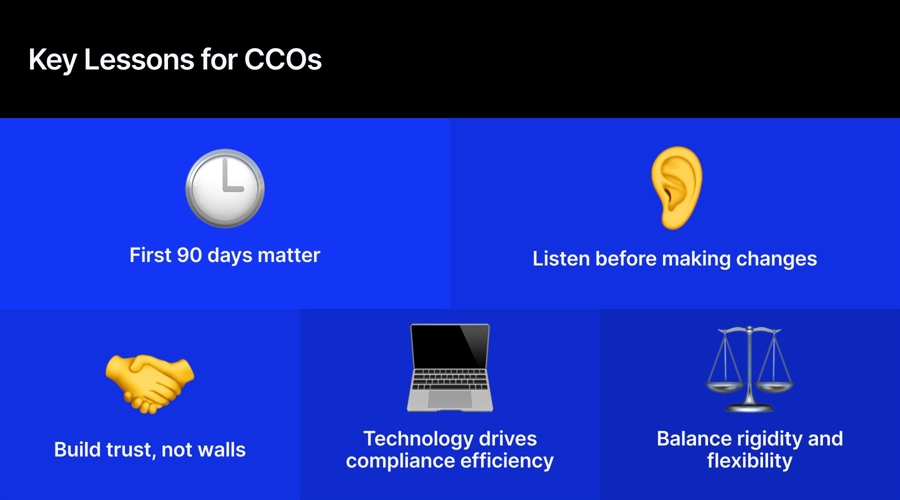
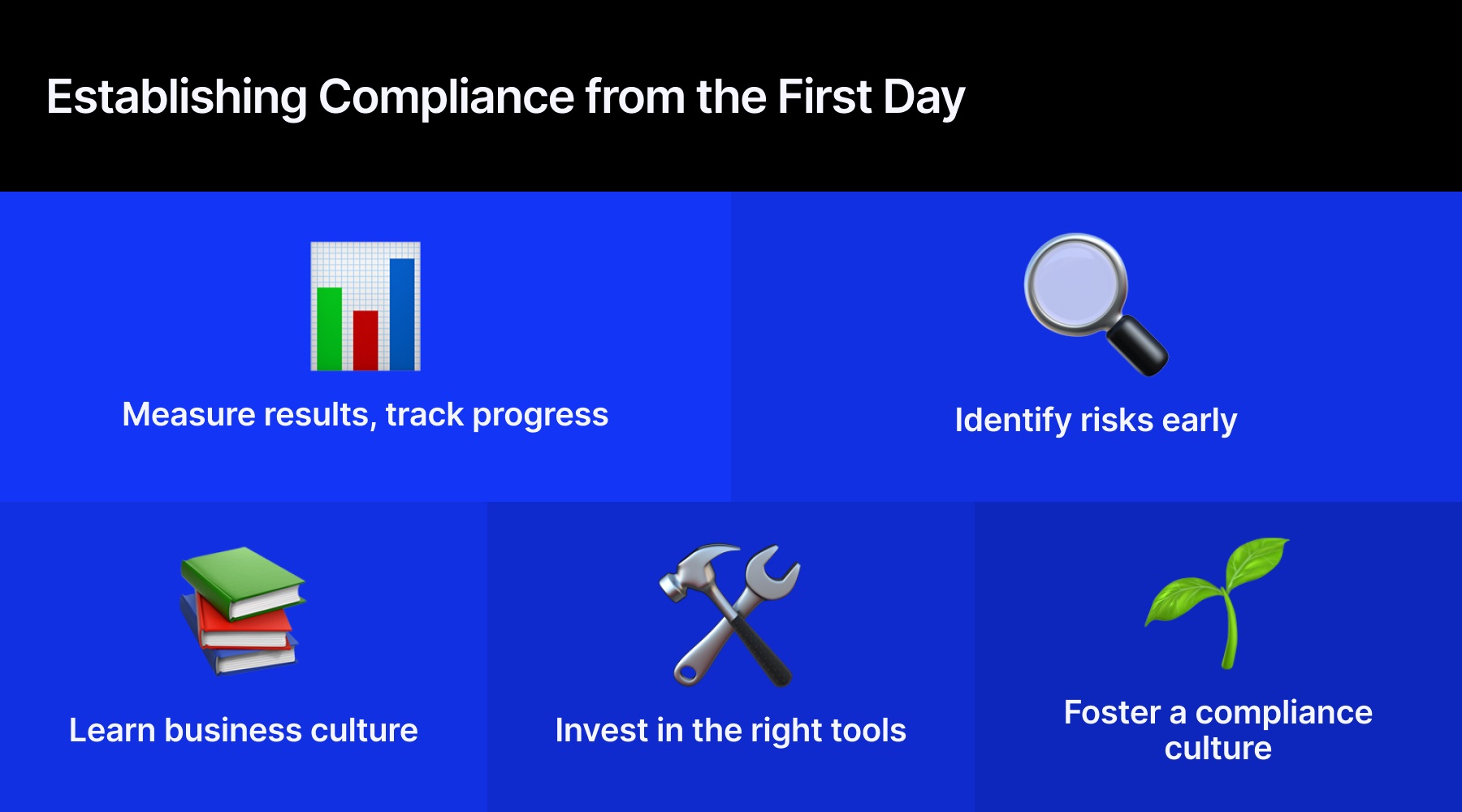
New CCOs must listen, build trust, and collaborate, not enforce compliance alone, to achieve success.
Technology is mission-critical because manual processes overwhelm compliance teams; rigid or lax approaches reduce effectiveness.
Starting as a new Chief
Compliance Officer is like being handed the keys to a complex machine that’s
already running at full speed—though perhaps in the wrong direction.
You must
quickly learn how every part functions, identify what needs fixing, and adjust
course without shutting down the operation or losing momentum. The pressure is
immediate, and a single misstep can undermine months of relationship-building.
Those first 90 days don’t
just shape your compliance program—they define how the entire organization
views compliance itself. Move too fast, too rigidly, or without context, and
you risk being labeled as the “department of no” before you’ve even earned a
seat at the table.
Through conversations with
experienced CCOs across advisory, private equity, and asset management firms,
five recurring pitfalls emerge—each with lessons from those who’ve learned to
navigate them effectively.
Pitfall #1:
Racing to Make Changes Without Understanding the Business
Every firm has its own
informal hierarchies, communication habits, and cultural norms. Failing to
grasp these can turn well-intended reforms into operational bottlenecks—or
worse, alienate the very people whose cooperation you need.
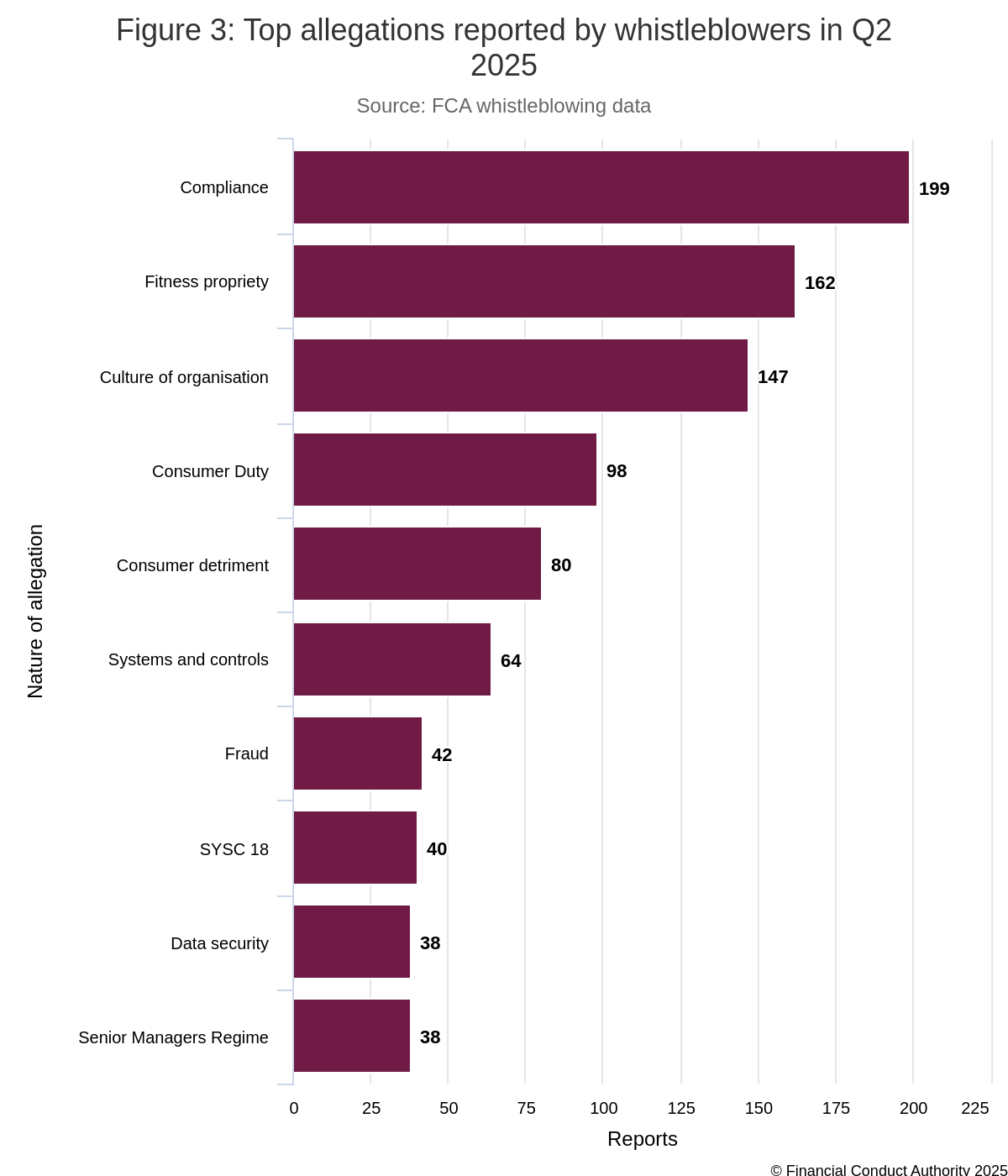
Source: FCA
The fix: Slow down and listen
first. Spend the first month observing how things actually get done. Understand
who the key influencers are and what the existing compliance culture looks
like. The goal isn’t to delay action—it’s to ensure that when you act, it’s
aligned with the business reality you’re stepping into.
Pitfall #2:
Treating Compliance as a Solo Mission
Compliance may sit under your
name, but it can’t succeed in isolation. Some new CCOs focus solely on crafting
impeccable policies or perfecting oversight frameworks while overlooking the
human side—relationship-building, trust, and internal advocacy.
Without allies, compliance
becomes something people tolerate rather than support. The absence of buy-in
ensures that even the most robust program will struggle in practice.
The fix: Frame compliance as
partnership, not policing. Build early credibility by helping other teams
achieve their goals safely. As one CCO put it, “It always circles back to
taking care of our clients.” When people see compliance as essential to that shared
mission, cooperation follows naturally.
Pitfall #3:
Assuming What Worked Before Will Work Again
Each firm is a unique
ecosystem. Strategies that worked in your previous role might not translate to
the new one. Relying on old playbooks can blind you to specific risks or
cultural nuances that require fresh thinking.
Compliance is inherently
adaptive—it must evolve alongside shifting regulations, technologies, and
business models. Bringing a rigid mindset into a dynamic environment risks both
oversight gaps and missed opportunities.
The fix: Stay curious and
flexible. Use your experience as a guide, not a template. Ask open questions,
test assumptions, and look for blind spots. The best compliance programs are
not imported—they’re built, layer by layer, to fit the contours of each organization.
Pitfall #4:
Overlooking the Technology Foundation
Manual monitoring and
fragmented systems can quickly overwhelm even the most capable compliance
teams. Yet, many CCOs delay technology assessments, seeing them as secondary to
“more urgent” tasks.
The fix: Make technology
evaluation a Day 1 priority. Whether it’s automated supervision, intelligent
risk detection, or unified message capture, the right systems multiply your
effectiveness. They free up bandwidth for strategic oversight instead of manual
firefighting.
Pitfall #5:
Swinging Too Far Toward Either Extreme
It’s easy to
overcorrect—either by enforcing rigid rules that choke productivity or by being
overly lenient to avoid friction. Both extremes create long-term
vulnerabilities.
The best compliance leaders
understand that control and flexibility aren’t opposites; they coexist.
Sustainable compliance frameworks protect the firm while supporting its people
and goals.
The fix: Find balance. Strong
oversight doesn’t have to mean red tape. The aim is not to slow the business
down, but to ensure it can move forward safely. Compliance should be an enabler
of growth, not a barrier to it.
The Path Forward
These pitfalls are not
inevitable. The CCOs who thrive share key traits: they listen before acting,
collaborate instead of dictating, tailor strategies to their environment,
invest in technology early, and keep the bigger purpose in view.
Ultimately, compliance
leadership isn’t about policy enforcement—it’s about cultural transformation.
Your first 90 days are your chance to set that tone, to demonstrate that
compliance can be both strategic and supportive.
As regulations tighten and
technologies evolve, the complexity will only increase. But the mission remains
the same: building a culture where compliance strengthens, rather than hinders,
business success.
Starting as a new Chief
Compliance Officer is like being handed the keys to a complex machine that’s
already running at full speed—though perhaps in the wrong direction.
You must
quickly learn how every part functions, identify what needs fixing, and adjust
course without shutting down the operation or losing momentum. The pressure is
immediate, and a single misstep can undermine months of relationship-building.
Those first 90 days don’t
just shape your compliance program—they define how the entire organization
views compliance itself. Move too fast, too rigidly, or without context, and
you risk being labeled as the “department of no” before you’ve even earned a
seat at the table.
Through conversations with
experienced CCOs across advisory, private equity, and asset management firms,
five recurring pitfalls emerge—each with lessons from those who’ve learned to
navigate them effectively.
Pitfall #1:
Racing to Make Changes Without Understanding the Business
Every firm has its own
informal hierarchies, communication habits, and cultural norms. Failing to
grasp these can turn well-intended reforms into operational bottlenecks—or
worse, alienate the very people whose cooperation you need.
Source: FCA
The fix: Slow down and listen
first. Spend the first month observing how things actually get done. Understand
who the key influencers are and what the existing compliance culture looks
like. The goal isn’t to delay action—it’s to ensure that when you act, it’s
aligned with the business reality you’re stepping into.
Pitfall #2:
Treating Compliance as a Solo Mission
Compliance may sit under your
name, but it can’t succeed in isolation. Some new CCOs focus solely on crafting
impeccable policies or perfecting oversight frameworks while overlooking the
human side—relationship-building, trust, and internal advocacy.
Without allies, compliance
becomes something people tolerate rather than support. The absence of buy-in
ensures that even the most robust program will struggle in practice.
The fix: Frame compliance as
partnership, not policing. Build early credibility by helping other teams
achieve their goals safely. As one CCO put it, “It always circles back to
taking care of our clients.” When people see compliance as essential to that shared
mission, cooperation follows naturally.
Pitfall #3:
Assuming What Worked Before Will Work Again
Each firm is a unique
ecosystem. Strategies that worked in your previous role might not translate to
the new one. Relying on old playbooks can blind you to specific risks or
cultural nuances that require fresh thinking.
Compliance is inherently
adaptive—it must evolve alongside shifting regulations, technologies, and
business models. Bringing a rigid mindset into a dynamic environment risks both
oversight gaps and missed opportunities.
The fix: Stay curious and
flexible. Use your experience as a guide, not a template. Ask open questions,
test assumptions, and look for blind spots. The best compliance programs are
not imported—they’re built, layer by layer, to fit the contours of each organization.
Pitfall #4:
Overlooking the Technology Foundation
Manual monitoring and
fragmented systems can quickly overwhelm even the most capable compliance
teams. Yet, many CCOs delay technology assessments, seeing them as secondary to
“more urgent” tasks.
The fix: Make technology
evaluation a Day 1 priority. Whether it’s automated supervision, intelligent
risk detection, or unified message capture, the right systems multiply your
effectiveness. They free up bandwidth for strategic oversight instead of manual
firefighting.
Pitfall #5:
Swinging Too Far Toward Either Extreme
It’s easy to
overcorrect—either by enforcing rigid rules that choke productivity or by being
overly lenient to avoid friction. Both extremes create long-term
vulnerabilities.
The best compliance leaders
understand that control and flexibility aren’t opposites; they coexist.
Sustainable compliance frameworks protect the firm while supporting its people
and goals.
The fix: Find balance. Strong
oversight doesn’t have to mean red tape. The aim is not to slow the business
down, but to ensure it can move forward safely. Compliance should be an enabler
of growth, not a barrier to it.
The Path Forward
These pitfalls are not
inevitable. The CCOs who thrive share key traits: they listen before acting,
collaborate instead of dictating, tailor strategies to their environment,
invest in technology early, and keep the bigger purpose in view.
Ultimately, compliance
leadership isn’t about policy enforcement—it’s about cultural transformation.
Your first 90 days are your chance to set that tone, to demonstrate that
compliance can be both strategic and supportive.
As regulations tighten and
technologies evolve, the complexity will only increase. But the mission remains
the same: building a culture where compliance strengthens, rather than hinders,
business success.
Jamie is VP, Product at MirrorWeb where he leads product strategy for the company. He joined MirrorWeb as Lead Software Engineer in 2017, eventually transitioning to Product and spearheading the development of their flagship communications supervision platform, MirrorWeb Insight.
In 2024, Jamie relocated to Austin, Texas to embed himself in the heart of the US compliance landscape and stay close to the customers shaping the future of digital communications oversight.
Most Axi Clients Now Trade on MetaTrader 5 as Broker Rolls Out MetaQuotes' Order Engine
Featured Videos
AvaTrade to Acquire Most of FXCM; NAGA Raises $8M
AvaTrade to Acquire Most of FXCM; NAGA Raises $8M
AvaTrade to Acquire Most of FXCM; NAGA Raises $8M
AvaTrade to Acquire Most of FXCM; NAGA Raises $8M
Today’s financial news recap covers AvaTrade agrees to acquire most of FXCM, NAGA secures eight million dollars in new financing, and Wise seeks a tax settlement in the UK.
Finance Magnates Daily Recap brings you the latest news from forex and CFD brokers, fintech, payments, cryptocurrency, digital assets, trading platforms, financial regulation and global markets.
Get the key company news, executive moves, deals, regulatory updates and market developments of the day, in just a few minutes. New episodes published every weekday.
Read more: https://www.financemagnates.com
#FinanceMagnates #ForexNews #FintechNews
Today’s financial news recap covers AvaTrade agrees to acquire most of FXCM, NAGA secures eight million dollars in new financing, and Wise seeks a tax settlement in the UK.
Finance Magnates Daily Recap brings you the latest news from forex and CFD brokers, fintech, payments, cryptocurrency, digital assets, trading platforms, financial regulation and global markets.
Get the key company news, executive moves, deals, regulatory updates and market developments of the day, in just a few minutes. New episodes published every weekday.
Read more: https://www.financemagnates.com
#FinanceMagnates #ForexNews #FintechNews
Today’s financial news recap covers AvaTrade agrees to acquire most of FXCM, NAGA secures eight million dollars in new financing, and Wise seeks a tax settlement in the UK.
Finance Magnates Daily Recap brings you the latest news from forex and CFD brokers, fintech, payments, cryptocurrency, digital assets, trading platforms, financial regulation and global markets.
Get the key company news, executive moves, deals, regulatory updates and market developments of the day, in just a few minutes. New episodes published every weekday.
Read more: https://www.financemagnates.com
#FinanceMagnates #ForexNews #FintechNews
Today’s financial news recap covers AvaTrade agrees to acquire most of FXCM, NAGA secures eight million dollars in new financing, and Wise seeks a tax settlement in the UK.
Finance Magnates Daily Recap brings you the latest news from forex and CFD brokers, fintech, payments, cryptocurrency, digital assets, trading platforms, financial regulation and global markets.
Get the key company news, executive moves, deals, regulatory updates and market developments of the day, in just a few minutes. New episodes published every weekday.
Read more: https://www.financemagnates.com
#FinanceMagnates #ForexNews #FintechNews
XTB Adds Overnight US Stock Trading; Nasdaq Ventures Invests in One Trading
XTB Adds Overnight US Stock Trading; Nasdaq Ventures Invests in One Trading
XTB Adds Overnight US Stock Trading; Nasdaq Ventures Invests in One Trading
XTB Adds Overnight US Stock Trading; Nasdaq Ventures Invests in One Trading
XTB Adds Overnight US Stock Trading; Nasdaq Ventures Invests in One Trading
XTB Adds Overnight US Stock Trading; Nasdaq Ventures Invests in One Trading
Today’s financial news recap covers XTB expands overnight US stock trading, Fortrade reports higher revenue, Nasdaq backs One Trading, and Vest Labs raises 13 million dollars.
Finance Magnates Daily Recap brings you the latest news from forex and CFD brokers, fintech, payments, cryptocurrency, digital assets, trading platforms, financial regulation and global markets.
Get the key company news, executive moves, deals, regulatory updates and market developments of the day, in just a few minutes. New episodes published every weekday.
Read more: https://www.financemagnates.com
#FinanceMagnates #ForexNews #FintechNews
Today’s financial news recap covers XTB expands overnight US stock trading, Fortrade reports higher revenue, Nasdaq backs One Trading, and Vest Labs raises 13 million dollars.
Finance Magnates Daily Recap brings you the latest news from forex and CFD brokers, fintech, payments, cryptocurrency, digital assets, trading platforms, financial regulation and global markets.
Get the key company news, executive moves, deals, regulatory updates and market developments of the day, in just a few minutes. New episodes published every weekday.
Read more: https://www.financemagnates.com
#FinanceMagnates #ForexNews #FintechNews
Today’s financial news recap covers XTB expands overnight US stock trading, Fortrade reports higher revenue, Nasdaq backs One Trading, and Vest Labs raises 13 million dollars.
Finance Magnates Daily Recap brings you the latest news from forex and CFD brokers, fintech, payments, cryptocurrency, digital assets, trading platforms, financial regulation and global markets.
Get the key company news, executive moves, deals, regulatory updates and market developments of the day, in just a few minutes. New episodes published every weekday.
Read more: https://www.financemagnates.com
#FinanceMagnates #ForexNews #FintechNews
Today’s financial news recap covers XTB expands overnight US stock trading, Fortrade reports higher revenue, Nasdaq backs One Trading, and Vest Labs raises 13 million dollars.
Finance Magnates Daily Recap brings you the latest news from forex and CFD brokers, fintech, payments, cryptocurrency, digital assets, trading platforms, financial regulation and global markets.
Get the key company news, executive moves, deals, regulatory updates and market developments of the day, in just a few minutes. New episodes published every weekday.
Read more: https://www.financemagnates.com
#FinanceMagnates #ForexNews #FintechNews
Today’s financial news recap covers XTB expands overnight US stock trading, Fortrade reports higher revenue, Nasdaq backs One Trading, and Vest Labs raises 13 million dollars.
Finance Magnates Daily Recap brings you the latest news from forex and CFD brokers, fintech, payments, cryptocurrency, digital assets, trading platforms, financial regulation and global markets.
Get the key company news, executive moves, deals, regulatory updates and market developments of the day, in just a few minutes. New episodes published every weekday.
Read more: https://www.financemagnates.com
#FinanceMagnates #ForexNews #FintechNews
Today’s financial news recap covers XTB expands overnight US stock trading, Fortrade reports higher revenue, Nasdaq backs One Trading, and Vest Labs raises 13 million dollars.
Finance Magnates Daily Recap brings you the latest news from forex and CFD brokers, fintech, payments, cryptocurrency, digital assets, trading platforms, financial regulation and global markets.
Get the key company news, executive moves, deals, regulatory updates and market developments of the day, in just a few minutes. New episodes published every weekday.
Read more: https://www.financemagnates.com
#FinanceMagnates #ForexNews #FintechNews
CMC Founder Downplays Volatility Hit; Devexperts Names CEO
CMC Founder Downplays Volatility Hit; Devexperts Names CEO
CMC Founder Downplays Volatility Hit; Devexperts Names CEO
CMC Founder Downplays Volatility Hit; Devexperts Names CEO
CMC Founder Downplays Volatility Hit; Devexperts Names CEO
CMC Founder Downplays Volatility Hit; Devexperts Names CEO
Today’s financial news recap covers low volatility pressures brokers, Devexperts names a new CEO, Saxo cuts onboarding time, and OKX reaches a 25 billion dollar valuation.
Finance Magnates Daily Recap brings you the latest news from forex and CFD brokers, fintech, payments, cryptocurrency, digital assets, trading platforms, financial regulation and global markets.
Get the key company news, executive moves, deals, regulatory updates and market developments of the day, in just a few minutes. New episodes published every weekday.
Read more: https://www.financemagnates.com
#FinanceMagnates #ForexNews #FintechNews
Today’s financial news recap covers low volatility pressures brokers, Devexperts names a new CEO, Saxo cuts onboarding time, and OKX reaches a 25 billion dollar valuation.
Finance Magnates Daily Recap brings you the latest news from forex and CFD brokers, fintech, payments, cryptocurrency, digital assets, trading platforms, financial regulation and global markets.
Get the key company news, executive moves, deals, regulatory updates and market developments of the day, in just a few minutes. New episodes published every weekday.
Read more: https://www.financemagnates.com
#FinanceMagnates #ForexNews #FintechNews
Today’s financial news recap covers low volatility pressures brokers, Devexperts names a new CEO, Saxo cuts onboarding time, and OKX reaches a 25 billion dollar valuation.
Finance Magnates Daily Recap brings you the latest news from forex and CFD brokers, fintech, payments, cryptocurrency, digital assets, trading platforms, financial regulation and global markets.
Get the key company news, executive moves, deals, regulatory updates and market developments of the day, in just a few minutes. New episodes published every weekday.
Read more: https://www.financemagnates.com
#FinanceMagnates #ForexNews #FintechNews
Today’s financial news recap covers low volatility pressures brokers, Devexperts names a new CEO, Saxo cuts onboarding time, and OKX reaches a 25 billion dollar valuation.
Finance Magnates Daily Recap brings you the latest news from forex and CFD brokers, fintech, payments, cryptocurrency, digital assets, trading platforms, financial regulation and global markets.
Get the key company news, executive moves, deals, regulatory updates and market developments of the day, in just a few minutes. New episodes published every weekday.
Read more: https://www.financemagnates.com
#FinanceMagnates #ForexNews #FintechNews
Today’s financial news recap covers low volatility pressures brokers, Devexperts names a new CEO, Saxo cuts onboarding time, and OKX reaches a 25 billion dollar valuation.
Finance Magnates Daily Recap brings you the latest news from forex and CFD brokers, fintech, payments, cryptocurrency, digital assets, trading platforms, financial regulation and global markets.
Get the key company news, executive moves, deals, regulatory updates and market developments of the day, in just a few minutes. New episodes published every weekday.
Read more: https://www.financemagnates.com
#FinanceMagnates #ForexNews #FintechNews
Today’s financial news recap covers low volatility pressures brokers, Devexperts names a new CEO, Saxo cuts onboarding time, and OKX reaches a 25 billion dollar valuation.
Finance Magnates Daily Recap brings you the latest news from forex and CFD brokers, fintech, payments, cryptocurrency, digital assets, trading platforms, financial regulation and global markets.
Get the key company news, executive moves, deals, regulatory updates and market developments of the day, in just a few minutes. New episodes published every weekday.
Read more: https://www.financemagnates.com
#FinanceMagnates #ForexNews #FintechNews
Today’s financial news recap covers Trade Nation buys FXCM's UK client book, Trading 212 reports higher revenue, the CFTC's move to allow perpetual index futures.
Finance Magnates Daily Recap brings you the latest news from forex and CFD brokers, fintech, payments, cryptocurrency, digital assets, trading platforms, financial regulation and global markets.
Get the key company news, executive moves, deals, regulatory updates and market developments of the day, in just a few minutes. New episodes published every weekday.
Read more: https://www.financemagnates.com
#FinanceMagnates #ForexNews #FintechNews
Today’s financial news recap covers Trade Nation buys FXCM's UK client book, Trading 212 reports higher revenue, the CFTC's move to allow perpetual index futures.
Finance Magnates Daily Recap brings you the latest news from forex and CFD brokers, fintech, payments, cryptocurrency, digital assets, trading platforms, financial regulation and global markets.
Get the key company news, executive moves, deals, regulatory updates and market developments of the day, in just a few minutes. New episodes published every weekday.
Read more: https://www.financemagnates.com
#FinanceMagnates #ForexNews #FintechNews
Today’s financial news recap covers Trade Nation buys FXCM's UK client book, Trading 212 reports higher revenue, the CFTC's move to allow perpetual index futures.
Finance Magnates Daily Recap brings you the latest news from forex and CFD brokers, fintech, payments, cryptocurrency, digital assets, trading platforms, financial regulation and global markets.
Get the key company news, executive moves, deals, regulatory updates and market developments of the day, in just a few minutes. New episodes published every weekday.
Read more: https://www.financemagnates.com
#FinanceMagnates #ForexNews #FintechNews
Today’s financial news recap covers Trade Nation buys FXCM's UK client book, Trading 212 reports higher revenue, the CFTC's move to allow perpetual index futures.
Finance Magnates Daily Recap brings you the latest news from forex and CFD brokers, fintech, payments, cryptocurrency, digital assets, trading platforms, financial regulation and global markets.
Get the key company news, executive moves, deals, regulatory updates and market developments of the day, in just a few minutes. New episodes published every weekday.
Read more: https://www.financemagnates.com
#FinanceMagnates #ForexNews #FintechNews
Today’s financial news recap covers Trade Nation buys FXCM's UK client book, Trading 212 reports higher revenue, the CFTC's move to allow perpetual index futures.
Finance Magnates Daily Recap brings you the latest news from forex and CFD brokers, fintech, payments, cryptocurrency, digital assets, trading platforms, financial regulation and global markets.
Get the key company news, executive moves, deals, regulatory updates and market developments of the day, in just a few minutes. New episodes published every weekday.
Read more: https://www.financemagnates.com
#FinanceMagnates #ForexNews #FintechNews
Today’s financial news recap covers Trade Nation buys FXCM's UK client book, Trading 212 reports higher revenue, the CFTC's move to allow perpetual index futures.
Finance Magnates Daily Recap brings you the latest news from forex and CFD brokers, fintech, payments, cryptocurrency, digital assets, trading platforms, financial regulation and global markets.
Get the key company news, executive moves, deals, regulatory updates and market developments of the day, in just a few minutes. New episodes published every weekday.
Read more: https://www.financemagnates.com
#FinanceMagnates #ForexNews #FintechNews
Your career isn’t a linear path.
Your career isn’t a linear path.
Your career isn’t a linear path.
Your career isn’t a linear path.
Your career isn’t a linear path.
Your career isn’t a linear path.
Roles change. Career goals change. Sometimes you want a completely new challenge.
But the skills and knowledge you build along the way can stay with you and give you something to build on.
For Jeff Patterson, that continued growth is key to long-term career development.
You bring the skills. FM Academy helps you build the knowledge.
#FMAcademy #FinanceMagnates #FinanceCareers #ProfessionalDevelopment #Fintech
Roles change. Career goals change. Sometimes you want a completely new challenge.
But the skills and knowledge you build along the way can stay with you and give you something to build on.
For Jeff Patterson, that continued growth is key to long-term career development.
You bring the skills. FM Academy helps you build the knowledge.
#FMAcademy #FinanceMagnates #FinanceCareers #ProfessionalDevelopment #Fintech
Roles change. Career goals change. Sometimes you want a completely new challenge.
But the skills and knowledge you build along the way can stay with you and give you something to build on.
For Jeff Patterson, that continued growth is key to long-term career development.
You bring the skills. FM Academy helps you build the knowledge.
#FMAcademy #FinanceMagnates #FinanceCareers #ProfessionalDevelopment #Fintech
Roles change. Career goals change. Sometimes you want a completely new challenge.
But the skills and knowledge you build along the way can stay with you and give you something to build on.
For Jeff Patterson, that continued growth is key to long-term career development.
You bring the skills. FM Academy helps you build the knowledge.
#FMAcademy #FinanceMagnates #FinanceCareers #ProfessionalDevelopment #Fintech
Roles change. Career goals change. Sometimes you want a completely new challenge.
But the skills and knowledge you build along the way can stay with you and give you something to build on.
For Jeff Patterson, that continued growth is key to long-term career development.
You bring the skills. FM Academy helps you build the knowledge.
#FMAcademy #FinanceMagnates #FinanceCareers #ProfessionalDevelopment #Fintech
Roles change. Career goals change. Sometimes you want a completely new challenge.
But the skills and knowledge you build along the way can stay with you and give you something to build on.
For Jeff Patterson, that continued growth is key to long-term career development.
You bring the skills. FM Academy helps you build the knowledge.
#FMAcademy #FinanceMagnates #FinanceCareers #ProfessionalDevelopment #Fintech