Dubai’s Regulatory Push Is Fueling Forex Growth. But Is It Enough?

Monday, 18/05/2026 | 06:35 GMT by Tatjana Meluskane
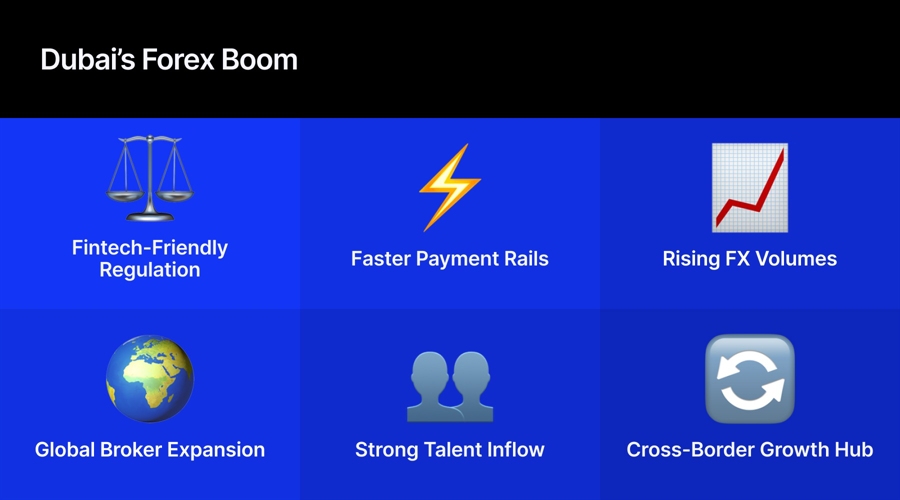
  • Dubai’s mix of fintech-friendly regulation, fast payments, and global talent is helping the UAE turn into a major centre for Forex and cross-border finance.
  • From instant payments to CBDC pilots, the UAE is building financial infrastructure that is attracting brokers, liquidity firms, and global expansion strategies.
Dubai's forex boom

Over the last two decades, Dubai has pursued an economic modernisation programme to reduce dependence on commodity exports and position itself as a global financial centre through reforms that attract international talent and innovative firms.

This strategy has drawn banks, investment companies, and fintech firms that now use the city as a base for regional and international growth.

Forex has become a major part of that success. The UAE’s currency market reached $4.15 billion in 2024 and is projected to grow to nearly $7.39 billion by 2033, driven by annual growth of around 6.6%. Dubai’s role as an international trade and tourism hub continues to generate large volumes of foreign exchange and cross-border transactions.

Using Regulation to Support Innovation

The UAE’s regulatory strategy focuses on enabling innovation while maintaining oversight.

Read more: CFD Brokers Flock to Dubai, but Few Go All In

In recent years, the Central Bank of the UAE (CBUAE) and the Dubai Financial Services Authority (DFSA) introduced frameworks that lower barriers for fintech firms. One major example is the CBUAE Open Finance Regulation announced in April 2024, requiring licensed banks, foreign bank branches, and insurers to provide API-based access to customer data and transaction services for approved Open Finance Providers.

The regulation supports advanced trading technologies and real-time interoperability across platforms.

At the same time, DFSA sandbox environments and the innovation hubs at ADGM and DIFC have attracted algorithmic trading firms, liquidity providers, and payment companies through specialised licensing and controlled testing conditions.

These measures directly affect market activity. By allowing fintech firms, brokers, and digital trading platforms to connect through regulated APIs and simplified licensing structures, regulators have improved trading efficiency while maintaining safeguards.

Further changes are planned for mid-2026, including new licensing categories for FX and digital remittance providers. One example is a 100% foreign-owned digital remittance licence with capital requirements of around AED 25 million, reflecting the UAE’s focus on scaling cross-border financial activity while strengthening AML and governance standards.

The result has been higher transaction activity. By reducing friction around execution and money movement, the UAE’s regulatory framework has helped accelerate deal flow and trading volumes.

A Growing Financial Community

Dubai’s rise has also been supported by its ability to attract talent and create a strong finance network.

Professionals are increasingly choosing the UAE for its lifestyle, business environment, and proximity to key markets. The city has developed a tight-knit finance community where traders, founders, allocators, and dealmakers regularly connect through networking groups and industry events.

Related: “People Knocking on Our Door to See That We’re Here,” IG Group’s MENA CEO

As more firms move to Dubai, these network effects continue to strengthen. Hedge funds now see the UAE not only as a business base, but as part of a growing financial culture that supports collaboration and visibility.

Many professionals also view Dubai as offering advantages that traditional financial centres have lost. While cities such as London, New York, Hong Kong, and Singapore face challenges including changing tax regimes, immigration restrictions, and post-pandemic stagnation, Dubai projects long-term stability and growth.

The UAE’s permanent residency pathways and lifestyle reforms have encouraged many professionals to settle long-term rather than treat the country as a temporary stop.

This shift is visible in the growing number of industry events. More than 20 major Forex and fintech conferences are scheduled across the UAE in 2025 and early 2026, compared with far fewer before 2020.

Payments Innovation

Dubai’s rise as an FX centre is also tied to rapid changes in payment infrastructure across the Middle East.

As cross-border trading volumes grow, the UAE has accelerated the development of faster and more integrated payment systems. A major driver is the Central Bank’s Financial Infrastructure Transformation (FIT) programme, which includes instant-payment systems, open finance standards, and upgraded settlement infrastructure.

The launch of the Aani instant-payments platform in late 2023 marked a major step. Retail and corporate users can now send and receive payments in seconds, 24/7, supporting faster treasury management, automated FX hedging, and real-time liquidity management.

Regional cooperation is also increasing. The UAE, Saudi Arabia, Bahrain, and other GCC countries are working toward interoperable real-time payment systems that reduce friction in cross-border commerce and support multi-currency settlement outside traditional correspondent banking networks.

At the same time, payment links between the UAE and India show how major trade corridors are being reshaped through bilateral payment agreements that shorten settlement times and reduce FX risk.

Dubai has also become an early participant in wholesale CBDC experiments through Project mBridge alongside China, Hong Kong, and Thailand. The initiative aims to enable multi-currency cross-border settlement on shared infrastructure, potentially reducing the cost and time of international FX transfers.

For brokers and liquidity providers operating from Dubai, these systems could lower compliance costs, tighten spreads, and improve settlement efficiency.

The impact is already visible. Over the past 12–18 months, inbound requests from Forex brokers looking to establish or restructure payment operations in the UAE have increased by 15–25%.

Many brokers now use Dubai not only as a regional office but as a launchpad for global expansion. In one recent case, a UAE-based broker integrated local payment methods across African markets, leading to a 30% increase in conversion rates and a 25% reduction in transaction declines.

The broader significance is that the UAE is becoming increasingly important in global payment infrastructure, not just regional finance.

Over the last two decades, Dubai has pursued an economic modernisation programme to reduce dependence on commodity exports and position itself as a global financial centre through reforms that attract international talent and innovative firms.

This strategy has drawn banks, investment companies, and fintech firms that now use the city as a base for regional and international growth.

Forex has become a major part of that success. The UAE’s currency market reached $4.15 billion in 2024 and is projected to grow to nearly $7.39 billion by 2033, driven by annual growth of around 6.6%. Dubai’s role as an international trade and tourism hub continues to generate large volumes of foreign exchange and cross-border transactions.

Using Regulation to Support Innovation

The UAE’s regulatory strategy focuses on enabling innovation while maintaining oversight.

Read more: CFD Brokers Flock to Dubai, but Few Go All In

In recent years, the Central Bank of the UAE (CBUAE) and the Dubai Financial Services Authority (DFSA) introduced frameworks that lower barriers for fintech firms. One major example is the CBUAE Open Finance Regulation announced in April 2024, requiring licensed banks, foreign bank branches, and insurers to provide API-based access to customer data and transaction services for approved Open Finance Providers.

The regulation supports advanced trading technologies and real-time interoperability across platforms.

At the same time, DFSA sandbox environments and the innovation hubs at ADGM and DIFC have attracted algorithmic trading firms, liquidity providers, and payment companies through specialised licensing and controlled testing conditions.

These measures directly affect market activity. By allowing fintech firms, brokers, and digital trading platforms to connect through regulated APIs and simplified licensing structures, regulators have improved trading efficiency while maintaining safeguards.

Further changes are planned for mid-2026, including new licensing categories for FX and digital remittance providers. One example is a 100% foreign-owned digital remittance licence with capital requirements of around AED 25 million, reflecting the UAE’s focus on scaling cross-border financial activity while strengthening AML and governance standards.

The result has been higher transaction activity. By reducing friction around execution and money movement, the UAE’s regulatory framework has helped accelerate deal flow and trading volumes.

A Growing Financial Community

Dubai’s rise has also been supported by its ability to attract talent and create a strong finance network.

Professionals are increasingly choosing the UAE for its lifestyle, business environment, and proximity to key markets. The city has developed a tight-knit finance community where traders, founders, allocators, and dealmakers regularly connect through networking groups and industry events.

Related: “People Knocking on Our Door to See That We’re Here,” IG Group’s MENA CEO

As more firms move to Dubai, these network effects continue to strengthen. Hedge funds now see the UAE not only as a business base, but as part of a growing financial culture that supports collaboration and visibility.

Many professionals also view Dubai as offering advantages that traditional financial centres have lost. While cities such as London, New York, Hong Kong, and Singapore face challenges including changing tax regimes, immigration restrictions, and post-pandemic stagnation, Dubai projects long-term stability and growth.

The UAE’s permanent residency pathways and lifestyle reforms have encouraged many professionals to settle long-term rather than treat the country as a temporary stop.

This shift is visible in the growing number of industry events. More than 20 major Forex and fintech conferences are scheduled across the UAE in 2025 and early 2026, compared with far fewer before 2020.

Payments Innovation

Dubai’s rise as an FX centre is also tied to rapid changes in payment infrastructure across the Middle East.

As cross-border trading volumes grow, the UAE has accelerated the development of faster and more integrated payment systems. A major driver is the Central Bank’s Financial Infrastructure Transformation (FIT) programme, which includes instant-payment systems, open finance standards, and upgraded settlement infrastructure.

The launch of the Aani instant-payments platform in late 2023 marked a major step. Retail and corporate users can now send and receive payments in seconds, 24/7, supporting faster treasury management, automated FX hedging, and real-time liquidity management.

Regional cooperation is also increasing. The UAE, Saudi Arabia, Bahrain, and other GCC countries are working toward interoperable real-time payment systems that reduce friction in cross-border commerce and support multi-currency settlement outside traditional correspondent banking networks.

At the same time, payment links between the UAE and India show how major trade corridors are being reshaped through bilateral payment agreements that shorten settlement times and reduce FX risk.

Dubai has also become an early participant in wholesale CBDC experiments through Project mBridge alongside China, Hong Kong, and Thailand. The initiative aims to enable multi-currency cross-border settlement on shared infrastructure, potentially reducing the cost and time of international FX transfers.

For brokers and liquidity providers operating from Dubai, these systems could lower compliance costs, tighten spreads, and improve settlement efficiency.

The impact is already visible. Over the past 12–18 months, inbound requests from Forex brokers looking to establish or restructure payment operations in the UAE have increased by 15–25%.

Many brokers now use Dubai not only as a regional office but as a launchpad for global expansion. In one recent case, a UAE-based broker integrated local payment methods across African markets, leading to a 30% increase in conversion rates and a 25% reduction in transaction declines.

The broader significance is that the UAE is becoming increasingly important in global payment infrastructure, not just regional finance.

About the Author: Tatjana Meluskane
Tatjana Meluskane
  • 1 Article
About the Author: Tatjana Meluskane
Tatjana Meluskane is the Chief Commercial Officer at SPAYZ.io, bringing over 15 years of leadership in fintech and banking. With a strong track record in scaling global payment solutions, she focuses on expanding payment solutions globally. Tatjana combines strategic thinking, commercial acumen, and deep industry expertise to help merchants grow through smarter payments, trusted partnerships, and agile go-to-market execution.
  • 1 Article

Retail FX

!"#$%&'()*+,-./0123456789:;<=>?@ABCDEFGHIJKLMNOPQRSTUVWXYZ[\]^_`abcdefghijklmnopqrstuvwxyz{|} !"#$%&'()*+,-./0123456789:;<=>?@ABCDEFGHIJKLMNOPQRSTUVWXYZ[\]^_`abcdefghijklmnopqrstuvwxyz{|}