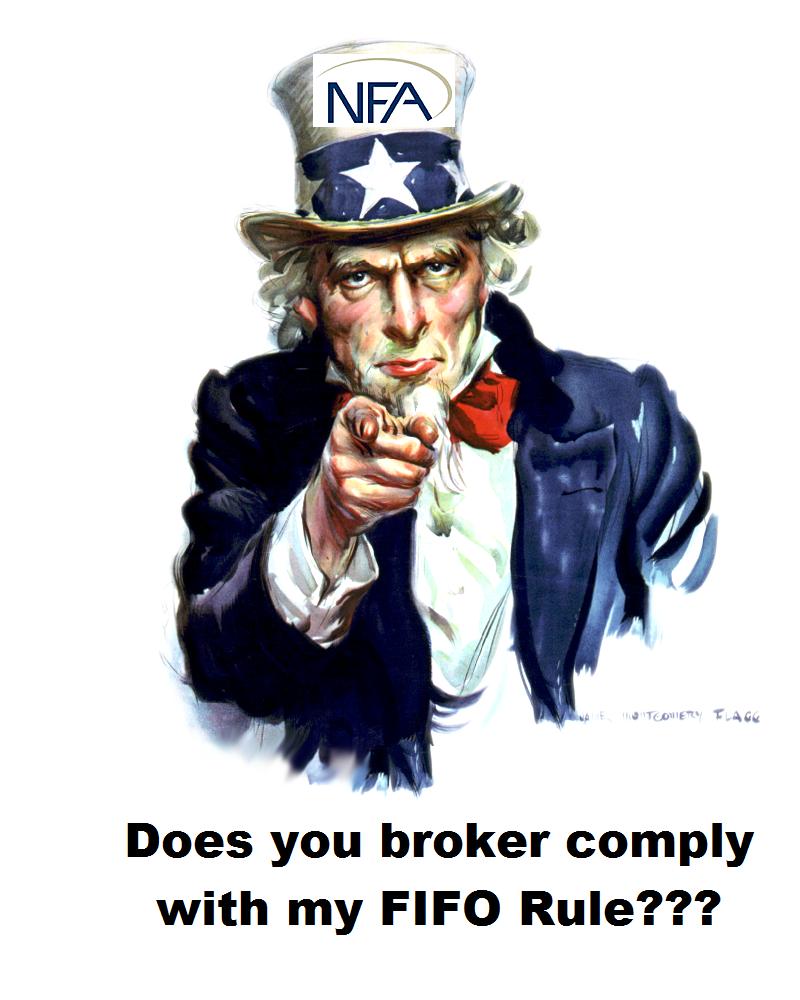
So if you’d like to know what your broker did, or didn’t, in order to comply with the upcoming regulation this is the post you need to read.
The list below shows (based on brokers’ own statements) which brokers were affected and in what manner (clicking the broker will take you to the relevant content):
Oanda – Announced that its FXTrade platform complied with the FIFO rule in the first place, no changes expected.
FXCM – Introduced OCO (One Cancels the Other) entry orders instead of stop loss and limit orders. Clients can also choose to shift funds to the FXCM UK subsidiary which doesn’t need to comply with this ridiculous regulation. https://www.fxcm.com/lp3-nfa-fifo.jsp
GFT – Says it won’t be affected. https://www.gftforex.com/about/2009-articles/gft-20090707-account-bonus.asp Simultaneously promotes a new bonus in the same press release (smart marketing move).
FX Solutions – Will affect the stop loss and limit orders. These will now need to be placed jointly on all trades. Closing Trade Function can only be placed on the oldest trade in each currency pair. Clients can choose to shift funds to the Australia subsidiary. https://www.fxsolutions.com/notice/fifo.asp
IBFX – Implemented a backoffice solution, probably altering the way orders are processed. Traders won’t see any effect except in daily and monthly statements. I’m curious how this really works – it’s impossible not to have clients affected unless the broker absorbs the risk somehow, which raises further questions... https://www.ibfx.com/company/newsmedia/pressrelease/2009/09_13.aspx
PFG – says it started complying a year and a half ago so no changes expected. https://www.pfgbestdirect.net/blogengine.net/post/2009/07/15/NFA-FIFO-Rule-for-Forex-A-response-to-rumours-and-scare-tactics.aspx
CMS Forex - will be adding three new order types, One Cancels the Other (OCO), If/Then, and If/Then OCO, to its VT Trader 2.0, to accommodate NFA Compliance Rule 2-43(b). https://www.cmsfx.com/en/about-cms/company-news/fifo/
IG Markets – No known press release. Which leads me to believe that IG’s US clients trade under the UK company.
Forex Club – No known press release. I found this thread that is some kind of unofficial statement, probably by a Forex Club employee. Poor response marketing-wise. https://www.forexfactory.com/showthread.php?t=180214
MB Trading – No known press release except this Forum thread which says they are working on a solution for MT4 while Navigator is not expected to be affected. https://www.mbtrading.com/dotnetnuke/Home/Forum/tabid/54/forumid/32/threadid/253/scope/posts/Default.aspx
Alpari – Announced compliance, and is probably the only broker that worked directly with Metaquotes to patch up a solution rather than develop one on its own. Stop loss and take profits shouldn’t be affected. https://www.prweb.com/releases/2009/07/prweb2682724.htm
Tradeview – No change for the Viking or Platinum platforms. Metatrader has been updated. https://www.financemagnates.com/forex/brokers/tradeview-announces-fifo-compliance/
Easy Forex – No known press release.
Advanced Markets – Announced that it already complies with FIFO for some time so the clients won’t be affected. https://amifx.com/newsDetails.asp?nid=14
FXDD – Is still in registration process with the NFA and no press release except the following was released: https://www.financemagnates.com/forex/brokers/fxdd-prepares-to-battle-nfa-on-hedging/. Although I doubt FXDD will actually battle the NFA I think they tried to persuade it that there are better solutions than FIFO. I bet they failed.
With the much talked about NFA’s FIFO (Rule 2-43) requirements kicking in shortly it’s time to do a recap and see how it affected the US Forex brokers’ software. The new FIFO (first in first out) regulation will severely affect the way you trade, doesn’t matter which broker you used to trade with previously, as it prevents hedging and stop and limit orders.
So if you’d like to know what your broker did, or didn’t, in order to comply with the upcoming regulation this is the post you need to read.
The list below shows (based on brokers’ own statements) which brokers were affected and in what manner (clicking the broker will take you to the relevant content):
Oanda – Announced that its FXTrade platform complied with the FIFO rule in the first place, no changes expected.
FXCM – Introduced OCO (One Cancels the Other) entry orders instead of stop loss and limit orders. Clients can also choose to shift funds to the FXCM UK subsidiary which doesn’t need to comply with the NFA.
Gain – Announced that its FOREXTrader proprietary trading platform has always used the FIFO method and therefore is not affected. However if you’d like to hedge you can shift funds to the Gain’s UK subsidiary.
GFT – Says it won’t be affected.
FX Solutions – Will affect the stop loss and limit orders. These will now need to be placed jointly on all trades. Closing Trade Function can only be placed on the oldest trade in each currency pair. Clients can choose to shift funds to the Australia subsidiary.
IBFX – Implemented a backoffice solution, probably altering the way orders are processed. Traders won’t see any effect except in daily and monthly statements. I’m curious how this really works – it’s impossible not to have clients affected unless the broker absorbs the risk somehow, which raises further questions...
PFG – says it started complying a year and a half ago so no changes expected.
CMS Forex - will be adding three new order types, One Cancels the Other (OCO), If/Then, and If/Then OCO, to its VT Trader 2.0, to accommodate NFA Compliance Rule 2-43(b).
IG Markets – No known press release. Which leads me to believe that IG’s US clients trade under the UK company.
Forex Club – No known press release. I found this thread that is some kind of unofficial statement, probably by a Forex Club employee. Poor response marketing-wise.
MB Trading – No known press release except this Forum thread which says they are working on a solution for MT4 while Navigator is not expected to be affected.
Alpari – Announced compliance, and is probably the only broker that worked directly with Metaquotes to patch up a solution rather than develop one on its own. Stop loss and take profits shouldn’t be affected.
Tradeview – No change for the Viking or Platinum platforms. Metatrader has been updated.
Easy Forex – Updated its site. Complies fully, requires changes in how deals are being made comparing to pre-FIFO trading.
Advanced Markets – Announced that it already complies with FIFO for some time so the clients won’t be affected.
FXDD – Is still in registration process with the NFA and no press release except this one was released.. Although I doubt FXDD will actually battle the NFA I think they tried to persuade it that there are better solutions than FIFO. I bet they failed.
So if you’d like to know what your broker did, or didn’t, in order to comply with the upcoming regulation this is the post you need to read.
The list below shows (based on brokers’ own statements) which brokers were affected and in what manner (clicking the broker will take you to the relevant content):
Oanda – Announced that its FXTrade platform complied with the FIFO rule in the first place, no changes expected.
FXCM – Introduced OCO (One Cancels the Other) entry orders instead of stop loss and limit orders. Clients can also choose to shift funds to the FXCM UK subsidiary which doesn’t need to comply with this ridiculous regulation. https://www.fxcm.com/lp3-nfa-fifo.jsp
GFT – Says it won’t be affected. https://www.gftforex.com/about/2009-articles/gft-20090707-account-bonus.asp Simultaneously promotes a new bonus in the same press release (smart marketing move).
FX Solutions – Will affect the stop loss and limit orders. These will now need to be placed jointly on all trades. Closing Trade Function can only be placed on the oldest trade in each currency pair. Clients can choose to shift funds to the Australia subsidiary. https://www.fxsolutions.com/notice/fifo.asp
IBFX – Implemented a backoffice solution, probably altering the way orders are processed. Traders won’t see any effect except in daily and monthly statements. I’m curious how this really works – it’s impossible not to have clients affected unless the broker absorbs the risk somehow, which raises further questions... https://www.ibfx.com/company/newsmedia/pressrelease/2009/09_13.aspx
PFG – says it started complying a year and a half ago so no changes expected. https://www.pfgbestdirect.net/blogengine.net/post/2009/07/15/NFA-FIFO-Rule-for-Forex-A-response-to-rumours-and-scare-tactics.aspx
CMS Forex - will be adding three new order types, One Cancels the Other (OCO), If/Then, and If/Then OCO, to its VT Trader 2.0, to accommodate NFA Compliance Rule 2-43(b). https://www.cmsfx.com/en/about-cms/company-news/fifo/
IG Markets – No known press release. Which leads me to believe that IG’s US clients trade under the UK company.
Forex Club – No known press release. I found this thread that is some kind of unofficial statement, probably by a Forex Club employee. Poor response marketing-wise. https://www.forexfactory.com/showthread.php?t=180214
MB Trading – No known press release except this Forum thread which says they are working on a solution for MT4 while Navigator is not expected to be affected. https://www.mbtrading.com/dotnetnuke/Home/Forum/tabid/54/forumid/32/threadid/253/scope/posts/Default.aspx
Alpari – Announced compliance, and is probably the only broker that worked directly with Metaquotes to patch up a solution rather than develop one on its own. Stop loss and take profits shouldn’t be affected. https://www.prweb.com/releases/2009/07/prweb2682724.htm
Tradeview – No change for the Viking or Platinum platforms. Metatrader has been updated. https://www.financemagnates.com/forex/brokers/tradeview-announces-fifo-compliance/
Easy Forex – No known press release.
Advanced Markets – Announced that it already complies with FIFO for some time so the clients won’t be affected. https://amifx.com/newsDetails.asp?nid=14
FXDD – Is still in registration process with the NFA and no press release except the following was released: https://www.financemagnates.com/forex/brokers/fxdd-prepares-to-battle-nfa-on-hedging/. Although I doubt FXDD will actually battle the NFA I think they tried to persuade it that there are better solutions than FIFO. I bet they failed.
With the much talked about NFA’s FIFO (Rule 2-43) requirements kicking in shortly it’s time to do a recap and see how it affected the US Forex brokers’ software. The new FIFO (first in first out) regulation will severely affect the way you trade, doesn’t matter which broker you used to trade with previously, as it prevents hedging and stop and limit orders.
So if you’d like to know what your broker did, or didn’t, in order to comply with the upcoming regulation this is the post you need to read.
The list below shows (based on brokers’ own statements) which brokers were affected and in what manner (clicking the broker will take you to the relevant content):
Oanda – Announced that its FXTrade platform complied with the FIFO rule in the first place, no changes expected.
FXCM – Introduced OCO (One Cancels the Other) entry orders instead of stop loss and limit orders. Clients can also choose to shift funds to the FXCM UK subsidiary which doesn’t need to comply with the NFA.
Gain – Announced that its FOREXTrader proprietary trading platform has always used the FIFO method and therefore is not affected. However if you’d like to hedge you can shift funds to the Gain’s UK subsidiary.
GFT – Says it won’t be affected.
FX Solutions – Will affect the stop loss and limit orders. These will now need to be placed jointly on all trades. Closing Trade Function can only be placed on the oldest trade in each currency pair. Clients can choose to shift funds to the Australia subsidiary.
IBFX – Implemented a backoffice solution, probably altering the way orders are processed. Traders won’t see any effect except in daily and monthly statements. I’m curious how this really works – it’s impossible not to have clients affected unless the broker absorbs the risk somehow, which raises further questions...
PFG – says it started complying a year and a half ago so no changes expected.
CMS Forex - will be adding three new order types, One Cancels the Other (OCO), If/Then, and If/Then OCO, to its VT Trader 2.0, to accommodate NFA Compliance Rule 2-43(b).
IG Markets – No known press release. Which leads me to believe that IG’s US clients trade under the UK company.
Forex Club – No known press release. I found this thread that is some kind of unofficial statement, probably by a Forex Club employee. Poor response marketing-wise.
MB Trading – No known press release except this Forum thread which says they are working on a solution for MT4 while Navigator is not expected to be affected.
Alpari – Announced compliance, and is probably the only broker that worked directly with Metaquotes to patch up a solution rather than develop one on its own. Stop loss and take profits shouldn’t be affected.
Tradeview – No change for the Viking or Platinum platforms. Metatrader has been updated.
Easy Forex – Updated its site. Complies fully, requires changes in how deals are being made comparing to pre-FIFO trading.
Advanced Markets – Announced that it already complies with FIFO for some time so the clients won’t be affected.
FXDD – Is still in registration process with the NFA and no press release except this one was released.. Although I doubt FXDD will actually battle the NFA I think they tried to persuade it that there are better solutions than FIFO. I bet they failed.
Italy’s Consob Tightens Net on AI-Fueled Scams With Fresh Website Bans
Featured Videos
FP Markets Winner Spotlight 🏆 | Global Broker of the Year 2025 #Trading #Broker #Innovation #Shorts
FP Markets Winner Spotlight 🏆 | Global Broker of the Year 2025 #Trading #Broker #Innovation #Shorts
FP Markets Winner Spotlight 🏆 | Global Broker of the Year 2025 #Trading #Broker #Innovation #Shorts
FP Markets Winner Spotlight 🏆 | Global Broker of the Year 2025 #Trading #Broker #Innovation #Shorts
FP Markets takes the spotlight as Global Broker of the Year 2025 at the Finance Magnates Awards.
Martin Stoilov, Head of Client Experience, shares that trust, innovation, and people played a key role in the company’s success, supported by a strong foundation of integrity and client-centricity.
Following this milestone, FP Markets continues to focus on growth, technology investment, and its core values of transparency and excellence.
👉 Be part of FM Awards 2026: https://awards.financemagnates.com/#nominate
FP Markets takes the spotlight as Global Broker of the Year 2025 at the Finance Magnates Awards.
Martin Stoilov, Head of Client Experience, shares that trust, innovation, and people played a key role in the company’s success, supported by a strong foundation of integrity and client-centricity.
Following this milestone, FP Markets continues to focus on growth, technology investment, and its core values of transparency and excellence.
👉 Be part of FM Awards 2026: https://awards.financemagnates.com/#nominate
FP Markets takes the spotlight as Global Broker of the Year 2025 at the Finance Magnates Awards.
Martin Stoilov, Head of Client Experience, shares that trust, innovation, and people played a key role in the company’s success, supported by a strong foundation of integrity and client-centricity.
Following this milestone, FP Markets continues to focus on growth, technology investment, and its core values of transparency and excellence.
👉 Be part of FM Awards 2026: https://awards.financemagnates.com/#nominate
FP Markets takes the spotlight as Global Broker of the Year 2025 at the Finance Magnates Awards.
Martin Stoilov, Head of Client Experience, shares that trust, innovation, and people played a key role in the company’s success, supported by a strong foundation of integrity and client-centricity.
Following this milestone, FP Markets continues to focus on growth, technology investment, and its core values of transparency and excellence.
👉 Be part of FM Awards 2026: https://awards.financemagnates.com/#nominate
In this video, we review @HolaPrimeMarketsOfficial, a multi-asset forex and CFDs broker offering different account types, trading platforms, and flexible trading conditions.
We cover the broker’s overall offering, including account options, trading environment, platforms like MT4 and MT5, and additional services such as managed accounts and fast withdrawals.
Watch the full video to see if Hola Prime Markets fits your trading needs.
📣 Stay up to date with the latest in finance and trading. Follow Finance Magnates for industry news, insights, and global event coverage.
Connect with us:
🔗 LinkedIn: /financemagnates
👍 Facebook: /financemagnates
📸 Instagram: https://www.instagram.com/financemagnates
🐦 X: https://x.com/financemagnates
🎥 TikTok: https://www.tiktok.com/tag/financemagnates
▶️ YouTube: /@financemagnates_official
#HolaPrime #ForexBroker #CFDTrading #FinanceMagnates #Trading #Forex #BrokerReview
In this video, we review @HolaPrimeMarketsOfficial, a multi-asset forex and CFDs broker offering different account types, trading platforms, and flexible trading conditions.
We cover the broker’s overall offering, including account options, trading environment, platforms like MT4 and MT5, and additional services such as managed accounts and fast withdrawals.
Watch the full video to see if Hola Prime Markets fits your trading needs.
📣 Stay up to date with the latest in finance and trading. Follow Finance Magnates for industry news, insights, and global event coverage.
Connect with us:
🔗 LinkedIn: /financemagnates
👍 Facebook: /financemagnates
📸 Instagram: https://www.instagram.com/financemagnates
🐦 X: https://x.com/financemagnates
🎥 TikTok: https://www.tiktok.com/tag/financemagnates
▶️ YouTube: /@financemagnates_official
#HolaPrime #ForexBroker #CFDTrading #FinanceMagnates #Trading #Forex #BrokerReview
In this video, we review @HolaPrimeMarketsOfficial, a multi-asset forex and CFDs broker offering different account types, trading platforms, and flexible trading conditions.
We cover the broker’s overall offering, including account options, trading environment, platforms like MT4 and MT5, and additional services such as managed accounts and fast withdrawals.
Watch the full video to see if Hola Prime Markets fits your trading needs.
📣 Stay up to date with the latest in finance and trading. Follow Finance Magnates for industry news, insights, and global event coverage.
Connect with us:
🔗 LinkedIn: /financemagnates
👍 Facebook: /financemagnates
📸 Instagram: https://www.instagram.com/financemagnates
🐦 X: https://x.com/financemagnates
🎥 TikTok: https://www.tiktok.com/tag/financemagnates
▶️ YouTube: /@financemagnates_official
#HolaPrime #ForexBroker #CFDTrading #FinanceMagnates #Trading #Forex #BrokerReview
In this video, we review @HolaPrimeMarketsOfficial, a multi-asset forex and CFDs broker offering different account types, trading platforms, and flexible trading conditions.
We cover the broker’s overall offering, including account options, trading environment, platforms like MT4 and MT5, and additional services such as managed accounts and fast withdrawals.
Watch the full video to see if Hola Prime Markets fits your trading needs.
📣 Stay up to date with the latest in finance and trading. Follow Finance Magnates for industry news, insights, and global event coverage.
Connect with us:
🔗 LinkedIn: /financemagnates
👍 Facebook: /financemagnates
📸 Instagram: https://www.instagram.com/financemagnates
🐦 X: https://x.com/financemagnates
🎥 TikTok: https://www.tiktok.com/tag/financemagnates
▶️ YouTube: /@financemagnates_official
#HolaPrime #ForexBroker #CFDTrading #FinanceMagnates #Trading #Forex #BrokerReview
In this video, we review @HolaPrimeMarketsOfficial, a multi-asset forex and CFDs broker offering different account types, trading platforms, and flexible trading conditions.
We cover the broker’s overall offering, including account options, trading environment, platforms like MT4 and MT5, and additional services such as managed accounts and fast withdrawals.
Watch the full video to see if Hola Prime Markets fits your trading needs.
📣 Stay up to date with the latest in finance and trading. Follow Finance Magnates for industry news, insights, and global event coverage.
Connect with us:
🔗 LinkedIn: /financemagnates
👍 Facebook: /financemagnates
📸 Instagram: https://www.instagram.com/financemagnates
🐦 X: https://x.com/financemagnates
🎥 TikTok: https://www.tiktok.com/tag/financemagnates
▶️ YouTube: /@financemagnates_official
#HolaPrime #ForexBroker #CFDTrading #FinanceMagnates #Trading #Forex #BrokerReview
In this video, we review @HolaPrimeMarketsOfficial, a multi-asset forex and CFDs broker offering different account types, trading platforms, and flexible trading conditions.
We cover the broker’s overall offering, including account options, trading environment, platforms like MT4 and MT5, and additional services such as managed accounts and fast withdrawals.
Watch the full video to see if Hola Prime Markets fits your trading needs.
📣 Stay up to date with the latest in finance and trading. Follow Finance Magnates for industry news, insights, and global event coverage.
Connect with us:
🔗 LinkedIn: /financemagnates
👍 Facebook: /financemagnates
📸 Instagram: https://www.instagram.com/financemagnates
🐦 X: https://x.com/financemagnates
🎥 TikTok: https://www.tiktok.com/tag/financemagnates
▶️ YouTube: /@financemagnates_official
#HolaPrime #ForexBroker #CFDTrading #FinanceMagnates #Trading #Forex #BrokerReview
Hola Prime Review: What You Need to Know | Full Breakdown by Finance Magnates
Hola Prime Review: What You Need to Know | Full Breakdown by Finance Magnates
Hola Prime Review: What You Need to Know | Full Breakdown by Finance Magnates
Hola Prime Review: What You Need to Know | Full Breakdown by Finance Magnates
Hola Prime Review: What You Need to Know | Full Breakdown by Finance Magnates
Hola Prime Review: What You Need to Know | Full Breakdown by Finance Magnates
In this video, we review @HolaPrime_Global, a proprietary trading firm offering evaluation programs and performance-based payouts in simulated market environments.
We cover how the challenge model works, including account types, profit splits (up to 95%), trading rules, and what it takes to reach a funded account. You’ll also learn about available platforms like MT4, MT5, cTrader, and more, along with insights into payouts, support, and trading conditions.
Watch the full video to see if Hola Prime fits your trading style.
📣 Stay up to date with the latest in finance and trading. Follow Finance Magnates for industry news, insights, and global event coverage.
Connect with us:
🔗 LinkedIn: /financemagnates
👍 Facebook: /financemagnates
📸 Instagram: https://www.instagram.com/financemagnates
🐦 X: https://x.com/financemagnates
🎥 TikTok: https://www.tiktok.com/tag/financemagnates
▶️ YouTube: /@financemagnates_official
#HolaPrime #PropFirm #Trading #FinanceMagnates #Forex #FuturesTrading #TradingReview #PropFirmReview
In this video, we review @HolaPrime_Global, a proprietary trading firm offering evaluation programs and performance-based payouts in simulated market environments.
We cover how the challenge model works, including account types, profit splits (up to 95%), trading rules, and what it takes to reach a funded account. You’ll also learn about available platforms like MT4, MT5, cTrader, and more, along with insights into payouts, support, and trading conditions.
Watch the full video to see if Hola Prime fits your trading style.
📣 Stay up to date with the latest in finance and trading. Follow Finance Magnates for industry news, insights, and global event coverage.
Connect with us:
🔗 LinkedIn: /financemagnates
👍 Facebook: /financemagnates
📸 Instagram: https://www.instagram.com/financemagnates
🐦 X: https://x.com/financemagnates
🎥 TikTok: https://www.tiktok.com/tag/financemagnates
▶️ YouTube: /@financemagnates_official
#HolaPrime #PropFirm #Trading #FinanceMagnates #Forex #FuturesTrading #TradingReview #PropFirmReview
In this video, we review @HolaPrime_Global, a proprietary trading firm offering evaluation programs and performance-based payouts in simulated market environments.
We cover how the challenge model works, including account types, profit splits (up to 95%), trading rules, and what it takes to reach a funded account. You’ll also learn about available platforms like MT4, MT5, cTrader, and more, along with insights into payouts, support, and trading conditions.
Watch the full video to see if Hola Prime fits your trading style.
📣 Stay up to date with the latest in finance and trading. Follow Finance Magnates for industry news, insights, and global event coverage.
Connect with us:
🔗 LinkedIn: /financemagnates
👍 Facebook: /financemagnates
📸 Instagram: https://www.instagram.com/financemagnates
🐦 X: https://x.com/financemagnates
🎥 TikTok: https://www.tiktok.com/tag/financemagnates
▶️ YouTube: /@financemagnates_official
#HolaPrime #PropFirm #Trading #FinanceMagnates #Forex #FuturesTrading #TradingReview #PropFirmReview
In this video, we review @HolaPrime_Global, a proprietary trading firm offering evaluation programs and performance-based payouts in simulated market environments.
We cover how the challenge model works, including account types, profit splits (up to 95%), trading rules, and what it takes to reach a funded account. You’ll also learn about available platforms like MT4, MT5, cTrader, and more, along with insights into payouts, support, and trading conditions.
Watch the full video to see if Hola Prime fits your trading style.
📣 Stay up to date with the latest in finance and trading. Follow Finance Magnates for industry news, insights, and global event coverage.
Connect with us:
🔗 LinkedIn: /financemagnates
👍 Facebook: /financemagnates
📸 Instagram: https://www.instagram.com/financemagnates
🐦 X: https://x.com/financemagnates
🎥 TikTok: https://www.tiktok.com/tag/financemagnates
▶️ YouTube: /@financemagnates_official
#HolaPrime #PropFirm #Trading #FinanceMagnates #Forex #FuturesTrading #TradingReview #PropFirmReview
In this video, we review @HolaPrime_Global, a proprietary trading firm offering evaluation programs and performance-based payouts in simulated market environments.
We cover how the challenge model works, including account types, profit splits (up to 95%), trading rules, and what it takes to reach a funded account. You’ll also learn about available platforms like MT4, MT5, cTrader, and more, along with insights into payouts, support, and trading conditions.
Watch the full video to see if Hola Prime fits your trading style.
📣 Stay up to date with the latest in finance and trading. Follow Finance Magnates for industry news, insights, and global event coverage.
Connect with us:
🔗 LinkedIn: /financemagnates
👍 Facebook: /financemagnates
📸 Instagram: https://www.instagram.com/financemagnates
🐦 X: https://x.com/financemagnates
🎥 TikTok: https://www.tiktok.com/tag/financemagnates
▶️ YouTube: /@financemagnates_official
#HolaPrime #PropFirm #Trading #FinanceMagnates #Forex #FuturesTrading #TradingReview #PropFirmReview
In this video, we review @HolaPrime_Global, a proprietary trading firm offering evaluation programs and performance-based payouts in simulated market environments.
We cover how the challenge model works, including account types, profit splits (up to 95%), trading rules, and what it takes to reach a funded account. You’ll also learn about available platforms like MT4, MT5, cTrader, and more, along with insights into payouts, support, and trading conditions.
Watch the full video to see if Hola Prime fits your trading style.
📣 Stay up to date with the latest in finance and trading. Follow Finance Magnates for industry news, insights, and global event coverage.
Connect with us:
🔗 LinkedIn: /financemagnates
👍 Facebook: /financemagnates
📸 Instagram: https://www.instagram.com/financemagnates
🐦 X: https://x.com/financemagnates
🎥 TikTok: https://www.tiktok.com/tag/financemagnates
▶️ YouTube: /@financemagnates_official
#HolaPrime #PropFirm #Trading #FinanceMagnates #Forex #FuturesTrading #TradingReview #PropFirmReview
Axi Winner Spotlight 🏆 | Global Most Innovative Broker 2025 #Innovation #Trading #Fintech #Broker
Axi Winner Spotlight 🏆 | Global Most Innovative Broker 2025 #Innovation #Trading #Fintech #Broker
Axi Winner Spotlight 🏆 | Global Most Innovative Broker 2025 #Innovation #Trading #Fintech #Broker
Axi Winner Spotlight 🏆 | Global Most Innovative Broker 2025 #Innovation #Trading #Fintech #Broker
Axi Winner Spotlight 🏆 | Global Most Innovative Broker 2025 #Innovation #Trading #Fintech #Broker
Axi Winner Spotlight 🏆 | Global Most Innovative Broker 2025 #Innovation #Trading #Fintech #Broker
Axi takes the spotlight at the Finance Magnates Awards, winning Global Most Innovative Broker 2025.
Olivia Xenofontos and Ivanna Openko share how the team will feel: proud, motivated, and ready to keep delivering.
They also describe the night as well-organized, focused, and enjoyable for all.
👉 Be part of FM Awards 2026.
Axi takes the spotlight at the Finance Magnates Awards, winning Global Most Innovative Broker 2025.
Olivia Xenofontos and Ivanna Openko share how the team will feel: proud, motivated, and ready to keep delivering.
They also describe the night as well-organized, focused, and enjoyable for all.
👉 Be part of FM Awards 2026.
Axi takes the spotlight at the Finance Magnates Awards, winning Global Most Innovative Broker 2025.
Olivia Xenofontos and Ivanna Openko share how the team will feel: proud, motivated, and ready to keep delivering.
They also describe the night as well-organized, focused, and enjoyable for all.
👉 Be part of FM Awards 2026.
Axi takes the spotlight at the Finance Magnates Awards, winning Global Most Innovative Broker 2025.
Olivia Xenofontos and Ivanna Openko share how the team will feel: proud, motivated, and ready to keep delivering.
They also describe the night as well-organized, focused, and enjoyable for all.
👉 Be part of FM Awards 2026.
Axi takes the spotlight at the Finance Magnates Awards, winning Global Most Innovative Broker 2025.
Olivia Xenofontos and Ivanna Openko share how the team will feel: proud, motivated, and ready to keep delivering.
They also describe the night as well-organized, focused, and enjoyable for all.
👉 Be part of FM Awards 2026.
Axi takes the spotlight at the Finance Magnates Awards, winning Global Most Innovative Broker 2025.
Olivia Xenofontos and Ivanna Openko share how the team will feel: proud, motivated, and ready to keep delivering.
They also describe the night as well-organized, focused, and enjoyable for all.
👉 Be part of FM Awards 2026.
Recognition that matters.
Built on transparency.
Driven by the industry.
The Finance Magnates Awards 2026.
Nominations are now open.
🔗 https://awards.financemagnates.com/?utm_source=SM&utm_medium=social&utm_campaign=recognition-matters
Recognition that matters.
Built on transparency.
Driven by the industry.
The Finance Magnates Awards 2026.
Nominations are now open.
🔗 https://awards.financemagnates.com/?utm_source=SM&utm_medium=social&utm_campaign=recognition-matters
Recognition that matters.
Built on transparency.
Driven by the industry.
The Finance Magnates Awards 2026.
Nominations are now open.
🔗 https://awards.financemagnates.com/?utm_source=SM&utm_medium=social&utm_campaign=recognition-matters
Recognition that matters.
Built on transparency.
Driven by the industry.
The Finance Magnates Awards 2026.
Nominations are now open.
🔗 https://awards.financemagnates.com/?utm_source=SM&utm_medium=social&utm_campaign=recognition-matters
Recognition that matters.
Built on transparency.
Driven by the industry.
The Finance Magnates Awards 2026.
Nominations are now open.
🔗 https://awards.financemagnates.com/?utm_source=SM&utm_medium=social&utm_campaign=recognition-matters
Recognition that matters.
Built on transparency.
Driven by the industry.
The Finance Magnates Awards 2026.
Nominations are now open.
🔗 https://awards.financemagnates.com/?utm_source=SM&utm_medium=social&utm_campaign=recognition-matters