With so many platforms to choose from, customers have very little reason to remain loyal to one brand.
Bloomberg
This article was written by Charlotte Day, Creative Director at Contentworks.
The online brokerage industry is as competitive as ever. With so many platforms to choose from, customers have very little reason to remain loyal to one brand unless the services they are receiving are truly exceptional. But in an industry with very little unique selling propositions (USPs), differentiating yourself from the competition isn’t always easy.
Assuming you’ve done all the groundwork to actually land customers, your goal should be to never let them go. Your customer retention rate is a metric that reveals whether your marketing and client care efforts are boosting your business or bleeding dollars from your business.
It can be measured by looking at the number of clients you still have at the end of a period relative to the number you had when that period began.
The formula is illustrated below:
Customer Retention Rate = ((E-N/S)) X 100, where:
E = the number of clients you have at the end of a specific period (e.g., week, month, year)
N = the number of new clients your business acquired during the given period
S = the number of clients you had at the beginning of the period.
Customer retention isn’t just about the performance of your marketing and sales teams. The number gives you a snapshot of your business development efforts and allows you to anticipate change in your growth expectations.
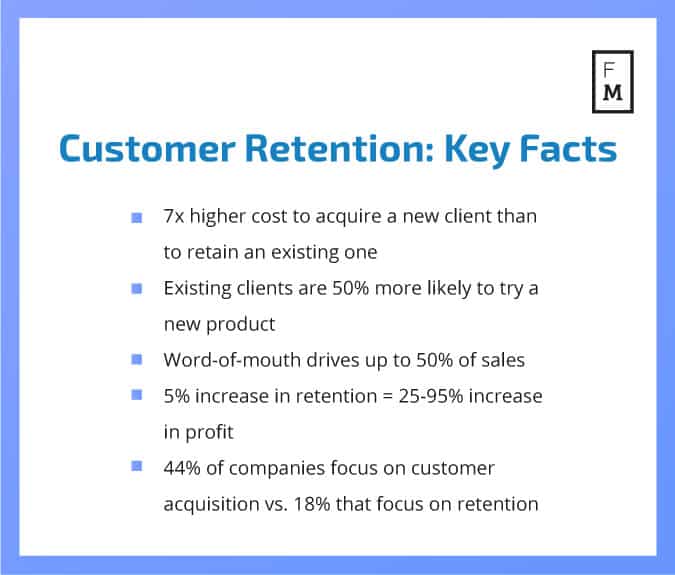
Research from Invesp shows that it costs as much as seven times more to acquire a new client than it does to retain an existing one. At the same time, your existing clients are about 50% more likely to try one of your new service offerings. These startling facts reveal that, while new business is important, retention is perhaps even more vital.
Why Reputation Matters
Industry research also reveals that retention is important from another important perspective: reputation. It has been shown that word of mouth is responsible for anywhere between 20% and 50% of purchasing choices. So, client retention doesn’t just guarantee steady business, but it ensures that customers have great things to say about your brokerage.
In other words, old customers can find you new customers. Nowhere is this more vital than the financial industry, where trust is extremely important. Brokers that are trustworthy and offer solid trading platforms are more likely to get good reviews written about them. This in turn generates warm Leads and maximizes conversion rates.
The Power of Customer Retention
To get the most out of any customer retention strategy, you need to calculate your CRR at regular intervals. Whether daily, monthly or annually, keeping an accurate log of your business’ retention rate is vital for long-term success. By keeping an accurate log of your retention rate, you can measure:
How many new clients your company gains
How long you’ll be able to retain each client if you continue with your existing marketing strategy
How much your company may grow in the future
Measuring customer retention also helps you determine if there’s a problem with your strategy. It’ll also tell you a lot about whether clients are happy with existing services and the impact of a new competitor on market share.
Together, these metrics can help your organization measure Customer Lifetime Value (CLV) accurately. Data from Invesp show that 76% of companies see CLV as an important concept for their organization.
It has also been shown that increasing retention by 5% can boost profits by 25% to 95%. If more financial service providers knew this, they’d be focusing more on the user experience and on upselling existing customers. This is in stark contrast to today’s business world, where 44% of companies place a greater focus on customer Acquisition versus 18% that focus on retention.
The financial service industry is a highly competitive space, especially for online brokers. It’s often extremely difficult for new brokers to compete effectively unless they’ve been operating for at least five years. In an industry where reputation is vital, it can take a while to lay a solid track record. That’s why online brokers especially need to cherish every client they land, especially early on.
Great Content Can Boost Retention
Effective customer retention often begins with a great content strategy. Developing engaging copy and personalization strategies can help your brand stand out from the rest. Conducting market research in the form of client feedback surveys is also a great way to learn more about the end-user experience.
And don’t forget social proof! One of the best ways to boost brand recognition and retention is to enable client testimonials and reviews. The social proof theory says that, when these metrics are positive, people are more likely to try your service.
This article was written by Charlotte Day, Creative Director at Contentworks.
The online brokerage industry is as competitive as ever. With so many platforms to choose from, customers have very little reason to remain loyal to one brand unless the services they are receiving are truly exceptional. But in an industry with very little unique selling propositions (USPs), differentiating yourself from the competition isn’t always easy.
Assuming you’ve done all the groundwork to actually land customers, your goal should be to never let them go. Your customer retention rate is a metric that reveals whether your marketing and client care efforts are boosting your business or bleeding dollars from your business.
It can be measured by looking at the number of clients you still have at the end of a period relative to the number you had when that period began.
The formula is illustrated below:
Customer Retention Rate = ((E-N/S)) X 100, where:
E = the number of clients you have at the end of a specific period (e.g., week, month, year)
N = the number of new clients your business acquired during the given period
S = the number of clients you had at the beginning of the period.
Customer retention isn’t just about the performance of your marketing and sales teams. The number gives you a snapshot of your business development efforts and allows you to anticipate change in your growth expectations.
Research from Invesp shows that it costs as much as seven times more to acquire a new client than it does to retain an existing one. At the same time, your existing clients are about 50% more likely to try one of your new service offerings. These startling facts reveal that, while new business is important, retention is perhaps even more vital.
Why Reputation Matters
Industry research also reveals that retention is important from another important perspective: reputation. It has been shown that word of mouth is responsible for anywhere between 20% and 50% of purchasing choices. So, client retention doesn’t just guarantee steady business, but it ensures that customers have great things to say about your brokerage.
In other words, old customers can find you new customers. Nowhere is this more vital than the financial industry, where trust is extremely important. Brokers that are trustworthy and offer solid trading platforms are more likely to get good reviews written about them. This in turn generates warm Leads and maximizes conversion rates.
The Power of Customer Retention
To get the most out of any customer retention strategy, you need to calculate your CRR at regular intervals. Whether daily, monthly or annually, keeping an accurate log of your business’ retention rate is vital for long-term success. By keeping an accurate log of your retention rate, you can measure:
How many new clients your company gains
How long you’ll be able to retain each client if you continue with your existing marketing strategy
How much your company may grow in the future
Measuring customer retention also helps you determine if there’s a problem with your strategy. It’ll also tell you a lot about whether clients are happy with existing services and the impact of a new competitor on market share.
Together, these metrics can help your organization measure Customer Lifetime Value (CLV) accurately. Data from Invesp show that 76% of companies see CLV as an important concept for their organization.
It has also been shown that increasing retention by 5% can boost profits by 25% to 95%. If more financial service providers knew this, they’d be focusing more on the user experience and on upselling existing customers. This is in stark contrast to today’s business world, where 44% of companies place a greater focus on customer Acquisition versus 18% that focus on retention.
The financial service industry is a highly competitive space, especially for online brokers. It’s often extremely difficult for new brokers to compete effectively unless they’ve been operating for at least five years. In an industry where reputation is vital, it can take a while to lay a solid track record. That’s why online brokers especially need to cherish every client they land, especially early on.
Great Content Can Boost Retention
Effective customer retention often begins with a great content strategy. Developing engaging copy and personalization strategies can help your brand stand out from the rest. Conducting market research in the form of client feedback surveys is also a great way to learn more about the end-user experience.
And don’t forget social proof! One of the best ways to boost brand recognition and retention is to enable client testimonials and reviews. The social proof theory says that, when these metrics are positive, people are more likely to try your service.
In this video, we review @HolaPrimeMarketsOfficial, a multi-asset forex and CFDs broker offering different account types, trading platforms, and flexible trading conditions.
We cover the broker’s overall offering, including account options, trading environment, platforms like MT4 and MT5, and additional services such as managed accounts and fast withdrawals.
Watch the full video to see if Hola Prime Markets fits your trading needs.
📣 Stay up to date with the latest in finance and trading. Follow Finance Magnates for industry news, insights, and global event coverage.
Connect with us:
🔗 LinkedIn: /financemagnates
👍 Facebook: /financemagnates
📸 Instagram: https://www.instagram.com/financemagnates
🐦 X: https://x.com/financemagnates
🎥 TikTok: https://www.tiktok.com/tag/financemagnates
▶️ YouTube: /@financemagnates_official
#HolaPrime #ForexBroker #CFDTrading #FinanceMagnates #Trading #Forex #BrokerReview
In this video, we review @HolaPrimeMarketsOfficial, a multi-asset forex and CFDs broker offering different account types, trading platforms, and flexible trading conditions.
We cover the broker’s overall offering, including account options, trading environment, platforms like MT4 and MT5, and additional services such as managed accounts and fast withdrawals.
Watch the full video to see if Hola Prime Markets fits your trading needs.
📣 Stay up to date with the latest in finance and trading. Follow Finance Magnates for industry news, insights, and global event coverage.
Connect with us:
🔗 LinkedIn: /financemagnates
👍 Facebook: /financemagnates
📸 Instagram: https://www.instagram.com/financemagnates
🐦 X: https://x.com/financemagnates
🎥 TikTok: https://www.tiktok.com/tag/financemagnates
▶️ YouTube: /@financemagnates_official
#HolaPrime #ForexBroker #CFDTrading #FinanceMagnates #Trading #Forex #BrokerReview
Hola Prime Review: What You Need to Know | Full Breakdown by Finance Magnates
Hola Prime Review: What You Need to Know | Full Breakdown by Finance Magnates
In this video, we review @HolaPrime_Global, a proprietary trading firm offering evaluation programs and performance-based payouts in simulated market environments.
We cover how the challenge model works, including account types, profit splits (up to 95%), trading rules, and what it takes to reach a funded account. You’ll also learn about available platforms like MT4, MT5, cTrader, and more, along with insights into payouts, support, and trading conditions.
Watch the full video to see if Hola Prime fits your trading style.
📣 Stay up to date with the latest in finance and trading. Follow Finance Magnates for industry news, insights, and global event coverage.
Connect with us:
🔗 LinkedIn: /financemagnates
👍 Facebook: /financemagnates
📸 Instagram: https://www.instagram.com/financemagnates
🐦 X: https://x.com/financemagnates
🎥 TikTok: https://www.tiktok.com/tag/financemagnates
▶️ YouTube: /@financemagnates_official
#HolaPrime #PropFirm #Trading #FinanceMagnates #Forex #FuturesTrading #TradingReview #PropFirmReview
In this video, we review @HolaPrime_Global, a proprietary trading firm offering evaluation programs and performance-based payouts in simulated market environments.
We cover how the challenge model works, including account types, profit splits (up to 95%), trading rules, and what it takes to reach a funded account. You’ll also learn about available platforms like MT4, MT5, cTrader, and more, along with insights into payouts, support, and trading conditions.
Watch the full video to see if Hola Prime fits your trading style.
📣 Stay up to date with the latest in finance and trading. Follow Finance Magnates for industry news, insights, and global event coverage.
Connect with us:
🔗 LinkedIn: /financemagnates
👍 Facebook: /financemagnates
📸 Instagram: https://www.instagram.com/financemagnates
🐦 X: https://x.com/financemagnates
🎥 TikTok: https://www.tiktok.com/tag/financemagnates
▶️ YouTube: /@financemagnates_official
#HolaPrime #PropFirm #Trading #FinanceMagnates #Forex #FuturesTrading #TradingReview #PropFirmReview
Axi Winner Spotlight 🏆 | Global Most Innovative Broker 2025 #Innovation #Trading #Fintech #Broker
Axi Winner Spotlight 🏆 | Global Most Innovative Broker 2025 #Innovation #Trading #Fintech #Broker
Axi takes the spotlight at the Finance Magnates Awards, winning Global Most Innovative Broker 2025.
Olivia Xenofontos and Ivanna Openko share how the team will feel: proud, motivated, and ready to keep delivering.
They also describe the night as well-organized, focused, and enjoyable for all.
👉 Be part of FM Awards 2026.
Axi takes the spotlight at the Finance Magnates Awards, winning Global Most Innovative Broker 2025.
Olivia Xenofontos and Ivanna Openko share how the team will feel: proud, motivated, and ready to keep delivering.
They also describe the night as well-organized, focused, and enjoyable for all.
👉 Be part of FM Awards 2026.
Recognition that matters.
Built on transparency.
Driven by the industry.
The Finance Magnates Awards 2026.
Nominations are now open.
🔗 https://awards.financemagnates.com/?utm_source=SM&utm_medium=social&utm_campaign=recognition-matters
Recognition that matters.
Built on transparency.
Driven by the industry.
The Finance Magnates Awards 2026.
Nominations are now open.
🔗 https://awards.financemagnates.com/?utm_source=SM&utm_medium=social&utm_campaign=recognition-matters
Tickmill Winner Spotlight | Broker of the Year 2025 (LATAM) 🏆 | Finance Magnates Awards #Trading
Tickmill Winner Spotlight | Broker of the Year 2025 (LATAM) 🏆 | Finance Magnates Awards #Trading
What helped Tickmill stand out this year?
In this Winner Spotlight, Johnny Khalil, Executive Director at Tickmill Europe, shares how listening closely to clients and delivering strong trading conditions made the difference.
A big thank you to the community whose support continues to drive progress every day.
👉 Think your brand has what it takes? Nominate for the 2026 Finance Magnates Awards: https://awards.financemagnates.com/#nominate
What helped Tickmill stand out this year?
In this Winner Spotlight, Johnny Khalil, Executive Director at Tickmill Europe, shares how listening closely to clients and delivering strong trading conditions made the difference.
A big thank you to the community whose support continues to drive progress every day.
👉 Think your brand has what it takes? Nominate for the 2026 Finance Magnates Awards: https://awards.financemagnates.com/#nominate