The Trading Pit, Trade The Pool, and Blueberry Funded are betting that stock challenges will become a material share of the prop trading business.
However, early data suggests the transition is anything but straightforward.
The prop
trading industry has spent the better part of a decade refining a model built
around foreign exchange and contracts for difference: high leverage, tight
spreads, rapid turnover. It has worked. Leading firms have collectively
distributed over $1 billion in payouts to traders, according to industry
estimates, with FTMO alone reporting $450 million over its first decade of operation.
Now, a
growing number of prop firms are looking beyond FX and futures toward a market
that dwarfs both: U.S. equities. But the shift introduces structural challenges
that cut to the heart of how the prop model generates revenue, and whether the
economics can hold without the leverage that makes FX prop trading viable.
The Trading Pit Launches
Its Stock Play
Among the
firms testing the waters is The Trading Pit, the Liechtenstein-headquartered
prop firm majority-owned by Pinorena Capital, a fintech investment vehicle led
by Tickmill co-founder Illimar Mattus.
The program
currently represents a modest share of the firm's overall business, accounting
for less than 10% of active traders and revenue, according to the company. That
compares to its established CFD and futures programs, which generate thousands
of active monthly accounts and have distributed more than €10 million in total
rewards to date.
Daniela Egli, Group CEO of The Trading Pit, Source: LinkedIn
"Considering
that the total addressable market of stock retail traders around the world is
in the range of tens of millions, we believe that stock prop trading has the
potential to shift from niche to a material share," Daniela Egli, the CEO of The Trading Pit, said in a conversation with FinanceMagnates.com.
The Trading
Pit projects stocks could eventually account for more than 30% of its revenue,
driven by what it describes as first-mover positioning as a multi-asset prop
firm spanning stocks, CFDs, and futures.
No Leverage Changes
Everything
The most
consequential difference between stock and FX prop trading is straightforward:
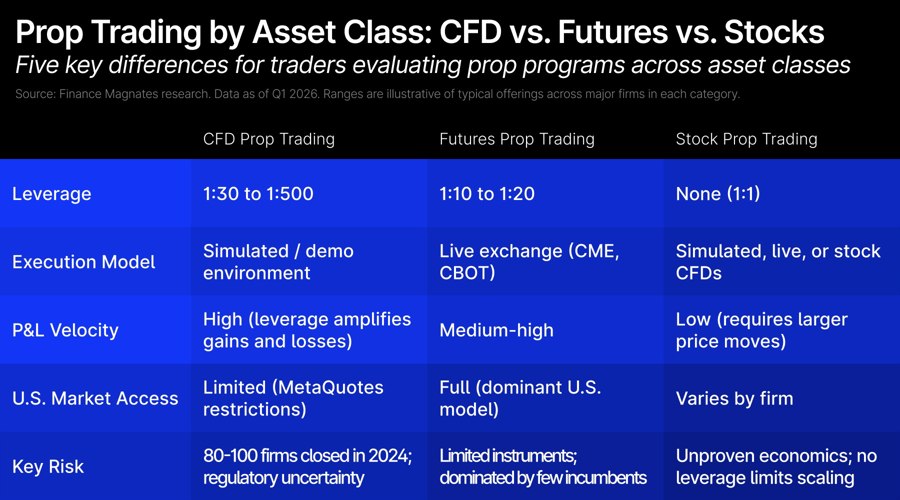
leverage. FX challenges typically offer leverage of 1:50 or higher, meaning a
trader with a $100,000 evaluation account can control positions worth $5
million or more. Stock prop programs, by contrast, operate with no leverage or
limited buying power multiples.
The Trading
Pit confirmed that its stock program applies no leverage, requiring
"strict position sizing and genuine risk control that mirrors professional
stock trading constraints."
The firm
frames this as a feature rather than a limitation, arguing that the absence of
amplification forces traders to develop habits aligned with institutional
equity desks rather than the leveraged retail FX environment.
The
practical consequence, however, is that profit generation on a $25,000 stock
account, the only size currently available at The Trading Pit, requires
meaningfully different mathematics than on a leveraged CFD account of the same
nominal size. A 2% daily move on a concentrated stock position is an
exceptional day. On a leveraged FX account, equivalent P&L swings are
routine.
From FX Dominance to
Multi-Asset - Rivals Already in the Field
The push
toward equities sits within a broader industry pivot. After a bruising period
that saw an estimated 80 to 100 prop firms
shut down in 2024,
driven by MetaQuotes restricting platform access and regulators scrutinizing
the simulated trading model, survivors have been forced to diversify. The move
into futures, crypto, and now stocks reflects a search for new revenue lines
and broader trader audiences.
Michael Katz, the CEO at Trade The Pool
Trade The
Pool, an Israel-based firm backed by The5ers, launched in 2022 as what appears
to be the first prop firm dedicated exclusively to U.S. stocks and ETFs. Unlike
The Trading Pit's simulated environment, Trade The Pool routes orders through
Interactive Brokers infrastructure with real-time exchange data, a distinction
that matters for traders whose strategies depend on authentic depth and
execution quality.
FinanceMagnates.com
contacted The5ers for comment on its stock prop strategy, but the company had
not responded by publication time.
Marcus Fetherston, Blueberry Funded’s General Manager (photo: LinkedIn)
On the
broker-backed side, Australia's Blueberry Funded expanded its
evaluation program in 2025 to include CFD stock trading challenges, offering access to more than 1,000
stocks through MetaTrader 5 and DXtrade. The key difference: Blueberry Funded's
offering is structured around stock CFDs rather than direct equity access,
meaning traders speculate on price movements without the market microstructure
characteristics of exchange-traded shares.
The firm, a
subsidiary of ASIC-regulated Blueberry Markets, reported $2.3 million in first-year
payouts across all
its products. The infrastructure layer is evolving too, with fintech firm
EBSWare expanding its white-label prop trading solution to include U.S., Hong
Kong, and Indian equities.
Unlike several competitors whose stock and CFD challenges remain restricted by jurisdiction, The Trading Pit said its stock program is available globally, including to U.S. and Canadian residents. That broad access is notable given the wider industry pattern: major prop firms only recently re-entered the American market after being forced out by the MetaQuotes crackdown in early 2024, and geographic availability remains uneven across firms and asset classes.
Can Stock Prop Scale, or
Will FX Always Dominate?
The
fundamental question is whether stock prop trading can generate the unit
economics that FX challenges deliver. The FX model thrives on volume: low
challenge fees, high fail rates, and leveraged trading that produces dramatic
outcomes quickly. Stock prop, with no leverage and more diversified trading
patterns, may require a different business calculus entirely.
The Trading
Pit is pricing its stock challenges at €99 for a $25,000 account with an 80%
profit split, competitive with mid-range FX challenges. But the firm
acknowledged it is "actively incorporating trader feedback to expand
offerings, including varied account sizes and types," suggesting the current
product is far from final.
The broader
industry trajectory may favor diversification regardless. Several CFD-focused
firms have already expanded into futures, with The5ers launching futures offerings in early 2026 and firms like
TopStep and Apex filling the gap that CFD props left when they
exited the U.S.
For now,
stock prop remains in its earliest innings, with limited performance data,
narrow product offerings, and a competitive landscape still measured in single
digits. The firms placing early bets are wagering that tens of millions of
retail stock traders represent an addressable market too large to ignore.
The prop
trading industry has spent the better part of a decade refining a model built
around foreign exchange and contracts for difference: high leverage, tight
spreads, rapid turnover. It has worked. Leading firms have collectively
distributed over $1 billion in payouts to traders, according to industry
estimates, with FTMO alone reporting $450 million over its first decade of operation.
Now, a
growing number of prop firms are looking beyond FX and futures toward a market
that dwarfs both: U.S. equities. But the shift introduces structural challenges
that cut to the heart of how the prop model generates revenue, and whether the
economics can hold without the leverage that makes FX prop trading viable.
The Trading Pit Launches
Its Stock Play
Among the
firms testing the waters is The Trading Pit, the Liechtenstein-headquartered
prop firm majority-owned by Pinorena Capital, a fintech investment vehicle led
by Tickmill co-founder Illimar Mattus.
The program
currently represents a modest share of the firm's overall business, accounting
for less than 10% of active traders and revenue, according to the company. That
compares to its established CFD and futures programs, which generate thousands
of active monthly accounts and have distributed more than €10 million in total
rewards to date.
Daniela Egli, Group CEO of The Trading Pit, Source: LinkedIn
"Considering
that the total addressable market of stock retail traders around the world is
in the range of tens of millions, we believe that stock prop trading has the
potential to shift from niche to a material share," Daniela Egli, the CEO of The Trading Pit, said in a conversation with FinanceMagnates.com.
The Trading
Pit projects stocks could eventually account for more than 30% of its revenue,
driven by what it describes as first-mover positioning as a multi-asset prop
firm spanning stocks, CFDs, and futures.
No Leverage Changes
Everything
The most
consequential difference between stock and FX prop trading is straightforward:
leverage. FX challenges typically offer leverage of 1:50 or higher, meaning a
trader with a $100,000 evaluation account can control positions worth $5
million or more. Stock prop programs, by contrast, operate with no leverage or
limited buying power multiples.
The Trading
Pit confirmed that its stock program applies no leverage, requiring
"strict position sizing and genuine risk control that mirrors professional
stock trading constraints."
The firm
frames this as a feature rather than a limitation, arguing that the absence of
amplification forces traders to develop habits aligned with institutional
equity desks rather than the leveraged retail FX environment.
The
practical consequence, however, is that profit generation on a $25,000 stock
account, the only size currently available at The Trading Pit, requires
meaningfully different mathematics than on a leveraged CFD account of the same
nominal size. A 2% daily move on a concentrated stock position is an
exceptional day. On a leveraged FX account, equivalent P&L swings are
routine.
From FX Dominance to
Multi-Asset - Rivals Already in the Field
The push
toward equities sits within a broader industry pivot. After a bruising period
that saw an estimated 80 to 100 prop firms
shut down in 2024,
driven by MetaQuotes restricting platform access and regulators scrutinizing
the simulated trading model, survivors have been forced to diversify. The move
into futures, crypto, and now stocks reflects a search for new revenue lines
and broader trader audiences.
Michael Katz, the CEO at Trade The Pool
Trade The
Pool, an Israel-based firm backed by The5ers, launched in 2022 as what appears
to be the first prop firm dedicated exclusively to U.S. stocks and ETFs. Unlike
The Trading Pit's simulated environment, Trade The Pool routes orders through
Interactive Brokers infrastructure with real-time exchange data, a distinction
that matters for traders whose strategies depend on authentic depth and
execution quality.
FinanceMagnates.com
contacted The5ers for comment on its stock prop strategy, but the company had
not responded by publication time.
Marcus Fetherston, Blueberry Funded’s General Manager (photo: LinkedIn)
On the
broker-backed side, Australia's Blueberry Funded expanded its
evaluation program in 2025 to include CFD stock trading challenges, offering access to more than 1,000
stocks through MetaTrader 5 and DXtrade. The key difference: Blueberry Funded's
offering is structured around stock CFDs rather than direct equity access,
meaning traders speculate on price movements without the market microstructure
characteristics of exchange-traded shares.
The firm, a
subsidiary of ASIC-regulated Blueberry Markets, reported $2.3 million in first-year
payouts across all
its products. The infrastructure layer is evolving too, with fintech firm
EBSWare expanding its white-label prop trading solution to include U.S., Hong
Kong, and Indian equities.
Unlike several competitors whose stock and CFD challenges remain restricted by jurisdiction, The Trading Pit said its stock program is available globally, including to U.S. and Canadian residents. That broad access is notable given the wider industry pattern: major prop firms only recently re-entered the American market after being forced out by the MetaQuotes crackdown in early 2024, and geographic availability remains uneven across firms and asset classes.
Can Stock Prop Scale, or
Will FX Always Dominate?
The
fundamental question is whether stock prop trading can generate the unit
economics that FX challenges deliver. The FX model thrives on volume: low
challenge fees, high fail rates, and leveraged trading that produces dramatic
outcomes quickly. Stock prop, with no leverage and more diversified trading
patterns, may require a different business calculus entirely.
The Trading
Pit is pricing its stock challenges at €99 for a $25,000 account with an 80%
profit split, competitive with mid-range FX challenges. But the firm
acknowledged it is "actively incorporating trader feedback to expand
offerings, including varied account sizes and types," suggesting the current
product is far from final.
The broader
industry trajectory may favor diversification regardless. Several CFD-focused
firms have already expanded into futures, with The5ers launching futures offerings in early 2026 and firms like
TopStep and Apex filling the gap that CFD props left when they
exited the U.S.
For now,
stock prop remains in its earliest innings, with limited performance data,
narrow product offerings, and a competitive landscape still measured in single
digits. The firms placing early bets are wagering that tens of millions of
retail stock traders represent an addressable market too large to ignore.
Damian Chmiel is a Senior Analyst & Editor at Finance Magnates with more than 15 years of experience in the CFD and online trading industry. Active as both a trader and journalist since 2010, he focuses on broker coverage, fintech innovation, and regulatory developments across Europe, the Middle East, and Asia.
His work includes interviews with C-level leaders at major brokerages and fintech platforms, as well as co-authoring Finance Magnates’ quarterly industry benchmarking reports. Damian’s reporting is data-driven, market-aware, and grounded in direct industry engagement. His analysis and commentary have also been cited by external media outlets, including Investing.com, Binance, The Asset, Stockhead, and Dispatch.
Education:
MA in Finance and Accounting, Cracow University of Economics
FTMO Says Monthly Rewards Near $15 Million in September
Featured Videos
AvaTrade to Acquire Most of FXCM; NAGA Raises $8M
AvaTrade to Acquire Most of FXCM; NAGA Raises $8M
AvaTrade to Acquire Most of FXCM; NAGA Raises $8M
AvaTrade to Acquire Most of FXCM; NAGA Raises $8M
Today’s financial news recap covers AvaTrade agrees to acquire most of FXCM, NAGA secures eight million dollars in new financing, and Wise seeks a tax settlement in the UK.
Finance Magnates Daily Recap brings you the latest news from forex and CFD brokers, fintech, payments, cryptocurrency, digital assets, trading platforms, financial regulation and global markets.
Get the key company news, executive moves, deals, regulatory updates and market developments of the day, in just a few minutes. New episodes published every weekday.
Read more: https://www.financemagnates.com
#FinanceMagnates #ForexNews #FintechNews
Today’s financial news recap covers AvaTrade agrees to acquire most of FXCM, NAGA secures eight million dollars in new financing, and Wise seeks a tax settlement in the UK.
Finance Magnates Daily Recap brings you the latest news from forex and CFD brokers, fintech, payments, cryptocurrency, digital assets, trading platforms, financial regulation and global markets.
Get the key company news, executive moves, deals, regulatory updates and market developments of the day, in just a few minutes. New episodes published every weekday.
Read more: https://www.financemagnates.com
#FinanceMagnates #ForexNews #FintechNews
Today’s financial news recap covers AvaTrade agrees to acquire most of FXCM, NAGA secures eight million dollars in new financing, and Wise seeks a tax settlement in the UK.
Finance Magnates Daily Recap brings you the latest news from forex and CFD brokers, fintech, payments, cryptocurrency, digital assets, trading platforms, financial regulation and global markets.
Get the key company news, executive moves, deals, regulatory updates and market developments of the day, in just a few minutes. New episodes published every weekday.
Read more: https://www.financemagnates.com
#FinanceMagnates #ForexNews #FintechNews
Today’s financial news recap covers AvaTrade agrees to acquire most of FXCM, NAGA secures eight million dollars in new financing, and Wise seeks a tax settlement in the UK.
Finance Magnates Daily Recap brings you the latest news from forex and CFD brokers, fintech, payments, cryptocurrency, digital assets, trading platforms, financial regulation and global markets.
Get the key company news, executive moves, deals, regulatory updates and market developments of the day, in just a few minutes. New episodes published every weekday.
Read more: https://www.financemagnates.com
#FinanceMagnates #ForexNews #FintechNews
XTB Adds Overnight US Stock Trading; Nasdaq Ventures Invests in One Trading
XTB Adds Overnight US Stock Trading; Nasdaq Ventures Invests in One Trading
XTB Adds Overnight US Stock Trading; Nasdaq Ventures Invests in One Trading
XTB Adds Overnight US Stock Trading; Nasdaq Ventures Invests in One Trading
XTB Adds Overnight US Stock Trading; Nasdaq Ventures Invests in One Trading
XTB Adds Overnight US Stock Trading; Nasdaq Ventures Invests in One Trading
Today’s financial news recap covers XTB expands overnight US stock trading, Fortrade reports higher revenue, Nasdaq backs One Trading, and Vest Labs raises 13 million dollars.
Finance Magnates Daily Recap brings you the latest news from forex and CFD brokers, fintech, payments, cryptocurrency, digital assets, trading platforms, financial regulation and global markets.
Get the key company news, executive moves, deals, regulatory updates and market developments of the day, in just a few minutes. New episodes published every weekday.
Read more: https://www.financemagnates.com
#FinanceMagnates #ForexNews #FintechNews
Today’s financial news recap covers XTB expands overnight US stock trading, Fortrade reports higher revenue, Nasdaq backs One Trading, and Vest Labs raises 13 million dollars.
Finance Magnates Daily Recap brings you the latest news from forex and CFD brokers, fintech, payments, cryptocurrency, digital assets, trading platforms, financial regulation and global markets.
Get the key company news, executive moves, deals, regulatory updates and market developments of the day, in just a few minutes. New episodes published every weekday.
Read more: https://www.financemagnates.com
#FinanceMagnates #ForexNews #FintechNews
Today’s financial news recap covers XTB expands overnight US stock trading, Fortrade reports higher revenue, Nasdaq backs One Trading, and Vest Labs raises 13 million dollars.
Finance Magnates Daily Recap brings you the latest news from forex and CFD brokers, fintech, payments, cryptocurrency, digital assets, trading platforms, financial regulation and global markets.
Get the key company news, executive moves, deals, regulatory updates and market developments of the day, in just a few minutes. New episodes published every weekday.
Read more: https://www.financemagnates.com
#FinanceMagnates #ForexNews #FintechNews
Today’s financial news recap covers XTB expands overnight US stock trading, Fortrade reports higher revenue, Nasdaq backs One Trading, and Vest Labs raises 13 million dollars.
Finance Magnates Daily Recap brings you the latest news from forex and CFD brokers, fintech, payments, cryptocurrency, digital assets, trading platforms, financial regulation and global markets.
Get the key company news, executive moves, deals, regulatory updates and market developments of the day, in just a few minutes. New episodes published every weekday.
Read more: https://www.financemagnates.com
#FinanceMagnates #ForexNews #FintechNews
Today’s financial news recap covers XTB expands overnight US stock trading, Fortrade reports higher revenue, Nasdaq backs One Trading, and Vest Labs raises 13 million dollars.
Finance Magnates Daily Recap brings you the latest news from forex and CFD brokers, fintech, payments, cryptocurrency, digital assets, trading platforms, financial regulation and global markets.
Get the key company news, executive moves, deals, regulatory updates and market developments of the day, in just a few minutes. New episodes published every weekday.
Read more: https://www.financemagnates.com
#FinanceMagnates #ForexNews #FintechNews
Today’s financial news recap covers XTB expands overnight US stock trading, Fortrade reports higher revenue, Nasdaq backs One Trading, and Vest Labs raises 13 million dollars.
Finance Magnates Daily Recap brings you the latest news from forex and CFD brokers, fintech, payments, cryptocurrency, digital assets, trading platforms, financial regulation and global markets.
Get the key company news, executive moves, deals, regulatory updates and market developments of the day, in just a few minutes. New episodes published every weekday.
Read more: https://www.financemagnates.com
#FinanceMagnates #ForexNews #FintechNews
CMC Founder Downplays Volatility Hit; Devexperts Names CEO
CMC Founder Downplays Volatility Hit; Devexperts Names CEO
CMC Founder Downplays Volatility Hit; Devexperts Names CEO
CMC Founder Downplays Volatility Hit; Devexperts Names CEO
CMC Founder Downplays Volatility Hit; Devexperts Names CEO
CMC Founder Downplays Volatility Hit; Devexperts Names CEO
Today’s financial news recap covers low volatility pressures brokers, Devexperts names a new CEO, Saxo cuts onboarding time, and OKX reaches a 25 billion dollar valuation.
Finance Magnates Daily Recap brings you the latest news from forex and CFD brokers, fintech, payments, cryptocurrency, digital assets, trading platforms, financial regulation and global markets.
Get the key company news, executive moves, deals, regulatory updates and market developments of the day, in just a few minutes. New episodes published every weekday.
Read more: https://www.financemagnates.com
#FinanceMagnates #ForexNews #FintechNews
Today’s financial news recap covers low volatility pressures brokers, Devexperts names a new CEO, Saxo cuts onboarding time, and OKX reaches a 25 billion dollar valuation.
Finance Magnates Daily Recap brings you the latest news from forex and CFD brokers, fintech, payments, cryptocurrency, digital assets, trading platforms, financial regulation and global markets.
Get the key company news, executive moves, deals, regulatory updates and market developments of the day, in just a few minutes. New episodes published every weekday.
Read more: https://www.financemagnates.com
#FinanceMagnates #ForexNews #FintechNews
Today’s financial news recap covers low volatility pressures brokers, Devexperts names a new CEO, Saxo cuts onboarding time, and OKX reaches a 25 billion dollar valuation.
Finance Magnates Daily Recap brings you the latest news from forex and CFD brokers, fintech, payments, cryptocurrency, digital assets, trading platforms, financial regulation and global markets.
Get the key company news, executive moves, deals, regulatory updates and market developments of the day, in just a few minutes. New episodes published every weekday.
Read more: https://www.financemagnates.com
#FinanceMagnates #ForexNews #FintechNews
Today’s financial news recap covers low volatility pressures brokers, Devexperts names a new CEO, Saxo cuts onboarding time, and OKX reaches a 25 billion dollar valuation.
Finance Magnates Daily Recap brings you the latest news from forex and CFD brokers, fintech, payments, cryptocurrency, digital assets, trading platforms, financial regulation and global markets.
Get the key company news, executive moves, deals, regulatory updates and market developments of the day, in just a few minutes. New episodes published every weekday.
Read more: https://www.financemagnates.com
#FinanceMagnates #ForexNews #FintechNews
Today’s financial news recap covers low volatility pressures brokers, Devexperts names a new CEO, Saxo cuts onboarding time, and OKX reaches a 25 billion dollar valuation.
Finance Magnates Daily Recap brings you the latest news from forex and CFD brokers, fintech, payments, cryptocurrency, digital assets, trading platforms, financial regulation and global markets.
Get the key company news, executive moves, deals, regulatory updates and market developments of the day, in just a few minutes. New episodes published every weekday.
Read more: https://www.financemagnates.com
#FinanceMagnates #ForexNews #FintechNews
Today’s financial news recap covers low volatility pressures brokers, Devexperts names a new CEO, Saxo cuts onboarding time, and OKX reaches a 25 billion dollar valuation.
Finance Magnates Daily Recap brings you the latest news from forex and CFD brokers, fintech, payments, cryptocurrency, digital assets, trading platforms, financial regulation and global markets.
Get the key company news, executive moves, deals, regulatory updates and market developments of the day, in just a few minutes. New episodes published every weekday.
Read more: https://www.financemagnates.com
#FinanceMagnates #ForexNews #FintechNews
Today’s financial news recap covers Trade Nation buys FXCM's UK client book, Trading 212 reports higher revenue, the CFTC's move to allow perpetual index futures.
Finance Magnates Daily Recap brings you the latest news from forex and CFD brokers, fintech, payments, cryptocurrency, digital assets, trading platforms, financial regulation and global markets.
Get the key company news, executive moves, deals, regulatory updates and market developments of the day, in just a few minutes. New episodes published every weekday.
Read more: https://www.financemagnates.com
#FinanceMagnates #ForexNews #FintechNews
Today’s financial news recap covers Trade Nation buys FXCM's UK client book, Trading 212 reports higher revenue, the CFTC's move to allow perpetual index futures.
Finance Magnates Daily Recap brings you the latest news from forex and CFD brokers, fintech, payments, cryptocurrency, digital assets, trading platforms, financial regulation and global markets.
Get the key company news, executive moves, deals, regulatory updates and market developments of the day, in just a few minutes. New episodes published every weekday.
Read more: https://www.financemagnates.com
#FinanceMagnates #ForexNews #FintechNews
Today’s financial news recap covers Trade Nation buys FXCM's UK client book, Trading 212 reports higher revenue, the CFTC's move to allow perpetual index futures.
Finance Magnates Daily Recap brings you the latest news from forex and CFD brokers, fintech, payments, cryptocurrency, digital assets, trading platforms, financial regulation and global markets.
Get the key company news, executive moves, deals, regulatory updates and market developments of the day, in just a few minutes. New episodes published every weekday.
Read more: https://www.financemagnates.com
#FinanceMagnates #ForexNews #FintechNews
Today’s financial news recap covers Trade Nation buys FXCM's UK client book, Trading 212 reports higher revenue, the CFTC's move to allow perpetual index futures.
Finance Magnates Daily Recap brings you the latest news from forex and CFD brokers, fintech, payments, cryptocurrency, digital assets, trading platforms, financial regulation and global markets.
Get the key company news, executive moves, deals, regulatory updates and market developments of the day, in just a few minutes. New episodes published every weekday.
Read more: https://www.financemagnates.com
#FinanceMagnates #ForexNews #FintechNews
Today’s financial news recap covers Trade Nation buys FXCM's UK client book, Trading 212 reports higher revenue, the CFTC's move to allow perpetual index futures.
Finance Magnates Daily Recap brings you the latest news from forex and CFD brokers, fintech, payments, cryptocurrency, digital assets, trading platforms, financial regulation and global markets.
Get the key company news, executive moves, deals, regulatory updates and market developments of the day, in just a few minutes. New episodes published every weekday.
Read more: https://www.financemagnates.com
#FinanceMagnates #ForexNews #FintechNews
Today’s financial news recap covers Trade Nation buys FXCM's UK client book, Trading 212 reports higher revenue, the CFTC's move to allow perpetual index futures.
Finance Magnates Daily Recap brings you the latest news from forex and CFD brokers, fintech, payments, cryptocurrency, digital assets, trading platforms, financial regulation and global markets.
Get the key company news, executive moves, deals, regulatory updates and market developments of the day, in just a few minutes. New episodes published every weekday.
Read more: https://www.financemagnates.com
#FinanceMagnates #ForexNews #FintechNews
Your career isn’t a linear path.
Your career isn’t a linear path.
Your career isn’t a linear path.
Your career isn’t a linear path.
Your career isn’t a linear path.
Your career isn’t a linear path.
Roles change. Career goals change. Sometimes you want a completely new challenge.
But the skills and knowledge you build along the way can stay with you and give you something to build on.
For Jeff Patterson, that continued growth is key to long-term career development.
You bring the skills. FM Academy helps you build the knowledge.
#FMAcademy #FinanceMagnates #FinanceCareers #ProfessionalDevelopment #Fintech
Roles change. Career goals change. Sometimes you want a completely new challenge.
But the skills and knowledge you build along the way can stay with you and give you something to build on.
For Jeff Patterson, that continued growth is key to long-term career development.
You bring the skills. FM Academy helps you build the knowledge.
#FMAcademy #FinanceMagnates #FinanceCareers #ProfessionalDevelopment #Fintech
Roles change. Career goals change. Sometimes you want a completely new challenge.
But the skills and knowledge you build along the way can stay with you and give you something to build on.
For Jeff Patterson, that continued growth is key to long-term career development.
You bring the skills. FM Academy helps you build the knowledge.
#FMAcademy #FinanceMagnates #FinanceCareers #ProfessionalDevelopment #Fintech
Roles change. Career goals change. Sometimes you want a completely new challenge.
But the skills and knowledge you build along the way can stay with you and give you something to build on.
For Jeff Patterson, that continued growth is key to long-term career development.
You bring the skills. FM Academy helps you build the knowledge.
#FMAcademy #FinanceMagnates #FinanceCareers #ProfessionalDevelopment #Fintech
Roles change. Career goals change. Sometimes you want a completely new challenge.
But the skills and knowledge you build along the way can stay with you and give you something to build on.
For Jeff Patterson, that continued growth is key to long-term career development.
You bring the skills. FM Academy helps you build the knowledge.
#FMAcademy #FinanceMagnates #FinanceCareers #ProfessionalDevelopment #Fintech
Roles change. Career goals change. Sometimes you want a completely new challenge.
But the skills and knowledge you build along the way can stay with you and give you something to build on.
For Jeff Patterson, that continued growth is key to long-term career development.
You bring the skills. FM Academy helps you build the knowledge.
#FMAcademy #FinanceMagnates #FinanceCareers #ProfessionalDevelopment #Fintech