The UK Banks and Payment Firms Shut 238K Suspected Money Mule Accounts Last Year

Wednesday, 23/09/2026 | 08:51 GMT by Damian Chmiel
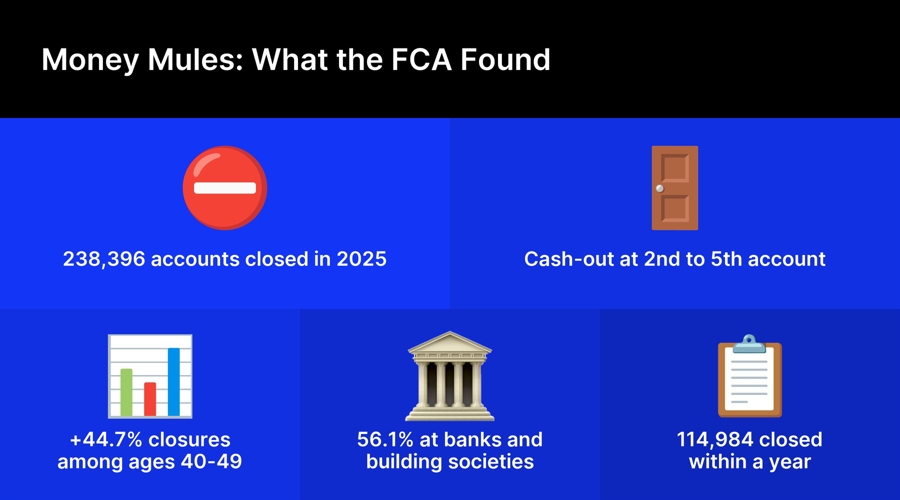
  • Stolen funds usually pass through two to five mules before criminals cash out, the FCA found.
  • Closures among customers aged 40 to 49 jumped 45% in a year, the sharpest rise of any age group.
Money Mules

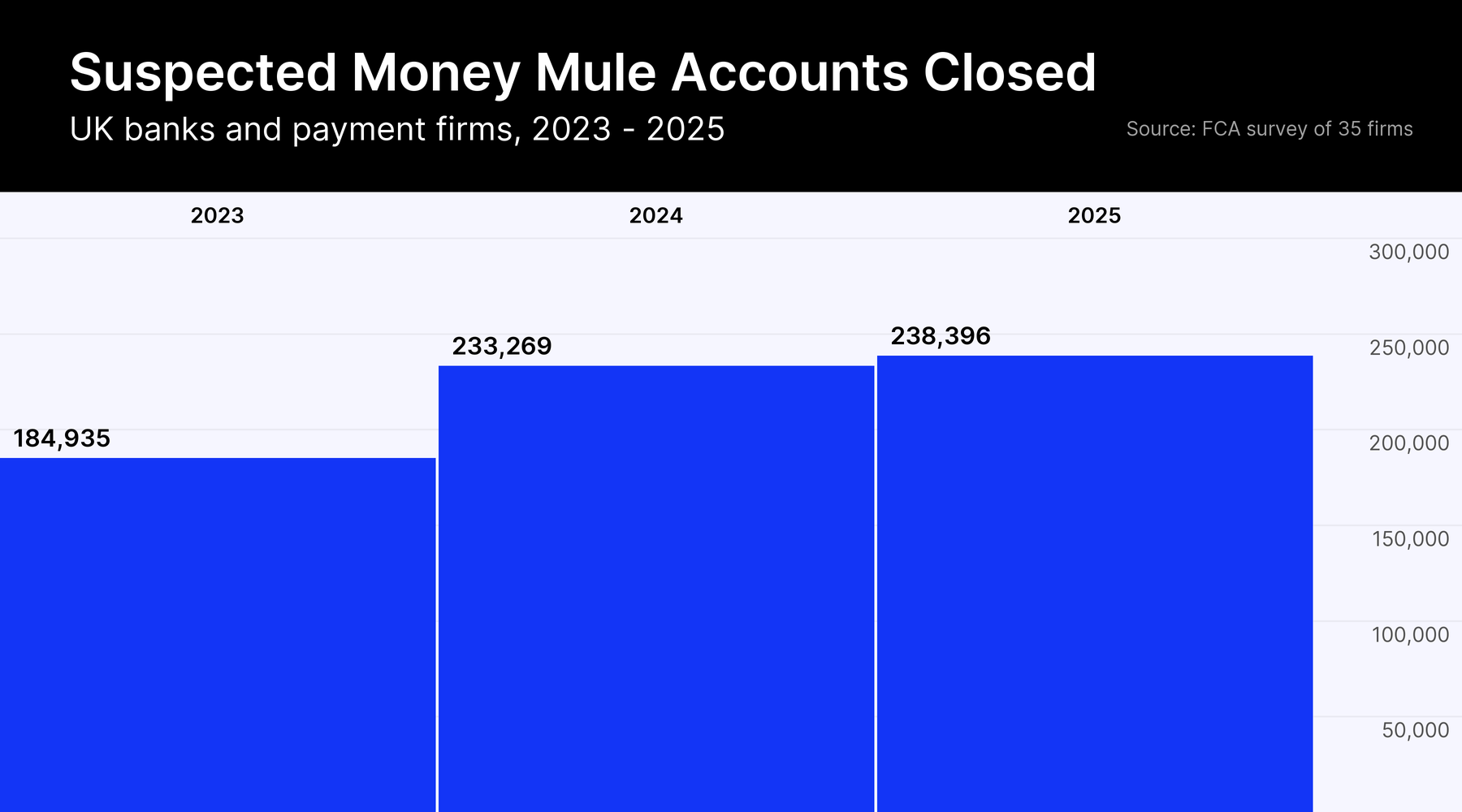
UK banks, building societies and payment firms closed 238,396 suspected money mule accounts in 2025, the Financial Conduct Authority (FCA) said today (Wednesday). The regulator wants firms to spot mule activity earlier.

Criminal groups still pass stolen funds through several accounts before cashing out, the FCA found in a survey of 35 firms. Closures rose 2.2% from 233,269 in 2024, after climbing 26.1% from 184,935 the year before.

London's trading industry is coming home!

Mule accounts are where fraud proceeds are split up and moved on, which makes stolen money harder to trace and recover. The FCA cited a National Crime Agency estimate that around £100 billion is laundered through the UK each year.

Singapore has taken a different approach. It began restricting digital banking, card and ATM access for people who sell their accounts to scam groups in October 2025.

Cash Leaves Between the Second and Fifth Account

A joint cell of 22 regulated firms, set up by the FCA in 2025, examined 140 cases across seven fraud types. Funds were usually cashed out between the second and fifth mule account, and most often at the second.

Criminals typically broke the money into smaller payments that were less likely to draw attention, the regulator found. Some accounts had been used as mules repeatedly before they were closed, which the FCA read as a sign of established criminal networks.

Steve Smart, Executive Director of Enforcement and Market Oversight at the FCA

"Money muling is a crime and it's not victimless," said Steve Smart, the FCA's executive director of enforcement and market oversight.

Smart also warned people to be wary of unsolicited approaches, including online, asking them to move money through their accounts, because they could face prosecution.

Card payments were the most common way to cash out. International transfers went repeatedly to South Asia, West Africa and the Middle East, while crypto transfers were fewer but larger per transaction.

US regulators have flagged the crypto route before. In 2024 the Commodity Futures Trading Commission (CFTC ) warned students that crime groups recruit them to move money through digital wallets.

Closures Among Customers in Their 40s Rise 45%

Customers aged 26 to 39 accounted for the most closures in 2025, at 91,073, followed by those aged 25 and under, at 85,425.

The sharpest increase came among customers aged 40 to 49. Closures in that group rose to 37,274 from 25,760 in 2024, up 44.7%, and were 79.8% higher than in 2023.
About two-thirds of offboarded customers were male where gender was recorded. Personal accounts made up 93.2% of closures.

Many accounts did not last long. Firms closed 114,984 accounts within their first year, including 55,353 within three months of opening.

E-Money Firms Record the Biggest Jump

Retail banks and building societies accounted for 56.1% of 2025 closures and challenger banks for 33%. E-money institutions posted the largest annual increase, at 164.6%, and closed most of their mule accounts within six months of opening.

Retail banks, by contrast, often caught older accounts. At those firms, 45.4% of closed accounts had been open for more than two years.

Firms also reported a smaller share of offboarded customers to the National Fraud Database, 15.3% in 2025 against 17.4% in 2024.

The FCA wants firms to monitor linked accounts and payment patterns beyond the first receiving account, and to use information-sharing provisions in the Economic Crime and Corporate Transparency Act 2023.

Last week the regulator said it had joined tax authorities and police to serve cease and desist letters on three London sites suspected of illegal peer-to-peer crypto trading.

UK banks, building societies and payment firms closed 238,396 suspected money mule accounts in 2025, the Financial Conduct Authority (FCA) said today (Wednesday). The regulator wants firms to spot mule activity earlier.

Criminal groups still pass stolen funds through several accounts before cashing out, the FCA found in a survey of 35 firms. Closures rose 2.2% from 233,269 in 2024, after climbing 26.1% from 184,935 the year before.

London's trading industry is coming home!

Mule accounts are where fraud proceeds are split up and moved on, which makes stolen money harder to trace and recover. The FCA cited a National Crime Agency estimate that around £100 billion is laundered through the UK each year.

Singapore has taken a different approach. It began restricting digital banking, card and ATM access for people who sell their accounts to scam groups in October 2025.

Cash Leaves Between the Second and Fifth Account

A joint cell of 22 regulated firms, set up by the FCA in 2025, examined 140 cases across seven fraud types. Funds were usually cashed out between the second and fifth mule account, and most often at the second.

Criminals typically broke the money into smaller payments that were less likely to draw attention, the regulator found. Some accounts had been used as mules repeatedly before they were closed, which the FCA read as a sign of established criminal networks.

Steve Smart, Executive Director of Enforcement and Market Oversight at the FCA

"Money muling is a crime and it's not victimless," said Steve Smart, the FCA's executive director of enforcement and market oversight.

Smart also warned people to be wary of unsolicited approaches, including online, asking them to move money through their accounts, because they could face prosecution.

Card payments were the most common way to cash out. International transfers went repeatedly to South Asia, West Africa and the Middle East, while crypto transfers were fewer but larger per transaction.

US regulators have flagged the crypto route before. In 2024 the Commodity Futures Trading Commission (CFTC ) warned students that crime groups recruit them to move money through digital wallets.

Closures Among Customers in Their 40s Rise 45%

Customers aged 26 to 39 accounted for the most closures in 2025, at 91,073, followed by those aged 25 and under, at 85,425.

The sharpest increase came among customers aged 40 to 49. Closures in that group rose to 37,274 from 25,760 in 2024, up 44.7%, and were 79.8% higher than in 2023.

About two-thirds of offboarded customers were male where gender was recorded. Personal accounts made up 93.2% of closures.

Many accounts did not last long. Firms closed 114,984 accounts within their first year, including 55,353 within three months of opening.

E-Money Firms Record the Biggest Jump

Retail banks and building societies accounted for 56.1% of 2025 closures and challenger banks for 33%. E-money institutions posted the largest annual increase, at 164.6%, and closed most of their mule accounts within six months of opening.

Retail banks, by contrast, often caught older accounts. At those firms, 45.4% of closed accounts had been open for more than two years.

Firms also reported a smaller share of offboarded customers to the National Fraud Database, 15.3% in 2025 against 17.4% in 2024.

The FCA wants firms to monitor linked accounts and payment patterns beyond the first receiving account, and to use information-sharing provisions in the Economic Crime and Corporate Transparency Act 2023.

Last week the regulator said it had joined tax authorities and police to serve cease and desist letters on three London sites suspected of illegal peer-to-peer crypto trading.

About the Author: Damian Chmiel
Damian Chmiel
  • 3992 Articles
  • 117 Followers
About the Author: Damian Chmiel
Damian Chmiel is a Senior Analyst & Editor at Finance Magnates with more than 15 years of experience in the CFD and online trading industry. Active as both a trader and journalist since 2010, he focuses on broker coverage, fintech innovation, and regulatory developments across Europe, the Middle East, and Asia. His work includes interviews with C-level leaders at major brokerages and fintech platforms, as well as co-authoring Finance Magnates’ quarterly industry benchmarking reports. Damian’s reporting is data-driven, market-aware, and grounded in direct industry engagement. His analysis and commentary have also been cited by external media outlets, including Investing.com, Binance, The Asset, Stockhead, and Dispatch. Education: MA in Finance and Accounting, Cracow University of Economics
  • 3992 Articles
  • 117 Followers

More from the Author

Retail FX

!"#$%&'()*+,-./0123456789:;<=>?@ABCDEFGHIJKLMNOPQRSTUVWXYZ[\]^_`abcdefghijklmnopqrstuvwxyz{|} !"#$%&'()*+,-./0123456789:;<=>?@ABCDEFGHIJKLMNOPQRSTUVWXYZ[\]^_`abcdefghijklmnopqrstuvwxyz{|}