80% of CFD Brokers Plan Futures Pivot as Regulatory Squeeze and US Competition Intensify

Wednesday, 17/12/2025 | 10:15 GMT by Damian Chmiel
  • Nearly four in five European CFD firms plot escape to listed derivatives, and most of them are "very concerned" about regulatory changes.
  • Actions by national regulators and Robinhood’s expansion are forcing a rethink of business models.
acuiti cme

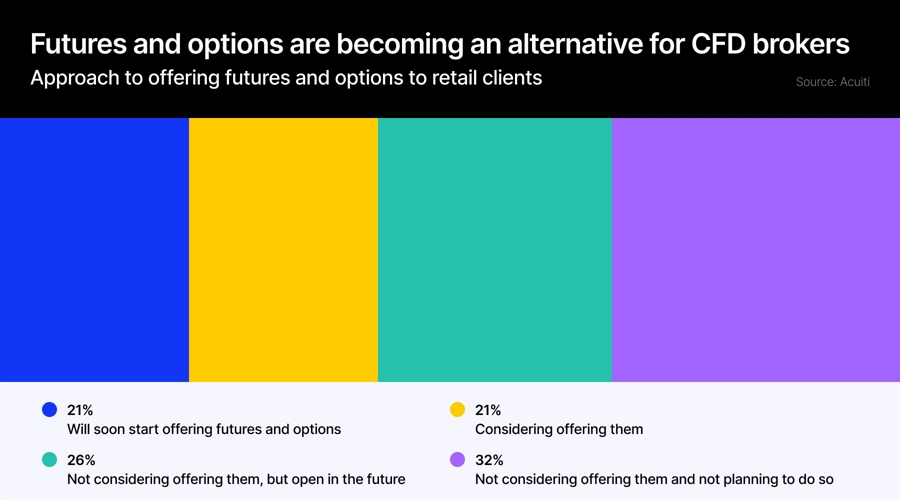
CFD brokers across Europe are scrambling to add futures and options to their platforms as regulatory pressure mounts on over-the-counter derivatives. 4 in 5 of firms not currently offering listed products either planning to or actively considering the move, according to the newest survey by Acuiti for CME Group.

Is the CFD Industry Facing a Major Pivot Toward Other Instruments?

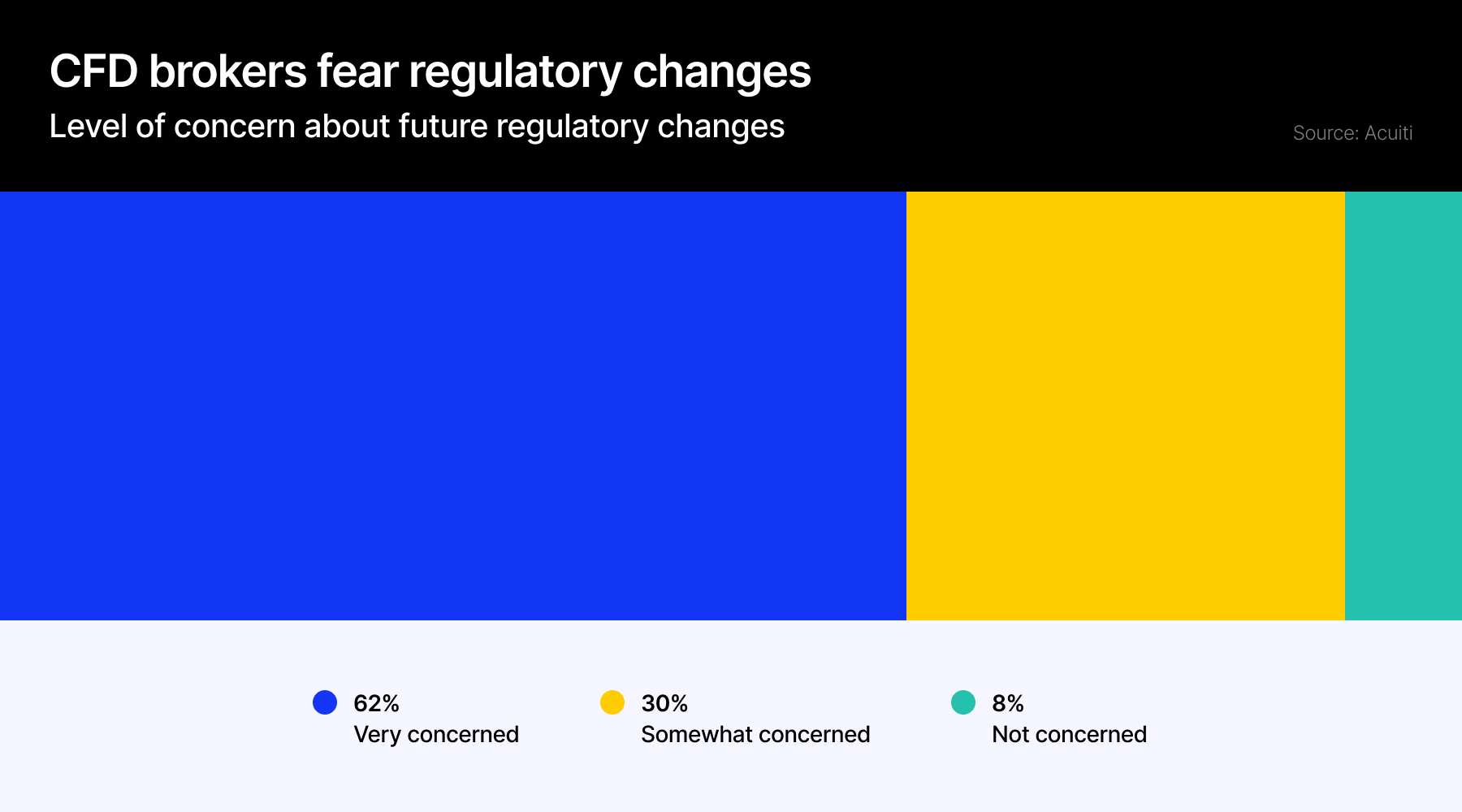
The potential pivot comes as CFD providers face mounting existential threats. The anxiety shows in the numbers. Among CFD brokers surveyed by Acuiti, 62 percent said they were "very concerned" about future regulatory changes impacting retail access to CFD markets, with only 8 percent expressing no concern.

For brokers currently offering CFDs, regulatory compliance ranked as the top operational challenge, cited by 89 percent of firms compared to 70 percent of non-CFD providers.

And the uncertainty is certainly not exaggerated.

Belgium has implemented an outright ban on CFDs, Spain's CNMV has prohibited advertising the products to retail clients, and the UK has introduced marketing restrictions. Germany's BaFin announced new regulations in October targeting turbo certificates, including bans on customer bonuses and rebates.

"CFDs are complex and high-risk products and therefore not generally suitable for retail investors," Spain's CNMV stated when introducing its advertising ban.
acuiti cme

Business Model Under Pressure

The regulatory squeeze is forcing brokers to reconsider their fundamental business models. CFDs operate on a B-Book structure where brokers act as counterparty to client trades, creating inherent conflicts of interest.

Listed derivatives eliminate this issue through exchange trading and central clearing , bypassing counterparty risk concerns that regulators increasingly view as problematic.

firms already offering futures and options, 67 percent described them as "very important" to their retail strategy over the next two years, with only 10 percent saying they weren't important. Client demand and additional revenue potential topped the list of drivers for expansion, though diversification and competitive pressure also featured prominently.

European retail broker revenues have grown from 2.3 billion euro in 2021 to 3.4 billion euro in 2025 across five listed firms including IG Group, CMC Markets, flatexDegiro, Swissquote, and XTB. But this growth occurred during a period when CFDs remained largely accessible. The question facing the industry is whether firms can maintain momentum while pivoting away from products that helped build their businesses.

“Adoption of futures and options by retail traders in Europe looks set to accelerate,” Acuiti comments in the report. “Restrictions on offering OTC instruments to retail clients are growing, the sophistication of retail investors across the continent is increasing and new competition is coming from US retail brokers, who specialize in futures and options.”

U.S. Brokers Pose an Additional Threat

The urgency is compounded by American competition. Robinhood is actively expanding into Europe with tokenized stocks and crypto products, while Kraken's 1.5 billion dollar acquisition of NinjaTrader was explicitly designed to leverage Kraken's FCA and MiFID licenses for European market access.

US retail brokers built their businesses on futures and options rather than CFDs, giving them natural expertise in products that European firms are only now rushing to add. Among European brokers surveyed, 39 percent viewed US market entry as a "significant challenge," with another 44 percent calling it a "slight challenge". Only 17 percent dismissed the competitive threat entirely.

The timing creates a strategic bind. European brokers spent years educating retail clients on CFD trading, building customer bases comfortable with leveraged products. Now they need to re-educate those same clients on futures and options - products they may have previously positioned as too complex for retail investors.

Client education ranked as the top barrier to offering or expanding futures and options, cited by brokers as a more significant obstacle than regulatory uncertainty, operational complexity, or technology integration.

CFD brokers across Europe are scrambling to add futures and options to their platforms as regulatory pressure mounts on over-the-counter derivatives. 4 in 5 of firms not currently offering listed products either planning to or actively considering the move, according to the newest survey by Acuiti for CME Group.

Is the CFD Industry Facing a Major Pivot Toward Other Instruments?

The potential pivot comes as CFD providers face mounting existential threats. The anxiety shows in the numbers. Among CFD brokers surveyed by Acuiti, 62 percent said they were "very concerned" about future regulatory changes impacting retail access to CFD markets, with only 8 percent expressing no concern.

For brokers currently offering CFDs, regulatory compliance ranked as the top operational challenge, cited by 89 percent of firms compared to 70 percent of non-CFD providers.

And the uncertainty is certainly not exaggerated.

Belgium has implemented an outright ban on CFDs, Spain's CNMV has prohibited advertising the products to retail clients, and the UK has introduced marketing restrictions. Germany's BaFin announced new regulations in October targeting turbo certificates, including bans on customer bonuses and rebates.

"CFDs are complex and high-risk products and therefore not generally suitable for retail investors," Spain's CNMV stated when introducing its advertising ban.

acuiti cme

Business Model Under Pressure

The regulatory squeeze is forcing brokers to reconsider their fundamental business models. CFDs operate on a B-Book structure where brokers act as counterparty to client trades, creating inherent conflicts of interest.

Listed derivatives eliminate this issue through exchange trading and central clearing , bypassing counterparty risk concerns that regulators increasingly view as problematic.

firms already offering futures and options, 67 percent described them as "very important" to their retail strategy over the next two years, with only 10 percent saying they weren't important. Client demand and additional revenue potential topped the list of drivers for expansion, though diversification and competitive pressure also featured prominently.

European retail broker revenues have grown from 2.3 billion euro in 2021 to 3.4 billion euro in 2025 across five listed firms including IG Group, CMC Markets, flatexDegiro, Swissquote, and XTB. But this growth occurred during a period when CFDs remained largely accessible. The question facing the industry is whether firms can maintain momentum while pivoting away from products that helped build their businesses.

“Adoption of futures and options by retail traders in Europe looks set to accelerate,” Acuiti comments in the report. “Restrictions on offering OTC instruments to retail clients are growing, the sophistication of retail investors across the continent is increasing and new competition is coming from US retail brokers, who specialize in futures and options.”

U.S. Brokers Pose an Additional Threat

The urgency is compounded by American competition. Robinhood is actively expanding into Europe with tokenized stocks and crypto products, while Kraken's 1.5 billion dollar acquisition of NinjaTrader was explicitly designed to leverage Kraken's FCA and MiFID licenses for European market access.

US retail brokers built their businesses on futures and options rather than CFDs, giving them natural expertise in products that European firms are only now rushing to add. Among European brokers surveyed, 39 percent viewed US market entry as a "significant challenge," with another 44 percent calling it a "slight challenge". Only 17 percent dismissed the competitive threat entirely.

The timing creates a strategic bind. European brokers spent years educating retail clients on CFD trading, building customer bases comfortable with leveraged products. Now they need to re-educate those same clients on futures and options - products they may have previously positioned as too complex for retail investors.

Client education ranked as the top barrier to offering or expanding futures and options, cited by brokers as a more significant obstacle than regulatory uncertainty, operational complexity, or technology integration.

About the Author: Damian Chmiel
Damian Chmiel
  • 3104 Articles
  • 96 Followers
About the Author: Damian Chmiel
Damian's adventure with financial markets began at the Cracow University of Economics, where he obtained his MA in finance and accounting. Starting from the retail trader perspective, he collaborated with brokerage houses and financial portals in Poland as an independent editor and content manager. His adventure with Finance Magnates began in 2016, where he is working as a business intelligence analyst.
  • 3104 Articles
  • 96 Followers

More from the Author

Retail FX

!"#$%&'()*+,-./0123456789:;<=>?@ABCDEFGHIJKLMNOPQRSTUVWXYZ[\]^_`abcdefghijklmnopqrstuvwxyz{|} !"#$%&'()*+,-./0123456789:;<=>?@ABCDEFGHIJKLMNOPQRSTUVWXYZ[\]^_`abcdefghijklmnopqrstuvwxyz{|}