Inflation increases the number of US-accredited investors by 18.5%.
Many of them choose gold as an alternative investment.
Statue of Liberty in New York, USA
The number
of "accredited" investors in the US has increased significantly over
the past few years, largely driven by high inflation rates. According to new
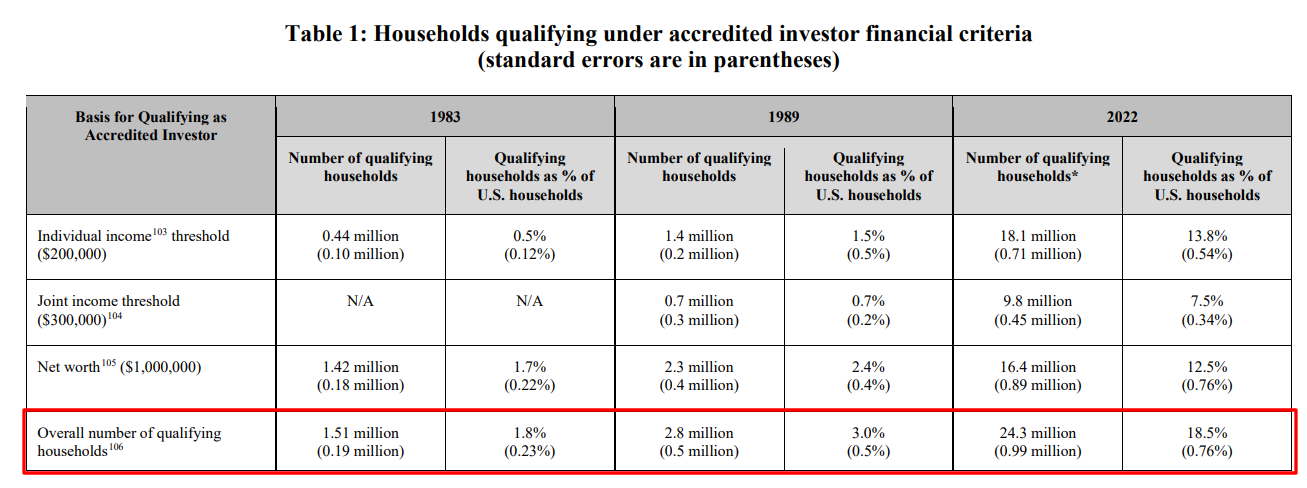
data from the Securities and Exchange Commission (SEC), there were over 24
million accredited investor households in the US in 2022, up from 16 million in
2019.
This gives them access to markets that are reserved for only a few. Despite this, the average investors prefer to diversify their savings differently, opting for crypto or gold.
More Americans Gain Access
to Private Investments amid High Inflation
An
accredited investor meets certain financial thresholds and can invest in
private securities like hedge funds, private equity, and venture capital. However,
just three years ago, only 13% of US households had access to private market
investments. The record-high inflation, which drove up prices and consequently
led to an increase in earnings, has resulted in a significantly larger number
of people exceeding the accredited investor threshold. The number of eligible households
has risen by over five percentage points to 18.5%.
Source: SEC
One of the
main reasons behind this rapid increase is that the financial qualifications
for accredited investor status have not kept pace with inflation. To qualify,
an individual must have $200,000 in annual income or $1 million in net assets,
excluding their primary residence. However, these thresholds have stayed static
since they were first introduced in the early 1980s.
Accounting
for inflation, the income threshold would now need to be over $900,000 for a
couple, or the net worth threshold would need to be around $3 million. If
adjusted accordingly, only 5.7% of US households would currently qualify as
accredited.
Freed or Too Much Risk?
Consumer
advocates have raised concerns that allowing too many people access to complex and
risky private investments may lead to issues down the line. Private markets
tend to be much less transparent than public markets, making it harder for
average investors to conduct proper due diligence.
However,
others argue that more investors should have the freedom to diversify their
portfolios beyond traditional stocks and bonds. In the long run, some private
assets like private equity have delivered returns exceeding public market
equivalents.
As
inflation continues to impact income and wealth, the pool of accredited
investors is likely to keep expanding rapidly. Whether that is ultimately good
or bad for investors remains to be seen.
During Inflation, Investors
Turn to Gold
Regardless
of whether the average retail investor should have access to private markets or
not, record-high inflation is pushing American savers towards alternative
assets. According to a study shared exclusively with Finance Magnates,
83% of millennials express doubts about the current state of the economy.
Consequently, they are exploring new investment and savings avenues, including
gold.
Precious
metals, long considered as a hedge against inflation, are experiencing a
notable increase in interest. Specifically, online queries for “how to invest
in gold and silver” have skyrocketed by 656% over the last year.
A look at
the gold price chart shows this situation is not a coincidence. The precious
metal has grown almost 12% this year, significantly outperforming inflation
and the interest rates of savings accounts. Moreover, it is a safer alternative
to the more rapidly growing but riskier stock market.
The price
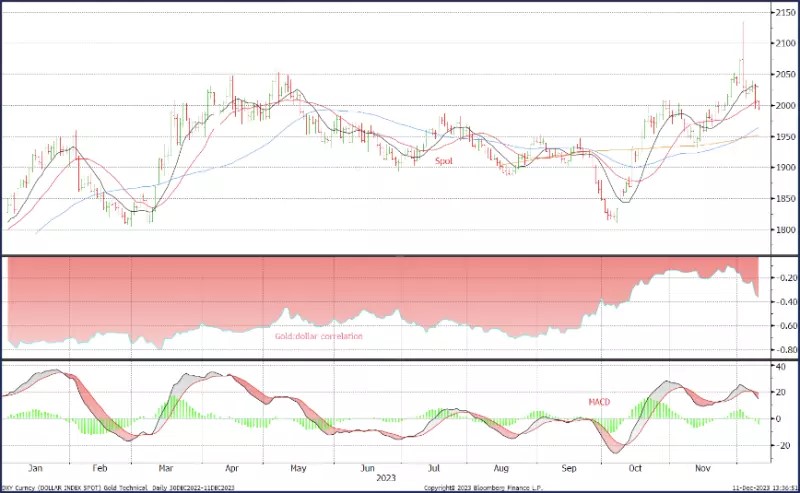
of gold is once again hovering above the psychological level of $2,000 per
ounce, and according to experts at StoneX Bullion, it “is showing resilience.”
They also pointed out that on the leveraged gold market, long positions
continue to dominate.
Gold above the $2,000 level. Source: StoneX Bullion, Bloomberg.
In addition
to gold, investors show interest in cryptocurrencies and collectables. One
out of four respondents indicated a heightened interest in alternative assets
following the Silicon Valley Bank collapse in March 2023. Among those who had
invested in the past six months, a third chose alternative investments, with cryptos
emerging as the most popular option.
The number
of "accredited" investors in the US has increased significantly over
the past few years, largely driven by high inflation rates. According to new
data from the Securities and Exchange Commission (SEC), there were over 24
million accredited investor households in the US in 2022, up from 16 million in
2019.
This gives them access to markets that are reserved for only a few. Despite this, the average investors prefer to diversify their savings differently, opting for crypto or gold.
More Americans Gain Access
to Private Investments amid High Inflation
An
accredited investor meets certain financial thresholds and can invest in
private securities like hedge funds, private equity, and venture capital. However,
just three years ago, only 13% of US households had access to private market
investments. The record-high inflation, which drove up prices and consequently
led to an increase in earnings, has resulted in a significantly larger number
of people exceeding the accredited investor threshold. The number of eligible households
has risen by over five percentage points to 18.5%.
Source: SEC
One of the
main reasons behind this rapid increase is that the financial qualifications
for accredited investor status have not kept pace with inflation. To qualify,
an individual must have $200,000 in annual income or $1 million in net assets,
excluding their primary residence. However, these thresholds have stayed static
since they were first introduced in the early 1980s.
Accounting
for inflation, the income threshold would now need to be over $900,000 for a
couple, or the net worth threshold would need to be around $3 million. If
adjusted accordingly, only 5.7% of US households would currently qualify as
accredited.
Freed or Too Much Risk?
Consumer
advocates have raised concerns that allowing too many people access to complex and
risky private investments may lead to issues down the line. Private markets
tend to be much less transparent than public markets, making it harder for
average investors to conduct proper due diligence.
However,
others argue that more investors should have the freedom to diversify their
portfolios beyond traditional stocks and bonds. In the long run, some private
assets like private equity have delivered returns exceeding public market
equivalents.
As
inflation continues to impact income and wealth, the pool of accredited
investors is likely to keep expanding rapidly. Whether that is ultimately good
or bad for investors remains to be seen.
During Inflation, Investors
Turn to Gold
Regardless
of whether the average retail investor should have access to private markets or
not, record-high inflation is pushing American savers towards alternative
assets. According to a study shared exclusively with Finance Magnates,
83% of millennials express doubts about the current state of the economy.
Consequently, they are exploring new investment and savings avenues, including
gold.
Precious
metals, long considered as a hedge against inflation, are experiencing a
notable increase in interest. Specifically, online queries for “how to invest
in gold and silver” have skyrocketed by 656% over the last year.
A look at
the gold price chart shows this situation is not a coincidence. The precious
metal has grown almost 12% this year, significantly outperforming inflation
and the interest rates of savings accounts. Moreover, it is a safer alternative
to the more rapidly growing but riskier stock market.
The price
of gold is once again hovering above the psychological level of $2,000 per
ounce, and according to experts at StoneX Bullion, it “is showing resilience.”
They also pointed out that on the leveraged gold market, long positions
continue to dominate.
Gold above the $2,000 level. Source: StoneX Bullion, Bloomberg.
In addition
to gold, investors show interest in cryptocurrencies and collectables. One
out of four respondents indicated a heightened interest in alternative assets
following the Silicon Valley Bank collapse in March 2023. Among those who had
invested in the past six months, a third chose alternative investments, with cryptos
emerging as the most popular option.
Damian Chmiel is a Senior Analyst & Editor at Finance Magnates with more than 15 years of experience in the CFD and online trading industry. Active as both a trader and journalist since 2010, he focuses on broker coverage, fintech innovation, and regulatory developments across Europe, the Middle East, and Asia.
His work includes interviews with C-level leaders at major brokerages and fintech platforms, as well as co-authoring Finance Magnates’ quarterly industry benchmarking reports. Damian’s reporting is data-driven, market-aware, and grounded in direct industry engagement. His analysis and commentary have also been cited by external media outlets, including Investing.com, Binance, The Asset, Stockhead, and Dispatch.
Education:
MA in Finance and Accounting, Cracow University of Economics
Retail Traders Can Now Access Prediction Markets Through Binance Wallet
FP Markets Winner Spotlight 🏆 | Global Broker of the Year 2025 #Trading #Broker #Innovation #Shorts
FP Markets Winner Spotlight 🏆 | Global Broker of the Year 2025 #Trading #Broker #Innovation #Shorts
FP Markets takes the spotlight as Global Broker of the Year 2025 at the Finance Magnates Awards.
Martin Stoilov, Head of Client Experience, shares that trust, innovation, and people played a key role in the company’s success, supported by a strong foundation of integrity and client-centricity.
Following this milestone, FP Markets continues to focus on growth, technology investment, and its core values of transparency and excellence.
👉 Be part of FM Awards 2026: https://awards.financemagnates.com/#nominate
FP Markets takes the spotlight as Global Broker of the Year 2025 at the Finance Magnates Awards.
Martin Stoilov, Head of Client Experience, shares that trust, innovation, and people played a key role in the company’s success, supported by a strong foundation of integrity and client-centricity.
Following this milestone, FP Markets continues to focus on growth, technology investment, and its core values of transparency and excellence.
👉 Be part of FM Awards 2026: https://awards.financemagnates.com/#nominate
In this video, we review @HolaPrimeMarketsOfficial, a multi-asset forex and CFDs broker offering different account types, trading platforms, and flexible trading conditions.
We cover the broker’s overall offering, including account options, trading environment, platforms like MT4 and MT5, and additional services such as managed accounts and fast withdrawals.
Watch the full video to see if Hola Prime Markets fits your trading needs.
📣 Stay up to date with the latest in finance and trading. Follow Finance Magnates for industry news, insights, and global event coverage.
Connect with us:
🔗 LinkedIn: /financemagnates
👍 Facebook: /financemagnates
📸 Instagram: https://www.instagram.com/financemagnates
🐦 X: https://x.com/financemagnates
🎥 TikTok: https://www.tiktok.com/tag/financemagnates
▶️ YouTube: /@financemagnates_official
#HolaPrime #ForexBroker #CFDTrading #FinanceMagnates #Trading #Forex #BrokerReview
In this video, we review @HolaPrimeMarketsOfficial, a multi-asset forex and CFDs broker offering different account types, trading platforms, and flexible trading conditions.
We cover the broker’s overall offering, including account options, trading environment, platforms like MT4 and MT5, and additional services such as managed accounts and fast withdrawals.
Watch the full video to see if Hola Prime Markets fits your trading needs.
📣 Stay up to date with the latest in finance and trading. Follow Finance Magnates for industry news, insights, and global event coverage.
Connect with us:
🔗 LinkedIn: /financemagnates
👍 Facebook: /financemagnates
📸 Instagram: https://www.instagram.com/financemagnates
🐦 X: https://x.com/financemagnates
🎥 TikTok: https://www.tiktok.com/tag/financemagnates
▶️ YouTube: /@financemagnates_official
#HolaPrime #ForexBroker #CFDTrading #FinanceMagnates #Trading #Forex #BrokerReview
Hola Prime Review: What You Need to Know | Full Breakdown by Finance Magnates
Hola Prime Review: What You Need to Know | Full Breakdown by Finance Magnates
In this video, we review @HolaPrime_Global, a proprietary trading firm offering evaluation programs and performance-based payouts in simulated market environments.
We cover how the challenge model works, including account types, profit splits (up to 95%), trading rules, and what it takes to reach a funded account. You’ll also learn about available platforms like MT4, MT5, cTrader, and more, along with insights into payouts, support, and trading conditions.
Watch the full video to see if Hola Prime fits your trading style.
📣 Stay up to date with the latest in finance and trading. Follow Finance Magnates for industry news, insights, and global event coverage.
Connect with us:
🔗 LinkedIn: /financemagnates
👍 Facebook: /financemagnates
📸 Instagram: https://www.instagram.com/financemagnates
🐦 X: https://x.com/financemagnates
🎥 TikTok: https://www.tiktok.com/tag/financemagnates
▶️ YouTube: /@financemagnates_official
#HolaPrime #PropFirm #Trading #FinanceMagnates #Forex #FuturesTrading #TradingReview #PropFirmReview
In this video, we review @HolaPrime_Global, a proprietary trading firm offering evaluation programs and performance-based payouts in simulated market environments.
We cover how the challenge model works, including account types, profit splits (up to 95%), trading rules, and what it takes to reach a funded account. You’ll also learn about available platforms like MT4, MT5, cTrader, and more, along with insights into payouts, support, and trading conditions.
Watch the full video to see if Hola Prime fits your trading style.
📣 Stay up to date with the latest in finance and trading. Follow Finance Magnates for industry news, insights, and global event coverage.
Connect with us:
🔗 LinkedIn: /financemagnates
👍 Facebook: /financemagnates
📸 Instagram: https://www.instagram.com/financemagnates
🐦 X: https://x.com/financemagnates
🎥 TikTok: https://www.tiktok.com/tag/financemagnates
▶️ YouTube: /@financemagnates_official
#HolaPrime #PropFirm #Trading #FinanceMagnates #Forex #FuturesTrading #TradingReview #PropFirmReview
Axi Winner Spotlight 🏆 | Global Most Innovative Broker 2025 #Innovation #Trading #Fintech #Broker
Axi Winner Spotlight 🏆 | Global Most Innovative Broker 2025 #Innovation #Trading #Fintech #Broker
Axi takes the spotlight at the Finance Magnates Awards, winning Global Most Innovative Broker 2025.
Olivia Xenofontos and Ivanna Openko share how the team will feel: proud, motivated, and ready to keep delivering.
They also describe the night as well-organized, focused, and enjoyable for all.
👉 Be part of FM Awards 2026.
Axi takes the spotlight at the Finance Magnates Awards, winning Global Most Innovative Broker 2025.
Olivia Xenofontos and Ivanna Openko share how the team will feel: proud, motivated, and ready to keep delivering.
They also describe the night as well-organized, focused, and enjoyable for all.
👉 Be part of FM Awards 2026.
Recognition that matters.
Built on transparency.
Driven by the industry.
The Finance Magnates Awards 2026.
Nominations are now open.
🔗 https://awards.financemagnates.com/?utm_source=SM&utm_medium=social&utm_campaign=recognition-matters
Recognition that matters.
Built on transparency.
Driven by the industry.
The Finance Magnates Awards 2026.
Nominations are now open.
🔗 https://awards.financemagnates.com/?utm_source=SM&utm_medium=social&utm_campaign=recognition-matters