Bitcoin tests important support zone as Trump’s tariffs spark inflation fears.
Crypto market drops 8% due to stalled momentum and liquidations.
Institutional ETF outflows hit $552.5M, pressuring Bitcoin price.
Bitcoin
(BTC), the world’s leading cryptocurrency, has taken a significant hit,
dropping below $91,000 as of February 25, 2025. From macroeconomic
uncertainties to market-specific dynamics, several factors are contributing to
why Bitcoin is falling and why its price is down today.
In this
article, we’ll break down the latest insights and explore the reasons behind
Bitcoin’s current struggles. Especially since the price has reached its lowest
level in three months, and some experts suggest that it may soon drop to around
$70,000.
Why Is Bitcoin Price
Falling?
As of
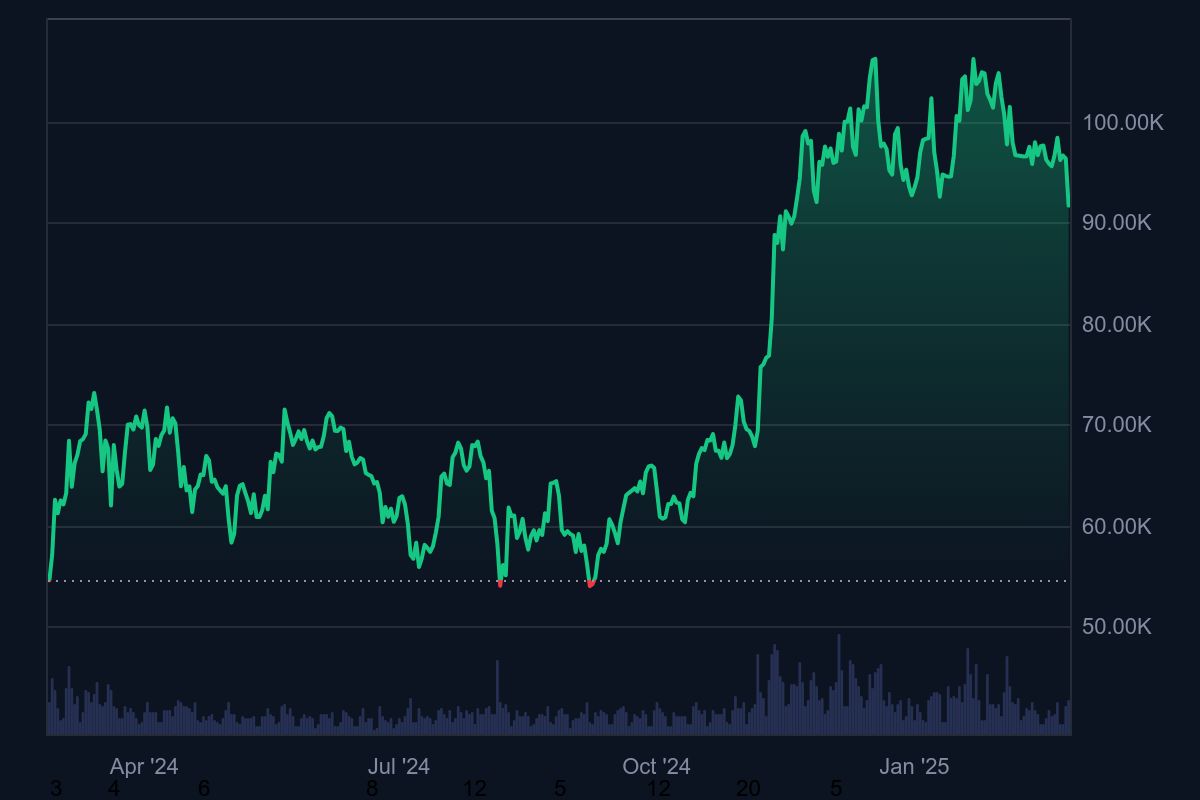
today, Bitcoin (BTC) has fallen over 4.5% in the past 24 hours, reaching its
lowest level since late November at under $91,000, according to CoinMarketCap
data. This drop mirrors a broader crypto market decline, with the total market
capitalization shedding 8%, sliding from over $3.31 trillion to approximately
$3.09 trillion.
It's worth
noting that Monday's nearly 5% decline was the steepest since January 25, when
BTC dropped 5.2%, losing over $5,000 in a single day.
Other
cryptocurrencies also saw significant losses. Ethereum (ETH) dropped 8.5% to
below $2,500, while XRP lost 9% of its value, trading at $2.25. In my previous
post, I
also reported the stronger slum of Dogecoin's (DOGE) price to November 2024
lows. The cascading effect has triggered nearly $1 billion in liquidations,
with long Bitcoin bets accounting for over $57 million of that total, per
CoinGlass.
Why is Bitcoin price down today? Source: CoinMarketCap
Bitcoin Price Technical
Analysis
Based on my
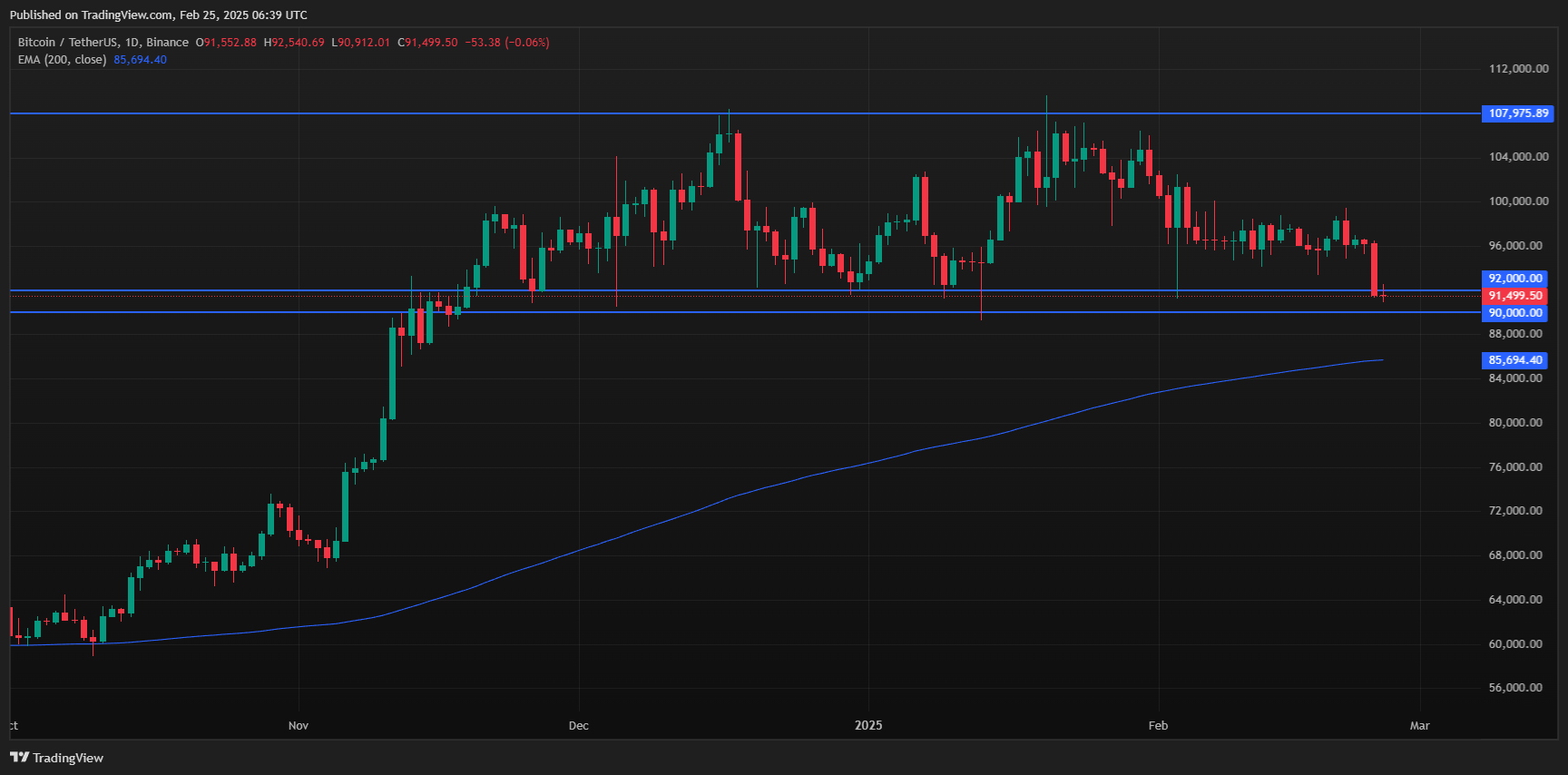
technical analysis, Bitcoin is currently testing the lower boundary of a
three-month consolidation range, which lies between $92,000 and $90,000. The
last interaction with this level in early February did not lead to a
significant upward correction, and the upper boundary of the range was last
tested in mid-January.
However,
there is a strong accumulation of buy orders at the current level, which, in my
view, could make it difficult for buyers to push through. If this level is
breached, my next target would be the 200 EMA, located just below $86,000.
Why is
Bitcoin falling now? Let’s dive into the key reasons behind this downward
spiral.
5 Reasons Bitcoin Is Crashing
Trump’s Tariffs Spark Crypto
Market Uncertainty
One of the
most immediate catalysts for Bitcoin’s price drop today is the announcement
from U.S. President Donald Trump regarding new tariffs. On February 24, 2025,
Trump confirmed during a news conference with French President Emmanuel Macron
that his administration’s planned 25% tariffs on imports from Canada and Mexico
are moving forward as scheduled. Additionally, a 10% tariff on Chinese goods
has added fuel to the fire.
Correlation with
Traditional Markets Intensifies
Bitcoin’s
price movement is increasingly mirroring traditional financial markets, a trend
highlighted by Bitfinex
in their February 24 Alpha report. The S&P 500 has dropped 2.3% over
the past five trading days, while the Nasdaq
Composite has fallen 4% in the same period. This suppression in broader
equity markets is dragging down risk assets, including cryptocurrencies.
"Technology sentiment deteriorated further following reports that the Trump administration is seeking to tighten Biden-era controls on chip technology exports to China, particularly targeting Nvidia chips and maintenance of semiconductor equipment. This comes after Trump ordered increased scrutiny of Chinese investments in key U.S. sectors, further straining U.S.-China relations," commnented XTB.
Institutional Demand Wanes
Another
critical factor in Bitcoin’s fall is the significant slowdown in institutional
demand via spot exchange-traded funds (ETFs). Bitfinex reported outflows
totaling $552.5 million from Bitcoin ETFs for the week ending February 21,
marking a consistent trend of withdrawals. This pullback suggests that large
investors are either taking profits or reallocating capital amid the uncertain
market environment.
"Bitcoin has broken the critical $95,000 level, a move that could have significant implications in the coming weeks. With several key factors at play, this is not the time for complacency—market dynamics are shifting, and traders should remain vigilant," commented Markus Thielen, the CEO of 10x Research.
👇1-21) Although Bitcoin ETFs have attracted $38.6 billion in net inflows since their January 2024 launch, our analysis suggests that only $17.5 billion (44%)… pic.twitter.com/7Bf95P9NpX
Crypto
influencer and former BitMEX CEO Arthur Hayes added fuel to the bearish
sentiment with a post on X on February 25, 2025. Hayes warned of an impending
“goblin town” for Bitcoin, a term signaling a severe price crash. He pointed to
hedge funds holding positions in BlackRock’s iShares Bitcoin Trust (IBIT) as a
potential trigger.
#Bitcoin goblin town incoming: Lots of $IBIT holders are hedge funds that went long ETF short CME future to earn a yield greater than where they fund, short term US treasuries.
If that basis drops as $BTC falls, then these funds will sell $IBIT and buy back CME futures.
Bitfinex
analysts have described Bitcoin as being at a “critical juncture” after nearly
90 days of range-bound trading between $91,000 and $102,000. This prolonged
consolidation reflects a lack of momentum needed for a sustained breakout.
The report
states, “The momentum required for a sustained breakout has been lacking, and
this has led to a period of contraction and consolidation across almost all
major crypto assets.”
This
stagnation, combined with external pressures like tariffs and declining
consumer sentiment, has left Bitcoin vulnerable to sharp declines, as seen
today.
Why Is Bitcoin Price Down
Today? A Perfect Storm
Today’s
Bitcoin price drop is the result of a perfect storm of macroeconomic and
crypto-specific factors:
Trump’s Tariff Policy: Inflation fears are pushing
investors away from risk assets.
Traditional Market Slump: Bitcoin’s correlation with
equities amplifies its losses.
Fading Institutional Support: ETF outflows signal waning
confidence from big players.
Bearish Sentiment: Predictions like Hayes’
“goblin town” add psychological pressure.
Consolidation Fatigue: A lack of breakout momentum
leaves BTC exposed to sell-offs.
FAQ
What’s Next for Bitcoin
Price?
With
Bitcoin trading at $91,572 as of this writing, investors are left wondering
whether this dip is a buying opportunity or the start of a deeper correction.
The cryptocurrency’s fate may hinge on how markets digest Trump’s tariffs and
whether institutional demand rebounds. For now, the $90,000 level is a critical
support to watch—if it breaks, Hayes’ $70,000 target could come into play.
Why Is Bitcoin Currently
Down?
Bitcoin is
currently down due to a combination of macroeconomic pressures and
crypto-specific dynamics. As of February 25, 2025, Bitcoin has fallen below
$91,000, driven by U.S. President Donald Trump’s announcement of 25% tariffs on
Canada and Mexico, alongside a 10% tariff on Chinese goods. These policies are
stoking inflation fears, prompting investors to pull back from risk assets like
Bitcoin.
The broader
crypto market is falling now alongside Bitcoin due to shared vulnerabilities
and external pressures. On February 25, 2025, the total crypto market cap
dropped 8%, from over $3.31 trillion to $3.09 trillion, spurred by nearly $1
billion in liquidations, with $891.52 million from long positions. Trump’s
tariff announcements are a major driver, as they threaten inflation and reduce
appetite for speculative assets like cryptocurrencies.
Bitcoin
(BTC), the world’s leading cryptocurrency, has taken a significant hit,
dropping below $91,000 as of February 25, 2025. From macroeconomic
uncertainties to market-specific dynamics, several factors are contributing to
why Bitcoin is falling and why its price is down today.
In this
article, we’ll break down the latest insights and explore the reasons behind
Bitcoin’s current struggles. Especially since the price has reached its lowest
level in three months, and some experts suggest that it may soon drop to around
$70,000.
Why Is Bitcoin Price
Falling?
As of
today, Bitcoin (BTC) has fallen over 4.5% in the past 24 hours, reaching its
lowest level since late November at under $91,000, according to CoinMarketCap
data. This drop mirrors a broader crypto market decline, with the total market
capitalization shedding 8%, sliding from over $3.31 trillion to approximately
$3.09 trillion.
It's worth
noting that Monday's nearly 5% decline was the steepest since January 25, when
BTC dropped 5.2%, losing over $5,000 in a single day.
Other
cryptocurrencies also saw significant losses. Ethereum (ETH) dropped 8.5% to
below $2,500, while XRP lost 9% of its value, trading at $2.25. In my previous
post, I
also reported the stronger slum of Dogecoin's (DOGE) price to November 2024
lows. The cascading effect has triggered nearly $1 billion in liquidations,
with long Bitcoin bets accounting for over $57 million of that total, per
CoinGlass.
Why is Bitcoin price down today? Source: CoinMarketCap
Bitcoin Price Technical
Analysis
Based on my
technical analysis, Bitcoin is currently testing the lower boundary of a
three-month consolidation range, which lies between $92,000 and $90,000. The
last interaction with this level in early February did not lead to a
significant upward correction, and the upper boundary of the range was last
tested in mid-January.
However,
there is a strong accumulation of buy orders at the current level, which, in my
view, could make it difficult for buyers to push through. If this level is
breached, my next target would be the 200 EMA, located just below $86,000.
Why is
Bitcoin falling now? Let’s dive into the key reasons behind this downward
spiral.
5 Reasons Bitcoin Is Crashing
Trump’s Tariffs Spark Crypto
Market Uncertainty
One of the
most immediate catalysts for Bitcoin’s price drop today is the announcement
from U.S. President Donald Trump regarding new tariffs. On February 24, 2025,
Trump confirmed during a news conference with French President Emmanuel Macron
that his administration’s planned 25% tariffs on imports from Canada and Mexico
are moving forward as scheduled. Additionally, a 10% tariff on Chinese goods
has added fuel to the fire.
Correlation with
Traditional Markets Intensifies
Bitcoin’s
price movement is increasingly mirroring traditional financial markets, a trend
highlighted by Bitfinex
in their February 24 Alpha report. The S&P 500 has dropped 2.3% over
the past five trading days, while the Nasdaq
Composite has fallen 4% in the same period. This suppression in broader
equity markets is dragging down risk assets, including cryptocurrencies.
"Technology sentiment deteriorated further following reports that the Trump administration is seeking to tighten Biden-era controls on chip technology exports to China, particularly targeting Nvidia chips and maintenance of semiconductor equipment. This comes after Trump ordered increased scrutiny of Chinese investments in key U.S. sectors, further straining U.S.-China relations," commnented XTB.
Institutional Demand Wanes
Another
critical factor in Bitcoin’s fall is the significant slowdown in institutional
demand via spot exchange-traded funds (ETFs). Bitfinex reported outflows
totaling $552.5 million from Bitcoin ETFs for the week ending February 21,
marking a consistent trend of withdrawals. This pullback suggests that large
investors are either taking profits or reallocating capital amid the uncertain
market environment.
"Bitcoin has broken the critical $95,000 level, a move that could have significant implications in the coming weeks. With several key factors at play, this is not the time for complacency—market dynamics are shifting, and traders should remain vigilant," commented Markus Thielen, the CEO of 10x Research.
👇1-21) Although Bitcoin ETFs have attracted $38.6 billion in net inflows since their January 2024 launch, our analysis suggests that only $17.5 billion (44%)… pic.twitter.com/7Bf95P9NpX
Crypto
influencer and former BitMEX CEO Arthur Hayes added fuel to the bearish
sentiment with a post on X on February 25, 2025. Hayes warned of an impending
“goblin town” for Bitcoin, a term signaling a severe price crash. He pointed to
hedge funds holding positions in BlackRock’s iShares Bitcoin Trust (IBIT) as a
potential trigger.
#Bitcoin goblin town incoming: Lots of $IBIT holders are hedge funds that went long ETF short CME future to earn a yield greater than where they fund, short term US treasuries.
If that basis drops as $BTC falls, then these funds will sell $IBIT and buy back CME futures.
Bitfinex
analysts have described Bitcoin as being at a “critical juncture” after nearly
90 days of range-bound trading between $91,000 and $102,000. This prolonged
consolidation reflects a lack of momentum needed for a sustained breakout.
The report
states, “The momentum required for a sustained breakout has been lacking, and
this has led to a period of contraction and consolidation across almost all
major crypto assets.”
This
stagnation, combined with external pressures like tariffs and declining
consumer sentiment, has left Bitcoin vulnerable to sharp declines, as seen
today.
Why Is Bitcoin Price Down
Today? A Perfect Storm
Today’s
Bitcoin price drop is the result of a perfect storm of macroeconomic and
crypto-specific factors:
Trump’s Tariff Policy: Inflation fears are pushing
investors away from risk assets.
Traditional Market Slump: Bitcoin’s correlation with
equities amplifies its losses.
Fading Institutional Support: ETF outflows signal waning
confidence from big players.
Bearish Sentiment: Predictions like Hayes’
“goblin town” add psychological pressure.
Consolidation Fatigue: A lack of breakout momentum
leaves BTC exposed to sell-offs.
FAQ
What’s Next for Bitcoin
Price?
With
Bitcoin trading at $91,572 as of this writing, investors are left wondering
whether this dip is a buying opportunity or the start of a deeper correction.
The cryptocurrency’s fate may hinge on how markets digest Trump’s tariffs and
whether institutional demand rebounds. For now, the $90,000 level is a critical
support to watch—if it breaks, Hayes’ $70,000 target could come into play.
Why Is Bitcoin Currently
Down?
Bitcoin is
currently down due to a combination of macroeconomic pressures and
crypto-specific dynamics. As of February 25, 2025, Bitcoin has fallen below
$91,000, driven by U.S. President Donald Trump’s announcement of 25% tariffs on
Canada and Mexico, alongside a 10% tariff on Chinese goods. These policies are
stoking inflation fears, prompting investors to pull back from risk assets like
Bitcoin.
The broader
crypto market is falling now alongside Bitcoin due to shared vulnerabilities
and external pressures. On February 25, 2025, the total crypto market cap
dropped 8%, from over $3.31 trillion to $3.09 trillion, spurred by nearly $1
billion in liquidations, with $891.52 million from long positions. Trump’s
tariff announcements are a major driver, as they threaten inflation and reduce
appetite for speculative assets like cryptocurrencies.
Damian Chmiel is a Senior Analyst & Editor at Finance Magnates with more than 15 years of experience in the CFD and online trading industry. Active as both a trader and journalist since 2010, he focuses on broker coverage, fintech innovation, and regulatory developments across Europe, the Middle East, and Asia.
His work includes interviews with C-level leaders at major brokerages and fintech platforms, as well as co-authoring Finance Magnates’ quarterly industry benchmarking reports. Damian’s reporting is data-driven, market-aware, and grounded in direct industry engagement. His analysis and commentary have also been cited by external media outlets, including Investing.com, Binance, The Asset, Stockhead, and Dispatch.
Education:
MA in Finance and Accounting, Cracow University of Economics
CFTC Seeks Public Input on Proposed Retail Crypto Regulatory Framework
Featured Videos
XTB Adds Overnight US Stock Trading; Nasdaq Ventures Invests in One Trading
XTB Adds Overnight US Stock Trading; Nasdaq Ventures Invests in One Trading
XTB Adds Overnight US Stock Trading; Nasdaq Ventures Invests in One Trading
XTB Adds Overnight US Stock Trading; Nasdaq Ventures Invests in One Trading
Today’s financial news recap covers XTB expands overnight US stock trading, Fortrade reports higher revenue, Nasdaq backs One Trading, and Vest Labs raises 13 million dollars.
Finance Magnates Daily Recap brings you the latest news from forex and CFD brokers, fintech, payments, cryptocurrency, digital assets, trading platforms, financial regulation and global markets.
Get the key company news, executive moves, deals, regulatory updates and market developments of the day, in just a few minutes. New episodes published every weekday.
Read more: https://www.financemagnates.com
#FinanceMagnates #ForexNews #FintechNews
Today’s financial news recap covers XTB expands overnight US stock trading, Fortrade reports higher revenue, Nasdaq backs One Trading, and Vest Labs raises 13 million dollars.
Finance Magnates Daily Recap brings you the latest news from forex and CFD brokers, fintech, payments, cryptocurrency, digital assets, trading platforms, financial regulation and global markets.
Get the key company news, executive moves, deals, regulatory updates and market developments of the day, in just a few minutes. New episodes published every weekday.
Read more: https://www.financemagnates.com
#FinanceMagnates #ForexNews #FintechNews
Today’s financial news recap covers XTB expands overnight US stock trading, Fortrade reports higher revenue, Nasdaq backs One Trading, and Vest Labs raises 13 million dollars.
Finance Magnates Daily Recap brings you the latest news from forex and CFD brokers, fintech, payments, cryptocurrency, digital assets, trading platforms, financial regulation and global markets.
Get the key company news, executive moves, deals, regulatory updates and market developments of the day, in just a few minutes. New episodes published every weekday.
Read more: https://www.financemagnates.com
#FinanceMagnates #ForexNews #FintechNews
Today’s financial news recap covers XTB expands overnight US stock trading, Fortrade reports higher revenue, Nasdaq backs One Trading, and Vest Labs raises 13 million dollars.
Finance Magnates Daily Recap brings you the latest news from forex and CFD brokers, fintech, payments, cryptocurrency, digital assets, trading platforms, financial regulation and global markets.
Get the key company news, executive moves, deals, regulatory updates and market developments of the day, in just a few minutes. New episodes published every weekday.
Read more: https://www.financemagnates.com
#FinanceMagnates #ForexNews #FintechNews
CMC Founder Downplays Volatility Hit; Devexperts Names CEO
CMC Founder Downplays Volatility Hit; Devexperts Names CEO
CMC Founder Downplays Volatility Hit; Devexperts Names CEO
CMC Founder Downplays Volatility Hit; Devexperts Names CEO
CMC Founder Downplays Volatility Hit; Devexperts Names CEO
CMC Founder Downplays Volatility Hit; Devexperts Names CEO
Today’s financial news recap covers low volatility pressures brokers, Devexperts names a new CEO, Saxo cuts onboarding time, and OKX reaches a 25 billion dollar valuation.
Finance Magnates Daily Recap brings you the latest news from forex and CFD brokers, fintech, payments, cryptocurrency, digital assets, trading platforms, financial regulation and global markets.
Get the key company news, executive moves, deals, regulatory updates and market developments of the day, in just a few minutes. New episodes published every weekday.
Read more: https://www.financemagnates.com
#FinanceMagnates #ForexNews #FintechNews
Today’s financial news recap covers low volatility pressures brokers, Devexperts names a new CEO, Saxo cuts onboarding time, and OKX reaches a 25 billion dollar valuation.
Finance Magnates Daily Recap brings you the latest news from forex and CFD brokers, fintech, payments, cryptocurrency, digital assets, trading platforms, financial regulation and global markets.
Get the key company news, executive moves, deals, regulatory updates and market developments of the day, in just a few minutes. New episodes published every weekday.
Read more: https://www.financemagnates.com
#FinanceMagnates #ForexNews #FintechNews
Today’s financial news recap covers low volatility pressures brokers, Devexperts names a new CEO, Saxo cuts onboarding time, and OKX reaches a 25 billion dollar valuation.
Finance Magnates Daily Recap brings you the latest news from forex and CFD brokers, fintech, payments, cryptocurrency, digital assets, trading platforms, financial regulation and global markets.
Get the key company news, executive moves, deals, regulatory updates and market developments of the day, in just a few minutes. New episodes published every weekday.
Read more: https://www.financemagnates.com
#FinanceMagnates #ForexNews #FintechNews
Today’s financial news recap covers low volatility pressures brokers, Devexperts names a new CEO, Saxo cuts onboarding time, and OKX reaches a 25 billion dollar valuation.
Finance Magnates Daily Recap brings you the latest news from forex and CFD brokers, fintech, payments, cryptocurrency, digital assets, trading platforms, financial regulation and global markets.
Get the key company news, executive moves, deals, regulatory updates and market developments of the day, in just a few minutes. New episodes published every weekday.
Read more: https://www.financemagnates.com
#FinanceMagnates #ForexNews #FintechNews
Today’s financial news recap covers low volatility pressures brokers, Devexperts names a new CEO, Saxo cuts onboarding time, and OKX reaches a 25 billion dollar valuation.
Finance Magnates Daily Recap brings you the latest news from forex and CFD brokers, fintech, payments, cryptocurrency, digital assets, trading platforms, financial regulation and global markets.
Get the key company news, executive moves, deals, regulatory updates and market developments of the day, in just a few minutes. New episodes published every weekday.
Read more: https://www.financemagnates.com
#FinanceMagnates #ForexNews #FintechNews
Today’s financial news recap covers low volatility pressures brokers, Devexperts names a new CEO, Saxo cuts onboarding time, and OKX reaches a 25 billion dollar valuation.
Finance Magnates Daily Recap brings you the latest news from forex and CFD brokers, fintech, payments, cryptocurrency, digital assets, trading platforms, financial regulation and global markets.
Get the key company news, executive moves, deals, regulatory updates and market developments of the day, in just a few minutes. New episodes published every weekday.
Read more: https://www.financemagnates.com
#FinanceMagnates #ForexNews #FintechNews
Today’s financial news recap covers Trade Nation buys FXCM's UK client book, Trading 212 reports higher revenue, the CFTC's move to allow perpetual index futures.
Finance Magnates Daily Recap brings you the latest news from forex and CFD brokers, fintech, payments, cryptocurrency, digital assets, trading platforms, financial regulation and global markets.
Get the key company news, executive moves, deals, regulatory updates and market developments of the day, in just a few minutes. New episodes published every weekday.
Read more: https://www.financemagnates.com
#FinanceMagnates #ForexNews #FintechNews
Today’s financial news recap covers Trade Nation buys FXCM's UK client book, Trading 212 reports higher revenue, the CFTC's move to allow perpetual index futures.
Finance Magnates Daily Recap brings you the latest news from forex and CFD brokers, fintech, payments, cryptocurrency, digital assets, trading platforms, financial regulation and global markets.
Get the key company news, executive moves, deals, regulatory updates and market developments of the day, in just a few minutes. New episodes published every weekday.
Read more: https://www.financemagnates.com
#FinanceMagnates #ForexNews #FintechNews
Today’s financial news recap covers Trade Nation buys FXCM's UK client book, Trading 212 reports higher revenue, the CFTC's move to allow perpetual index futures.
Finance Magnates Daily Recap brings you the latest news from forex and CFD brokers, fintech, payments, cryptocurrency, digital assets, trading platforms, financial regulation and global markets.
Get the key company news, executive moves, deals, regulatory updates and market developments of the day, in just a few minutes. New episodes published every weekday.
Read more: https://www.financemagnates.com
#FinanceMagnates #ForexNews #FintechNews
Today’s financial news recap covers Trade Nation buys FXCM's UK client book, Trading 212 reports higher revenue, the CFTC's move to allow perpetual index futures.
Finance Magnates Daily Recap brings you the latest news from forex and CFD brokers, fintech, payments, cryptocurrency, digital assets, trading platforms, financial regulation and global markets.
Get the key company news, executive moves, deals, regulatory updates and market developments of the day, in just a few minutes. New episodes published every weekday.
Read more: https://www.financemagnates.com
#FinanceMagnates #ForexNews #FintechNews
Today’s financial news recap covers Trade Nation buys FXCM's UK client book, Trading 212 reports higher revenue, the CFTC's move to allow perpetual index futures.
Finance Magnates Daily Recap brings you the latest news from forex and CFD brokers, fintech, payments, cryptocurrency, digital assets, trading platforms, financial regulation and global markets.
Get the key company news, executive moves, deals, regulatory updates and market developments of the day, in just a few minutes. New episodes published every weekday.
Read more: https://www.financemagnates.com
#FinanceMagnates #ForexNews #FintechNews
Today’s financial news recap covers Trade Nation buys FXCM's UK client book, Trading 212 reports higher revenue, the CFTC's move to allow perpetual index futures.
Finance Magnates Daily Recap brings you the latest news from forex and CFD brokers, fintech, payments, cryptocurrency, digital assets, trading platforms, financial regulation and global markets.
Get the key company news, executive moves, deals, regulatory updates and market developments of the day, in just a few minutes. New episodes published every weekday.
Read more: https://www.financemagnates.com
#FinanceMagnates #ForexNews #FintechNews
Your career isn’t a linear path.
Your career isn’t a linear path.
Your career isn’t a linear path.
Your career isn’t a linear path.
Your career isn’t a linear path.
Your career isn’t a linear path.
Roles change. Career goals change. Sometimes you want a completely new challenge.
But the skills and knowledge you build along the way can stay with you and give you something to build on.
For Jeff Patterson, that continued growth is key to long-term career development.
You bring the skills. FM Academy helps you build the knowledge.
#FMAcademy #FinanceMagnates #FinanceCareers #ProfessionalDevelopment #Fintech
Roles change. Career goals change. Sometimes you want a completely new challenge.
But the skills and knowledge you build along the way can stay with you and give you something to build on.
For Jeff Patterson, that continued growth is key to long-term career development.
You bring the skills. FM Academy helps you build the knowledge.
#FMAcademy #FinanceMagnates #FinanceCareers #ProfessionalDevelopment #Fintech
Roles change. Career goals change. Sometimes you want a completely new challenge.
But the skills and knowledge you build along the way can stay with you and give you something to build on.
For Jeff Patterson, that continued growth is key to long-term career development.
You bring the skills. FM Academy helps you build the knowledge.
#FMAcademy #FinanceMagnates #FinanceCareers #ProfessionalDevelopment #Fintech
Roles change. Career goals change. Sometimes you want a completely new challenge.
But the skills and knowledge you build along the way can stay with you and give you something to build on.
For Jeff Patterson, that continued growth is key to long-term career development.
You bring the skills. FM Academy helps you build the knowledge.
#FMAcademy #FinanceMagnates #FinanceCareers #ProfessionalDevelopment #Fintech
Roles change. Career goals change. Sometimes you want a completely new challenge.
But the skills and knowledge you build along the way can stay with you and give you something to build on.
For Jeff Patterson, that continued growth is key to long-term career development.
You bring the skills. FM Academy helps you build the knowledge.
#FMAcademy #FinanceMagnates #FinanceCareers #ProfessionalDevelopment #Fintech
Roles change. Career goals change. Sometimes you want a completely new challenge.
But the skills and knowledge you build along the way can stay with you and give you something to build on.
For Jeff Patterson, that continued growth is key to long-term career development.
You bring the skills. FM Academy helps you build the knowledge.
#FMAcademy #FinanceMagnates #FinanceCareers #ProfessionalDevelopment #Fintech
IG Group Tech Chiefs Exit; Pepperstone Revenue Grows
IG Group Tech Chiefs Exit; Pepperstone Revenue Grows
IG Group Tech Chiefs Exit; Pepperstone Revenue Grows
IG Group Tech Chiefs Exit; Pepperstone Revenue Grows
IG Group Tech Chiefs Exit; Pepperstone Revenue Grows
IG Group Tech Chiefs Exit; Pepperstone Revenue Grows
Today’s financial news recap covers IG Group loses two technology chiefs, Pepperstone reports double-digit growth, and eToro backs a euro stablecoin.
Finance Magnates Daily Recap brings you the latest news from forex and CFD brokers, fintech, payments, cryptocurrency, digital assets, trading platforms, financial regulation and global markets.
Get the key company news, executive moves, deals, regulatory updates and market developments of the day, in just a few minutes. New episodes published every weekday.
Read more: https://www.financemagnates.com
#FinanceMagnates #ForexNews #FintechNews
Today’s financial news recap covers IG Group loses two technology chiefs, Pepperstone reports double-digit growth, and eToro backs a euro stablecoin.
Finance Magnates Daily Recap brings you the latest news from forex and CFD brokers, fintech, payments, cryptocurrency, digital assets, trading platforms, financial regulation and global markets.
Get the key company news, executive moves, deals, regulatory updates and market developments of the day, in just a few minutes. New episodes published every weekday.
Read more: https://www.financemagnates.com
#FinanceMagnates #ForexNews #FintechNews
Today’s financial news recap covers IG Group loses two technology chiefs, Pepperstone reports double-digit growth, and eToro backs a euro stablecoin.
Finance Magnates Daily Recap brings you the latest news from forex and CFD brokers, fintech, payments, cryptocurrency, digital assets, trading platforms, financial regulation and global markets.
Get the key company news, executive moves, deals, regulatory updates and market developments of the day, in just a few minutes. New episodes published every weekday.
Read more: https://www.financemagnates.com
#FinanceMagnates #ForexNews #FintechNews
Today’s financial news recap covers IG Group loses two technology chiefs, Pepperstone reports double-digit growth, and eToro backs a euro stablecoin.
Finance Magnates Daily Recap brings you the latest news from forex and CFD brokers, fintech, payments, cryptocurrency, digital assets, trading platforms, financial regulation and global markets.
Get the key company news, executive moves, deals, regulatory updates and market developments of the day, in just a few minutes. New episodes published every weekday.
Read more: https://www.financemagnates.com
#FinanceMagnates #ForexNews #FintechNews
Today’s financial news recap covers IG Group loses two technology chiefs, Pepperstone reports double-digit growth, and eToro backs a euro stablecoin.
Finance Magnates Daily Recap brings you the latest news from forex and CFD brokers, fintech, payments, cryptocurrency, digital assets, trading platforms, financial regulation and global markets.
Get the key company news, executive moves, deals, regulatory updates and market developments of the day, in just a few minutes. New episodes published every weekday.
Read more: https://www.financemagnates.com
#FinanceMagnates #ForexNews #FintechNews
Today’s financial news recap covers IG Group loses two technology chiefs, Pepperstone reports double-digit growth, and eToro backs a euro stablecoin.
Finance Magnates Daily Recap brings you the latest news from forex and CFD brokers, fintech, payments, cryptocurrency, digital assets, trading platforms, financial regulation and global markets.
Get the key company news, executive moves, deals, regulatory updates and market developments of the day, in just a few minutes. New episodes published every weekday.
Read more: https://www.financemagnates.com
#FinanceMagnates #ForexNews #FintechNews