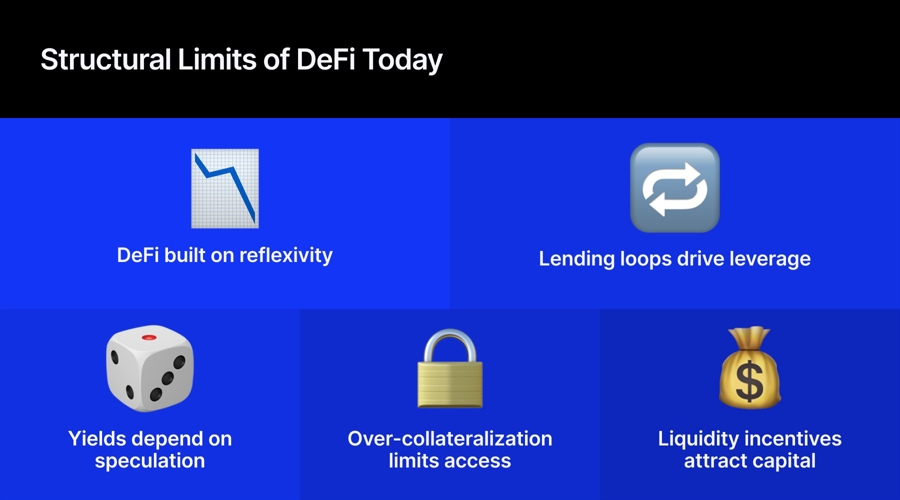
Structurally reflexive, DeFi is driven by leverage loops and incentive-based liquidity rather than real economic output.
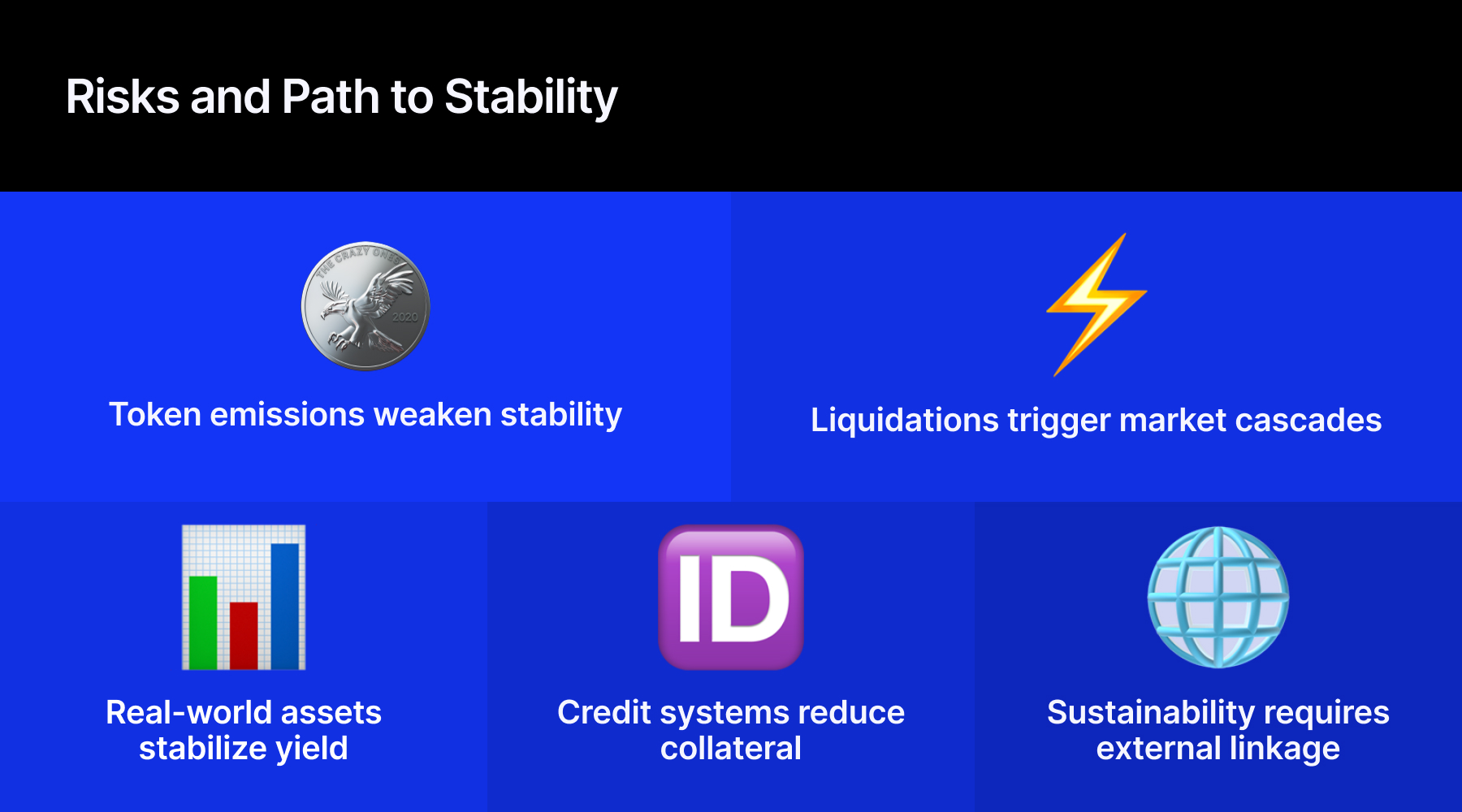
DeFi’s long-term sustainability depends on shifting away from internal speculation toward external, productive economic linkage.
The promise of decentralized finance was once a clarion call
for a democratic financial revolution. It envisioned a world where the rigid,
exclusionary walls of traditional banking would be replaced by transparent,
automated, permissionless systems. As we move through 2026, that early optimism
has given way to a more sober reality.
While the technology remains
powerful, the economic foundations of most DeFi lending protocols are still
structurally weak. Much of the system operates on reflexivity, where value is
borrowed from the future to support the present. Without a shift from internal
speculation toward external utility, the ecosystem risks long-term irrelevance.
Recursive Lending Without Productive Output
At the core of the problem is the circular nature of DeFi
lending. In traditional finance, loans fund productive activity that generates
real economic output. In DeFi, lending is largely recursive. Users deposit
volatile assets, borrow stablecoins, and
often recycle them back into the same assets.
This creates leverage loops that
function in bull markets but produce no real economic surplus. Yield is driven
not by productivity, but by demand for leverage among speculators, making the
system heavily dependent on rising asset prices.
Inflationary Tokens Attract Mercenary Liquidity
This fragility is reinforced by inflationary tokenomics.
Many protocols rely on liquidity mining incentives paid in governance tokens to
attract capital. This creates mercenary liquidity that
constantly chases the highest yield.
These tokens often have limited real
utility, meaning their value depends heavily on future buyers. When prices
fall, yields collapse, liquidity exits, and protocols can spiral quickly. The
collapse of Iron Finance in 2021 illustrated this dynamic clearly, as its
partially collateralized stablecoin system broke down rapidly once confidence
eroded.
Over-Collateralization Limits Real Access
Capital inefficiency is another structural flaw. Traditional
banking extends credit based on trust and repayment history, while DeFi is overwhelmingly
over-collateralized. Borrowers must lock up more value than they receive, often
making the system unusable for those who actually need capital.
A small
business in an emerging market cannot access DeFi credit if it requires holding
150% collateral in volatile crypto assets. As a
result, the system favors capital-rich speculators rather than real economic
participants.
Automated Liquidations Amplify Market Stress
Systemic risk is further amplified by liquidation cascades.
Smart contracts automatically liquidate positions when collateral falls below
thresholds. In volatile markets, these forced sales push prices lower,
triggering further liquidations in a feedback loop.
To become sustainable, DeFi must integrate real-world
assets. Closed-loop crypto economies cannot sustain themselves indefinitely.
Lending protocols need exposure to external sources of yield such as government
debt, trade finance, and private credit.
Another key evolution is decentralized identity and on-chain
credit scoring. Moving beyond over-collateralized lending is essential for real
adoption. Zero-knowledge proofs allow borrowers to demonstrate creditworthiness
without revealing sensitive data, enabling risk assessment based on financial
history rather than collateral alone.
DeFi is inevitable, but only if it can support the existing financial system.
Real-world assets are giving the industry the chance it needs to find its footing in traditional market structure. https://t.co/XP6NjHEu0Q
This could eventually allow DeFi to
extend credit to real businesses in emerging markets, bringing productive
activity onto the blockchain instead of purely speculative flows.
Modular Design Reduces Systemic Contagion
Protocol design also needs to become more modular. Early
DeFi systems relied on shared liquidity pools, which are highly vulnerable to
contagion. Newer models are introducing isolated markets where failures are
contained rather than spreading across the entire system. Aave has already
taken steps in this direction with isolation modes and risk segmentation.
Combined with better insurance mechanisms and improved smart contract security,
these changes could make DeFi more resilient and attractive to institutional
capital.
Speculative Culture Undermines Stability
We must also recognize that sustainability is as much about
human behavior as it is about code. The culture of "get rich quick"
schemes and astronomical annual percentage yields must be replaced by a culture
of risk-adjusted returns and long-term value creation.
Regulatory clarity will
play a vital role here. While some in the crypto space fear
oversight, a clear legal framework provides the certainty needed for legitimate
businesses to build on-chain. When investors can distinguish between a
high-risk speculative play and a regulated, asset-backed lending product, the
market will naturally gravitate toward the more sustainable options.
Meanwhile, watch out for the falling yields. Do not be
caught by surprise.
The promise of decentralized finance was once a clarion call
for a democratic financial revolution. It envisioned a world where the rigid,
exclusionary walls of traditional banking would be replaced by transparent,
automated, permissionless systems. As we move through 2026, that early optimism
has given way to a more sober reality.
While the technology remains
powerful, the economic foundations of most DeFi lending protocols are still
structurally weak. Much of the system operates on reflexivity, where value is
borrowed from the future to support the present. Without a shift from internal
speculation toward external utility, the ecosystem risks long-term irrelevance.
Recursive Lending Without Productive Output
At the core of the problem is the circular nature of DeFi
lending. In traditional finance, loans fund productive activity that generates
real economic output. In DeFi, lending is largely recursive. Users deposit
volatile assets, borrow stablecoins, and
often recycle them back into the same assets.
This creates leverage loops that
function in bull markets but produce no real economic surplus. Yield is driven
not by productivity, but by demand for leverage among speculators, making the
system heavily dependent on rising asset prices.
Inflationary Tokens Attract Mercenary Liquidity
This fragility is reinforced by inflationary tokenomics.
Many protocols rely on liquidity mining incentives paid in governance tokens to
attract capital. This creates mercenary liquidity that
constantly chases the highest yield.
These tokens often have limited real
utility, meaning their value depends heavily on future buyers. When prices
fall, yields collapse, liquidity exits, and protocols can spiral quickly. The
collapse of Iron Finance in 2021 illustrated this dynamic clearly, as its
partially collateralized stablecoin system broke down rapidly once confidence
eroded.
Over-Collateralization Limits Real Access
Capital inefficiency is another structural flaw. Traditional
banking extends credit based on trust and repayment history, while DeFi is overwhelmingly
over-collateralized. Borrowers must lock up more value than they receive, often
making the system unusable for those who actually need capital.
A small
business in an emerging market cannot access DeFi credit if it requires holding
150% collateral in volatile crypto assets. As a
result, the system favors capital-rich speculators rather than real economic
participants.
Automated Liquidations Amplify Market Stress
Systemic risk is further amplified by liquidation cascades.
Smart contracts automatically liquidate positions when collateral falls below
thresholds. In volatile markets, these forced sales push prices lower,
triggering further liquidations in a feedback loop.
To become sustainable, DeFi must integrate real-world
assets. Closed-loop crypto economies cannot sustain themselves indefinitely.
Lending protocols need exposure to external sources of yield such as government
debt, trade finance, and private credit.
Another key evolution is decentralized identity and on-chain
credit scoring. Moving beyond over-collateralized lending is essential for real
adoption. Zero-knowledge proofs allow borrowers to demonstrate creditworthiness
without revealing sensitive data, enabling risk assessment based on financial
history rather than collateral alone.
DeFi is inevitable, but only if it can support the existing financial system.
Real-world assets are giving the industry the chance it needs to find its footing in traditional market structure. https://t.co/XP6NjHEu0Q
This could eventually allow DeFi to
extend credit to real businesses in emerging markets, bringing productive
activity onto the blockchain instead of purely speculative flows.
Modular Design Reduces Systemic Contagion
Protocol design also needs to become more modular. Early
DeFi systems relied on shared liquidity pools, which are highly vulnerable to
contagion. Newer models are introducing isolated markets where failures are
contained rather than spreading across the entire system. Aave has already
taken steps in this direction with isolation modes and risk segmentation.
Combined with better insurance mechanisms and improved smart contract security,
these changes could make DeFi more resilient and attractive to institutional
capital.
Speculative Culture Undermines Stability
We must also recognize that sustainability is as much about
human behavior as it is about code. The culture of "get rich quick"
schemes and astronomical annual percentage yields must be replaced by a culture
of risk-adjusted returns and long-term value creation.
Regulatory clarity will
play a vital role here. While some in the crypto space fear
oversight, a clear legal framework provides the certainty needed for legitimate
businesses to build on-chain. When investors can distinguish between a
high-risk speculative play and a regulated, asset-backed lending product, the
market will naturally gravitate toward the more sustainable options.
Meanwhile, watch out for the falling yields. Do not be
caught by surprise.
Anndy Lian is an all-rounded business strategist in Asia. He has provided advisory across a variety of industries for local, international, public listed companies and governments. He is an early blockchain adopter and experienced serial entrepreneur, book author, investor, board member and keynote speaker.
Deribit Moves Beyond Crypto with 90+ USDC-Settled Perpetuals
Featured Videos
Revolut Reconsiders London Listing; NAGA CEO on Return to Profit
Revolut Reconsiders London Listing; NAGA CEO on Return to Profit
Revolut Reconsiders London Listing; NAGA CEO on Return to Profit
Revolut Reconsiders London Listing; NAGA CEO on Return to Profit
Today’s financial news recap covers NAGA CEO discusses its return to profitability, Revolut reconsiders a London listing, Warren Buffett is stepping down as chairman and the FCA targets illegal peer-to-peer crypto sites.
Finance Magnates Daily Recap brings you the latest news from forex and CFD brokers, fintech, payments, cryptocurrency, digital assets, trading platforms, financial regulation and global markets.
Get the key company news, executive moves, deals, regulatory updates and market developments of the day, in just a few minutes. New episodes published every weekday.
Read more: https://www.financemagnates.com
#FinanceMagnates #ForexNews #FintechNews
Today’s financial news recap covers NAGA CEO discusses its return to profitability, Revolut reconsiders a London listing, Warren Buffett is stepping down as chairman and the FCA targets illegal peer-to-peer crypto sites.
Finance Magnates Daily Recap brings you the latest news from forex and CFD brokers, fintech, payments, cryptocurrency, digital assets, trading platforms, financial regulation and global markets.
Get the key company news, executive moves, deals, regulatory updates and market developments of the day, in just a few minutes. New episodes published every weekday.
Read more: https://www.financemagnates.com
#FinanceMagnates #ForexNews #FintechNews
Today’s financial news recap covers NAGA CEO discusses its return to profitability, Revolut reconsiders a London listing, Warren Buffett is stepping down as chairman and the FCA targets illegal peer-to-peer crypto sites.
Finance Magnates Daily Recap brings you the latest news from forex and CFD brokers, fintech, payments, cryptocurrency, digital assets, trading platforms, financial regulation and global markets.
Get the key company news, executive moves, deals, regulatory updates and market developments of the day, in just a few minutes. New episodes published every weekday.
Read more: https://www.financemagnates.com
#FinanceMagnates #ForexNews #FintechNews
Today’s financial news recap covers NAGA CEO discusses its return to profitability, Revolut reconsiders a London listing, Warren Buffett is stepping down as chairman and the FCA targets illegal peer-to-peer crypto sites.
Finance Magnates Daily Recap brings you the latest news from forex and CFD brokers, fintech, payments, cryptocurrency, digital assets, trading platforms, financial regulation and global markets.
Get the key company news, executive moves, deals, regulatory updates and market developments of the day, in just a few minutes. New episodes published every weekday.
Read more: https://www.financemagnates.com
#FinanceMagnates #ForexNews #FintechNews
iFOREX Revises Earnings Forecast; AvaTrade to Close Polish Office
iFOREX Revises Earnings Forecast; AvaTrade to Close Polish Office
iFOREX Revises Earnings Forecast; AvaTrade to Close Polish Office
iFOREX Revises Earnings Forecast; AvaTrade to Close Polish Office
iFOREX Revises Earnings Forecast; AvaTrade to Close Polish Office
iFOREX Revises Earnings Forecast; AvaTrade to Close Polish Office
Today’s financial news recap covers iFOREX cuts its first-half earnings estimate, AvaTrade closes its Poland branch, Devexperts targets South Korean brokers, and TradingView adds MCP for AI tools.
Finance Magnates Daily Recap brings you the latest news from forex and CFD brokers, fintech, payments, cryptocurrency, digital assets, trading platforms, financial regulation and global markets.
Get the key company news, executive moves, deals, regulatory updates and market developments of the day, in just a few minutes. New episodes published every weekday.
Read more: https://www.financemagnates.com
#FinanceMagnates #ForexNews #FintechNews
Today’s financial news recap covers iFOREX cuts its first-half earnings estimate, AvaTrade closes its Poland branch, Devexperts targets South Korean brokers, and TradingView adds MCP for AI tools.
Finance Magnates Daily Recap brings you the latest news from forex and CFD brokers, fintech, payments, cryptocurrency, digital assets, trading platforms, financial regulation and global markets.
Get the key company news, executive moves, deals, regulatory updates and market developments of the day, in just a few minutes. New episodes published every weekday.
Read more: https://www.financemagnates.com
#FinanceMagnates #ForexNews #FintechNews
Today’s financial news recap covers iFOREX cuts its first-half earnings estimate, AvaTrade closes its Poland branch, Devexperts targets South Korean brokers, and TradingView adds MCP for AI tools.
Finance Magnates Daily Recap brings you the latest news from forex and CFD brokers, fintech, payments, cryptocurrency, digital assets, trading platforms, financial regulation and global markets.
Get the key company news, executive moves, deals, regulatory updates and market developments of the day, in just a few minutes. New episodes published every weekday.
Read more: https://www.financemagnates.com
#FinanceMagnates #ForexNews #FintechNews
Today’s financial news recap covers iFOREX cuts its first-half earnings estimate, AvaTrade closes its Poland branch, Devexperts targets South Korean brokers, and TradingView adds MCP for AI tools.
Finance Magnates Daily Recap brings you the latest news from forex and CFD brokers, fintech, payments, cryptocurrency, digital assets, trading platforms, financial regulation and global markets.
Get the key company news, executive moves, deals, regulatory updates and market developments of the day, in just a few minutes. New episodes published every weekday.
Read more: https://www.financemagnates.com
#FinanceMagnates #ForexNews #FintechNews
Today’s financial news recap covers iFOREX cuts its first-half earnings estimate, AvaTrade closes its Poland branch, Devexperts targets South Korean brokers, and TradingView adds MCP for AI tools.
Finance Magnates Daily Recap brings you the latest news from forex and CFD brokers, fintech, payments, cryptocurrency, digital assets, trading platforms, financial regulation and global markets.
Get the key company news, executive moves, deals, regulatory updates and market developments of the day, in just a few minutes. New episodes published every weekday.
Read more: https://www.financemagnates.com
#FinanceMagnates #ForexNews #FintechNews
Today’s financial news recap covers iFOREX cuts its first-half earnings estimate, AvaTrade closes its Poland branch, Devexperts targets South Korean brokers, and TradingView adds MCP for AI tools.
Finance Magnates Daily Recap brings you the latest news from forex and CFD brokers, fintech, payments, cryptocurrency, digital assets, trading platforms, financial regulation and global markets.
Get the key company news, executive moves, deals, regulatory updates and market developments of the day, in just a few minutes. New episodes published every weekday.
Read more: https://www.financemagnates.com
#FinanceMagnates #ForexNews #FintechNews
Can you memorise the textbook? That’s not necessarily the point.
Can you memorise the textbook? That’s not necessarily the point.
Can you memorise the textbook? That’s not necessarily the point.
Can you memorise the textbook? That’s not necessarily the point.
Can you memorise the textbook? That’s not necessarily the point.
Can you memorise the textbook? That’s not necessarily the point.
What matters is whether you can retain the information, understand it and actually apply it.
Take brokerage models. Knowing what a brokerage model is only gets you so far. What companies really need is an understanding of how to build one and how it can be applied.
That kind of practical understanding goes beyond simply reading a textbook.
#FinanceMagnates #FMAcademy #Fintech #FinanceCareers #ProfessionalDevelopment
What matters is whether you can retain the information, understand it and actually apply it.
Take brokerage models. Knowing what a brokerage model is only gets you so far. What companies really need is an understanding of how to build one and how it can be applied.
That kind of practical understanding goes beyond simply reading a textbook.
#FinanceMagnates #FMAcademy #Fintech #FinanceCareers #ProfessionalDevelopment
What matters is whether you can retain the information, understand it and actually apply it.
Take brokerage models. Knowing what a brokerage model is only gets you so far. What companies really need is an understanding of how to build one and how it can be applied.
That kind of practical understanding goes beyond simply reading a textbook.
#FinanceMagnates #FMAcademy #Fintech #FinanceCareers #ProfessionalDevelopment
What matters is whether you can retain the information, understand it and actually apply it.
Take brokerage models. Knowing what a brokerage model is only gets you so far. What companies really need is an understanding of how to build one and how it can be applied.
That kind of practical understanding goes beyond simply reading a textbook.
#FinanceMagnates #FMAcademy #Fintech #FinanceCareers #ProfessionalDevelopment
What matters is whether you can retain the information, understand it and actually apply it.
Take brokerage models. Knowing what a brokerage model is only gets you so far. What companies really need is an understanding of how to build one and how it can be applied.
That kind of practical understanding goes beyond simply reading a textbook.
#FinanceMagnates #FMAcademy #Fintech #FinanceCareers #ProfessionalDevelopment
What matters is whether you can retain the information, understand it and actually apply it.
Take brokerage models. Knowing what a brokerage model is only gets you so far. What companies really need is an understanding of how to build one and how it can be applied.
That kind of practical understanding goes beyond simply reading a textbook.
#FinanceMagnates #FMAcademy #Fintech #FinanceCareers #ProfessionalDevelopment
US Senate Blocks CLARITY Act; IBKR Links X to Trading
US Senate Blocks CLARITY Act; IBKR Links X to Trading
US Senate Blocks CLARITY Act; IBKR Links X to Trading
US Senate Blocks CLARITY Act; IBKR Links X to Trading
US Senate Blocks CLARITY Act; IBKR Links X to Trading
US Senate Blocks CLARITY Act; IBKR Links X to Trading
Today’s financial news recap covers the US Senate blocks the CLARITY Act, Interactive Brokers links X Cashtags to trading, and Match-Trade offers seven-day prop firm launch with Match-Prop.
Finance Magnates Daily Recap brings you the latest news from forex and CFD brokers, fintech, payments, cryptocurrency, digital assets, trading platforms, financial regulation and global markets.
Get the key company news, executive moves, deals, regulatory updates and market developments of the day, in just a few minutes. New episodes published every weekday.
Read more: https://www.financemagnates.com
#FinanceMagnates #ForexNews #FintechNews
Today’s financial news recap covers the US Senate blocks the CLARITY Act, Interactive Brokers links X Cashtags to trading, and Match-Trade offers seven-day prop firm launch with Match-Prop.
Finance Magnates Daily Recap brings you the latest news from forex and CFD brokers, fintech, payments, cryptocurrency, digital assets, trading platforms, financial regulation and global markets.
Get the key company news, executive moves, deals, regulatory updates and market developments of the day, in just a few minutes. New episodes published every weekday.
Read more: https://www.financemagnates.com
#FinanceMagnates #ForexNews #FintechNews
Today’s financial news recap covers the US Senate blocks the CLARITY Act, Interactive Brokers links X Cashtags to trading, and Match-Trade offers seven-day prop firm launch with Match-Prop.
Finance Magnates Daily Recap brings you the latest news from forex and CFD brokers, fintech, payments, cryptocurrency, digital assets, trading platforms, financial regulation and global markets.
Get the key company news, executive moves, deals, regulatory updates and market developments of the day, in just a few minutes. New episodes published every weekday.
Read more: https://www.financemagnates.com
#FinanceMagnates #ForexNews #FintechNews
Today’s financial news recap covers the US Senate blocks the CLARITY Act, Interactive Brokers links X Cashtags to trading, and Match-Trade offers seven-day prop firm launch with Match-Prop.
Finance Magnates Daily Recap brings you the latest news from forex and CFD brokers, fintech, payments, cryptocurrency, digital assets, trading platforms, financial regulation and global markets.
Get the key company news, executive moves, deals, regulatory updates and market developments of the day, in just a few minutes. New episodes published every weekday.
Read more: https://www.financemagnates.com
#FinanceMagnates #ForexNews #FintechNews
Today’s financial news recap covers the US Senate blocks the CLARITY Act, Interactive Brokers links X Cashtags to trading, and Match-Trade offers seven-day prop firm launch with Match-Prop.
Finance Magnates Daily Recap brings you the latest news from forex and CFD brokers, fintech, payments, cryptocurrency, digital assets, trading platforms, financial regulation and global markets.
Get the key company news, executive moves, deals, regulatory updates and market developments of the day, in just a few minutes. New episodes published every weekday.
Read more: https://www.financemagnates.com
#FinanceMagnates #ForexNews #FintechNews
Today’s financial news recap covers the US Senate blocks the CLARITY Act, Interactive Brokers links X Cashtags to trading, and Match-Trade offers seven-day prop firm launch with Match-Prop.
Finance Magnates Daily Recap brings you the latest news from forex and CFD brokers, fintech, payments, cryptocurrency, digital assets, trading platforms, financial regulation and global markets.
Get the key company news, executive moves, deals, regulatory updates and market developments of the day, in just a few minutes. New episodes published every weekday.
Read more: https://www.financemagnates.com
#FinanceMagnates #ForexNews #FintechNews
Revolut KYC Incident; CoinEx Shuts Down
Revolut KYC Incident; CoinEx Shuts Down
Revolut KYC Incident; CoinEx Shuts Down
Revolut KYC Incident; CoinEx Shuts Down
Revolut KYC Incident; CoinEx Shuts Down
Revolut KYC Incident; CoinEx Shuts Down
Today’s financial news recap covers the Revolut KYC data incident, CoinEx’s shutdown, and Anthropic’s push into financial services.
Finance Magnates Daily Recap brings you the latest news from forex and CFD brokers, fintech, payments, cryptocurrency, digital assets, trading platforms, financial regulation and global markets.
Get the key company news, executive moves, deals, regulatory updates and market developments of the day, in just a few minutes. New episodes published every weekday.
Read more: https://www.financemagnates.com
#FinanceMagnates #ForexNews #FintechNews
Today’s financial news recap covers the Revolut KYC data incident, CoinEx’s shutdown, and Anthropic’s push into financial services.
Finance Magnates Daily Recap brings you the latest news from forex and CFD brokers, fintech, payments, cryptocurrency, digital assets, trading platforms, financial regulation and global markets.
Get the key company news, executive moves, deals, regulatory updates and market developments of the day, in just a few minutes. New episodes published every weekday.
Read more: https://www.financemagnates.com
#FinanceMagnates #ForexNews #FintechNews
Today’s financial news recap covers the Revolut KYC data incident, CoinEx’s shutdown, and Anthropic’s push into financial services.
Finance Magnates Daily Recap brings you the latest news from forex and CFD brokers, fintech, payments, cryptocurrency, digital assets, trading platforms, financial regulation and global markets.
Get the key company news, executive moves, deals, regulatory updates and market developments of the day, in just a few minutes. New episodes published every weekday.
Read more: https://www.financemagnates.com
#FinanceMagnates #ForexNews #FintechNews
Today’s financial news recap covers the Revolut KYC data incident, CoinEx’s shutdown, and Anthropic’s push into financial services.
Finance Magnates Daily Recap brings you the latest news from forex and CFD brokers, fintech, payments, cryptocurrency, digital assets, trading platforms, financial regulation and global markets.
Get the key company news, executive moves, deals, regulatory updates and market developments of the day, in just a few minutes. New episodes published every weekday.
Read more: https://www.financemagnates.com
#FinanceMagnates #ForexNews #FintechNews
Today’s financial news recap covers the Revolut KYC data incident, CoinEx’s shutdown, and Anthropic’s push into financial services.
Finance Magnates Daily Recap brings you the latest news from forex and CFD brokers, fintech, payments, cryptocurrency, digital assets, trading platforms, financial regulation and global markets.
Get the key company news, executive moves, deals, regulatory updates and market developments of the day, in just a few minutes. New episodes published every weekday.
Read more: https://www.financemagnates.com
#FinanceMagnates #ForexNews #FintechNews
Today’s financial news recap covers the Revolut KYC data incident, CoinEx’s shutdown, and Anthropic’s push into financial services.
Finance Magnates Daily Recap brings you the latest news from forex and CFD brokers, fintech, payments, cryptocurrency, digital assets, trading platforms, financial regulation and global markets.
Get the key company news, executive moves, deals, regulatory updates and market developments of the day, in just a few minutes. New episodes published every weekday.
Read more: https://www.financemagnates.com
#FinanceMagnates #ForexNews #FintechNews