
EU’s First DORA Review Finds One-Third of Financial ICT Incidents Spread Across Borders

Wednesday, 03/06/2026 | 14:11 GMT by Tareq Sikder
  • EU regulators publish financial ICT incident review flagging 3,383 incidents.
  • Cyber incidents make up 10% of EU ICT failures, with AI tools expected to raise future risk pressure.
ESMA
Source: ESMA

The European Supervisory Authorities have published their first annual overview of major ICT-related incidents in the EU financial sector under the reporting framework of the Digital Operational Resilience Act.

The report is issued by the European Banking Authority, the European Insurance and Occupational Pensions Authority, and the European Securities and Markets Authority.

DORA Review Finds Cross-Border ICT Risk

The report consolidates incident reporting requirements under DORA and aims to standardise how financial entities classify, manage, and report ICT-related disruptions across the European Union.

According to the findings, ICT risks are increasingly cross-border and interconnected. The report stated that “ICT risks are increasingly borderless and interconnected.” It added that shared digital infrastructure and outsourced services are contributing to wider operational risk transmission across markets.
ESA and ESMA

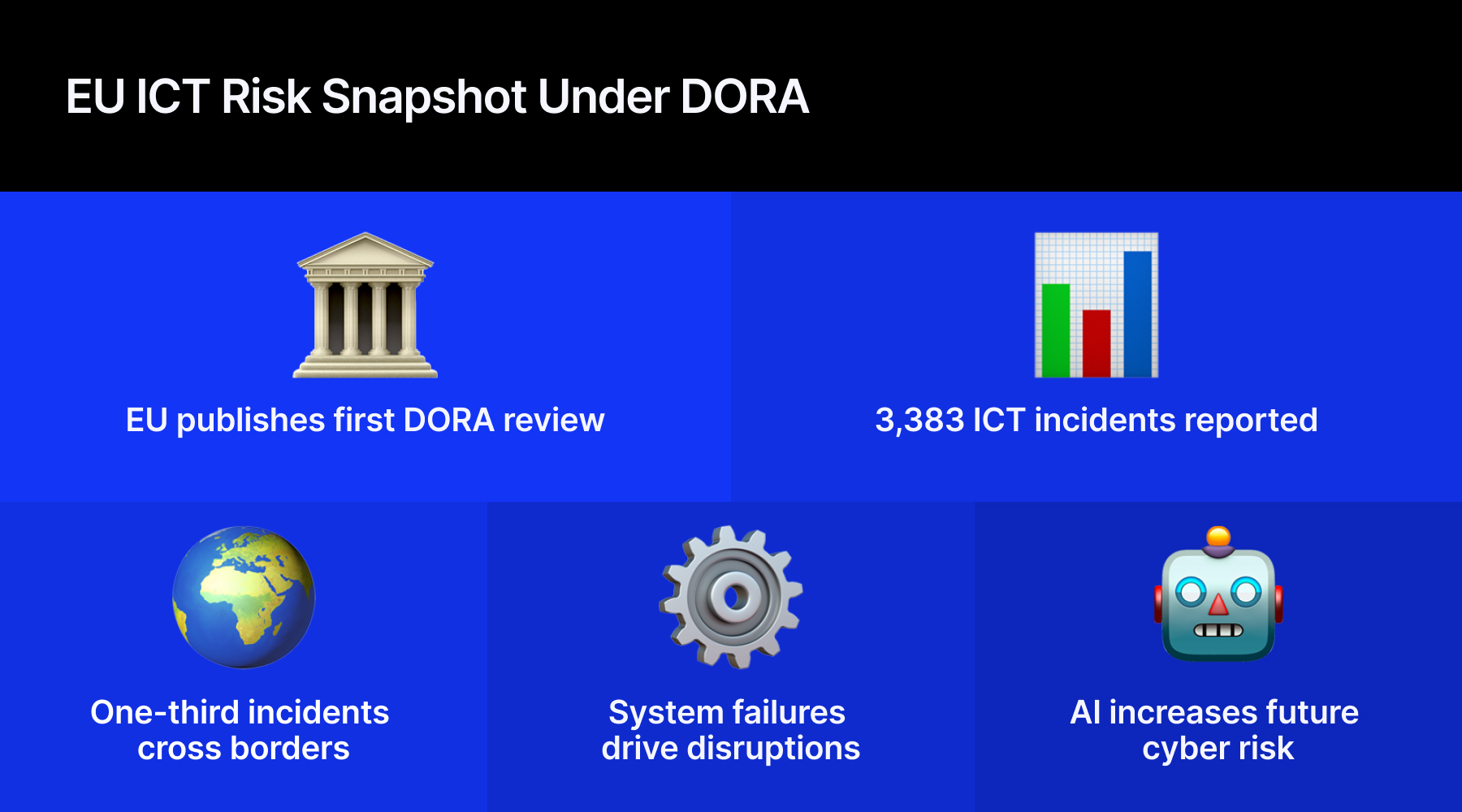
Financial firms in the EU reported 3,383 major ICT-related incidents. Around one third had cross-border effects, reflecting greater interconnectedness in financial systems. The authorities noted that the direct impact on customers and transactions was generally limited.

AI Raises Future Financial Cyber Risk

System failures and external events were identified as the main drivers of disruption. The report highlighted the importance of third-party risk management , oversight of outsourced services, and coordination with providers during incident response and recovery.

Cybersecurity-related incidents accounted for about 10% of the total. While the share was relatively small, the report warned that firms must maintain strong cybersecurity standards. It also pointed to the potential use of highly capable AI-driven tools as a factor that could increase future risk pressure on financial systems.

Overall, the authorities said the findings point to a more systemic ICT risk environment across the financial sector, requiring stronger resilience, supervision, and coordination to prevent and respond to future disruptions.

Under DORA, ICT-related incidents are defined as unplanned events affecting the security of network and information systems and impacting availability, integrity, authenticity, or confidentiality of data or services. A major ICT-related incident is one with a high impact on critical or important functions of a financial entity.

The European Supervisory Authorities have published their first annual overview of major ICT-related incidents in the EU financial sector under the reporting framework of the Digital Operational Resilience Act.

The report is issued by the European Banking Authority, the European Insurance and Occupational Pensions Authority, and the European Securities and Markets Authority.

DORA Review Finds Cross-Border ICT Risk

The report consolidates incident reporting requirements under DORA and aims to standardise how financial entities classify, manage, and report ICT-related disruptions across the European Union.

According to the findings, ICT risks are increasingly cross-border and interconnected. The report stated that “ICT risks are increasingly borderless and interconnected.” It added that shared digital infrastructure and outsourced services are contributing to wider operational risk transmission across markets.

ESA and ESMA

Financial firms in the EU reported 3,383 major ICT-related incidents. Around one third had cross-border effects, reflecting greater interconnectedness in financial systems. The authorities noted that the direct impact on customers and transactions was generally limited.

AI Raises Future Financial Cyber Risk

System failures and external events were identified as the main drivers of disruption. The report highlighted the importance of third-party risk management , oversight of outsourced services, and coordination with providers during incident response and recovery.

Cybersecurity-related incidents accounted for about 10% of the total. While the share was relatively small, the report warned that firms must maintain strong cybersecurity standards. It also pointed to the potential use of highly capable AI-driven tools as a factor that could increase future risk pressure on financial systems.

Overall, the authorities said the findings point to a more systemic ICT risk environment across the financial sector, requiring stronger resilience, supervision, and coordination to prevent and respond to future disruptions.

Under DORA, ICT-related incidents are defined as unplanned events affecting the security of network and information systems and impacting availability, integrity, authenticity, or confidentiality of data or services. A major ICT-related incident is one with a high impact on critical or important functions of a financial entity.

About the Author: Tareq Sikder
Tareq Sikder
  • 2314 Articles
  • 41 Followers
About the Author: Tareq Sikder
Tareq is a financial writer with 15 years of experience covering global markets. His work spans technical analysis, forex broker reviews, and market sentiment, with a focus on topics relevant to retail traders. He joined Finance Magnates in 2023. At Finance Magnates, he serves as News Editor, covering retail forex and CFD brokers, cryptocurrency exchanges, fintech firms, and regulatory developments shaping the trading industry. He holds an Honours degree in Information Technology from Anfell College, London. Education: Honours degree Information Technology, Anfell College, London
  • 2314 Articles
  • 41 Followers

More from the Author

Retail FX

!"#$%&'()*+,-./0123456789:;<=>?@ABCDEFGHIJKLMNOPQRSTUVWXYZ[\]^_`abcdefghijklmnopqrstuvwxyz{|} !"#$%&'()*+,-./0123456789:;<=>?@ABCDEFGHIJKLMNOPQRSTUVWXYZ[\]^_`abcdefghijklmnopqrstuvwxyz{|}