Anndy Lian highlights private chains trade openness for control, while public rails optimise for user dignity. Which one holds the true essence of blockchain?
Stablecoins have passed $300 billion, but three very different digital-dollar models now share the name.
When you scroll through the financial news these days, you
meet one stablecoin. The articles describe a digital dollar, a boring token
that hugs the greenback, and a shiny new tool for Wall Street. Then you open a
DeFi app and meet something else entirely, a lively instrument that moves at 3
a.m. on a Sunday and settles in seconds.
My complaint with the coverage is
simple. The media keeps flattening three different animals into one word, and
that word hides the parts I care about most. So let me separate the animals,
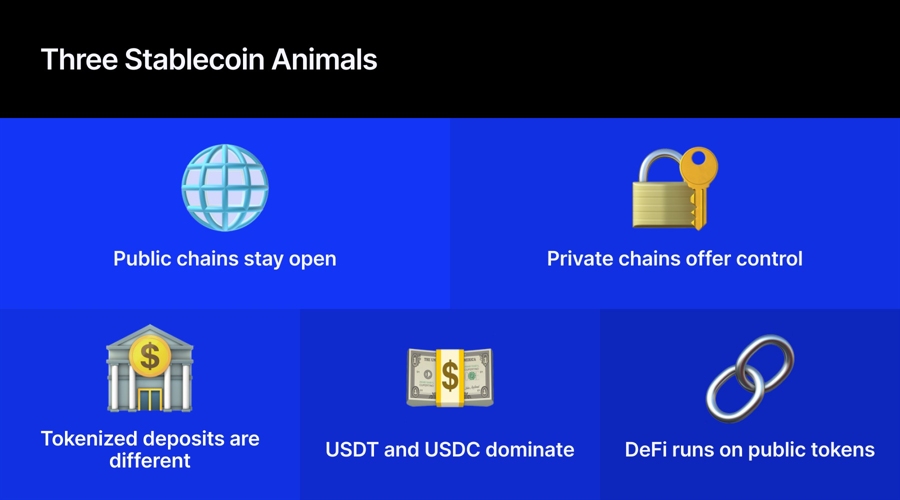
because a public-chain stablecoin, a private-chain stablecoin, and a tokenized
deposit do not share much beyond a family resemblance.
The Public-Chain Stablecoin
Start with the creature crypto natives know first. A typical
stablecoin in our world is a fiat-collateralized token, and the idea is
refreshingly simple. For every digital token an issuer mints on a blockchain,
one real dollar sits in a bank account or in a short-term U.S. Treasury bill.
They fuel lending markets on
Aave, for instance, and they let anyone with a phone and a wallet earn, borrow,
and settle without asking a branch manager for permission.
Every transaction is printed on a public ledger that anyone can audit
with a block explorer. That transparency cuts both ways, and it is why
regulators actually love these ledgers as tools for tracking illicit finance,
but it also means the system answers to mathematics before it answers to a
committee.
The Private-Chain Version
Now meet the second animal, the one Wall Street prefers.
Banks can also mint dollar tokens, but they do it on private blockchains where
only approved clients participate. JPMorgan
runs JPM Coin on its own internal ledger, and the bank now moves billions
of dollars a day for corporate clients through that system.
The industry calls
this a wholesale stablecoin or a tokenized deposit, and the GENIUS Act, which
President Trump signed in July 2025, explicitly lets licensed banks build on
private chains with built-in controls. The differences from the public version
are not cosmetic.
A corporation does not want rivals watching its treasury
flows, a bank wants the power to freeze or reverse a mistaken transfer, and
nobody wants to pay public gas fees that spike without warning. So the private
chain trades openness for control, and it serves interbank settlements and
large corporate payments rather than you and me.
The Third Animal Is Different
The third animal is not a stablecoin at all, even though
journalists keep calling it one. The dollar balance you see in your PayPal or
Venmo app is a stored-value liability under state money-transmitter law, and
the balance in your Chase app is a commercial bank deposit insured by the FDIC
up to $250,000.
The Federal Reserve's FedNow rail, which launched in 2023,
settles bank dollars instantly around the clock without any ledger technology.
Federal law draws a bright line here. To earn the name stablecoin, a digital
dollar must exist as a token on a distributed ledger, and the law does not care
whether that ledger is public or private.
Off-chain database dollars fall under
older banking and electronic-money rules, and they come with fractional-reserve
lending rather than the strict one-to-one reserve mandate that the GENIUS Act
sets for payment stablecoins.
What Washington Sees
Notice what Washington sees in all of this, because the
government views stablecoins through a completely different lens than either
crypto natives or bankers do. Treasury officials cheer dollar-backed
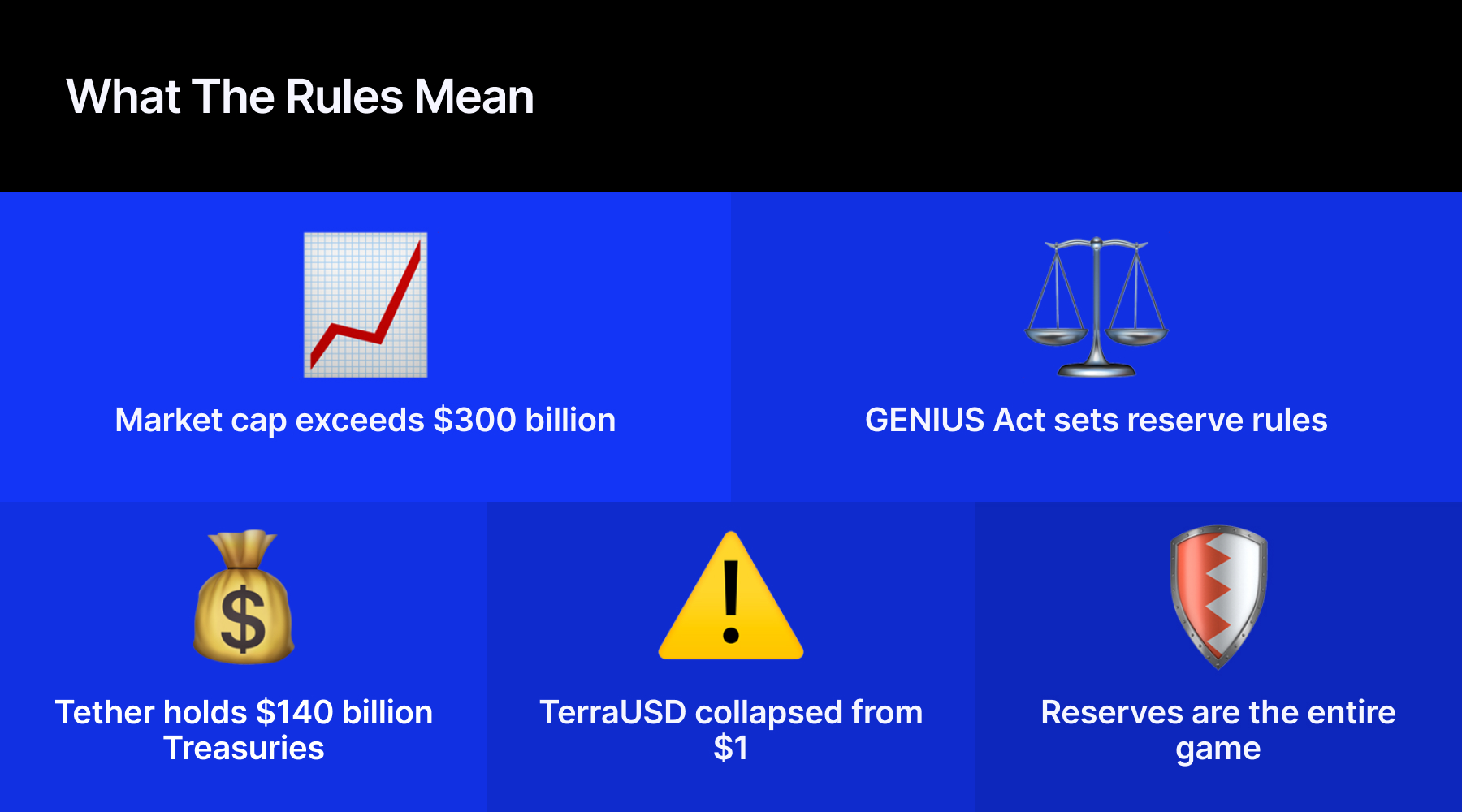
stablecoins as hungry buyers of short-term U.S. debt, and Tether
alone holds roughly $140 billion in Treasuries, a stake that ranks it ahead
of countries like South Korea and the United Arab Emirates.
Lawmakers wrote the
GENIUS Act to turn stablecoin issuers into something like narrow banks that
must hold cash and Treasuries one-to-one, publish audited reserve reports, and
freeze tokens when law enforcement flags a wallet.
That legal carve-out explains why the government refuses to
call a payment stablecoin a security or a commodity. The SEC and the CFTC
police bets on rising prices, and a token that stays at one dollar and pays no
yield gives nobody an expectation of profit.
Banking regulators like the OCC
and the Federal Reserve take the stablecoin file instead, because a run on a
big issuer would spill into real banks and the Treasury market, while a crash
in a speculative coin mostly burns its own holders. The 2022 collapse of TerraUSD
perfectly illustrates risk.
That algorithmic coin had no real reserves backing
it, and when trust evaporated, it fell from $1 to a few cents, wiping out about
$45 billion in market value in days. Reserve quality is the entire game, and
the law now writes that lesson into statute.
Where I Plant My Flag
Here is where I plant my flag. The private-chain version and
the tokenized deposit do real work for corporate treasurers, and I welcome the
clarity the GENIUS Act brings. I still root for the public one because openness
compounds.
A permissionless dollar token lets a freelancer in Manila collect
wages from Berlin in seconds for pennies, lets an unbanked teenager hold
digital cash that no one can freeze with a phone call, and lets developers
compose money into code the way they compose software.
DeFi turns those tokens
into credit markets, savings tools, and insurance pools that run in the open,
and every transaction leaves a public trail that any citizen can check. The
private rails optimise for institutional comfort, while the public rails
optimise for user dignity.
So the next time a headline calls stablecoins "boring
digital dollars," ask which animal the writer actually means. The answer
changes everything about the risk you hold, the rights you keep, and the future
you get. I know which one I hold, and I know which one I cheer for.
When you scroll through the financial news these days, you
meet one stablecoin. The articles describe a digital dollar, a boring token
that hugs the greenback, and a shiny new tool for Wall Street. Then you open a
DeFi app and meet something else entirely, a lively instrument that moves at 3
a.m. on a Sunday and settles in seconds.
My complaint with the coverage is
simple. The media keeps flattening three different animals into one word, and
that word hides the parts I care about most. So let me separate the animals,
because a public-chain stablecoin, a private-chain stablecoin, and a tokenized
deposit do not share much beyond a family resemblance.
The Public-Chain Stablecoin
Start with the creature crypto natives know first. A typical
stablecoin in our world is a fiat-collateralized token, and the idea is
refreshingly simple. For every digital token an issuer mints on a blockchain,
one real dollar sits in a bank account or in a short-term U.S. Treasury bill.
They fuel lending markets on
Aave, for instance, and they let anyone with a phone and a wallet earn, borrow,
and settle without asking a branch manager for permission.
Every transaction is printed on a public ledger that anyone can audit
with a block explorer. That transparency cuts both ways, and it is why
regulators actually love these ledgers as tools for tracking illicit finance,
but it also means the system answers to mathematics before it answers to a
committee.
The Private-Chain Version
Now meet the second animal, the one Wall Street prefers.
Banks can also mint dollar tokens, but they do it on private blockchains where
only approved clients participate. JPMorgan
runs JPM Coin on its own internal ledger, and the bank now moves billions
of dollars a day for corporate clients through that system.
The industry calls
this a wholesale stablecoin or a tokenized deposit, and the GENIUS Act, which
President Trump signed in July 2025, explicitly lets licensed banks build on
private chains with built-in controls. The differences from the public version
are not cosmetic.
A corporation does not want rivals watching its treasury
flows, a bank wants the power to freeze or reverse a mistaken transfer, and
nobody wants to pay public gas fees that spike without warning. So the private
chain trades openness for control, and it serves interbank settlements and
large corporate payments rather than you and me.
The Third Animal Is Different
The third animal is not a stablecoin at all, even though
journalists keep calling it one. The dollar balance you see in your PayPal or
Venmo app is a stored-value liability under state money-transmitter law, and
the balance in your Chase app is a commercial bank deposit insured by the FDIC
up to $250,000.
The Federal Reserve's FedNow rail, which launched in 2023,
settles bank dollars instantly around the clock without any ledger technology.
Federal law draws a bright line here. To earn the name stablecoin, a digital
dollar must exist as a token on a distributed ledger, and the law does not care
whether that ledger is public or private.
Off-chain database dollars fall under
older banking and electronic-money rules, and they come with fractional-reserve
lending rather than the strict one-to-one reserve mandate that the GENIUS Act
sets for payment stablecoins.
What Washington Sees
Notice what Washington sees in all of this, because the
government views stablecoins through a completely different lens than either
crypto natives or bankers do. Treasury officials cheer dollar-backed
stablecoins as hungry buyers of short-term U.S. debt, and Tether
alone holds roughly $140 billion in Treasuries, a stake that ranks it ahead
of countries like South Korea and the United Arab Emirates.
Lawmakers wrote the
GENIUS Act to turn stablecoin issuers into something like narrow banks that
must hold cash and Treasuries one-to-one, publish audited reserve reports, and
freeze tokens when law enforcement flags a wallet.
That legal carve-out explains why the government refuses to
call a payment stablecoin a security or a commodity. The SEC and the CFTC
police bets on rising prices, and a token that stays at one dollar and pays no
yield gives nobody an expectation of profit.
Banking regulators like the OCC
and the Federal Reserve take the stablecoin file instead, because a run on a
big issuer would spill into real banks and the Treasury market, while a crash
in a speculative coin mostly burns its own holders. The 2022 collapse of TerraUSD
perfectly illustrates risk.
That algorithmic coin had no real reserves backing
it, and when trust evaporated, it fell from $1 to a few cents, wiping out about
$45 billion in market value in days. Reserve quality is the entire game, and
the law now writes that lesson into statute.
Where I Plant My Flag
Here is where I plant my flag. The private-chain version and
the tokenized deposit do real work for corporate treasurers, and I welcome the
clarity the GENIUS Act brings. I still root for the public one because openness
compounds.
A permissionless dollar token lets a freelancer in Manila collect
wages from Berlin in seconds for pennies, lets an unbanked teenager hold
digital cash that no one can freeze with a phone call, and lets developers
compose money into code the way they compose software.
DeFi turns those tokens
into credit markets, savings tools, and insurance pools that run in the open,
and every transaction leaves a public trail that any citizen can check. The
private rails optimise for institutional comfort, while the public rails
optimise for user dignity.
So the next time a headline calls stablecoins "boring
digital dollars," ask which animal the writer actually means. The answer
changes everything about the risk you hold, the rights you keep, and the future
you get. I know which one I hold, and I know which one I cheer for.
Anndy Lian is an all-rounded business strategist in Asia. He has provided advisory across a variety of industries for local, international, public listed companies and governments. He is an early blockchain adopter and experienced serial entrepreneur, book author, investor, board member and keynote speaker.
Coinbase and Robinhood Futures Arms Now Hold More Client Money Than the US Retail Forex Pool
Featured Videos
FxPro Sells EU Clients to Capital.com; NAGA H1 Profit Revised
FxPro Sells EU Clients to Capital.com; NAGA H1 Profit Revised
FxPro Sells EU Clients to Capital.com; NAGA H1 Profit Revised
FxPro Sells EU Clients to Capital.com; NAGA H1 Profit Revised
Today’s financial news recap covers FxPro agrees to sell its European client book to Capital.com, NAGA raises its first-half profit estimate, Trade Republic prepares a fee-free pension account, and Interactive Brokers introduces Ether staking.
Finance Magnates Daily Recap brings you the latest news from forex and CFD brokers, fintech, payments, cryptocurrency, digital assets, trading platforms, financial regulation and global markets.
Get the key company news, executive moves, deals, regulatory updates and market developments of the day, in just a few minutes. New episodes published every weekday.
Read more: https://www.financemagnates.com
#FinanceMagnates #ForexNews #FintechNews
Today’s financial news recap covers FxPro agrees to sell its European client book to Capital.com, NAGA raises its first-half profit estimate, Trade Republic prepares a fee-free pension account, and Interactive Brokers introduces Ether staking.
Finance Magnates Daily Recap brings you the latest news from forex and CFD brokers, fintech, payments, cryptocurrency, digital assets, trading platforms, financial regulation and global markets.
Get the key company news, executive moves, deals, regulatory updates and market developments of the day, in just a few minutes. New episodes published every weekday.
Read more: https://www.financemagnates.com
#FinanceMagnates #ForexNews #FintechNews
Today’s financial news recap covers FxPro agrees to sell its European client book to Capital.com, NAGA raises its first-half profit estimate, Trade Republic prepares a fee-free pension account, and Interactive Brokers introduces Ether staking.
Finance Magnates Daily Recap brings you the latest news from forex and CFD brokers, fintech, payments, cryptocurrency, digital assets, trading platforms, financial regulation and global markets.
Get the key company news, executive moves, deals, regulatory updates and market developments of the day, in just a few minutes. New episodes published every weekday.
Read more: https://www.financemagnates.com
#FinanceMagnates #ForexNews #FintechNews
Today’s financial news recap covers FxPro agrees to sell its European client book to Capital.com, NAGA raises its first-half profit estimate, Trade Republic prepares a fee-free pension account, and Interactive Brokers introduces Ether staking.
Finance Magnates Daily Recap brings you the latest news from forex and CFD brokers, fintech, payments, cryptocurrency, digital assets, trading platforms, financial regulation and global markets.
Get the key company news, executive moves, deals, regulatory updates and market developments of the day, in just a few minutes. New episodes published every weekday.
Read more: https://www.financemagnates.com
#FinanceMagnates #ForexNews #FintechNews
Plus500 Plans US Super-App; Investec to Offer IG Platform
Plus500 Plans US Super-App; Investec to Offer IG Platform
Plus500 Plans US Super-App; Investec to Offer IG Platform
Plus500 Plans US Super-App; Investec to Offer IG Platform
Plus500 Plans US Super-App; Investec to Offer IG Platform
Plus500 Plans US Super-App; Investec to Offer IG Platform
Today’s financial news recap covers Plus500 plans a US trading super-app, Investec partners with IG, Trade Republic reports a sevenfold profit jump, and BingX adds thousands of US stocks.
Finance Magnates Daily Recap brings you the latest news from forex and CFD brokers, fintech, payments, cryptocurrency, digital assets, trading platforms, financial regulation and global markets.
Get the key company news, executive moves, deals, regulatory updates and market developments of the day, in just a few minutes. New episodes published every weekday.
Read more: https://www.financemagnates.com
#FinanceMagnates #ForexNews #FintechNews
Today’s financial news recap covers Plus500 plans a US trading super-app, Investec partners with IG, Trade Republic reports a sevenfold profit jump, and BingX adds thousands of US stocks.
Finance Magnates Daily Recap brings you the latest news from forex and CFD brokers, fintech, payments, cryptocurrency, digital assets, trading platforms, financial regulation and global markets.
Get the key company news, executive moves, deals, regulatory updates and market developments of the day, in just a few minutes. New episodes published every weekday.
Read more: https://www.financemagnates.com
#FinanceMagnates #ForexNews #FintechNews
Today’s financial news recap covers Plus500 plans a US trading super-app, Investec partners with IG, Trade Republic reports a sevenfold profit jump, and BingX adds thousands of US stocks.
Finance Magnates Daily Recap brings you the latest news from forex and CFD brokers, fintech, payments, cryptocurrency, digital assets, trading platforms, financial regulation and global markets.
Get the key company news, executive moves, deals, regulatory updates and market developments of the day, in just a few minutes. New episodes published every weekday.
Read more: https://www.financemagnates.com
#FinanceMagnates #ForexNews #FintechNews
Today’s financial news recap covers Plus500 plans a US trading super-app, Investec partners with IG, Trade Republic reports a sevenfold profit jump, and BingX adds thousands of US stocks.
Finance Magnates Daily Recap brings you the latest news from forex and CFD brokers, fintech, payments, cryptocurrency, digital assets, trading platforms, financial regulation and global markets.
Get the key company news, executive moves, deals, regulatory updates and market developments of the day, in just a few minutes. New episodes published every weekday.
Read more: https://www.financemagnates.com
#FinanceMagnates #ForexNews #FintechNews
Today’s financial news recap covers Plus500 plans a US trading super-app, Investec partners with IG, Trade Republic reports a sevenfold profit jump, and BingX adds thousands of US stocks.
Finance Magnates Daily Recap brings you the latest news from forex and CFD brokers, fintech, payments, cryptocurrency, digital assets, trading platforms, financial regulation and global markets.
Get the key company news, executive moves, deals, regulatory updates and market developments of the day, in just a few minutes. New episodes published every weekday.
Read more: https://www.financemagnates.com
#FinanceMagnates #ForexNews #FintechNews
Today’s financial news recap covers Plus500 plans a US trading super-app, Investec partners with IG, Trade Republic reports a sevenfold profit jump, and BingX adds thousands of US stocks.
Finance Magnates Daily Recap brings you the latest news from forex and CFD brokers, fintech, payments, cryptocurrency, digital assets, trading platforms, financial regulation and global markets.
Get the key company news, executive moves, deals, regulatory updates and market developments of the day, in just a few minutes. New episodes published every weekday.
Read more: https://www.financemagnates.com
#FinanceMagnates #ForexNews #FintechNews
FXCM UK Holds $110m in Client Money; IG CEO Questions Prediction Market Volumes
FXCM UK Holds $110m in Client Money; IG CEO Questions Prediction Market Volumes
FXCM UK Holds $110m in Client Money; IG CEO Questions Prediction Market Volumes
FXCM UK Holds $110m in Client Money; IG CEO Questions Prediction Market Volumes
FXCM UK Holds $110m in Client Money; IG CEO Questions Prediction Market Volumes
FXCM UK Holds $110m in Client Money; IG CEO Questions Prediction Market Volumes
Today’s financial news recap covers FXCM's UK arm holds $110 million in client money ahead of its sale to Trade Nation, Citadel Securities' UK profit falls 38 per cent, and Kraken secures its final Dubai crypto licence.
Finance Magnates Daily Recap brings you the latest news from forex and CFD brokers, fintech, payments, cryptocurrency, digital assets, trading platforms, financial regulation and global markets.
Get the key company news, executive moves, deals, regulatory updates and market developments of the day, in just a few minutes. New episodes published every weekday.
Read more: https://www.financemagnates.com
#FinanceMagnates #ForexNews #FintechNews
Today’s financial news recap covers FXCM's UK arm holds $110 million in client money ahead of its sale to Trade Nation, Citadel Securities' UK profit falls 38 per cent, and Kraken secures its final Dubai crypto licence.
Finance Magnates Daily Recap brings you the latest news from forex and CFD brokers, fintech, payments, cryptocurrency, digital assets, trading platforms, financial regulation and global markets.
Get the key company news, executive moves, deals, regulatory updates and market developments of the day, in just a few minutes. New episodes published every weekday.
Read more: https://www.financemagnates.com
#FinanceMagnates #ForexNews #FintechNews
Today’s financial news recap covers FXCM's UK arm holds $110 million in client money ahead of its sale to Trade Nation, Citadel Securities' UK profit falls 38 per cent, and Kraken secures its final Dubai crypto licence.
Finance Magnates Daily Recap brings you the latest news from forex and CFD brokers, fintech, payments, cryptocurrency, digital assets, trading platforms, financial regulation and global markets.
Get the key company news, executive moves, deals, regulatory updates and market developments of the day, in just a few minutes. New episodes published every weekday.
Read more: https://www.financemagnates.com
#FinanceMagnates #ForexNews #FintechNews
Today’s financial news recap covers FXCM's UK arm holds $110 million in client money ahead of its sale to Trade Nation, Citadel Securities' UK profit falls 38 per cent, and Kraken secures its final Dubai crypto licence.
Finance Magnates Daily Recap brings you the latest news from forex and CFD brokers, fintech, payments, cryptocurrency, digital assets, trading platforms, financial regulation and global markets.
Get the key company news, executive moves, deals, regulatory updates and market developments of the day, in just a few minutes. New episodes published every weekday.
Read more: https://www.financemagnates.com
#FinanceMagnates #ForexNews #FintechNews
Today’s financial news recap covers FXCM's UK arm holds $110 million in client money ahead of its sale to Trade Nation, Citadel Securities' UK profit falls 38 per cent, and Kraken secures its final Dubai crypto licence.
Finance Magnates Daily Recap brings you the latest news from forex and CFD brokers, fintech, payments, cryptocurrency, digital assets, trading platforms, financial regulation and global markets.
Get the key company news, executive moves, deals, regulatory updates and market developments of the day, in just a few minutes. New episodes published every weekday.
Read more: https://www.financemagnates.com
#FinanceMagnates #ForexNews #FintechNews
Today’s financial news recap covers FXCM's UK arm holds $110 million in client money ahead of its sale to Trade Nation, Citadel Securities' UK profit falls 38 per cent, and Kraken secures its final Dubai crypto licence.
Finance Magnates Daily Recap brings you the latest news from forex and CFD brokers, fintech, payments, cryptocurrency, digital assets, trading platforms, financial regulation and global markets.
Get the key company news, executive moves, deals, regulatory updates and market developments of the day, in just a few minutes. New episodes published every weekday.
Read more: https://www.financemagnates.com
#FinanceMagnates #ForexNews #FintechNews
AvaTrade to Acquire Most of FXCM; NAGA Raises $8M
AvaTrade to Acquire Most of FXCM; NAGA Raises $8M
AvaTrade to Acquire Most of FXCM; NAGA Raises $8M
AvaTrade to Acquire Most of FXCM; NAGA Raises $8M
AvaTrade to Acquire Most of FXCM; NAGA Raises $8M
AvaTrade to Acquire Most of FXCM; NAGA Raises $8M
Today’s financial news recap covers AvaTrade agrees to acquire most of FXCM, NAGA secures eight million dollars in new financing, and Wise seeks a tax settlement in the UK.
Finance Magnates Daily Recap brings you the latest news from forex and CFD brokers, fintech, payments, cryptocurrency, digital assets, trading platforms, financial regulation and global markets.
Get the key company news, executive moves, deals, regulatory updates and market developments of the day, in just a few minutes. New episodes published every weekday.
Read more: https://www.financemagnates.com
#FinanceMagnates #ForexNews #FintechNews
Today’s financial news recap covers AvaTrade agrees to acquire most of FXCM, NAGA secures eight million dollars in new financing, and Wise seeks a tax settlement in the UK.
Finance Magnates Daily Recap brings you the latest news from forex and CFD brokers, fintech, payments, cryptocurrency, digital assets, trading platforms, financial regulation and global markets.
Get the key company news, executive moves, deals, regulatory updates and market developments of the day, in just a few minutes. New episodes published every weekday.
Read more: https://www.financemagnates.com
#FinanceMagnates #ForexNews #FintechNews
Today’s financial news recap covers AvaTrade agrees to acquire most of FXCM, NAGA secures eight million dollars in new financing, and Wise seeks a tax settlement in the UK.
Finance Magnates Daily Recap brings you the latest news from forex and CFD brokers, fintech, payments, cryptocurrency, digital assets, trading platforms, financial regulation and global markets.
Get the key company news, executive moves, deals, regulatory updates and market developments of the day, in just a few minutes. New episodes published every weekday.
Read more: https://www.financemagnates.com
#FinanceMagnates #ForexNews #FintechNews
Today’s financial news recap covers AvaTrade agrees to acquire most of FXCM, NAGA secures eight million dollars in new financing, and Wise seeks a tax settlement in the UK.
Finance Magnates Daily Recap brings you the latest news from forex and CFD brokers, fintech, payments, cryptocurrency, digital assets, trading platforms, financial regulation and global markets.
Get the key company news, executive moves, deals, regulatory updates and market developments of the day, in just a few minutes. New episodes published every weekday.
Read more: https://www.financemagnates.com
#FinanceMagnates #ForexNews #FintechNews
Today’s financial news recap covers AvaTrade agrees to acquire most of FXCM, NAGA secures eight million dollars in new financing, and Wise seeks a tax settlement in the UK.
Finance Magnates Daily Recap brings you the latest news from forex and CFD brokers, fintech, payments, cryptocurrency, digital assets, trading platforms, financial regulation and global markets.
Get the key company news, executive moves, deals, regulatory updates and market developments of the day, in just a few minutes. New episodes published every weekday.
Read more: https://www.financemagnates.com
#FinanceMagnates #ForexNews #FintechNews
Today’s financial news recap covers AvaTrade agrees to acquire most of FXCM, NAGA secures eight million dollars in new financing, and Wise seeks a tax settlement in the UK.
Finance Magnates Daily Recap brings you the latest news from forex and CFD brokers, fintech, payments, cryptocurrency, digital assets, trading platforms, financial regulation and global markets.
Get the key company news, executive moves, deals, regulatory updates and market developments of the day, in just a few minutes. New episodes published every weekday.
Read more: https://www.financemagnates.com
#FinanceMagnates #ForexNews #FintechNews
XTB Adds Overnight US Stock Trading; Nasdaq Ventures Invests in One Trading
XTB Adds Overnight US Stock Trading; Nasdaq Ventures Invests in One Trading
XTB Adds Overnight US Stock Trading; Nasdaq Ventures Invests in One Trading
XTB Adds Overnight US Stock Trading; Nasdaq Ventures Invests in One Trading
XTB Adds Overnight US Stock Trading; Nasdaq Ventures Invests in One Trading
XTB Adds Overnight US Stock Trading; Nasdaq Ventures Invests in One Trading
Today’s financial news recap covers XTB expands overnight US stock trading, Fortrade reports higher revenue, Nasdaq backs One Trading, and Vest Labs raises 13 million dollars.
Finance Magnates Daily Recap brings you the latest news from forex and CFD brokers, fintech, payments, cryptocurrency, digital assets, trading platforms, financial regulation and global markets.
Get the key company news, executive moves, deals, regulatory updates and market developments of the day, in just a few minutes. New episodes published every weekday.
Read more: https://www.financemagnates.com
#FinanceMagnates #ForexNews #FintechNews
Today’s financial news recap covers XTB expands overnight US stock trading, Fortrade reports higher revenue, Nasdaq backs One Trading, and Vest Labs raises 13 million dollars.
Finance Magnates Daily Recap brings you the latest news from forex and CFD brokers, fintech, payments, cryptocurrency, digital assets, trading platforms, financial regulation and global markets.
Get the key company news, executive moves, deals, regulatory updates and market developments of the day, in just a few minutes. New episodes published every weekday.
Read more: https://www.financemagnates.com
#FinanceMagnates #ForexNews #FintechNews
Today’s financial news recap covers XTB expands overnight US stock trading, Fortrade reports higher revenue, Nasdaq backs One Trading, and Vest Labs raises 13 million dollars.
Finance Magnates Daily Recap brings you the latest news from forex and CFD brokers, fintech, payments, cryptocurrency, digital assets, trading platforms, financial regulation and global markets.
Get the key company news, executive moves, deals, regulatory updates and market developments of the day, in just a few minutes. New episodes published every weekday.
Read more: https://www.financemagnates.com
#FinanceMagnates #ForexNews #FintechNews
Today’s financial news recap covers XTB expands overnight US stock trading, Fortrade reports higher revenue, Nasdaq backs One Trading, and Vest Labs raises 13 million dollars.
Finance Magnates Daily Recap brings you the latest news from forex and CFD brokers, fintech, payments, cryptocurrency, digital assets, trading platforms, financial regulation and global markets.
Get the key company news, executive moves, deals, regulatory updates and market developments of the day, in just a few minutes. New episodes published every weekday.
Read more: https://www.financemagnates.com
#FinanceMagnates #ForexNews #FintechNews
Today’s financial news recap covers XTB expands overnight US stock trading, Fortrade reports higher revenue, Nasdaq backs One Trading, and Vest Labs raises 13 million dollars.
Finance Magnates Daily Recap brings you the latest news from forex and CFD brokers, fintech, payments, cryptocurrency, digital assets, trading platforms, financial regulation and global markets.
Get the key company news, executive moves, deals, regulatory updates and market developments of the day, in just a few minutes. New episodes published every weekday.
Read more: https://www.financemagnates.com
#FinanceMagnates #ForexNews #FintechNews
Today’s financial news recap covers XTB expands overnight US stock trading, Fortrade reports higher revenue, Nasdaq backs One Trading, and Vest Labs raises 13 million dollars.
Finance Magnates Daily Recap brings you the latest news from forex and CFD brokers, fintech, payments, cryptocurrency, digital assets, trading platforms, financial regulation and global markets.
Get the key company news, executive moves, deals, regulatory updates and market developments of the day, in just a few minutes. New episodes published every weekday.
Read more: https://www.financemagnates.com
#FinanceMagnates #ForexNews #FintechNews