Italy Filed 95% of the EU's Register of Unlicensed Crypto Firms

Wednesday, 04/11/2026 | 18:39 GMT by Damian Chmiel
  • CONSOB sent 179 of 188 entries. Germany, home to the most licensed providers, sent none.
  • BaFin issued 89 warnings mentioning crypto this year, and none reached the ESMA file.
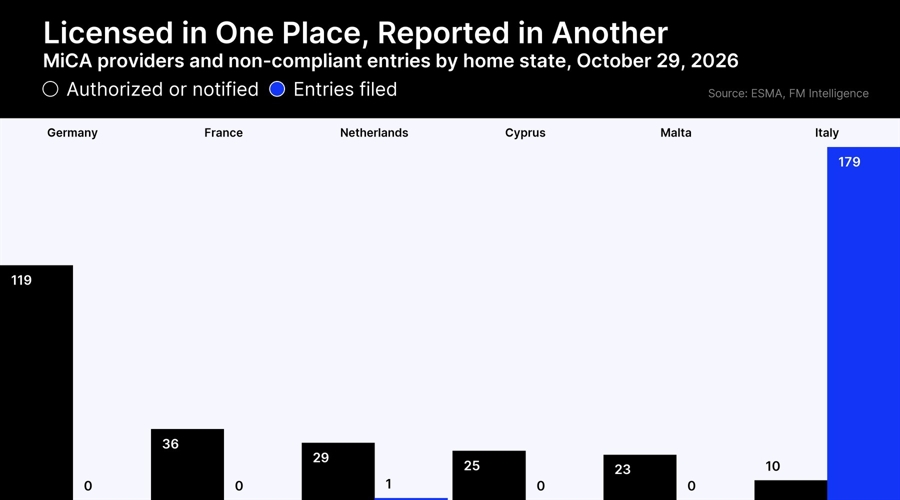
Chart: Germany has 119 MiCA providers and filed no entries, Italy has 10 and filed 179

Italy's market regulator filed 179 of the 188 entries on the EU's register of unlicensed crypto firms, an FM Intelligence analysis published today (Wednesday) shows. Authorities in four other countries supplied the remaining nine.

The European Securities and Markets Authority (ESMA ) keeps the list under the Markets in Crypto-Assets Regulation (MiCA). The law's transition period ended on July 1 for providers without a license.

It is the only EU-wide public record of firms that national supervisors say serve clients without authorization, and it is mostly a record of one supervisor's work.

Banks, payment firms and brokers that screen counterparties against it draw on five of the 30 European Economic Area (EEA) states, according to FM Intelligence's review of ESMA's October 29 file.

London's trading industry is coming home!

Italy's Commissione Nazionale per le Società e la Borsa (CONSOB) has ordered internet providers to black out unauthorized financial websites since 2019. Its tally reached 1,861 sites on October 29, 250 of them tied to crypto-assets, according to the regulator.

A supervisor that already names domains in bulk may find it easier to pass them on to ESMA, the analysis said.

Germany Leads on Licenses and Files No Entries

Germany sits at the other end. ESMA lists 119 authorized or notified providers based there, the most of any member state, as it was when FM Intelligence mapped the register in August. Most of them are banks and investment firms notified under MiCA.

German supervisors have filed no entry in the non-compliant register. At home, the Federal Financial Supervisory Authority (BaFin) published 245 consumer warnings in 2026 to November 3, and 89 of them mention crypto services, FM Intelligence's Fines & Warnings Tracker shows.

The same split appears wherever national warning lists are busy. France's Autorité des marchés financiers (AMF) said on October 19 it had added 64 crypto names to its own blacklist since January.

The Cyprus Securities and Exchange Commission (CySEC ) cited MiCA's Article 59 in its September website warnings, and again in October. Neither authority has an entry in the ESMA file.

The rest of the file comes from four authorities. Belgium's Financial Services and Markets Authority filed six entries and the Czech, Dutch and Slovak authorities one each, which leaves 25 EEA states with none.
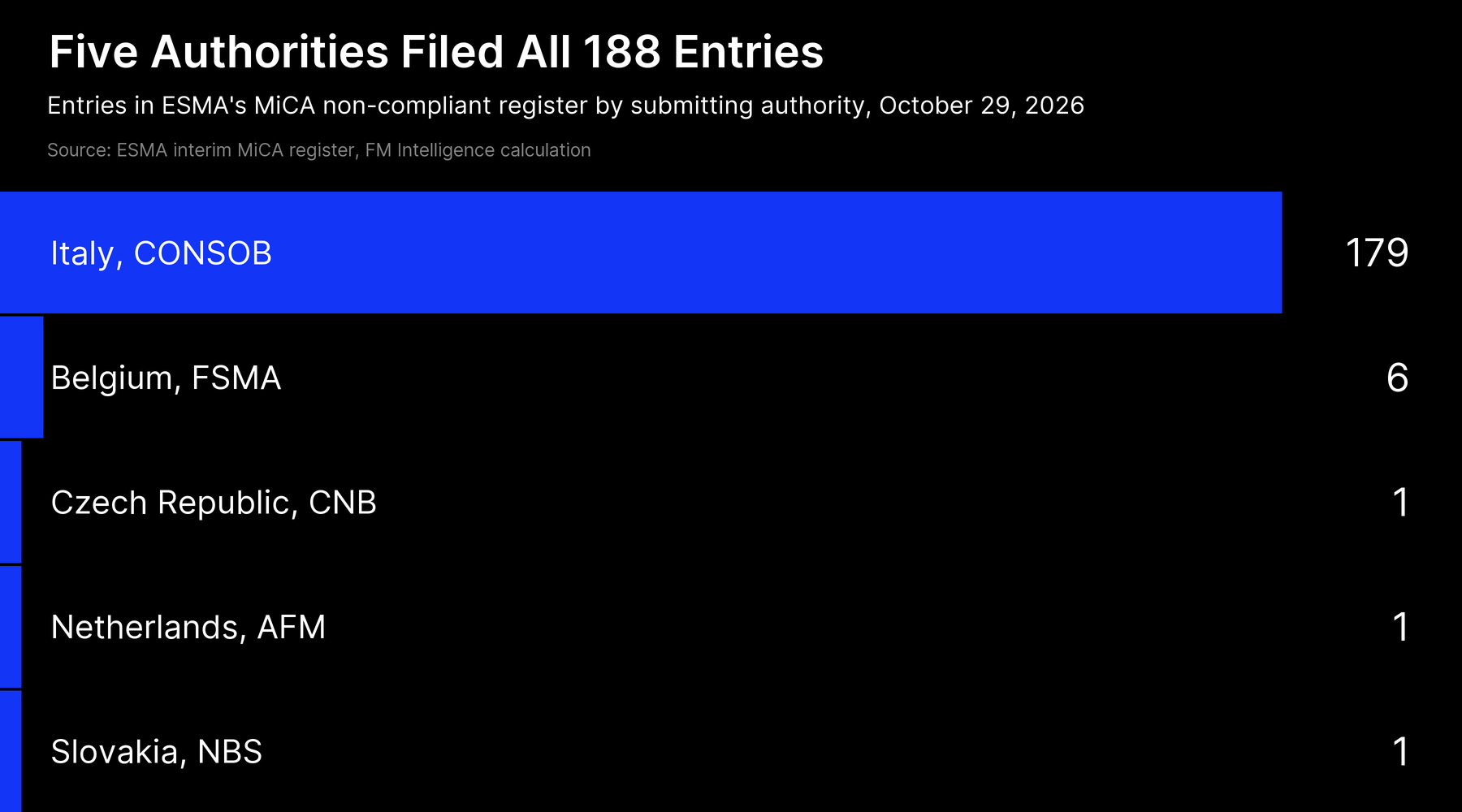
Chart: Italy's CONSOB filed 179 of 188 MiCA non-compliant entries, four others filed nine

Nothing Obliges Supervisors to File

MiCA's Article 110 describes the register as non-exhaustive. It sets the minimum content of an entry but no duty or deadline for national authorities to submit one. Many German and French warnings also cover mixed investment and crypto offers that fall under national banking or securities law.

Germany's zero is therefore consistent with a different reporting channel rather than an absence of unlicensed crypto offers, the analysis concluded.

The gap sits beside a separate debate over who supervises crypto firms. EU finance ministers agreed on October 9 to limit direct ESMA supervision to the largest cross-border providers, narrowing a European Commission plan to move all of them to the Paris-based authority.

A BaFin executive director said in September that firms choose Europe's weakest supervisor and then expand across the bloc.

Central supervision would address where firms are licensed. The ESMA file points to a second gap, in where unlicensed activity is reported, and ESMA has added no entry of its own.

The full FM Intelligence analysis examines what the 188 entries contain, a detail that limits their use in counterparty screening, and projects the size of the file by June 30, 2027, when the Commission is due to report on MiCA.

Italy's market regulator filed 179 of the 188 entries on the EU's register of unlicensed crypto firms, an FM Intelligence analysis published today (Wednesday) shows. Authorities in four other countries supplied the remaining nine.

The European Securities and Markets Authority (ESMA ) keeps the list under the Markets in Crypto-Assets Regulation (MiCA). The law's transition period ended on July 1 for providers without a license.

It is the only EU-wide public record of firms that national supervisors say serve clients without authorization, and it is mostly a record of one supervisor's work.

Banks, payment firms and brokers that screen counterparties against it draw on five of the 30 European Economic Area (EEA) states, according to FM Intelligence's review of ESMA's October 29 file.

London's trading industry is coming home!

Italy's Commissione Nazionale per le Società e la Borsa (CONSOB) has ordered internet providers to black out unauthorized financial websites since 2019. Its tally reached 1,861 sites on October 29, 250 of them tied to crypto-assets, according to the regulator.

A supervisor that already names domains in bulk may find it easier to pass them on to ESMA, the analysis said.

Germany Leads on Licenses and Files No Entries

Germany sits at the other end. ESMA lists 119 authorized or notified providers based there, the most of any member state, as it was when FM Intelligence mapped the register in August. Most of them are banks and investment firms notified under MiCA.

German supervisors have filed no entry in the non-compliant register. At home, the Federal Financial Supervisory Authority (BaFin) published 245 consumer warnings in 2026 to November 3, and 89 of them mention crypto services, FM Intelligence's Fines & Warnings Tracker shows.

The same split appears wherever national warning lists are busy. France's Autorité des marchés financiers (AMF) said on October 19 it had added 64 crypto names to its own blacklist since January.

The Cyprus Securities and Exchange Commission (CySEC ) cited MiCA's Article 59 in its September website warnings, and again in October. Neither authority has an entry in the ESMA file.

The rest of the file comes from four authorities. Belgium's Financial Services and Markets Authority filed six entries and the Czech, Dutch and Slovak authorities one each, which leaves 25 EEA states with none.

Chart: Italy's CONSOB filed 179 of 188 MiCA non-compliant entries, four others filed nine

Nothing Obliges Supervisors to File

MiCA's Article 110 describes the register as non-exhaustive. It sets the minimum content of an entry but no duty or deadline for national authorities to submit one. Many German and French warnings also cover mixed investment and crypto offers that fall under national banking or securities law.

Germany's zero is therefore consistent with a different reporting channel rather than an absence of unlicensed crypto offers, the analysis concluded.

The gap sits beside a separate debate over who supervises crypto firms. EU finance ministers agreed on October 9 to limit direct ESMA supervision to the largest cross-border providers, narrowing a European Commission plan to move all of them to the Paris-based authority.

A BaFin executive director said in September that firms choose Europe's weakest supervisor and then expand across the bloc.

Central supervision would address where firms are licensed. The ESMA file points to a second gap, in where unlicensed activity is reported, and ESMA has added no entry of its own.

The full FM Intelligence analysis examines what the 188 entries contain, a detail that limits their use in counterparty screening, and projects the size of the file by June 30, 2027, when the Commission is due to report on MiCA.

About the Author: Damian Chmiel
Damian Chmiel
  • 4147 Articles
  • 119 Followers
About the Author: Damian Chmiel
Damian Chmiel is a Senior Analyst & Editor at Finance Magnates with more than 15 years of experience in the CFD and online trading industry. Active as both a trader and journalist since 2010, he focuses on broker coverage, fintech innovation, and regulatory developments across Europe, the Middle East, and Asia. His work includes interviews with C-level leaders at major brokerages and fintech platforms, as well as co-authoring Finance Magnates’ quarterly industry benchmarking reports. Damian’s reporting is data-driven, market-aware, and grounded in direct industry engagement. His analysis and commentary have also been cited by external media outlets, including Investing.com, Binance, The Asset, Stockhead, and Dispatch. Education: MA in Finance and Accounting, Cracow University of Economics
  • 4147 Articles
  • 119 Followers

More from the Author

CryptoCurrency

!"#$%&'()*+,-./0123456789:;<=>?@ABCDEFGHIJKLMNOPQRSTUVWXYZ[\]^_`abcdefghijklmnopqrstuvwxyz{|} !"#$%&'()*+,-./0123456789:;<=>?@ABCDEFGHIJKLMNOPQRSTUVWXYZ[\]^_`abcdefghijklmnopqrstuvwxyz{|}