This week, the exchange was licensed by CySEC and VARA.
However, the UAE's license is 'very restricted'.
Bybit
After
obtaining licenses in Cyprus and Kazakhstan and having exited Canada, the
cryptocurrency exchange Bybit continues its organizational redevelopment. Since announcing in April that it established its main global headquarters in
Dubai, it has now obtained one of the local licenses.
Although Bybit has not received permission to start virtual asset operations in the Emirate of Dubai, it has made considerable progress towards securing operational approval.
Bybit Acquires MVP License
in Dubai
Bybit
FinTech FZE, a branch of Bybit operating in the Middle East, announced
yesterday (Tuesday) that the Dubai-based Virtual Assets Regulatory Authority
(VARA) granted it a preliminary Minimum Viable Product (MVP) licence.
Under this
license, however, Bybit cannot provide crypto trading services. It will only be able to fully present its offering to
customers from the United Arab Emirates (UAE) after it receives the full
authorization
Although
Bybit's current operational capabilities in the country are 'very restricted',
the exchange's CEO, Ben Zhou, looks positively to the future and claims that
VARA wants to support innovation and entrepreneurship in the cryptocurrency
sector.
When the
exchange obtains a full license, it wants to provide all possible
cryptocurrency services permitted by local law. VARA allows companies to
provide services in the areas of advisory, trust, loans, payments, investments,
money transfers, and brokerage.
“We would like to express our gratitude to VARA for their careful consideration of our application and for granting us the MVP Preparatory License. This is a crucial step forward for Bybit in the UAE, as Dubai plays a pioneering role in advancing the world's development of financial innovation and digital assets,” Zhou said. “We consider the receipt of this license to be a significant milestone that acknowledges the hard work, dedication, and strong commitment to compliance exhibited by our team.”
📣 #Bybit has been Granted MVP License from Dubai’s Virtual Assets Regulatory Authority.
Dubai's pioneering role in driving financial innovation and digital assets makes this a significant stride forward for Bybit.
Bybit received in-principle approval to conduct business in the UAE more than a year ago. Yet in March 2022, it obtained
in-principle approval to operate in this region. In April 2023, it also decided to
move its main headquarters there. Currently, it is located in One Central at the
Dubai World Trade Center, occupying a 16,000-square-foot open space with views
of the city's iconic landmarks.
Along with
the information about changing the main headquarters, Bybit reported an increase of 50% in its customer base.
Bybit Changes Its
Regulatory Areas
As
mentioned in the introduction, Bybit's recent moves clearly aim to change the
exchange's existing regulatory environment. In addition to moving to Dubai and
obtaining an MVP license, the exchange obtained permission to operate
in Kazakhstan with certain limitations.
The
country, which is associated with cryptocurrency enthusiasts mainly with cheap
energy used by digital asset mines, is supposed to be a 'gateway' to the CIS
region for the company. The CIS is a regional intergovernmental organization
created after the collapse of the Soviet Union. It represents a lively market
for the adoption of digital assets and is a promising center for
cryptocurrencies.
Also, in
May, Bybit decided to exit Canada, following its agreement with regulators. Since
May 31, the exchange has no longer accepted new customers from Canada. "In light of recent regulatory development, Bybit has made the difficult but necessary decision to pause the availability of our products and services," the company commented in a statement published on May 30.
Earlier
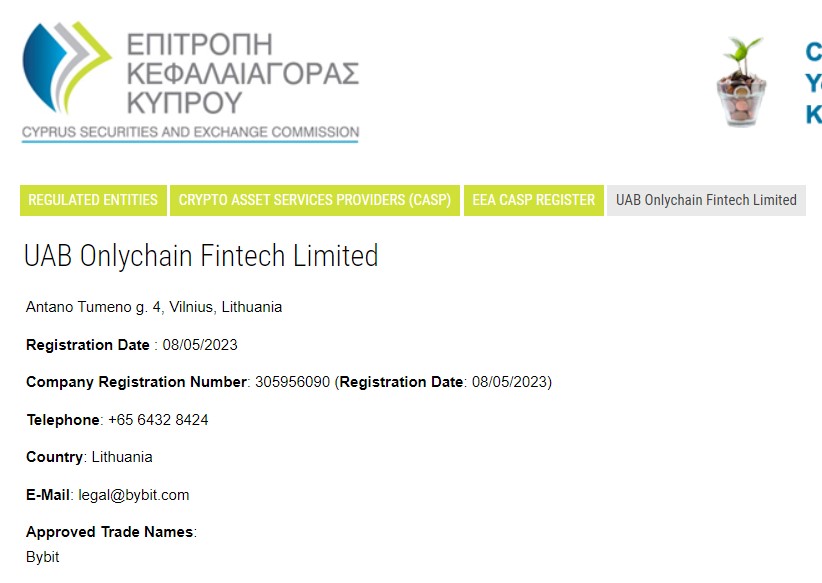
this week, the platform announced it had obtained a new license in Cyprus. According
to the regulator's register, the license was granted to the Lithuanian company
UAB Onlychain Fintech Limited in May 2023.
"This
landmark is a testament to Bybit's commitment to adhering to robust regulatory
frameworks while expanding our global presence. We look forward to bringing the
Crypto Ark to Cyprus," Zhou commented.
Bybit's CySEC registration
After
obtaining licenses in Cyprus and Kazakhstan and having exited Canada, the
cryptocurrency exchange Bybit continues its organizational redevelopment. Since announcing in April that it established its main global headquarters in
Dubai, it has now obtained one of the local licenses.
Although Bybit has not received permission to start virtual asset operations in the Emirate of Dubai, it has made considerable progress towards securing operational approval.
Bybit Acquires MVP License
in Dubai
Bybit
FinTech FZE, a branch of Bybit operating in the Middle East, announced
yesterday (Tuesday) that the Dubai-based Virtual Assets Regulatory Authority
(VARA) granted it a preliminary Minimum Viable Product (MVP) licence.
Under this
license, however, Bybit cannot provide crypto trading services. It will only be able to fully present its offering to
customers from the United Arab Emirates (UAE) after it receives the full
authorization
Although
Bybit's current operational capabilities in the country are 'very restricted',
the exchange's CEO, Ben Zhou, looks positively to the future and claims that
VARA wants to support innovation and entrepreneurship in the cryptocurrency
sector.
When the
exchange obtains a full license, it wants to provide all possible
cryptocurrency services permitted by local law. VARA allows companies to
provide services in the areas of advisory, trust, loans, payments, investments,
money transfers, and brokerage.
“We would like to express our gratitude to VARA for their careful consideration of our application and for granting us the MVP Preparatory License. This is a crucial step forward for Bybit in the UAE, as Dubai plays a pioneering role in advancing the world's development of financial innovation and digital assets,” Zhou said. “We consider the receipt of this license to be a significant milestone that acknowledges the hard work, dedication, and strong commitment to compliance exhibited by our team.”
📣 #Bybit has been Granted MVP License from Dubai’s Virtual Assets Regulatory Authority.
Dubai's pioneering role in driving financial innovation and digital assets makes this a significant stride forward for Bybit.
Bybit received in-principle approval to conduct business in the UAE more than a year ago. Yet in March 2022, it obtained
in-principle approval to operate in this region. In April 2023, it also decided to
move its main headquarters there. Currently, it is located in One Central at the
Dubai World Trade Center, occupying a 16,000-square-foot open space with views
of the city's iconic landmarks.
Along with
the information about changing the main headquarters, Bybit reported an increase of 50% in its customer base.
Bybit Changes Its
Regulatory Areas
As
mentioned in the introduction, Bybit's recent moves clearly aim to change the
exchange's existing regulatory environment. In addition to moving to Dubai and
obtaining an MVP license, the exchange obtained permission to operate
in Kazakhstan with certain limitations.
The
country, which is associated with cryptocurrency enthusiasts mainly with cheap
energy used by digital asset mines, is supposed to be a 'gateway' to the CIS
region for the company. The CIS is a regional intergovernmental organization
created after the collapse of the Soviet Union. It represents a lively market
for the adoption of digital assets and is a promising center for
cryptocurrencies.
Also, in
May, Bybit decided to exit Canada, following its agreement with regulators. Since
May 31, the exchange has no longer accepted new customers from Canada. "In light of recent regulatory development, Bybit has made the difficult but necessary decision to pause the availability of our products and services," the company commented in a statement published on May 30.
Earlier
this week, the platform announced it had obtained a new license in Cyprus. According
to the regulator's register, the license was granted to the Lithuanian company
UAB Onlychain Fintech Limited in May 2023.
"This
landmark is a testament to Bybit's commitment to adhering to robust regulatory
frameworks while expanding our global presence. We look forward to bringing the
Crypto Ark to Cyprus," Zhou commented.
Damian Chmiel is a Senior Analyst & Editor at Finance Magnates with more than 15 years of experience in the CFD and online trading industry. Active as both a trader and journalist since 2010, he focuses on broker coverage, fintech innovation, and regulatory developments across Europe, the Middle East, and Asia.
His work includes interviews with C-level leaders at major brokerages and fintech platforms, as well as co-authoring Finance Magnates’ quarterly industry benchmarking reports. Damian’s reporting is data-driven, market-aware, and grounded in direct industry engagement. His analysis and commentary have also been cited by external media outlets, including Investing.com, Binance, The Asset, Stockhead, and Dispatch.
Education:
MA in Finance and Accounting, Cracow University of Economics
CFTC Seeks Public Input on Proposed Retail Crypto Regulatory Framework
Featured Videos
AvaTrade to Acquire Most of FXCM; NAGA Raises $8M
AvaTrade to Acquire Most of FXCM; NAGA Raises $8M
AvaTrade to Acquire Most of FXCM; NAGA Raises $8M
AvaTrade to Acquire Most of FXCM; NAGA Raises $8M
Today’s financial news recap covers AvaTrade agrees to acquire most of FXCM, NAGA secures eight million dollars in new financing, and Wise seeks a tax settlement in the UK.
Finance Magnates Daily Recap brings you the latest news from forex and CFD brokers, fintech, payments, cryptocurrency, digital assets, trading platforms, financial regulation and global markets.
Get the key company news, executive moves, deals, regulatory updates and market developments of the day, in just a few minutes. New episodes published every weekday.
Read more: https://www.financemagnates.com
#FinanceMagnates #ForexNews #FintechNews
Today’s financial news recap covers AvaTrade agrees to acquire most of FXCM, NAGA secures eight million dollars in new financing, and Wise seeks a tax settlement in the UK.
Finance Magnates Daily Recap brings you the latest news from forex and CFD brokers, fintech, payments, cryptocurrency, digital assets, trading platforms, financial regulation and global markets.
Get the key company news, executive moves, deals, regulatory updates and market developments of the day, in just a few minutes. New episodes published every weekday.
Read more: https://www.financemagnates.com
#FinanceMagnates #ForexNews #FintechNews
Today’s financial news recap covers AvaTrade agrees to acquire most of FXCM, NAGA secures eight million dollars in new financing, and Wise seeks a tax settlement in the UK.
Finance Magnates Daily Recap brings you the latest news from forex and CFD brokers, fintech, payments, cryptocurrency, digital assets, trading platforms, financial regulation and global markets.
Get the key company news, executive moves, deals, regulatory updates and market developments of the day, in just a few minutes. New episodes published every weekday.
Read more: https://www.financemagnates.com
#FinanceMagnates #ForexNews #FintechNews
Today’s financial news recap covers AvaTrade agrees to acquire most of FXCM, NAGA secures eight million dollars in new financing, and Wise seeks a tax settlement in the UK.
Finance Magnates Daily Recap brings you the latest news from forex and CFD brokers, fintech, payments, cryptocurrency, digital assets, trading platforms, financial regulation and global markets.
Get the key company news, executive moves, deals, regulatory updates and market developments of the day, in just a few minutes. New episodes published every weekday.
Read more: https://www.financemagnates.com
#FinanceMagnates #ForexNews #FintechNews
XTB Adds Overnight US Stock Trading; Nasdaq Ventures Invests in One Trading
XTB Adds Overnight US Stock Trading; Nasdaq Ventures Invests in One Trading
XTB Adds Overnight US Stock Trading; Nasdaq Ventures Invests in One Trading
XTB Adds Overnight US Stock Trading; Nasdaq Ventures Invests in One Trading
XTB Adds Overnight US Stock Trading; Nasdaq Ventures Invests in One Trading
XTB Adds Overnight US Stock Trading; Nasdaq Ventures Invests in One Trading
Today’s financial news recap covers XTB expands overnight US stock trading, Fortrade reports higher revenue, Nasdaq backs One Trading, and Vest Labs raises 13 million dollars.
Finance Magnates Daily Recap brings you the latest news from forex and CFD brokers, fintech, payments, cryptocurrency, digital assets, trading platforms, financial regulation and global markets.
Get the key company news, executive moves, deals, regulatory updates and market developments of the day, in just a few minutes. New episodes published every weekday.
Read more: https://www.financemagnates.com
#FinanceMagnates #ForexNews #FintechNews
Today’s financial news recap covers XTB expands overnight US stock trading, Fortrade reports higher revenue, Nasdaq backs One Trading, and Vest Labs raises 13 million dollars.
Finance Magnates Daily Recap brings you the latest news from forex and CFD brokers, fintech, payments, cryptocurrency, digital assets, trading platforms, financial regulation and global markets.
Get the key company news, executive moves, deals, regulatory updates and market developments of the day, in just a few minutes. New episodes published every weekday.
Read more: https://www.financemagnates.com
#FinanceMagnates #ForexNews #FintechNews
Today’s financial news recap covers XTB expands overnight US stock trading, Fortrade reports higher revenue, Nasdaq backs One Trading, and Vest Labs raises 13 million dollars.
Finance Magnates Daily Recap brings you the latest news from forex and CFD brokers, fintech, payments, cryptocurrency, digital assets, trading platforms, financial regulation and global markets.
Get the key company news, executive moves, deals, regulatory updates and market developments of the day, in just a few minutes. New episodes published every weekday.
Read more: https://www.financemagnates.com
#FinanceMagnates #ForexNews #FintechNews
Today’s financial news recap covers XTB expands overnight US stock trading, Fortrade reports higher revenue, Nasdaq backs One Trading, and Vest Labs raises 13 million dollars.
Finance Magnates Daily Recap brings you the latest news from forex and CFD brokers, fintech, payments, cryptocurrency, digital assets, trading platforms, financial regulation and global markets.
Get the key company news, executive moves, deals, regulatory updates and market developments of the day, in just a few minutes. New episodes published every weekday.
Read more: https://www.financemagnates.com
#FinanceMagnates #ForexNews #FintechNews
Today’s financial news recap covers XTB expands overnight US stock trading, Fortrade reports higher revenue, Nasdaq backs One Trading, and Vest Labs raises 13 million dollars.
Finance Magnates Daily Recap brings you the latest news from forex and CFD brokers, fintech, payments, cryptocurrency, digital assets, trading platforms, financial regulation and global markets.
Get the key company news, executive moves, deals, regulatory updates and market developments of the day, in just a few minutes. New episodes published every weekday.
Read more: https://www.financemagnates.com
#FinanceMagnates #ForexNews #FintechNews
Today’s financial news recap covers XTB expands overnight US stock trading, Fortrade reports higher revenue, Nasdaq backs One Trading, and Vest Labs raises 13 million dollars.
Finance Magnates Daily Recap brings you the latest news from forex and CFD brokers, fintech, payments, cryptocurrency, digital assets, trading platforms, financial regulation and global markets.
Get the key company news, executive moves, deals, regulatory updates and market developments of the day, in just a few minutes. New episodes published every weekday.
Read more: https://www.financemagnates.com
#FinanceMagnates #ForexNews #FintechNews
CMC Founder Downplays Volatility Hit; Devexperts Names CEO
CMC Founder Downplays Volatility Hit; Devexperts Names CEO
CMC Founder Downplays Volatility Hit; Devexperts Names CEO
CMC Founder Downplays Volatility Hit; Devexperts Names CEO
CMC Founder Downplays Volatility Hit; Devexperts Names CEO
CMC Founder Downplays Volatility Hit; Devexperts Names CEO
Today’s financial news recap covers low volatility pressures brokers, Devexperts names a new CEO, Saxo cuts onboarding time, and OKX reaches a 25 billion dollar valuation.
Finance Magnates Daily Recap brings you the latest news from forex and CFD brokers, fintech, payments, cryptocurrency, digital assets, trading platforms, financial regulation and global markets.
Get the key company news, executive moves, deals, regulatory updates and market developments of the day, in just a few minutes. New episodes published every weekday.
Read more: https://www.financemagnates.com
#FinanceMagnates #ForexNews #FintechNews
Today’s financial news recap covers low volatility pressures brokers, Devexperts names a new CEO, Saxo cuts onboarding time, and OKX reaches a 25 billion dollar valuation.
Finance Magnates Daily Recap brings you the latest news from forex and CFD brokers, fintech, payments, cryptocurrency, digital assets, trading platforms, financial regulation and global markets.
Get the key company news, executive moves, deals, regulatory updates and market developments of the day, in just a few minutes. New episodes published every weekday.
Read more: https://www.financemagnates.com
#FinanceMagnates #ForexNews #FintechNews
Today’s financial news recap covers low volatility pressures brokers, Devexperts names a new CEO, Saxo cuts onboarding time, and OKX reaches a 25 billion dollar valuation.
Finance Magnates Daily Recap brings you the latest news from forex and CFD brokers, fintech, payments, cryptocurrency, digital assets, trading platforms, financial regulation and global markets.
Get the key company news, executive moves, deals, regulatory updates and market developments of the day, in just a few minutes. New episodes published every weekday.
Read more: https://www.financemagnates.com
#FinanceMagnates #ForexNews #FintechNews
Today’s financial news recap covers low volatility pressures brokers, Devexperts names a new CEO, Saxo cuts onboarding time, and OKX reaches a 25 billion dollar valuation.
Finance Magnates Daily Recap brings you the latest news from forex and CFD brokers, fintech, payments, cryptocurrency, digital assets, trading platforms, financial regulation and global markets.
Get the key company news, executive moves, deals, regulatory updates and market developments of the day, in just a few minutes. New episodes published every weekday.
Read more: https://www.financemagnates.com
#FinanceMagnates #ForexNews #FintechNews
Today’s financial news recap covers low volatility pressures brokers, Devexperts names a new CEO, Saxo cuts onboarding time, and OKX reaches a 25 billion dollar valuation.
Finance Magnates Daily Recap brings you the latest news from forex and CFD brokers, fintech, payments, cryptocurrency, digital assets, trading platforms, financial regulation and global markets.
Get the key company news, executive moves, deals, regulatory updates and market developments of the day, in just a few minutes. New episodes published every weekday.
Read more: https://www.financemagnates.com
#FinanceMagnates #ForexNews #FintechNews
Today’s financial news recap covers low volatility pressures brokers, Devexperts names a new CEO, Saxo cuts onboarding time, and OKX reaches a 25 billion dollar valuation.
Finance Magnates Daily Recap brings you the latest news from forex and CFD brokers, fintech, payments, cryptocurrency, digital assets, trading platforms, financial regulation and global markets.
Get the key company news, executive moves, deals, regulatory updates and market developments of the day, in just a few minutes. New episodes published every weekday.
Read more: https://www.financemagnates.com
#FinanceMagnates #ForexNews #FintechNews
Today’s financial news recap covers Trade Nation buys FXCM's UK client book, Trading 212 reports higher revenue, the CFTC's move to allow perpetual index futures.
Finance Magnates Daily Recap brings you the latest news from forex and CFD brokers, fintech, payments, cryptocurrency, digital assets, trading platforms, financial regulation and global markets.
Get the key company news, executive moves, deals, regulatory updates and market developments of the day, in just a few minutes. New episodes published every weekday.
Read more: https://www.financemagnates.com
#FinanceMagnates #ForexNews #FintechNews
Today’s financial news recap covers Trade Nation buys FXCM's UK client book, Trading 212 reports higher revenue, the CFTC's move to allow perpetual index futures.
Finance Magnates Daily Recap brings you the latest news from forex and CFD brokers, fintech, payments, cryptocurrency, digital assets, trading platforms, financial regulation and global markets.
Get the key company news, executive moves, deals, regulatory updates and market developments of the day, in just a few minutes. New episodes published every weekday.
Read more: https://www.financemagnates.com
#FinanceMagnates #ForexNews #FintechNews
Today’s financial news recap covers Trade Nation buys FXCM's UK client book, Trading 212 reports higher revenue, the CFTC's move to allow perpetual index futures.
Finance Magnates Daily Recap brings you the latest news from forex and CFD brokers, fintech, payments, cryptocurrency, digital assets, trading platforms, financial regulation and global markets.
Get the key company news, executive moves, deals, regulatory updates and market developments of the day, in just a few minutes. New episodes published every weekday.
Read more: https://www.financemagnates.com
#FinanceMagnates #ForexNews #FintechNews
Today’s financial news recap covers Trade Nation buys FXCM's UK client book, Trading 212 reports higher revenue, the CFTC's move to allow perpetual index futures.
Finance Magnates Daily Recap brings you the latest news from forex and CFD brokers, fintech, payments, cryptocurrency, digital assets, trading platforms, financial regulation and global markets.
Get the key company news, executive moves, deals, regulatory updates and market developments of the day, in just a few minutes. New episodes published every weekday.
Read more: https://www.financemagnates.com
#FinanceMagnates #ForexNews #FintechNews
Today’s financial news recap covers Trade Nation buys FXCM's UK client book, Trading 212 reports higher revenue, the CFTC's move to allow perpetual index futures.
Finance Magnates Daily Recap brings you the latest news from forex and CFD brokers, fintech, payments, cryptocurrency, digital assets, trading platforms, financial regulation and global markets.
Get the key company news, executive moves, deals, regulatory updates and market developments of the day, in just a few minutes. New episodes published every weekday.
Read more: https://www.financemagnates.com
#FinanceMagnates #ForexNews #FintechNews
Today’s financial news recap covers Trade Nation buys FXCM's UK client book, Trading 212 reports higher revenue, the CFTC's move to allow perpetual index futures.
Finance Magnates Daily Recap brings you the latest news from forex and CFD brokers, fintech, payments, cryptocurrency, digital assets, trading platforms, financial regulation and global markets.
Get the key company news, executive moves, deals, regulatory updates and market developments of the day, in just a few minutes. New episodes published every weekday.
Read more: https://www.financemagnates.com
#FinanceMagnates #ForexNews #FintechNews
Your career isn’t a linear path.
Your career isn’t a linear path.
Your career isn’t a linear path.
Your career isn’t a linear path.
Your career isn’t a linear path.
Your career isn’t a linear path.
Roles change. Career goals change. Sometimes you want a completely new challenge.
But the skills and knowledge you build along the way can stay with you and give you something to build on.
For Jeff Patterson, that continued growth is key to long-term career development.
You bring the skills. FM Academy helps you build the knowledge.
#FMAcademy #FinanceMagnates #FinanceCareers #ProfessionalDevelopment #Fintech
Roles change. Career goals change. Sometimes you want a completely new challenge.
But the skills and knowledge you build along the way can stay with you and give you something to build on.
For Jeff Patterson, that continued growth is key to long-term career development.
You bring the skills. FM Academy helps you build the knowledge.
#FMAcademy #FinanceMagnates #FinanceCareers #ProfessionalDevelopment #Fintech
Roles change. Career goals change. Sometimes you want a completely new challenge.
But the skills and knowledge you build along the way can stay with you and give you something to build on.
For Jeff Patterson, that continued growth is key to long-term career development.
You bring the skills. FM Academy helps you build the knowledge.
#FMAcademy #FinanceMagnates #FinanceCareers #ProfessionalDevelopment #Fintech
Roles change. Career goals change. Sometimes you want a completely new challenge.
But the skills and knowledge you build along the way can stay with you and give you something to build on.
For Jeff Patterson, that continued growth is key to long-term career development.
You bring the skills. FM Academy helps you build the knowledge.
#FMAcademy #FinanceMagnates #FinanceCareers #ProfessionalDevelopment #Fintech
Roles change. Career goals change. Sometimes you want a completely new challenge.
But the skills and knowledge you build along the way can stay with you and give you something to build on.
For Jeff Patterson, that continued growth is key to long-term career development.
You bring the skills. FM Academy helps you build the knowledge.
#FMAcademy #FinanceMagnates #FinanceCareers #ProfessionalDevelopment #Fintech
Roles change. Career goals change. Sometimes you want a completely new challenge.
But the skills and knowledge you build along the way can stay with you and give you something to build on.
For Jeff Patterson, that continued growth is key to long-term career development.
You bring the skills. FM Academy helps you build the knowledge.
#FMAcademy #FinanceMagnates #FinanceCareers #ProfessionalDevelopment #Fintech