Elon Musk caused prices to move on both Dogecoin and a well known NFT collection.
On the same day, an unsubstantiated Twitter rumor affected the prices of BNB and BTC.
The impact that events on Twitter are able to have on crypto markets cannot be overstated, as was demonstrated by a sequence of events on the chaotic social media platform on Monday.
The Elon Effect
Back in October last year, when Elon Musk took over at Twitter, it was understood that he would likely make some significant changes to how the platform operates, and that has indeed been the case.
What users were less prepared for was that when they opened the app on Monday, its familiar blue bird logo would have been replaced with an image of a dog, or, more specifically, replaced with the Dogecoin logo.
While users not familiar with the crypto world were confused, for crypto traders it was a buy signal, the price of Doge immediately spiked, and it remains, at the time of writing, significantly higher than it was leading up to Monday.
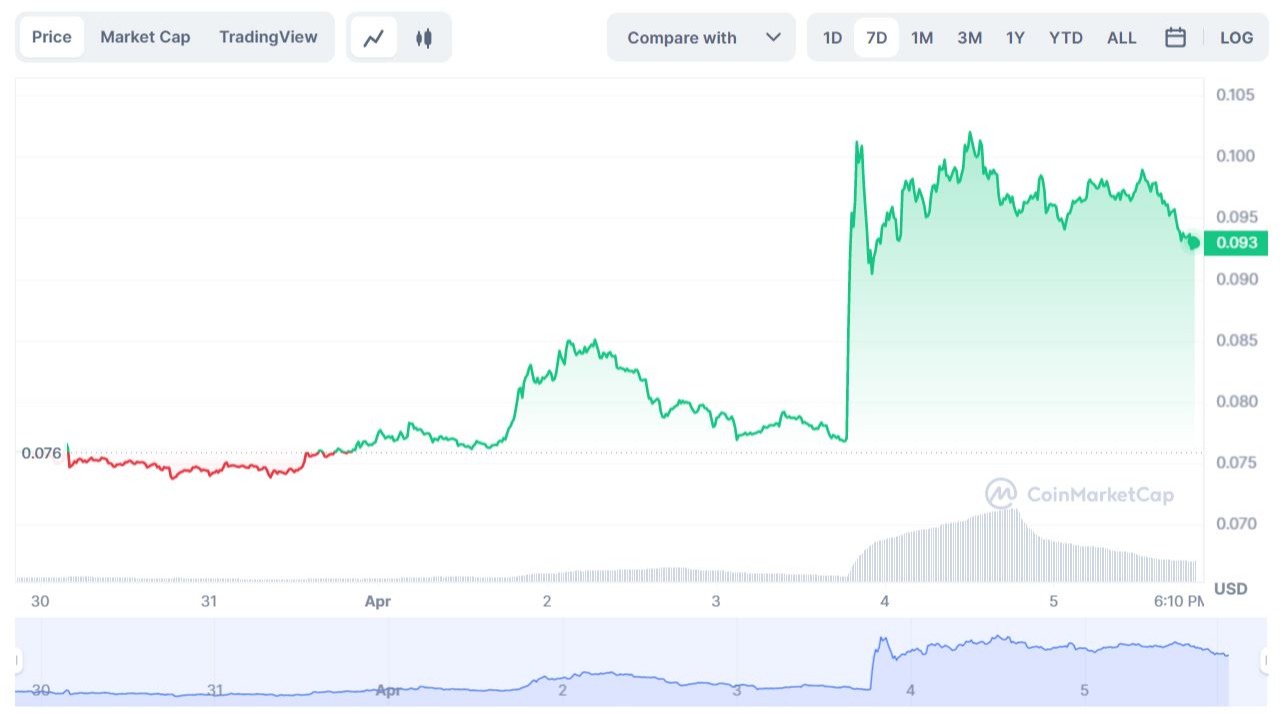
Dogecoin to USD chart from CoinMarketCap
The question now is whether or not the switch of logo is indicative of more substantial news to come. Currently, it could be nothing more than an in-joke, relating back to an exchange (itself subsequently screenshotted and tweeted out by Musk) when the now-owner of Twitter joked about doing exactly what he has just executed: buying Twitter and putting up the Doge logo.
Alternatively, there is speculation about the possibility of Musk utilizing crypto in some capacity on the platform, perhaps, for example, to facilitate payments between users, which is a view arguably reinforced (but still highly speculative) by the fact that the Doge logo remains prominent.
Seize the Memes
Remarkably, on the same day that Musk initiated a surge in the price of Dogecoin, he also caused a run on an NFT collection called The Memes by 6529. This collection was already highly regarded within the NFT space, and is overseen by an influential, pseudonymous figure known as Punk6529.
This time, Musk tweeted an image of an NFT from the collection which featured the message “seize the memes of production,” and prices immediately soared on that NFT (of which there are 1,000 editions), while also increasing other NFTs in the same broad collection.
Musk did not actually mention that the image was of an NFT or give any details about the collection, and he subsequently deleted the tweet, suggesting he may not have been aware of the origins of the image. Nonetheless, it was a demonstration of the extent to which NFT markets can be shifted by activity on social media, whether deliberately or by accident, and it’s also been noted that this accidental element is precisely how memes are supposed to work.
Elon Musk tweeting about the memes is not some random accident but the result of the thorough strategy of @punk6529 to spread the memes.
The above-mentioned factor, markets sometimes being moved apparently by accident, came to the fore in one more notable incident on the same day, this time relating to a well-known figure in the crypto space known as Cobie, whose real name is Jordan Fish. Exerting a significant amount of online clout, Fish has a large following on Twitter, hosts a podcast called 'Up Only', and has a reputation for being in the know and analytical, but also entertainingly irreverent.
Fish took a leading role in crypto events on Monday when he tweeted out an SHA-256 hash encrypted message. What this basically means is that a message can be converted into a string of random-looking letters and numbers, which is ideal for making predictions without actually stating the prediction openly.
In short, Fish turned his prediction sentence into a coded hash, knowing that if it came true, he could then reveal the underlying sentence. This sentence could be confirmed as matching the tweeted hash by entering it into a hash generator, which would output the exact same hash as was first tweeted.
It sounds a little convoluted, but it essentially means that one can make predictions in a coded format, including statements that may be sensitive or controversial, and only ever reveal the ones that come true.
Predictions that aren’t correct would usually never be revealed, but on Monday, someone was able to guess, or had knowledge of, Fish’s prediction, entering it into a hash generator and hitting on the same coded string that Fish had tweeted.
As for the message itself, it read: “Interpol Red Notice for CZ.” This refers to Changpeng Zhao, the CEO of Binance, and feeds into fears around the stability of Binance in light of a CFTC lawsuit the crypto exchange is currently contending with.
Btw, this hash (EFEDF7C4A51516EF909FB0A1C11E7443EE8CF85727D3EC14D0B7C3682E4A2BB6) from @Cobie does convert to
There is, in fact, no such Interpol interest in Zhao, and there is also no suggestion that Fish intended for his statement to become public. After all, Fish tweeted what could reasonably be expected to be an unreadable SHA-256 hash, and subsequently explained, via Twitter.
“Have posted sha256 hash of rumours >20 times in the last year without the secret being revealed – the point of a hash commitment scheme is nobody is supposed to be able to read them until after the secret is revealed. Looks like someone I discussed the rumour with … leaked the secret to ‘cause a stir’ at my expense.”
However, by this time, the rumor had already been relayed around Twitter and picked up on by crypto media, leading to a sudden, temporary dip in the prices of both BNB (Binance’s token) and Bitcoin.
Prices recovered quickly but, overall, it was a bizarre chain of events, indicating that it pays to keep aware of what’s happening on Twitter while, at the same time, remaining skeptical of the content that is posted there.
The impact that events on Twitter are able to have on crypto markets cannot be overstated, as was demonstrated by a sequence of events on the chaotic social media platform on Monday.
The Elon Effect
Back in October last year, when Elon Musk took over at Twitter, it was understood that he would likely make some significant changes to how the platform operates, and that has indeed been the case.
What users were less prepared for was that when they opened the app on Monday, its familiar blue bird logo would have been replaced with an image of a dog, or, more specifically, replaced with the Dogecoin logo.
While users not familiar with the crypto world were confused, for crypto traders it was a buy signal, the price of Doge immediately spiked, and it remains, at the time of writing, significantly higher than it was leading up to Monday.
Dogecoin to USD chart from CoinMarketCap
The question now is whether or not the switch of logo is indicative of more substantial news to come. Currently, it could be nothing more than an in-joke, relating back to an exchange (itself subsequently screenshotted and tweeted out by Musk) when the now-owner of Twitter joked about doing exactly what he has just executed: buying Twitter and putting up the Doge logo.
Alternatively, there is speculation about the possibility of Musk utilizing crypto in some capacity on the platform, perhaps, for example, to facilitate payments between users, which is a view arguably reinforced (but still highly speculative) by the fact that the Doge logo remains prominent.
Seize the Memes
Remarkably, on the same day that Musk initiated a surge in the price of Dogecoin, he also caused a run on an NFT collection called The Memes by 6529. This collection was already highly regarded within the NFT space, and is overseen by an influential, pseudonymous figure known as Punk6529.
This time, Musk tweeted an image of an NFT from the collection which featured the message “seize the memes of production,” and prices immediately soared on that NFT (of which there are 1,000 editions), while also increasing other NFTs in the same broad collection.
Musk did not actually mention that the image was of an NFT or give any details about the collection, and he subsequently deleted the tweet, suggesting he may not have been aware of the origins of the image. Nonetheless, it was a demonstration of the extent to which NFT markets can be shifted by activity on social media, whether deliberately or by accident, and it’s also been noted that this accidental element is precisely how memes are supposed to work.
Elon Musk tweeting about the memes is not some random accident but the result of the thorough strategy of @punk6529 to spread the memes.
The above-mentioned factor, markets sometimes being moved apparently by accident, came to the fore in one more notable incident on the same day, this time relating to a well-known figure in the crypto space known as Cobie, whose real name is Jordan Fish. Exerting a significant amount of online clout, Fish has a large following on Twitter, hosts a podcast called 'Up Only', and has a reputation for being in the know and analytical, but also entertainingly irreverent.
Fish took a leading role in crypto events on Monday when he tweeted out an SHA-256 hash encrypted message. What this basically means is that a message can be converted into a string of random-looking letters and numbers, which is ideal for making predictions without actually stating the prediction openly.
In short, Fish turned his prediction sentence into a coded hash, knowing that if it came true, he could then reveal the underlying sentence. This sentence could be confirmed as matching the tweeted hash by entering it into a hash generator, which would output the exact same hash as was first tweeted.
It sounds a little convoluted, but it essentially means that one can make predictions in a coded format, including statements that may be sensitive or controversial, and only ever reveal the ones that come true.
Predictions that aren’t correct would usually never be revealed, but on Monday, someone was able to guess, or had knowledge of, Fish’s prediction, entering it into a hash generator and hitting on the same coded string that Fish had tweeted.
As for the message itself, it read: “Interpol Red Notice for CZ.” This refers to Changpeng Zhao, the CEO of Binance, and feeds into fears around the stability of Binance in light of a CFTC lawsuit the crypto exchange is currently contending with.
Btw, this hash (EFEDF7C4A51516EF909FB0A1C11E7443EE8CF85727D3EC14D0B7C3682E4A2BB6) from @Cobie does convert to
There is, in fact, no such Interpol interest in Zhao, and there is also no suggestion that Fish intended for his statement to become public. After all, Fish tweeted what could reasonably be expected to be an unreadable SHA-256 hash, and subsequently explained, via Twitter.
“Have posted sha256 hash of rumours >20 times in the last year without the secret being revealed – the point of a hash commitment scheme is nobody is supposed to be able to read them until after the secret is revealed. Looks like someone I discussed the rumour with … leaked the secret to ‘cause a stir’ at my expense.”
However, by this time, the rumor had already been relayed around Twitter and picked up on by crypto media, leading to a sudden, temporary dip in the prices of both BNB (Binance’s token) and Bitcoin.
Prices recovered quickly but, overall, it was a bizarre chain of events, indicating that it pays to keep aware of what’s happening on Twitter while, at the same time, remaining skeptical of the content that is posted there.
Sam White is a writer and journalist from the UK who covers cryptocurrencies and web3, with a particular interest in NFTs and the crossover between art and finance. His work, on a wide variety of topics, has appeared on platforms including The Spectator, Vice and Hacker Noon.
Kalshi Prediction Market and TRON Integration Bridges Traditional Finance with Crypto
Featured Videos
Executive Interview | Charlotte Bullock | Chief Product Officer, Bank of London | FMLS:25
In this interview, we sat down with Charlotte Bullock, Head of Product at The Bank of London, previously at SAP and now shaping product at one of the sector’s most ambitious new banking players.
Charlotte reflects on the Summit so far and talks about the culture inside fintech banks today. We look at the pressures that come with scaling, and how firms can hold onto the nimble approach that made them stand out early on.
We also cover the state of payments ahead of her appearance on the payments roundtable: the blockages financial firms face, the areas that still need fixing, and what a realistic solution looks like in 2026.
In this interview, we sat down with Charlotte Bullock, Head of Product at The Bank of London, previously at SAP and now shaping product at one of the sector’s most ambitious new banking players.
Charlotte reflects on the Summit so far and talks about the culture inside fintech banks today. We look at the pressures that come with scaling, and how firms can hold onto the nimble approach that made them stand out early on.
We also cover the state of payments ahead of her appearance on the payments roundtable: the blockages financial firms face, the areas that still need fixing, and what a realistic solution looks like in 2026.
In this interview, we sat down with Charlotte Bullock, Head of Product at The Bank of London, previously at SAP and now shaping product at one of the sector’s most ambitious new banking players.
Charlotte reflects on the Summit so far and talks about the culture inside fintech banks today. We look at the pressures that come with scaling, and how firms can hold onto the nimble approach that made them stand out early on.
We also cover the state of payments ahead of her appearance on the payments roundtable: the blockages financial firms face, the areas that still need fixing, and what a realistic solution looks like in 2026.
In this interview, we sat down with Charlotte Bullock, Head of Product at The Bank of London, previously at SAP and now shaping product at one of the sector’s most ambitious new banking players.
Charlotte reflects on the Summit so far and talks about the culture inside fintech banks today. We look at the pressures that come with scaling, and how firms can hold onto the nimble approach that made them stand out early on.
We also cover the state of payments ahead of her appearance on the payments roundtable: the blockages financial firms face, the areas that still need fixing, and what a realistic solution looks like in 2026.
In this conversation, we sit down with Drew Niv, CSO at ATFX Connect and one of the most influential figures in modern FX.
We speak about market structure, the institutional view on liquidity, and the sharp rise of prop trading, a sector Drew has been commenting on in recent months. Drew explains why he once dismissed prop trading, why his view changed, and what he now thinks the model means for brokers, clients and risk managers.
We explore subscription-fee dependency, the high reneging rate, and the long-term challenge: how brokers can build a more stable and honest version of the model. Drew also talks about the traffic advantage standalone prop firms have built and why brokers may still win in the long run if they take the right approach.
In this conversation, we sit down with Drew Niv, CSO at ATFX Connect and one of the most influential figures in modern FX.
We speak about market structure, the institutional view on liquidity, and the sharp rise of prop trading, a sector Drew has been commenting on in recent months. Drew explains why he once dismissed prop trading, why his view changed, and what he now thinks the model means for brokers, clients and risk managers.
We explore subscription-fee dependency, the high reneging rate, and the long-term challenge: how brokers can build a more stable and honest version of the model. Drew also talks about the traffic advantage standalone prop firms have built and why brokers may still win in the long run if they take the right approach.
In this conversation, we sit down with Drew Niv, CSO at ATFX Connect and one of the most influential figures in modern FX.
We speak about market structure, the institutional view on liquidity, and the sharp rise of prop trading, a sector Drew has been commenting on in recent months. Drew explains why he once dismissed prop trading, why his view changed, and what he now thinks the model means for brokers, clients and risk managers.
We explore subscription-fee dependency, the high reneging rate, and the long-term challenge: how brokers can build a more stable and honest version of the model. Drew also talks about the traffic advantage standalone prop firms have built and why brokers may still win in the long run if they take the right approach.
In this conversation, we sit down with Drew Niv, CSO at ATFX Connect and one of the most influential figures in modern FX.
We speak about market structure, the institutional view on liquidity, and the sharp rise of prop trading, a sector Drew has been commenting on in recent months. Drew explains why he once dismissed prop trading, why his view changed, and what he now thinks the model means for brokers, clients and risk managers.
We explore subscription-fee dependency, the high reneging rate, and the long-term challenge: how brokers can build a more stable and honest version of the model. Drew also talks about the traffic advantage standalone prop firms have built and why brokers may still win in the long run if they take the right approach.
In this conversation, we sit down with Drew Niv, CSO at ATFX Connect and one of the most influential figures in modern FX.
We speak about market structure, the institutional view on liquidity, and the sharp rise of prop trading, a sector Drew has been commenting on in recent months. Drew explains why he once dismissed prop trading, why his view changed, and what he now thinks the model means for brokers, clients and risk managers.
We explore subscription-fee dependency, the high reneging rate, and the long-term challenge: how brokers can build a more stable and honest version of the model. Drew also talks about the traffic advantage standalone prop firms have built and why brokers may still win in the long run if they take the right approach.
In this conversation, we sit down with Drew Niv, CSO at ATFX Connect and one of the most influential figures in modern FX.
We speak about market structure, the institutional view on liquidity, and the sharp rise of prop trading, a sector Drew has been commenting on in recent months. Drew explains why he once dismissed prop trading, why his view changed, and what he now thinks the model means for brokers, clients and risk managers.
We explore subscription-fee dependency, the high reneging rate, and the long-term challenge: how brokers can build a more stable and honest version of the model. Drew also talks about the traffic advantage standalone prop firms have built and why brokers may still win in the long run if they take the right approach.
Executive Interview | Remonda Z. Kirketerp Møller| CEO & Founder Muinmos | FMLS:25
In this interview, Remonda Z. Kirketerp Møller, founder of Muinmos, breaks down the state of AI in regtech and what responsible adoption really looks like for brokers. We talk about rising fragmentation, the pressures around compliance accuracy, and why most firms are still in the early stages of AI maturity.
Ramanda also shares insights on regulator sandboxes, shifting expectations around accountability, and the current reality of MiCA licensing and passporting in Europe.
A concise look at where compliance, onboarding, and AI-driven processes are heading next.
In this interview, Remonda Z. Kirketerp Møller, founder of Muinmos, breaks down the state of AI in regtech and what responsible adoption really looks like for brokers. We talk about rising fragmentation, the pressures around compliance accuracy, and why most firms are still in the early stages of AI maturity.
Ramanda also shares insights on regulator sandboxes, shifting expectations around accountability, and the current reality of MiCA licensing and passporting in Europe.
A concise look at where compliance, onboarding, and AI-driven processes are heading next.
In this interview, Remonda Z. Kirketerp Møller, founder of Muinmos, breaks down the state of AI in regtech and what responsible adoption really looks like for brokers. We talk about rising fragmentation, the pressures around compliance accuracy, and why most firms are still in the early stages of AI maturity.
Ramanda also shares insights on regulator sandboxes, shifting expectations around accountability, and the current reality of MiCA licensing and passporting in Europe.
A concise look at where compliance, onboarding, and AI-driven processes are heading next.
In this interview, Remonda Z. Kirketerp Møller, founder of Muinmos, breaks down the state of AI in regtech and what responsible adoption really looks like for brokers. We talk about rising fragmentation, the pressures around compliance accuracy, and why most firms are still in the early stages of AI maturity.
Ramanda also shares insights on regulator sandboxes, shifting expectations around accountability, and the current reality of MiCA licensing and passporting in Europe.
A concise look at where compliance, onboarding, and AI-driven processes are heading next.
In this interview, Remonda Z. Kirketerp Møller, founder of Muinmos, breaks down the state of AI in regtech and what responsible adoption really looks like for brokers. We talk about rising fragmentation, the pressures around compliance accuracy, and why most firms are still in the early stages of AI maturity.
Ramanda also shares insights on regulator sandboxes, shifting expectations around accountability, and the current reality of MiCA licensing and passporting in Europe.
A concise look at where compliance, onboarding, and AI-driven processes are heading next.
In this interview, Remonda Z. Kirketerp Møller, founder of Muinmos, breaks down the state of AI in regtech and what responsible adoption really looks like for brokers. We talk about rising fragmentation, the pressures around compliance accuracy, and why most firms are still in the early stages of AI maturity.
Ramanda also shares insights on regulator sandboxes, shifting expectations around accountability, and the current reality of MiCA licensing and passporting in Europe.
A concise look at where compliance, onboarding, and AI-driven processes are heading next.
In this conversation, we speak with Aydin Bonabi, CEO and co-founder of Surveill, a firm focused on fraud detection and AI-driven compliance tools for financial institutions.
We start with Aydin’s view of the Summit and the challenges brokers face as fraud tactics grow more complex. He explains how firms can stay ahead through real-time signals, data patterns, and early-stage detection.
We also talk about AI training and why compliance teams often struggle to keep models accurate, fair, and aligned with regulatory expectations. Aydin breaks down what “good” AI training looks like inside a financial environment, including the importance of clean data, domain expertise, and human oversight.
He closes with a clear message: fraud is scaling, and so must the tools that stop it.
In this conversation, we speak with Aydin Bonabi, CEO and co-founder of Surveill, a firm focused on fraud detection and AI-driven compliance tools for financial institutions.
We start with Aydin’s view of the Summit and the challenges brokers face as fraud tactics grow more complex. He explains how firms can stay ahead through real-time signals, data patterns, and early-stage detection.
We also talk about AI training and why compliance teams often struggle to keep models accurate, fair, and aligned with regulatory expectations. Aydin breaks down what “good” AI training looks like inside a financial environment, including the importance of clean data, domain expertise, and human oversight.
He closes with a clear message: fraud is scaling, and so must the tools that stop it.
In this conversation, we speak with Aydin Bonabi, CEO and co-founder of Surveill, a firm focused on fraud detection and AI-driven compliance tools for financial institutions.
We start with Aydin’s view of the Summit and the challenges brokers face as fraud tactics grow more complex. He explains how firms can stay ahead through real-time signals, data patterns, and early-stage detection.
We also talk about AI training and why compliance teams often struggle to keep models accurate, fair, and aligned with regulatory expectations. Aydin breaks down what “good” AI training looks like inside a financial environment, including the importance of clean data, domain expertise, and human oversight.
He closes with a clear message: fraud is scaling, and so must the tools that stop it.
In this conversation, we speak with Aydin Bonabi, CEO and co-founder of Surveill, a firm focused on fraud detection and AI-driven compliance tools for financial institutions.
We start with Aydin’s view of the Summit and the challenges brokers face as fraud tactics grow more complex. He explains how firms can stay ahead through real-time signals, data patterns, and early-stage detection.
We also talk about AI training and why compliance teams often struggle to keep models accurate, fair, and aligned with regulatory expectations. Aydin breaks down what “good” AI training looks like inside a financial environment, including the importance of clean data, domain expertise, and human oversight.
He closes with a clear message: fraud is scaling, and so must the tools that stop it.
In this conversation, we speak with Aydin Bonabi, CEO and co-founder of Surveill, a firm focused on fraud detection and AI-driven compliance tools for financial institutions.
We start with Aydin’s view of the Summit and the challenges brokers face as fraud tactics grow more complex. He explains how firms can stay ahead through real-time signals, data patterns, and early-stage detection.
We also talk about AI training and why compliance teams often struggle to keep models accurate, fair, and aligned with regulatory expectations. Aydin breaks down what “good” AI training looks like inside a financial environment, including the importance of clean data, domain expertise, and human oversight.
He closes with a clear message: fraud is scaling, and so must the tools that stop it.
In this conversation, we speak with Aydin Bonabi, CEO and co-founder of Surveill, a firm focused on fraud detection and AI-driven compliance tools for financial institutions.
We start with Aydin’s view of the Summit and the challenges brokers face as fraud tactics grow more complex. He explains how firms can stay ahead through real-time signals, data patterns, and early-stage detection.
We also talk about AI training and why compliance teams often struggle to keep models accurate, fair, and aligned with regulatory expectations. Aydin breaks down what “good” AI training looks like inside a financial environment, including the importance of clean data, domain expertise, and human oversight.
He closes with a clear message: fraud is scaling, and so must the tools that stop it.
Exness expands its presence in Africa: Inside our interview with Paul Margarites in Cape Town
Finance Magnates met with Paul Margarites, Exness regional commercial director for Sub-Saharan Africa, during a visit to the firm’s office opening in Cape Town. In this talk, led by Andrea Badiola Mateos, Co-CEO at Finance Magnates, Paul shares views on the South African trading space, local user behavior, mobile trends, regulation, team growth, and how Exness plans to grow in more markets across the region. @Exness
Read the article at: https://www.financemagnates.com/thought-leadership/exness-expands-its-presence-in-africa-inside-our-interview-with-paul-margarites/
#exness #financemagnates #exnesstrading #CFDtrading #tradeonline #africanews #capetown
Finance Magnates met with Paul Margarites, Exness regional commercial director for Sub-Saharan Africa, during a visit to the firm’s office opening in Cape Town. In this talk, led by Andrea Badiola Mateos, Co-CEO at Finance Magnates, Paul shares views on the South African trading space, local user behavior, mobile trends, regulation, team growth, and how Exness plans to grow in more markets across the region. @Exness
Read the article at: https://www.financemagnates.com/thought-leadership/exness-expands-its-presence-in-africa-inside-our-interview-with-paul-margarites/
#exness #financemagnates #exnesstrading #CFDtrading #tradeonline #africanews #capetown
Finance Magnates met with Paul Margarites, Exness regional commercial director for Sub-Saharan Africa, during a visit to the firm’s office opening in Cape Town. In this talk, led by Andrea Badiola Mateos, Co-CEO at Finance Magnates, Paul shares views on the South African trading space, local user behavior, mobile trends, regulation, team growth, and how Exness plans to grow in more markets across the region. @Exness
Read the article at: https://www.financemagnates.com/thought-leadership/exness-expands-its-presence-in-africa-inside-our-interview-with-paul-margarites/
#exness #financemagnates #exnesstrading #CFDtrading #tradeonline #africanews #capetown
Finance Magnates met with Paul Margarites, Exness regional commercial director for Sub-Saharan Africa, during a visit to the firm’s office opening in Cape Town. In this talk, led by Andrea Badiola Mateos, Co-CEO at Finance Magnates, Paul shares views on the South African trading space, local user behavior, mobile trends, regulation, team growth, and how Exness plans to grow in more markets across the region. @Exness
Read the article at: https://www.financemagnates.com/thought-leadership/exness-expands-its-presence-in-africa-inside-our-interview-with-paul-margarites/
#exness #financemagnates #exnesstrading #CFDtrading #tradeonline #africanews #capetown
Finance Magnates met with Paul Margarites, Exness regional commercial director for Sub-Saharan Africa, during a visit to the firm’s office opening in Cape Town. In this talk, led by Andrea Badiola Mateos, Co-CEO at Finance Magnates, Paul shares views on the South African trading space, local user behavior, mobile trends, regulation, team growth, and how Exness plans to grow in more markets across the region. @Exness
Read the article at: https://www.financemagnates.com/thought-leadership/exness-expands-its-presence-in-africa-inside-our-interview-with-paul-margarites/
#exness #financemagnates #exnesstrading #CFDtrading #tradeonline #africanews #capetown
Finance Magnates met with Paul Margarites, Exness regional commercial director for Sub-Saharan Africa, during a visit to the firm’s office opening in Cape Town. In this talk, led by Andrea Badiola Mateos, Co-CEO at Finance Magnates, Paul shares views on the South African trading space, local user behavior, mobile trends, regulation, team growth, and how Exness plans to grow in more markets across the region. @Exness
Read the article at: https://www.financemagnates.com/thought-leadership/exness-expands-its-presence-in-africa-inside-our-interview-with-paul-margarites/
#exness #financemagnates #exnesstrading #CFDtrading #tradeonline #africanews #capetown