One BTC is now priced at $35,000, the highest level in 2023.
Investor expectations for profits are as high as the current cryptocurrency price.
The Bitcoin market's fear and greed index shows that investors once again have Bitcoin in their eyes
While it's
too early to talk about a speculative cryptocurrency rally like the ones
Bitcoin (BTC) has historically offered, something is definitely going on. Just
yesterday (Monday), the price of the oldest cryptocurrency surged 15%,
testing its highest levels since May 2022, or in 17 months.
Along with
the rising price, investor expectations and dreams are also soaring, with some
already mentally cashing in above-average profits. The fear-of-missing-out
(FOMO) sentiment is also making a definitive comeback in the bull market.
Moreover,
technical indicators suggest that bulls are in control for the first time in a
while. Not only has Bitcoin's price seen a significant increase, but its
"dominance," or total share in the market capitalization of all
digital assets, has also risen. On Tuesday, it reached 52%, the highest since
April 2021.
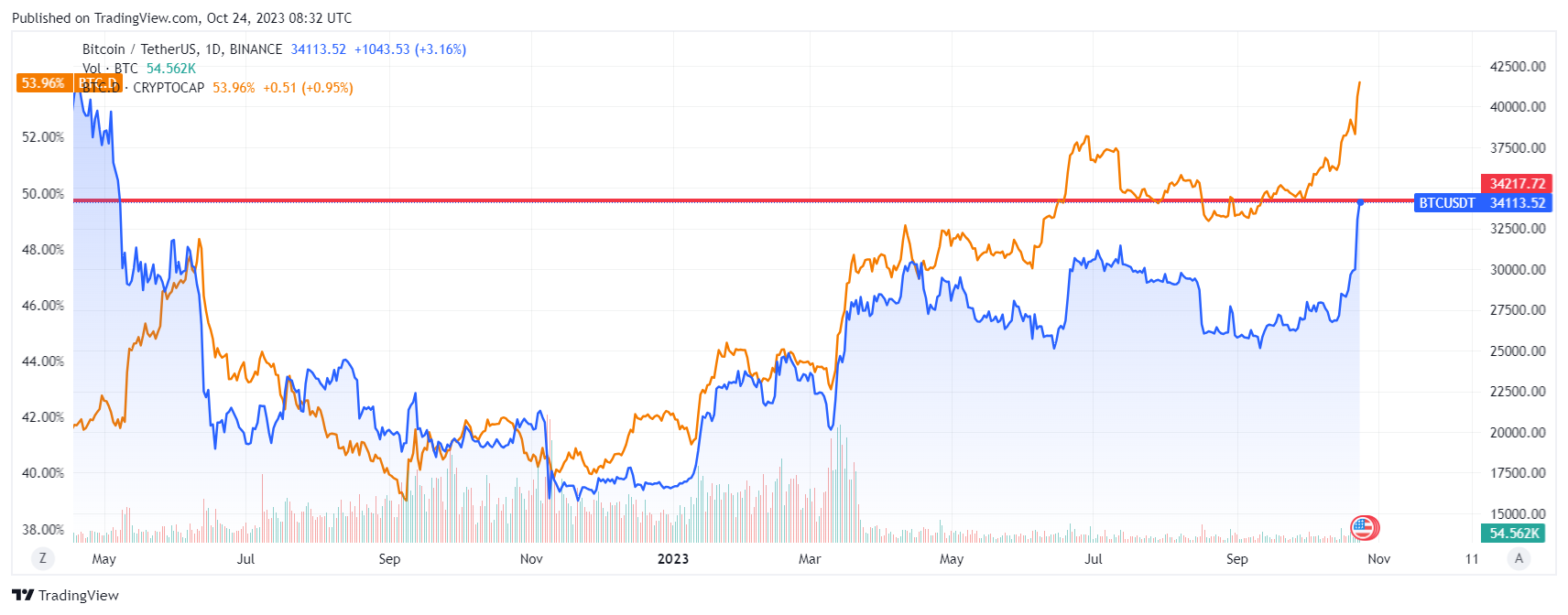
The price of Bitcoin (in blue) and market dominance (in orange). Source: Tradingview.com.
Meanwhile,
trading volumes exploded, reaching nearly $30 billion in 24 hours, and Bitcoin
futures funding rates hit record highs, indicating panic buying from investors
wanting to get a piece of the action. The full-blown FOMO has returned to the
markets.
Even though the Relative Strength Index indicates that Bitcoin is "significantly overvalued," Twitter is filled with posts competing in forecasts about how far the cryptocurrency's price will go.
Bitcoin 45,000 - FOMO is hitting the Market
👇 1/12 The Bitcoin futures funding rate is exceptionally high, indicating that many traders are panic buying at current levels – FOMO is back. Bitcoin dominance has reached 52.1%, and volumes are exploding as Bitcoin trades $29bn… pic.twitter.com/CKtkAPEhhk
"The
current optimism surrounding the leading cryptocurrency can be largely
attributed to insights provided by a Morgan Stanley report, suggesting that the
so-called 'crypto winter,' which has concerned investors, might be approaching
its end," commented Walid Koudmani, the Chief Market Analyst at XTB.
While
Koudmani is likely correct, it's not the only reason for the gains.
Bitcoin ETF Reignites
Investor Imagination
We all
remember how the news that BlackRock would apply to create the first spot
Bitcoin ETF triggered euphoria in the cryptocurrency markets just a few months
ago. Now, speculation about the imminent approval of this financial instrument
has once again captured investors' imagination.
BlackRock
has taken another step toward launching a spot ETF product and has begun the
"seeding" process. As Eric Balchunas from Bloomberg admitted, this is
usually a good sign that brings the ETF closer to launch.
Note: Seeding is typically not a lot of money just enough to get ETF going. So I wouldn't read this as 'omg Blackrock is buying a ton of bitcoin' at all but more the fact they doing it and disclosing it shows another step in the process of launching.
Additionally,
the planned BlackRock iShares Bitcoin Trust has been listed on the Depository
Trust & Clearing Corporation (DTCC), which clears NASDAQ trades. The
instrument will be available under the symbol IBTC.
The iShares Bitcoin Trust has been listed on the DTCC (Depository Trust & Clearing Corporation, which clears NASDAQ trades). And the ticker will be $IBTC. Again all part of the process of bringing ETF to market.. h/t @martypartymusicpic.twitter.com/8PQP3h2yW0
Some industry representatives, however, remain cautious optimists. Among them is David Lo, the Head of Financial Logics at Bybit, who believes that one cannot be 100% certain about the future of the BTC ETF acceptance process. He thinks "there is the potential for GBTC holders and various bankruptcy estates to sell Bitcoin, which could put downward pressure on prices."
According to Lo, the market is returning to a normalized trading environment. However, the price may enter another broad trading range, between $31,000 and $40,000.
"The
total cryptoasset market will grow by $1 trillion if the bitcoin spot ETF gets
approval, data analytics firm CryptoQuant has claimed," eToro commented in
today's note. "The firm has estimated that if the issuers that have
applied to list bitcoin ETFs put just 1% of their Assets Under Management into
the ETF, circa $155 billion could enter the market."
This would
elevate Bitcoin's market capitalization by nearly one-third, pushing it to a
valuation back to $900 billion.
While it's
too early to talk about a speculative cryptocurrency rally like the ones
Bitcoin (BTC) has historically offered, something is definitely going on. Just
yesterday (Monday), the price of the oldest cryptocurrency surged 15%,
testing its highest levels since May 2022, or in 17 months.
Along with
the rising price, investor expectations and dreams are also soaring, with some
already mentally cashing in above-average profits. The fear-of-missing-out
(FOMO) sentiment is also making a definitive comeback in the bull market.
Moreover,
technical indicators suggest that bulls are in control for the first time in a
while. Not only has Bitcoin's price seen a significant increase, but its
"dominance," or total share in the market capitalization of all
digital assets, has also risen. On Tuesday, it reached 52%, the highest since
April 2021.
The price of Bitcoin (in blue) and market dominance (in orange). Source: Tradingview.com.
Meanwhile,
trading volumes exploded, reaching nearly $30 billion in 24 hours, and Bitcoin
futures funding rates hit record highs, indicating panic buying from investors
wanting to get a piece of the action. The full-blown FOMO has returned to the
markets.
Even though the Relative Strength Index indicates that Bitcoin is "significantly overvalued," Twitter is filled with posts competing in forecasts about how far the cryptocurrency's price will go.
Bitcoin 45,000 - FOMO is hitting the Market
👇 1/12 The Bitcoin futures funding rate is exceptionally high, indicating that many traders are panic buying at current levels – FOMO is back. Bitcoin dominance has reached 52.1%, and volumes are exploding as Bitcoin trades $29bn… pic.twitter.com/CKtkAPEhhk
"The
current optimism surrounding the leading cryptocurrency can be largely
attributed to insights provided by a Morgan Stanley report, suggesting that the
so-called 'crypto winter,' which has concerned investors, might be approaching
its end," commented Walid Koudmani, the Chief Market Analyst at XTB.
While
Koudmani is likely correct, it's not the only reason for the gains.
Bitcoin ETF Reignites
Investor Imagination
We all
remember how the news that BlackRock would apply to create the first spot
Bitcoin ETF triggered euphoria in the cryptocurrency markets just a few months
ago. Now, speculation about the imminent approval of this financial instrument
has once again captured investors' imagination.
BlackRock
has taken another step toward launching a spot ETF product and has begun the
"seeding" process. As Eric Balchunas from Bloomberg admitted, this is
usually a good sign that brings the ETF closer to launch.
Note: Seeding is typically not a lot of money just enough to get ETF going. So I wouldn't read this as 'omg Blackrock is buying a ton of bitcoin' at all but more the fact they doing it and disclosing it shows another step in the process of launching.
Additionally,
the planned BlackRock iShares Bitcoin Trust has been listed on the Depository
Trust & Clearing Corporation (DTCC), which clears NASDAQ trades. The
instrument will be available under the symbol IBTC.
The iShares Bitcoin Trust has been listed on the DTCC (Depository Trust & Clearing Corporation, which clears NASDAQ trades). And the ticker will be $IBTC. Again all part of the process of bringing ETF to market.. h/t @martypartymusicpic.twitter.com/8PQP3h2yW0
Some industry representatives, however, remain cautious optimists. Among them is David Lo, the Head of Financial Logics at Bybit, who believes that one cannot be 100% certain about the future of the BTC ETF acceptance process. He thinks "there is the potential for GBTC holders and various bankruptcy estates to sell Bitcoin, which could put downward pressure on prices."
According to Lo, the market is returning to a normalized trading environment. However, the price may enter another broad trading range, between $31,000 and $40,000.
"The
total cryptoasset market will grow by $1 trillion if the bitcoin spot ETF gets
approval, data analytics firm CryptoQuant has claimed," eToro commented in
today's note. "The firm has estimated that if the issuers that have
applied to list bitcoin ETFs put just 1% of their Assets Under Management into
the ETF, circa $155 billion could enter the market."
This would
elevate Bitcoin's market capitalization by nearly one-third, pushing it to a
valuation back to $900 billion.
Damian's adventure with financial markets began at the Cracow University of Economics, where he obtained his MA in finance and accounting. Starting from the retail trader perspective, he collaborated with brokerage houses and financial portals in Poland as an independent editor and content manager. His adventure with Finance Magnates began in 2016, where he is working as a business intelligence analyst.
Coinbase Enters Prediction Markets as the Amazonification of Financial Platforms Gathers Pace
Featured Videos
Executive Interview | Charlotte Bullock | Chief Product Officer, Bank of London | FMLS:25
In this interview, we sat down with Charlotte Bullock, Head of Product at The Bank of London, previously at SAP and now shaping product at one of the sector’s most ambitious new banking players.
Charlotte reflects on the Summit so far and talks about the culture inside fintech banks today. We look at the pressures that come with scaling, and how firms can hold onto the nimble approach that made them stand out early on.
We also cover the state of payments ahead of her appearance on the payments roundtable: the blockages financial firms face, the areas that still need fixing, and what a realistic solution looks like in 2026.
In this interview, we sat down with Charlotte Bullock, Head of Product at The Bank of London, previously at SAP and now shaping product at one of the sector’s most ambitious new banking players.
Charlotte reflects on the Summit so far and talks about the culture inside fintech banks today. We look at the pressures that come with scaling, and how firms can hold onto the nimble approach that made them stand out early on.
We also cover the state of payments ahead of her appearance on the payments roundtable: the blockages financial firms face, the areas that still need fixing, and what a realistic solution looks like in 2026.
In this interview, we sat down with Charlotte Bullock, Head of Product at The Bank of London, previously at SAP and now shaping product at one of the sector’s most ambitious new banking players.
Charlotte reflects on the Summit so far and talks about the culture inside fintech banks today. We look at the pressures that come with scaling, and how firms can hold onto the nimble approach that made them stand out early on.
We also cover the state of payments ahead of her appearance on the payments roundtable: the blockages financial firms face, the areas that still need fixing, and what a realistic solution looks like in 2026.
In this interview, we sat down with Charlotte Bullock, Head of Product at The Bank of London, previously at SAP and now shaping product at one of the sector’s most ambitious new banking players.
Charlotte reflects on the Summit so far and talks about the culture inside fintech banks today. We look at the pressures that come with scaling, and how firms can hold onto the nimble approach that made them stand out early on.
We also cover the state of payments ahead of her appearance on the payments roundtable: the blockages financial firms face, the areas that still need fixing, and what a realistic solution looks like in 2026.
In this conversation, we sit down with Drew Niv, CSO at ATFX Connect and one of the most influential figures in modern FX.
We speak about market structure, the institutional view on liquidity, and the sharp rise of prop trading, a sector Drew has been commenting on in recent months. Drew explains why he once dismissed prop trading, why his view changed, and what he now thinks the model means for brokers, clients and risk managers.
We explore subscription-fee dependency, the high reneging rate, and the long-term challenge: how brokers can build a more stable and honest version of the model. Drew also talks about the traffic advantage standalone prop firms have built and why brokers may still win in the long run if they take the right approach.
In this conversation, we sit down with Drew Niv, CSO at ATFX Connect and one of the most influential figures in modern FX.
We speak about market structure, the institutional view on liquidity, and the sharp rise of prop trading, a sector Drew has been commenting on in recent months. Drew explains why he once dismissed prop trading, why his view changed, and what he now thinks the model means for brokers, clients and risk managers.
We explore subscription-fee dependency, the high reneging rate, and the long-term challenge: how brokers can build a more stable and honest version of the model. Drew also talks about the traffic advantage standalone prop firms have built and why brokers may still win in the long run if they take the right approach.
In this conversation, we sit down with Drew Niv, CSO at ATFX Connect and one of the most influential figures in modern FX.
We speak about market structure, the institutional view on liquidity, and the sharp rise of prop trading, a sector Drew has been commenting on in recent months. Drew explains why he once dismissed prop trading, why his view changed, and what he now thinks the model means for brokers, clients and risk managers.
We explore subscription-fee dependency, the high reneging rate, and the long-term challenge: how brokers can build a more stable and honest version of the model. Drew also talks about the traffic advantage standalone prop firms have built and why brokers may still win in the long run if they take the right approach.
In this conversation, we sit down with Drew Niv, CSO at ATFX Connect and one of the most influential figures in modern FX.
We speak about market structure, the institutional view on liquidity, and the sharp rise of prop trading, a sector Drew has been commenting on in recent months. Drew explains why he once dismissed prop trading, why his view changed, and what he now thinks the model means for brokers, clients and risk managers.
We explore subscription-fee dependency, the high reneging rate, and the long-term challenge: how brokers can build a more stable and honest version of the model. Drew also talks about the traffic advantage standalone prop firms have built and why brokers may still win in the long run if they take the right approach.
In this conversation, we sit down with Drew Niv, CSO at ATFX Connect and one of the most influential figures in modern FX.
We speak about market structure, the institutional view on liquidity, and the sharp rise of prop trading, a sector Drew has been commenting on in recent months. Drew explains why he once dismissed prop trading, why his view changed, and what he now thinks the model means for brokers, clients and risk managers.
We explore subscription-fee dependency, the high reneging rate, and the long-term challenge: how brokers can build a more stable and honest version of the model. Drew also talks about the traffic advantage standalone prop firms have built and why brokers may still win in the long run if they take the right approach.
In this conversation, we sit down with Drew Niv, CSO at ATFX Connect and one of the most influential figures in modern FX.
We speak about market structure, the institutional view on liquidity, and the sharp rise of prop trading, a sector Drew has been commenting on in recent months. Drew explains why he once dismissed prop trading, why his view changed, and what he now thinks the model means for brokers, clients and risk managers.
We explore subscription-fee dependency, the high reneging rate, and the long-term challenge: how brokers can build a more stable and honest version of the model. Drew also talks about the traffic advantage standalone prop firms have built and why brokers may still win in the long run if they take the right approach.
Executive Interview | Remonda Z. Kirketerp Møller| CEO & Founder Muinmos | FMLS:25
In this interview, Remonda Z. Kirketerp Møller, founder of Muinmos, breaks down the state of AI in regtech and what responsible adoption really looks like for brokers. We talk about rising fragmentation, the pressures around compliance accuracy, and why most firms are still in the early stages of AI maturity.
Ramanda also shares insights on regulator sandboxes, shifting expectations around accountability, and the current reality of MiCA licensing and passporting in Europe.
A concise look at where compliance, onboarding, and AI-driven processes are heading next.
In this interview, Remonda Z. Kirketerp Møller, founder of Muinmos, breaks down the state of AI in regtech and what responsible adoption really looks like for brokers. We talk about rising fragmentation, the pressures around compliance accuracy, and why most firms are still in the early stages of AI maturity.
Ramanda also shares insights on regulator sandboxes, shifting expectations around accountability, and the current reality of MiCA licensing and passporting in Europe.
A concise look at where compliance, onboarding, and AI-driven processes are heading next.
In this interview, Remonda Z. Kirketerp Møller, founder of Muinmos, breaks down the state of AI in regtech and what responsible adoption really looks like for brokers. We talk about rising fragmentation, the pressures around compliance accuracy, and why most firms are still in the early stages of AI maturity.
Ramanda also shares insights on regulator sandboxes, shifting expectations around accountability, and the current reality of MiCA licensing and passporting in Europe.
A concise look at where compliance, onboarding, and AI-driven processes are heading next.
In this interview, Remonda Z. Kirketerp Møller, founder of Muinmos, breaks down the state of AI in regtech and what responsible adoption really looks like for brokers. We talk about rising fragmentation, the pressures around compliance accuracy, and why most firms are still in the early stages of AI maturity.
Ramanda also shares insights on regulator sandboxes, shifting expectations around accountability, and the current reality of MiCA licensing and passporting in Europe.
A concise look at where compliance, onboarding, and AI-driven processes are heading next.
In this interview, Remonda Z. Kirketerp Møller, founder of Muinmos, breaks down the state of AI in regtech and what responsible adoption really looks like for brokers. We talk about rising fragmentation, the pressures around compliance accuracy, and why most firms are still in the early stages of AI maturity.
Ramanda also shares insights on regulator sandboxes, shifting expectations around accountability, and the current reality of MiCA licensing and passporting in Europe.
A concise look at where compliance, onboarding, and AI-driven processes are heading next.
In this interview, Remonda Z. Kirketerp Møller, founder of Muinmos, breaks down the state of AI in regtech and what responsible adoption really looks like for brokers. We talk about rising fragmentation, the pressures around compliance accuracy, and why most firms are still in the early stages of AI maturity.
Ramanda also shares insights on regulator sandboxes, shifting expectations around accountability, and the current reality of MiCA licensing and passporting in Europe.
A concise look at where compliance, onboarding, and AI-driven processes are heading next.
In this conversation, we speak with Aydin Bonabi, CEO and co-founder of Surveill, a firm focused on fraud detection and AI-driven compliance tools for financial institutions.
We start with Aydin’s view of the Summit and the challenges brokers face as fraud tactics grow more complex. He explains how firms can stay ahead through real-time signals, data patterns, and early-stage detection.
We also talk about AI training and why compliance teams often struggle to keep models accurate, fair, and aligned with regulatory expectations. Aydin breaks down what “good” AI training looks like inside a financial environment, including the importance of clean data, domain expertise, and human oversight.
He closes with a clear message: fraud is scaling, and so must the tools that stop it.
In this conversation, we speak with Aydin Bonabi, CEO and co-founder of Surveill, a firm focused on fraud detection and AI-driven compliance tools for financial institutions.
We start with Aydin’s view of the Summit and the challenges brokers face as fraud tactics grow more complex. He explains how firms can stay ahead through real-time signals, data patterns, and early-stage detection.
We also talk about AI training and why compliance teams often struggle to keep models accurate, fair, and aligned with regulatory expectations. Aydin breaks down what “good” AI training looks like inside a financial environment, including the importance of clean data, domain expertise, and human oversight.
He closes with a clear message: fraud is scaling, and so must the tools that stop it.
In this conversation, we speak with Aydin Bonabi, CEO and co-founder of Surveill, a firm focused on fraud detection and AI-driven compliance tools for financial institutions.
We start with Aydin’s view of the Summit and the challenges brokers face as fraud tactics grow more complex. He explains how firms can stay ahead through real-time signals, data patterns, and early-stage detection.
We also talk about AI training and why compliance teams often struggle to keep models accurate, fair, and aligned with regulatory expectations. Aydin breaks down what “good” AI training looks like inside a financial environment, including the importance of clean data, domain expertise, and human oversight.
He closes with a clear message: fraud is scaling, and so must the tools that stop it.
In this conversation, we speak with Aydin Bonabi, CEO and co-founder of Surveill, a firm focused on fraud detection and AI-driven compliance tools for financial institutions.
We start with Aydin’s view of the Summit and the challenges brokers face as fraud tactics grow more complex. He explains how firms can stay ahead through real-time signals, data patterns, and early-stage detection.
We also talk about AI training and why compliance teams often struggle to keep models accurate, fair, and aligned with regulatory expectations. Aydin breaks down what “good” AI training looks like inside a financial environment, including the importance of clean data, domain expertise, and human oversight.
He closes with a clear message: fraud is scaling, and so must the tools that stop it.
In this conversation, we speak with Aydin Bonabi, CEO and co-founder of Surveill, a firm focused on fraud detection and AI-driven compliance tools for financial institutions.
We start with Aydin’s view of the Summit and the challenges brokers face as fraud tactics grow more complex. He explains how firms can stay ahead through real-time signals, data patterns, and early-stage detection.
We also talk about AI training and why compliance teams often struggle to keep models accurate, fair, and aligned with regulatory expectations. Aydin breaks down what “good” AI training looks like inside a financial environment, including the importance of clean data, domain expertise, and human oversight.
He closes with a clear message: fraud is scaling, and so must the tools that stop it.
In this conversation, we speak with Aydin Bonabi, CEO and co-founder of Surveill, a firm focused on fraud detection and AI-driven compliance tools for financial institutions.
We start with Aydin’s view of the Summit and the challenges brokers face as fraud tactics grow more complex. He explains how firms can stay ahead through real-time signals, data patterns, and early-stage detection.
We also talk about AI training and why compliance teams often struggle to keep models accurate, fair, and aligned with regulatory expectations. Aydin breaks down what “good” AI training looks like inside a financial environment, including the importance of clean data, domain expertise, and human oversight.
He closes with a clear message: fraud is scaling, and so must the tools that stop it.
Exness expands its presence in Africa: Inside our interview with Paul Margarites in Cape Town
Finance Magnates met with Paul Margarites, Exness regional commercial director for Sub-Saharan Africa, during a visit to the firm’s office opening in Cape Town. In this talk, led by Andrea Badiola Mateos, Co-CEO at Finance Magnates, Paul shares views on the South African trading space, local user behavior, mobile trends, regulation, team growth, and how Exness plans to grow in more markets across the region. @Exness
Read the article at: https://www.financemagnates.com/thought-leadership/exness-expands-its-presence-in-africa-inside-our-interview-with-paul-margarites/
#exness #financemagnates #exnesstrading #CFDtrading #tradeonline #africanews #capetown
Finance Magnates met with Paul Margarites, Exness regional commercial director for Sub-Saharan Africa, during a visit to the firm’s office opening in Cape Town. In this talk, led by Andrea Badiola Mateos, Co-CEO at Finance Magnates, Paul shares views on the South African trading space, local user behavior, mobile trends, regulation, team growth, and how Exness plans to grow in more markets across the region. @Exness
Read the article at: https://www.financemagnates.com/thought-leadership/exness-expands-its-presence-in-africa-inside-our-interview-with-paul-margarites/
#exness #financemagnates #exnesstrading #CFDtrading #tradeonline #africanews #capetown
Finance Magnates met with Paul Margarites, Exness regional commercial director for Sub-Saharan Africa, during a visit to the firm’s office opening in Cape Town. In this talk, led by Andrea Badiola Mateos, Co-CEO at Finance Magnates, Paul shares views on the South African trading space, local user behavior, mobile trends, regulation, team growth, and how Exness plans to grow in more markets across the region. @Exness
Read the article at: https://www.financemagnates.com/thought-leadership/exness-expands-its-presence-in-africa-inside-our-interview-with-paul-margarites/
#exness #financemagnates #exnesstrading #CFDtrading #tradeonline #africanews #capetown
Finance Magnates met with Paul Margarites, Exness regional commercial director for Sub-Saharan Africa, during a visit to the firm’s office opening in Cape Town. In this talk, led by Andrea Badiola Mateos, Co-CEO at Finance Magnates, Paul shares views on the South African trading space, local user behavior, mobile trends, regulation, team growth, and how Exness plans to grow in more markets across the region. @Exness
Read the article at: https://www.financemagnates.com/thought-leadership/exness-expands-its-presence-in-africa-inside-our-interview-with-paul-margarites/
#exness #financemagnates #exnesstrading #CFDtrading #tradeonline #africanews #capetown
Finance Magnates met with Paul Margarites, Exness regional commercial director for Sub-Saharan Africa, during a visit to the firm’s office opening in Cape Town. In this talk, led by Andrea Badiola Mateos, Co-CEO at Finance Magnates, Paul shares views on the South African trading space, local user behavior, mobile trends, regulation, team growth, and how Exness plans to grow in more markets across the region. @Exness
Read the article at: https://www.financemagnates.com/thought-leadership/exness-expands-its-presence-in-africa-inside-our-interview-with-paul-margarites/
#exness #financemagnates #exnesstrading #CFDtrading #tradeonline #africanews #capetown
Finance Magnates met with Paul Margarites, Exness regional commercial director for Sub-Saharan Africa, during a visit to the firm’s office opening in Cape Town. In this talk, led by Andrea Badiola Mateos, Co-CEO at Finance Magnates, Paul shares views on the South African trading space, local user behavior, mobile trends, regulation, team growth, and how Exness plans to grow in more markets across the region. @Exness
Read the article at: https://www.financemagnates.com/thought-leadership/exness-expands-its-presence-in-africa-inside-our-interview-with-paul-margarites/
#exness #financemagnates #exnesstrading #CFDtrading #tradeonline #africanews #capetown