Federal Reserve delivers first rate cut of 2025, sparking cryptocurrency rally, including Bitcoin, XRP and Dogecoin.
XRP gains 1.5% to $3.08 while Bitcoin price climbs toward $118,000 milestone.
Institutional developments, including new ETF launches, fuel optimism for digital assets.
XRP price and broader cryptocurrency market surged after Fed monetary policy decision
The
cryptocurrency market experienced significant momentum on September 17, 2025,
as digital assets surged following the Federal Reserve's (Fed) decision to
cut interest rates by 25 basis points.
This marked
the Fed's first rate reduction of the year, lowering the benchmark rate to a
range of 4.00% to 4.25%. XRP emerged as one of the standout performers,
demonstrating why crypto is going up today with notable gains across major
tokens.
The Federal
Open Market Committee's (FOMC) unanimous decision to reduce rates by a
quarter percentage point immediately impacted cryptocurrency markets. Fed
Chairman Jerome Powell characterized the move as a "risk management"
decision, acknowledging that job gains have slowed and unemployment has
edged higher. The central bank's dovish stance, although projected, signals growing concern over
economic momentum, creating favorable conditions for risk assets like
cryptocurrencies.
Vijay
Valecha, Chief Investment Officer at Century Financial, noted the economic
context: "Chairman Powell acknowledged that a slowdown in consumer
spending was weighing on economic growth. The U.S. economy grew at 1.5% in
H1'2025, down from 2.5% in H1'2024".
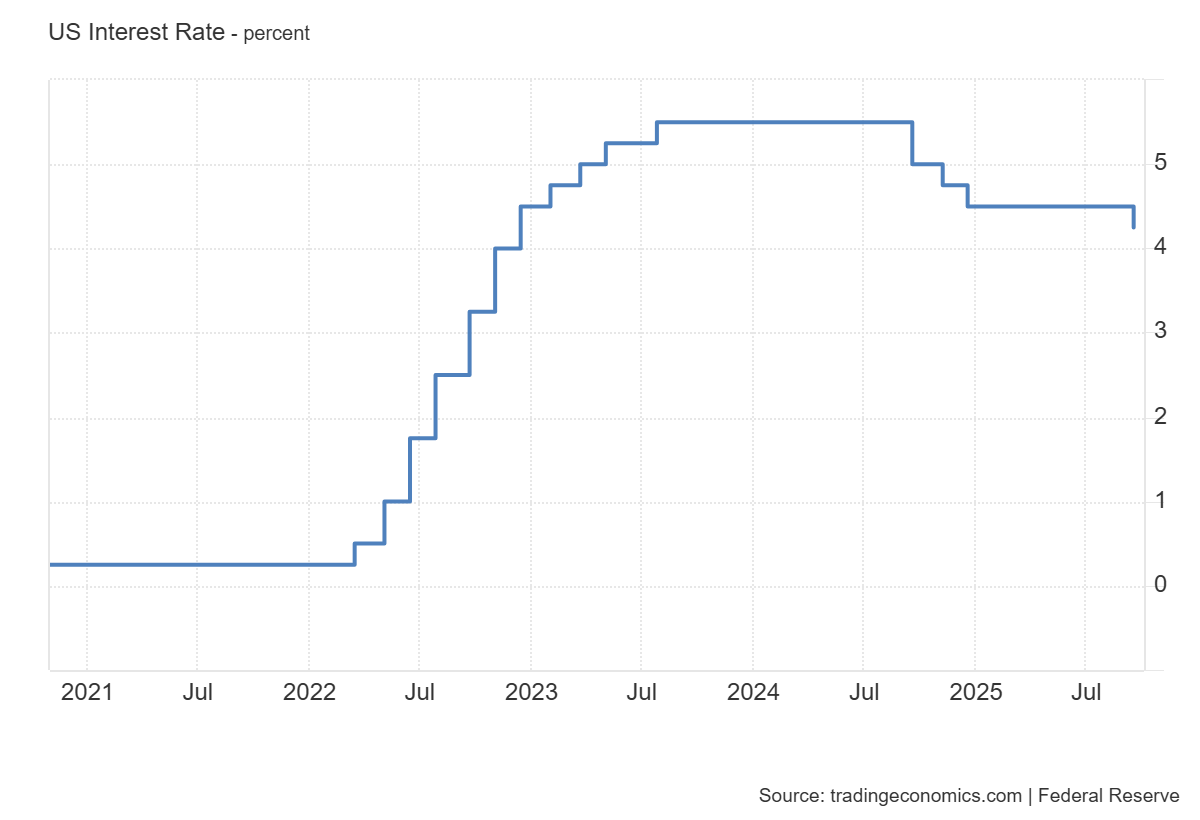
The level of interest rates in the US is now the lowest since in 3 years. Source: Trading Economics
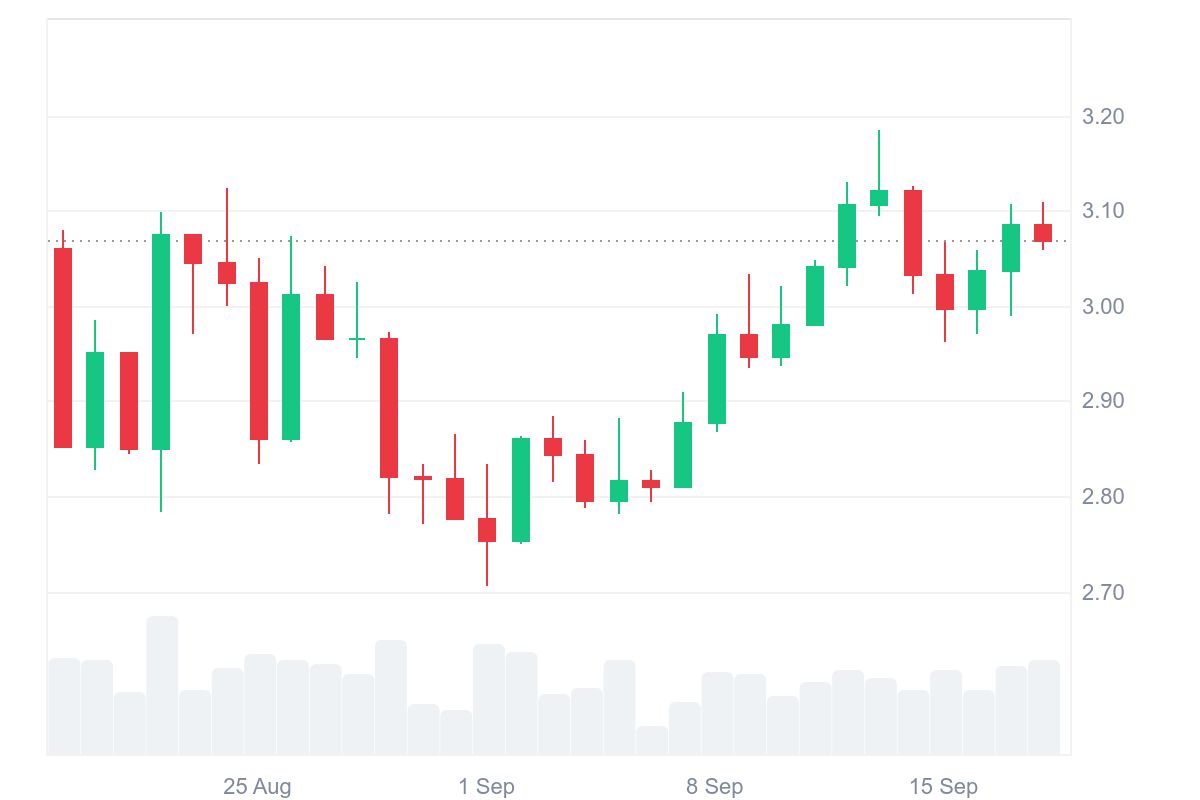
XRP jumped
by more than 1.5% on Wednesday, closing the day at $3.08 and marking intraday
highs at almost $3.11. The payments-focused cryptocurrency demonstrated strong
resilience during the Fed announcement, trading nearly 3% higher and looking to
build upside momentum. Today (Thursday), 18 September 2025, XRP is changing
hands at $3.06, falling modestly by 0.6% as markets digest the rate decision
implications.
XRP price today. Source: CoinMarketCap
Rate Cut Implications for
Digital Assets
Kathleen
Brooks, XTB analyst, provided crucial insight into the Fed's forward guidance:
"The Fed has cut interest rates by 25bps as expected and also reduced its
forecast for interest rates in 2025. The Dot Plot shows that the median
estimate for rates this year has been revised down to 3.625% from 3.875% in
June". She emphasized that "the forecasts for further out the curve
have been left unchanged, and the terminal rate was also unchanged at 3%,
signaling a 5 more rate cuts in this cycle".
September has historically been a weak month for XRP (as well as for cryptocurrencies), which I pointed out in this analysis. However, 2025 defies that trend, with the cryptocurrency already up 11 percent.
My technical
analysis shows the Federal Reserve meeting positively influenced the broader
cryptocurrency market, which gained during Wednesday's session despite declines
in equity markets including major Wall Street indices. Both markets typically
move in tandem during similar macroeconomic events, but this time they moved in
opposite directions.
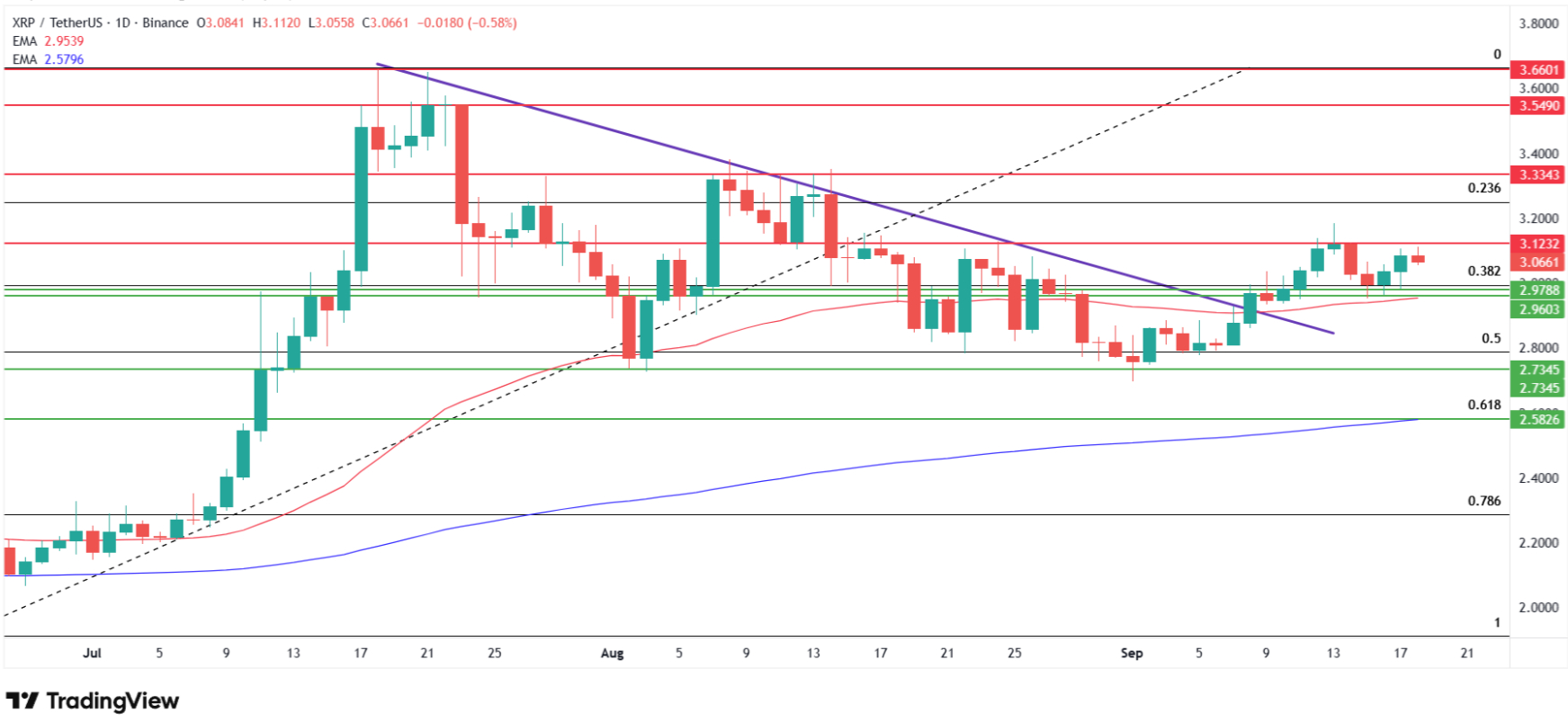
XRP prices
rose by one and a half percent following Powell's comments, representing the
strongest strengthening in a week. From a technical perspective, little has
changed as XRP continues to move within consolidation around the $3 level
and support zone, reinforced by the 50-day exponential moving average and 38.2%
Fibonacci retracement at the third level, plus horizontal support established
by summer results at the $2.90 level.
Local peaks
on September 13 at $3.13 serve as local resistance that may block
short-term bull runs heading toward August peaks around the $3.30 level. The
ultimate resistance zone extends from $3.60 to $3.66 - this year's peaks.
Additional support levels, though I don't expect XRP to decline significantly
in the short to medium term, are located around $2.80 covering August and
September minimums and 50% Fibonacci retracement, as well as at $2.66
coinciding with May peaks.
The next
support level is at $2.60 where the 61.8% Fibonacci retracement and 200-day EMA
run. We're missing about 17% to reach these downward levels, though I would
consider this entire decline a technical correction and an opportunity to buy
at more attractive prices. Only a break below would mean bears are gaining
advantage, and XRP could decline more significantly, even toward $2, or June
lows.
Technical analysis of XRP price to USDT on the daily chart. Source: TradingView
The first U.S.-listed ETFs offering spot exposure to $XRP and $DOGE go live tomorrow, offering investors a way to access these digital assets through an ETF structure.
CME Group
announced plans to introduce options on XRP and SOL futures on October 13,
pending regulatory review. The exchange cited strong growth in newer altcoin
futures, with SOL futures logging over 540,000 contracts traded since
March ($22.3 billion notional), while XRP futures introduced in May have
seen more than 370,000 contracts ($16.2 billion notional).
Broader Crypto Market
Performance: Bitcoin, Solana and Dogecoin Are Up
The global
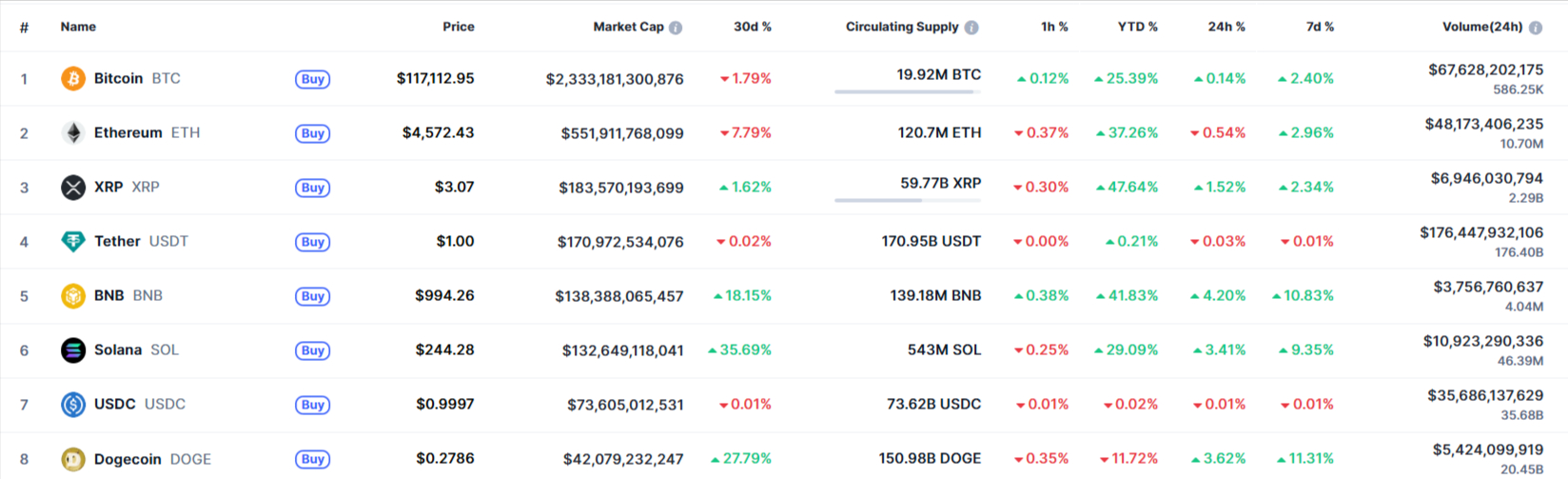
crypto market cap rose 2% to $4.2 trillion on Thursday, lifted by Bitcoin's
steady climb toward $118,000. Bitcoin traded 1% higher at $117,426,
while Ethereum experienced a 2.8% increase to $4,609. The measured gains
reflected investors weighing the central bank's cautious tone on future policy
moves.
Crypto prices after Fed meeting. Source: CoinMarketCap
Matt Mena,
crypto research strategist at 21Shares, noted the Fed's openness to accelerate
easing pace creates an asymmetric setup for Bitcoin: "The dots leaned more
dovish, signaling the Fed is open to accelerating the pace of easing if
conditions demand it".
He
predicted Bitcoin could set an all-time high above $124,000 by end of
October, with Ether topping the $5,000 psychological barrier.
XRP Price FAQ
Are the Federal Reserves
going to use XRP?
No, there
is no indication that the Federal Reserve will use XRP. The Federal Reserve
operates its own payment systems and is developing a Central Bank Digital
Currency (CBDC) separate from existing cryptocurrencies like XRP. While XRP's
technology focuses on cross-border payments and financial institutions, the Fed
maintains its independence in monetary policy and payment infrastructure
decisions.
Will XRP reach $10
dollars?
Yes, however,
XRP reaching $10 would require significant market developments and adoption.
Based on current technical analysis, XRP faces immediate resistance at $3.13
and ultimate resistance between $3.60-$3.66. For XRP to reach $10, it would
need to overcome multiple resistance levels and achieve substantial
institutional adoption or regulatory clarity.
Is XRP a good buy?
Yes, but XRP
investment decisions should be based on individual risk tolerance and market
analysis. Current technical analysis shows XRP consolidating around $3 with
support at $2.90 and the 50-day exponential moving average. Recent positive
developments include the first U.S. XRP ETF launch and upcoming CME options
trading. However, cryptocurrency investments carry significant volatility and
risk. The Fed's dovish monetary policy may benefit risk assets like XRP, but
investors should consider support levels at $2.60-$2.80 and potential downside
risks.
The
cryptocurrency market experienced significant momentum on September 17, 2025,
as digital assets surged following the Federal Reserve's (Fed) decision to
cut interest rates by 25 basis points.
This marked
the Fed's first rate reduction of the year, lowering the benchmark rate to a
range of 4.00% to 4.25%. XRP emerged as one of the standout performers,
demonstrating why crypto is going up today with notable gains across major
tokens.
The Federal
Open Market Committee's (FOMC) unanimous decision to reduce rates by a
quarter percentage point immediately impacted cryptocurrency markets. Fed
Chairman Jerome Powell characterized the move as a "risk management"
decision, acknowledging that job gains have slowed and unemployment has
edged higher. The central bank's dovish stance, although projected, signals growing concern over
economic momentum, creating favorable conditions for risk assets like
cryptocurrencies.
Vijay
Valecha, Chief Investment Officer at Century Financial, noted the economic
context: "Chairman Powell acknowledged that a slowdown in consumer
spending was weighing on economic growth. The U.S. economy grew at 1.5% in
H1'2025, down from 2.5% in H1'2024".
The level of interest rates in the US is now the lowest since in 3 years. Source: Trading Economics
XRP jumped
by more than 1.5% on Wednesday, closing the day at $3.08 and marking intraday
highs at almost $3.11. The payments-focused cryptocurrency demonstrated strong
resilience during the Fed announcement, trading nearly 3% higher and looking to
build upside momentum. Today (Thursday), 18 September 2025, XRP is changing
hands at $3.06, falling modestly by 0.6% as markets digest the rate decision
implications.
XRP price today. Source: CoinMarketCap
Rate Cut Implications for
Digital Assets
Kathleen
Brooks, XTB analyst, provided crucial insight into the Fed's forward guidance:
"The Fed has cut interest rates by 25bps as expected and also reduced its
forecast for interest rates in 2025. The Dot Plot shows that the median
estimate for rates this year has been revised down to 3.625% from 3.875% in
June". She emphasized that "the forecasts for further out the curve
have been left unchanged, and the terminal rate was also unchanged at 3%,
signaling a 5 more rate cuts in this cycle".
September has historically been a weak month for XRP (as well as for cryptocurrencies), which I pointed out in this analysis. However, 2025 defies that trend, with the cryptocurrency already up 11 percent.
My technical
analysis shows the Federal Reserve meeting positively influenced the broader
cryptocurrency market, which gained during Wednesday's session despite declines
in equity markets including major Wall Street indices. Both markets typically
move in tandem during similar macroeconomic events, but this time they moved in
opposite directions.
XRP prices
rose by one and a half percent following Powell's comments, representing the
strongest strengthening in a week. From a technical perspective, little has
changed as XRP continues to move within consolidation around the $3 level
and support zone, reinforced by the 50-day exponential moving average and 38.2%
Fibonacci retracement at the third level, plus horizontal support established
by summer results at the $2.90 level.
Local peaks
on September 13 at $3.13 serve as local resistance that may block
short-term bull runs heading toward August peaks around the $3.30 level. The
ultimate resistance zone extends from $3.60 to $3.66 - this year's peaks.
Additional support levels, though I don't expect XRP to decline significantly
in the short to medium term, are located around $2.80 covering August and
September minimums and 50% Fibonacci retracement, as well as at $2.66
coinciding with May peaks.
The next
support level is at $2.60 where the 61.8% Fibonacci retracement and 200-day EMA
run. We're missing about 17% to reach these downward levels, though I would
consider this entire decline a technical correction and an opportunity to buy
at more attractive prices. Only a break below would mean bears are gaining
advantage, and XRP could decline more significantly, even toward $2, or June
lows.
Technical analysis of XRP price to USDT on the daily chart. Source: TradingView
The first U.S.-listed ETFs offering spot exposure to $XRP and $DOGE go live tomorrow, offering investors a way to access these digital assets through an ETF structure.
CME Group
announced plans to introduce options on XRP and SOL futures on October 13,
pending regulatory review. The exchange cited strong growth in newer altcoin
futures, with SOL futures logging over 540,000 contracts traded since
March ($22.3 billion notional), while XRP futures introduced in May have
seen more than 370,000 contracts ($16.2 billion notional).
Broader Crypto Market
Performance: Bitcoin, Solana and Dogecoin Are Up
The global
crypto market cap rose 2% to $4.2 trillion on Thursday, lifted by Bitcoin's
steady climb toward $118,000. Bitcoin traded 1% higher at $117,426,
while Ethereum experienced a 2.8% increase to $4,609. The measured gains
reflected investors weighing the central bank's cautious tone on future policy
moves.
Crypto prices after Fed meeting. Source: CoinMarketCap
Matt Mena,
crypto research strategist at 21Shares, noted the Fed's openness to accelerate
easing pace creates an asymmetric setup for Bitcoin: "The dots leaned more
dovish, signaling the Fed is open to accelerating the pace of easing if
conditions demand it".
He
predicted Bitcoin could set an all-time high above $124,000 by end of
October, with Ether topping the $5,000 psychological barrier.
XRP Price FAQ
Are the Federal Reserves
going to use XRP?
No, there
is no indication that the Federal Reserve will use XRP. The Federal Reserve
operates its own payment systems and is developing a Central Bank Digital
Currency (CBDC) separate from existing cryptocurrencies like XRP. While XRP's
technology focuses on cross-border payments and financial institutions, the Fed
maintains its independence in monetary policy and payment infrastructure
decisions.
Will XRP reach $10
dollars?
Yes, however,
XRP reaching $10 would require significant market developments and adoption.
Based on current technical analysis, XRP faces immediate resistance at $3.13
and ultimate resistance between $3.60-$3.66. For XRP to reach $10, it would
need to overcome multiple resistance levels and achieve substantial
institutional adoption or regulatory clarity.
Is XRP a good buy?
Yes, but XRP
investment decisions should be based on individual risk tolerance and market
analysis. Current technical analysis shows XRP consolidating around $3 with
support at $2.90 and the 50-day exponential moving average. Recent positive
developments include the first U.S. XRP ETF launch and upcoming CME options
trading. However, cryptocurrency investments carry significant volatility and
risk. The Fed's dovish monetary policy may benefit risk assets like XRP, but
investors should consider support levels at $2.60-$2.80 and potential downside
risks.
Damian Chmiel is a Senior Analyst & Editor at Finance Magnates with more than 15 years of experience in the CFD and online trading industry. Active as both a trader and journalist since 2010, he focuses on broker coverage, fintech innovation, and regulatory developments across Europe, the Middle East, and Asia.
His work includes interviews with C-level leaders at major brokerages and fintech platforms, as well as co-authoring Finance Magnates’ quarterly industry benchmarking reports. Damian’s reporting is data-driven, market-aware, and grounded in direct industry engagement. His analysis and commentary have also been cited by external media outlets, including Investing.com, Binance, The Asset, Stockhead, and Dispatch.
Education:
MA in Finance and Accounting, Cracow University of Economics
Inside the Prediction Markets: $1.6B Institutional Inflow Meets a Federal Crackdown
Featured Videos
FP Markets Winner Spotlight 🏆 | Global Broker of the Year 2025 #Trading #Broker #Innovation #Shorts
FP Markets Winner Spotlight 🏆 | Global Broker of the Year 2025 #Trading #Broker #Innovation #Shorts
FP Markets Winner Spotlight 🏆 | Global Broker of the Year 2025 #Trading #Broker #Innovation #Shorts
FP Markets Winner Spotlight 🏆 | Global Broker of the Year 2025 #Trading #Broker #Innovation #Shorts
FP Markets takes the spotlight as Global Broker of the Year 2025 at the Finance Magnates Awards.
Martin Stoilov, Head of Client Experience, shares that trust, innovation, and people played a key role in the company’s success, supported by a strong foundation of integrity and client-centricity.
Following this milestone, FP Markets continues to focus on growth, technology investment, and its core values of transparency and excellence.
👉 Be part of FM Awards 2026: https://awards.financemagnates.com/#nominate
FP Markets takes the spotlight as Global Broker of the Year 2025 at the Finance Magnates Awards.
Martin Stoilov, Head of Client Experience, shares that trust, innovation, and people played a key role in the company’s success, supported by a strong foundation of integrity and client-centricity.
Following this milestone, FP Markets continues to focus on growth, technology investment, and its core values of transparency and excellence.
👉 Be part of FM Awards 2026: https://awards.financemagnates.com/#nominate
FP Markets takes the spotlight as Global Broker of the Year 2025 at the Finance Magnates Awards.
Martin Stoilov, Head of Client Experience, shares that trust, innovation, and people played a key role in the company’s success, supported by a strong foundation of integrity and client-centricity.
Following this milestone, FP Markets continues to focus on growth, technology investment, and its core values of transparency and excellence.
👉 Be part of FM Awards 2026: https://awards.financemagnates.com/#nominate
FP Markets takes the spotlight as Global Broker of the Year 2025 at the Finance Magnates Awards.
Martin Stoilov, Head of Client Experience, shares that trust, innovation, and people played a key role in the company’s success, supported by a strong foundation of integrity and client-centricity.
Following this milestone, FP Markets continues to focus on growth, technology investment, and its core values of transparency and excellence.
👉 Be part of FM Awards 2026: https://awards.financemagnates.com/#nominate
In this video, we review @HolaPrimeMarketsOfficial, a multi-asset forex and CFDs broker offering different account types, trading platforms, and flexible trading conditions.
We cover the broker’s overall offering, including account options, trading environment, platforms like MT4 and MT5, and additional services such as managed accounts and fast withdrawals.
Watch the full video to see if Hola Prime Markets fits your trading needs.
📣 Stay up to date with the latest in finance and trading. Follow Finance Magnates for industry news, insights, and global event coverage.
Connect with us:
🔗 LinkedIn: /financemagnates
👍 Facebook: /financemagnates
📸 Instagram: https://www.instagram.com/financemagnates
🐦 X: https://x.com/financemagnates
🎥 TikTok: https://www.tiktok.com/tag/financemagnates
▶️ YouTube: /@financemagnates_official
#HolaPrime #ForexBroker #CFDTrading #FinanceMagnates #Trading #Forex #BrokerReview
In this video, we review @HolaPrimeMarketsOfficial, a multi-asset forex and CFDs broker offering different account types, trading platforms, and flexible trading conditions.
We cover the broker’s overall offering, including account options, trading environment, platforms like MT4 and MT5, and additional services such as managed accounts and fast withdrawals.
Watch the full video to see if Hola Prime Markets fits your trading needs.
📣 Stay up to date with the latest in finance and trading. Follow Finance Magnates for industry news, insights, and global event coverage.
Connect with us:
🔗 LinkedIn: /financemagnates
👍 Facebook: /financemagnates
📸 Instagram: https://www.instagram.com/financemagnates
🐦 X: https://x.com/financemagnates
🎥 TikTok: https://www.tiktok.com/tag/financemagnates
▶️ YouTube: /@financemagnates_official
#HolaPrime #ForexBroker #CFDTrading #FinanceMagnates #Trading #Forex #BrokerReview
In this video, we review @HolaPrimeMarketsOfficial, a multi-asset forex and CFDs broker offering different account types, trading platforms, and flexible trading conditions.
We cover the broker’s overall offering, including account options, trading environment, platforms like MT4 and MT5, and additional services such as managed accounts and fast withdrawals.
Watch the full video to see if Hola Prime Markets fits your trading needs.
📣 Stay up to date with the latest in finance and trading. Follow Finance Magnates for industry news, insights, and global event coverage.
Connect with us:
🔗 LinkedIn: /financemagnates
👍 Facebook: /financemagnates
📸 Instagram: https://www.instagram.com/financemagnates
🐦 X: https://x.com/financemagnates
🎥 TikTok: https://www.tiktok.com/tag/financemagnates
▶️ YouTube: /@financemagnates_official
#HolaPrime #ForexBroker #CFDTrading #FinanceMagnates #Trading #Forex #BrokerReview
In this video, we review @HolaPrimeMarketsOfficial, a multi-asset forex and CFDs broker offering different account types, trading platforms, and flexible trading conditions.
We cover the broker’s overall offering, including account options, trading environment, platforms like MT4 and MT5, and additional services such as managed accounts and fast withdrawals.
Watch the full video to see if Hola Prime Markets fits your trading needs.
📣 Stay up to date with the latest in finance and trading. Follow Finance Magnates for industry news, insights, and global event coverage.
Connect with us:
🔗 LinkedIn: /financemagnates
👍 Facebook: /financemagnates
📸 Instagram: https://www.instagram.com/financemagnates
🐦 X: https://x.com/financemagnates
🎥 TikTok: https://www.tiktok.com/tag/financemagnates
▶️ YouTube: /@financemagnates_official
#HolaPrime #ForexBroker #CFDTrading #FinanceMagnates #Trading #Forex #BrokerReview
In this video, we review @HolaPrimeMarketsOfficial, a multi-asset forex and CFDs broker offering different account types, trading platforms, and flexible trading conditions.
We cover the broker’s overall offering, including account options, trading environment, platforms like MT4 and MT5, and additional services such as managed accounts and fast withdrawals.
Watch the full video to see if Hola Prime Markets fits your trading needs.
📣 Stay up to date with the latest in finance and trading. Follow Finance Magnates for industry news, insights, and global event coverage.
Connect with us:
🔗 LinkedIn: /financemagnates
👍 Facebook: /financemagnates
📸 Instagram: https://www.instagram.com/financemagnates
🐦 X: https://x.com/financemagnates
🎥 TikTok: https://www.tiktok.com/tag/financemagnates
▶️ YouTube: /@financemagnates_official
#HolaPrime #ForexBroker #CFDTrading #FinanceMagnates #Trading #Forex #BrokerReview
In this video, we review @HolaPrimeMarketsOfficial, a multi-asset forex and CFDs broker offering different account types, trading platforms, and flexible trading conditions.
We cover the broker’s overall offering, including account options, trading environment, platforms like MT4 and MT5, and additional services such as managed accounts and fast withdrawals.
Watch the full video to see if Hola Prime Markets fits your trading needs.
📣 Stay up to date with the latest in finance and trading. Follow Finance Magnates for industry news, insights, and global event coverage.
Connect with us:
🔗 LinkedIn: /financemagnates
👍 Facebook: /financemagnates
📸 Instagram: https://www.instagram.com/financemagnates
🐦 X: https://x.com/financemagnates
🎥 TikTok: https://www.tiktok.com/tag/financemagnates
▶️ YouTube: /@financemagnates_official
#HolaPrime #ForexBroker #CFDTrading #FinanceMagnates #Trading #Forex #BrokerReview
Hola Prime Review: What You Need to Know | Full Breakdown by Finance Magnates
Hola Prime Review: What You Need to Know | Full Breakdown by Finance Magnates
Hola Prime Review: What You Need to Know | Full Breakdown by Finance Magnates
Hola Prime Review: What You Need to Know | Full Breakdown by Finance Magnates
Hola Prime Review: What You Need to Know | Full Breakdown by Finance Magnates
Hola Prime Review: What You Need to Know | Full Breakdown by Finance Magnates
In this video, we review @HolaPrime_Global, a proprietary trading firm offering evaluation programs and performance-based payouts in simulated market environments.
We cover how the challenge model works, including account types, profit splits (up to 95%), trading rules, and what it takes to reach a funded account. You’ll also learn about available platforms like MT4, MT5, cTrader, and more, along with insights into payouts, support, and trading conditions.
Watch the full video to see if Hola Prime fits your trading style.
📣 Stay up to date with the latest in finance and trading. Follow Finance Magnates for industry news, insights, and global event coverage.
Connect with us:
🔗 LinkedIn: /financemagnates
👍 Facebook: /financemagnates
📸 Instagram: https://www.instagram.com/financemagnates
🐦 X: https://x.com/financemagnates
🎥 TikTok: https://www.tiktok.com/tag/financemagnates
▶️ YouTube: /@financemagnates_official
#HolaPrime #PropFirm #Trading #FinanceMagnates #Forex #FuturesTrading #TradingReview #PropFirmReview
In this video, we review @HolaPrime_Global, a proprietary trading firm offering evaluation programs and performance-based payouts in simulated market environments.
We cover how the challenge model works, including account types, profit splits (up to 95%), trading rules, and what it takes to reach a funded account. You’ll also learn about available platforms like MT4, MT5, cTrader, and more, along with insights into payouts, support, and trading conditions.
Watch the full video to see if Hola Prime fits your trading style.
📣 Stay up to date with the latest in finance and trading. Follow Finance Magnates for industry news, insights, and global event coverage.
Connect with us:
🔗 LinkedIn: /financemagnates
👍 Facebook: /financemagnates
📸 Instagram: https://www.instagram.com/financemagnates
🐦 X: https://x.com/financemagnates
🎥 TikTok: https://www.tiktok.com/tag/financemagnates
▶️ YouTube: /@financemagnates_official
#HolaPrime #PropFirm #Trading #FinanceMagnates #Forex #FuturesTrading #TradingReview #PropFirmReview
In this video, we review @HolaPrime_Global, a proprietary trading firm offering evaluation programs and performance-based payouts in simulated market environments.
We cover how the challenge model works, including account types, profit splits (up to 95%), trading rules, and what it takes to reach a funded account. You’ll also learn about available platforms like MT4, MT5, cTrader, and more, along with insights into payouts, support, and trading conditions.
Watch the full video to see if Hola Prime fits your trading style.
📣 Stay up to date with the latest in finance and trading. Follow Finance Magnates for industry news, insights, and global event coverage.
Connect with us:
🔗 LinkedIn: /financemagnates
👍 Facebook: /financemagnates
📸 Instagram: https://www.instagram.com/financemagnates
🐦 X: https://x.com/financemagnates
🎥 TikTok: https://www.tiktok.com/tag/financemagnates
▶️ YouTube: /@financemagnates_official
#HolaPrime #PropFirm #Trading #FinanceMagnates #Forex #FuturesTrading #TradingReview #PropFirmReview
In this video, we review @HolaPrime_Global, a proprietary trading firm offering evaluation programs and performance-based payouts in simulated market environments.
We cover how the challenge model works, including account types, profit splits (up to 95%), trading rules, and what it takes to reach a funded account. You’ll also learn about available platforms like MT4, MT5, cTrader, and more, along with insights into payouts, support, and trading conditions.
Watch the full video to see if Hola Prime fits your trading style.
📣 Stay up to date with the latest in finance and trading. Follow Finance Magnates for industry news, insights, and global event coverage.
Connect with us:
🔗 LinkedIn: /financemagnates
👍 Facebook: /financemagnates
📸 Instagram: https://www.instagram.com/financemagnates
🐦 X: https://x.com/financemagnates
🎥 TikTok: https://www.tiktok.com/tag/financemagnates
▶️ YouTube: /@financemagnates_official
#HolaPrime #PropFirm #Trading #FinanceMagnates #Forex #FuturesTrading #TradingReview #PropFirmReview
In this video, we review @HolaPrime_Global, a proprietary trading firm offering evaluation programs and performance-based payouts in simulated market environments.
We cover how the challenge model works, including account types, profit splits (up to 95%), trading rules, and what it takes to reach a funded account. You’ll also learn about available platforms like MT4, MT5, cTrader, and more, along with insights into payouts, support, and trading conditions.
Watch the full video to see if Hola Prime fits your trading style.
📣 Stay up to date with the latest in finance and trading. Follow Finance Magnates for industry news, insights, and global event coverage.
Connect with us:
🔗 LinkedIn: /financemagnates
👍 Facebook: /financemagnates
📸 Instagram: https://www.instagram.com/financemagnates
🐦 X: https://x.com/financemagnates
🎥 TikTok: https://www.tiktok.com/tag/financemagnates
▶️ YouTube: /@financemagnates_official
#HolaPrime #PropFirm #Trading #FinanceMagnates #Forex #FuturesTrading #TradingReview #PropFirmReview
In this video, we review @HolaPrime_Global, a proprietary trading firm offering evaluation programs and performance-based payouts in simulated market environments.
We cover how the challenge model works, including account types, profit splits (up to 95%), trading rules, and what it takes to reach a funded account. You’ll also learn about available platforms like MT4, MT5, cTrader, and more, along with insights into payouts, support, and trading conditions.
Watch the full video to see if Hola Prime fits your trading style.
📣 Stay up to date with the latest in finance and trading. Follow Finance Magnates for industry news, insights, and global event coverage.
Connect with us:
🔗 LinkedIn: /financemagnates
👍 Facebook: /financemagnates
📸 Instagram: https://www.instagram.com/financemagnates
🐦 X: https://x.com/financemagnates
🎥 TikTok: https://www.tiktok.com/tag/financemagnates
▶️ YouTube: /@financemagnates_official
#HolaPrime #PropFirm #Trading #FinanceMagnates #Forex #FuturesTrading #TradingReview #PropFirmReview
Axi Winner Spotlight 🏆 | Global Most Innovative Broker 2025 #Innovation #Trading #Fintech #Broker
Axi Winner Spotlight 🏆 | Global Most Innovative Broker 2025 #Innovation #Trading #Fintech #Broker
Axi Winner Spotlight 🏆 | Global Most Innovative Broker 2025 #Innovation #Trading #Fintech #Broker
Axi Winner Spotlight 🏆 | Global Most Innovative Broker 2025 #Innovation #Trading #Fintech #Broker
Axi Winner Spotlight 🏆 | Global Most Innovative Broker 2025 #Innovation #Trading #Fintech #Broker
Axi Winner Spotlight 🏆 | Global Most Innovative Broker 2025 #Innovation #Trading #Fintech #Broker
Axi takes the spotlight at the Finance Magnates Awards, winning Global Most Innovative Broker 2025.
Olivia Xenofontos and Ivanna Openko share how the team will feel: proud, motivated, and ready to keep delivering.
They also describe the night as well-organized, focused, and enjoyable for all.
👉 Be part of FM Awards 2026.
Axi takes the spotlight at the Finance Magnates Awards, winning Global Most Innovative Broker 2025.
Olivia Xenofontos and Ivanna Openko share how the team will feel: proud, motivated, and ready to keep delivering.
They also describe the night as well-organized, focused, and enjoyable for all.
👉 Be part of FM Awards 2026.
Axi takes the spotlight at the Finance Magnates Awards, winning Global Most Innovative Broker 2025.
Olivia Xenofontos and Ivanna Openko share how the team will feel: proud, motivated, and ready to keep delivering.
They also describe the night as well-organized, focused, and enjoyable for all.
👉 Be part of FM Awards 2026.
Axi takes the spotlight at the Finance Magnates Awards, winning Global Most Innovative Broker 2025.
Olivia Xenofontos and Ivanna Openko share how the team will feel: proud, motivated, and ready to keep delivering.
They also describe the night as well-organized, focused, and enjoyable for all.
👉 Be part of FM Awards 2026.
Axi takes the spotlight at the Finance Magnates Awards, winning Global Most Innovative Broker 2025.
Olivia Xenofontos and Ivanna Openko share how the team will feel: proud, motivated, and ready to keep delivering.
They also describe the night as well-organized, focused, and enjoyable for all.
👉 Be part of FM Awards 2026.
Axi takes the spotlight at the Finance Magnates Awards, winning Global Most Innovative Broker 2025.
Olivia Xenofontos and Ivanna Openko share how the team will feel: proud, motivated, and ready to keep delivering.
They also describe the night as well-organized, focused, and enjoyable for all.
👉 Be part of FM Awards 2026.
Recognition that matters.
Built on transparency.
Driven by the industry.
The Finance Magnates Awards 2026.
Nominations are now open.
🔗 https://awards.financemagnates.com/?utm_source=SM&utm_medium=social&utm_campaign=recognition-matters
Recognition that matters.
Built on transparency.
Driven by the industry.
The Finance Magnates Awards 2026.
Nominations are now open.
🔗 https://awards.financemagnates.com/?utm_source=SM&utm_medium=social&utm_campaign=recognition-matters
Recognition that matters.
Built on transparency.
Driven by the industry.
The Finance Magnates Awards 2026.
Nominations are now open.
🔗 https://awards.financemagnates.com/?utm_source=SM&utm_medium=social&utm_campaign=recognition-matters
Recognition that matters.
Built on transparency.
Driven by the industry.
The Finance Magnates Awards 2026.
Nominations are now open.
🔗 https://awards.financemagnates.com/?utm_source=SM&utm_medium=social&utm_campaign=recognition-matters
Recognition that matters.
Built on transparency.
Driven by the industry.
The Finance Magnates Awards 2026.
Nominations are now open.
🔗 https://awards.financemagnates.com/?utm_source=SM&utm_medium=social&utm_campaign=recognition-matters
Recognition that matters.
Built on transparency.
Driven by the industry.
The Finance Magnates Awards 2026.
Nominations are now open.
🔗 https://awards.financemagnates.com/?utm_source=SM&utm_medium=social&utm_campaign=recognition-matters