What's the XRP price today? Let's check current quotes and the most up to date XRP price predictions
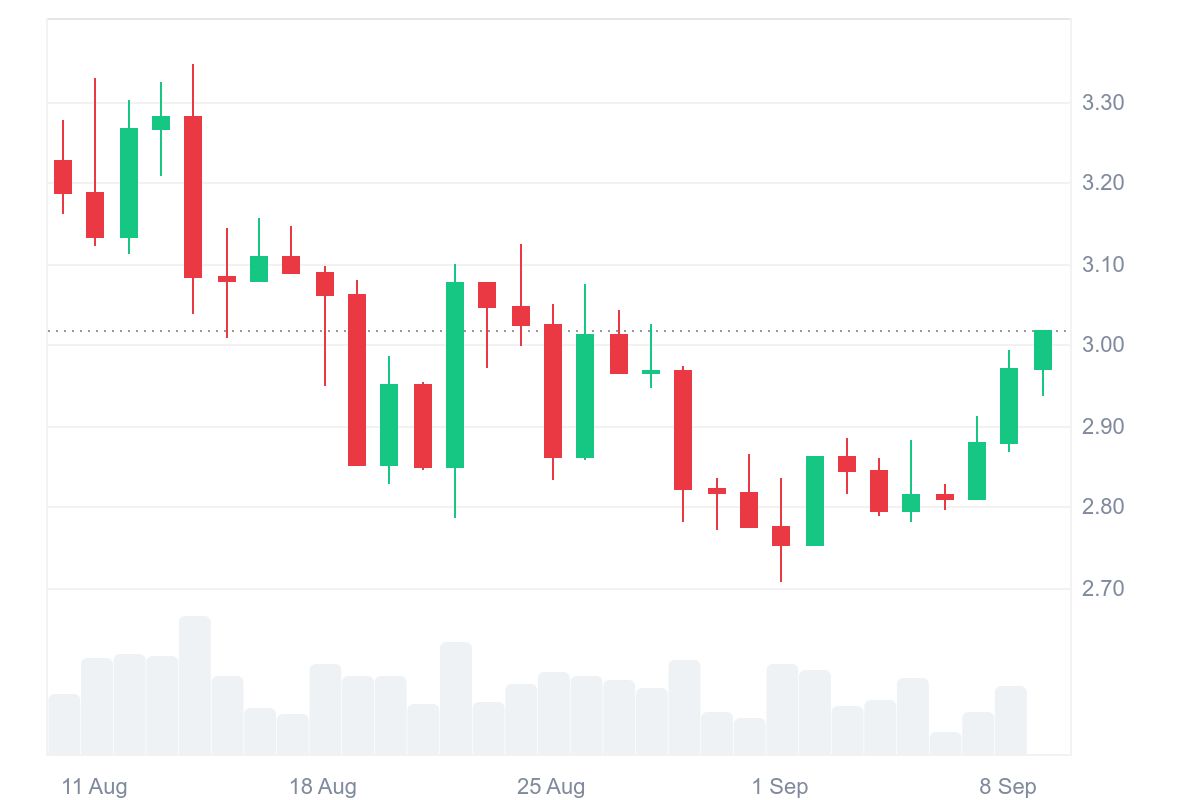
XRP price climbed 4.15% to $3.02 today
(Tuesday), September 9, 2025, marking its third consecutive session of gains
and pushing the cryptocurrency back above the psychologically important $3.00 level.
The surge comes as Federal Reserve (Fed) rate cut expectations hit 99%
probability and Ripple announced an expanded custody partnership with
Spanish banking giant BBVA.
In this
article, I address the question of why the XRP price is surging and provide a
technical analysis of the XRP/USDT chart, which suggests that current XRP price
predictions are pointing to a potential increase of more than 50 percent.
XRP Price Today Retakes $3 Mark
During
Tuesday’s session, XRP extended its upward correction and broke through the
psychological level of $3. XRP's 4.15% daily gain significantly outpaced other
major cryptocurrencies, with only Cardano posting stronger performance at 5.4%.
The cryptocurrency has recovered 7.5% from Sunday's lows, adding over 21 cents
to its value during the three-day rally.
Current
market capitalization stands at approximately $178 billion, with 24-hour
trading volume reaching $6.78 billion across major exchanges. The token
maintains its position as the fourth-largest cryptocurrency by market cap, with
59.6 billion XRP in circulation from a maximum supply of 100 billion tokens.
XRP price today. Source: CoinMarketCap
Why XRP Price Is Going Up?
Federal Reserve Rate Cut
Expectations Fuel Crypto Rally
The primary
catalyst behind XRP's surge stems from overwhelming market expectations that
the Federal Reserve will cut interest rates at its September 16-17
meeting. Fed futures now indicate a 99% probability of at least a 25-basis
point rate cut, with some analysts predicting a more aggressive 50-basis point
reduction following weak August employment data.
Cassie Craddock, Ripple's managing director for Europe
Adding to
the bullish momentum, Ripple announced it will provide digital asset custody
technology to BBVA for Spanish retail clients, extending their existing
partnerships in Switzerland and Turkey. The expanded collaboration allows BBVA
to offer end-to-end custody services for Bitcoin and Ethereum trading
under the European Union's Markets in Crypto Assets (MiCA) regulation
framework.
"Now
that MiCA is established, the region's banks are emboldened to launch the
digital asset offerings that their customers are asking for," said Cassie
Craddock, Ripple's managing director for Europe.
From my
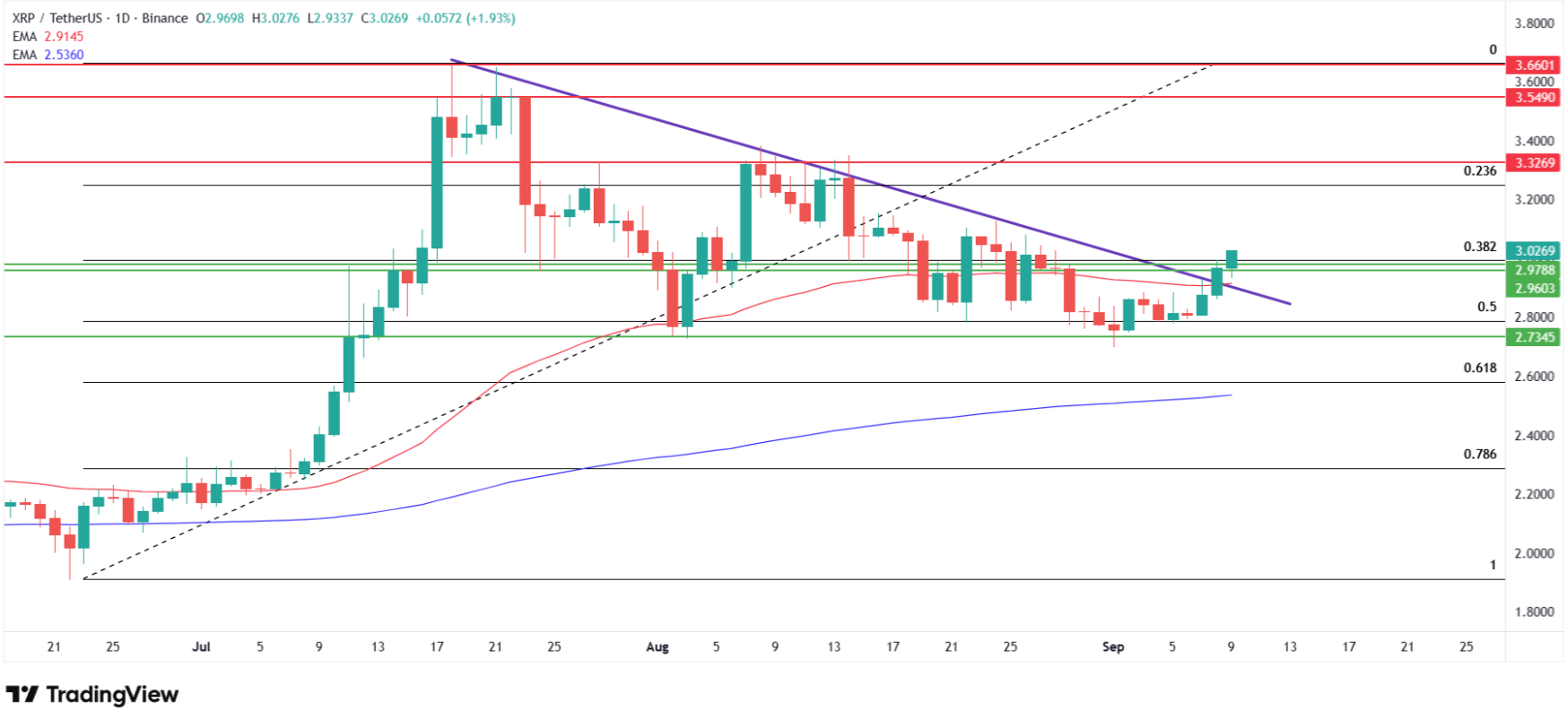
technical analysis perspective, XRP has successfully reclaimed the 50-day
exponential moving average (50 EMA) and broken above the $2.96-$3.00
resistance zone, which was reinforced by the 38.2% Fibonacci retracement level
measured from June lows to July highs near $3.65. This breakthrough opens the
path for testing local August highs around $3.30 and potentially the
year's peak levels starting from $3.60.
Trading
volume spiked to 159.63 million, nearly three times daily averages,
confirming institutional participation in the breakout. The RSI remains in
neutral-to-bullish territory in the mid-50s, while the MACD histogram
is converging toward a bullish crossover, indicating accumulation patterns.
Current upside
potential exceeds 21% to the $3.30 level.
XRP Price Prediction And
55% Jump After Flag Formation
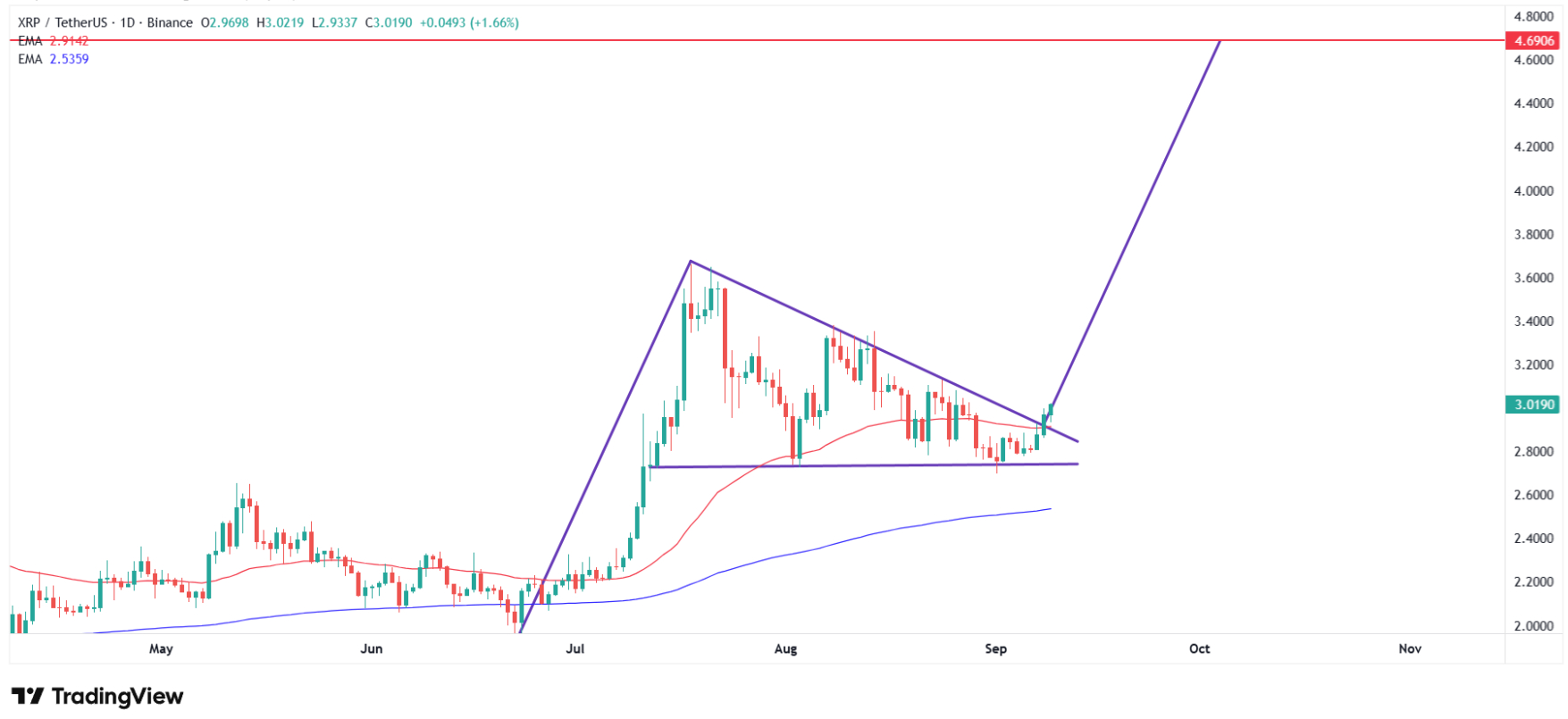
The flag
pattern had been forming since the June lows, and within the current triangle,
XRP had less and less room to move. Ultimately, it broke to the upside, which
in my view opens the way for bulls to drive a significant rally from the local
lows we are now observing.
Market
analysts are also increasingly optimistic about XRP's trajectory. Paul
Howard from Wincent noted that "XRP is now just 18% off its all time
high. The team has built an impressive crypto cohort the last 9 months with
acquisitions, corporate adoption and regulatory movements that add credibility
to the token."
How high can XRP price go? Source: Tradingview.com
Paul Howard, Wincent
Howard
emphasized that while the short-term outlook shows range-bound trading,
"XRP likely to outperform and break the $3.00 technical line given its
volatility over BTC." The analyst highlighted XRP's superior performance
relative to Bitcoin's more constrained trading range.
The
cryptocurrency market is experiencing significant institutional momentum that
extends beyond XRP. Bitcoin ETFs recorded $246 million in net inflows during
early September 2025, driven by BlackRock's iShares Bitcoin Trust
absorbing $434.3 million and Fidelity's FBTC adding $25.1
million.
Bitcoin's
illiquid supply has climbed to a record 14.3 million BTC, with Ryan Lee,
Chief Analyst at Bitget, noting that "more than 70 percent of coins now in
wallets with little spending history, confidence in Bitcoin's long-term value
remains evident." This supply tightening "not only reinforces the
asset's role as a store of value but also heightens the potential for sharp
moves as demand persists".
Lee expects
Bitcoin to stabilize and regain upward momentum, with a target range of
$105,000 to $118,000 supported by sustained institutional inflows and
bullish technical signals. This broader crypto market strength provides a
supportive backdrop for XRP's rally.
Despite
increased exchange reserves reaching 12-month peaks, sophisticated investors
continue accumulating XRP. Whale wallets reportedly accumulated 10 million
XRP in just 15 minutes during Tuesday's breakout, while broader whale
holdings increased by 340 million tokens over recent weeks.
This
divergence between short-term selling pressure from exchange inflows and
long-term accumulation by large holders suggests different time horizons among
market participants. The whale buying activity totaling $700 million in
recent transfers has sparked speculation about institutional positioning ahead
of potential XRP ETF approvals in October.
Outlook and Key Levels to
Watch
Looking
ahead, traders are monitoring several critical factors that could influence
XRP's trajectory. The $2.99-$3.00 resistance zone that was repeatedly
rejected in recent sessions has now become potential support, while the next
major resistance lies at $3.30-$3.50.
Six XRP ETF
applications currently under SEC review for October decisions represent a
structural catalyst that could transform institutional access and demand
dynamics. Combined with the Federal Reserve's anticipated rate cut and
continued banking partnerships, these fundamentals support the technical
breakout scenario.
However,
risks remain if the cryptocurrency fails to maintain momentum above $3.00, with
key support levels at $2.88-$2.89 where buying interest has
consistently emerged during recent corrections.
XRP Price Analysis FAQ
Why is XRP surging today?
XRP is
surging due to 99% probability Federal Reserve rate cut expectations and
Ripple's expanded digital asset custody partnership with BBVA in Spain.
The combination of dovish monetary policy and institutional banking adoption is
driving demand across cryptocurrency markets.
How high can XRP go in
2025?
Technical
analysis suggests XRP could reach $4.70 if it completes the
three-month flag formation breakout, representing 55% upside potential.
Conservative predictions target $3.30-$3.60 resistance levels, while
bullish forecasts from analysts like Standard Chartered project $5.50-$15.00 by
year-end depending on ETF approvals and institutional adoption.
What is driving XRP price
predictions?
Key drivers
include institutional partnerships with banks like BBVA, potential XRP
ETF approvals in October 2025, Federal Reserve rate cuts, and whale
accumulation patterns. Technical breakouts above $3.00 combined with regulatory
clarity are supporting higher price targets.
What makes XRP different
from other cryptocurrencies?
XRP's
primary advantage lies in cross-border payment utility and institutional
banking adoption. With 3-5 second settlement times and minimal
transaction fees, XRP serves as a bridge currency for financial institutions.
Recent partnerships with major banks and potential Amazon and Uber
adoption distinguish it from speculative altcoins.
XRP price climbed 4.15% to $3.02 today
(Tuesday), September 9, 2025, marking its third consecutive session of gains
and pushing the cryptocurrency back above the psychologically important $3.00 level.
The surge comes as Federal Reserve (Fed) rate cut expectations hit 99%
probability and Ripple announced an expanded custody partnership with
Spanish banking giant BBVA.
In this
article, I address the question of why the XRP price is surging and provide a
technical analysis of the XRP/USDT chart, which suggests that current XRP price
predictions are pointing to a potential increase of more than 50 percent.
XRP Price Today Retakes $3 Mark
During
Tuesday’s session, XRP extended its upward correction and broke through the
psychological level of $3. XRP's 4.15% daily gain significantly outpaced other
major cryptocurrencies, with only Cardano posting stronger performance at 5.4%.
The cryptocurrency has recovered 7.5% from Sunday's lows, adding over 21 cents
to its value during the three-day rally.
Current
market capitalization stands at approximately $178 billion, with 24-hour
trading volume reaching $6.78 billion across major exchanges. The token
maintains its position as the fourth-largest cryptocurrency by market cap, with
59.6 billion XRP in circulation from a maximum supply of 100 billion tokens.
XRP price today. Source: CoinMarketCap
Why XRP Price Is Going Up?
Federal Reserve Rate Cut
Expectations Fuel Crypto Rally
The primary
catalyst behind XRP's surge stems from overwhelming market expectations that
the Federal Reserve will cut interest rates at its September 16-17
meeting. Fed futures now indicate a 99% probability of at least a 25-basis
point rate cut, with some analysts predicting a more aggressive 50-basis point
reduction following weak August employment data.
Cassie Craddock, Ripple's managing director for Europe
Adding to
the bullish momentum, Ripple announced it will provide digital asset custody
technology to BBVA for Spanish retail clients, extending their existing
partnerships in Switzerland and Turkey. The expanded collaboration allows BBVA
to offer end-to-end custody services for Bitcoin and Ethereum trading
under the European Union's Markets in Crypto Assets (MiCA) regulation
framework.
"Now
that MiCA is established, the region's banks are emboldened to launch the
digital asset offerings that their customers are asking for," said Cassie
Craddock, Ripple's managing director for Europe.
From my
technical analysis perspective, XRP has successfully reclaimed the 50-day
exponential moving average (50 EMA) and broken above the $2.96-$3.00
resistance zone, which was reinforced by the 38.2% Fibonacci retracement level
measured from June lows to July highs near $3.65. This breakthrough opens the
path for testing local August highs around $3.30 and potentially the
year's peak levels starting from $3.60.
Trading
volume spiked to 159.63 million, nearly three times daily averages,
confirming institutional participation in the breakout. The RSI remains in
neutral-to-bullish territory in the mid-50s, while the MACD histogram
is converging toward a bullish crossover, indicating accumulation patterns.
Current upside
potential exceeds 21% to the $3.30 level.
XRP Price Prediction And
55% Jump After Flag Formation
The flag
pattern had been forming since the June lows, and within the current triangle,
XRP had less and less room to move. Ultimately, it broke to the upside, which
in my view opens the way for bulls to drive a significant rally from the local
lows we are now observing.
Market
analysts are also increasingly optimistic about XRP's trajectory. Paul
Howard from Wincent noted that "XRP is now just 18% off its all time
high. The team has built an impressive crypto cohort the last 9 months with
acquisitions, corporate adoption and regulatory movements that add credibility
to the token."
How high can XRP price go? Source: Tradingview.com
Paul Howard, Wincent
Howard
emphasized that while the short-term outlook shows range-bound trading,
"XRP likely to outperform and break the $3.00 technical line given its
volatility over BTC." The analyst highlighted XRP's superior performance
relative to Bitcoin's more constrained trading range.
The
cryptocurrency market is experiencing significant institutional momentum that
extends beyond XRP. Bitcoin ETFs recorded $246 million in net inflows during
early September 2025, driven by BlackRock's iShares Bitcoin Trust
absorbing $434.3 million and Fidelity's FBTC adding $25.1
million.
Bitcoin's
illiquid supply has climbed to a record 14.3 million BTC, with Ryan Lee,
Chief Analyst at Bitget, noting that "more than 70 percent of coins now in
wallets with little spending history, confidence in Bitcoin's long-term value
remains evident." This supply tightening "not only reinforces the
asset's role as a store of value but also heightens the potential for sharp
moves as demand persists".
Lee expects
Bitcoin to stabilize and regain upward momentum, with a target range of
$105,000 to $118,000 supported by sustained institutional inflows and
bullish technical signals. This broader crypto market strength provides a
supportive backdrop for XRP's rally.
Despite
increased exchange reserves reaching 12-month peaks, sophisticated investors
continue accumulating XRP. Whale wallets reportedly accumulated 10 million
XRP in just 15 minutes during Tuesday's breakout, while broader whale
holdings increased by 340 million tokens over recent weeks.
This
divergence between short-term selling pressure from exchange inflows and
long-term accumulation by large holders suggests different time horizons among
market participants. The whale buying activity totaling $700 million in
recent transfers has sparked speculation about institutional positioning ahead
of potential XRP ETF approvals in October.
Outlook and Key Levels to
Watch
Looking
ahead, traders are monitoring several critical factors that could influence
XRP's trajectory. The $2.99-$3.00 resistance zone that was repeatedly
rejected in recent sessions has now become potential support, while the next
major resistance lies at $3.30-$3.50.
Six XRP ETF
applications currently under SEC review for October decisions represent a
structural catalyst that could transform institutional access and demand
dynamics. Combined with the Federal Reserve's anticipated rate cut and
continued banking partnerships, these fundamentals support the technical
breakout scenario.
However,
risks remain if the cryptocurrency fails to maintain momentum above $3.00, with
key support levels at $2.88-$2.89 where buying interest has
consistently emerged during recent corrections.
XRP Price Analysis FAQ
Why is XRP surging today?
XRP is
surging due to 99% probability Federal Reserve rate cut expectations and
Ripple's expanded digital asset custody partnership with BBVA in Spain.
The combination of dovish monetary policy and institutional banking adoption is
driving demand across cryptocurrency markets.
How high can XRP go in
2025?
Technical
analysis suggests XRP could reach $4.70 if it completes the
three-month flag formation breakout, representing 55% upside potential.
Conservative predictions target $3.30-$3.60 resistance levels, while
bullish forecasts from analysts like Standard Chartered project $5.50-$15.00 by
year-end depending on ETF approvals and institutional adoption.
What is driving XRP price
predictions?
Key drivers
include institutional partnerships with banks like BBVA, potential XRP
ETF approvals in October 2025, Federal Reserve rate cuts, and whale
accumulation patterns. Technical breakouts above $3.00 combined with regulatory
clarity are supporting higher price targets.
What makes XRP different
from other cryptocurrencies?
XRP's
primary advantage lies in cross-border payment utility and institutional
banking adoption. With 3-5 second settlement times and minimal
transaction fees, XRP serves as a bridge currency for financial institutions.
Recent partnerships with major banks and potential Amazon and Uber
adoption distinguish it from speculative altcoins.
Damian Chmiel is a Senior Analyst & Editor at Finance Magnates with more than 15 years of experience in the CFD and online trading industry. Active as both a trader and journalist since 2010, he focuses on broker coverage, fintech innovation, and regulatory developments across Europe, the Middle East, and Asia.
His work includes interviews with C-level leaders at major brokerages and fintech platforms, as well as co-authoring Finance Magnates’ quarterly industry benchmarking reports. Damian’s reporting is data-driven, market-aware, and grounded in direct industry engagement. His analysis and commentary have also been cited by external media outlets, including Investing.com, Binance, The Asset, Stockhead, and Dispatch.
Education:
MA in Finance and Accounting, Cracow University of Economics
Why Is Dogecoin Going Up Today? DOGE Price Prediction Shows 25% Upside Potential
Featured Videos
AvaTrade to Acquire Most of FXCM; NAGA Raises $8M
AvaTrade to Acquire Most of FXCM; NAGA Raises $8M
AvaTrade to Acquire Most of FXCM; NAGA Raises $8M
AvaTrade to Acquire Most of FXCM; NAGA Raises $8M
Today’s financial news recap covers AvaTrade agrees to acquire most of FXCM, NAGA secures eight million dollars in new financing, and Wise seeks a tax settlement in the UK.
Finance Magnates Daily Recap brings you the latest news from forex and CFD brokers, fintech, payments, cryptocurrency, digital assets, trading platforms, financial regulation and global markets.
Get the key company news, executive moves, deals, regulatory updates and market developments of the day, in just a few minutes. New episodes published every weekday.
Read more: https://www.financemagnates.com
#FinanceMagnates #ForexNews #FintechNews
Today’s financial news recap covers AvaTrade agrees to acquire most of FXCM, NAGA secures eight million dollars in new financing, and Wise seeks a tax settlement in the UK.
Finance Magnates Daily Recap brings you the latest news from forex and CFD brokers, fintech, payments, cryptocurrency, digital assets, trading platforms, financial regulation and global markets.
Get the key company news, executive moves, deals, regulatory updates and market developments of the day, in just a few minutes. New episodes published every weekday.
Read more: https://www.financemagnates.com
#FinanceMagnates #ForexNews #FintechNews
Today’s financial news recap covers AvaTrade agrees to acquire most of FXCM, NAGA secures eight million dollars in new financing, and Wise seeks a tax settlement in the UK.
Finance Magnates Daily Recap brings you the latest news from forex and CFD brokers, fintech, payments, cryptocurrency, digital assets, trading platforms, financial regulation and global markets.
Get the key company news, executive moves, deals, regulatory updates and market developments of the day, in just a few minutes. New episodes published every weekday.
Read more: https://www.financemagnates.com
#FinanceMagnates #ForexNews #FintechNews
Today’s financial news recap covers AvaTrade agrees to acquire most of FXCM, NAGA secures eight million dollars in new financing, and Wise seeks a tax settlement in the UK.
Finance Magnates Daily Recap brings you the latest news from forex and CFD brokers, fintech, payments, cryptocurrency, digital assets, trading platforms, financial regulation and global markets.
Get the key company news, executive moves, deals, regulatory updates and market developments of the day, in just a few minutes. New episodes published every weekday.
Read more: https://www.financemagnates.com
#FinanceMagnates #ForexNews #FintechNews
XTB Adds Overnight US Stock Trading; Nasdaq Ventures Invests in One Trading
XTB Adds Overnight US Stock Trading; Nasdaq Ventures Invests in One Trading
XTB Adds Overnight US Stock Trading; Nasdaq Ventures Invests in One Trading
XTB Adds Overnight US Stock Trading; Nasdaq Ventures Invests in One Trading
XTB Adds Overnight US Stock Trading; Nasdaq Ventures Invests in One Trading
XTB Adds Overnight US Stock Trading; Nasdaq Ventures Invests in One Trading
Today’s financial news recap covers XTB expands overnight US stock trading, Fortrade reports higher revenue, Nasdaq backs One Trading, and Vest Labs raises 13 million dollars.
Finance Magnates Daily Recap brings you the latest news from forex and CFD brokers, fintech, payments, cryptocurrency, digital assets, trading platforms, financial regulation and global markets.
Get the key company news, executive moves, deals, regulatory updates and market developments of the day, in just a few minutes. New episodes published every weekday.
Read more: https://www.financemagnates.com
#FinanceMagnates #ForexNews #FintechNews
Today’s financial news recap covers XTB expands overnight US stock trading, Fortrade reports higher revenue, Nasdaq backs One Trading, and Vest Labs raises 13 million dollars.
Finance Magnates Daily Recap brings you the latest news from forex and CFD brokers, fintech, payments, cryptocurrency, digital assets, trading platforms, financial regulation and global markets.
Get the key company news, executive moves, deals, regulatory updates and market developments of the day, in just a few minutes. New episodes published every weekday.
Read more: https://www.financemagnates.com
#FinanceMagnates #ForexNews #FintechNews
Today’s financial news recap covers XTB expands overnight US stock trading, Fortrade reports higher revenue, Nasdaq backs One Trading, and Vest Labs raises 13 million dollars.
Finance Magnates Daily Recap brings you the latest news from forex and CFD brokers, fintech, payments, cryptocurrency, digital assets, trading platforms, financial regulation and global markets.
Get the key company news, executive moves, deals, regulatory updates and market developments of the day, in just a few minutes. New episodes published every weekday.
Read more: https://www.financemagnates.com
#FinanceMagnates #ForexNews #FintechNews
Today’s financial news recap covers XTB expands overnight US stock trading, Fortrade reports higher revenue, Nasdaq backs One Trading, and Vest Labs raises 13 million dollars.
Finance Magnates Daily Recap brings you the latest news from forex and CFD brokers, fintech, payments, cryptocurrency, digital assets, trading platforms, financial regulation and global markets.
Get the key company news, executive moves, deals, regulatory updates and market developments of the day, in just a few minutes. New episodes published every weekday.
Read more: https://www.financemagnates.com
#FinanceMagnates #ForexNews #FintechNews
Today’s financial news recap covers XTB expands overnight US stock trading, Fortrade reports higher revenue, Nasdaq backs One Trading, and Vest Labs raises 13 million dollars.
Finance Magnates Daily Recap brings you the latest news from forex and CFD brokers, fintech, payments, cryptocurrency, digital assets, trading platforms, financial regulation and global markets.
Get the key company news, executive moves, deals, regulatory updates and market developments of the day, in just a few minutes. New episodes published every weekday.
Read more: https://www.financemagnates.com
#FinanceMagnates #ForexNews #FintechNews
Today’s financial news recap covers XTB expands overnight US stock trading, Fortrade reports higher revenue, Nasdaq backs One Trading, and Vest Labs raises 13 million dollars.
Finance Magnates Daily Recap brings you the latest news from forex and CFD brokers, fintech, payments, cryptocurrency, digital assets, trading platforms, financial regulation and global markets.
Get the key company news, executive moves, deals, regulatory updates and market developments of the day, in just a few minutes. New episodes published every weekday.
Read more: https://www.financemagnates.com
#FinanceMagnates #ForexNews #FintechNews
CMC Founder Downplays Volatility Hit; Devexperts Names CEO
CMC Founder Downplays Volatility Hit; Devexperts Names CEO
CMC Founder Downplays Volatility Hit; Devexperts Names CEO
CMC Founder Downplays Volatility Hit; Devexperts Names CEO
CMC Founder Downplays Volatility Hit; Devexperts Names CEO
CMC Founder Downplays Volatility Hit; Devexperts Names CEO
Today’s financial news recap covers low volatility pressures brokers, Devexperts names a new CEO, Saxo cuts onboarding time, and OKX reaches a 25 billion dollar valuation.
Finance Magnates Daily Recap brings you the latest news from forex and CFD brokers, fintech, payments, cryptocurrency, digital assets, trading platforms, financial regulation and global markets.
Get the key company news, executive moves, deals, regulatory updates and market developments of the day, in just a few minutes. New episodes published every weekday.
Read more: https://www.financemagnates.com
#FinanceMagnates #ForexNews #FintechNews
Today’s financial news recap covers low volatility pressures brokers, Devexperts names a new CEO, Saxo cuts onboarding time, and OKX reaches a 25 billion dollar valuation.
Finance Magnates Daily Recap brings you the latest news from forex and CFD brokers, fintech, payments, cryptocurrency, digital assets, trading platforms, financial regulation and global markets.
Get the key company news, executive moves, deals, regulatory updates and market developments of the day, in just a few minutes. New episodes published every weekday.
Read more: https://www.financemagnates.com
#FinanceMagnates #ForexNews #FintechNews
Today’s financial news recap covers low volatility pressures brokers, Devexperts names a new CEO, Saxo cuts onboarding time, and OKX reaches a 25 billion dollar valuation.
Finance Magnates Daily Recap brings you the latest news from forex and CFD brokers, fintech, payments, cryptocurrency, digital assets, trading platforms, financial regulation and global markets.
Get the key company news, executive moves, deals, regulatory updates and market developments of the day, in just a few minutes. New episodes published every weekday.
Read more: https://www.financemagnates.com
#FinanceMagnates #ForexNews #FintechNews
Today’s financial news recap covers low volatility pressures brokers, Devexperts names a new CEO, Saxo cuts onboarding time, and OKX reaches a 25 billion dollar valuation.
Finance Magnates Daily Recap brings you the latest news from forex and CFD brokers, fintech, payments, cryptocurrency, digital assets, trading platforms, financial regulation and global markets.
Get the key company news, executive moves, deals, regulatory updates and market developments of the day, in just a few minutes. New episodes published every weekday.
Read more: https://www.financemagnates.com
#FinanceMagnates #ForexNews #FintechNews
Today’s financial news recap covers low volatility pressures brokers, Devexperts names a new CEO, Saxo cuts onboarding time, and OKX reaches a 25 billion dollar valuation.
Finance Magnates Daily Recap brings you the latest news from forex and CFD brokers, fintech, payments, cryptocurrency, digital assets, trading platforms, financial regulation and global markets.
Get the key company news, executive moves, deals, regulatory updates and market developments of the day, in just a few minutes. New episodes published every weekday.
Read more: https://www.financemagnates.com
#FinanceMagnates #ForexNews #FintechNews
Today’s financial news recap covers low volatility pressures brokers, Devexperts names a new CEO, Saxo cuts onboarding time, and OKX reaches a 25 billion dollar valuation.
Finance Magnates Daily Recap brings you the latest news from forex and CFD brokers, fintech, payments, cryptocurrency, digital assets, trading platforms, financial regulation and global markets.
Get the key company news, executive moves, deals, regulatory updates and market developments of the day, in just a few minutes. New episodes published every weekday.
Read more: https://www.financemagnates.com
#FinanceMagnates #ForexNews #FintechNews
Today’s financial news recap covers Trade Nation buys FXCM's UK client book, Trading 212 reports higher revenue, the CFTC's move to allow perpetual index futures.
Finance Magnates Daily Recap brings you the latest news from forex and CFD brokers, fintech, payments, cryptocurrency, digital assets, trading platforms, financial regulation and global markets.
Get the key company news, executive moves, deals, regulatory updates and market developments of the day, in just a few minutes. New episodes published every weekday.
Read more: https://www.financemagnates.com
#FinanceMagnates #ForexNews #FintechNews
Today’s financial news recap covers Trade Nation buys FXCM's UK client book, Trading 212 reports higher revenue, the CFTC's move to allow perpetual index futures.
Finance Magnates Daily Recap brings you the latest news from forex and CFD brokers, fintech, payments, cryptocurrency, digital assets, trading platforms, financial regulation and global markets.
Get the key company news, executive moves, deals, regulatory updates and market developments of the day, in just a few minutes. New episodes published every weekday.
Read more: https://www.financemagnates.com
#FinanceMagnates #ForexNews #FintechNews
Today’s financial news recap covers Trade Nation buys FXCM's UK client book, Trading 212 reports higher revenue, the CFTC's move to allow perpetual index futures.
Finance Magnates Daily Recap brings you the latest news from forex and CFD brokers, fintech, payments, cryptocurrency, digital assets, trading platforms, financial regulation and global markets.
Get the key company news, executive moves, deals, regulatory updates and market developments of the day, in just a few minutes. New episodes published every weekday.
Read more: https://www.financemagnates.com
#FinanceMagnates #ForexNews #FintechNews
Today’s financial news recap covers Trade Nation buys FXCM's UK client book, Trading 212 reports higher revenue, the CFTC's move to allow perpetual index futures.
Finance Magnates Daily Recap brings you the latest news from forex and CFD brokers, fintech, payments, cryptocurrency, digital assets, trading platforms, financial regulation and global markets.
Get the key company news, executive moves, deals, regulatory updates and market developments of the day, in just a few minutes. New episodes published every weekday.
Read more: https://www.financemagnates.com
#FinanceMagnates #ForexNews #FintechNews
Today’s financial news recap covers Trade Nation buys FXCM's UK client book, Trading 212 reports higher revenue, the CFTC's move to allow perpetual index futures.
Finance Magnates Daily Recap brings you the latest news from forex and CFD brokers, fintech, payments, cryptocurrency, digital assets, trading platforms, financial regulation and global markets.
Get the key company news, executive moves, deals, regulatory updates and market developments of the day, in just a few minutes. New episodes published every weekday.
Read more: https://www.financemagnates.com
#FinanceMagnates #ForexNews #FintechNews
Today’s financial news recap covers Trade Nation buys FXCM's UK client book, Trading 212 reports higher revenue, the CFTC's move to allow perpetual index futures.
Finance Magnates Daily Recap brings you the latest news from forex and CFD brokers, fintech, payments, cryptocurrency, digital assets, trading platforms, financial regulation and global markets.
Get the key company news, executive moves, deals, regulatory updates and market developments of the day, in just a few minutes. New episodes published every weekday.
Read more: https://www.financemagnates.com
#FinanceMagnates #ForexNews #FintechNews
Your career isn’t a linear path.
Your career isn’t a linear path.
Your career isn’t a linear path.
Your career isn’t a linear path.
Your career isn’t a linear path.
Your career isn’t a linear path.
Roles change. Career goals change. Sometimes you want a completely new challenge.
But the skills and knowledge you build along the way can stay with you and give you something to build on.
For Jeff Patterson, that continued growth is key to long-term career development.
You bring the skills. FM Academy helps you build the knowledge.
#FMAcademy #FinanceMagnates #FinanceCareers #ProfessionalDevelopment #Fintech
Roles change. Career goals change. Sometimes you want a completely new challenge.
But the skills and knowledge you build along the way can stay with you and give you something to build on.
For Jeff Patterson, that continued growth is key to long-term career development.
You bring the skills. FM Academy helps you build the knowledge.
#FMAcademy #FinanceMagnates #FinanceCareers #ProfessionalDevelopment #Fintech
Roles change. Career goals change. Sometimes you want a completely new challenge.
But the skills and knowledge you build along the way can stay with you and give you something to build on.
For Jeff Patterson, that continued growth is key to long-term career development.
You bring the skills. FM Academy helps you build the knowledge.
#FMAcademy #FinanceMagnates #FinanceCareers #ProfessionalDevelopment #Fintech
Roles change. Career goals change. Sometimes you want a completely new challenge.
But the skills and knowledge you build along the way can stay with you and give you something to build on.
For Jeff Patterson, that continued growth is key to long-term career development.
You bring the skills. FM Academy helps you build the knowledge.
#FMAcademy #FinanceMagnates #FinanceCareers #ProfessionalDevelopment #Fintech
Roles change. Career goals change. Sometimes you want a completely new challenge.
But the skills and knowledge you build along the way can stay with you and give you something to build on.
For Jeff Patterson, that continued growth is key to long-term career development.
You bring the skills. FM Academy helps you build the knowledge.
#FMAcademy #FinanceMagnates #FinanceCareers #ProfessionalDevelopment #Fintech
Roles change. Career goals change. Sometimes you want a completely new challenge.
But the skills and knowledge you build along the way can stay with you and give you something to build on.
For Jeff Patterson, that continued growth is key to long-term career development.
You bring the skills. FM Academy helps you build the knowledge.
#FMAcademy #FinanceMagnates #FinanceCareers #ProfessionalDevelopment #Fintech