Gold surged to all-time high of $4,568 on January 12, 2026, as criminal investigation into Fed Chair Jerome Powell sparks independence crisis.
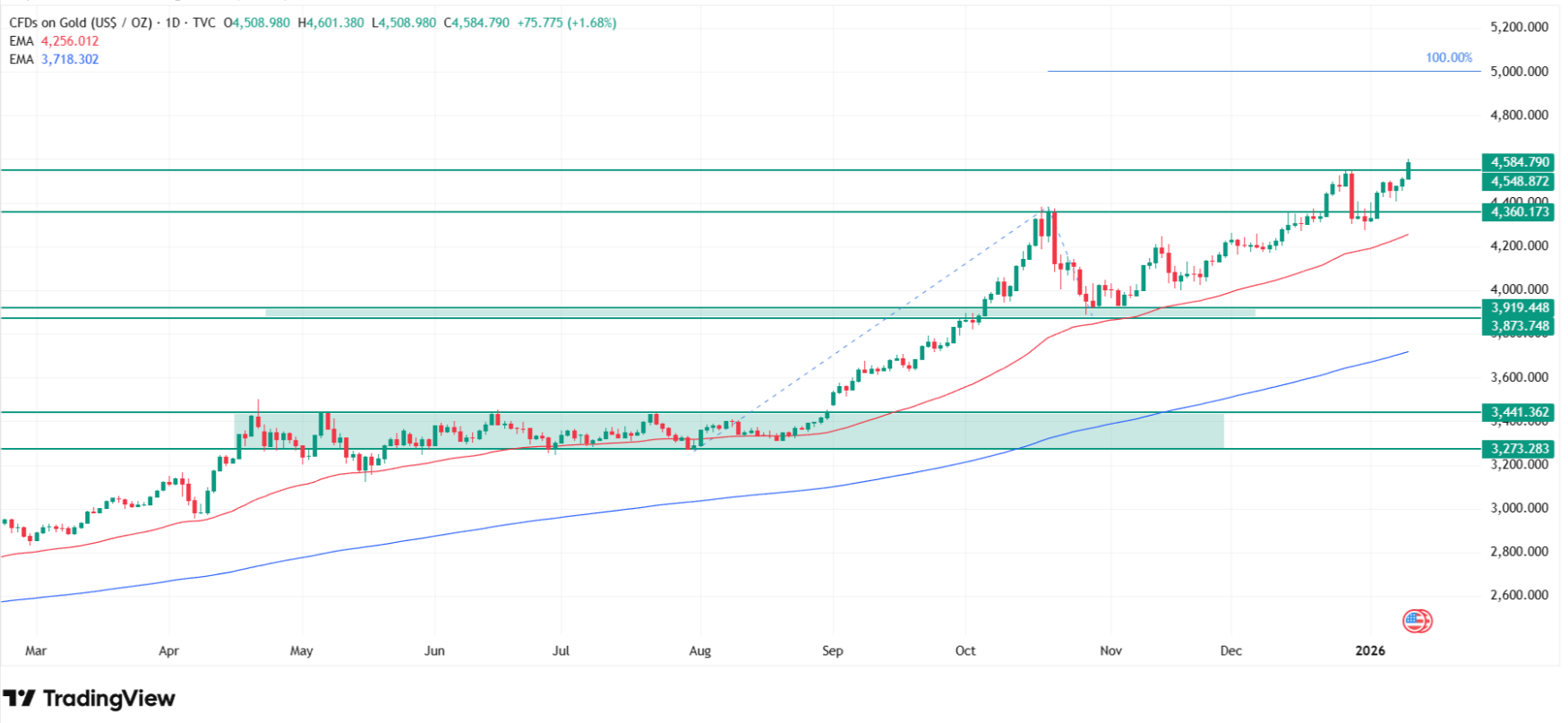
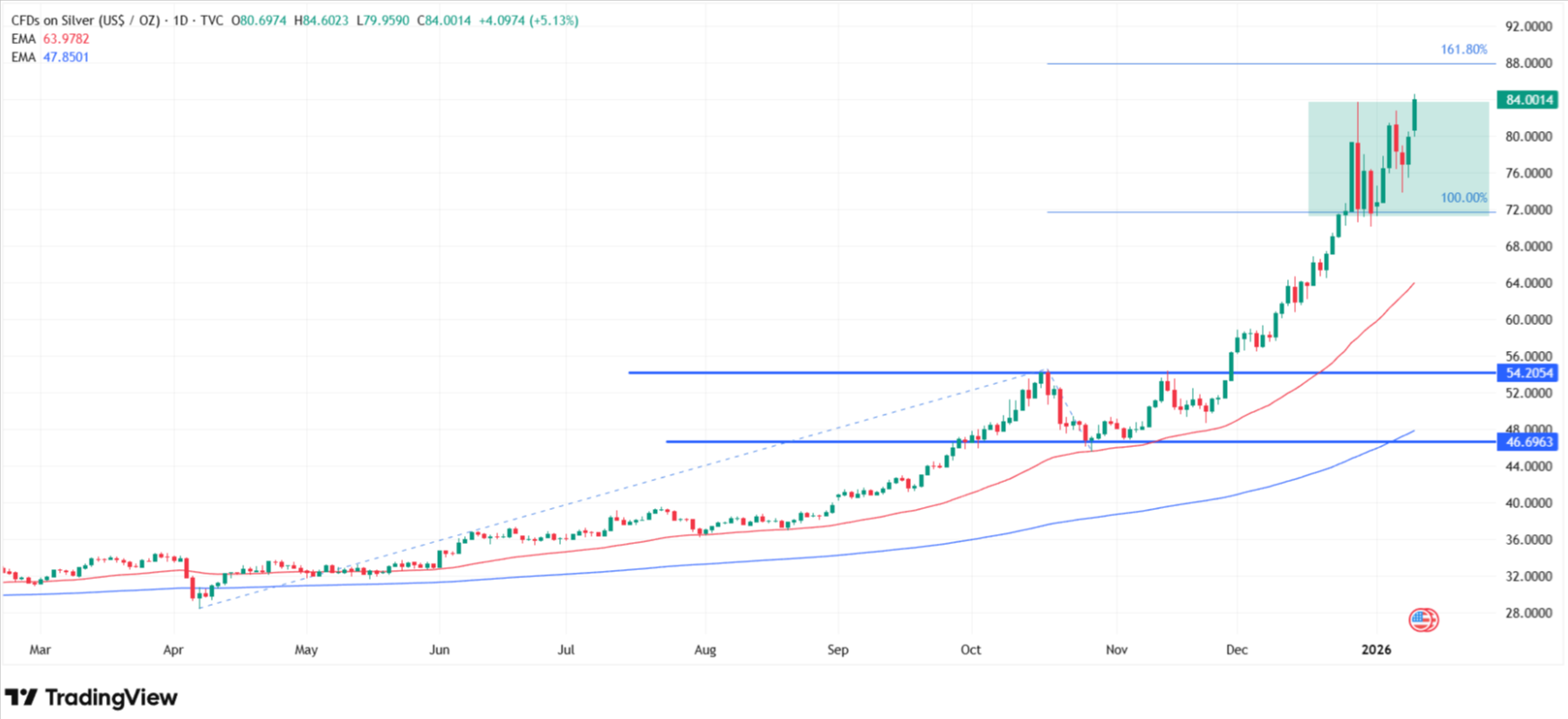
The metal entered price discovery phase targeting $5,000 (100% Fibonacci extension) while silver aims for $88 (161.8% extension) after gaining 150%.
Expert predictions cluster around $5,000-6,000 for gold, while Robert Kiyosaki forecasts silver reaching $200 next.
Why gold price is going down today and what are the newest gold price forecasts?
Gold price surged
to a new all-time high of $4,568.36 per troy ounce today (Monday), January 12,
2026, rising 1.28% as investors fled to safe haven assets amid an unprecedented
crisis at the Federal Reserve. Silver outperformed with a dramatic 4.54% surge
to $83.58, extending its extraordinary rally that has seen the white metal gain
181.78% over the past year.
The
precious metals surge came after federal prosecutors opened a criminal
investigation into Fed Chair Jerome Powell, raising alarming questions about
central bank independence and triggering a flight to safety across global
markets.
In this article, I explain why gold prices are rising
and what is driving the recent gains in silver. I analyze the XAU/USD and
XAG/USD charts and examine how high gold and silver could climb in 2026, based
on expert forecasts.
Why Gold Is Surging? Fed
Independence Crisis
Gold surged
to a new all-time high of $4,563.61 per ounce on Monday, January 12, 2026,
rising more than 1% as spot prices hit their first record high of the year. The
rally was propelled by safe-haven demand following an unprecedented
development: federal prosecutors have opened a criminal investigation into
Federal Reserve Chairman Jerome Powell.
Powell
revealed Sunday evening that the U.S. Department of Justice had issued
subpoenas to the Federal Reserve and threatened a criminal indictment related
to his testimony before the Senate Banking Committee in June 2025 concerning a
$2.5 billion renovation of the Fed's Washington, DC headquarters. In a
remarkable video statement, Powell characterized the investigation as a
"pretext" stemming from his ongoing conflict with the Trump
administration over interest rates.
"The
threat of criminal charges arises from the Federal Reserve determining interest
rates based on our best judgment of what serves the public, rather than
aligning with the President's preferences," Powell stated in his late
Sunday announcement.
In the meantime,
silver rocketed 4.54% to $83.58 per troy ounce.
As a result
of the above, gold is entering the price discovery phase again. However,
today's close above the previous ATH will be crucial. This will be confirmation
that gold is ready to continue climbing northward.
How high?
Technical analysis does not provide us with a crystal ball. However, using
Fibonacci extensions, we see that the potential level for further growth coincides
with the $5,000 threshold, where the 100% extension falls. Many
large financial institutions also mention this level in their analyses and
forecasts.
As I show
on my chart, the October peak around $4,360 and the 50-day
exponential moving average (50 EMA) around $4,255 per
ounce will serve as important support levels.
At the same
time, according to my technical analysis, bulls will only have reasons for
concern after a decline below $3,730 per ounce, where the 200-day
exponential moving average (200 EMA) currently sits. This would be a
signal for me that we are returning to a downtrend and a stronger correction
will take place.
However,
the current enthusiasm suggests that this scenario is very far from being
realized.
Key Gold Technical Levels
Current
structure:
Current price: $4,568 (new ATH, price
discovery phase)
Next
target: $5,000 (100% Fibonacci extension)
Support
1: $4,360 (October 2025 peak)
Support
2: $4,255 (50-day EMA)
Critical support: $3,730 (200-day EMA -
bearish invalidation)
Trend status: Bullish until break below
200 EMA
Silver Technical Analysis:
$88 Target as Metal Outperforms Gold
Silver's
chart is rising even more strongly than gold, gaining over 5% on Monday and
testing levels above $84 per ounce, slightly exceeding the peaks reached on
December 29. the same day when gold reached its previous highs.
Some time
ago, I
stretched the Fibonacci extension grid on silver's uptrend from April to
the October peaks at $54 per ounce, followed by the corrective decline that
lasted for the next 2 weeks. It indicated a 100% Fibonacci extension around
$72. This target has already been achieved with a significant surplus.
The next
target level is the 161.8% extension, which falls a few dollars
above current levels, around $88 per ounce. However, some experts
have a much more bullish view on silver forecasts relative to the US dollar.
The only
thing I would consider dangerous on the chart is the price running away from
the main moving averages. The 50 EMA is located around $64, and
the 200 EMA around just $48, which shows how dynamic the recent
uptrend has been.
It's worth
reminding that in 2025, silver gained 150%, and just since the beginning of
this year, it's already up another 17%—equivalent to what the S&P 500
gained over the last 12 months.
Key Silver Technical
Levels
Current
structure:
Current price: $83.58 (exceeding
December 29 highs)
Next
target: $88 (161.8% Fibonacci extension)
Previous
target: $72 (100% Fibonacci - exceeded)
Support 1: $64 (50-day EMA -
significantly below)
Support 2: $48 (200-day EMA - shows
trend strength)
Warning: Large distance from
moving averages suggests overextension risk
Over the
past month, silver's price has risen 30.50%, and is up 181.78% compared to one
year ago. This extraordinary performance reflects both safe haven demand and
robust industrial fundamentals.
Major
financial institutions and expert analysts have released updated gold price
forecasts for 2026, with most clustering around the $5,000 level that my
Fibonacci analysis targets.
Realistic Scenario: $5,000
Per Ounce
Bogusz
Kasowski, professional trader and founder of Surowcowe.info, explains:
"Realistic perspective for gold is around $5,000 per ounce, driven by
central banks, Federal Reserve, and individual investors."
Rafał Rak,
leader of communication at InstaForex, notes that "banks have been modest
so far and talked about $5,000. Goldman Sachs and other large institutions as
well, but I think they may change recommendations higher."
Extreme Scenario: $6,000+
Per Ounce
The most
aggressive forecast relates to potential geopolitical escalation around
Greenland. Kasowski explains: "In such a case, $6,000 would be the
absolute minimum, because we would have a reshuffling of the entire policy that
has functioned since the 1940s."
The
scenario envisions President Trump's administration taking military action to
acquire Greenland from Denmark. "What does this mean in practice? NATO
collapse. This would be an attack on an allied state, Denmark, a NATO and
European Union member," Kasowski warns.
Greenland
holds strategic significance on the missile route between Russia, China, and
the United States, is rich in rare earth metals, and controls the Northern
Route—a year-round trade corridor maintained by atomic icebreakers enabling
China-Russia cooperation.
"Either
you take the money we want to pay you, or we'll enter anyway. This is a
situation that will push gold prices up because it would be a total destruction
of order when the United States enters the territory of a semi-autonomous NATO
state," Kasowski adds.
Goldman
Sachs predicts gold will reach approximately $4,900 per ounce by the end of
2026, supported by continued central bank purchases. JP Morgan Private Bank
analysts are more optimistic, forecasting an average price of $5,055 in the
fourth quarter of 2026, with potential peaks reaching $5,200-$5,300 per ounce.
Deutsche
Bank raised its average 2026 gold price forecast from $4,000 to $4,450 per
ounce, citing continued diversification of reserves by central banks and
stabilizing demand from investors. Bank
of America estimates the average 2026 gold price at $4,538 per ounce,
assuming central bank and investor purchases averaging approximately 566 tons
quarterly.
For retail traders, the challenge is less about identifying the target and more about execution: sizing, drawdown tolerance, and timing entries in volatile conditions. These execution-level questions are increasingly being addressed in live environments, including trader-focused sessions at Dubai’s Trading Festival, where strategies are dissected beyond headline price targets.
Silver Price Prediction:
Robert Kiyosaki's $200-$500 Targets
"Rich
Dad Poor Dad" author Robert Kiyosaki has been vocal about silver's
potential, issuing a series of predictions as the metal rocketed toward $80 in
late December.
On December
29, as silver approached $80, Kiyosaki posted on social media: "SILVER
BREAKS $80.00. $200 NEXT?" The bold prediction came just before a brief
correction that validated his earlier caution.
Two days
earlier, on December 28, Kiyosaki had warned followers about "FOMO Fear of
Missing Out MANIA" and advised patience: "If you are planning on
investing in silver be patient. Wait for a crash then GO or NO." The
subsequent pullback from $83 to $70 vindicated that warning, though prices
quickly recovered.
Kiyosaki
has previously predicted silver would reach $500 from $100 within a year,
representing a 5x return for investors who positioned themselves correctly.
Expert Silver Outlook
Rak from
InstaForex explains: "Silver can rise more than gold this year, especially
since the growth parity hasn't been filled yet and governments haven't
stockpiled silver" like they have with gold. This creates significant
catch-up potential.
The
manipulation attempt on the American exchange, which raised collateral
requirements for silver, failed to trigger a market collapse. Kasowski notes
the correction was brief, with silver quickly recovering to new highs.
You may also like my previous articles on silver and gold price predictions:
Gold surged
to $4,568 all-time high on January 12, 2026, driven by criminal investigation
into Fed Chair Jay Powell raising independence concerns, geopolitical tensions
(Iran military operations, Greenland crisis), and safe haven demand. According
to my technical analysis, gold entered price discovery phase targeting $5,000
(100% Fibonacci extension) with support at $4,360 and $4,255.
Why is silver surging more
than gold?
Silver
gained 5% to $83.58 on January 12, 2026, outperforming gold's 1.6% rise.
According to my analysis, silver targets $88 (161.8% Fibonacci extension) after
gaining 150% in 2025 and 17% in 2026 YTD. matching S&P 500's entire 2025
gain.
How high can gold go in
2026?
According
to my technical analysis using Fibonacci extensions, gold targets $5,000 (100%
extension). Expert predictions: Goldman Sachs $4,900, JP Morgan $5,055-$5,300,
realistic consensus $5,000 driven by central bank buying (566 tons/quarter) and
Fed cuts. Extreme Greenland escalation scenario could push gold to $6,000+ per
Kasowski analysis from Surowcowe.info.
How high can silver go in
2026?
According
to my chart analysis, silver's next target is $88 (161.8% Fibonacci extension)
from current $83.58 levels. Robert Kiyosaki predicts $200 near-term and $500
long-term. Experts note silver has upside potential versus gold given
governments haven't stockpiled silver like gold, plus strong industrial demand
fundamentals supporting structural deficit.
What is gold price
prediction for 2026?
Major bank
forecasts cluster around $4,900-$5,300: Goldman Sachs $4,900 year-end, JP
Morgan $5,055 Q4 average with $5,200-$5,300 peak potential, Deutsche Bank
$4,450 annual average, Bank of America $4,538. Realistic expert consensus
$5,000 based on central bank buying and Fed policy. Extreme geopolitical
scenario targets $6,000+.
What is silver price
prediction for 2026?
According
to my technical analysis, immediate target $88 (161.8% Fibonacci extension).
Robert Kiyosaki forecasts $200 next milestone, previously predicted $500 from
$100 within a year. Experts expect silver to outperform gold due to industrial
demand growth (AI data centers, solar panels), market deficit, and lower
institutional ownership creating catch-up trade potential.
For
real-time gold and silver analysis as prices target $5,000 and $88
respectively, follow me on X (Twitter) @ChmielDk. I provide technical breakdowns, Fibonacci
projections, institutional forecasts, and trading insights on precious metals
and crypto markets.
Gold price surged
to a new all-time high of $4,568.36 per troy ounce today (Monday), January 12,
2026, rising 1.28% as investors fled to safe haven assets amid an unprecedented
crisis at the Federal Reserve. Silver outperformed with a dramatic 4.54% surge
to $83.58, extending its extraordinary rally that has seen the white metal gain
181.78% over the past year.
The
precious metals surge came after federal prosecutors opened a criminal
investigation into Fed Chair Jerome Powell, raising alarming questions about
central bank independence and triggering a flight to safety across global
markets.
In this article, I explain why gold prices are rising
and what is driving the recent gains in silver. I analyze the XAU/USD and
XAG/USD charts and examine how high gold and silver could climb in 2026, based
on expert forecasts.
Why Gold Is Surging? Fed
Independence Crisis
Gold surged
to a new all-time high of $4,563.61 per ounce on Monday, January 12, 2026,
rising more than 1% as spot prices hit their first record high of the year. The
rally was propelled by safe-haven demand following an unprecedented
development: federal prosecutors have opened a criminal investigation into
Federal Reserve Chairman Jerome Powell.
Powell
revealed Sunday evening that the U.S. Department of Justice had issued
subpoenas to the Federal Reserve and threatened a criminal indictment related
to his testimony before the Senate Banking Committee in June 2025 concerning a
$2.5 billion renovation of the Fed's Washington, DC headquarters. In a
remarkable video statement, Powell characterized the investigation as a
"pretext" stemming from his ongoing conflict with the Trump
administration over interest rates.
"The
threat of criminal charges arises from the Federal Reserve determining interest
rates based on our best judgment of what serves the public, rather than
aligning with the President's preferences," Powell stated in his late
Sunday announcement.
In the meantime,
silver rocketed 4.54% to $83.58 per troy ounce.
As a result
of the above, gold is entering the price discovery phase again. However,
today's close above the previous ATH will be crucial. This will be confirmation
that gold is ready to continue climbing northward.
How high?
Technical analysis does not provide us with a crystal ball. However, using
Fibonacci extensions, we see that the potential level for further growth coincides
with the $5,000 threshold, where the 100% extension falls. Many
large financial institutions also mention this level in their analyses and
forecasts.
As I show
on my chart, the October peak around $4,360 and the 50-day
exponential moving average (50 EMA) around $4,255 per
ounce will serve as important support levels.
At the same
time, according to my technical analysis, bulls will only have reasons for
concern after a decline below $3,730 per ounce, where the 200-day
exponential moving average (200 EMA) currently sits. This would be a
signal for me that we are returning to a downtrend and a stronger correction
will take place.
However,
the current enthusiasm suggests that this scenario is very far from being
realized.
Key Gold Technical Levels
Current
structure:
Current price: $4,568 (new ATH, price
discovery phase)
Next
target: $5,000 (100% Fibonacci extension)
Support
1: $4,360 (October 2025 peak)
Support
2: $4,255 (50-day EMA)
Critical support: $3,730 (200-day EMA -
bearish invalidation)
Trend status: Bullish until break below
200 EMA
Silver Technical Analysis:
$88 Target as Metal Outperforms Gold
Silver's
chart is rising even more strongly than gold, gaining over 5% on Monday and
testing levels above $84 per ounce, slightly exceeding the peaks reached on
December 29. the same day when gold reached its previous highs.
Some time
ago, I
stretched the Fibonacci extension grid on silver's uptrend from April to
the October peaks at $54 per ounce, followed by the corrective decline that
lasted for the next 2 weeks. It indicated a 100% Fibonacci extension around
$72. This target has already been achieved with a significant surplus.
The next
target level is the 161.8% extension, which falls a few dollars
above current levels, around $88 per ounce. However, some experts
have a much more bullish view on silver forecasts relative to the US dollar.
The only
thing I would consider dangerous on the chart is the price running away from
the main moving averages. The 50 EMA is located around $64, and
the 200 EMA around just $48, which shows how dynamic the recent
uptrend has been.
It's worth
reminding that in 2025, silver gained 150%, and just since the beginning of
this year, it's already up another 17%—equivalent to what the S&P 500
gained over the last 12 months.
Key Silver Technical
Levels
Current
structure:
Current price: $83.58 (exceeding
December 29 highs)
Next
target: $88 (161.8% Fibonacci extension)
Previous
target: $72 (100% Fibonacci - exceeded)
Support 1: $64 (50-day EMA -
significantly below)
Support 2: $48 (200-day EMA - shows
trend strength)
Warning: Large distance from
moving averages suggests overextension risk
Over the
past month, silver's price has risen 30.50%, and is up 181.78% compared to one
year ago. This extraordinary performance reflects both safe haven demand and
robust industrial fundamentals.
Major
financial institutions and expert analysts have released updated gold price
forecasts for 2026, with most clustering around the $5,000 level that my
Fibonacci analysis targets.
Realistic Scenario: $5,000
Per Ounce
Bogusz
Kasowski, professional trader and founder of Surowcowe.info, explains:
"Realistic perspective for gold is around $5,000 per ounce, driven by
central banks, Federal Reserve, and individual investors."
Rafał Rak,
leader of communication at InstaForex, notes that "banks have been modest
so far and talked about $5,000. Goldman Sachs and other large institutions as
well, but I think they may change recommendations higher."
Extreme Scenario: $6,000+
Per Ounce
The most
aggressive forecast relates to potential geopolitical escalation around
Greenland. Kasowski explains: "In such a case, $6,000 would be the
absolute minimum, because we would have a reshuffling of the entire policy that
has functioned since the 1940s."
The
scenario envisions President Trump's administration taking military action to
acquire Greenland from Denmark. "What does this mean in practice? NATO
collapse. This would be an attack on an allied state, Denmark, a NATO and
European Union member," Kasowski warns.
Greenland
holds strategic significance on the missile route between Russia, China, and
the United States, is rich in rare earth metals, and controls the Northern
Route—a year-round trade corridor maintained by atomic icebreakers enabling
China-Russia cooperation.
"Either
you take the money we want to pay you, or we'll enter anyway. This is a
situation that will push gold prices up because it would be a total destruction
of order when the United States enters the territory of a semi-autonomous NATO
state," Kasowski adds.
Goldman
Sachs predicts gold will reach approximately $4,900 per ounce by the end of
2026, supported by continued central bank purchases. JP Morgan Private Bank
analysts are more optimistic, forecasting an average price of $5,055 in the
fourth quarter of 2026, with potential peaks reaching $5,200-$5,300 per ounce.
Deutsche
Bank raised its average 2026 gold price forecast from $4,000 to $4,450 per
ounce, citing continued diversification of reserves by central banks and
stabilizing demand from investors. Bank
of America estimates the average 2026 gold price at $4,538 per ounce,
assuming central bank and investor purchases averaging approximately 566 tons
quarterly.
For retail traders, the challenge is less about identifying the target and more about execution: sizing, drawdown tolerance, and timing entries in volatile conditions. These execution-level questions are increasingly being addressed in live environments, including trader-focused sessions at Dubai’s Trading Festival, where strategies are dissected beyond headline price targets.
Silver Price Prediction:
Robert Kiyosaki's $200-$500 Targets
"Rich
Dad Poor Dad" author Robert Kiyosaki has been vocal about silver's
potential, issuing a series of predictions as the metal rocketed toward $80 in
late December.
On December
29, as silver approached $80, Kiyosaki posted on social media: "SILVER
BREAKS $80.00. $200 NEXT?" The bold prediction came just before a brief
correction that validated his earlier caution.
Two days
earlier, on December 28, Kiyosaki had warned followers about "FOMO Fear of
Missing Out MANIA" and advised patience: "If you are planning on
investing in silver be patient. Wait for a crash then GO or NO." The
subsequent pullback from $83 to $70 vindicated that warning, though prices
quickly recovered.
Kiyosaki
has previously predicted silver would reach $500 from $100 within a year,
representing a 5x return for investors who positioned themselves correctly.
Expert Silver Outlook
Rak from
InstaForex explains: "Silver can rise more than gold this year, especially
since the growth parity hasn't been filled yet and governments haven't
stockpiled silver" like they have with gold. This creates significant
catch-up potential.
The
manipulation attempt on the American exchange, which raised collateral
requirements for silver, failed to trigger a market collapse. Kasowski notes
the correction was brief, with silver quickly recovering to new highs.
You may also like my previous articles on silver and gold price predictions:
Gold surged
to $4,568 all-time high on January 12, 2026, driven by criminal investigation
into Fed Chair Jay Powell raising independence concerns, geopolitical tensions
(Iran military operations, Greenland crisis), and safe haven demand. According
to my technical analysis, gold entered price discovery phase targeting $5,000
(100% Fibonacci extension) with support at $4,360 and $4,255.
Why is silver surging more
than gold?
Silver
gained 5% to $83.58 on January 12, 2026, outperforming gold's 1.6% rise.
According to my analysis, silver targets $88 (161.8% Fibonacci extension) after
gaining 150% in 2025 and 17% in 2026 YTD. matching S&P 500's entire 2025
gain.
How high can gold go in
2026?
According
to my technical analysis using Fibonacci extensions, gold targets $5,000 (100%
extension). Expert predictions: Goldman Sachs $4,900, JP Morgan $5,055-$5,300,
realistic consensus $5,000 driven by central bank buying (566 tons/quarter) and
Fed cuts. Extreme Greenland escalation scenario could push gold to $6,000+ per
Kasowski analysis from Surowcowe.info.
How high can silver go in
2026?
According
to my chart analysis, silver's next target is $88 (161.8% Fibonacci extension)
from current $83.58 levels. Robert Kiyosaki predicts $200 near-term and $500
long-term. Experts note silver has upside potential versus gold given
governments haven't stockpiled silver like gold, plus strong industrial demand
fundamentals supporting structural deficit.
What is gold price
prediction for 2026?
Major bank
forecasts cluster around $4,900-$5,300: Goldman Sachs $4,900 year-end, JP
Morgan $5,055 Q4 average with $5,200-$5,300 peak potential, Deutsche Bank
$4,450 annual average, Bank of America $4,538. Realistic expert consensus
$5,000 based on central bank buying and Fed policy. Extreme geopolitical
scenario targets $6,000+.
What is silver price
prediction for 2026?
According
to my technical analysis, immediate target $88 (161.8% Fibonacci extension).
Robert Kiyosaki forecasts $200 next milestone, previously predicted $500 from
$100 within a year. Experts expect silver to outperform gold due to industrial
demand growth (AI data centers, solar panels), market deficit, and lower
institutional ownership creating catch-up trade potential.
For
real-time gold and silver analysis as prices target $5,000 and $88
respectively, follow me on X (Twitter) @ChmielDk. I provide technical breakdowns, Fibonacci
projections, institutional forecasts, and trading insights on precious metals
and crypto markets.
Damian Chmiel is a Senior Analyst & Editor at Finance Magnates with more than 15 years of experience in the CFD and online trading industry. Active as both a trader and journalist since 2010, he focuses on broker coverage, fintech innovation, and regulatory developments across Europe, the Middle East, and Asia.
His work includes interviews with C-level leaders at major brokerages and fintech platforms, as well as co-authoring Finance Magnates’ quarterly industry benchmarking reports. Damian’s reporting is data-driven, market-aware, and grounded in direct industry engagement. His analysis and commentary have also been cited by external media outlets, including Investing.com, Binance, The Asset, Stockhead, and Dispatch.
Education:
MA in Finance and Accounting, Cracow University of Economics
Why Is Dogecoin Going Up Today? DOGE Price Prediction Shows 25% Upside Potential
Featured Videos
XTB Adds Overnight US Stock Trading; Nasdaq Ventures Invests in One Trading
XTB Adds Overnight US Stock Trading; Nasdaq Ventures Invests in One Trading
XTB Adds Overnight US Stock Trading; Nasdaq Ventures Invests in One Trading
XTB Adds Overnight US Stock Trading; Nasdaq Ventures Invests in One Trading
Today’s financial news recap covers XTB expands overnight US stock trading, Fortrade reports higher revenue, Nasdaq backs One Trading, and Vest Labs raises 13 million dollars.
Finance Magnates Daily Recap brings you the latest news from forex and CFD brokers, fintech, payments, cryptocurrency, digital assets, trading platforms, financial regulation and global markets.
Get the key company news, executive moves, deals, regulatory updates and market developments of the day, in just a few minutes. New episodes published every weekday.
Read more: https://www.financemagnates.com
#FinanceMagnates #ForexNews #FintechNews
Today’s financial news recap covers XTB expands overnight US stock trading, Fortrade reports higher revenue, Nasdaq backs One Trading, and Vest Labs raises 13 million dollars.
Finance Magnates Daily Recap brings you the latest news from forex and CFD brokers, fintech, payments, cryptocurrency, digital assets, trading platforms, financial regulation and global markets.
Get the key company news, executive moves, deals, regulatory updates and market developments of the day, in just a few minutes. New episodes published every weekday.
Read more: https://www.financemagnates.com
#FinanceMagnates #ForexNews #FintechNews
Today’s financial news recap covers XTB expands overnight US stock trading, Fortrade reports higher revenue, Nasdaq backs One Trading, and Vest Labs raises 13 million dollars.
Finance Magnates Daily Recap brings you the latest news from forex and CFD brokers, fintech, payments, cryptocurrency, digital assets, trading platforms, financial regulation and global markets.
Get the key company news, executive moves, deals, regulatory updates and market developments of the day, in just a few minutes. New episodes published every weekday.
Read more: https://www.financemagnates.com
#FinanceMagnates #ForexNews #FintechNews
Today’s financial news recap covers XTB expands overnight US stock trading, Fortrade reports higher revenue, Nasdaq backs One Trading, and Vest Labs raises 13 million dollars.
Finance Magnates Daily Recap brings you the latest news from forex and CFD brokers, fintech, payments, cryptocurrency, digital assets, trading platforms, financial regulation and global markets.
Get the key company news, executive moves, deals, regulatory updates and market developments of the day, in just a few minutes. New episodes published every weekday.
Read more: https://www.financemagnates.com
#FinanceMagnates #ForexNews #FintechNews
CMC Founder Downplays Volatility Hit; Devexperts Names CEO
CMC Founder Downplays Volatility Hit; Devexperts Names CEO
CMC Founder Downplays Volatility Hit; Devexperts Names CEO
CMC Founder Downplays Volatility Hit; Devexperts Names CEO
CMC Founder Downplays Volatility Hit; Devexperts Names CEO
CMC Founder Downplays Volatility Hit; Devexperts Names CEO
Today’s financial news recap covers low volatility pressures brokers, Devexperts names a new CEO, Saxo cuts onboarding time, and OKX reaches a 25 billion dollar valuation.
Finance Magnates Daily Recap brings you the latest news from forex and CFD brokers, fintech, payments, cryptocurrency, digital assets, trading platforms, financial regulation and global markets.
Get the key company news, executive moves, deals, regulatory updates and market developments of the day, in just a few minutes. New episodes published every weekday.
Read more: https://www.financemagnates.com
#FinanceMagnates #ForexNews #FintechNews
Today’s financial news recap covers low volatility pressures brokers, Devexperts names a new CEO, Saxo cuts onboarding time, and OKX reaches a 25 billion dollar valuation.
Finance Magnates Daily Recap brings you the latest news from forex and CFD brokers, fintech, payments, cryptocurrency, digital assets, trading platforms, financial regulation and global markets.
Get the key company news, executive moves, deals, regulatory updates and market developments of the day, in just a few minutes. New episodes published every weekday.
Read more: https://www.financemagnates.com
#FinanceMagnates #ForexNews #FintechNews
Today’s financial news recap covers low volatility pressures brokers, Devexperts names a new CEO, Saxo cuts onboarding time, and OKX reaches a 25 billion dollar valuation.
Finance Magnates Daily Recap brings you the latest news from forex and CFD brokers, fintech, payments, cryptocurrency, digital assets, trading platforms, financial regulation and global markets.
Get the key company news, executive moves, deals, regulatory updates and market developments of the day, in just a few minutes. New episodes published every weekday.
Read more: https://www.financemagnates.com
#FinanceMagnates #ForexNews #FintechNews
Today’s financial news recap covers low volatility pressures brokers, Devexperts names a new CEO, Saxo cuts onboarding time, and OKX reaches a 25 billion dollar valuation.
Finance Magnates Daily Recap brings you the latest news from forex and CFD brokers, fintech, payments, cryptocurrency, digital assets, trading platforms, financial regulation and global markets.
Get the key company news, executive moves, deals, regulatory updates and market developments of the day, in just a few minutes. New episodes published every weekday.
Read more: https://www.financemagnates.com
#FinanceMagnates #ForexNews #FintechNews
Today’s financial news recap covers low volatility pressures brokers, Devexperts names a new CEO, Saxo cuts onboarding time, and OKX reaches a 25 billion dollar valuation.
Finance Magnates Daily Recap brings you the latest news from forex and CFD brokers, fintech, payments, cryptocurrency, digital assets, trading platforms, financial regulation and global markets.
Get the key company news, executive moves, deals, regulatory updates and market developments of the day, in just a few minutes. New episodes published every weekday.
Read more: https://www.financemagnates.com
#FinanceMagnates #ForexNews #FintechNews
Today’s financial news recap covers low volatility pressures brokers, Devexperts names a new CEO, Saxo cuts onboarding time, and OKX reaches a 25 billion dollar valuation.
Finance Magnates Daily Recap brings you the latest news from forex and CFD brokers, fintech, payments, cryptocurrency, digital assets, trading platforms, financial regulation and global markets.
Get the key company news, executive moves, deals, regulatory updates and market developments of the day, in just a few minutes. New episodes published every weekday.
Read more: https://www.financemagnates.com
#FinanceMagnates #ForexNews #FintechNews
Today’s financial news recap covers Trade Nation buys FXCM's UK client book, Trading 212 reports higher revenue, the CFTC's move to allow perpetual index futures.
Finance Magnates Daily Recap brings you the latest news from forex and CFD brokers, fintech, payments, cryptocurrency, digital assets, trading platforms, financial regulation and global markets.
Get the key company news, executive moves, deals, regulatory updates and market developments of the day, in just a few minutes. New episodes published every weekday.
Read more: https://www.financemagnates.com
#FinanceMagnates #ForexNews #FintechNews
Today’s financial news recap covers Trade Nation buys FXCM's UK client book, Trading 212 reports higher revenue, the CFTC's move to allow perpetual index futures.
Finance Magnates Daily Recap brings you the latest news from forex and CFD brokers, fintech, payments, cryptocurrency, digital assets, trading platforms, financial regulation and global markets.
Get the key company news, executive moves, deals, regulatory updates and market developments of the day, in just a few minutes. New episodes published every weekday.
Read more: https://www.financemagnates.com
#FinanceMagnates #ForexNews #FintechNews
Today’s financial news recap covers Trade Nation buys FXCM's UK client book, Trading 212 reports higher revenue, the CFTC's move to allow perpetual index futures.
Finance Magnates Daily Recap brings you the latest news from forex and CFD brokers, fintech, payments, cryptocurrency, digital assets, trading platforms, financial regulation and global markets.
Get the key company news, executive moves, deals, regulatory updates and market developments of the day, in just a few minutes. New episodes published every weekday.
Read more: https://www.financemagnates.com
#FinanceMagnates #ForexNews #FintechNews
Today’s financial news recap covers Trade Nation buys FXCM's UK client book, Trading 212 reports higher revenue, the CFTC's move to allow perpetual index futures.
Finance Magnates Daily Recap brings you the latest news from forex and CFD brokers, fintech, payments, cryptocurrency, digital assets, trading platforms, financial regulation and global markets.
Get the key company news, executive moves, deals, regulatory updates and market developments of the day, in just a few minutes. New episodes published every weekday.
Read more: https://www.financemagnates.com
#FinanceMagnates #ForexNews #FintechNews
Today’s financial news recap covers Trade Nation buys FXCM's UK client book, Trading 212 reports higher revenue, the CFTC's move to allow perpetual index futures.
Finance Magnates Daily Recap brings you the latest news from forex and CFD brokers, fintech, payments, cryptocurrency, digital assets, trading platforms, financial regulation and global markets.
Get the key company news, executive moves, deals, regulatory updates and market developments of the day, in just a few minutes. New episodes published every weekday.
Read more: https://www.financemagnates.com
#FinanceMagnates #ForexNews #FintechNews
Today’s financial news recap covers Trade Nation buys FXCM's UK client book, Trading 212 reports higher revenue, the CFTC's move to allow perpetual index futures.
Finance Magnates Daily Recap brings you the latest news from forex and CFD brokers, fintech, payments, cryptocurrency, digital assets, trading platforms, financial regulation and global markets.
Get the key company news, executive moves, deals, regulatory updates and market developments of the day, in just a few minutes. New episodes published every weekday.
Read more: https://www.financemagnates.com
#FinanceMagnates #ForexNews #FintechNews
Your career isn’t a linear path.
Your career isn’t a linear path.
Your career isn’t a linear path.
Your career isn’t a linear path.
Your career isn’t a linear path.
Your career isn’t a linear path.
Roles change. Career goals change. Sometimes you want a completely new challenge.
But the skills and knowledge you build along the way can stay with you and give you something to build on.
For Jeff Patterson, that continued growth is key to long-term career development.
You bring the skills. FM Academy helps you build the knowledge.
#FMAcademy #FinanceMagnates #FinanceCareers #ProfessionalDevelopment #Fintech
Roles change. Career goals change. Sometimes you want a completely new challenge.
But the skills and knowledge you build along the way can stay with you and give you something to build on.
For Jeff Patterson, that continued growth is key to long-term career development.
You bring the skills. FM Academy helps you build the knowledge.
#FMAcademy #FinanceMagnates #FinanceCareers #ProfessionalDevelopment #Fintech
Roles change. Career goals change. Sometimes you want a completely new challenge.
But the skills and knowledge you build along the way can stay with you and give you something to build on.
For Jeff Patterson, that continued growth is key to long-term career development.
You bring the skills. FM Academy helps you build the knowledge.
#FMAcademy #FinanceMagnates #FinanceCareers #ProfessionalDevelopment #Fintech
Roles change. Career goals change. Sometimes you want a completely new challenge.
But the skills and knowledge you build along the way can stay with you and give you something to build on.
For Jeff Patterson, that continued growth is key to long-term career development.
You bring the skills. FM Academy helps you build the knowledge.
#FMAcademy #FinanceMagnates #FinanceCareers #ProfessionalDevelopment #Fintech
Roles change. Career goals change. Sometimes you want a completely new challenge.
But the skills and knowledge you build along the way can stay with you and give you something to build on.
For Jeff Patterson, that continued growth is key to long-term career development.
You bring the skills. FM Academy helps you build the knowledge.
#FMAcademy #FinanceMagnates #FinanceCareers #ProfessionalDevelopment #Fintech
Roles change. Career goals change. Sometimes you want a completely new challenge.
But the skills and knowledge you build along the way can stay with you and give you something to build on.
For Jeff Patterson, that continued growth is key to long-term career development.
You bring the skills. FM Academy helps you build the knowledge.
#FMAcademy #FinanceMagnates #FinanceCareers #ProfessionalDevelopment #Fintech
IG Group Tech Chiefs Exit; Pepperstone Revenue Grows
IG Group Tech Chiefs Exit; Pepperstone Revenue Grows
IG Group Tech Chiefs Exit; Pepperstone Revenue Grows
IG Group Tech Chiefs Exit; Pepperstone Revenue Grows
IG Group Tech Chiefs Exit; Pepperstone Revenue Grows
IG Group Tech Chiefs Exit; Pepperstone Revenue Grows
Today’s financial news recap covers IG Group loses two technology chiefs, Pepperstone reports double-digit growth, and eToro backs a euro stablecoin.
Finance Magnates Daily Recap brings you the latest news from forex and CFD brokers, fintech, payments, cryptocurrency, digital assets, trading platforms, financial regulation and global markets.
Get the key company news, executive moves, deals, regulatory updates and market developments of the day, in just a few minutes. New episodes published every weekday.
Read more: https://www.financemagnates.com
#FinanceMagnates #ForexNews #FintechNews
Today’s financial news recap covers IG Group loses two technology chiefs, Pepperstone reports double-digit growth, and eToro backs a euro stablecoin.
Finance Magnates Daily Recap brings you the latest news from forex and CFD brokers, fintech, payments, cryptocurrency, digital assets, trading platforms, financial regulation and global markets.
Get the key company news, executive moves, deals, regulatory updates and market developments of the day, in just a few minutes. New episodes published every weekday.
Read more: https://www.financemagnates.com
#FinanceMagnates #ForexNews #FintechNews
Today’s financial news recap covers IG Group loses two technology chiefs, Pepperstone reports double-digit growth, and eToro backs a euro stablecoin.
Finance Magnates Daily Recap brings you the latest news from forex and CFD brokers, fintech, payments, cryptocurrency, digital assets, trading platforms, financial regulation and global markets.
Get the key company news, executive moves, deals, regulatory updates and market developments of the day, in just a few minutes. New episodes published every weekday.
Read more: https://www.financemagnates.com
#FinanceMagnates #ForexNews #FintechNews
Today’s financial news recap covers IG Group loses two technology chiefs, Pepperstone reports double-digit growth, and eToro backs a euro stablecoin.
Finance Magnates Daily Recap brings you the latest news from forex and CFD brokers, fintech, payments, cryptocurrency, digital assets, trading platforms, financial regulation and global markets.
Get the key company news, executive moves, deals, regulatory updates and market developments of the day, in just a few minutes. New episodes published every weekday.
Read more: https://www.financemagnates.com
#FinanceMagnates #ForexNews #FintechNews
Today’s financial news recap covers IG Group loses two technology chiefs, Pepperstone reports double-digit growth, and eToro backs a euro stablecoin.
Finance Magnates Daily Recap brings you the latest news from forex and CFD brokers, fintech, payments, cryptocurrency, digital assets, trading platforms, financial regulation and global markets.
Get the key company news, executive moves, deals, regulatory updates and market developments of the day, in just a few minutes. New episodes published every weekday.
Read more: https://www.financemagnates.com
#FinanceMagnates #ForexNews #FintechNews
Today’s financial news recap covers IG Group loses two technology chiefs, Pepperstone reports double-digit growth, and eToro backs a euro stablecoin.
Finance Magnates Daily Recap brings you the latest news from forex and CFD brokers, fintech, payments, cryptocurrency, digital assets, trading platforms, financial regulation and global markets.
Get the key company news, executive moves, deals, regulatory updates and market developments of the day, in just a few minutes. New episodes published every weekday.
Read more: https://www.financemagnates.com
#FinanceMagnates #ForexNews #FintechNews