Financial and Business News

Why Gold Is Surging? Gold Price Climbs Today for 5th Session, Touches ATH

Monday, 15/12/2025 | 14:51 GMT by Damian Chmiel
  • Gold futures climbed to $4,355 per ounce, marking the fifth consecutive session of gains and approaching the all-time high set in October.
  • Major banks, including Bank of America, HSBC, and Goldman Sachs, forecast gold will breach $5,000 in 2026.
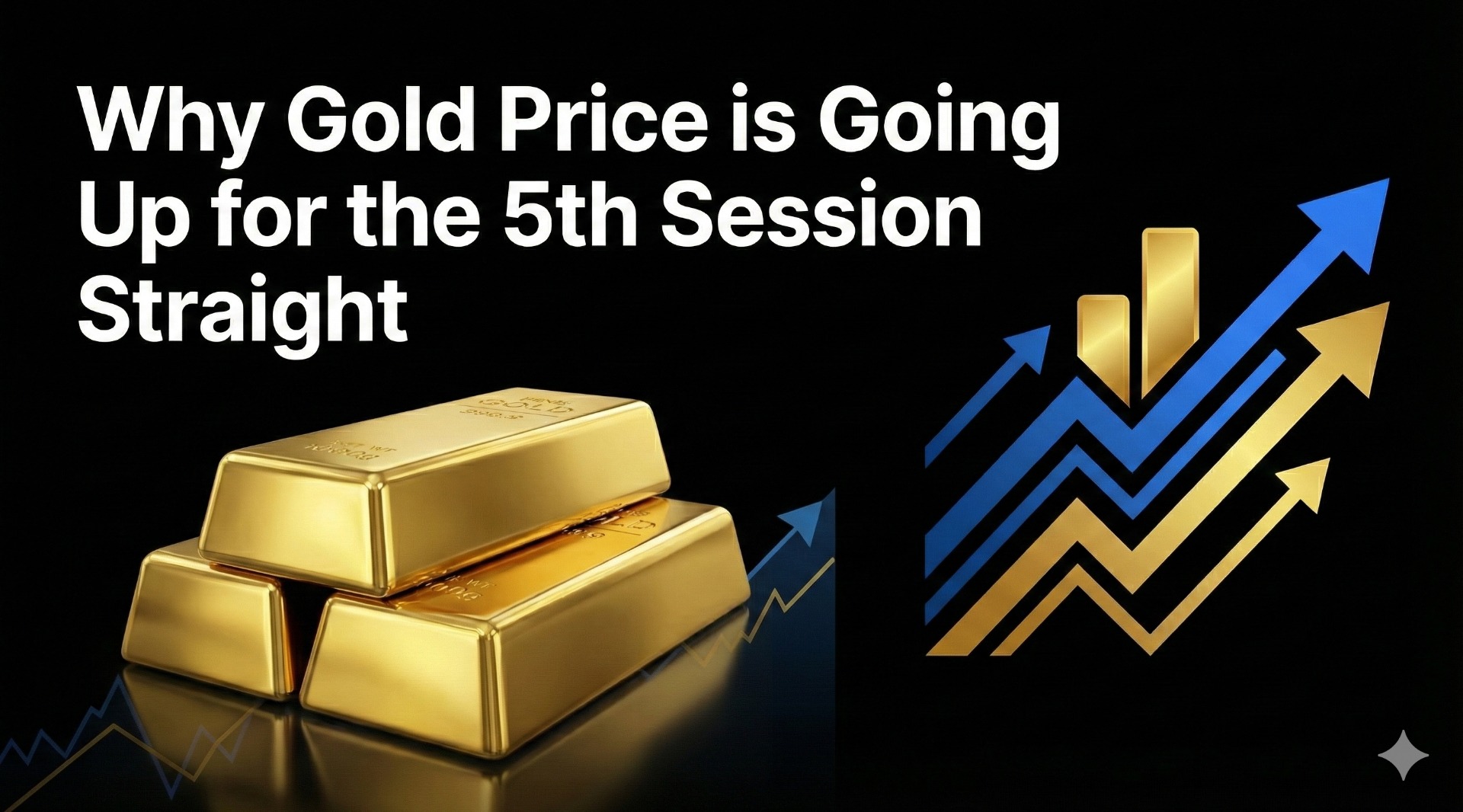
A graphic with a question why gold price is going up showing gold bars and upward arrows
Let's check why gold price is going up today and what are the newest gold price predictions

Gold price surged to $4,355 per ounce today (Monday), December 15, 2025, marking its fifth consecutive session of gains and approaching the all-time high of $4,383 reached on October 20.

The precious metal climbed 0.5% at the end of last week, testing $4,353, and continues trading just $28 below historical maximums. This rally represents a stunning 66% year-to-date performance, significantly outpacing most traditional asset classes.

In this article, I look for answers to why gold price is surging and what the latest gold price forecasts suggest.

Why Gold Is Surging? Federal Reserve Rate Cuts Fuel Rally

The Federal Reserve delivered its third 25-basis-point rate cut of 2025 during its December 9-10 meeting, bringing the federal funds rate to its lowest level in three years. This dovish policy stance has dramatically reduced the opportunity cost of holding non-yielding assets like gold, triggering massive capital flows into precious metals.

Markets currently price in a 75.6% probability of a pause at the January meeting, though Fed Chair Stephen Miran and New York Fed President John Williams are scheduled to speak today, potentially providing fresh guidance on the policy trajectory. The central bank is simultaneously purchasing $40 billion in bonds monthly, adding liquidity to the financial system and pressuring the dollar lower.
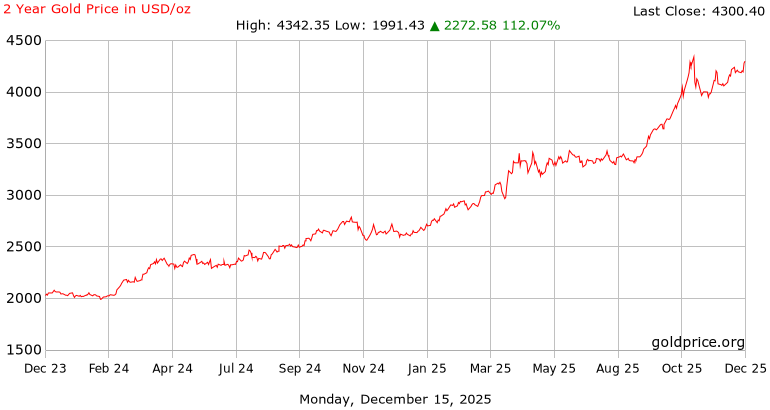
What is the price of gold today? Source: Goldprice.org

Ten-year U.S. Treasury yields climbed to 4.2%, the highest since early September, creating a paradox where nominal rates rise but real yields fall, a historically bullish configuration for gold.

As Ray Youssef from NoOnes notes, "Gold's move from around $4,200 before the Fed's 25-bps announcement to $4,326 reveals that smart capital is hedging policy ambiguity."

How High Can Gold Go? Technical Analysis Shows Strong Momentum

Gold futures are strengthening with rising bullish DMI/ADX signals, suggesting sustained upward momentum, according to Michał Pietrzyca from Bossafx. The price is pressuring the upper bullish range of $4,345-$4,381, with critical resistance at the seven-week maximum near the technical pivot of $4,350.

According to my own technical analysis, the friday's pin bar pattern indicates supply rejected the bull move toward all-time highs, though the new week brings another attempt at price discovery.
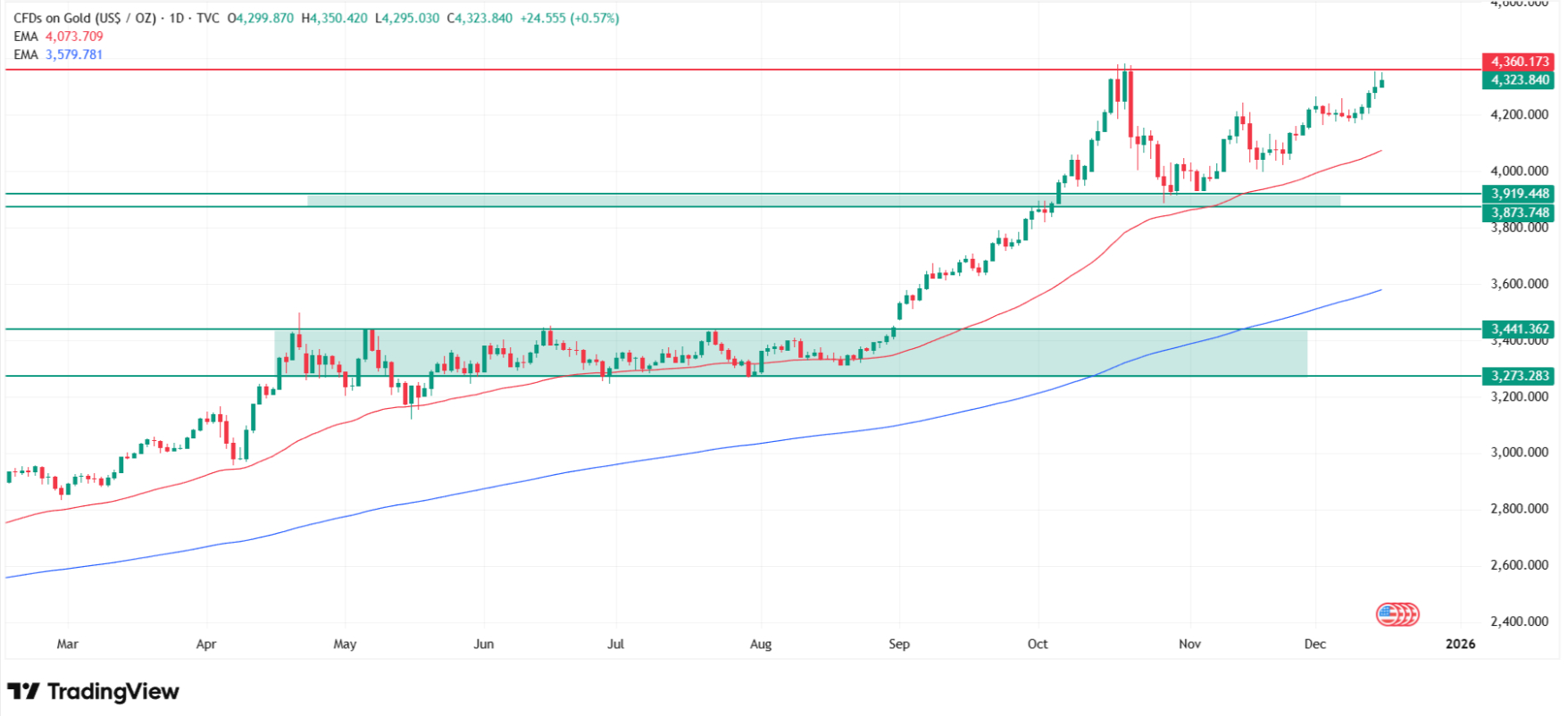
Gold price prediction based on technical analysis. Source: Tradingview.com

Key support levels include the 50-day EMA combined with the psychological $4,000 threshold, followed by a secondary support zone around $3,900 where late October and early November lows reside. Deeper support sits at $3,600 (200-day EMA) and the major range of $3,273-$3,441, representing previous April-August highs.

Silver has accompanied gold's ascent, reaching a record $62.37 and posting a 120% year-to-date gain, demonstrating broad-based precious metals strength.

Gold Price Prediction: Major Banks Forecast $5,000 Gold

Wall Street's largest institutions have dramatically increased their gold price forecasts, with several predicting the metal will breach $5,000 per ounce in 2026:

  • Bank of America raised its 2026 forecast to $5,000, with an average of $4,400, stating "a 6-14% increase in investment demand, similar to this year's trend, could elevate gold to $5,000 per ounce".
  • Goldman Sachs lifted its December 2026 target to $4,900 from $4,300, noting "risks associated with our revised gold price forecast are predominantly tilted towards the upside, as private sector investments in the comparatively small gold market may enhance ETF holdings beyond our rates-implied calculations". The bank expects central bank buying to average 80 tonnes in 2025 and 70 tonnes in 2026.
  • HSBC projects gold could reach $5,000 in the first half of 2026, raising its average 2026 forecast to $4,600 from $3,950. The bank stated, "Unlike previous rallies, we believe many of these new buyers are likely to remain in the gold market, even after the rally concludes, not solely for appreciation but also gold's diversification and safe haven attributes".
  • Société Générale also targets $5,000 by end-2026, with head of commodity research Mike Haigh declaring "Gold's ascent to $5000 seems increasingly inevitable".

While consensus forecasts cluster around $5,000, two extreme scenarios demonstrate gold's potential range in 2026, from spectacular gains to significant corrections. In their "Outrageous Predictions 2026" report, Saxo Bank outlines two tail-risk scenarios that could send gold skyrocketing to unprecedented levels.

The first involves "Q-Day," when a quantum computer breaks standard digital encryption. Neil Wilson, Saxo's UK Investor Strategist, warns this would trigger trust collapse in digital assets and traditional banking systems. "Bitcoin collapses toward zero. Fear spills into traditional finance... Gold rockets toward $10,000 as the ultimate 'no-password' asset," Wilson projects.

Balancing the euphoric forecasts, the World Gold Council's Gold Outlook 2026 report presents four distinct macroeconomic scenarios, including a bearish "Reflation Return" path where gold could crash 5-20% from current levels.

Major Bank Gold Price Forecasts Table 2026

Institution

2026 Target

Average 2026 Forecast

Timeline

Key Rationale

Bank of America

$5,000

$4,400

End-2026

6-14% increase in investment demand similar to 2025 trend

Goldman Sachs

$4,900

-

December 2026

Private sector ETF holdings may exceed rates-implied calculations; central bank buying 80t (2025), 70t (2026)

HSBC

$5,000

$4,600

First half 2026

New buyers likely to remain for diversification and safe-haven attributes, not just appreciation

Société Générale

$5,000

-

End-2026

"Gold's ascent to $5,000 seems increasingly inevitable" - Mike Haigh

Saxo Bank (Q-Day Scenario)

$10,000

-

2026

Quantum computing breaks encryption, triggering digital asset collapse and flight to physical gold

Saxo Bank (Golden Yuan)

$6,000+

-

2026

China backs offshore yuan with gold, creating second global reserve anchor

World Gold Council (Bear Case)

$3,360-$3,990

-

2026

Reflation Return scenario: Trump policies succeed, Fed holds/hikes rates, dollar strengthens (5-20% decline)

What's Next for Gold Prices?

Critical data releases this week could determine gold's trajectory toward all-time highs. Tuesday brings U.S. employment reports for October and November, including nonfarm payrolls, average hourly earnings, and the unemployment rate, metrics that will shape expectations for the Fed's January meeting.

The Bank of Japan meeting on December 19 represents another potential pivot point, as any tightening by the BOJ could trigger yen strength and broader currency market volatility.

Pietrzyca added that "uncertainty and risk aversion may increase capital flows to safe havens" while highlighting important technical support at $3,919.

FAQ: Gold Price Analysis Questions

Will gold reach $5,000 per ounce?

Bank of America, HSBC, and Société Générale all forecast gold will hit $5,000 in 2026, driven by continued Fed easing, central bank buying, and ETF inflows. Goldman Sachs predicts $4,900 by December 2026. The consensus among major institutions places 2026 forecasts between $4,000 and $5,300 per ounce.

Why is gold price surging right now?

Gold is surging due to the Federal Reserve's third rate cut of 2025, dollar weakness, safe-haven demand from tech sector rotation, central bank diversification away from U.S. Treasuries, and robust ETF inflows. Lower interest rates reduce the opportunity cost of holding gold while geopolitical uncertainty increases safe-haven appeal.

Is gold a good investment in 2026?

Experts remain bullish on gold for 2026, though they caution that repeating 2025's 66% returns is unlikely. Most analysts expect double-digit percentage gains supported by Fed policy, dollar weakness, and structural demand from central banks. Gold performs best as a long-term investment during periods of economic uncertainty and currency debasement.

What drives gold prices higher?

Key drivers include Federal Reserve monetary policy and real interest rates, U.S. dollar strength, inflation expectations, central bank reserve diversification, geopolitical risks, and physical demand from technology and jewelry industries. When real yields fall or turn negative, gold becomes more attractive relative to bonds and cash equivalents.


Gold price surged to $4,355 per ounce today (Monday), December 15, 2025, marking its fifth consecutive session of gains and approaching the all-time high of $4,383 reached on October 20.

The precious metal climbed 0.5% at the end of last week, testing $4,353, and continues trading just $28 below historical maximums. This rally represents a stunning 66% year-to-date performance, significantly outpacing most traditional asset classes.

In this article, I look for answers to why gold price is surging and what the latest gold price forecasts suggest.

Why Gold Is Surging? Federal Reserve Rate Cuts Fuel Rally

The Federal Reserve delivered its third 25-basis-point rate cut of 2025 during its December 9-10 meeting, bringing the federal funds rate to its lowest level in three years. This dovish policy stance has dramatically reduced the opportunity cost of holding non-yielding assets like gold, triggering massive capital flows into precious metals.

Markets currently price in a 75.6% probability of a pause at the January meeting, though Fed Chair Stephen Miran and New York Fed President John Williams are scheduled to speak today, potentially providing fresh guidance on the policy trajectory. The central bank is simultaneously purchasing $40 billion in bonds monthly, adding liquidity to the financial system and pressuring the dollar lower.

What is the price of gold today? Source: Goldprice.org

Ten-year U.S. Treasury yields climbed to 4.2%, the highest since early September, creating a paradox where nominal rates rise but real yields fall, a historically bullish configuration for gold.

As Ray Youssef from NoOnes notes, "Gold's move from around $4,200 before the Fed's 25-bps announcement to $4,326 reveals that smart capital is hedging policy ambiguity."

How High Can Gold Go? Technical Analysis Shows Strong Momentum

Gold futures are strengthening with rising bullish DMI/ADX signals, suggesting sustained upward momentum, according to Michał Pietrzyca from Bossafx. The price is pressuring the upper bullish range of $4,345-$4,381, with critical resistance at the seven-week maximum near the technical pivot of $4,350.

According to my own technical analysis, the friday's pin bar pattern indicates supply rejected the bull move toward all-time highs, though the new week brings another attempt at price discovery.

Gold price prediction based on technical analysis. Source: Tradingview.com

Key support levels include the 50-day EMA combined with the psychological $4,000 threshold, followed by a secondary support zone around $3,900 where late October and early November lows reside. Deeper support sits at $3,600 (200-day EMA) and the major range of $3,273-$3,441, representing previous April-August highs.

Silver has accompanied gold's ascent, reaching a record $62.37 and posting a 120% year-to-date gain, demonstrating broad-based precious metals strength.

Gold Price Prediction: Major Banks Forecast $5,000 Gold

Wall Street's largest institutions have dramatically increased their gold price forecasts, with several predicting the metal will breach $5,000 per ounce in 2026:

  • Bank of America raised its 2026 forecast to $5,000, with an average of $4,400, stating "a 6-14% increase in investment demand, similar to this year's trend, could elevate gold to $5,000 per ounce".
  • Goldman Sachs lifted its December 2026 target to $4,900 from $4,300, noting "risks associated with our revised gold price forecast are predominantly tilted towards the upside, as private sector investments in the comparatively small gold market may enhance ETF holdings beyond our rates-implied calculations". The bank expects central bank buying to average 80 tonnes in 2025 and 70 tonnes in 2026.
  • HSBC projects gold could reach $5,000 in the first half of 2026, raising its average 2026 forecast to $4,600 from $3,950. The bank stated, "Unlike previous rallies, we believe many of these new buyers are likely to remain in the gold market, even after the rally concludes, not solely for appreciation but also gold's diversification and safe haven attributes".
  • Société Générale also targets $5,000 by end-2026, with head of commodity research Mike Haigh declaring "Gold's ascent to $5000 seems increasingly inevitable".

While consensus forecasts cluster around $5,000, two extreme scenarios demonstrate gold's potential range in 2026, from spectacular gains to significant corrections. In their "Outrageous Predictions 2026" report, Saxo Bank outlines two tail-risk scenarios that could send gold skyrocketing to unprecedented levels.

The first involves "Q-Day," when a quantum computer breaks standard digital encryption. Neil Wilson, Saxo's UK Investor Strategist, warns this would trigger trust collapse in digital assets and traditional banking systems. "Bitcoin collapses toward zero. Fear spills into traditional finance... Gold rockets toward $10,000 as the ultimate 'no-password' asset," Wilson projects.

Balancing the euphoric forecasts, the World Gold Council's Gold Outlook 2026 report presents four distinct macroeconomic scenarios, including a bearish "Reflation Return" path where gold could crash 5-20% from current levels.

Major Bank Gold Price Forecasts Table 2026

Institution

2026 Target

Average 2026 Forecast

Timeline

Key Rationale

Bank of America

$5,000

$4,400

End-2026

6-14% increase in investment demand similar to 2025 trend

Goldman Sachs

$4,900

-

December 2026

Private sector ETF holdings may exceed rates-implied calculations; central bank buying 80t (2025), 70t (2026)

HSBC

$5,000

$4,600

First half 2026

New buyers likely to remain for diversification and safe-haven attributes, not just appreciation

Société Générale

$5,000

-

End-2026

"Gold's ascent to $5,000 seems increasingly inevitable" - Mike Haigh

Saxo Bank (Q-Day Scenario)

$10,000

-

2026

Quantum computing breaks encryption, triggering digital asset collapse and flight to physical gold

Saxo Bank (Golden Yuan)

$6,000+

-

2026

China backs offshore yuan with gold, creating second global reserve anchor

World Gold Council (Bear Case)

$3,360-$3,990

-

2026

Reflation Return scenario: Trump policies succeed, Fed holds/hikes rates, dollar strengthens (5-20% decline)

What's Next for Gold Prices?

Critical data releases this week could determine gold's trajectory toward all-time highs. Tuesday brings U.S. employment reports for October and November, including nonfarm payrolls, average hourly earnings, and the unemployment rate, metrics that will shape expectations for the Fed's January meeting.

The Bank of Japan meeting on December 19 represents another potential pivot point, as any tightening by the BOJ could trigger yen strength and broader currency market volatility.

Pietrzyca added that "uncertainty and risk aversion may increase capital flows to safe havens" while highlighting important technical support at $3,919.

FAQ: Gold Price Analysis Questions

Will gold reach $5,000 per ounce?

Bank of America, HSBC, and Société Générale all forecast gold will hit $5,000 in 2026, driven by continued Fed easing, central bank buying, and ETF inflows. Goldman Sachs predicts $4,900 by December 2026. The consensus among major institutions places 2026 forecasts between $4,000 and $5,300 per ounce.

Why is gold price surging right now?

Gold is surging due to the Federal Reserve's third rate cut of 2025, dollar weakness, safe-haven demand from tech sector rotation, central bank diversification away from U.S. Treasuries, and robust ETF inflows. Lower interest rates reduce the opportunity cost of holding gold while geopolitical uncertainty increases safe-haven appeal.

Is gold a good investment in 2026?

Experts remain bullish on gold for 2026, though they caution that repeating 2025's 66% returns is unlikely. Most analysts expect double-digit percentage gains supported by Fed policy, dollar weakness, and structural demand from central banks. Gold performs best as a long-term investment during periods of economic uncertainty and currency debasement.

What drives gold prices higher?

Key drivers include Federal Reserve monetary policy and real interest rates, U.S. dollar strength, inflation expectations, central bank reserve diversification, geopolitical risks, and physical demand from technology and jewelry industries. When real yields fall or turn negative, gold becomes more attractive relative to bonds and cash equivalents.

About the Author: Damian Chmiel
Damian Chmiel
  • 3094 Articles
  • 96 Followers
Damian's adventure with financial markets began at the Cracow University of Economics, where he obtained his MA in finance and accounting. Starting from the retail trader perspective, he collaborated with brokerage houses and financial portals in Poland as an independent editor and content manager. His adventure with Finance Magnates began in 2016, where he is working as a business intelligence analyst.

More from the Author

Trending