The
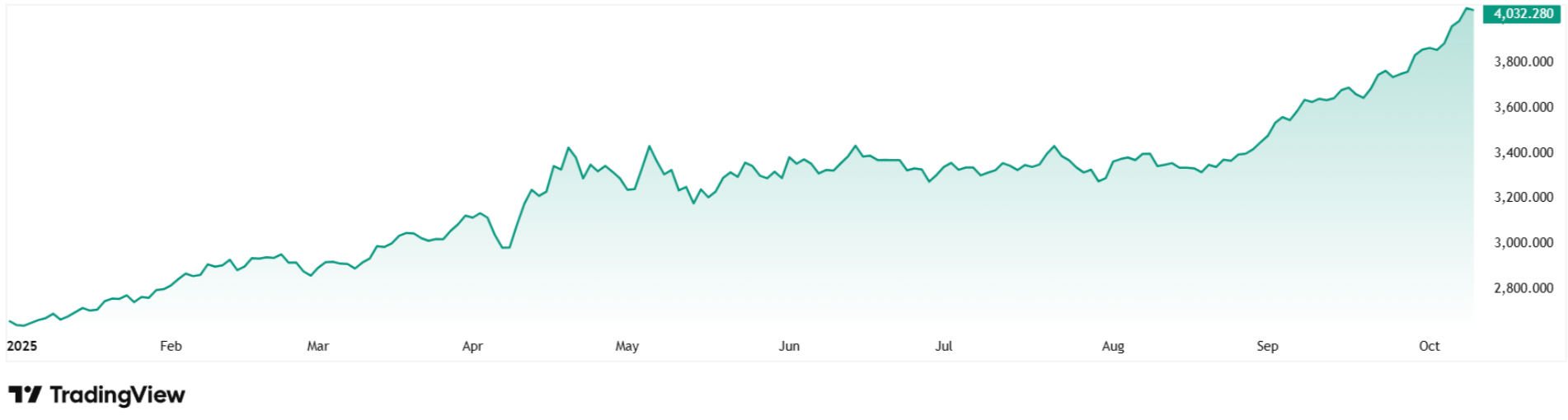
precious metal closed at $4,042.03 after hitting an intraday peak of
$4,059.31, extending gains that have made it one of 2025's best-performing
assets with a 52% year-to-date surge.
The rally
accelerated as the U.S. government shutdown entered its seventh day,
delaying critical economic data releases and amplifying uncertainty across
financial markets. Spot gold has now climbed more than 50% since
January while the dollar index dropped 10%, creating conditions that
independent metals trader Tai Wong says could push prices toward $5,000.
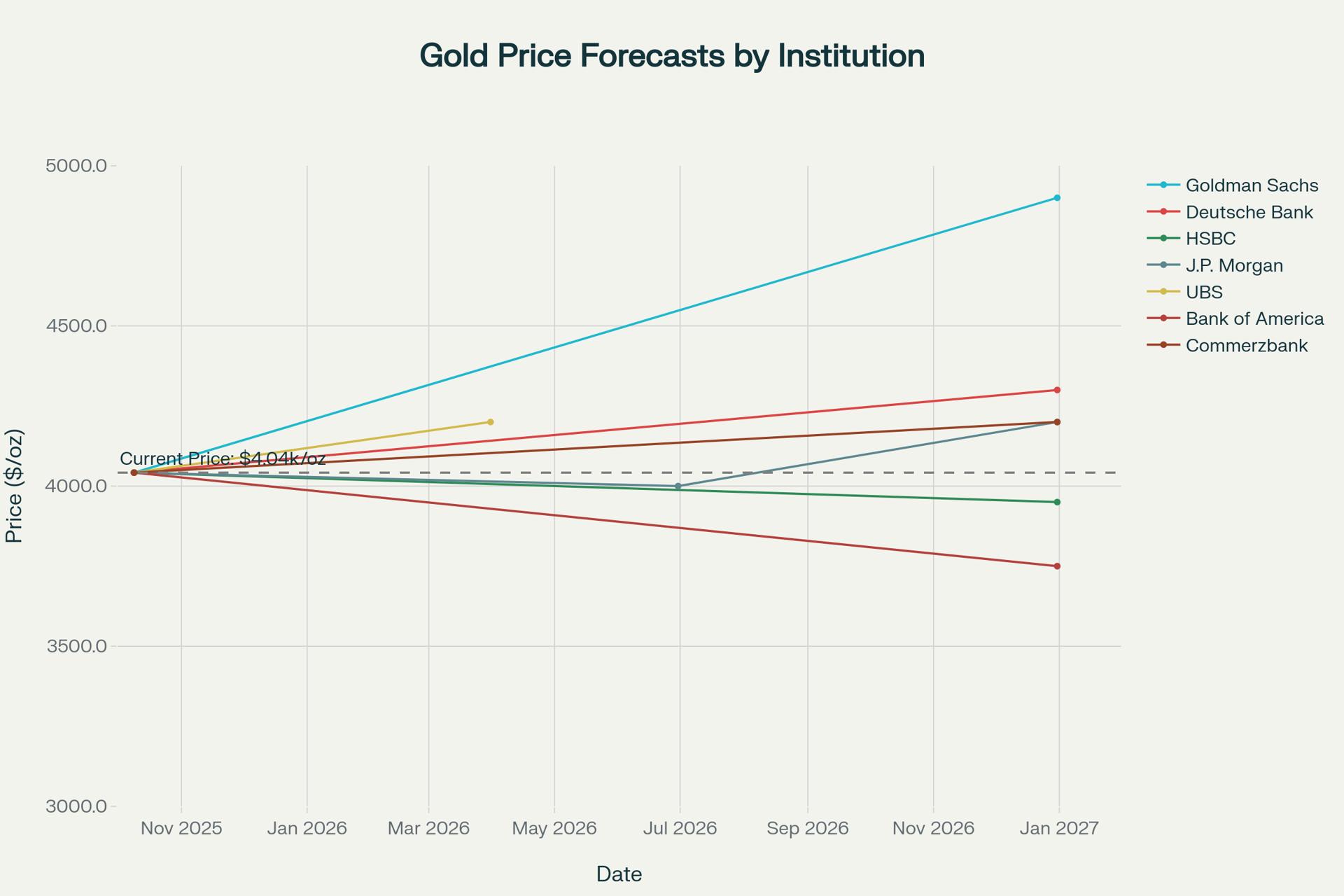
The biggest investment banks are bullish on gold price predictions. Source: Reuters/Perplexity
Why Gold Price Is Going
Up?
Western Money Floods
Back Into Gold
Western
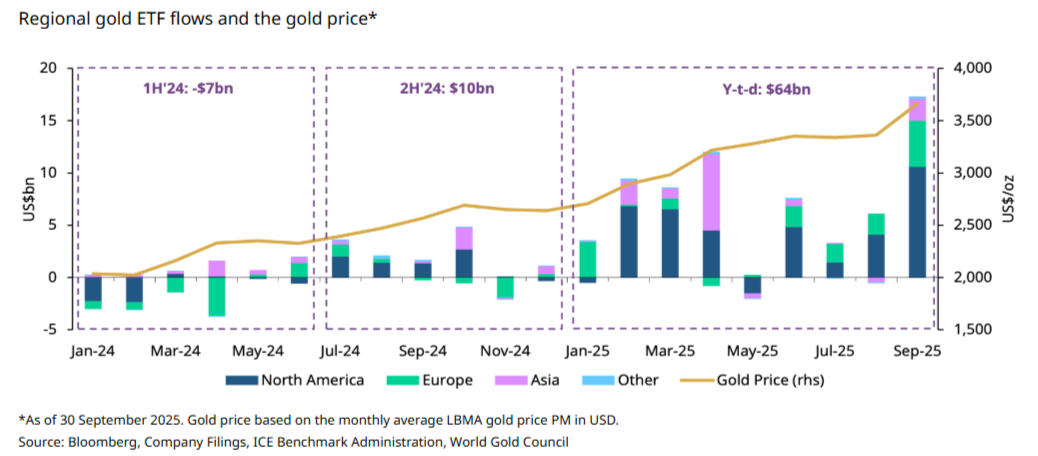
investors poured $64 billion into gold ETFs through September, with the
month alone recording a record $17.3 billion, nearly double the previous
monthly high set during the 2020 pandemic panic.
U.S.-based
funds captured $35 billion of these flows, surpassing the entire
pandemic year of 2020 when gold ETFs attracted $29 billion. September's
inflows represented the largest monthly gain in ETF history, capping the
strongest quarter on record at $26 billion. Holdings across global
gold ETFs reached 3,692 tonnes by August's end, the highest monthly close
since July 2022 and just 6% below the all-time record of
3,929 tonnes.
Western inflows go four-for-four resulting in strongest quarter on record. Source: Gold.org
Goldman
Sachs raised its December 2026 price target to $4,900 per ounce from
$4,300, citing sustained ETF demand and likely central bank
purchases. The bank expects Western ETF holdings to climb as the
Federal Reserve cuts rates by 100 basis points through
mid-2026, historically a powerful tailwind for bullion.
The price of gold is currently above $4,000 level. Source: Tradingview.com
Central Banks Stack Gold
at Unprecedented Pace
Central
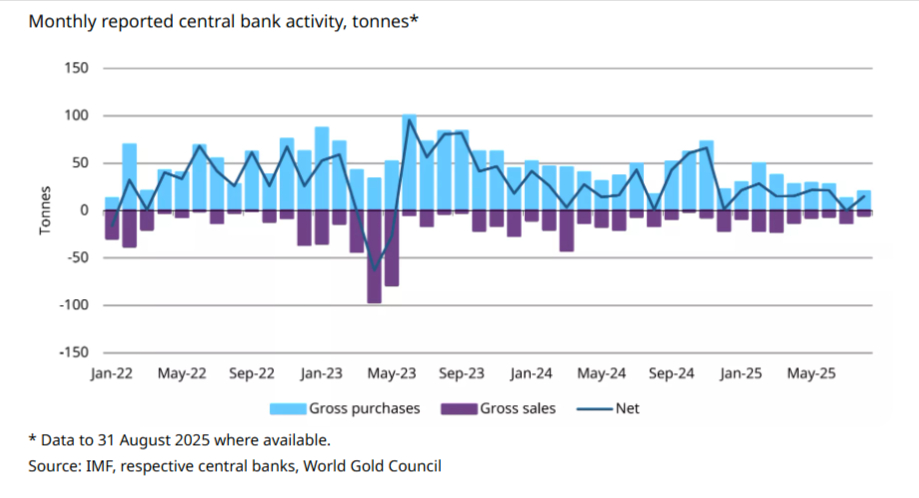
banks emerged as the dominant force behind gold's ascent, accumulating over
1,000 tonnes annually since 2022, more than double the 2016-2021
average of 457 tonnes. The buying spree reflects strategic
diversification away from dollar assets following Russia's 2022 invasion of
Ukraine and subsequent Western sanctions.
Key drivers
behind central bank accumulation include:
Reserve diversification away
from U.S. Treasuries and dollar-denominated assets
Protection against
potential asset freezes and geopolitical sanctions
Hedge against mounting
sovereign debt concerns and fiscal instability
Inflation protection as
consumer prices remain above central bank targets
August
saw net additions of 15 tonnes to global reserves, with Kazakhstan's
central bank leading purchases. Poland remained 2025's largest buyer
year-to-date, even reaffirming its commitment by raising its gold target
allocation. Gold's market value in central bank reserves has now almost
certainly surpassed holdings of non-U.S. Treasuries, while overtaking
the euro as the second-largest reserve asset earlier this year.
Central banks return to buying form in August. Source: Gold.org
World Gold
Council data shows 44% of central banks actively manage their gold reserves
in 2025, up from 37% the prior year. Survey respondents cite reserve
diversification, inflation protection, and geopolitical security as
primary motivations.
China Steps Back as
West Steps In
Chinese
gold demand drove much of 2024's 27% gain and the rally's first four months,
visible in the "Shanghai premium", the spread between
London benchmark prices and Chinese exchanges. But Chinese prices slipped below
the benchmark in recent months even as gold hit new highs, signaling
Western investors took over as the primary force.
The
shift occurred as trade tensions escalated under President
Trump's tariff policies, roiling global markets and unleashing safe-haven
buying in China through April. India's Reserve Bank also curtailed purchases,
buying just 3.8 tonnes through August compared to 45.4 tonnes during the
same 2024 period.
Multiple Tailwinds
Converge on Gold
The
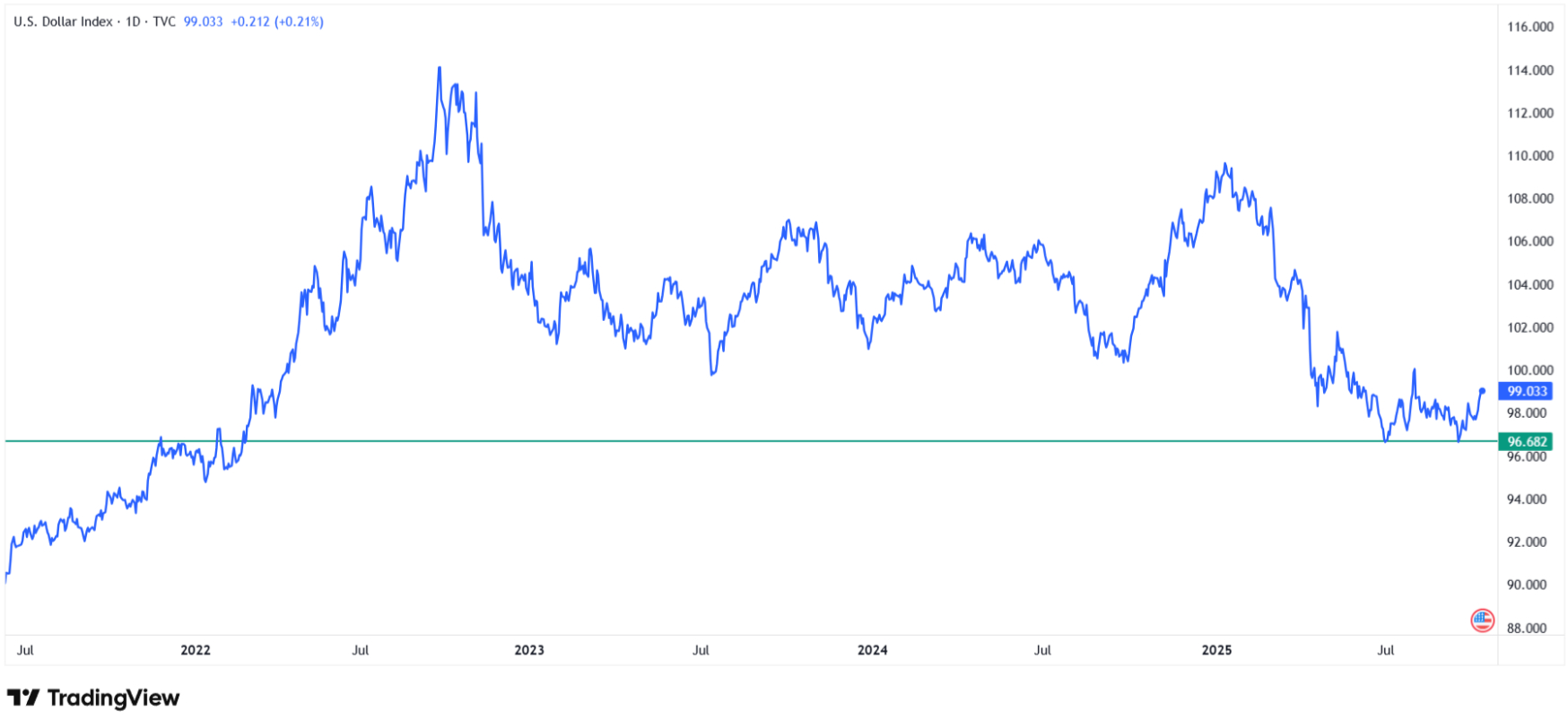
dollar's 10% year-to-date decline made gold cheaper for international
buyers while reducing opportunity costs for holding non-yielding assets.
Inflation remains elevated at 2.9%, above the Federal Reserve's 2% target,
sustaining gold's appeal as a purchasing power hedge.
U.S. dollar hits the lowest levels since 2022. Source: Tradingview.com
Geopolitical
tensions across the Middle East and Ukraine continue fueling safe-haven
demand, with energy market disruptions creating inflation risks that
further support bullion. The U.S. government shutdown compounded
uncertainty by delaying employment reports and other data crucial for Fed
decisions.
Ray Dalio
advised investors at the Greenwich Economic Forum to allocate
"approximately 15% of your portfolio to gold," calling it
"the one asset that performs well when the usual components of your
portfolio decline". Bank of America cautioned clients about
potential "uptrend exhaustion" and consolidation near $4,000,
though the warning came before gold powered through the level.
Breaking Every Record
in the Book
Gold
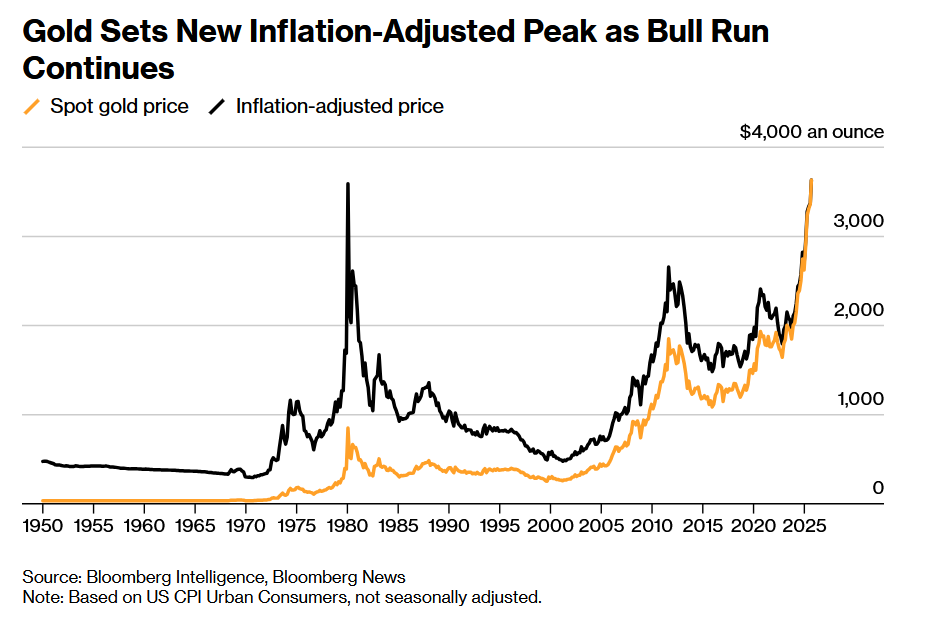
eclipsed its inflation-adjusted peak set 45 years ago when
prices topped $850 in January 1980. That high came as the U.S. battled
currency collapse, spiking inflation, and recession following
President Carter's freeze on Iranian assets during the hostage
crisis. Analysts see faint echoes of those conditions today in
Trump's trade policies, Fed independence concerns, and persistent inflation.
Source: Bloomberg
The rally's
magnitude has benefited the U.S. government itself, with official
holdings surpassing $1 trillion in market value last month, over 90 times what
appears on federal balance sheets. This windfall dwarfs
the stated book value established when the Treasury valued gold at $42.22
per ounce.
Major
investment banks dramatically revised their gold outlooks as
prices shattered previous targets. The table below shows how rapidly
analyst expectations have shifted upward:
Institution
2025 Average Forecast
2026 Average Forecast
Price Target
Date Updated
Goldman Sachs
$3,400/oz
$4,525/oz
$4,900/oz by Dec 2026
October 7, 2025
Deutsche Bank
$3,291/oz
$4,000/oz
$4,300/oz by Q4 2026
September 17, 2025
HSBC
$3,355/oz
$3,950/oz
$3,600/oz avg in 2027
October 3, 2025
J.P. Morgan
$3,675/oz by Q4
—
$4,000/oz by Q2 2026
August 10, 2025
UBS
—
—
$4,200/oz in coming months
October 3, 2025
Bank of America
$3,356/oz
$3,750/oz
—
September 15, 2025
ANZ
$3,338/oz
$3,845/oz
—
September 10, 2025
Commerzbank
$4,000/oz
—
$4,200/oz by end 2026
October 7, 2025
Citi Research
$3,400/oz
$3,250/oz
—
2025
Goldman
Sachs leads with the most aggressive forecast, projecting $4,900 by
December 2026, a 23% increase from current levels. The bank expects
emerging market central banks to average 80 tonnes of purchases in
2025 and 70 tonnes in 2026, contributing roughly 19 percentage points to
the expected price gain.
Deutsche Bank
raised its 2026 average forecast to $4,000 per ounce from $3,700,
citing official demand running at double the 10-year average and recycled
gold supply coming in 4% lower than expected. HSBC also lifted its 2027 forecast
to $3,600 from $2,925 and introduced a 2028 forecast of $3,330.
Technical Levels
Point Higher Despite Overbought Signals
According
to my technical analysis, gold's 14-day Relative Strength Index reached
78.4 in mid-April, entering overbought territory for the first time since
2020's pandemic surge. Fibonacci retracement analysis suggests
resistance near $3,250, though gold blasted through that level weeks
ago. Support now sits at $3,930, $3,900, and $3,860, with resistance at
$3,980, $4,020, and $4,070.
Moreover,
the volume patterns show institutional rather than speculative
participation, suggesting sustained momentum despite extreme readings.
COMEX futures open interest declined 12% during recent price spikes,
potentially signaling distribution, though ETF inflows contradict this
bearish interpretation.
What's Driving Gold Prices
Higher?
Economic factors:
Federal Reserve rate cuts
totaling 100 basis points expected through mid-2026
U.S. dollar weakness with 10%
year-to-date decline against major currencies
Persistent inflation at
2.9%, above Fed's 2% target rate
Mounting U.S.
fiscal concerns with debt approaching $36 trillion
Geopolitical catalysts:
Ongoing conflicts in
Ukraine and Middle East fueling safe-haven demand
U.S. government shutdown
delaying economic data and policy decisions
Trump administration tariff
policies creating trade war uncertainty
Asset seizure concerns
following Western sanctions on Russia
Structural demand shifts:
Central banks
buying 1,000+ tonnes annually versus 457-tonne historical
average
Western ETF inflows
totaling $64 billion year-to-date
Dedollarization trend among
emerging market central banks
Portfolio diversification away
from traditional 60/40 stock-bond allocation
Risks Remain
Despite Bullish Sentiment
Goldman Sachs
acknowledges risks skew to the upside "because private sector
diversification into the relatively small gold market may boost ETF
holdings above our rates-implied estimate". The bank expects
emerging market central banks to continue structural reserve
diversification, averaging 80 tonnes in 2025 and 70 tonnes in 2026.
Potential
headwinds include lasting peace in Ukraine or the Middle East,
though analysts say core drivers, massive debt, reserve
diversification, and dollar weakness, won't shift soon. Better U.S.
growth or Fed rate hikes due to inflation surprises could
pressure gold, though market consensus leans toward continued easing.
The put/call
ratio for gold options climbed to 1.4 as net long futures contracts reached
287,000 in March, suggesting sophisticated investors hedge while maintaining
core positions. Retail sentiment surveys show 42% consider gold
"overvalued" above $3,000, compared to 18% at $2,500, potential
fuel for further upside if skeptics capitulate.
Gold ETF Holdings Surge
But Room Remains
Holdings in
bullion-backed exchange traded funds tell a story of renewed investor
conviction. The table below shows how ETF positions have evolved:
Period
Global Gold ETF Holdings
Monthly/Quarterly Inflow
Notable Milestone
Pandemic Peak (2020)
3,929 tonnes
$29 billion annual
All-time record holdings
July 2022 Low
3,200 tonnes
Outflows for 18 months
Post-pandemic selloff bottom
August 2025
3,692 tonnes
—
Highest since July 2022
September 2025
—
$17.3 billion
Largest monthly inflow ever
Q3 2025
—
$26 billion
Strongest quarter on record
2025 Year-to-Date
—
$64 billion
Exceeds full-year 2020
Holdings remain
6% below pandemic highs, suggesting substantial upside potential if buying
continues. J.P. Morgan notes every 100 tonnes of net purchases by
conviction buyers corresponds to a 1.7% rise in gold prices.
Ole Hansen,
commodities strategist at Saxo Bank, said the move above $4,000
"reflects a deeper shift in investor psychology and global
capital flows". He added that "sanctions, asset seizures, and
concerns about fiscal sustainability have nudged investors, both institutional
and sovereign, toward tangible assets that sit outside the
financial system".
Gold's
performance since 1979's similar rally suggests the bull market may
have substantial room to run. Historical patterns show gold
functions better as long-term inflation hedge than short-term
tactical play, with correlation to inflation rising from 0.16 over
five-year periods to 0.58 over twenty years.
Whether gold
consolidates near $4,000 or powers toward $5,000 depends on Fed policy,
geopolitical developments, and whether the structural shift away from
dollar assets accelerates. What's clear is that gold has reclaimed its position
at the center of global monetary discussions after decades as an
afterthought.
Gold Price Analysis, FAQ
Is gold price expected to
rise or drop?
Gold is
expected to continue rising based on consensus analyst forecasts. Goldman Sachs
projects $4,900 by December 2026, while other major institutions including
Deutsche Bank, UBS, and Commerzbank forecast targets between $4,200 and $4,300
over the same period.
What will the price of
gold be in 2025?
Gold has
already surpassed most 2025 forecasts by reaching $4,042 in October, well above
the $3,400-$3,700 range predicted by major banks earlier this year. The current
price represents a 52% gain year-to-date, making gold one of 2025's
best-performing assets. Analysts now expect gold to average between $3,800 and
$4,000 for the remainder of 2025, with potential spikes above $4,100 if Fed
rate cuts accelerate or geopolitical tensions intensify.
Will gold go to $5,000 an
ounce?
Yes, multiple
analysts believe gold will reach $5,000, though timelines vary. Goldman Sachs
sees potential for $5,000 if Federal Reserve independence comes under pressure
and investors shift just 1% of the $57 trillion U.S. Treasury market into gold.
Ed Yardeni predicts $5,000 by end of 2026 under current conditions, calling it
the "next big round number" that markets will target.
Will the price of gold go
up in the next 5 years?
Long-term
forecasts through 2030 show strong consensus for continued gains. Analysts
project gold reaching $4,500-$5,000 by 2027-2028 in medium-term scenarios, with
potential to hit $5,150-$5,800 by 2030 under optimistic conditions. Ed
Yardeni's most aggressive forecast sees $10,000 by 2030, implying 151% gains
over five years, though this requires extreme scenarios including runaway
inflation or severe geopolitical crises.
The
precious metal closed at $4,042.03 after hitting an intraday peak of
$4,059.31, extending gains that have made it one of 2025's best-performing
assets with a 52% year-to-date surge.
The rally
accelerated as the U.S. government shutdown entered its seventh day,
delaying critical economic data releases and amplifying uncertainty across
financial markets. Spot gold has now climbed more than 50% since
January while the dollar index dropped 10%, creating conditions that
independent metals trader Tai Wong says could push prices toward $5,000.
The biggest investment banks are bullish on gold price predictions. Source: Reuters/Perplexity
Why Gold Price Is Going
Up?
Western Money Floods
Back Into Gold
Western
investors poured $64 billion into gold ETFs through September, with the
month alone recording a record $17.3 billion, nearly double the previous
monthly high set during the 2020 pandemic panic.
U.S.-based
funds captured $35 billion of these flows, surpassing the entire
pandemic year of 2020 when gold ETFs attracted $29 billion. September's
inflows represented the largest monthly gain in ETF history, capping the
strongest quarter on record at $26 billion. Holdings across global
gold ETFs reached 3,692 tonnes by August's end, the highest monthly close
since July 2022 and just 6% below the all-time record of
3,929 tonnes.
Western inflows go four-for-four resulting in strongest quarter on record. Source: Gold.org
Goldman
Sachs raised its December 2026 price target to $4,900 per ounce from
$4,300, citing sustained ETF demand and likely central bank
purchases. The bank expects Western ETF holdings to climb as the
Federal Reserve cuts rates by 100 basis points through
mid-2026, historically a powerful tailwind for bullion.
The price of gold is currently above $4,000 level. Source: Tradingview.com
Central Banks Stack Gold
at Unprecedented Pace
Central
banks emerged as the dominant force behind gold's ascent, accumulating over
1,000 tonnes annually since 2022, more than double the 2016-2021
average of 457 tonnes. The buying spree reflects strategic
diversification away from dollar assets following Russia's 2022 invasion of
Ukraine and subsequent Western sanctions.
Key drivers
behind central bank accumulation include:
Reserve diversification away
from U.S. Treasuries and dollar-denominated assets
Protection against
potential asset freezes and geopolitical sanctions
Hedge against mounting
sovereign debt concerns and fiscal instability
Inflation protection as
consumer prices remain above central bank targets
August
saw net additions of 15 tonnes to global reserves, with Kazakhstan's
central bank leading purchases. Poland remained 2025's largest buyer
year-to-date, even reaffirming its commitment by raising its gold target
allocation. Gold's market value in central bank reserves has now almost
certainly surpassed holdings of non-U.S. Treasuries, while overtaking
the euro as the second-largest reserve asset earlier this year.
Central banks return to buying form in August. Source: Gold.org
World Gold
Council data shows 44% of central banks actively manage their gold reserves
in 2025, up from 37% the prior year. Survey respondents cite reserve
diversification, inflation protection, and geopolitical security as
primary motivations.
China Steps Back as
West Steps In
Chinese
gold demand drove much of 2024's 27% gain and the rally's first four months,
visible in the "Shanghai premium", the spread between
London benchmark prices and Chinese exchanges. But Chinese prices slipped below
the benchmark in recent months even as gold hit new highs, signaling
Western investors took over as the primary force.
The
shift occurred as trade tensions escalated under President
Trump's tariff policies, roiling global markets and unleashing safe-haven
buying in China through April. India's Reserve Bank also curtailed purchases,
buying just 3.8 tonnes through August compared to 45.4 tonnes during the
same 2024 period.
Multiple Tailwinds
Converge on Gold
The
dollar's 10% year-to-date decline made gold cheaper for international
buyers while reducing opportunity costs for holding non-yielding assets.
Inflation remains elevated at 2.9%, above the Federal Reserve's 2% target,
sustaining gold's appeal as a purchasing power hedge.
U.S. dollar hits the lowest levels since 2022. Source: Tradingview.com
Geopolitical
tensions across the Middle East and Ukraine continue fueling safe-haven
demand, with energy market disruptions creating inflation risks that
further support bullion. The U.S. government shutdown compounded
uncertainty by delaying employment reports and other data crucial for Fed
decisions.
Ray Dalio
advised investors at the Greenwich Economic Forum to allocate
"approximately 15% of your portfolio to gold," calling it
"the one asset that performs well when the usual components of your
portfolio decline". Bank of America cautioned clients about
potential "uptrend exhaustion" and consolidation near $4,000,
though the warning came before gold powered through the level.
Breaking Every Record
in the Book
Gold
eclipsed its inflation-adjusted peak set 45 years ago when
prices topped $850 in January 1980. That high came as the U.S. battled
currency collapse, spiking inflation, and recession following
President Carter's freeze on Iranian assets during the hostage
crisis. Analysts see faint echoes of those conditions today in
Trump's trade policies, Fed independence concerns, and persistent inflation.
Source: Bloomberg
The rally's
magnitude has benefited the U.S. government itself, with official
holdings surpassing $1 trillion in market value last month, over 90 times what
appears on federal balance sheets. This windfall dwarfs
the stated book value established when the Treasury valued gold at $42.22
per ounce.
Major
investment banks dramatically revised their gold outlooks as
prices shattered previous targets. The table below shows how rapidly
analyst expectations have shifted upward:
Institution
2025 Average Forecast
2026 Average Forecast
Price Target
Date Updated
Goldman Sachs
$3,400/oz
$4,525/oz
$4,900/oz by Dec 2026
October 7, 2025
Deutsche Bank
$3,291/oz
$4,000/oz
$4,300/oz by Q4 2026
September 17, 2025
HSBC
$3,355/oz
$3,950/oz
$3,600/oz avg in 2027
October 3, 2025
J.P. Morgan
$3,675/oz by Q4
—
$4,000/oz by Q2 2026
August 10, 2025
UBS
—
—
$4,200/oz in coming months
October 3, 2025
Bank of America
$3,356/oz
$3,750/oz
—
September 15, 2025
ANZ
$3,338/oz
$3,845/oz
—
September 10, 2025
Commerzbank
$4,000/oz
—
$4,200/oz by end 2026
October 7, 2025
Citi Research
$3,400/oz
$3,250/oz
—
2025
Goldman
Sachs leads with the most aggressive forecast, projecting $4,900 by
December 2026, a 23% increase from current levels. The bank expects
emerging market central banks to average 80 tonnes of purchases in
2025 and 70 tonnes in 2026, contributing roughly 19 percentage points to
the expected price gain.
Deutsche Bank
raised its 2026 average forecast to $4,000 per ounce from $3,700,
citing official demand running at double the 10-year average and recycled
gold supply coming in 4% lower than expected. HSBC also lifted its 2027 forecast
to $3,600 from $2,925 and introduced a 2028 forecast of $3,330.
Technical Levels
Point Higher Despite Overbought Signals
According
to my technical analysis, gold's 14-day Relative Strength Index reached
78.4 in mid-April, entering overbought territory for the first time since
2020's pandemic surge. Fibonacci retracement analysis suggests
resistance near $3,250, though gold blasted through that level weeks
ago. Support now sits at $3,930, $3,900, and $3,860, with resistance at
$3,980, $4,020, and $4,070.
Moreover,
the volume patterns show institutional rather than speculative
participation, suggesting sustained momentum despite extreme readings.
COMEX futures open interest declined 12% during recent price spikes,
potentially signaling distribution, though ETF inflows contradict this
bearish interpretation.
What's Driving Gold Prices
Higher?
Economic factors:
Federal Reserve rate cuts
totaling 100 basis points expected through mid-2026
U.S. dollar weakness with 10%
year-to-date decline against major currencies
Persistent inflation at
2.9%, above Fed's 2% target rate
Mounting U.S.
fiscal concerns with debt approaching $36 trillion
Geopolitical catalysts:
Ongoing conflicts in
Ukraine and Middle East fueling safe-haven demand
U.S. government shutdown
delaying economic data and policy decisions
Trump administration tariff
policies creating trade war uncertainty
Asset seizure concerns
following Western sanctions on Russia
Structural demand shifts:
Central banks
buying 1,000+ tonnes annually versus 457-tonne historical
average
Western ETF inflows
totaling $64 billion year-to-date
Dedollarization trend among
emerging market central banks
Portfolio diversification away
from traditional 60/40 stock-bond allocation
Risks Remain
Despite Bullish Sentiment
Goldman Sachs
acknowledges risks skew to the upside "because private sector
diversification into the relatively small gold market may boost ETF
holdings above our rates-implied estimate". The bank expects
emerging market central banks to continue structural reserve
diversification, averaging 80 tonnes in 2025 and 70 tonnes in 2026.
Potential
headwinds include lasting peace in Ukraine or the Middle East,
though analysts say core drivers, massive debt, reserve
diversification, and dollar weakness, won't shift soon. Better U.S.
growth or Fed rate hikes due to inflation surprises could
pressure gold, though market consensus leans toward continued easing.
The put/call
ratio for gold options climbed to 1.4 as net long futures contracts reached
287,000 in March, suggesting sophisticated investors hedge while maintaining
core positions. Retail sentiment surveys show 42% consider gold
"overvalued" above $3,000, compared to 18% at $2,500, potential
fuel for further upside if skeptics capitulate.
Gold ETF Holdings Surge
But Room Remains
Holdings in
bullion-backed exchange traded funds tell a story of renewed investor
conviction. The table below shows how ETF positions have evolved:
Period
Global Gold ETF Holdings
Monthly/Quarterly Inflow
Notable Milestone
Pandemic Peak (2020)
3,929 tonnes
$29 billion annual
All-time record holdings
July 2022 Low
3,200 tonnes
Outflows for 18 months
Post-pandemic selloff bottom
August 2025
3,692 tonnes
—
Highest since July 2022
September 2025
—
$17.3 billion
Largest monthly inflow ever
Q3 2025
—
$26 billion
Strongest quarter on record
2025 Year-to-Date
—
$64 billion
Exceeds full-year 2020
Holdings remain
6% below pandemic highs, suggesting substantial upside potential if buying
continues. J.P. Morgan notes every 100 tonnes of net purchases by
conviction buyers corresponds to a 1.7% rise in gold prices.
Ole Hansen,
commodities strategist at Saxo Bank, said the move above $4,000
"reflects a deeper shift in investor psychology and global
capital flows". He added that "sanctions, asset seizures, and
concerns about fiscal sustainability have nudged investors, both institutional
and sovereign, toward tangible assets that sit outside the
financial system".
Gold's
performance since 1979's similar rally suggests the bull market may
have substantial room to run. Historical patterns show gold
functions better as long-term inflation hedge than short-term
tactical play, with correlation to inflation rising from 0.16 over
five-year periods to 0.58 over twenty years.
Whether gold
consolidates near $4,000 or powers toward $5,000 depends on Fed policy,
geopolitical developments, and whether the structural shift away from
dollar assets accelerates. What's clear is that gold has reclaimed its position
at the center of global monetary discussions after decades as an
afterthought.
Gold Price Analysis, FAQ
Is gold price expected to
rise or drop?
Gold is
expected to continue rising based on consensus analyst forecasts. Goldman Sachs
projects $4,900 by December 2026, while other major institutions including
Deutsche Bank, UBS, and Commerzbank forecast targets between $4,200 and $4,300
over the same period.
What will the price of
gold be in 2025?
Gold has
already surpassed most 2025 forecasts by reaching $4,042 in October, well above
the $3,400-$3,700 range predicted by major banks earlier this year. The current
price represents a 52% gain year-to-date, making gold one of 2025's
best-performing assets. Analysts now expect gold to average between $3,800 and
$4,000 for the remainder of 2025, with potential spikes above $4,100 if Fed
rate cuts accelerate or geopolitical tensions intensify.
Will gold go to $5,000 an
ounce?
Yes, multiple
analysts believe gold will reach $5,000, though timelines vary. Goldman Sachs
sees potential for $5,000 if Federal Reserve independence comes under pressure
and investors shift just 1% of the $57 trillion U.S. Treasury market into gold.
Ed Yardeni predicts $5,000 by end of 2026 under current conditions, calling it
the "next big round number" that markets will target.
Will the price of gold go
up in the next 5 years?
Long-term
forecasts through 2030 show strong consensus for continued gains. Analysts
project gold reaching $4,500-$5,000 by 2027-2028 in medium-term scenarios, with
potential to hit $5,150-$5,800 by 2030 under optimistic conditions. Ed
Yardeni's most aggressive forecast sees $10,000 by 2030, implying 151% gains
over five years, though this requires extreme scenarios including runaway
inflation or severe geopolitical crises.
Damian Chmiel is a Senior Analyst & Editor at Finance Magnates with more than 15 years of experience in the CFD and online trading industry. Active as both a trader and journalist since 2010, he focuses on broker coverage, fintech innovation, and regulatory developments across Europe, the Middle East, and Asia.
His work includes interviews with C-level leaders at major brokerages and fintech platforms, as well as co-authoring Finance Magnates’ quarterly industry benchmarking reports. Damian’s reporting is data-driven, market-aware, and grounded in direct industry engagement. His analysis and commentary have also been cited by external media outlets, including Investing.com, Binance, The Asset, Stockhead, and Dispatch.
Education:
MA in Finance and Accounting, Cracow University of Economics
Inside the Prediction Markets: $1.6B Institutional Inflow Meets a Federal Crackdown
FP Markets Winner Spotlight 🏆 | Global Broker of the Year 2025 #Trading #Broker #Innovation #Shorts
FP Markets Winner Spotlight 🏆 | Global Broker of the Year 2025 #Trading #Broker #Innovation #Shorts
FP Markets takes the spotlight as Global Broker of the Year 2025 at the Finance Magnates Awards.
Martin Stoilov, Head of Client Experience, shares that trust, innovation, and people played a key role in the company’s success, supported by a strong foundation of integrity and client-centricity.
Following this milestone, FP Markets continues to focus on growth, technology investment, and its core values of transparency and excellence.
👉 Be part of FM Awards 2026: https://awards.financemagnates.com/#nominate
FP Markets takes the spotlight as Global Broker of the Year 2025 at the Finance Magnates Awards.
Martin Stoilov, Head of Client Experience, shares that trust, innovation, and people played a key role in the company’s success, supported by a strong foundation of integrity and client-centricity.
Following this milestone, FP Markets continues to focus on growth, technology investment, and its core values of transparency and excellence.
👉 Be part of FM Awards 2026: https://awards.financemagnates.com/#nominate
In this video, we review @HolaPrimeMarketsOfficial, a multi-asset forex and CFDs broker offering different account types, trading platforms, and flexible trading conditions.
We cover the broker’s overall offering, including account options, trading environment, platforms like MT4 and MT5, and additional services such as managed accounts and fast withdrawals.
Watch the full video to see if Hola Prime Markets fits your trading needs.
📣 Stay up to date with the latest in finance and trading. Follow Finance Magnates for industry news, insights, and global event coverage.
Connect with us:
🔗 LinkedIn: /financemagnates
👍 Facebook: /financemagnates
📸 Instagram: https://www.instagram.com/financemagnates
🐦 X: https://x.com/financemagnates
🎥 TikTok: https://www.tiktok.com/tag/financemagnates
▶️ YouTube: /@financemagnates_official
#HolaPrime #ForexBroker #CFDTrading #FinanceMagnates #Trading #Forex #BrokerReview
In this video, we review @HolaPrimeMarketsOfficial, a multi-asset forex and CFDs broker offering different account types, trading platforms, and flexible trading conditions.
We cover the broker’s overall offering, including account options, trading environment, platforms like MT4 and MT5, and additional services such as managed accounts and fast withdrawals.
Watch the full video to see if Hola Prime Markets fits your trading needs.
📣 Stay up to date with the latest in finance and trading. Follow Finance Magnates for industry news, insights, and global event coverage.
Connect with us:
🔗 LinkedIn: /financemagnates
👍 Facebook: /financemagnates
📸 Instagram: https://www.instagram.com/financemagnates
🐦 X: https://x.com/financemagnates
🎥 TikTok: https://www.tiktok.com/tag/financemagnates
▶️ YouTube: /@financemagnates_official
#HolaPrime #ForexBroker #CFDTrading #FinanceMagnates #Trading #Forex #BrokerReview
Hola Prime Review: What You Need to Know | Full Breakdown by Finance Magnates
Hola Prime Review: What You Need to Know | Full Breakdown by Finance Magnates
In this video, we review @HolaPrime_Global, a proprietary trading firm offering evaluation programs and performance-based payouts in simulated market environments.
We cover how the challenge model works, including account types, profit splits (up to 95%), trading rules, and what it takes to reach a funded account. You’ll also learn about available platforms like MT4, MT5, cTrader, and more, along with insights into payouts, support, and trading conditions.
Watch the full video to see if Hola Prime fits your trading style.
📣 Stay up to date with the latest in finance and trading. Follow Finance Magnates for industry news, insights, and global event coverage.
Connect with us:
🔗 LinkedIn: /financemagnates
👍 Facebook: /financemagnates
📸 Instagram: https://www.instagram.com/financemagnates
🐦 X: https://x.com/financemagnates
🎥 TikTok: https://www.tiktok.com/tag/financemagnates
▶️ YouTube: /@financemagnates_official
#HolaPrime #PropFirm #Trading #FinanceMagnates #Forex #FuturesTrading #TradingReview #PropFirmReview
In this video, we review @HolaPrime_Global, a proprietary trading firm offering evaluation programs and performance-based payouts in simulated market environments.
We cover how the challenge model works, including account types, profit splits (up to 95%), trading rules, and what it takes to reach a funded account. You’ll also learn about available platforms like MT4, MT5, cTrader, and more, along with insights into payouts, support, and trading conditions.
Watch the full video to see if Hola Prime fits your trading style.
📣 Stay up to date with the latest in finance and trading. Follow Finance Magnates for industry news, insights, and global event coverage.
Connect with us:
🔗 LinkedIn: /financemagnates
👍 Facebook: /financemagnates
📸 Instagram: https://www.instagram.com/financemagnates
🐦 X: https://x.com/financemagnates
🎥 TikTok: https://www.tiktok.com/tag/financemagnates
▶️ YouTube: /@financemagnates_official
#HolaPrime #PropFirm #Trading #FinanceMagnates #Forex #FuturesTrading #TradingReview #PropFirmReview
Axi Winner Spotlight 🏆 | Global Most Innovative Broker 2025 #Innovation #Trading #Fintech #Broker
Axi Winner Spotlight 🏆 | Global Most Innovative Broker 2025 #Innovation #Trading #Fintech #Broker
Axi takes the spotlight at the Finance Magnates Awards, winning Global Most Innovative Broker 2025.
Olivia Xenofontos and Ivanna Openko share how the team will feel: proud, motivated, and ready to keep delivering.
They also describe the night as well-organized, focused, and enjoyable for all.
👉 Be part of FM Awards 2026.
Axi takes the spotlight at the Finance Magnates Awards, winning Global Most Innovative Broker 2025.
Olivia Xenofontos and Ivanna Openko share how the team will feel: proud, motivated, and ready to keep delivering.
They also describe the night as well-organized, focused, and enjoyable for all.
👉 Be part of FM Awards 2026.
Recognition that matters.
Built on transparency.
Driven by the industry.
The Finance Magnates Awards 2026.
Nominations are now open.
🔗 https://awards.financemagnates.com/?utm_source=SM&utm_medium=social&utm_campaign=recognition-matters
Recognition that matters.
Built on transparency.
Driven by the industry.
The Finance Magnates Awards 2026.
Nominations are now open.
🔗 https://awards.financemagnates.com/?utm_source=SM&utm_medium=social&utm_campaign=recognition-matters