Open interest on prediction markets has crossed $1 billion for the first time since the U.S. presidential election, reflecting a growing share of capital tied up in contracts that will not resolve quickly.
Singapore Summit: Meet the largest APAC brokers you know (and those you still don't!)
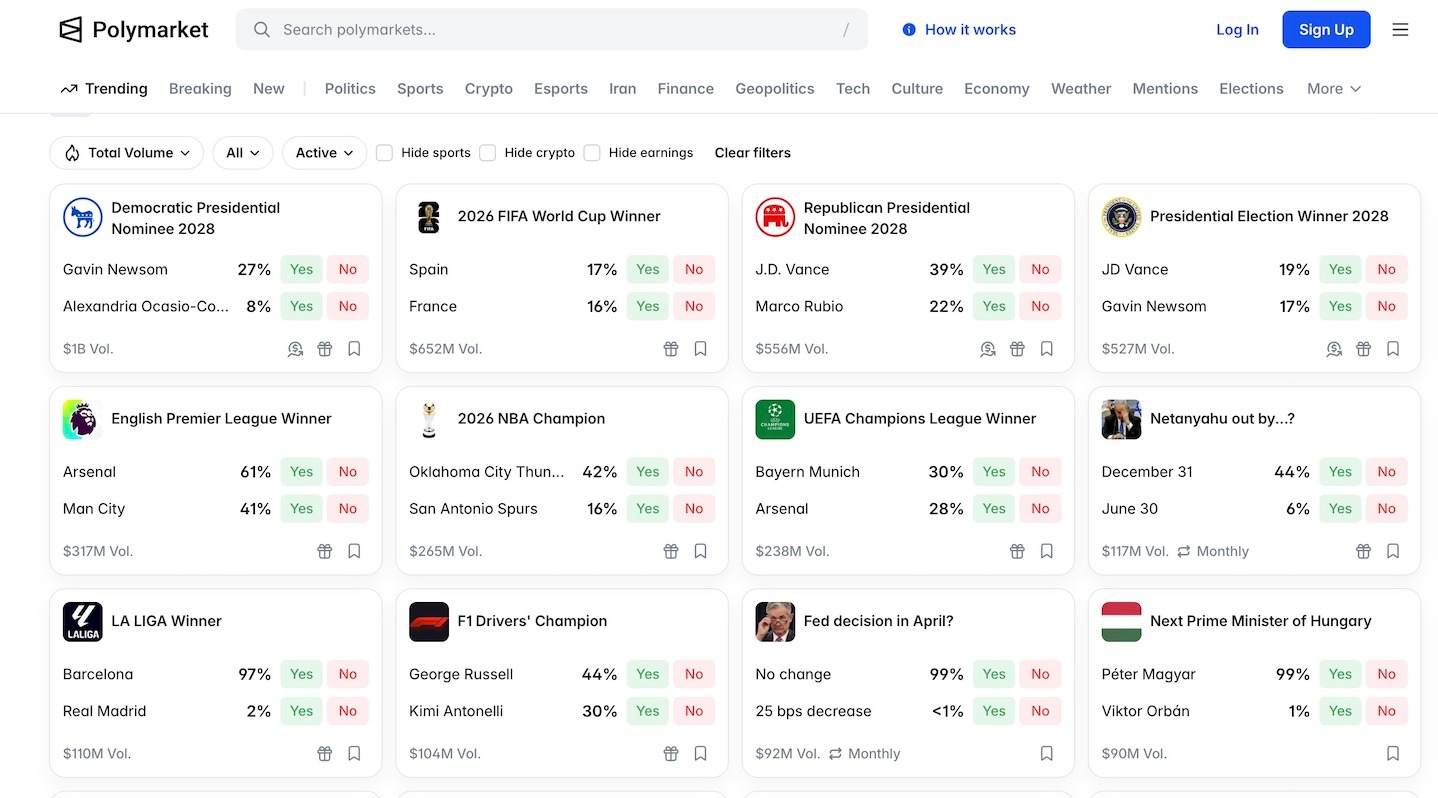
The figure is not being driven by a single event spike. Several categories are running at once: the Masters, the NBA playoffs, ongoing U.S.-Iran geopolitical developments, and the 2026 midterm elections, where positions will stay open for another six months.
Sports alone accounts for an estimated $4 billion in notional volume on the prediction markets, but the more important shift is duration. Capital is not just passing through the market. More of it is staying locked in.
Volume is Accelerating Faster Than Forecasts
Total weekly notional volume across the sector recently reached $6.5 billion, up roughly 25% week-over-week. Kalshi processed $3.54 billion of that; Polymarket handled $2.48 billion. That pace is already testing projections made only months ago.
Bernstein forecast $240 billion in annual volume by the end of 2026. Yet year-to-date volume from Kalshi and Polymarket alone has already exceeded the sector’s entire 2025 total, underscoring how quickly activity is scaling. Bernstein’s longer-range estimate of $1 trillion in annual volume by 2030 no longer looks isolated.
Other forecasts point in the same direction, even if they differ on timing and composition. What matters for the open-interest story is that many of these projections also assume a gradual shift away from sports-driven bursts toward political, economic, and corporate event contracts.
What the Open Interest Number Signals
Volume can be generated by short-term trading that says little about whether money is actually staying in the market. Open interest measures committed positions — capital that remains locked in until contracts resolve.
Crossing $1 billion on that metric, across contracts with multi-week and multi-month horizons, suggests a change in market structure. The sector is retaining capital for longer periods.
A market dominated by short-lived sports trades looks very different from one where capital is tied up across elections, macro events, and unresolved geopolitical outcomes. The latter points to longer-duration positioning rather than episodic speculation.
- Inside the Prediction Markets: Who Controls the Trade
- Retail Traders Can Now Access Prediction Markets Through Binance Wallet
- Inside the Prediction Markets: $1.6B Institutional Inflow Meets a Federal Crackdown
Growth is Clear, Durability is Less So
Forecasts broadly agree on the direction of travel, but they diverge sharply on timing, composition, and regulatory outcomes for the prediction markets. That uncertainty still matters.
Some of the most bullish projections depend on continued growth in sports contracts, while others assume expansion into economic and political markets with clearer institutional use cases. Regulatory pressure remains a live variable, particularly in categories that state regulators continue to challenge.
The $1 billion open-interest figure sits inside that tension. It is a stronger signal than volume alone because it shows capital staying in the market rather than simply passing through it.
Whether that capital proves durable will depend on how the product mix evolves — and how much of today’s growth survives regulatory contact.