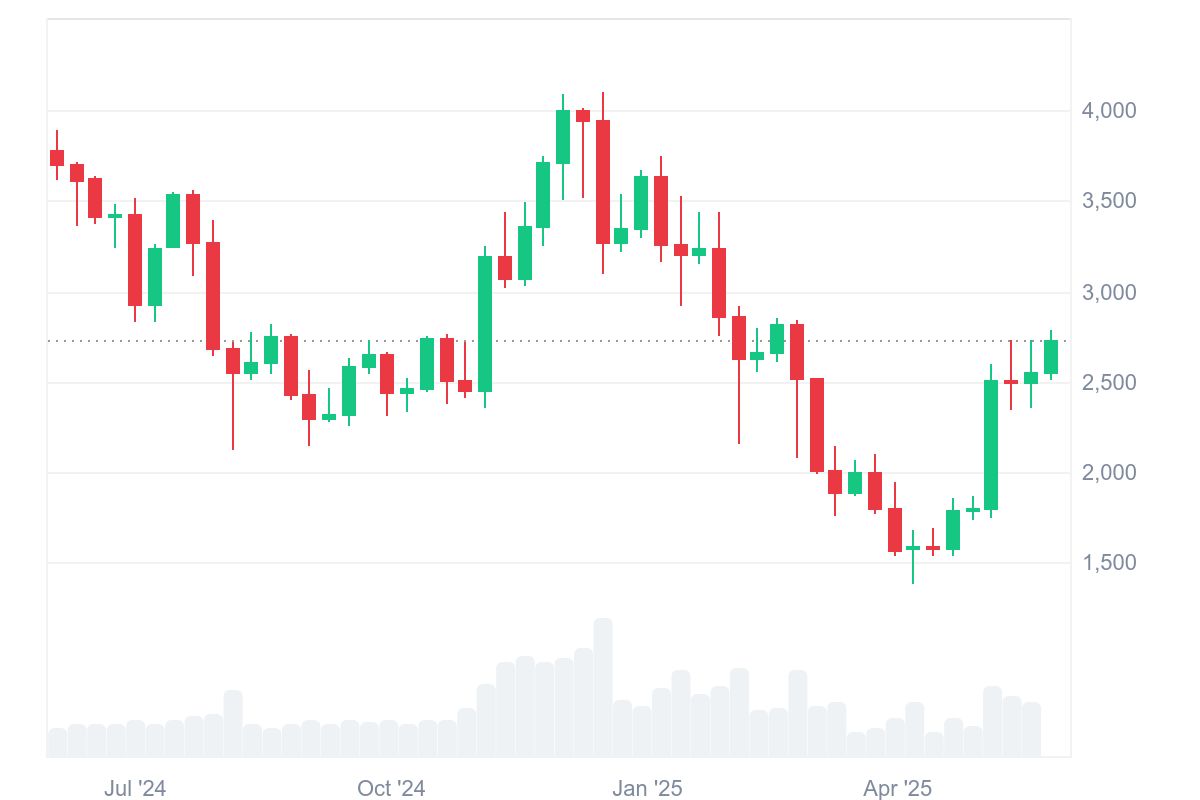
Ethereum is trading at $2,720 with strong bullish momentum targeting $3,000 in May 2025, supported by institutional inflows.
Price predictions suggest ETH could reach $4,900-$5,950 by year-end 2025, with technical indicators showing the strongest uptrend in months.
Why is Ethereum surging today? Check tecnical and fundamental analysis and price predictions
Ethereum (ETH)
has emerged as the cryptocurrency market's standout performer in late May 2025,
with the ETH price surging almost 11% in six consecutive trading sessions to
reach a three-month high of $2,789. This rally has positioned Ethereum as the
most trending cryptocurrency of the month, capturing investor attention as
Bitcoin's momentum begins to cool.
For retail
traders wondering how high can Ethereum go, the current price action suggests
we're witnessing the early stages of a significant breakout that could propel
ETH toward the psychological $3,000 level. Moreover, the long-term Ethereum
price predictions suggest it can jump to almost $6,000, rising 120% from the
current levels.
The
Ethereum price has demonstrated exceptional strength throughout May 2025, with
ETH climbing from lows around $1,750 to test intraday highs of $2,789 - marking
the highest levels seen in over three months and going up over 50% this month.
This represents a nearly 4% single-day gain that has technical analysts buzzing
about a potential breakout scenario.
Ethereum price is going up today, while other cryptos are trading water. Source: CoinMarketCap.com
What makes
this rally particularly compelling is the underlying market structure. Ethereum
has successfully broken out of its downtrend that dominated the first quarter
of 2025, with the chart now forming higher lows and testing key resistance
levels. The $2,700-$2,800 zone represents critical resistance that, once
flipped to support, could accelerate ETH toward the $3,000 target.
Trading
volumes have surged alongside the price action, with 24-hour volume reaching
$34.2 billion as institutional and retail interest converges.
The
derivatives market tells an even more compelling story. Call options
significantly outweigh puts in ETH's upcoming $2.4 billion options expiry on
May 30, with 97% of put options set to expire worthless if ETH holds above
$2,600. This massive imbalance creates strong incentives for bulls to push
prices higher, potentially triggering a squeeze that could accelerate the move
toward $3,000.
ETH options total open interest (USD). Source: Laevitas.ch
Whale
accumulation patterns provide additional confirmation of institutional
confidence. On-chain data reveals that top ETH holders now own more than at any
point since early 2023, signaling strong conviction in Ethereum's long-term
prospects. Historically, such accumulation phases often precede explosive price
movements, especially when combined with retail interest and favorable macro
conditions.
Ethereum Price Predictions
Point to $5,950
Multiple
Ethereum price prediction models converge on a bullish outlook for the
remainder of 2025. For May specifically, analysts expect ETH to trade between
$2,400-$2,900, with the upper end of this range representing a successful
breakout scenario. The psychological $3,000 level appears increasingly within
reach as technical indicators align.
Short-term
price targets include:
Immediate
resistance:
$2,700-$2,800 zone
May 2025
target: $3,000
breakthrough
Q2 2025
range:
$2,900-$3,200
Summer
2025: $3,200-$3,500
consolidation
Looking
beyond the immediate term, how high can Ethereum go becomes even more
intriguing. Conservative estimates place ETH between $1,669-$4,905 for 2025,
while more aggressive projections suggest a stretched target of $5,950.
Considers regulatory risks and
current market signals.
Andy
LaPointe
No specific
price given
Suggests buying ETH due to
favorable trends and potential ETF influence.
Fred
Schebesta
$5,710 to
$7,996
Uses technical indicators and
investor sentiment to inform his forecast.
Jeremy
Britton
$4,043.75 to
$6,500
Bases outlook on core analysis and
broader market conditions.
Consensus
(7 experts)
Average:
$5,785
Range: $2,300–$11,411
Overall sentiment suggests
confidence in Ethereum's gradual growth potential.
Technical Analysis
Supports Bullish Ethereum Outlook
What does
the Ethereum chart say from a technical perspective? According to my analysis,
Ethereum remains in a consolidation range, with the lower boundary defined by
the $2,400 level and the 200-day EMA, and the upper boundary set by local highs
from early May around $2,735.
This range
is further reinforced by a Fibonacci retracement grid drawn from the downward
trend spanning December 2024 to April 2025. Notably, the upper boundary aligns
with the strong 50% retracement level. A breakout above this level would serve
as a clear signal that bullish sentiment is returning to ETH, and breaking
through the psychological $3,000 mark could soon follow.
That said,
consolidation remains consolidation, and for now, the Ethereum price is still
trapped within that range. While the price could technically move in either
direction, I believe the current arrangement of moving averages suggests that
upward movement is the more likely scenario.
Technical analysis of Ethereum on the daily chart. Source: TradingView.com
Fundamental Catalysts
Drive Long-Term Ethereum Value
Beyond
technical factors, Ethereum's fundamental outlook remains exceptionally strong.
The network continues to dominate the decentralized finance (DeFi) and smart
contract space, with growing adoption of Layer 2 scaling solutions like Base
and Optimism driving increased utility and demand.
The
upcoming Pectra upgrade, launched on May 7 following successful testnet
implementation, introduces significant improvements to network efficiency and
security. Vitalik Buterin's new roadmap focuses on enhancing Layer 2 networks
through a "2-of-3" proof model incorporating Optimistic,
Zero-Knowledge, and Trusted Execution Environment proofs.
Supply
dynamics also favor higher prices. Ethereum 2.0's proof-of-stake mechanism,
combined with ongoing token burns from network activity, continues to reduce
the circulating supply. Increased staking activity further removes ETH from
liquid markets, creating a supply squeeze that supports higher valuations.
The broader
cryptocurrency market is experiencing what traders call a "Goldilocks
zone" - a period of stability where major risks have been absorbed and new
catalysts are building. With Bitcoin's momentum slowing after reaching new
highs above $110,000, capital rotation into major altcoins like Ethereum
appears to be accelerating.
Ethereum
news highlights this shift, with ETH becoming the most trending cryptocurrency
of May 2025. Social media sentiment, search interest, and trading volumes all
confirm that Ethereum is capturing the spotlight from Bitcoin, potentially
fueling the next major leg higher.
The
derivatives market reinforces this sentiment shift. ETH risk reversals trade at
higher premiums than Bitcoin equivalents, indicating that options traders are
more bullish on Ethereum relative to Bitcoin. Similarly, ETH futures premiums
have reached 10.5% annualized - the highest since January - compared to
Bitcoin's 8.74%.
Ethereum Positioned for
Breakout Success
The
convergence of technical momentum, institutional adoption, and fundamental
improvements positions Ethereum for a potential breakout that could define the
remainder of 2025. With the Ethereum price testing multi-month highs and
approaching the critical $3,000 psychological level, retail traders have a
compelling opportunity to participate in what could become the year's most
significant cryptocurrency rally.
The
combination of whale accumulation, derivatives market positioning, and
improving network fundamentals creates a perfect storm for sustained upward
momentum. While short-term volatility remains likely, the medium to long-term
outlook for Ethereum appears exceptionally promising.
Ethereum News FAQ
Why Is the Ethereum Price
Increasing?
Ethereum's
price surge stems from multiple converging factors creating unprecedented
bullish momentum. Institutional adoption leads the charge, with spot Ethereum
ETFs attracting $287 million in net inflows between May 19-27, demonstrating
growing institutional appetite. The derivatives market shows overwhelming
bullish sentiment, with 97% of put options set to expire worthless if ETH holds
above $2,600 in the May 30 expiry.
Can Ethereum Reach
$100,000?
Current
realistic predictions for 2025 range from $4,905 to $5,950 in stretched
scenarios, with some analysts like Julian Hosp projecting $11,111 driven by
continued ETF adoption. Reaching $100,000 would require approximately 37x
growth from current levels, which would likely need multiple bull cycles and
fundamental shifts in global finance toward cryptocurrency adoption.
How Much Will 1 Eth Be
Worth in 2025?
Based on
current analysis and market predictions, 1 ETH could be worth between $4,905
and $5,950 by the end of 2025, with conservative estimates placing it in the
$3,200-$4,900 range.
How Much Is $500 Dollars
in Ethereum Worth Today?
At
Ethereum's current price of approximately $2,720, $500 would purchase about
0.184 ETH. This calculation shows that with Ethereum trading near multi-month
highs, the dollar cost averaging approach becomes particularly relevant for
retail investors. For perspective, if Ethereum reaches the conservative 2025
prediction of $4,905, that 0.184 ETH would be worth approximately $902,
representing an 80% gain. In the optimistic $5,950 scenario, the same
investment would be worth about $1,095, delivering a 119% return.
Ethereum (ETH)
has emerged as the cryptocurrency market's standout performer in late May 2025,
with the ETH price surging almost 11% in six consecutive trading sessions to
reach a three-month high of $2,789. This rally has positioned Ethereum as the
most trending cryptocurrency of the month, capturing investor attention as
Bitcoin's momentum begins to cool.
For retail
traders wondering how high can Ethereum go, the current price action suggests
we're witnessing the early stages of a significant breakout that could propel
ETH toward the psychological $3,000 level. Moreover, the long-term Ethereum
price predictions suggest it can jump to almost $6,000, rising 120% from the
current levels.
The
Ethereum price has demonstrated exceptional strength throughout May 2025, with
ETH climbing from lows around $1,750 to test intraday highs of $2,789 - marking
the highest levels seen in over three months and going up over 50% this month.
This represents a nearly 4% single-day gain that has technical analysts buzzing
about a potential breakout scenario.
Ethereum price is going up today, while other cryptos are trading water. Source: CoinMarketCap.com
What makes
this rally particularly compelling is the underlying market structure. Ethereum
has successfully broken out of its downtrend that dominated the first quarter
of 2025, with the chart now forming higher lows and testing key resistance
levels. The $2,700-$2,800 zone represents critical resistance that, once
flipped to support, could accelerate ETH toward the $3,000 target.
Trading
volumes have surged alongside the price action, with 24-hour volume reaching
$34.2 billion as institutional and retail interest converges.
The
derivatives market tells an even more compelling story. Call options
significantly outweigh puts in ETH's upcoming $2.4 billion options expiry on
May 30, with 97% of put options set to expire worthless if ETH holds above
$2,600. This massive imbalance creates strong incentives for bulls to push
prices higher, potentially triggering a squeeze that could accelerate the move
toward $3,000.
ETH options total open interest (USD). Source: Laevitas.ch
Whale
accumulation patterns provide additional confirmation of institutional
confidence. On-chain data reveals that top ETH holders now own more than at any
point since early 2023, signaling strong conviction in Ethereum's long-term
prospects. Historically, such accumulation phases often precede explosive price
movements, especially when combined with retail interest and favorable macro
conditions.
Ethereum Price Predictions
Point to $5,950
Multiple
Ethereum price prediction models converge on a bullish outlook for the
remainder of 2025. For May specifically, analysts expect ETH to trade between
$2,400-$2,900, with the upper end of this range representing a successful
breakout scenario. The psychological $3,000 level appears increasingly within
reach as technical indicators align.
Short-term
price targets include:
Immediate
resistance:
$2,700-$2,800 zone
May 2025
target: $3,000
breakthrough
Q2 2025
range:
$2,900-$3,200
Summer
2025: $3,200-$3,500
consolidation
Looking
beyond the immediate term, how high can Ethereum go becomes even more
intriguing. Conservative estimates place ETH between $1,669-$4,905 for 2025,
while more aggressive projections suggest a stretched target of $5,950.
Considers regulatory risks and
current market signals.
Andy
LaPointe
No specific
price given
Suggests buying ETH due to
favorable trends and potential ETF influence.
Fred
Schebesta
$5,710 to
$7,996
Uses technical indicators and
investor sentiment to inform his forecast.
Jeremy
Britton
$4,043.75 to
$6,500
Bases outlook on core analysis and
broader market conditions.
Consensus
(7 experts)
Average:
$5,785
Range: $2,300–$11,411
Overall sentiment suggests
confidence in Ethereum's gradual growth potential.
Technical Analysis
Supports Bullish Ethereum Outlook
What does
the Ethereum chart say from a technical perspective? According to my analysis,
Ethereum remains in a consolidation range, with the lower boundary defined by
the $2,400 level and the 200-day EMA, and the upper boundary set by local highs
from early May around $2,735.
This range
is further reinforced by a Fibonacci retracement grid drawn from the downward
trend spanning December 2024 to April 2025. Notably, the upper boundary aligns
with the strong 50% retracement level. A breakout above this level would serve
as a clear signal that bullish sentiment is returning to ETH, and breaking
through the psychological $3,000 mark could soon follow.
That said,
consolidation remains consolidation, and for now, the Ethereum price is still
trapped within that range. While the price could technically move in either
direction, I believe the current arrangement of moving averages suggests that
upward movement is the more likely scenario.
Technical analysis of Ethereum on the daily chart. Source: TradingView.com
Fundamental Catalysts
Drive Long-Term Ethereum Value
Beyond
technical factors, Ethereum's fundamental outlook remains exceptionally strong.
The network continues to dominate the decentralized finance (DeFi) and smart
contract space, with growing adoption of Layer 2 scaling solutions like Base
and Optimism driving increased utility and demand.
The
upcoming Pectra upgrade, launched on May 7 following successful testnet
implementation, introduces significant improvements to network efficiency and
security. Vitalik Buterin's new roadmap focuses on enhancing Layer 2 networks
through a "2-of-3" proof model incorporating Optimistic,
Zero-Knowledge, and Trusted Execution Environment proofs.
Supply
dynamics also favor higher prices. Ethereum 2.0's proof-of-stake mechanism,
combined with ongoing token burns from network activity, continues to reduce
the circulating supply. Increased staking activity further removes ETH from
liquid markets, creating a supply squeeze that supports higher valuations.
The broader
cryptocurrency market is experiencing what traders call a "Goldilocks
zone" - a period of stability where major risks have been absorbed and new
catalysts are building. With Bitcoin's momentum slowing after reaching new
highs above $110,000, capital rotation into major altcoins like Ethereum
appears to be accelerating.
Ethereum
news highlights this shift, with ETH becoming the most trending cryptocurrency
of May 2025. Social media sentiment, search interest, and trading volumes all
confirm that Ethereum is capturing the spotlight from Bitcoin, potentially
fueling the next major leg higher.
The
derivatives market reinforces this sentiment shift. ETH risk reversals trade at
higher premiums than Bitcoin equivalents, indicating that options traders are
more bullish on Ethereum relative to Bitcoin. Similarly, ETH futures premiums
have reached 10.5% annualized - the highest since January - compared to
Bitcoin's 8.74%.
Ethereum Positioned for
Breakout Success
The
convergence of technical momentum, institutional adoption, and fundamental
improvements positions Ethereum for a potential breakout that could define the
remainder of 2025. With the Ethereum price testing multi-month highs and
approaching the critical $3,000 psychological level, retail traders have a
compelling opportunity to participate in what could become the year's most
significant cryptocurrency rally.
The
combination of whale accumulation, derivatives market positioning, and
improving network fundamentals creates a perfect storm for sustained upward
momentum. While short-term volatility remains likely, the medium to long-term
outlook for Ethereum appears exceptionally promising.
Ethereum News FAQ
Why Is the Ethereum Price
Increasing?
Ethereum's
price surge stems from multiple converging factors creating unprecedented
bullish momentum. Institutional adoption leads the charge, with spot Ethereum
ETFs attracting $287 million in net inflows between May 19-27, demonstrating
growing institutional appetite. The derivatives market shows overwhelming
bullish sentiment, with 97% of put options set to expire worthless if ETH holds
above $2,600 in the May 30 expiry.
Can Ethereum Reach
$100,000?
Current
realistic predictions for 2025 range from $4,905 to $5,950 in stretched
scenarios, with some analysts like Julian Hosp projecting $11,111 driven by
continued ETF adoption. Reaching $100,000 would require approximately 37x
growth from current levels, which would likely need multiple bull cycles and
fundamental shifts in global finance toward cryptocurrency adoption.
How Much Will 1 Eth Be
Worth in 2025?
Based on
current analysis and market predictions, 1 ETH could be worth between $4,905
and $5,950 by the end of 2025, with conservative estimates placing it in the
$3,200-$4,900 range.
How Much Is $500 Dollars
in Ethereum Worth Today?
At
Ethereum's current price of approximately $2,720, $500 would purchase about
0.184 ETH. This calculation shows that with Ethereum trading near multi-month
highs, the dollar cost averaging approach becomes particularly relevant for
retail investors. For perspective, if Ethereum reaches the conservative 2025
prediction of $4,905, that 0.184 ETH would be worth approximately $902,
representing an 80% gain. In the optimistic $5,950 scenario, the same
investment would be worth about $1,095, delivering a 119% return.
Damian Chmiel is a Senior Analyst & Editor at Finance Magnates with more than 15 years of experience in the CFD and online trading industry. Active as both a trader and journalist since 2010, he focuses on broker coverage, fintech innovation, and regulatory developments across Europe, the Middle East, and Asia.
His work includes interviews with C-level leaders at major brokerages and fintech platforms, as well as co-authoring Finance Magnates’ quarterly industry benchmarking reports. Damian’s reporting is data-driven, market-aware, and grounded in direct industry engagement. His analysis and commentary have also been cited by external media outlets, including Investing.com, Binance, The Asset, Stockhead, and Dispatch.
Education:
MA in Finance and Accounting, Cracow University of Economics
Why Is Dogecoin Going Up Today? DOGE Price Prediction Shows 25% Upside Potential
Featured Videos
AvaTrade to Acquire Most of FXCM; NAGA Raises $8M
AvaTrade to Acquire Most of FXCM; NAGA Raises $8M
AvaTrade to Acquire Most of FXCM; NAGA Raises $8M
AvaTrade to Acquire Most of FXCM; NAGA Raises $8M
Today’s financial news recap covers AvaTrade agrees to acquire most of FXCM, NAGA secures eight million dollars in new financing, and Wise seeks a tax settlement in the UK.
Finance Magnates Daily Recap brings you the latest news from forex and CFD brokers, fintech, payments, cryptocurrency, digital assets, trading platforms, financial regulation and global markets.
Get the key company news, executive moves, deals, regulatory updates and market developments of the day, in just a few minutes. New episodes published every weekday.
Read more: https://www.financemagnates.com
#FinanceMagnates #ForexNews #FintechNews
Today’s financial news recap covers AvaTrade agrees to acquire most of FXCM, NAGA secures eight million dollars in new financing, and Wise seeks a tax settlement in the UK.
Finance Magnates Daily Recap brings you the latest news from forex and CFD brokers, fintech, payments, cryptocurrency, digital assets, trading platforms, financial regulation and global markets.
Get the key company news, executive moves, deals, regulatory updates and market developments of the day, in just a few minutes. New episodes published every weekday.
Read more: https://www.financemagnates.com
#FinanceMagnates #ForexNews #FintechNews
Today’s financial news recap covers AvaTrade agrees to acquire most of FXCM, NAGA secures eight million dollars in new financing, and Wise seeks a tax settlement in the UK.
Finance Magnates Daily Recap brings you the latest news from forex and CFD brokers, fintech, payments, cryptocurrency, digital assets, trading platforms, financial regulation and global markets.
Get the key company news, executive moves, deals, regulatory updates and market developments of the day, in just a few minutes. New episodes published every weekday.
Read more: https://www.financemagnates.com
#FinanceMagnates #ForexNews #FintechNews
Today’s financial news recap covers AvaTrade agrees to acquire most of FXCM, NAGA secures eight million dollars in new financing, and Wise seeks a tax settlement in the UK.
Finance Magnates Daily Recap brings you the latest news from forex and CFD brokers, fintech, payments, cryptocurrency, digital assets, trading platforms, financial regulation and global markets.
Get the key company news, executive moves, deals, regulatory updates and market developments of the day, in just a few minutes. New episodes published every weekday.
Read more: https://www.financemagnates.com
#FinanceMagnates #ForexNews #FintechNews
XTB Adds Overnight US Stock Trading; Nasdaq Ventures Invests in One Trading
XTB Adds Overnight US Stock Trading; Nasdaq Ventures Invests in One Trading
XTB Adds Overnight US Stock Trading; Nasdaq Ventures Invests in One Trading
XTB Adds Overnight US Stock Trading; Nasdaq Ventures Invests in One Trading
XTB Adds Overnight US Stock Trading; Nasdaq Ventures Invests in One Trading
XTB Adds Overnight US Stock Trading; Nasdaq Ventures Invests in One Trading
Today’s financial news recap covers XTB expands overnight US stock trading, Fortrade reports higher revenue, Nasdaq backs One Trading, and Vest Labs raises 13 million dollars.
Finance Magnates Daily Recap brings you the latest news from forex and CFD brokers, fintech, payments, cryptocurrency, digital assets, trading platforms, financial regulation and global markets.
Get the key company news, executive moves, deals, regulatory updates and market developments of the day, in just a few minutes. New episodes published every weekday.
Read more: https://www.financemagnates.com
#FinanceMagnates #ForexNews #FintechNews
Today’s financial news recap covers XTB expands overnight US stock trading, Fortrade reports higher revenue, Nasdaq backs One Trading, and Vest Labs raises 13 million dollars.
Finance Magnates Daily Recap brings you the latest news from forex and CFD brokers, fintech, payments, cryptocurrency, digital assets, trading platforms, financial regulation and global markets.
Get the key company news, executive moves, deals, regulatory updates and market developments of the day, in just a few minutes. New episodes published every weekday.
Read more: https://www.financemagnates.com
#FinanceMagnates #ForexNews #FintechNews
Today’s financial news recap covers XTB expands overnight US stock trading, Fortrade reports higher revenue, Nasdaq backs One Trading, and Vest Labs raises 13 million dollars.
Finance Magnates Daily Recap brings you the latest news from forex and CFD brokers, fintech, payments, cryptocurrency, digital assets, trading platforms, financial regulation and global markets.
Get the key company news, executive moves, deals, regulatory updates and market developments of the day, in just a few minutes. New episodes published every weekday.
Read more: https://www.financemagnates.com
#FinanceMagnates #ForexNews #FintechNews
Today’s financial news recap covers XTB expands overnight US stock trading, Fortrade reports higher revenue, Nasdaq backs One Trading, and Vest Labs raises 13 million dollars.
Finance Magnates Daily Recap brings you the latest news from forex and CFD brokers, fintech, payments, cryptocurrency, digital assets, trading platforms, financial regulation and global markets.
Get the key company news, executive moves, deals, regulatory updates and market developments of the day, in just a few minutes. New episodes published every weekday.
Read more: https://www.financemagnates.com
#FinanceMagnates #ForexNews #FintechNews
Today’s financial news recap covers XTB expands overnight US stock trading, Fortrade reports higher revenue, Nasdaq backs One Trading, and Vest Labs raises 13 million dollars.
Finance Magnates Daily Recap brings you the latest news from forex and CFD brokers, fintech, payments, cryptocurrency, digital assets, trading platforms, financial regulation and global markets.
Get the key company news, executive moves, deals, regulatory updates and market developments of the day, in just a few minutes. New episodes published every weekday.
Read more: https://www.financemagnates.com
#FinanceMagnates #ForexNews #FintechNews
Today’s financial news recap covers XTB expands overnight US stock trading, Fortrade reports higher revenue, Nasdaq backs One Trading, and Vest Labs raises 13 million dollars.
Finance Magnates Daily Recap brings you the latest news from forex and CFD brokers, fintech, payments, cryptocurrency, digital assets, trading platforms, financial regulation and global markets.
Get the key company news, executive moves, deals, regulatory updates and market developments of the day, in just a few minutes. New episodes published every weekday.
Read more: https://www.financemagnates.com
#FinanceMagnates #ForexNews #FintechNews
CMC Founder Downplays Volatility Hit; Devexperts Names CEO
CMC Founder Downplays Volatility Hit; Devexperts Names CEO
CMC Founder Downplays Volatility Hit; Devexperts Names CEO
CMC Founder Downplays Volatility Hit; Devexperts Names CEO
CMC Founder Downplays Volatility Hit; Devexperts Names CEO
CMC Founder Downplays Volatility Hit; Devexperts Names CEO
Today’s financial news recap covers low volatility pressures brokers, Devexperts names a new CEO, Saxo cuts onboarding time, and OKX reaches a 25 billion dollar valuation.
Finance Magnates Daily Recap brings you the latest news from forex and CFD brokers, fintech, payments, cryptocurrency, digital assets, trading platforms, financial regulation and global markets.
Get the key company news, executive moves, deals, regulatory updates and market developments of the day, in just a few minutes. New episodes published every weekday.
Read more: https://www.financemagnates.com
#FinanceMagnates #ForexNews #FintechNews
Today’s financial news recap covers low volatility pressures brokers, Devexperts names a new CEO, Saxo cuts onboarding time, and OKX reaches a 25 billion dollar valuation.
Finance Magnates Daily Recap brings you the latest news from forex and CFD brokers, fintech, payments, cryptocurrency, digital assets, trading platforms, financial regulation and global markets.
Get the key company news, executive moves, deals, regulatory updates and market developments of the day, in just a few minutes. New episodes published every weekday.
Read more: https://www.financemagnates.com
#FinanceMagnates #ForexNews #FintechNews
Today’s financial news recap covers low volatility pressures brokers, Devexperts names a new CEO, Saxo cuts onboarding time, and OKX reaches a 25 billion dollar valuation.
Finance Magnates Daily Recap brings you the latest news from forex and CFD brokers, fintech, payments, cryptocurrency, digital assets, trading platforms, financial regulation and global markets.
Get the key company news, executive moves, deals, regulatory updates and market developments of the day, in just a few minutes. New episodes published every weekday.
Read more: https://www.financemagnates.com
#FinanceMagnates #ForexNews #FintechNews
Today’s financial news recap covers low volatility pressures brokers, Devexperts names a new CEO, Saxo cuts onboarding time, and OKX reaches a 25 billion dollar valuation.
Finance Magnates Daily Recap brings you the latest news from forex and CFD brokers, fintech, payments, cryptocurrency, digital assets, trading platforms, financial regulation and global markets.
Get the key company news, executive moves, deals, regulatory updates and market developments of the day, in just a few minutes. New episodes published every weekday.
Read more: https://www.financemagnates.com
#FinanceMagnates #ForexNews #FintechNews
Today’s financial news recap covers low volatility pressures brokers, Devexperts names a new CEO, Saxo cuts onboarding time, and OKX reaches a 25 billion dollar valuation.
Finance Magnates Daily Recap brings you the latest news from forex and CFD brokers, fintech, payments, cryptocurrency, digital assets, trading platforms, financial regulation and global markets.
Get the key company news, executive moves, deals, regulatory updates and market developments of the day, in just a few minutes. New episodes published every weekday.
Read more: https://www.financemagnates.com
#FinanceMagnates #ForexNews #FintechNews
Today’s financial news recap covers low volatility pressures brokers, Devexperts names a new CEO, Saxo cuts onboarding time, and OKX reaches a 25 billion dollar valuation.
Finance Magnates Daily Recap brings you the latest news from forex and CFD brokers, fintech, payments, cryptocurrency, digital assets, trading platforms, financial regulation and global markets.
Get the key company news, executive moves, deals, regulatory updates and market developments of the day, in just a few minutes. New episodes published every weekday.
Read more: https://www.financemagnates.com
#FinanceMagnates #ForexNews #FintechNews
Today’s financial news recap covers Trade Nation buys FXCM's UK client book, Trading 212 reports higher revenue, the CFTC's move to allow perpetual index futures.
Finance Magnates Daily Recap brings you the latest news from forex and CFD brokers, fintech, payments, cryptocurrency, digital assets, trading platforms, financial regulation and global markets.
Get the key company news, executive moves, deals, regulatory updates and market developments of the day, in just a few minutes. New episodes published every weekday.
Read more: https://www.financemagnates.com
#FinanceMagnates #ForexNews #FintechNews
Today’s financial news recap covers Trade Nation buys FXCM's UK client book, Trading 212 reports higher revenue, the CFTC's move to allow perpetual index futures.
Finance Magnates Daily Recap brings you the latest news from forex and CFD brokers, fintech, payments, cryptocurrency, digital assets, trading platforms, financial regulation and global markets.
Get the key company news, executive moves, deals, regulatory updates and market developments of the day, in just a few minutes. New episodes published every weekday.
Read more: https://www.financemagnates.com
#FinanceMagnates #ForexNews #FintechNews
Today’s financial news recap covers Trade Nation buys FXCM's UK client book, Trading 212 reports higher revenue, the CFTC's move to allow perpetual index futures.
Finance Magnates Daily Recap brings you the latest news from forex and CFD brokers, fintech, payments, cryptocurrency, digital assets, trading platforms, financial regulation and global markets.
Get the key company news, executive moves, deals, regulatory updates and market developments of the day, in just a few minutes. New episodes published every weekday.
Read more: https://www.financemagnates.com
#FinanceMagnates #ForexNews #FintechNews
Today’s financial news recap covers Trade Nation buys FXCM's UK client book, Trading 212 reports higher revenue, the CFTC's move to allow perpetual index futures.
Finance Magnates Daily Recap brings you the latest news from forex and CFD brokers, fintech, payments, cryptocurrency, digital assets, trading platforms, financial regulation and global markets.
Get the key company news, executive moves, deals, regulatory updates and market developments of the day, in just a few minutes. New episodes published every weekday.
Read more: https://www.financemagnates.com
#FinanceMagnates #ForexNews #FintechNews
Today’s financial news recap covers Trade Nation buys FXCM's UK client book, Trading 212 reports higher revenue, the CFTC's move to allow perpetual index futures.
Finance Magnates Daily Recap brings you the latest news from forex and CFD brokers, fintech, payments, cryptocurrency, digital assets, trading platforms, financial regulation and global markets.
Get the key company news, executive moves, deals, regulatory updates and market developments of the day, in just a few minutes. New episodes published every weekday.
Read more: https://www.financemagnates.com
#FinanceMagnates #ForexNews #FintechNews
Today’s financial news recap covers Trade Nation buys FXCM's UK client book, Trading 212 reports higher revenue, the CFTC's move to allow perpetual index futures.
Finance Magnates Daily Recap brings you the latest news from forex and CFD brokers, fintech, payments, cryptocurrency, digital assets, trading platforms, financial regulation and global markets.
Get the key company news, executive moves, deals, regulatory updates and market developments of the day, in just a few minutes. New episodes published every weekday.
Read more: https://www.financemagnates.com
#FinanceMagnates #ForexNews #FintechNews
Your career isn’t a linear path.
Your career isn’t a linear path.
Your career isn’t a linear path.
Your career isn’t a linear path.
Your career isn’t a linear path.
Your career isn’t a linear path.
Roles change. Career goals change. Sometimes you want a completely new challenge.
But the skills and knowledge you build along the way can stay with you and give you something to build on.
For Jeff Patterson, that continued growth is key to long-term career development.
You bring the skills. FM Academy helps you build the knowledge.
#FMAcademy #FinanceMagnates #FinanceCareers #ProfessionalDevelopment #Fintech
Roles change. Career goals change. Sometimes you want a completely new challenge.
But the skills and knowledge you build along the way can stay with you and give you something to build on.
For Jeff Patterson, that continued growth is key to long-term career development.
You bring the skills. FM Academy helps you build the knowledge.
#FMAcademy #FinanceMagnates #FinanceCareers #ProfessionalDevelopment #Fintech
Roles change. Career goals change. Sometimes you want a completely new challenge.
But the skills and knowledge you build along the way can stay with you and give you something to build on.
For Jeff Patterson, that continued growth is key to long-term career development.
You bring the skills. FM Academy helps you build the knowledge.
#FMAcademy #FinanceMagnates #FinanceCareers #ProfessionalDevelopment #Fintech
Roles change. Career goals change. Sometimes you want a completely new challenge.
But the skills and knowledge you build along the way can stay with you and give you something to build on.
For Jeff Patterson, that continued growth is key to long-term career development.
You bring the skills. FM Academy helps you build the knowledge.
#FMAcademy #FinanceMagnates #FinanceCareers #ProfessionalDevelopment #Fintech
Roles change. Career goals change. Sometimes you want a completely new challenge.
But the skills and knowledge you build along the way can stay with you and give you something to build on.
For Jeff Patterson, that continued growth is key to long-term career development.
You bring the skills. FM Academy helps you build the knowledge.
#FMAcademy #FinanceMagnates #FinanceCareers #ProfessionalDevelopment #Fintech
Roles change. Career goals change. Sometimes you want a completely new challenge.
But the skills and knowledge you build along the way can stay with you and give you something to build on.
For Jeff Patterson, that continued growth is key to long-term career development.
You bring the skills. FM Academy helps you build the knowledge.
#FMAcademy #FinanceMagnates #FinanceCareers #ProfessionalDevelopment #Fintech