Major cryptocurrencies are experiencing visible price gains in early July 2025.
Bitcoin is returning to the $100,000 area, Ethereum is breaking above the $2,500 level, and Dogecoin is gaining over 7%.
Let's check why crypto prices are going up today and what the newest price predictions are for BTC, ETH, XRP, and DOGE.
The
cryptocurrency market is experiencing a significant surge today, with Bitcoin
(BTC) price climbing nearly 3% during Wednesday's session to test the $109,800
level, followed by an additional 0.5% gain on Thursday. This bullish momentum
extends across major digital assets, as Ethereum (ETH) price jumped 7% on
Wednesday and continues rising over 1% today, while Dogecoin (DOGE) price and
XRP price are also posting substantial gains amid renewed investor optimism.
In this
article, I examine why crypto is going up today and what the latest price predictions
are for Bitcoin, Ethereum, Doge, and XRP for July 2025.
This above is an advertisement by Utip
Why is Crypto Going Up
Today? 4 Key Market Drivers
The current
cryptocurrency rally stems from multiple converging factors that are driving
institutional and retail investor confidence. Market sentiment has shifted
dramatically as digital assets break through key resistance levels, with
Bitcoin price reaching its strongest position in over a month at $109,406. This
surge represents a clear departure from recent consolidation patterns,
signaling renewed bullish momentum across the entire crypto ecosystem.
Eurozone
monetary expansion
has emerged as a significant catalyst behind the current rally. The eurozone's
broad money supply (M2) reached record highs in April, showing a 2.7%
year-over-year expansion that aligns with the expansionary trajectory of the US
monetary base. This monetary expansion has increased global liquidity, creating
favorable conditions for risk assets including cryptocurrencies. The European
Central Bank's data shows the Euro Area Money Supply M2 at 15.74 trillion euros
for May 2025, up 3.55% from one year ago.
Global
liquidity conditions continue supporting cryptocurrency valuations, as Bitcoin's price closely follows
global liquidity trends. When there is more money available in the financial
system, asset prices tend to rise, and the current monetary expansion across
major economies is providing this supportive backdrop. The relationship between
M2 money supply and Bitcoin's market cycles has historically been strong, with
growth in M2 correlating with Bitcoin's bull cycles.
Institutional
adoption continues accelerating, with major financial institutions increasing their cryptocurrency
exposure and regulatory clarity improving in key markets. The combination of
these fundamental drivers with technical breakouts has created a perfect storm
for upward price action across Bitcoin, Ethereum, XRP, and Dogecoin.
The
technical picture for Bitcoin remains overwhelmingly bullish, as the
cryptocurrency has successfully broken through multiple resistance zones.
Trading volumes have increased significantly during this rally, indicating
genuine buying interest rather than low-volume manipulation.
Why is Bitcoin price going up today. Source: Tradingview.com
As shown in
the chart above, however, Bitcoin’s price continues to move within the same
consolidation channel, with the upper boundary marked by the May all-time high.
While the recent gains allowed BTC to break above the trendline connecting the
lower highs formed since then, it still faces a fairly strong bearish
resistance ahead.
“The
macro backdrop for Bitcoin’s long-term bullish market structure remains broadly
supportive. Inflationary pressures are building up again, the U.S. dollar is
softening, and equities are breaking into new all-time highs, all of which
keep Bitcoin’s structural bullish thesis intact. But until a clear macro
catalyst emerges, the market seems hesitant to push higher,” said Ray Yossef, CEO of crypto app NoOnes and a long-time Bitcoin advocate.
Ethereum
price has delivered even more impressive gains than Bitcoin, with a 7% surge on
Wednesday that tested intraday highs at $2,620. Thursday's continued momentum
has added over 1% to Ethereum's value, bringing the current price to $2,598,
representing the highest level in a month.
Why is Ethereum price going up today. Source: Tradingview.com
My technical analysis shows that, like Bitcoin, Ethereum is also moving
within a consolidation range, recently testing its lower boundary near $2,400.
On Wednesday, the price bounced off that level, reopening the path toward the
upper band, which lies between $2,750 and $2,830.
The
Ethereum network's fundamental strength continues driving investor interest,
with smart contract activity reaching new highs and decentralized finance
protocols showing robust growth. This technical innovation, combined with
Ethereum's proof-of-stake consensus mechanism, has positioned the network as a
cornerstone of the evolving digital economy.
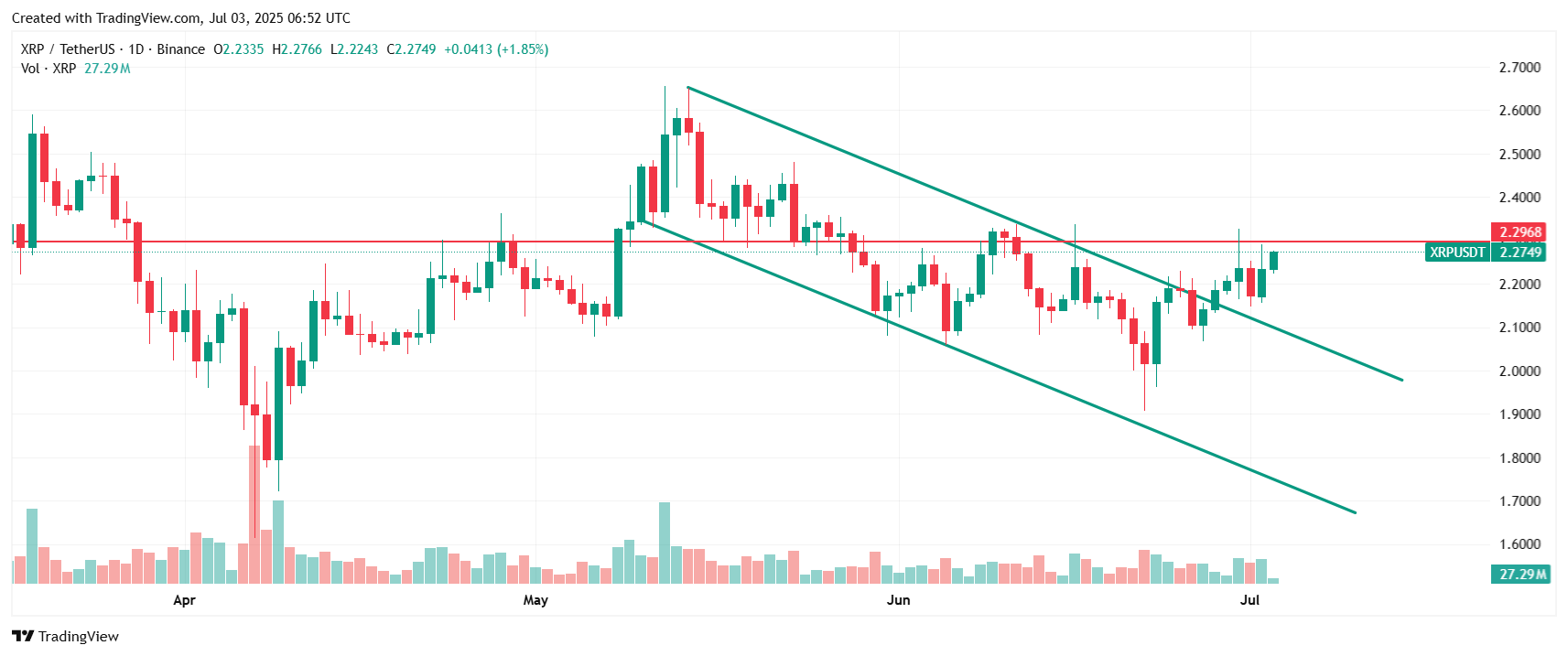
XRP price
has demonstrated steady upward momentum, with a 1.75% gain on Wednesday
followed by another 1.75% increase on Thursday. Current trading levels around
$2.2764 represent significant progress for the digital asset, though technical
analysis indicates that the $2.30 level remains a crucial resistance point on
the XRP/USDT chart.
The recent
XRP price surge coincides with improving regulatory clarity surrounding the
digital asset's classification and usage. Legal developments have reduced
uncertainty that previously weighed on investor sentiment, allowing XRP to
participate more fully in the broader cryptocurrency rally.
Cross-border
payment adoption continues expanding for XRP, with financial institutions
increasingly recognizing the token's utility for international transactions.
This real-world usage provides fundamental support for XRP's current price
levels and suggests potential for sustained growth.
Why is XRP price going up today. Source: Tradingview.com
On the
technical front, XRP broke out of a bearish regression channel some time ago,
opening the door to potential stronger gains. However, appreciation is
currently being capped by a key resistance zone around $2.30, which has halted
price advances three times since early June. Only a breakout above this level
would pave the way for XRP to retest the May highs above $2.60.
Dogecoin Price Action:
Meme Coin Momentum
Dogecoin
price has emerged as one of the strongest performers in the current rally,
adding over 7% to its value on Wednesday and continuing with a 2.5% gain on
Thursday. The meme cryptocurrency has established new local highs at the
$0.1750 level, demonstrating remarkable resilience and investor interest.
The
Dogecoin surge reflects broader risk-on sentiment in cryptocurrency markets,
with investors showing renewed appetite for higher-volatility digital assets.
Social media engagement around Dogecoin has increased substantially,
contributing to the positive momentum and attracting new participants to the
market.
From a technical standpoint, Dogecoin remains weak. It continues to trade
near local lows and is still far from the key resistance zone between $0.19 and
$0.20. While the bounce from the local bottom at $0.15 and the breakout from
the bearish regression channel allowed it to recover above the May lows around
$0.1674, the May highs near $0.26 still appear to be a distant target.
Why is Dogecoin price going up today. Source: Tradingview.com
Bitcoin, Ethereum and XRP
Price Predictions and Analyst Perspectives on Digital Asset Rally
Bitcoin
price predictions for 2025 have reached unprecedented levels, with Standard
Chartered projecting Bitcoin could reach $135,000 by Q3 2025. The bank's
analysis emphasizes macroeconomic factors including inflation and global
recovery as key drivers, while highlighting Bitcoin's evolution from
speculative asset to recognized store of value.
Ethereum
price predictions show consistency across multiple forecasting models. October
2025 projections suggest ETH will trade between $3,300 and $3,400, with
technical charts showing bullish flag formations and potential upside targets
around $3,400.
XRP price
predictions present the widest range among major cryptocurrencies, reflecting
ongoing regulatory uncertainties and potential catalysts. CoinPedia's analysis
suggests XRP could reach $5.81 by the end of 2025, with potential lows around
$2.30 and average prices near $4.89.
More
aggressive XRP forecasts project the token could hit $26.50 by 2030 and $526 by
2050, driven by institutional adoption and resolution of legal challenges. The
potential approval of an XRP ETF in 2025 represents a significant catalyst that
could accelerate these timelines.
2025 Crypto Price Prediction Table
Cryptocurrency
Conservative
2025 Target
Bullish
2025 Target
Potential
2030 Range
Bitcoin
$120,000–$135,000
$175,000–$200,000
$400,000–$500,000
Ethereum
$3,200–$3,700
$4,500–$5,000
$10,500–$30,000
XRP
$4.50–$5.81
$8.00–$15.00
$26.50–$50.00
Dogecoin
$0.25–$0.35
$0.50–$0.75
$1.00–$2.00
The
convergence of institutional adoption, regulatory clarity, and technical
momentum creates a compelling case for the bullish price predictions outlined
above. However, cryptocurrency markets remain inherently volatile, and these
forecasts should be considered alongside appropriate risk management
strategies.
Crypto News, FAQ
Why Are Cryptos Going Up
Right Now?
Cryptocurrencies
are experiencing significant upward momentum due to a convergence of powerful
market forces. Eurozone monetary expansion has emerged as a key catalyst, with
the broad money supply (M2) reaching record highs in April and showing a 2.7%
year-over-year expansion that aligns with US monetary base growth. This
increased global liquidity creates favorable conditions for risk assets
including cryptocurrencies.
Why Will Crypto Rise
Again?
The
cryptocurrency market is positioned for continued growth based on several
structural developments that support long-term appreciation. Institutional
infrastructure has matured significantly, with major corporations, pension
funds, and sovereign wealth funds allocating substantial portions of their
portfolios to digital assets. This institutional foundation provides stability
and sustained demand that wasn't present in previous market cycles.
Which Crypto Will Give
1000x in 2025?
While
established cryptocurrencies like Bitcoin and Ethereum offer more conservative
growth prospects, several emerging projects are positioned for exponential
returns. Bitcoin Hyper ($HYPER) represents a compelling 1000x opportunity as a
layer-2 solution leveraging Solana's Virtual Machine to bring speed and
scalability to Bitcoin. Currently priced at $0.011825 in presale, the project
recently reached $1 million valuation and offers staking rewards up to 1298%
annual yield.
The
cryptocurrency market is experiencing a significant surge today, with Bitcoin
(BTC) price climbing nearly 3% during Wednesday's session to test the $109,800
level, followed by an additional 0.5% gain on Thursday. This bullish momentum
extends across major digital assets, as Ethereum (ETH) price jumped 7% on
Wednesday and continues rising over 1% today, while Dogecoin (DOGE) price and
XRP price are also posting substantial gains amid renewed investor optimism.
In this
article, I examine why crypto is going up today and what the latest price predictions
are for Bitcoin, Ethereum, Doge, and XRP for July 2025.
This above is an advertisement by Utip
Why is Crypto Going Up
Today? 4 Key Market Drivers
The current
cryptocurrency rally stems from multiple converging factors that are driving
institutional and retail investor confidence. Market sentiment has shifted
dramatically as digital assets break through key resistance levels, with
Bitcoin price reaching its strongest position in over a month at $109,406. This
surge represents a clear departure from recent consolidation patterns,
signaling renewed bullish momentum across the entire crypto ecosystem.
Eurozone
monetary expansion
has emerged as a significant catalyst behind the current rally. The eurozone's
broad money supply (M2) reached record highs in April, showing a 2.7%
year-over-year expansion that aligns with the expansionary trajectory of the US
monetary base. This monetary expansion has increased global liquidity, creating
favorable conditions for risk assets including cryptocurrencies. The European
Central Bank's data shows the Euro Area Money Supply M2 at 15.74 trillion euros
for May 2025, up 3.55% from one year ago.
Global
liquidity conditions continue supporting cryptocurrency valuations, as Bitcoin's price closely follows
global liquidity trends. When there is more money available in the financial
system, asset prices tend to rise, and the current monetary expansion across
major economies is providing this supportive backdrop. The relationship between
M2 money supply and Bitcoin's market cycles has historically been strong, with
growth in M2 correlating with Bitcoin's bull cycles.
Institutional
adoption continues accelerating, with major financial institutions increasing their cryptocurrency
exposure and regulatory clarity improving in key markets. The combination of
these fundamental drivers with technical breakouts has created a perfect storm
for upward price action across Bitcoin, Ethereum, XRP, and Dogecoin.
The
technical picture for Bitcoin remains overwhelmingly bullish, as the
cryptocurrency has successfully broken through multiple resistance zones.
Trading volumes have increased significantly during this rally, indicating
genuine buying interest rather than low-volume manipulation.
Why is Bitcoin price going up today. Source: Tradingview.com
As shown in
the chart above, however, Bitcoin’s price continues to move within the same
consolidation channel, with the upper boundary marked by the May all-time high.
While the recent gains allowed BTC to break above the trendline connecting the
lower highs formed since then, it still faces a fairly strong bearish
resistance ahead.
“The
macro backdrop for Bitcoin’s long-term bullish market structure remains broadly
supportive. Inflationary pressures are building up again, the U.S. dollar is
softening, and equities are breaking into new all-time highs, all of which
keep Bitcoin’s structural bullish thesis intact. But until a clear macro
catalyst emerges, the market seems hesitant to push higher,” said Ray Yossef, CEO of crypto app NoOnes and a long-time Bitcoin advocate.
Ethereum
price has delivered even more impressive gains than Bitcoin, with a 7% surge on
Wednesday that tested intraday highs at $2,620. Thursday's continued momentum
has added over 1% to Ethereum's value, bringing the current price to $2,598,
representing the highest level in a month.
Why is Ethereum price going up today. Source: Tradingview.com
My technical analysis shows that, like Bitcoin, Ethereum is also moving
within a consolidation range, recently testing its lower boundary near $2,400.
On Wednesday, the price bounced off that level, reopening the path toward the
upper band, which lies between $2,750 and $2,830.
The
Ethereum network's fundamental strength continues driving investor interest,
with smart contract activity reaching new highs and decentralized finance
protocols showing robust growth. This technical innovation, combined with
Ethereum's proof-of-stake consensus mechanism, has positioned the network as a
cornerstone of the evolving digital economy.
XRP price
has demonstrated steady upward momentum, with a 1.75% gain on Wednesday
followed by another 1.75% increase on Thursday. Current trading levels around
$2.2764 represent significant progress for the digital asset, though technical
analysis indicates that the $2.30 level remains a crucial resistance point on
the XRP/USDT chart.
The recent
XRP price surge coincides with improving regulatory clarity surrounding the
digital asset's classification and usage. Legal developments have reduced
uncertainty that previously weighed on investor sentiment, allowing XRP to
participate more fully in the broader cryptocurrency rally.
Cross-border
payment adoption continues expanding for XRP, with financial institutions
increasingly recognizing the token's utility for international transactions.
This real-world usage provides fundamental support for XRP's current price
levels and suggests potential for sustained growth.
Why is XRP price going up today. Source: Tradingview.com
On the
technical front, XRP broke out of a bearish regression channel some time ago,
opening the door to potential stronger gains. However, appreciation is
currently being capped by a key resistance zone around $2.30, which has halted
price advances three times since early June. Only a breakout above this level
would pave the way for XRP to retest the May highs above $2.60.
Dogecoin Price Action:
Meme Coin Momentum
Dogecoin
price has emerged as one of the strongest performers in the current rally,
adding over 7% to its value on Wednesday and continuing with a 2.5% gain on
Thursday. The meme cryptocurrency has established new local highs at the
$0.1750 level, demonstrating remarkable resilience and investor interest.
The
Dogecoin surge reflects broader risk-on sentiment in cryptocurrency markets,
with investors showing renewed appetite for higher-volatility digital assets.
Social media engagement around Dogecoin has increased substantially,
contributing to the positive momentum and attracting new participants to the
market.
From a technical standpoint, Dogecoin remains weak. It continues to trade
near local lows and is still far from the key resistance zone between $0.19 and
$0.20. While the bounce from the local bottom at $0.15 and the breakout from
the bearish regression channel allowed it to recover above the May lows around
$0.1674, the May highs near $0.26 still appear to be a distant target.
Why is Dogecoin price going up today. Source: Tradingview.com
Bitcoin, Ethereum and XRP
Price Predictions and Analyst Perspectives on Digital Asset Rally
Bitcoin
price predictions for 2025 have reached unprecedented levels, with Standard
Chartered projecting Bitcoin could reach $135,000 by Q3 2025. The bank's
analysis emphasizes macroeconomic factors including inflation and global
recovery as key drivers, while highlighting Bitcoin's evolution from
speculative asset to recognized store of value.
Ethereum
price predictions show consistency across multiple forecasting models. October
2025 projections suggest ETH will trade between $3,300 and $3,400, with
technical charts showing bullish flag formations and potential upside targets
around $3,400.
XRP price
predictions present the widest range among major cryptocurrencies, reflecting
ongoing regulatory uncertainties and potential catalysts. CoinPedia's analysis
suggests XRP could reach $5.81 by the end of 2025, with potential lows around
$2.30 and average prices near $4.89.
More
aggressive XRP forecasts project the token could hit $26.50 by 2030 and $526 by
2050, driven by institutional adoption and resolution of legal challenges. The
potential approval of an XRP ETF in 2025 represents a significant catalyst that
could accelerate these timelines.
2025 Crypto Price Prediction Table
Cryptocurrency
Conservative
2025 Target
Bullish
2025 Target
Potential
2030 Range
Bitcoin
$120,000–$135,000
$175,000–$200,000
$400,000–$500,000
Ethereum
$3,200–$3,700
$4,500–$5,000
$10,500–$30,000
XRP
$4.50–$5.81
$8.00–$15.00
$26.50–$50.00
Dogecoin
$0.25–$0.35
$0.50–$0.75
$1.00–$2.00
The
convergence of institutional adoption, regulatory clarity, and technical
momentum creates a compelling case for the bullish price predictions outlined
above. However, cryptocurrency markets remain inherently volatile, and these
forecasts should be considered alongside appropriate risk management
strategies.
Crypto News, FAQ
Why Are Cryptos Going Up
Right Now?
Cryptocurrencies
are experiencing significant upward momentum due to a convergence of powerful
market forces. Eurozone monetary expansion has emerged as a key catalyst, with
the broad money supply (M2) reaching record highs in April and showing a 2.7%
year-over-year expansion that aligns with US monetary base growth. This
increased global liquidity creates favorable conditions for risk assets
including cryptocurrencies.
Why Will Crypto Rise
Again?
The
cryptocurrency market is positioned for continued growth based on several
structural developments that support long-term appreciation. Institutional
infrastructure has matured significantly, with major corporations, pension
funds, and sovereign wealth funds allocating substantial portions of their
portfolios to digital assets. This institutional foundation provides stability
and sustained demand that wasn't present in previous market cycles.
Which Crypto Will Give
1000x in 2025?
While
established cryptocurrencies like Bitcoin and Ethereum offer more conservative
growth prospects, several emerging projects are positioned for exponential
returns. Bitcoin Hyper ($HYPER) represents a compelling 1000x opportunity as a
layer-2 solution leveraging Solana's Virtual Machine to bring speed and
scalability to Bitcoin. Currently priced at $0.011825 in presale, the project
recently reached $1 million valuation and offers staking rewards up to 1298%
annual yield.
Damian Chmiel is a Senior Analyst & Editor at Finance Magnates with more than 15 years of experience in the CFD and online trading industry. Active as both a trader and journalist since 2010, he focuses on broker coverage, fintech innovation, and regulatory developments across Europe, the Middle East, and Asia.
His work includes interviews with C-level leaders at major brokerages and fintech platforms, as well as co-authoring Finance Magnates’ quarterly industry benchmarking reports. Damian’s reporting is data-driven, market-aware, and grounded in direct industry engagement. His analysis and commentary have also been cited by external media outlets, including Investing.com, Binance, The Asset, Stockhead, and Dispatch.
Education:
MA in Finance and Accounting, Cracow University of Economics
Why Is Dogecoin Going Up Today? DOGE Price Prediction Shows 25% Upside Potential
Featured Videos
AvaTrade to Acquire Most of FXCM; NAGA Raises $8M
AvaTrade to Acquire Most of FXCM; NAGA Raises $8M
AvaTrade to Acquire Most of FXCM; NAGA Raises $8M
AvaTrade to Acquire Most of FXCM; NAGA Raises $8M
Today’s financial news recap covers AvaTrade agrees to acquire most of FXCM, NAGA secures eight million dollars in new financing, and Wise seeks a tax settlement in the UK.
Finance Magnates Daily Recap brings you the latest news from forex and CFD brokers, fintech, payments, cryptocurrency, digital assets, trading platforms, financial regulation and global markets.
Get the key company news, executive moves, deals, regulatory updates and market developments of the day, in just a few minutes. New episodes published every weekday.
Read more: https://www.financemagnates.com
#FinanceMagnates #ForexNews #FintechNews
Today’s financial news recap covers AvaTrade agrees to acquire most of FXCM, NAGA secures eight million dollars in new financing, and Wise seeks a tax settlement in the UK.
Finance Magnates Daily Recap brings you the latest news from forex and CFD brokers, fintech, payments, cryptocurrency, digital assets, trading platforms, financial regulation and global markets.
Get the key company news, executive moves, deals, regulatory updates and market developments of the day, in just a few minutes. New episodes published every weekday.
Read more: https://www.financemagnates.com
#FinanceMagnates #ForexNews #FintechNews
Today’s financial news recap covers AvaTrade agrees to acquire most of FXCM, NAGA secures eight million dollars in new financing, and Wise seeks a tax settlement in the UK.
Finance Magnates Daily Recap brings you the latest news from forex and CFD brokers, fintech, payments, cryptocurrency, digital assets, trading platforms, financial regulation and global markets.
Get the key company news, executive moves, deals, regulatory updates and market developments of the day, in just a few minutes. New episodes published every weekday.
Read more: https://www.financemagnates.com
#FinanceMagnates #ForexNews #FintechNews
Today’s financial news recap covers AvaTrade agrees to acquire most of FXCM, NAGA secures eight million dollars in new financing, and Wise seeks a tax settlement in the UK.
Finance Magnates Daily Recap brings you the latest news from forex and CFD brokers, fintech, payments, cryptocurrency, digital assets, trading platforms, financial regulation and global markets.
Get the key company news, executive moves, deals, regulatory updates and market developments of the day, in just a few minutes. New episodes published every weekday.
Read more: https://www.financemagnates.com
#FinanceMagnates #ForexNews #FintechNews
XTB Adds Overnight US Stock Trading; Nasdaq Ventures Invests in One Trading
XTB Adds Overnight US Stock Trading; Nasdaq Ventures Invests in One Trading
XTB Adds Overnight US Stock Trading; Nasdaq Ventures Invests in One Trading
XTB Adds Overnight US Stock Trading; Nasdaq Ventures Invests in One Trading
XTB Adds Overnight US Stock Trading; Nasdaq Ventures Invests in One Trading
XTB Adds Overnight US Stock Trading; Nasdaq Ventures Invests in One Trading
Today’s financial news recap covers XTB expands overnight US stock trading, Fortrade reports higher revenue, Nasdaq backs One Trading, and Vest Labs raises 13 million dollars.
Finance Magnates Daily Recap brings you the latest news from forex and CFD brokers, fintech, payments, cryptocurrency, digital assets, trading platforms, financial regulation and global markets.
Get the key company news, executive moves, deals, regulatory updates and market developments of the day, in just a few minutes. New episodes published every weekday.
Read more: https://www.financemagnates.com
#FinanceMagnates #ForexNews #FintechNews
Today’s financial news recap covers XTB expands overnight US stock trading, Fortrade reports higher revenue, Nasdaq backs One Trading, and Vest Labs raises 13 million dollars.
Finance Magnates Daily Recap brings you the latest news from forex and CFD brokers, fintech, payments, cryptocurrency, digital assets, trading platforms, financial regulation and global markets.
Get the key company news, executive moves, deals, regulatory updates and market developments of the day, in just a few minutes. New episodes published every weekday.
Read more: https://www.financemagnates.com
#FinanceMagnates #ForexNews #FintechNews
Today’s financial news recap covers XTB expands overnight US stock trading, Fortrade reports higher revenue, Nasdaq backs One Trading, and Vest Labs raises 13 million dollars.
Finance Magnates Daily Recap brings you the latest news from forex and CFD brokers, fintech, payments, cryptocurrency, digital assets, trading platforms, financial regulation and global markets.
Get the key company news, executive moves, deals, regulatory updates and market developments of the day, in just a few minutes. New episodes published every weekday.
Read more: https://www.financemagnates.com
#FinanceMagnates #ForexNews #FintechNews
Today’s financial news recap covers XTB expands overnight US stock trading, Fortrade reports higher revenue, Nasdaq backs One Trading, and Vest Labs raises 13 million dollars.
Finance Magnates Daily Recap brings you the latest news from forex and CFD brokers, fintech, payments, cryptocurrency, digital assets, trading platforms, financial regulation and global markets.
Get the key company news, executive moves, deals, regulatory updates and market developments of the day, in just a few minutes. New episodes published every weekday.
Read more: https://www.financemagnates.com
#FinanceMagnates #ForexNews #FintechNews
Today’s financial news recap covers XTB expands overnight US stock trading, Fortrade reports higher revenue, Nasdaq backs One Trading, and Vest Labs raises 13 million dollars.
Finance Magnates Daily Recap brings you the latest news from forex and CFD brokers, fintech, payments, cryptocurrency, digital assets, trading platforms, financial regulation and global markets.
Get the key company news, executive moves, deals, regulatory updates and market developments of the day, in just a few minutes. New episodes published every weekday.
Read more: https://www.financemagnates.com
#FinanceMagnates #ForexNews #FintechNews
Today’s financial news recap covers XTB expands overnight US stock trading, Fortrade reports higher revenue, Nasdaq backs One Trading, and Vest Labs raises 13 million dollars.
Finance Magnates Daily Recap brings you the latest news from forex and CFD brokers, fintech, payments, cryptocurrency, digital assets, trading platforms, financial regulation and global markets.
Get the key company news, executive moves, deals, regulatory updates and market developments of the day, in just a few minutes. New episodes published every weekday.
Read more: https://www.financemagnates.com
#FinanceMagnates #ForexNews #FintechNews
CMC Founder Downplays Volatility Hit; Devexperts Names CEO
CMC Founder Downplays Volatility Hit; Devexperts Names CEO
CMC Founder Downplays Volatility Hit; Devexperts Names CEO
CMC Founder Downplays Volatility Hit; Devexperts Names CEO
CMC Founder Downplays Volatility Hit; Devexperts Names CEO
CMC Founder Downplays Volatility Hit; Devexperts Names CEO
Today’s financial news recap covers low volatility pressures brokers, Devexperts names a new CEO, Saxo cuts onboarding time, and OKX reaches a 25 billion dollar valuation.
Finance Magnates Daily Recap brings you the latest news from forex and CFD brokers, fintech, payments, cryptocurrency, digital assets, trading platforms, financial regulation and global markets.
Get the key company news, executive moves, deals, regulatory updates and market developments of the day, in just a few minutes. New episodes published every weekday.
Read more: https://www.financemagnates.com
#FinanceMagnates #ForexNews #FintechNews
Today’s financial news recap covers low volatility pressures brokers, Devexperts names a new CEO, Saxo cuts onboarding time, and OKX reaches a 25 billion dollar valuation.
Finance Magnates Daily Recap brings you the latest news from forex and CFD brokers, fintech, payments, cryptocurrency, digital assets, trading platforms, financial regulation and global markets.
Get the key company news, executive moves, deals, regulatory updates and market developments of the day, in just a few minutes. New episodes published every weekday.
Read more: https://www.financemagnates.com
#FinanceMagnates #ForexNews #FintechNews
Today’s financial news recap covers low volatility pressures brokers, Devexperts names a new CEO, Saxo cuts onboarding time, and OKX reaches a 25 billion dollar valuation.
Finance Magnates Daily Recap brings you the latest news from forex and CFD brokers, fintech, payments, cryptocurrency, digital assets, trading platforms, financial regulation and global markets.
Get the key company news, executive moves, deals, regulatory updates and market developments of the day, in just a few minutes. New episodes published every weekday.
Read more: https://www.financemagnates.com
#FinanceMagnates #ForexNews #FintechNews
Today’s financial news recap covers low volatility pressures brokers, Devexperts names a new CEO, Saxo cuts onboarding time, and OKX reaches a 25 billion dollar valuation.
Finance Magnates Daily Recap brings you the latest news from forex and CFD brokers, fintech, payments, cryptocurrency, digital assets, trading platforms, financial regulation and global markets.
Get the key company news, executive moves, deals, regulatory updates and market developments of the day, in just a few minutes. New episodes published every weekday.
Read more: https://www.financemagnates.com
#FinanceMagnates #ForexNews #FintechNews
Today’s financial news recap covers low volatility pressures brokers, Devexperts names a new CEO, Saxo cuts onboarding time, and OKX reaches a 25 billion dollar valuation.
Finance Magnates Daily Recap brings you the latest news from forex and CFD brokers, fintech, payments, cryptocurrency, digital assets, trading platforms, financial regulation and global markets.
Get the key company news, executive moves, deals, regulatory updates and market developments of the day, in just a few minutes. New episodes published every weekday.
Read more: https://www.financemagnates.com
#FinanceMagnates #ForexNews #FintechNews
Today’s financial news recap covers low volatility pressures brokers, Devexperts names a new CEO, Saxo cuts onboarding time, and OKX reaches a 25 billion dollar valuation.
Finance Magnates Daily Recap brings you the latest news from forex and CFD brokers, fintech, payments, cryptocurrency, digital assets, trading platforms, financial regulation and global markets.
Get the key company news, executive moves, deals, regulatory updates and market developments of the day, in just a few minutes. New episodes published every weekday.
Read more: https://www.financemagnates.com
#FinanceMagnates #ForexNews #FintechNews
Today’s financial news recap covers Trade Nation buys FXCM's UK client book, Trading 212 reports higher revenue, the CFTC's move to allow perpetual index futures.
Finance Magnates Daily Recap brings you the latest news from forex and CFD brokers, fintech, payments, cryptocurrency, digital assets, trading platforms, financial regulation and global markets.
Get the key company news, executive moves, deals, regulatory updates and market developments of the day, in just a few minutes. New episodes published every weekday.
Read more: https://www.financemagnates.com
#FinanceMagnates #ForexNews #FintechNews
Today’s financial news recap covers Trade Nation buys FXCM's UK client book, Trading 212 reports higher revenue, the CFTC's move to allow perpetual index futures.
Finance Magnates Daily Recap brings you the latest news from forex and CFD brokers, fintech, payments, cryptocurrency, digital assets, trading platforms, financial regulation and global markets.
Get the key company news, executive moves, deals, regulatory updates and market developments of the day, in just a few minutes. New episodes published every weekday.
Read more: https://www.financemagnates.com
#FinanceMagnates #ForexNews #FintechNews
Today’s financial news recap covers Trade Nation buys FXCM's UK client book, Trading 212 reports higher revenue, the CFTC's move to allow perpetual index futures.
Finance Magnates Daily Recap brings you the latest news from forex and CFD brokers, fintech, payments, cryptocurrency, digital assets, trading platforms, financial regulation and global markets.
Get the key company news, executive moves, deals, regulatory updates and market developments of the day, in just a few minutes. New episodes published every weekday.
Read more: https://www.financemagnates.com
#FinanceMagnates #ForexNews #FintechNews
Today’s financial news recap covers Trade Nation buys FXCM's UK client book, Trading 212 reports higher revenue, the CFTC's move to allow perpetual index futures.
Finance Magnates Daily Recap brings you the latest news from forex and CFD brokers, fintech, payments, cryptocurrency, digital assets, trading platforms, financial regulation and global markets.
Get the key company news, executive moves, deals, regulatory updates and market developments of the day, in just a few minutes. New episodes published every weekday.
Read more: https://www.financemagnates.com
#FinanceMagnates #ForexNews #FintechNews
Today’s financial news recap covers Trade Nation buys FXCM's UK client book, Trading 212 reports higher revenue, the CFTC's move to allow perpetual index futures.
Finance Magnates Daily Recap brings you the latest news from forex and CFD brokers, fintech, payments, cryptocurrency, digital assets, trading platforms, financial regulation and global markets.
Get the key company news, executive moves, deals, regulatory updates and market developments of the day, in just a few minutes. New episodes published every weekday.
Read more: https://www.financemagnates.com
#FinanceMagnates #ForexNews #FintechNews
Today’s financial news recap covers Trade Nation buys FXCM's UK client book, Trading 212 reports higher revenue, the CFTC's move to allow perpetual index futures.
Finance Magnates Daily Recap brings you the latest news from forex and CFD brokers, fintech, payments, cryptocurrency, digital assets, trading platforms, financial regulation and global markets.
Get the key company news, executive moves, deals, regulatory updates and market developments of the day, in just a few minutes. New episodes published every weekday.
Read more: https://www.financemagnates.com
#FinanceMagnates #ForexNews #FintechNews
Your career isn’t a linear path.
Your career isn’t a linear path.
Your career isn’t a linear path.
Your career isn’t a linear path.
Your career isn’t a linear path.
Your career isn’t a linear path.
Roles change. Career goals change. Sometimes you want a completely new challenge.
But the skills and knowledge you build along the way can stay with you and give you something to build on.
For Jeff Patterson, that continued growth is key to long-term career development.
You bring the skills. FM Academy helps you build the knowledge.
#FMAcademy #FinanceMagnates #FinanceCareers #ProfessionalDevelopment #Fintech
Roles change. Career goals change. Sometimes you want a completely new challenge.
But the skills and knowledge you build along the way can stay with you and give you something to build on.
For Jeff Patterson, that continued growth is key to long-term career development.
You bring the skills. FM Academy helps you build the knowledge.
#FMAcademy #FinanceMagnates #FinanceCareers #ProfessionalDevelopment #Fintech
Roles change. Career goals change. Sometimes you want a completely new challenge.
But the skills and knowledge you build along the way can stay with you and give you something to build on.
For Jeff Patterson, that continued growth is key to long-term career development.
You bring the skills. FM Academy helps you build the knowledge.
#FMAcademy #FinanceMagnates #FinanceCareers #ProfessionalDevelopment #Fintech
Roles change. Career goals change. Sometimes you want a completely new challenge.
But the skills and knowledge you build along the way can stay with you and give you something to build on.
For Jeff Patterson, that continued growth is key to long-term career development.
You bring the skills. FM Academy helps you build the knowledge.
#FMAcademy #FinanceMagnates #FinanceCareers #ProfessionalDevelopment #Fintech
Roles change. Career goals change. Sometimes you want a completely new challenge.
But the skills and knowledge you build along the way can stay with you and give you something to build on.
For Jeff Patterson, that continued growth is key to long-term career development.
You bring the skills. FM Academy helps you build the knowledge.
#FMAcademy #FinanceMagnates #FinanceCareers #ProfessionalDevelopment #Fintech
Roles change. Career goals change. Sometimes you want a completely new challenge.
But the skills and knowledge you build along the way can stay with you and give you something to build on.
For Jeff Patterson, that continued growth is key to long-term career development.
You bring the skills. FM Academy helps you build the knowledge.
#FMAcademy #FinanceMagnates #FinanceCareers #ProfessionalDevelopment #Fintech