This is the second publication in a series of articles on natural gas market. It explains the demand side of the US market.
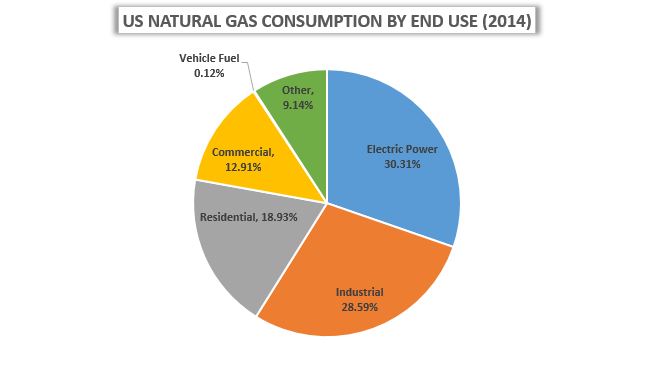
As an energy source, natural gas can be used in a variety of ways. It can heat homes and businesses, generate electricity, cook food, drive vehicles or serve as an industrial fuel. It is possible to divide consumers into several categories:
• Population (residential consumption) – private dwellings, apartments.
• Businesses and non-manufacturing activities (commercial consumption) – hotels, restaurants, wholesale and retail stores, etc.
• Industry and manufacturing (industrial consumption) – chemical plants, mining and mineral extraction, etc.
• Power plants (electric power sector) – gas-fired power plants and utility companies in general, whose primary business is to sell electricity and/or heat to the public.
• Transportation (vehicle fuel consumption) – trucks, cars, container ships and other vehicles that run on natural gas.
• Other consumption (technical consumption) – include gas used in drilling operations, as a fuel in natural gas processing plants and gas used in the operation of pipelines.
Source: EIA
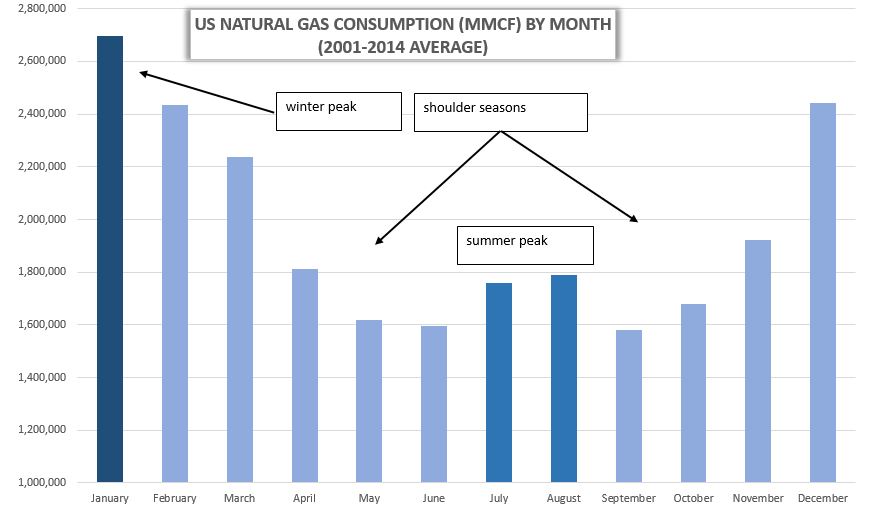
A very important characteristic of natural gas consumption is its seasonality. Demand peaks in January because of heavy usage for residential and commercial heating. It then weakens during spring and rises again in the summer months of July and August on electrical generation demand driven by air conditioning use. Demand then cools down again in autumn and starts rising again in winter. Spring and autumn are called “shoulder seasons”. In all three cases the demand for natural gas is driven by weather, which is probably a single most important factor determining natural gas consumption.
Source: EIA
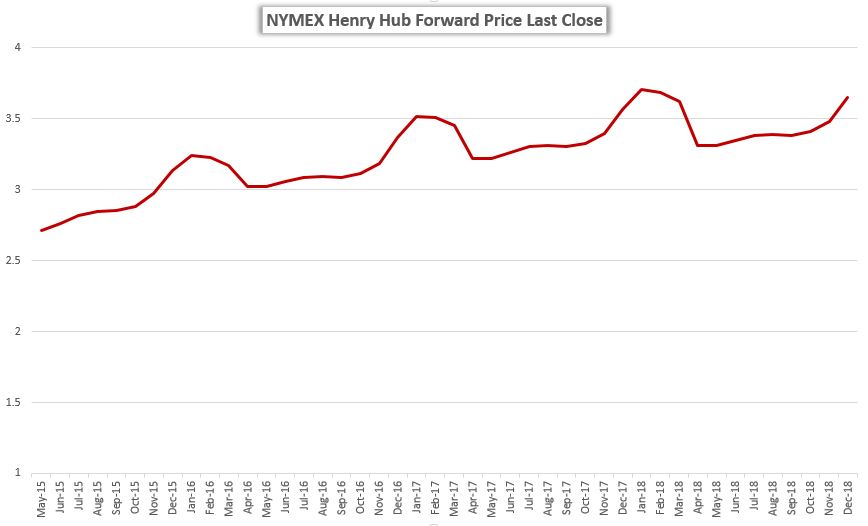
The seasonality of natural gas consumption is exhibited in the futures curve, where the highest-priced months of January and February are also the two months with the highest demand.
Source: Thomson Reuters
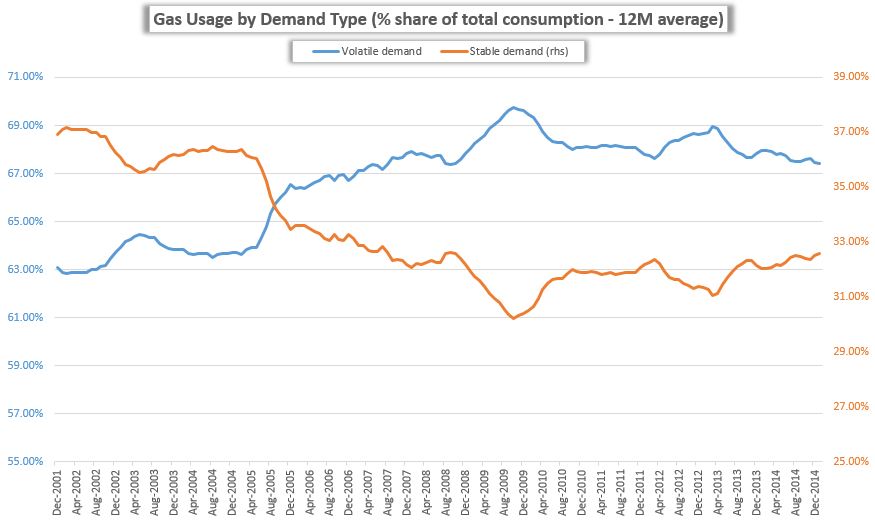
It is important to note, however, that weather does not drive all of the demand for natural gas (although, it does drive most of it). In fact, roughly a third of consumption has no seasonal pattern. Therefore, one can also divide demand into two broad categories:
1. Volatile, seasonal demand – weather-related demand (residential & commercial consumers and electric power sector) – 62% of total consumption in 2014.
2. Stable, non-seasonal demand – not directly driven by weather (industrial consumers, vehicle fuel, lease, plant fuel, pipeline & distribution use) – 38% of total consumption in 2014. However, one should note that some of the industrial consumption does have a degree of cyclicality, while the amount of gas used for distribution purposes is closely tied to the aggregate consumption and is therefore partly seasonal as well.
Source: EIA
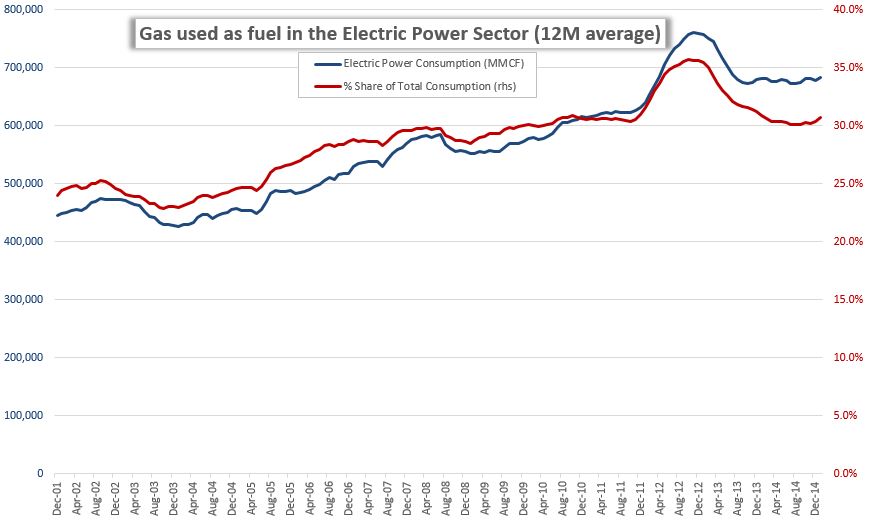
Over the past five years, the share of stable demand has been gradually rising – specifically, due to increased gas consumption in the industrial sector. Natural gas use in electric generation has also grown as the fuel is considered environmentally friendly and has a high heat content.
Source: EIA
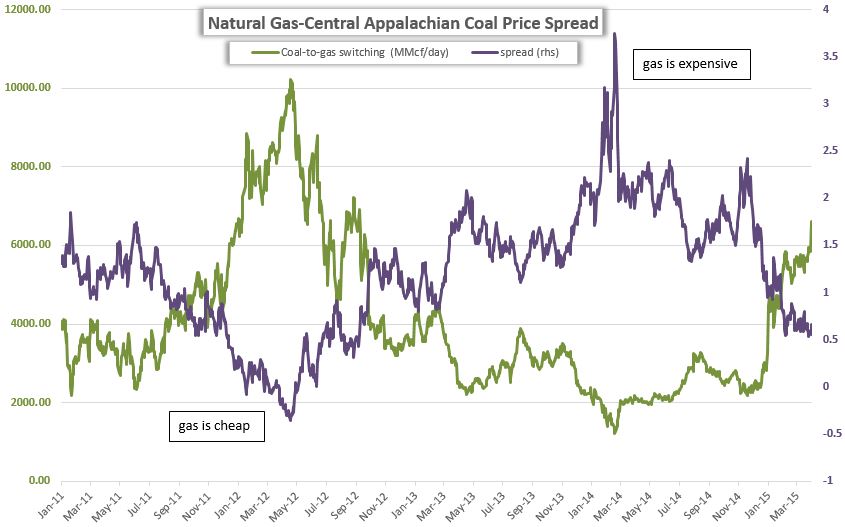
Natural gas is not the only hydrocarbon in the world and is not the only fuel that can be used to generate electricity. There are other substitutes out there and they may have an impact on consumption patterns in different sectors under different market conditions. One sector in which fuel switching occurs most profoundly is electrical generation. There are power plants that can burn both natural gas and coal and utilities may switch between one fuel to another depending on which is more profitable to burn. The spread between two substitute fuels play a key role in driving consumption dynamics. The most obvious substitute of gas in the electric power sector is coal. The graph below shows the spread between natural gas futures and Central Appalachian coal futures. As can be seen from that graph, there is a strong negative correlation between coal-to-gas switching and the spread. Natural gas consumption in the electric power sector rises as gas gets cheaper relative to coal and falls when the opposite occurs.
Source: Thomson Reuters
However, the cost of fuel is not the only factor determining the economics of fuel switching. Other important factors include: the cost of switching itself (technical cost), taxes, the cost of extra emissions produced by burning a dirtier fuel. In addition, utilities will not switch fuels if it is beneficial for just one day. They will look at the cost of either fuel over a medium to longer time frame to determine which fuel is more beneficial on a BTU basis.
In the next part of our natural gas series, we will take a closer look on the supply side of the market.
As an energy source, natural gas can be used in a variety of ways. It can heat homes and businesses, generate electricity, cook food, drive vehicles or serve as an industrial fuel. It is possible to divide consumers into several categories:
• Population (residential consumption) – private dwellings, apartments.
• Businesses and non-manufacturing activities (commercial consumption) – hotels, restaurants, wholesale and retail stores, etc.
• Industry and manufacturing (industrial consumption) – chemical plants, mining and mineral extraction, etc.
• Power plants (electric power sector) – gas-fired power plants and utility companies in general, whose primary business is to sell electricity and/or heat to the public.
• Transportation (vehicle fuel consumption) – trucks, cars, container ships and other vehicles that run on natural gas.
• Other consumption (technical consumption) – include gas used in drilling operations, as a fuel in natural gas processing plants and gas used in the operation of pipelines.
Source: EIA
A very important characteristic of natural gas consumption is its seasonality. Demand peaks in January because of heavy usage for residential and commercial heating. It then weakens during spring and rises again in the summer months of July and August on electrical generation demand driven by air conditioning use. Demand then cools down again in autumn and starts rising again in winter. Spring and autumn are called “shoulder seasons”. In all three cases the demand for natural gas is driven by weather, which is probably a single most important factor determining natural gas consumption.
Source: EIA
The seasonality of natural gas consumption is exhibited in the futures curve, where the highest-priced months of January and February are also the two months with the highest demand.
Source: Thomson Reuters
It is important to note, however, that weather does not drive all of the demand for natural gas (although, it does drive most of it). In fact, roughly a third of consumption has no seasonal pattern. Therefore, one can also divide demand into two broad categories:
1. Volatile, seasonal demand – weather-related demand (residential & commercial consumers and electric power sector) – 62% of total consumption in 2014.
2. Stable, non-seasonal demand – not directly driven by weather (industrial consumers, vehicle fuel, lease, plant fuel, pipeline & distribution use) – 38% of total consumption in 2014. However, one should note that some of the industrial consumption does have a degree of cyclicality, while the amount of gas used for distribution purposes is closely tied to the aggregate consumption and is therefore partly seasonal as well.
Source: EIA
Over the past five years, the share of stable demand has been gradually rising – specifically, due to increased gas consumption in the industrial sector. Natural gas use in electric generation has also grown as the fuel is considered environmentally friendly and has a high heat content.
Source: EIA
Natural gas is not the only hydrocarbon in the world and is not the only fuel that can be used to generate electricity. There are other substitutes out there and they may have an impact on consumption patterns in different sectors under different market conditions. One sector in which fuel switching occurs most profoundly is electrical generation. There are power plants that can burn both natural gas and coal and utilities may switch between one fuel to another depending on which is more profitable to burn. The spread between two substitute fuels play a key role in driving consumption dynamics. The most obvious substitute of gas in the electric power sector is coal. The graph below shows the spread between natural gas futures and Central Appalachian coal futures. As can be seen from that graph, there is a strong negative correlation between coal-to-gas switching and the spread. Natural gas consumption in the electric power sector rises as gas gets cheaper relative to coal and falls when the opposite occurs.
Source: Thomson Reuters
However, the cost of fuel is not the only factor determining the economics of fuel switching. Other important factors include: the cost of switching itself (technical cost), taxes, the cost of extra emissions produced by burning a dirtier fuel. In addition, utilities will not switch fuels if it is beneficial for just one day. They will look at the cost of either fuel over a medium to longer time frame to determine which fuel is more beneficial on a BTU basis.
In the next part of our natural gas series, we will take a closer look on the supply side of the market.
Vladimir Bezruchenko is an independent trader and financial writer based in The Hague, Netherlands.
He has been actively trading from home since 2013, specializing in US natural gas futures (NYMEX Henry Hub) and high-yielding commodity currencies. Vladimir is an active contributor to Seeking Alpha, where he writes detailed articles covering financial markets. His expertise also includes investing in non-public companies over the OTC market, focusing on pre-IPO deals.
Prior to his career in financial markets, Vladimir gained professional experience at Thomson Reuters. Before that, he pursued a career in real estate, working for well-known international brands such as CBRE and Colliers International.
Clearstream to Settle LCH-Cleared Equity Contracts
Featured Videos
CMC Founder Downplays Volatility Hit; Devexperts Names CEO
CMC Founder Downplays Volatility Hit; Devexperts Names CEO
CMC Founder Downplays Volatility Hit; Devexperts Names CEO
CMC Founder Downplays Volatility Hit; Devexperts Names CEO
Today’s financial news recap covers low volatility pressures brokers, Devexperts names a new CEO, Saxo cuts onboarding time, and OKX reaches a 25 billion dollar valuation.
Finance Magnates Daily Recap brings you the latest news from forex and CFD brokers, fintech, payments, cryptocurrency, digital assets, trading platforms, financial regulation and global markets.
Get the key company news, executive moves, deals, regulatory updates and market developments of the day, in just a few minutes. New episodes published every weekday.
Read more: https://www.financemagnates.com
#FinanceMagnates #ForexNews #FintechNews
Today’s financial news recap covers low volatility pressures brokers, Devexperts names a new CEO, Saxo cuts onboarding time, and OKX reaches a 25 billion dollar valuation.
Finance Magnates Daily Recap brings you the latest news from forex and CFD brokers, fintech, payments, cryptocurrency, digital assets, trading platforms, financial regulation and global markets.
Get the key company news, executive moves, deals, regulatory updates and market developments of the day, in just a few minutes. New episodes published every weekday.
Read more: https://www.financemagnates.com
#FinanceMagnates #ForexNews #FintechNews
Today’s financial news recap covers low volatility pressures brokers, Devexperts names a new CEO, Saxo cuts onboarding time, and OKX reaches a 25 billion dollar valuation.
Finance Magnates Daily Recap brings you the latest news from forex and CFD brokers, fintech, payments, cryptocurrency, digital assets, trading platforms, financial regulation and global markets.
Get the key company news, executive moves, deals, regulatory updates and market developments of the day, in just a few minutes. New episodes published every weekday.
Read more: https://www.financemagnates.com
#FinanceMagnates #ForexNews #FintechNews
Today’s financial news recap covers low volatility pressures brokers, Devexperts names a new CEO, Saxo cuts onboarding time, and OKX reaches a 25 billion dollar valuation.
Finance Magnates Daily Recap brings you the latest news from forex and CFD brokers, fintech, payments, cryptocurrency, digital assets, trading platforms, financial regulation and global markets.
Get the key company news, executive moves, deals, regulatory updates and market developments of the day, in just a few minutes. New episodes published every weekday.
Read more: https://www.financemagnates.com
#FinanceMagnates #ForexNews #FintechNews
Today’s financial news recap covers Trade Nation buys FXCM's UK client book, Trading 212 reports higher revenue, the CFTC's move to allow perpetual index futures.
Finance Magnates Daily Recap brings you the latest news from forex and CFD brokers, fintech, payments, cryptocurrency, digital assets, trading platforms, financial regulation and global markets.
Get the key company news, executive moves, deals, regulatory updates and market developments of the day, in just a few minutes. New episodes published every weekday.
Read more: https://www.financemagnates.com
#FinanceMagnates #ForexNews #FintechNews
Today’s financial news recap covers Trade Nation buys FXCM's UK client book, Trading 212 reports higher revenue, the CFTC's move to allow perpetual index futures.
Finance Magnates Daily Recap brings you the latest news from forex and CFD brokers, fintech, payments, cryptocurrency, digital assets, trading platforms, financial regulation and global markets.
Get the key company news, executive moves, deals, regulatory updates and market developments of the day, in just a few minutes. New episodes published every weekday.
Read more: https://www.financemagnates.com
#FinanceMagnates #ForexNews #FintechNews
Today’s financial news recap covers Trade Nation buys FXCM's UK client book, Trading 212 reports higher revenue, the CFTC's move to allow perpetual index futures.
Finance Magnates Daily Recap brings you the latest news from forex and CFD brokers, fintech, payments, cryptocurrency, digital assets, trading platforms, financial regulation and global markets.
Get the key company news, executive moves, deals, regulatory updates and market developments of the day, in just a few minutes. New episodes published every weekday.
Read more: https://www.financemagnates.com
#FinanceMagnates #ForexNews #FintechNews
Today’s financial news recap covers Trade Nation buys FXCM's UK client book, Trading 212 reports higher revenue, the CFTC's move to allow perpetual index futures.
Finance Magnates Daily Recap brings you the latest news from forex and CFD brokers, fintech, payments, cryptocurrency, digital assets, trading platforms, financial regulation and global markets.
Get the key company news, executive moves, deals, regulatory updates and market developments of the day, in just a few minutes. New episodes published every weekday.
Read more: https://www.financemagnates.com
#FinanceMagnates #ForexNews #FintechNews
Today’s financial news recap covers Trade Nation buys FXCM's UK client book, Trading 212 reports higher revenue, the CFTC's move to allow perpetual index futures.
Finance Magnates Daily Recap brings you the latest news from forex and CFD brokers, fintech, payments, cryptocurrency, digital assets, trading platforms, financial regulation and global markets.
Get the key company news, executive moves, deals, regulatory updates and market developments of the day, in just a few minutes. New episodes published every weekday.
Read more: https://www.financemagnates.com
#FinanceMagnates #ForexNews #FintechNews
Today’s financial news recap covers Trade Nation buys FXCM's UK client book, Trading 212 reports higher revenue, the CFTC's move to allow perpetual index futures.
Finance Magnates Daily Recap brings you the latest news from forex and CFD brokers, fintech, payments, cryptocurrency, digital assets, trading platforms, financial regulation and global markets.
Get the key company news, executive moves, deals, regulatory updates and market developments of the day, in just a few minutes. New episodes published every weekday.
Read more: https://www.financemagnates.com
#FinanceMagnates #ForexNews #FintechNews
Your career isn’t a linear path.
Your career isn’t a linear path.
Your career isn’t a linear path.
Your career isn’t a linear path.
Your career isn’t a linear path.
Your career isn’t a linear path.
Roles change. Career goals change. Sometimes you want a completely new challenge.
But the skills and knowledge you build along the way can stay with you and give you something to build on.
For Jeff Patterson, that continued growth is key to long-term career development.
You bring the skills. FM Academy helps you build the knowledge.
#FMAcademy #FinanceMagnates #FinanceCareers #ProfessionalDevelopment #Fintech
Roles change. Career goals change. Sometimes you want a completely new challenge.
But the skills and knowledge you build along the way can stay with you and give you something to build on.
For Jeff Patterson, that continued growth is key to long-term career development.
You bring the skills. FM Academy helps you build the knowledge.
#FMAcademy #FinanceMagnates #FinanceCareers #ProfessionalDevelopment #Fintech
Roles change. Career goals change. Sometimes you want a completely new challenge.
But the skills and knowledge you build along the way can stay with you and give you something to build on.
For Jeff Patterson, that continued growth is key to long-term career development.
You bring the skills. FM Academy helps you build the knowledge.
#FMAcademy #FinanceMagnates #FinanceCareers #ProfessionalDevelopment #Fintech
Roles change. Career goals change. Sometimes you want a completely new challenge.
But the skills and knowledge you build along the way can stay with you and give you something to build on.
For Jeff Patterson, that continued growth is key to long-term career development.
You bring the skills. FM Academy helps you build the knowledge.
#FMAcademy #FinanceMagnates #FinanceCareers #ProfessionalDevelopment #Fintech
Roles change. Career goals change. Sometimes you want a completely new challenge.
But the skills and knowledge you build along the way can stay with you and give you something to build on.
For Jeff Patterson, that continued growth is key to long-term career development.
You bring the skills. FM Academy helps you build the knowledge.
#FMAcademy #FinanceMagnates #FinanceCareers #ProfessionalDevelopment #Fintech
Roles change. Career goals change. Sometimes you want a completely new challenge.
But the skills and knowledge you build along the way can stay with you and give you something to build on.
For Jeff Patterson, that continued growth is key to long-term career development.
You bring the skills. FM Academy helps you build the knowledge.
#FMAcademy #FinanceMagnates #FinanceCareers #ProfessionalDevelopment #Fintech
IG Group Tech Chiefs Exit; Pepperstone Revenue Grows
IG Group Tech Chiefs Exit; Pepperstone Revenue Grows
IG Group Tech Chiefs Exit; Pepperstone Revenue Grows
IG Group Tech Chiefs Exit; Pepperstone Revenue Grows
IG Group Tech Chiefs Exit; Pepperstone Revenue Grows
IG Group Tech Chiefs Exit; Pepperstone Revenue Grows
Today’s financial news recap covers IG Group loses two technology chiefs, Pepperstone reports double-digit growth, and eToro backs a euro stablecoin.
Finance Magnates Daily Recap brings you the latest news from forex and CFD brokers, fintech, payments, cryptocurrency, digital assets, trading platforms, financial regulation and global markets.
Get the key company news, executive moves, deals, regulatory updates and market developments of the day, in just a few minutes. New episodes published every weekday.
Read more: https://www.financemagnates.com
#FinanceMagnates #ForexNews #FintechNews
Today’s financial news recap covers IG Group loses two technology chiefs, Pepperstone reports double-digit growth, and eToro backs a euro stablecoin.
Finance Magnates Daily Recap brings you the latest news from forex and CFD brokers, fintech, payments, cryptocurrency, digital assets, trading platforms, financial regulation and global markets.
Get the key company news, executive moves, deals, regulatory updates and market developments of the day, in just a few minutes. New episodes published every weekday.
Read more: https://www.financemagnates.com
#FinanceMagnates #ForexNews #FintechNews
Today’s financial news recap covers IG Group loses two technology chiefs, Pepperstone reports double-digit growth, and eToro backs a euro stablecoin.
Finance Magnates Daily Recap brings you the latest news from forex and CFD brokers, fintech, payments, cryptocurrency, digital assets, trading platforms, financial regulation and global markets.
Get the key company news, executive moves, deals, regulatory updates and market developments of the day, in just a few minutes. New episodes published every weekday.
Read more: https://www.financemagnates.com
#FinanceMagnates #ForexNews #FintechNews
Today’s financial news recap covers IG Group loses two technology chiefs, Pepperstone reports double-digit growth, and eToro backs a euro stablecoin.
Finance Magnates Daily Recap brings you the latest news from forex and CFD brokers, fintech, payments, cryptocurrency, digital assets, trading platforms, financial regulation and global markets.
Get the key company news, executive moves, deals, regulatory updates and market developments of the day, in just a few minutes. New episodes published every weekday.
Read more: https://www.financemagnates.com
#FinanceMagnates #ForexNews #FintechNews
Today’s financial news recap covers IG Group loses two technology chiefs, Pepperstone reports double-digit growth, and eToro backs a euro stablecoin.
Finance Magnates Daily Recap brings you the latest news from forex and CFD brokers, fintech, payments, cryptocurrency, digital assets, trading platforms, financial regulation and global markets.
Get the key company news, executive moves, deals, regulatory updates and market developments of the day, in just a few minutes. New episodes published every weekday.
Read more: https://www.financemagnates.com
#FinanceMagnates #ForexNews #FintechNews
Today’s financial news recap covers IG Group loses two technology chiefs, Pepperstone reports double-digit growth, and eToro backs a euro stablecoin.
Finance Magnates Daily Recap brings you the latest news from forex and CFD brokers, fintech, payments, cryptocurrency, digital assets, trading platforms, financial regulation and global markets.
Get the key company news, executive moves, deals, regulatory updates and market developments of the day, in just a few minutes. New episodes published every weekday.
Read more: https://www.financemagnates.com
#FinanceMagnates #ForexNews #FintechNews
Today’s financial news recap covers IG Group expects lower Q3 revenue, MetaQuotes adds Benzinga news, Match-Trader launches an MCP, and brokers weigh build versus buy.
Finance Magnates Daily Recap brings you the latest news from forex and CFD brokers, fintech, payments, cryptocurrency, digital assets, trading platforms, financial regulation and global markets.
Get the key company news, executive moves, deals, regulatory updates and market developments of the day, in just a few minutes. New episodes published every weekday.
Read more: https://www.financemagnates.com
#FinanceMagnates #ForexNews #FintechNews
Today’s financial news recap covers IG Group expects lower Q3 revenue, MetaQuotes adds Benzinga news, Match-Trader launches an MCP, and brokers weigh build versus buy.
Finance Magnates Daily Recap brings you the latest news from forex and CFD brokers, fintech, payments, cryptocurrency, digital assets, trading platforms, financial regulation and global markets.
Get the key company news, executive moves, deals, regulatory updates and market developments of the day, in just a few minutes. New episodes published every weekday.
Read more: https://www.financemagnates.com
#FinanceMagnates #ForexNews #FintechNews
Today’s financial news recap covers IG Group expects lower Q3 revenue, MetaQuotes adds Benzinga news, Match-Trader launches an MCP, and brokers weigh build versus buy.
Finance Magnates Daily Recap brings you the latest news from forex and CFD brokers, fintech, payments, cryptocurrency, digital assets, trading platforms, financial regulation and global markets.
Get the key company news, executive moves, deals, regulatory updates and market developments of the day, in just a few minutes. New episodes published every weekday.
Read more: https://www.financemagnates.com
#FinanceMagnates #ForexNews #FintechNews
Today’s financial news recap covers IG Group expects lower Q3 revenue, MetaQuotes adds Benzinga news, Match-Trader launches an MCP, and brokers weigh build versus buy.
Finance Magnates Daily Recap brings you the latest news from forex and CFD brokers, fintech, payments, cryptocurrency, digital assets, trading platforms, financial regulation and global markets.
Get the key company news, executive moves, deals, regulatory updates and market developments of the day, in just a few minutes. New episodes published every weekday.
Read more: https://www.financemagnates.com
#FinanceMagnates #ForexNews #FintechNews
Today’s financial news recap covers IG Group expects lower Q3 revenue, MetaQuotes adds Benzinga news, Match-Trader launches an MCP, and brokers weigh build versus buy.
Finance Magnates Daily Recap brings you the latest news from forex and CFD brokers, fintech, payments, cryptocurrency, digital assets, trading platforms, financial regulation and global markets.
Get the key company news, executive moves, deals, regulatory updates and market developments of the day, in just a few minutes. New episodes published every weekday.
Read more: https://www.financemagnates.com
#FinanceMagnates #ForexNews #FintechNews
Today’s financial news recap covers IG Group expects lower Q3 revenue, MetaQuotes adds Benzinga news, Match-Trader launches an MCP, and brokers weigh build versus buy.
Finance Magnates Daily Recap brings you the latest news from forex and CFD brokers, fintech, payments, cryptocurrency, digital assets, trading platforms, financial regulation and global markets.
Get the key company news, executive moves, deals, regulatory updates and market developments of the day, in just a few minutes. New episodes published every weekday.
Read more: https://www.financemagnates.com
#FinanceMagnates #ForexNews #FintechNews