FX clients have lost their trust in the banks and investors are worried about the overall impact of fines crossing over $10 billion.
The past year was marked by high profile, billion-dollar fines imposed on major global banks for manipulating critical FX rates. However, the situation is far from over, American and British authorities keep on investigating, and more regulators worldwide are joining them. Meanwhile, the FCA maintains that UK banks have done little to improve the situation. The time has come for reassessment, and what better place to do it than at the Finance Magnates' London Summit 2015.
Providing a hands on perspective on the upcoming regulatory changes as a result of the scandal will be David Woodlock. He is Chair of the Committee for Professionalism at ACI – The Financial Markets Association - as well as Vice-Chair of the ACI FX Committee, in addition he has vast experience in writing Codes of Conduct in Ethical, Fair & Transparent OTC Markets.
Woodlock explains how he sees the issue: “Twenty five years on from the Federal Bureau of Investigation's crack-down on improprieties in the Chicago futures pit the largest OTC market in the world has been caught in a maelstrom of allegations of impropriety and large fines have been levied for currency manipulation, rate rigging and collusion on an unprecedented scale.
In an industry that is self-regulated was this just the participants ignoring the Model Code, which is the blueprint for ethical behaviour and best practice, or indicative of a breakdown in the responsibilities of senior managers in their duties towards training and education. The current push to make sure the FX market displays a higher level of professionalism once again is causing a seismic shift in how it regulates itself.”
Woodlock is also an experienced FX trader with a good knowledge of Fixed Income and related matters gained through a variety of roles in the industry. After working for a number of banks between 1977 and 2003, specializing in e-FX from 1998, he did a stint at FXall leaving when it was sold to Thomson Reuters, taking up his current position as Global Head of Sales and Business Development for Eurobase Banking Solutions.
The Scandal
The FX rigging scandal is the result of investigations by financial watchdogs and regulators from around the world, that focused on chat groups in which institutional dealers sent instant messages over their Bloomberg terminals.
For a period of three years, in chat groups with names such as, ”The Cartel” and “The Bandits’ Club,” bank traders shared information with competitors allowing them to execute their own trades before filling client orders.
The revelations of the rates manipulation had serious negative effects on the brands of the major international banks as traders were exposed, clients had their confidence shaken and investors worried about the overall impact of the fines crossing over $10 billion.
Beyond the regulatory fines, the banks are also faced with class action lawsuits by their clients, including institutional investors and hedge funds, that have engaged in FX swaps, futures, options and spot transactions.
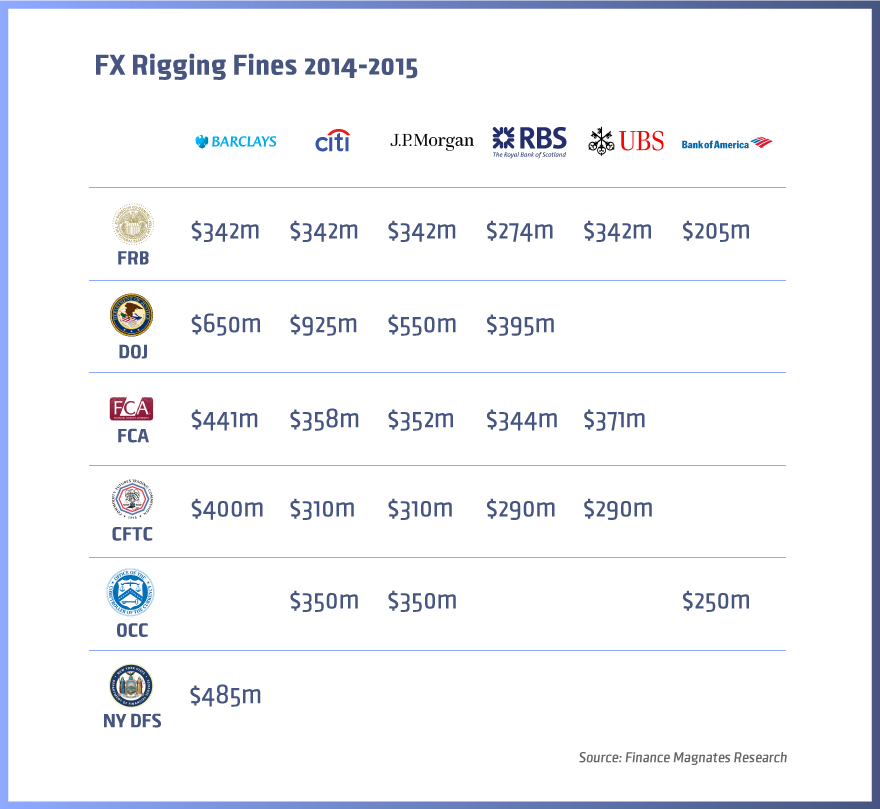
The past year was marked by high profile, billion-dollar fines imposed on major global banks for manipulating critical FX rates. However, the situation is far from over, American and British authorities keep on investigating, and more regulators worldwide are joining them. Meanwhile, the FCA maintains that UK banks have done little to improve the situation. The time has come for reassessment, and what better place to do it than at the Finance Magnates' London Summit 2015.
Providing a hands on perspective on the upcoming regulatory changes as a result of the scandal will be David Woodlock. He is Chair of the Committee for Professionalism at ACI – The Financial Markets Association - as well as Vice-Chair of the ACI FX Committee, in addition he has vast experience in writing Codes of Conduct in Ethical, Fair & Transparent OTC Markets.
Woodlock explains how he sees the issue: “Twenty five years on from the Federal Bureau of Investigation's crack-down on improprieties in the Chicago futures pit the largest OTC market in the world has been caught in a maelstrom of allegations of impropriety and large fines have been levied for currency manipulation, rate rigging and collusion on an unprecedented scale.
In an industry that is self-regulated was this just the participants ignoring the Model Code, which is the blueprint for ethical behaviour and best practice, or indicative of a breakdown in the responsibilities of senior managers in their duties towards training and education. The current push to make sure the FX market displays a higher level of professionalism once again is causing a seismic shift in how it regulates itself.”
Woodlock is also an experienced FX trader with a good knowledge of Fixed Income and related matters gained through a variety of roles in the industry. After working for a number of banks between 1977 and 2003, specializing in e-FX from 1998, he did a stint at FXall leaving when it was sold to Thomson Reuters, taking up his current position as Global Head of Sales and Business Development for Eurobase Banking Solutions.
The Scandal
The FX rigging scandal is the result of investigations by financial watchdogs and regulators from around the world, that focused on chat groups in which institutional dealers sent instant messages over their Bloomberg terminals.
For a period of three years, in chat groups with names such as, ”The Cartel” and “The Bandits’ Club,” bank traders shared information with competitors allowing them to execute their own trades before filling client orders.
The revelations of the rates manipulation had serious negative effects on the brands of the major international banks as traders were exposed, clients had their confidence shaken and investors worried about the overall impact of the fines crossing over $10 billion.
Beyond the regulatory fines, the banks are also faced with class action lawsuits by their clients, including institutional investors and hedge funds, that have engaged in FX swaps, futures, options and spot transactions.
GCEX Adds Tokenized Oil as Crude Volatility Pulls Traders Back to Energy
Featured Videos
Buying The Deep: Digital Asset Adoption in APAC and Beyond
The persisting price drops test the industry's commitment to crypto adoption. While on-chain innovation is making headway across market mechanics, from stablecoins to tokenization, investors remains cautious.
This session brings together market structure experts and institutional investors to explore how a prolonged bear market affects their long-term strategy, and where the opportunities lie ahead of the next cycle.
Attendees will walk away with:
First-hand account of the bear market's impact on various industry players
Understanding of what custody, connectivity, and settlement gaps still hamper growth in APAC
Insight into how client mandates and operational readiness are shaping who moves and who waits
Perspective on what institutional investors need to move toward actual digital asset capital deployment
The persisting price drops test the industry's commitment to crypto adoption. While on-chain innovation is making headway across market mechanics, from stablecoins to tokenization, investors remains cautious.
This session brings together market structure experts and institutional investors to explore how a prolonged bear market affects their long-term strategy, and where the opportunities lie ahead of the next cycle.
Attendees will walk away with:
First-hand account of the bear market's impact on various industry players
Understanding of what custody, connectivity, and settlement gaps still hamper growth in APAC
Insight into how client mandates and operational readiness are shaping who moves and who waits
Perspective on what institutional investors need to move toward actual digital asset capital deployment
The persisting price drops test the industry's commitment to crypto adoption. While on-chain innovation is making headway across market mechanics, from stablecoins to tokenization, investors remains cautious.
This session brings together market structure experts and institutional investors to explore how a prolonged bear market affects their long-term strategy, and where the opportunities lie ahead of the next cycle.
Attendees will walk away with:
First-hand account of the bear market's impact on various industry players
Understanding of what custody, connectivity, and settlement gaps still hamper growth in APAC
Insight into how client mandates and operational readiness are shaping who moves and who waits
Perspective on what institutional investors need to move toward actual digital asset capital deployment
The persisting price drops test the industry's commitment to crypto adoption. While on-chain innovation is making headway across market mechanics, from stablecoins to tokenization, investors remains cautious.
This session brings together market structure experts and institutional investors to explore how a prolonged bear market affects their long-term strategy, and where the opportunities lie ahead of the next cycle.
Attendees will walk away with:
First-hand account of the bear market's impact on various industry players
Understanding of what custody, connectivity, and settlement gaps still hamper growth in APAC
Insight into how client mandates and operational readiness are shaping who moves and who waits
Perspective on what institutional investors need to move toward actual digital asset capital deployment
This panel explores the key insights and emerging trends shaping modern trading behavior, examining how user expectations are evolving across global markets and what these shifts mean for industry participants.
Funding & Exit in Singapore from Pre-Seed to Liquidity
Singapore's capital infrastructure is wider than its reputation for stability suggests.
Sovereign backing from Temasek and GIC, a growing family office network, sector-specialized venture funds, and a public market pathway through the Singapore Exchange, the city-state supports capital formation at every stage of the lifecycle.
Held in partnership with 8Circle, this session gathers practitioners across the capital stack to examine how Singapore functions as both an investment and an exit destination.
Attendees will walk away with:
Understanding of what makes SGX a credible listing pathway for high-growth companies in 2026
Insight into alternative exit channels: private secondary markets, digital marketplace exits, and strategic acquisitions
Perspective on what founders and capital allocators should be doing at each stage to preserve exit optionality
Singapore's capital infrastructure is wider than its reputation for stability suggests.
Sovereign backing from Temasek and GIC, a growing family office network, sector-specialized venture funds, and a public market pathway through the Singapore Exchange, the city-state supports capital formation at every stage of the lifecycle.
Held in partnership with 8Circle, this session gathers practitioners across the capital stack to examine how Singapore functions as both an investment and an exit destination.
Attendees will walk away with:
Understanding of what makes SGX a credible listing pathway for high-growth companies in 2026
Insight into alternative exit channels: private secondary markets, digital marketplace exits, and strategic acquisitions
Perspective on what founders and capital allocators should be doing at each stage to preserve exit optionality
Singapore's capital infrastructure is wider than its reputation for stability suggests.
Sovereign backing from Temasek and GIC, a growing family office network, sector-specialized venture funds, and a public market pathway through the Singapore Exchange, the city-state supports capital formation at every stage of the lifecycle.
Held in partnership with 8Circle, this session gathers practitioners across the capital stack to examine how Singapore functions as both an investment and an exit destination.
Attendees will walk away with:
Understanding of what makes SGX a credible listing pathway for high-growth companies in 2026
Insight into alternative exit channels: private secondary markets, digital marketplace exits, and strategic acquisitions
Perspective on what founders and capital allocators should be doing at each stage to preserve exit optionality
Singapore's capital infrastructure is wider than its reputation for stability suggests.
Sovereign backing from Temasek and GIC, a growing family office network, sector-specialized venture funds, and a public market pathway through the Singapore Exchange, the city-state supports capital formation at every stage of the lifecycle.
Held in partnership with 8Circle, this session gathers practitioners across the capital stack to examine how Singapore functions as both an investment and an exit destination.
Attendees will walk away with:
Understanding of what makes SGX a credible listing pathway for high-growth companies in 2026
Insight into alternative exit channels: private secondary markets, digital marketplace exits, and strategic acquisitions
Perspective on what founders and capital allocators should be doing at each stage to preserve exit optionality
Singapore's capital infrastructure is wider than its reputation for stability suggests.
Sovereign backing from Temasek and GIC, a growing family office network, sector-specialized venture funds, and a public market pathway through the Singapore Exchange, the city-state supports capital formation at every stage of the lifecycle.
Held in partnership with 8Circle, this session gathers practitioners across the capital stack to examine how Singapore functions as both an investment and an exit destination.
Attendees will walk away with:
Understanding of what makes SGX a credible listing pathway for high-growth companies in 2026
Insight into alternative exit channels: private secondary markets, digital marketplace exits, and strategic acquisitions
Perspective on what founders and capital allocators should be doing at each stage to preserve exit optionality
Singapore's capital infrastructure is wider than its reputation for stability suggests.
Sovereign backing from Temasek and GIC, a growing family office network, sector-specialized venture funds, and a public market pathway through the Singapore Exchange, the city-state supports capital formation at every stage of the lifecycle.
Held in partnership with 8Circle, this session gathers practitioners across the capital stack to examine how Singapore functions as both an investment and an exit destination.
Attendees will walk away with:
Understanding of what makes SGX a credible listing pathway for high-growth companies in 2026
Insight into alternative exit channels: private secondary markets, digital marketplace exits, and strategic acquisitions
Perspective on what founders and capital allocators should be doing at each stage to preserve exit optionality
FM Daily Brief – 10 June 2026
Today’s Wednesday, the 10th of June 2026, and these are our main stories: Bybit’s zero-fee stock CFD push, prop trading access to SpaceX shares, and TradeStation’s European expansion into US markets.
AI Getting Real for Brokers
Brokers and providers moved from the noise phase to treating AI tools as a core product question, with implications on anything from hiring priorities to acquisition strategy.
This session gathers retail brokers, platform builders, and AI tool providers to examine how LLMs change affect client trust, results, and risk.
Attendees will walk away with:
A first-hand account of where AI-driven trading tools generate real client value
Insight into how institutional adoption is raising client expectations and what brokers need to do to keep pace
Clarity on the liability question: when an AI-driven recommendation leads to a bad trade, where does responsibility
Brokers and providers moved from the noise phase to treating AI tools as a core product question, with implications on anything from hiring priorities to acquisition strategy.
This session gathers retail brokers, platform builders, and AI tool providers to examine how LLMs change affect client trust, results, and risk.
Attendees will walk away with:
A first-hand account of where AI-driven trading tools generate real client value
Insight into how institutional adoption is raising client expectations and what brokers need to do to keep pace
Clarity on the liability question: when an AI-driven recommendation leads to a bad trade, where does responsibility
Brokers and providers moved from the noise phase to treating AI tools as a core product question, with implications on anything from hiring priorities to acquisition strategy.
This session gathers retail brokers, platform builders, and AI tool providers to examine how LLMs change affect client trust, results, and risk.
Attendees will walk away with:
A first-hand account of where AI-driven trading tools generate real client value
Insight into how institutional adoption is raising client expectations and what brokers need to do to keep pace
Clarity on the liability question: when an AI-driven recommendation leads to a bad trade, where does responsibility
Brokers and providers moved from the noise phase to treating AI tools as a core product question, with implications on anything from hiring priorities to acquisition strategy.
This session gathers retail brokers, platform builders, and AI tool providers to examine how LLMs change affect client trust, results, and risk.
Attendees will walk away with:
A first-hand account of where AI-driven trading tools generate real client value
Insight into how institutional adoption is raising client expectations and what brokers need to do to keep pace
Clarity on the liability question: when an AI-driven recommendation leads to a bad trade, where does responsibility
Brokers and providers moved from the noise phase to treating AI tools as a core product question, with implications on anything from hiring priorities to acquisition strategy.
This session gathers retail brokers, platform builders, and AI tool providers to examine how LLMs change affect client trust, results, and risk.
Attendees will walk away with:
A first-hand account of where AI-driven trading tools generate real client value
Insight into how institutional adoption is raising client expectations and what brokers need to do to keep pace
Clarity on the liability question: when an AI-driven recommendation leads to a bad trade, where does responsibility
Brokers and providers moved from the noise phase to treating AI tools as a core product question, with implications on anything from hiring priorities to acquisition strategy.
This session gathers retail brokers, platform builders, and AI tool providers to examine how LLMs change affect client trust, results, and risk.
Attendees will walk away with:
A first-hand account of where AI-driven trading tools generate real client value
Insight into how institutional adoption is raising client expectations and what brokers need to do to keep pace
Clarity on the liability question: when an AI-driven recommendation leads to a bad trade, where does responsibility