More than half of the EU’s member countries are still rushing to finalize a revised version of MiFID II.
Bloomberg
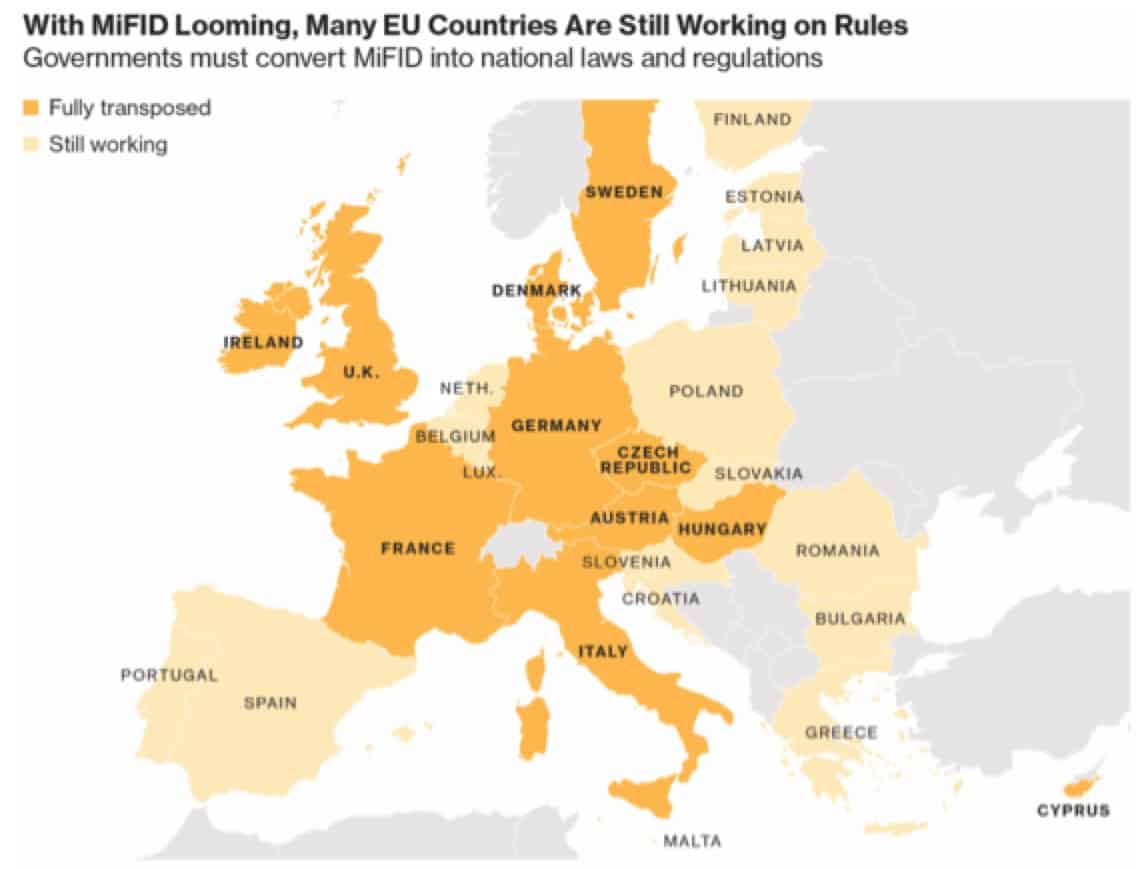
The new year is fast approaching and this month it looks like many regulators will be working harder than ever leading up to the holiday season. More than half of the EU’s member countries are still rushing to put the revised version of MiFID II into their legal compendiums.
Now in the eleventh hour, the directive will soon be enforced as of January 3, 2018 – however the upcoming regime is still being met with widespread industry confusion. Financial firms are racing to comply while their respective regulatory authorities are still in transposition, the process of converting the directive into enforceable law within their jurisdictions.
Unlike its companion, MiFIR (Markets in Financial Instruments Regulation), which is entirely binding and directly applies to all EU countries, the second iteration of MiFID has to be codified into nationally based law before it can take effect.
Back on October 17, Valdis Dombrovski, the EU’s chief on financial policy confirmed: “Member states are still continuing with their transposition”. Conceding that this was indeed very late, “the process of transposition is being followed closely to ensure that there is consistency in its application across the EU."
Widespread uncertainty?
This last minute scramble certainly adds to the uncertainty of the wide sweeping changes that are expected to cost banks, money managers and financial brokers $2 billion in order to comply. Not surprisingly, this has put pressure on regulators across the EU to show leniency once the law becomes operative.
Without there being an EU country that hasn’t been contacted with this request, sources say that it has been met with unofficially supportive feedback.
Many regulators have reassured firms that they do not intend to clamp down on the first day. BaFin, the German financial regulator advised it will “look closely at which processes are being put in place for implementation and determine if it is happening in a timely fashion.” Spokeswoman Anja Schuchhardt said: “We are aware the schedule is tight and for that reason we will maintain a sense of proportion.”
The Financial Conduct Authority of the UK has advised that it will act “proportionately” given the scale of changes, particularly in the early stages where it will not take an approach of strict liability.
Last month, Mark Steward, FCA director of enforcement and market oversight, said: “We are very aware of how much work many firms have been engaged in for a very long time now in re-tooling and preparing…this means we have no intention of taking enforcement action against firms for not meeting all requirements straight away where there is evidence they have taken sufficient steps to meet the new obligation by the start date.”
With much of its own implementation still incomplete, the Dutch Financial Authority advised that while there are doubtless going to be ambiguities, firms should still have a rough sense of what is going to be required.
What comes next?
While EU directives are binding, national authorities have discretion in terms of how overall objectives are achieved. This entails that regulations will differ between one EU country and the next.
“It is understandable that, for certain topics, financial firms will have difficulty getting ready in time as there is still lack of clarity” said an officer within the Dutch AFM, “and we will be taking this in to account in the way we perform our supervisions. However where significant regulatory uncertainties are not a factor, we expect market participants to be in compliance.”
Although the deadline for transposition was July 3, 2017, a date that has well and truly come and gone, many EU governments are still hopeful that they will have regulations in place by the deadline.
Finland’s Finance Ministry said the schedule is “tight, but possible” even with approval still required to be passed through parliamentary debate. Belgium, which ironically is the home to the EU legislative body, and Luxembourg, a happy host to major investment funds, both still have their regulations uncompleted. Somehow, Lithuania’s regulator expects firms will abide by rules, even despite the law not being adopted.
Strict deadline
As uncertain as it all seems the deadline is a strict one, where infringement proceedings will be put in motion against tardy regulation authorities, whereby they can be taken to court by the commission and potentially fined.
So this Christmas, a wide berth is likely to be given to EU policy makers, lawyers and administrators still sitting in the cold, deliberating on how to avoid an irrevocable fracture on a $438 trillion market.
The new year is fast approaching and this month it looks like many regulators will be working harder than ever leading up to the holiday season. More than half of the EU’s member countries are still rushing to put the revised version of MiFID II into their legal compendiums.
Now in the eleventh hour, the directive will soon be enforced as of January 3, 2018 – however the upcoming regime is still being met with widespread industry confusion. Financial firms are racing to comply while their respective regulatory authorities are still in transposition, the process of converting the directive into enforceable law within their jurisdictions.
Unlike its companion, MiFIR (Markets in Financial Instruments Regulation), which is entirely binding and directly applies to all EU countries, the second iteration of MiFID has to be codified into nationally based law before it can take effect.
Back on October 17, Valdis Dombrovski, the EU’s chief on financial policy confirmed: “Member states are still continuing with their transposition”. Conceding that this was indeed very late, “the process of transposition is being followed closely to ensure that there is consistency in its application across the EU."
Widespread uncertainty?
This last minute scramble certainly adds to the uncertainty of the wide sweeping changes that are expected to cost banks, money managers and financial brokers $2 billion in order to comply. Not surprisingly, this has put pressure on regulators across the EU to show leniency once the law becomes operative.
Without there being an EU country that hasn’t been contacted with this request, sources say that it has been met with unofficially supportive feedback.
Many regulators have reassured firms that they do not intend to clamp down on the first day. BaFin, the German financial regulator advised it will “look closely at which processes are being put in place for implementation and determine if it is happening in a timely fashion.” Spokeswoman Anja Schuchhardt said: “We are aware the schedule is tight and for that reason we will maintain a sense of proportion.”
The Financial Conduct Authority of the UK has advised that it will act “proportionately” given the scale of changes, particularly in the early stages where it will not take an approach of strict liability.
Last month, Mark Steward, FCA director of enforcement and market oversight, said: “We are very aware of how much work many firms have been engaged in for a very long time now in re-tooling and preparing…this means we have no intention of taking enforcement action against firms for not meeting all requirements straight away where there is evidence they have taken sufficient steps to meet the new obligation by the start date.”
With much of its own implementation still incomplete, the Dutch Financial Authority advised that while there are doubtless going to be ambiguities, firms should still have a rough sense of what is going to be required.
What comes next?
While EU directives are binding, national authorities have discretion in terms of how overall objectives are achieved. This entails that regulations will differ between one EU country and the next.
“It is understandable that, for certain topics, financial firms will have difficulty getting ready in time as there is still lack of clarity” said an officer within the Dutch AFM, “and we will be taking this in to account in the way we perform our supervisions. However where significant regulatory uncertainties are not a factor, we expect market participants to be in compliance.”
Although the deadline for transposition was July 3, 2017, a date that has well and truly come and gone, many EU governments are still hopeful that they will have regulations in place by the deadline.
Finland’s Finance Ministry said the schedule is “tight, but possible” even with approval still required to be passed through parliamentary debate. Belgium, which ironically is the home to the EU legislative body, and Luxembourg, a happy host to major investment funds, both still have their regulations uncompleted. Somehow, Lithuania’s regulator expects firms will abide by rules, even despite the law not being adopted.
Strict deadline
As uncertain as it all seems the deadline is a strict one, where infringement proceedings will be put in motion against tardy regulation authorities, whereby they can be taken to court by the commission and potentially fined.
So this Christmas, a wide berth is likely to be given to EU policy makers, lawyers and administrators still sitting in the cold, deliberating on how to avoid an irrevocable fracture on a $438 trillion market.
CME to Launch Treasury Clearing Weeks Before SEC Mandate Takes Effect
Featured Videos
Revolut Reconsiders London Listing; NAGA CEO on Return to Profit
Revolut Reconsiders London Listing; NAGA CEO on Return to Profit
Revolut Reconsiders London Listing; NAGA CEO on Return to Profit
Revolut Reconsiders London Listing; NAGA CEO on Return to Profit
Today’s financial news recap covers NAGA CEO discusses its return to profitability, Revolut reconsiders a London listing, Warren Buffett is stepping down as chairman and the FCA targets illegal peer-to-peer crypto sites.
Finance Magnates Daily Recap brings you the latest news from forex and CFD brokers, fintech, payments, cryptocurrency, digital assets, trading platforms, financial regulation and global markets.
Get the key company news, executive moves, deals, regulatory updates and market developments of the day, in just a few minutes. New episodes published every weekday.
Read more: https://www.financemagnates.com
#FinanceMagnates #ForexNews #FintechNews
Today’s financial news recap covers NAGA CEO discusses its return to profitability, Revolut reconsiders a London listing, Warren Buffett is stepping down as chairman and the FCA targets illegal peer-to-peer crypto sites.
Finance Magnates Daily Recap brings you the latest news from forex and CFD brokers, fintech, payments, cryptocurrency, digital assets, trading platforms, financial regulation and global markets.
Get the key company news, executive moves, deals, regulatory updates and market developments of the day, in just a few minutes. New episodes published every weekday.
Read more: https://www.financemagnates.com
#FinanceMagnates #ForexNews #FintechNews
Today’s financial news recap covers NAGA CEO discusses its return to profitability, Revolut reconsiders a London listing, Warren Buffett is stepping down as chairman and the FCA targets illegal peer-to-peer crypto sites.
Finance Magnates Daily Recap brings you the latest news from forex and CFD brokers, fintech, payments, cryptocurrency, digital assets, trading platforms, financial regulation and global markets.
Get the key company news, executive moves, deals, regulatory updates and market developments of the day, in just a few minutes. New episodes published every weekday.
Read more: https://www.financemagnates.com
#FinanceMagnates #ForexNews #FintechNews
Today’s financial news recap covers NAGA CEO discusses its return to profitability, Revolut reconsiders a London listing, Warren Buffett is stepping down as chairman and the FCA targets illegal peer-to-peer crypto sites.
Finance Magnates Daily Recap brings you the latest news from forex and CFD brokers, fintech, payments, cryptocurrency, digital assets, trading platforms, financial regulation and global markets.
Get the key company news, executive moves, deals, regulatory updates and market developments of the day, in just a few minutes. New episodes published every weekday.
Read more: https://www.financemagnates.com
#FinanceMagnates #ForexNews #FintechNews
iFOREX Revises Earnings Forecast; AvaTrade to Close Polish Office
iFOREX Revises Earnings Forecast; AvaTrade to Close Polish Office
iFOREX Revises Earnings Forecast; AvaTrade to Close Polish Office
iFOREX Revises Earnings Forecast; AvaTrade to Close Polish Office
iFOREX Revises Earnings Forecast; AvaTrade to Close Polish Office
iFOREX Revises Earnings Forecast; AvaTrade to Close Polish Office
Today’s financial news recap covers iFOREX cuts its first-half earnings estimate, AvaTrade closes its Poland branch, Devexperts targets South Korean brokers, and TradingView adds MCP for AI tools.
Finance Magnates Daily Recap brings you the latest news from forex and CFD brokers, fintech, payments, cryptocurrency, digital assets, trading platforms, financial regulation and global markets.
Get the key company news, executive moves, deals, regulatory updates and market developments of the day, in just a few minutes. New episodes published every weekday.
Read more: https://www.financemagnates.com
#FinanceMagnates #ForexNews #FintechNews
Today’s financial news recap covers iFOREX cuts its first-half earnings estimate, AvaTrade closes its Poland branch, Devexperts targets South Korean brokers, and TradingView adds MCP for AI tools.
Finance Magnates Daily Recap brings you the latest news from forex and CFD brokers, fintech, payments, cryptocurrency, digital assets, trading platforms, financial regulation and global markets.
Get the key company news, executive moves, deals, regulatory updates and market developments of the day, in just a few minutes. New episodes published every weekday.
Read more: https://www.financemagnates.com
#FinanceMagnates #ForexNews #FintechNews
Today’s financial news recap covers iFOREX cuts its first-half earnings estimate, AvaTrade closes its Poland branch, Devexperts targets South Korean brokers, and TradingView adds MCP for AI tools.
Finance Magnates Daily Recap brings you the latest news from forex and CFD brokers, fintech, payments, cryptocurrency, digital assets, trading platforms, financial regulation and global markets.
Get the key company news, executive moves, deals, regulatory updates and market developments of the day, in just a few minutes. New episodes published every weekday.
Read more: https://www.financemagnates.com
#FinanceMagnates #ForexNews #FintechNews
Today’s financial news recap covers iFOREX cuts its first-half earnings estimate, AvaTrade closes its Poland branch, Devexperts targets South Korean brokers, and TradingView adds MCP for AI tools.
Finance Magnates Daily Recap brings you the latest news from forex and CFD brokers, fintech, payments, cryptocurrency, digital assets, trading platforms, financial regulation and global markets.
Get the key company news, executive moves, deals, regulatory updates and market developments of the day, in just a few minutes. New episodes published every weekday.
Read more: https://www.financemagnates.com
#FinanceMagnates #ForexNews #FintechNews
Today’s financial news recap covers iFOREX cuts its first-half earnings estimate, AvaTrade closes its Poland branch, Devexperts targets South Korean brokers, and TradingView adds MCP for AI tools.
Finance Magnates Daily Recap brings you the latest news from forex and CFD brokers, fintech, payments, cryptocurrency, digital assets, trading platforms, financial regulation and global markets.
Get the key company news, executive moves, deals, regulatory updates and market developments of the day, in just a few minutes. New episodes published every weekday.
Read more: https://www.financemagnates.com
#FinanceMagnates #ForexNews #FintechNews
Today’s financial news recap covers iFOREX cuts its first-half earnings estimate, AvaTrade closes its Poland branch, Devexperts targets South Korean brokers, and TradingView adds MCP for AI tools.
Finance Magnates Daily Recap brings you the latest news from forex and CFD brokers, fintech, payments, cryptocurrency, digital assets, trading platforms, financial regulation and global markets.
Get the key company news, executive moves, deals, regulatory updates and market developments of the day, in just a few minutes. New episodes published every weekday.
Read more: https://www.financemagnates.com
#FinanceMagnates #ForexNews #FintechNews
Can you memorise the textbook? That’s not necessarily the point.
Can you memorise the textbook? That’s not necessarily the point.
Can you memorise the textbook? That’s not necessarily the point.
Can you memorise the textbook? That’s not necessarily the point.
Can you memorise the textbook? That’s not necessarily the point.
Can you memorise the textbook? That’s not necessarily the point.
What matters is whether you can retain the information, understand it and actually apply it.
Take brokerage models. Knowing what a brokerage model is only gets you so far. What companies really need is an understanding of how to build one and how it can be applied.
That kind of practical understanding goes beyond simply reading a textbook.
#FinanceMagnates #FMAcademy #Fintech #FinanceCareers #ProfessionalDevelopment
What matters is whether you can retain the information, understand it and actually apply it.
Take brokerage models. Knowing what a brokerage model is only gets you so far. What companies really need is an understanding of how to build one and how it can be applied.
That kind of practical understanding goes beyond simply reading a textbook.
#FinanceMagnates #FMAcademy #Fintech #FinanceCareers #ProfessionalDevelopment
What matters is whether you can retain the information, understand it and actually apply it.
Take brokerage models. Knowing what a brokerage model is only gets you so far. What companies really need is an understanding of how to build one and how it can be applied.
That kind of practical understanding goes beyond simply reading a textbook.
#FinanceMagnates #FMAcademy #Fintech #FinanceCareers #ProfessionalDevelopment
What matters is whether you can retain the information, understand it and actually apply it.
Take brokerage models. Knowing what a brokerage model is only gets you so far. What companies really need is an understanding of how to build one and how it can be applied.
That kind of practical understanding goes beyond simply reading a textbook.
#FinanceMagnates #FMAcademy #Fintech #FinanceCareers #ProfessionalDevelopment
What matters is whether you can retain the information, understand it and actually apply it.
Take brokerage models. Knowing what a brokerage model is only gets you so far. What companies really need is an understanding of how to build one and how it can be applied.
That kind of practical understanding goes beyond simply reading a textbook.
#FinanceMagnates #FMAcademy #Fintech #FinanceCareers #ProfessionalDevelopment
What matters is whether you can retain the information, understand it and actually apply it.
Take brokerage models. Knowing what a brokerage model is only gets you so far. What companies really need is an understanding of how to build one and how it can be applied.
That kind of practical understanding goes beyond simply reading a textbook.
#FinanceMagnates #FMAcademy #Fintech #FinanceCareers #ProfessionalDevelopment
US Senate Blocks CLARITY Act; IBKR Links X to Trading
US Senate Blocks CLARITY Act; IBKR Links X to Trading
US Senate Blocks CLARITY Act; IBKR Links X to Trading
US Senate Blocks CLARITY Act; IBKR Links X to Trading
US Senate Blocks CLARITY Act; IBKR Links X to Trading
US Senate Blocks CLARITY Act; IBKR Links X to Trading
Today’s financial news recap covers the US Senate blocks the CLARITY Act, Interactive Brokers links X Cashtags to trading, and Match-Trade offers seven-day prop firm launch with Match-Prop.
Finance Magnates Daily Recap brings you the latest news from forex and CFD brokers, fintech, payments, cryptocurrency, digital assets, trading platforms, financial regulation and global markets.
Get the key company news, executive moves, deals, regulatory updates and market developments of the day, in just a few minutes. New episodes published every weekday.
Read more: https://www.financemagnates.com
#FinanceMagnates #ForexNews #FintechNews
Today’s financial news recap covers the US Senate blocks the CLARITY Act, Interactive Brokers links X Cashtags to trading, and Match-Trade offers seven-day prop firm launch with Match-Prop.
Finance Magnates Daily Recap brings you the latest news from forex and CFD brokers, fintech, payments, cryptocurrency, digital assets, trading platforms, financial regulation and global markets.
Get the key company news, executive moves, deals, regulatory updates and market developments of the day, in just a few minutes. New episodes published every weekday.
Read more: https://www.financemagnates.com
#FinanceMagnates #ForexNews #FintechNews
Today’s financial news recap covers the US Senate blocks the CLARITY Act, Interactive Brokers links X Cashtags to trading, and Match-Trade offers seven-day prop firm launch with Match-Prop.
Finance Magnates Daily Recap brings you the latest news from forex and CFD brokers, fintech, payments, cryptocurrency, digital assets, trading platforms, financial regulation and global markets.
Get the key company news, executive moves, deals, regulatory updates and market developments of the day, in just a few minutes. New episodes published every weekday.
Read more: https://www.financemagnates.com
#FinanceMagnates #ForexNews #FintechNews
Today’s financial news recap covers the US Senate blocks the CLARITY Act, Interactive Brokers links X Cashtags to trading, and Match-Trade offers seven-day prop firm launch with Match-Prop.
Finance Magnates Daily Recap brings you the latest news from forex and CFD brokers, fintech, payments, cryptocurrency, digital assets, trading platforms, financial regulation and global markets.
Get the key company news, executive moves, deals, regulatory updates and market developments of the day, in just a few minutes. New episodes published every weekday.
Read more: https://www.financemagnates.com
#FinanceMagnates #ForexNews #FintechNews
Today’s financial news recap covers the US Senate blocks the CLARITY Act, Interactive Brokers links X Cashtags to trading, and Match-Trade offers seven-day prop firm launch with Match-Prop.
Finance Magnates Daily Recap brings you the latest news from forex and CFD brokers, fintech, payments, cryptocurrency, digital assets, trading platforms, financial regulation and global markets.
Get the key company news, executive moves, deals, regulatory updates and market developments of the day, in just a few minutes. New episodes published every weekday.
Read more: https://www.financemagnates.com
#FinanceMagnates #ForexNews #FintechNews
Today’s financial news recap covers the US Senate blocks the CLARITY Act, Interactive Brokers links X Cashtags to trading, and Match-Trade offers seven-day prop firm launch with Match-Prop.
Finance Magnates Daily Recap brings you the latest news from forex and CFD brokers, fintech, payments, cryptocurrency, digital assets, trading platforms, financial regulation and global markets.
Get the key company news, executive moves, deals, regulatory updates and market developments of the day, in just a few minutes. New episodes published every weekday.
Read more: https://www.financemagnates.com
#FinanceMagnates #ForexNews #FintechNews
Revolut KYC Incident; CoinEx Shuts Down
Revolut KYC Incident; CoinEx Shuts Down
Revolut KYC Incident; CoinEx Shuts Down
Revolut KYC Incident; CoinEx Shuts Down
Revolut KYC Incident; CoinEx Shuts Down
Revolut KYC Incident; CoinEx Shuts Down
Today’s financial news recap covers the Revolut KYC data incident, CoinEx’s shutdown, and Anthropic’s push into financial services.
Finance Magnates Daily Recap brings you the latest news from forex and CFD brokers, fintech, payments, cryptocurrency, digital assets, trading platforms, financial regulation and global markets.
Get the key company news, executive moves, deals, regulatory updates and market developments of the day, in just a few minutes. New episodes published every weekday.
Read more: https://www.financemagnates.com
#FinanceMagnates #ForexNews #FintechNews
Today’s financial news recap covers the Revolut KYC data incident, CoinEx’s shutdown, and Anthropic’s push into financial services.
Finance Magnates Daily Recap brings you the latest news from forex and CFD brokers, fintech, payments, cryptocurrency, digital assets, trading platforms, financial regulation and global markets.
Get the key company news, executive moves, deals, regulatory updates and market developments of the day, in just a few minutes. New episodes published every weekday.
Read more: https://www.financemagnates.com
#FinanceMagnates #ForexNews #FintechNews
Today’s financial news recap covers the Revolut KYC data incident, CoinEx’s shutdown, and Anthropic’s push into financial services.
Finance Magnates Daily Recap brings you the latest news from forex and CFD brokers, fintech, payments, cryptocurrency, digital assets, trading platforms, financial regulation and global markets.
Get the key company news, executive moves, deals, regulatory updates and market developments of the day, in just a few minutes. New episodes published every weekday.
Read more: https://www.financemagnates.com
#FinanceMagnates #ForexNews #FintechNews
Today’s financial news recap covers the Revolut KYC data incident, CoinEx’s shutdown, and Anthropic’s push into financial services.
Finance Magnates Daily Recap brings you the latest news from forex and CFD brokers, fintech, payments, cryptocurrency, digital assets, trading platforms, financial regulation and global markets.
Get the key company news, executive moves, deals, regulatory updates and market developments of the day, in just a few minutes. New episodes published every weekday.
Read more: https://www.financemagnates.com
#FinanceMagnates #ForexNews #FintechNews
Today’s financial news recap covers the Revolut KYC data incident, CoinEx’s shutdown, and Anthropic’s push into financial services.
Finance Magnates Daily Recap brings you the latest news from forex and CFD brokers, fintech, payments, cryptocurrency, digital assets, trading platforms, financial regulation and global markets.
Get the key company news, executive moves, deals, regulatory updates and market developments of the day, in just a few minutes. New episodes published every weekday.
Read more: https://www.financemagnates.com
#FinanceMagnates #ForexNews #FintechNews
Today’s financial news recap covers the Revolut KYC data incident, CoinEx’s shutdown, and Anthropic’s push into financial services.
Finance Magnates Daily Recap brings you the latest news from forex and CFD brokers, fintech, payments, cryptocurrency, digital assets, trading platforms, financial regulation and global markets.
Get the key company news, executive moves, deals, regulatory updates and market developments of the day, in just a few minutes. New episodes published every weekday.
Read more: https://www.financemagnates.com
#FinanceMagnates #ForexNews #FintechNews