

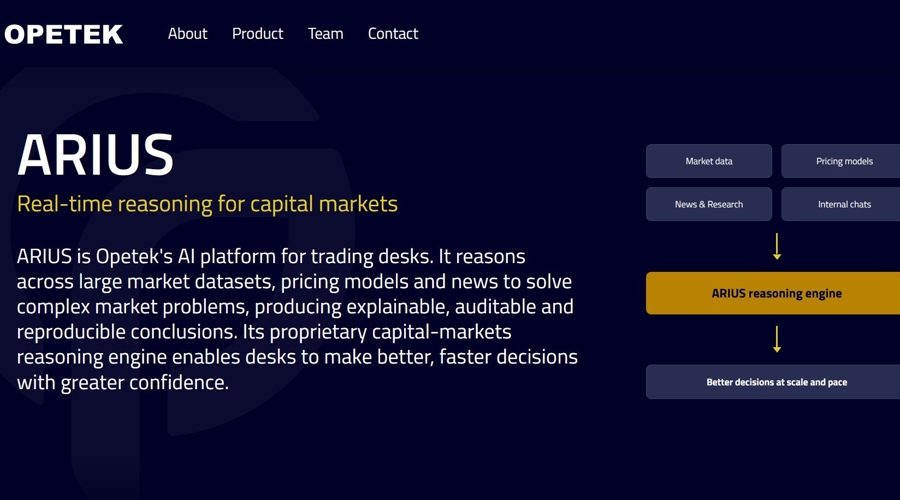
Opetek has launched ARIUS, a quantitative reasoning platform for institutional capital markets designed for front-office trading desks. The company said the platform helps traders and quantitative analysts analyse complex market problems and make trading decisions.
AI assistants are becoming more common in retail trading, with brokers and proprietary trading firms integrating them into their workflows. Opetek's platform is aimed instead at institutional trading desks.
Tier 1 Bank Pilots Opetek's ARIUS

ARIUS is being piloted by traders and quants at a Tier 1 global investment bank across foreign exchange options workflows in New York, London and Singapore. The company said users are analysing market scenarios and supporting live trading decisions. It is also preparing a deployment with another Tier 1 financial institution.
- Liquidnet Targets Brazil and Mexico with Expanded Institutional Equities Offering
- The Hardest Part of Digital Asset Adoption Isn't Trading; It's Everything Around It
- After Expanding FX Connectivity, FlexTrade Brings Portx Portfolio Analytics
Opetek was founded by Varqa Abyaneh, formerly Chief Product Officer at Quantile before its acquisition by London Stock Exchange Group. He previously worked in derivatives trading, quantitative analysis and product development at investment banks, including HSBC.
Abyaneh said trading decisions require quantitative analysis and qualitative judgement under significant time pressure. He said trading desks need reasoning that is "explainable, auditable, and reproducible."
ARIUS Creates Auditable Trading Decision Trails
Opetek said trading desks continue to face fragmented workflows across market data, analytics, risk, research and communications systems. The company also cited growing data volumes, manual analysis and undocumented assumptions that make trading decisions harder to review and reproduce.
To address these challenges, Opetek said ARIUS reasons across market data, pricing models, analytics and news. Through a natural-language interface, users can generate analysis and code without manually preparing data or creating one-off analytical tools.
According to the company, users can inspect the calculations, assumptions, methodologies, code and market data behind each output, creating a reasoning trail that can be reviewed while keeping decision-making under human oversight.


