Trading Has a Customer Problem. iGaming Has Seen It Before

Monday, 07/09/2026 | 06:13 GMT by Line Ho Young Peteri
  • ATFX's Line Peteri argues that poker shows why trading education should focus on risk and decision-making, not just profits, as winning a trade does not always mean the decision was right.
  • iGaming’s experience with CRM, affiliates and localisation offers trading firms practical lessons on retention, partnerships and adapting the same product to different markets.
What trading can learn from iGaming

After almost 16 years in iGaming, I moved into trading last year. Almost immediately, I started noticing the same pattern: a problem comes up, and I think, we've already dealt with this in iGaming.

Trading and igaming are not the same thing, and I don't think they should be treated as if they are. But from a B2B perspective, the crossover is bigger than I expected, and it shows up everywhere. In how differently the same product needs to be sold across borders. In how much easier it is to win a customer than to keep one. In how much intelligence sits inside partnerships that never gets used. And in how badly both industries need to understand the psychology of the person on the other side of the screen.

Both industries are digital-first, global and heavily regulated, and both have had to make something genuinely complicated accessible worldwide. My view doesn't come only from working for gaming companies. I spent years around poker, including my time at partypoker, working with operators, players, affiliates and media, and I play the game myself. Here's what I think trading can take from it.

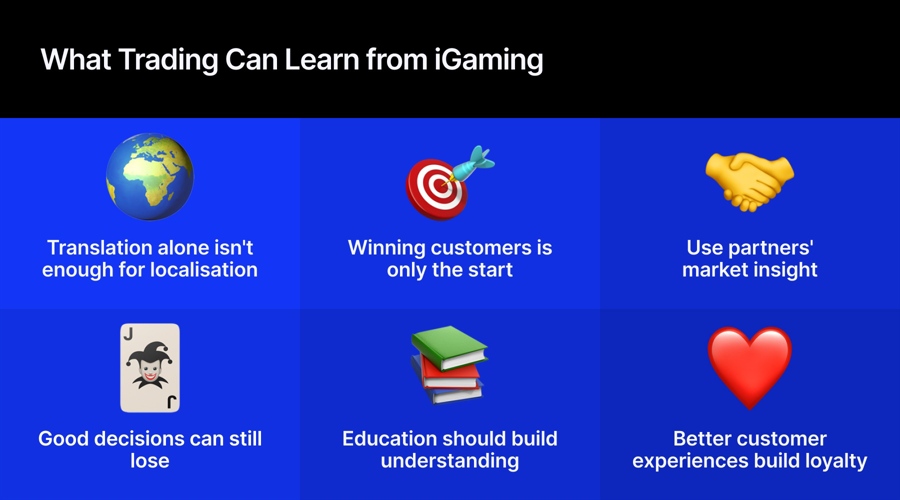
Localisation Is More Than Translation

People are different, and international companies forget that constantly. Translate the site, switch the currency, hire someone who speaks the language, and call it localisation. It isn't. Poker makes the point well, because the game itself doesn't change when you cross a border: the cards are the same, the rules are the same, the people aren't.

How they communicate, build trust and prefer to pay all shifts from market to market. Some of the most useful things I've learned about a market came from sitting with local partners, not from reading a report. Trading is global too, and it's tempting to assume that makes customers global as well. They're not. You can sell the same product everywhere without distributing it the same way everywhere.

Conversion, revenue, retention, ROI: I've built a large part of my career around these numbers, and they matter. But as a poker player myself, I don't care about anyone's conversion funnel. I care whether registration is painless, whether withdrawals work, and whether someone helps when things go wrong. I notice fast when a company was very interested in me before I signed up and much less interested afterwards.

Read more: Inside Prop Trading’s iGaming Psychology Engine

iGaming learned this the hard way, because acquiring players became so expensive that getting someone through the door stopped being enough. That pressure forced the industry to get genuinely sophisticated about CRM and retention, not out of principle, but because the alternative was losing money on every early churner.

Trading can learn the same lesson. Someone opened an account. Good, now what? Do they understand the risk? Are you educating them? Do they trust the platform, and would they still choose you tomorrow if a competitor offered an incentive to switch? Opening an account isn't a relationship. It's the beginning of one.

Your Partners Probably Know Things You Don't

This might be the biggest lesson from almost 16 years in partnerships. I've never much liked purely transactional arrangements built on "you send me customers, I pay you." The commercial side matters, but some of the most valuable information I've received in my career has come directly from partners rather than internal dashboards.

Partners often know their audience better than we do, and know when sentiment is shifting well before it shows up in internal numbers. Some of my professional relationships in poker have outlasted several employers, because the relationship was never really between two logos. It was between people.

Trading already runs on affiliates and introducing brokers. If every conversation with them is limited to CPA and revenue share, a lot of that value is being left on the table.

Trading Customers Are Still Human

Poker draws a sharp line between process and outcome that financial education needs more of. You can play a hand correctly, get your money in with the odds heavily in your favour, and still watch the wrong card land. That doesn't retroactively make the decision wrong, just as playing badly and winning doesn't make it a good one.

Trading has the exact same trap. "I made money, therefore I was right" is a comforting story, but it might just mean you got lucky. Good financial education should teach people to understand risk, probability, discipline and their own decision-making, not just how to chase profit.

There's a neuroscience reason this is hard to internalise. Poker and trading both put people in situations involving money, risk and anticipated reward, and the brain reacts through dopamine-driven motivation. Once emotion enters the mix, decision-making stops behaving like a calm spreadsheet. Add loss aversion, the tendency for a loss to hurt more than an equivalent gain feels good, and you get what poker calls tilt: lose, and you chase it back; win, and you take on more risk than the situation warrants. Traders don't stop being human the moment they open a platform either.

Understand the Psychology

The better an industry gets at understanding what makes people click, return and take another action, the greater its responsibility becomes. iGaming has spent years getting sophisticated about customer behaviour, and that knowledge can build a genuinely better experience. It can also be used to push people when they're vulnerable, a tension the industry has had to sit with for a long time.

For trading, particularly where leveraged products are involved, it's worth inheriting that lesson early rather than learning it the hard way. Just because you know how to make someone take another action doesn't mean you should. If you're building a business for the long term, trust is commercial, not the opposite of it.

Poker is genuinely complicated, and millions of people have learned concepts like position, pot odds and bankroll management without ever opening a 40-page manual. They played, watched, asked questions, and learned inside communities built around the game.

Trading can feel intimidating for similar reasons: charts, leverage and margin, plus vocabulary that makes people feel unqualified to ask a basic question. Accessible isn't the same as dumbed down, and education shouldn't simply be designed to make someone trade more. It should help people understand what they're risking, and how their own judgement shifts after a loss or a big win.

Every industry watches its own competitors, and eventually every industry risks becoming an echo chamber. Coming into trading from almost 16 years in iGaming, I sometimes ask questions that sound obvious. Why do we do it this way? Sometimes there's a genuinely good answer. Sometimes it's simply "because that's how we've always done it," and those are the answers I find most interesting.

I have a lot to learn about trading, and 16 years in gaming doesn't make me an expert in financial markets. Trading shouldn't become more like igaming, and that isn't the argument here. But iGaming has spent decades working through many of the same challenges trading companies face today: localisation, retention, partnerships, payments, customer education, and understanding the person on the other side of the screen.

Trading shouldn't copy iGaming. But it definitely doesn't need to reinvent every wheel either.

After almost 16 years in iGaming, I moved into trading last year. Almost immediately, I started noticing the same pattern: a problem comes up, and I think, we've already dealt with this in iGaming.

Trading and igaming are not the same thing, and I don't think they should be treated as if they are. But from a B2B perspective, the crossover is bigger than I expected, and it shows up everywhere. In how differently the same product needs to be sold across borders. In how much easier it is to win a customer than to keep one. In how much intelligence sits inside partnerships that never gets used. And in how badly both industries need to understand the psychology of the person on the other side of the screen.

Both industries are digital-first, global and heavily regulated, and both have had to make something genuinely complicated accessible worldwide. My view doesn't come only from working for gaming companies. I spent years around poker, including my time at partypoker, working with operators, players, affiliates and media, and I play the game myself. Here's what I think trading can take from it.

Localisation Is More Than Translation

People are different, and international companies forget that constantly. Translate the site, switch the currency, hire someone who speaks the language, and call it localisation. It isn't. Poker makes the point well, because the game itself doesn't change when you cross a border: the cards are the same, the rules are the same, the people aren't.

How they communicate, build trust and prefer to pay all shifts from market to market. Some of the most useful things I've learned about a market came from sitting with local partners, not from reading a report. Trading is global too, and it's tempting to assume that makes customers global as well. They're not. You can sell the same product everywhere without distributing it the same way everywhere.

Conversion, revenue, retention, ROI: I've built a large part of my career around these numbers, and they matter. But as a poker player myself, I don't care about anyone's conversion funnel. I care whether registration is painless, whether withdrawals work, and whether someone helps when things go wrong. I notice fast when a company was very interested in me before I signed up and much less interested afterwards.

Read more: Inside Prop Trading’s iGaming Psychology Engine

iGaming learned this the hard way, because acquiring players became so expensive that getting someone through the door stopped being enough. That pressure forced the industry to get genuinely sophisticated about CRM and retention, not out of principle, but because the alternative was losing money on every early churner.

Trading can learn the same lesson. Someone opened an account. Good, now what? Do they understand the risk? Are you educating them? Do they trust the platform, and would they still choose you tomorrow if a competitor offered an incentive to switch? Opening an account isn't a relationship. It's the beginning of one.

Your Partners Probably Know Things You Don't

This might be the biggest lesson from almost 16 years in partnerships. I've never much liked purely transactional arrangements built on "you send me customers, I pay you." The commercial side matters, but some of the most valuable information I've received in my career has come directly from partners rather than internal dashboards.

Partners often know their audience better than we do, and know when sentiment is shifting well before it shows up in internal numbers. Some of my professional relationships in poker have outlasted several employers, because the relationship was never really between two logos. It was between people.

Trading already runs on affiliates and introducing brokers. If every conversation with them is limited to CPA and revenue share, a lot of that value is being left on the table.

Trading Customers Are Still Human

Poker draws a sharp line between process and outcome that financial education needs more of. You can play a hand correctly, get your money in with the odds heavily in your favour, and still watch the wrong card land. That doesn't retroactively make the decision wrong, just as playing badly and winning doesn't make it a good one.

Trading has the exact same trap. "I made money, therefore I was right" is a comforting story, but it might just mean you got lucky. Good financial education should teach people to understand risk, probability, discipline and their own decision-making, not just how to chase profit.

There's a neuroscience reason this is hard to internalise. Poker and trading both put people in situations involving money, risk and anticipated reward, and the brain reacts through dopamine-driven motivation. Once emotion enters the mix, decision-making stops behaving like a calm spreadsheet. Add loss aversion, the tendency for a loss to hurt more than an equivalent gain feels good, and you get what poker calls tilt: lose, and you chase it back; win, and you take on more risk than the situation warrants. Traders don't stop being human the moment they open a platform either.

Understand the Psychology

The better an industry gets at understanding what makes people click, return and take another action, the greater its responsibility becomes. iGaming has spent years getting sophisticated about customer behaviour, and that knowledge can build a genuinely better experience. It can also be used to push people when they're vulnerable, a tension the industry has had to sit with for a long time.

For trading, particularly where leveraged products are involved, it's worth inheriting that lesson early rather than learning it the hard way. Just because you know how to make someone take another action doesn't mean you should. If you're building a business for the long term, trust is commercial, not the opposite of it.

Poker is genuinely complicated, and millions of people have learned concepts like position, pot odds and bankroll management without ever opening a 40-page manual. They played, watched, asked questions, and learned inside communities built around the game.

Trading can feel intimidating for similar reasons: charts, leverage and margin, plus vocabulary that makes people feel unqualified to ask a basic question. Accessible isn't the same as dumbed down, and education shouldn't simply be designed to make someone trade more. It should help people understand what they're risking, and how their own judgement shifts after a loss or a big win.

Every industry watches its own competitors, and eventually every industry risks becoming an echo chamber. Coming into trading from almost 16 years in iGaming, I sometimes ask questions that sound obvious. Why do we do it this way? Sometimes there's a genuinely good answer. Sometimes it's simply "because that's how we've always done it," and those are the answers I find most interesting.

I have a lot to learn about trading, and 16 years in gaming doesn't make me an expert in financial markets. Trading shouldn't become more like igaming, and that isn't the argument here. But iGaming has spent decades working through many of the same challenges trading companies face today: localisation, retention, partnerships, payments, customer education, and understanding the person on the other side of the screen.

Trading shouldn't copy iGaming. But it definitely doesn't need to reinvent every wheel either.

About the Author: Line Ho Young Peteri
Line Ho Young Peteri
  • 1 Article
About the Author: Line Ho Young Peteri
Line Ho Young Peteri is a global partnerships and business development leader with nearly 25 years of experience across fintech, trading, iGaming, poker, technology and e-commerce. She is currently VP Strategic Partnerships & Affiliates at ATFX and previously held senior roles at Exinity, World Poker Tour and Entain’s partypoker and PartyCasino, as well as co-founding Zmags and Shareholder in roccamore shoes. Having started part of her career in journalism, Line has maintained a strong interest in media, communication and understanding what drives people and audiences. She holds an Executive MBA with Merit from the University of Exeter, is a Chartered Fellow of the Chartered Management Institute (CMgr FCMI) and has completed HarvardX’s Fundamentals of Neuroscience. A TEDx speaker on confidence and leadership, she has a particular interest in human behaviour, decision-making, international partnerships and what different industries can learn from each other.
  • 1 Article

Retail FX

!"#$%&'()*+,-./0123456789:;<=>?@ABCDEFGHIJKLMNOPQRSTUVWXYZ[\]^_`abcdefghijklmnopqrstuvwxyz{|} !"#$%&'()*+,-./0123456789:;<=>?@ABCDEFGHIJKLMNOPQRSTUVWXYZ[\]^_`abcdefghijklmnopqrstuvwxyz{|}