

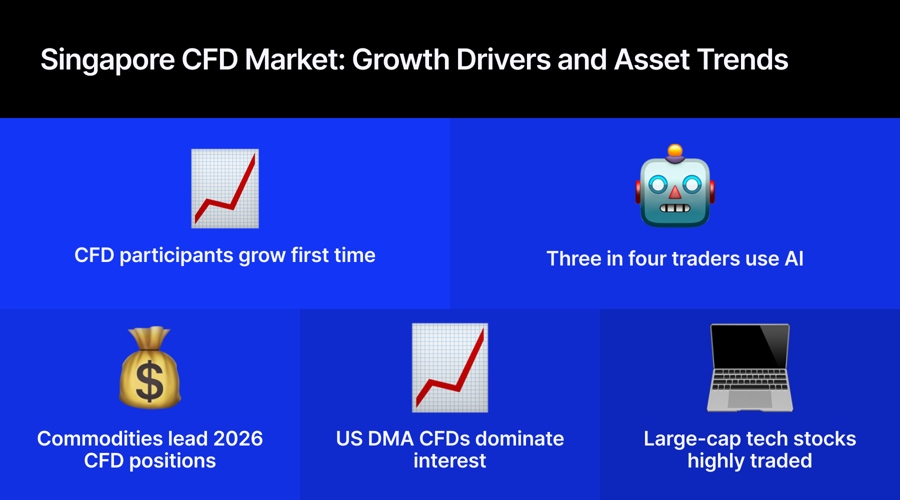
Favourable market conditions have seen CFD traders in Singapore emerge from several years of ‘hibernation’ – and the diversity of products they are trading points to a sustainable return to growth.
Market Growth and Confidence
According to Investment Trends’ 2025 Singapore Leverage Trading Report, Singapore's leverage trading market posted its first growth in active participants since 2021.
Lorenzo Vignati, associate research director at Investment Trends, refers to a market that has come through significant macroeconomic shifts with its core base intact, which is significant because sustained confidence enables traders to stay active, adapt their strategies, and continue contributing to market liquidity and momentum.
Return of Experienced Traders

Phil Waters, managing director for Asia Pacific and emerging markets for OANDA, observes that traders who stepped back during quieter periods have returned as volatility and macro themes picked up again and describes Singapore as a market where, when conditions present an opportunity, experienced traders re-engage quickly.
- OANDA Transitions Prop Trading Clients to FTMO as Brokerage Refocuses
- Brokers Brace for EU Equity Transparency Changes in ESMA Annual Update
- HKEX Regains “Top Global Listing Spot,” Equity Turnover Nearly Doubles in 2025
“What we are seeing is a more mature cycle, less hype and more informed participation,” he adds.
Structural Improvements Support Growth
Last year’s growth was driven by a combination of market conditions and structural improvements in the trading experience, with improved access to educational resources and trading technology—particularly AI-powered tools—giving traders greater confidence in identifying and managing opportunities, suggests Yaki Razmovich, managing director, eToro Singapore and Asia.
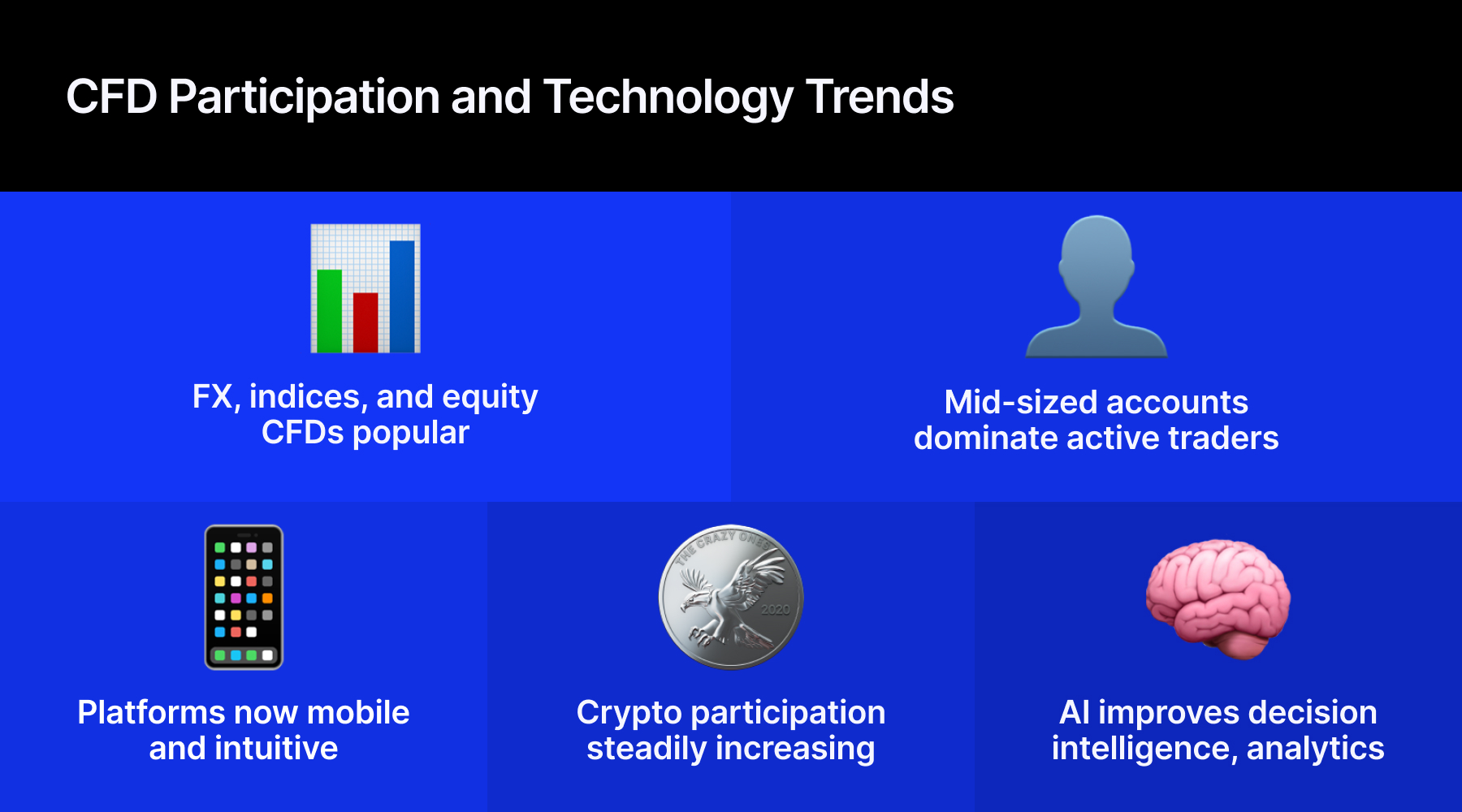
“In parallel, platforms have enhanced the user experience, becoming more intuitive and mobile-friendly and enabling users to start with smaller investment amounts, which has lowered barriers to entry,” he explains.
Popular Products and Market Sophistication
While brokers agree on the factors that have contributed to increased CFD trading volumes, their views on the most popular products reveal a sophisticated market where no one type of trader dominates.
“Generally, US single-stock direct market access CFDs (DMA CFDs) dominate interest in Singapore,” suggests Ademola Olopade, group head of prime brokerage and investment banking and CEO of Mauritius, CGS International Securities. “Large-cap US equities—particularly in technology, AI-linked names, and high-liquidity blue chips—see the highest engagement across all age groups.”
But Olopade also refers to increased participation in crypto and hard commodities such as gold and silver, as well as market indices, noting that earnings cycles and macro announcements often drive concentrated activity in these names.
“Then there is consistent interest in commodities during macro-driven volatility, although US equities remain the anchor product,” he continues. “The client profile in Singapore does not exhibit extreme retail speculation, and capital allocation tends to be more measured, with traders being more attentive to margin discipline. The most active client segments comprise experienced retail traders with mid-sized accounts.”
Balanced Expansion Across Client Segments
A combination of previously inactive clients returning to the market and demand from new participants, particularly through institutional and professional channels, has created balanced expansion, according to Andreas Wigström, managing director, LMAX Global.
“FX, major global indices, commodities, and equity CFDs remain the most popular products in Singapore, reflecting demand for liquidity, transparency, and global market access,” he says. “The most active participants tend to be experienced retail traders and institutional-style clients, often trading around macro events and short-term opportunities.”
Wigström also refers to strong underlying interest in digital assets, which is increasingly influencing demand for regulated crypto-related leveraged products.
Asset Classes and Trading Behaviour
While observing that FX remains foundational in Singapore, Waters also notes strong engagement in major indices and commodities as traders position around global macro themes, and says stocks have also progressively gained traction, which is one of the reasons his firm recently added international share CFDs to its offering.

“The typical active client here is informed and self-directed,” he says. “They understand leverage, they compare platforms carefully, and they tend to trade across asset classes rather than sticking to just one. They also commonly use guaranteed stop-loss orders, which is the trait of a smarter trader.”
In 2026 so far, commodities rank first in terms of the number of Singapore-based users who have opened CFD positions, notes Razmovich, due to huge price movements in precious metals like gold and silver.
Robson Lee, assistant honorary secretary of the Securities Investors Association, adds demand for improved platform consolidation to the list of growth factors and says inexperienced traders tend to gravitate towards major indices, FX pairs, and large-cap stocks, as such instruments tend to display more predictable behaviour and have tighter spreads.
Increasing Role of AI in Trading
Three in four of the traders surveyed by Investment Trends are either using or plan to use AI for charting, signal generation, and performance analysis, an indication that such tools have moved from experimental features to core infrastructure for many retail participants.

Access to AI-driven tools has become increasingly important for Singapore CFD traders, suggests Wigström. “Many traders are already using AI, or actively planning to, as part of their daily workflow to improve speed, consistency, and decision-making. The strongest demand is for tools that are embedded seamlessly into the platform and genuinely enhance outcomes rather than add complexity.”
CFD traders’ AI demands focus more on decision intelligence rather than AI tools per se, notes Olopade, who adds that these traders are not seeking automated, algorithm-driven systems that generate buy or sell signals, but rather tools that improve decision-making and clarity, such as enhanced charting, behavioural insights, and risk attribution.
“In Singapore, traders prefer tools that augment judgement rather than replace it,” he continues. “We see the strongest demand lying in post-trade analytics, such as understanding drawdowns, sizing of positions, and capital concentration risks. AI is valued not for shortcuts but for deeper market understanding.”
This theme is taken up by Waters, who agrees that traders don’t want ‘AI for the sake of AI,’ but instead are looking for tools that genuinely improve decision-making.
“Whether that is to learn, for trading signals, or performance analytics, the expectation now is that platforms should help them see opportunities more clearly and manage risk more effectively,” he says. “The key is integration—traders don’t want to use different systems. They want these capabilities built into the platforms they already use, whether that is TradingView, MT4, or increasingly MT5.”


