The lack of access to private markets for retail investors cuts them off from the biggest opportunities, says Vlad Tenev.
His company, however, is working on solutions, including tokenized products in Europe.
On the other hand, regulators and hard data suggest that private markets may not be suitable for retail investors.
Vlad Tenev, CEO and Co-Founder of Robinhood; Photo: Wikimedia Commons
Robinhood's
boss thinks there's something fundamentally broken about how global capital
markets work. Vlad Tenev, the CEO who built his fortune democratizing stock
trading, now says it's a “tragedy” that regular investors can't
access private markets where the real money gets made.
Robinhood Boss Says Wall
Street's Biggest Secret Is Unfair
Speaking on
Bloomberg
Wealth, Tenev didn't mince words about what he sees as Wall Street's
biggest inequity. “A big tragedy is that private markets are where the
bulk of the interesting appreciation and exposure is nowadays,” Robinhood's Tenev told
host David Rubenstein. “It's a shame that it's so difficult to get
exposure in the US.”
What’s
important here, private market investments dramatically outperform public
markets over the long term, generating returns that can be 400-500 basis points
higher annually. The wealth creation difference is staggering - while public
market investors earned 6.6x their money over 25 years, private market
investors generated 19.9x returns according to Cambridge Associates' comprehensive
data.
The Numbers Don't Lie
Private
equity has delivered an average annual return of 13.1% over 25 years,
significantly outpacing the S&P 500's 8.6% return during the same period.
Even more
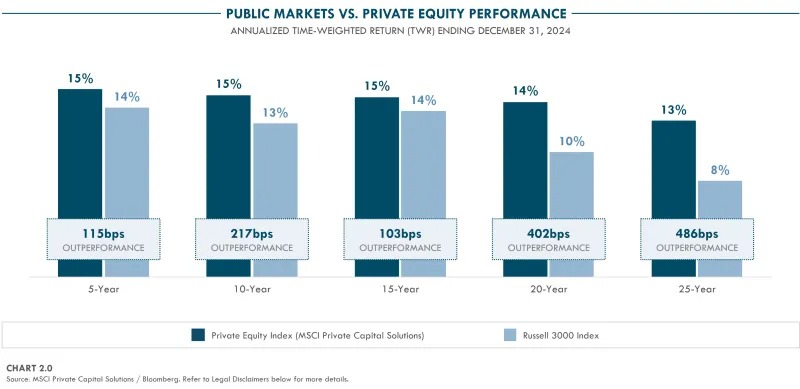
compelling data comes from MSCI Private Capital Solutions, which shows that
since 2000, private equity has generated a 13% net annualized return compared
to the Russell 3000's 8% return. This represents outperformance of 486 basis
points annually.
The
illiquidity premium alone adds 2–4% annually to private equity returns over the
long run. This premium compensates investors for giving up the ability to sell
their investments quickly, but the trade-off has proven highly rewarding for
those who can afford to wait.
Private
equity has outperformed public markets in 97 out of the last 100 quarters when
looking at 10-year rolling returns. Even during the three quarters of
underperformance, private equity regained its lead in the immediately following
quarter.
The move
raised eyebrows among regulators and industry watchers who questioned how these
products are valued and whether retail investors truly understand what they're
buying. Critics worry about transparency and whether these complex instruments
could blow up in customers' faces.
Robinhood CEO downplays OpenAI concerns on tokenized stock structure https://t.co/6tWzgrtBXa
But Tenev
seems undeterred. “We're obviously working to solve that,” he said,
suggesting more products could be coming to bridge the gap between retail
investors and private markets.
Why Private Markets May Be
Too Risky for Regular Investors
The
fundamental mismatch between how private markets operate and what everyday
investors need could create dangerous situations for both individuals and the
broader financial system.
Sarah Pritchard, FCA Executive Director for Supervision
The UK's
Financial Conduct Authority delivered
a stark warning about this trend. Deputy Chief Executive Sarah Pritchard
emphasized that while some people might benefit from private market exposure
“with the right information and support,” the reality is that
“for others, it will not” be appropriate. The regulator's position
acknowledges a harsh truth – these investments simply aren't designed for most
people.
Even more
troubling is what might happen if retail money floods into private markets too
quickly. Moody's research suggests this could trigger a dangerous race among
fund managers to deploy capital, potentially leading them to “compromise
on underwriting standards or stretch into riskier assets to keep pace with
inflows.”
Wall Street Takes Notice
The private
markets boom has caught everyone's attention, not just regulators and fintech
upstarts like Robinhood. Earlier this month, banking giants JPMorgan Chase and
Citigroup announced they're expanding research coverage to include private
companies in hot sectors like artificial intelligence and aerospace.
The numbers
explain why. Private company valuations have been surging for years, creating
paper fortunes for those lucky enough to get in early. Meanwhile, the
traditional initial public offering market has struggled, with many companies
choosing to raise money privately rather than face the scrutiny of public
markets.
This trend
has created what Tenev calls the “greatest remaining iniquity” in
American finance. While pension funds, endowments, and wealthy individuals can
write checks to private equity firms and venture capital funds, regular
investors are largely shut out by regulations designed to protect them from
risky investments.
The Access Problem
The irony
isn't lost on anyone. Robinhood made its name by eliminating trading
commissions and making it easier for millennials to buy stocks and options. But
when it comes to the investments that have generated the biggest returns over
the past decade, even Robinhood's millions of users are stuck on the outside
looking in.
Current
regulations require investors to be “accredited” to participate in
most private investments, meaning they need either $1 million in net worth or
$200,000 in annual income. Those rules were written decades ago to protect
unsophisticated investors from losing their shirts on risky deals.
But critics
argue these outdated thresholds now serve mainly to protect the wealthy's
access to the best investment opportunities. While a middle-class investor can
day-trade meme stocks on Robinhood, they can't buy shares in the next big tech
startup.
“That's
where I would point to as the greatest remaining iniquity and opportunity in
our capital markets,” Tenev said, making clear he sees this as more than
just a business opportunity for his company.
The
question now is whether regulators will go along with efforts to democratize
private markets, or whether they'll stick with rules designed for a different
era of finance.
Robinhood's
boss thinks there's something fundamentally broken about how global capital
markets work. Vlad Tenev, the CEO who built his fortune democratizing stock
trading, now says it's a “tragedy” that regular investors can't
access private markets where the real money gets made.
Robinhood Boss Says Wall
Street's Biggest Secret Is Unfair
Speaking on
Bloomberg
Wealth, Tenev didn't mince words about what he sees as Wall Street's
biggest inequity. “A big tragedy is that private markets are where the
bulk of the interesting appreciation and exposure is nowadays,” Robinhood's Tenev told
host David Rubenstein. “It's a shame that it's so difficult to get
exposure in the US.”
What’s
important here, private market investments dramatically outperform public
markets over the long term, generating returns that can be 400-500 basis points
higher annually. The wealth creation difference is staggering - while public
market investors earned 6.6x their money over 25 years, private market
investors generated 19.9x returns according to Cambridge Associates' comprehensive
data.
The Numbers Don't Lie
Private
equity has delivered an average annual return of 13.1% over 25 years,
significantly outpacing the S&P 500's 8.6% return during the same period.
Even more
compelling data comes from MSCI Private Capital Solutions, which shows that
since 2000, private equity has generated a 13% net annualized return compared
to the Russell 3000's 8% return. This represents outperformance of 486 basis
points annually.
The
illiquidity premium alone adds 2–4% annually to private equity returns over the
long run. This premium compensates investors for giving up the ability to sell
their investments quickly, but the trade-off has proven highly rewarding for
those who can afford to wait.
Private
equity has outperformed public markets in 97 out of the last 100 quarters when
looking at 10-year rolling returns. Even during the three quarters of
underperformance, private equity regained its lead in the immediately following
quarter.
The move
raised eyebrows among regulators and industry watchers who questioned how these
products are valued and whether retail investors truly understand what they're
buying. Critics worry about transparency and whether these complex instruments
could blow up in customers' faces.
Robinhood CEO downplays OpenAI concerns on tokenized stock structure https://t.co/6tWzgrtBXa
But Tenev
seems undeterred. “We're obviously working to solve that,” he said,
suggesting more products could be coming to bridge the gap between retail
investors and private markets.
Why Private Markets May Be
Too Risky for Regular Investors
The
fundamental mismatch between how private markets operate and what everyday
investors need could create dangerous situations for both individuals and the
broader financial system.
Sarah Pritchard, FCA Executive Director for Supervision
The UK's
Financial Conduct Authority delivered
a stark warning about this trend. Deputy Chief Executive Sarah Pritchard
emphasized that while some people might benefit from private market exposure
“with the right information and support,” the reality is that
“for others, it will not” be appropriate. The regulator's position
acknowledges a harsh truth – these investments simply aren't designed for most
people.
Even more
troubling is what might happen if retail money floods into private markets too
quickly. Moody's research suggests this could trigger a dangerous race among
fund managers to deploy capital, potentially leading them to “compromise
on underwriting standards or stretch into riskier assets to keep pace with
inflows.”
Wall Street Takes Notice
The private
markets boom has caught everyone's attention, not just regulators and fintech
upstarts like Robinhood. Earlier this month, banking giants JPMorgan Chase and
Citigroup announced they're expanding research coverage to include private
companies in hot sectors like artificial intelligence and aerospace.
The numbers
explain why. Private company valuations have been surging for years, creating
paper fortunes for those lucky enough to get in early. Meanwhile, the
traditional initial public offering market has struggled, with many companies
choosing to raise money privately rather than face the scrutiny of public
markets.
This trend
has created what Tenev calls the “greatest remaining iniquity” in
American finance. While pension funds, endowments, and wealthy individuals can
write checks to private equity firms and venture capital funds, regular
investors are largely shut out by regulations designed to protect them from
risky investments.
The Access Problem
The irony
isn't lost on anyone. Robinhood made its name by eliminating trading
commissions and making it easier for millennials to buy stocks and options. But
when it comes to the investments that have generated the biggest returns over
the past decade, even Robinhood's millions of users are stuck on the outside
looking in.
Current
regulations require investors to be “accredited” to participate in
most private investments, meaning they need either $1 million in net worth or
$200,000 in annual income. Those rules were written decades ago to protect
unsophisticated investors from losing their shirts on risky deals.
But critics
argue these outdated thresholds now serve mainly to protect the wealthy's
access to the best investment opportunities. While a middle-class investor can
day-trade meme stocks on Robinhood, they can't buy shares in the next big tech
startup.
“That's
where I would point to as the greatest remaining iniquity and opportunity in
our capital markets,” Tenev said, making clear he sees this as more than
just a business opportunity for his company.
The
question now is whether regulators will go along with efforts to democratize
private markets, or whether they'll stick with rules designed for a different
era of finance.
Damian Chmiel is a Senior Analyst & Editor at Finance Magnates with more than 15 years of experience in the CFD and online trading industry. Active as both a trader and journalist since 2010, he focuses on broker coverage, fintech innovation, and regulatory developments across Europe, the Middle East, and Asia.
His work includes interviews with C-level leaders at major brokerages and fintech platforms, as well as co-authoring Finance Magnates’ quarterly industry benchmarking reports. Damian’s reporting is data-driven, market-aware, and grounded in direct industry engagement. His analysis and commentary have also been cited by external media outlets, including Investing.com, Binance, The Asset, Stockhead, and Dispatch.
Education:
MA in Finance and Accounting, Cracow University of Economics
FTMO Says Monthly Rewards Near $15 Million in September
Featured Videos
AvaTrade to Acquire Most of FXCM; NAGA Raises $8M
AvaTrade to Acquire Most of FXCM; NAGA Raises $8M
AvaTrade to Acquire Most of FXCM; NAGA Raises $8M
AvaTrade to Acquire Most of FXCM; NAGA Raises $8M
Today’s financial news recap covers AvaTrade agrees to acquire most of FXCM, NAGA secures eight million dollars in new financing, and Wise seeks a tax settlement in the UK.
Finance Magnates Daily Recap brings you the latest news from forex and CFD brokers, fintech, payments, cryptocurrency, digital assets, trading platforms, financial regulation and global markets.
Get the key company news, executive moves, deals, regulatory updates and market developments of the day, in just a few minutes. New episodes published every weekday.
Read more: https://www.financemagnates.com
#FinanceMagnates #ForexNews #FintechNews
Today’s financial news recap covers AvaTrade agrees to acquire most of FXCM, NAGA secures eight million dollars in new financing, and Wise seeks a tax settlement in the UK.
Finance Magnates Daily Recap brings you the latest news from forex and CFD brokers, fintech, payments, cryptocurrency, digital assets, trading platforms, financial regulation and global markets.
Get the key company news, executive moves, deals, regulatory updates and market developments of the day, in just a few minutes. New episodes published every weekday.
Read more: https://www.financemagnates.com
#FinanceMagnates #ForexNews #FintechNews
Today’s financial news recap covers AvaTrade agrees to acquire most of FXCM, NAGA secures eight million dollars in new financing, and Wise seeks a tax settlement in the UK.
Finance Magnates Daily Recap brings you the latest news from forex and CFD brokers, fintech, payments, cryptocurrency, digital assets, trading platforms, financial regulation and global markets.
Get the key company news, executive moves, deals, regulatory updates and market developments of the day, in just a few minutes. New episodes published every weekday.
Read more: https://www.financemagnates.com
#FinanceMagnates #ForexNews #FintechNews
Today’s financial news recap covers AvaTrade agrees to acquire most of FXCM, NAGA secures eight million dollars in new financing, and Wise seeks a tax settlement in the UK.
Finance Magnates Daily Recap brings you the latest news from forex and CFD brokers, fintech, payments, cryptocurrency, digital assets, trading platforms, financial regulation and global markets.
Get the key company news, executive moves, deals, regulatory updates and market developments of the day, in just a few minutes. New episodes published every weekday.
Read more: https://www.financemagnates.com
#FinanceMagnates #ForexNews #FintechNews
XTB Adds Overnight US Stock Trading; Nasdaq Ventures Invests in One Trading
XTB Adds Overnight US Stock Trading; Nasdaq Ventures Invests in One Trading
XTB Adds Overnight US Stock Trading; Nasdaq Ventures Invests in One Trading
XTB Adds Overnight US Stock Trading; Nasdaq Ventures Invests in One Trading
XTB Adds Overnight US Stock Trading; Nasdaq Ventures Invests in One Trading
XTB Adds Overnight US Stock Trading; Nasdaq Ventures Invests in One Trading
Today’s financial news recap covers XTB expands overnight US stock trading, Fortrade reports higher revenue, Nasdaq backs One Trading, and Vest Labs raises 13 million dollars.
Finance Magnates Daily Recap brings you the latest news from forex and CFD brokers, fintech, payments, cryptocurrency, digital assets, trading platforms, financial regulation and global markets.
Get the key company news, executive moves, deals, regulatory updates and market developments of the day, in just a few minutes. New episodes published every weekday.
Read more: https://www.financemagnates.com
#FinanceMagnates #ForexNews #FintechNews
Today’s financial news recap covers XTB expands overnight US stock trading, Fortrade reports higher revenue, Nasdaq backs One Trading, and Vest Labs raises 13 million dollars.
Finance Magnates Daily Recap brings you the latest news from forex and CFD brokers, fintech, payments, cryptocurrency, digital assets, trading platforms, financial regulation and global markets.
Get the key company news, executive moves, deals, regulatory updates and market developments of the day, in just a few minutes. New episodes published every weekday.
Read more: https://www.financemagnates.com
#FinanceMagnates #ForexNews #FintechNews
Today’s financial news recap covers XTB expands overnight US stock trading, Fortrade reports higher revenue, Nasdaq backs One Trading, and Vest Labs raises 13 million dollars.
Finance Magnates Daily Recap brings you the latest news from forex and CFD brokers, fintech, payments, cryptocurrency, digital assets, trading platforms, financial regulation and global markets.
Get the key company news, executive moves, deals, regulatory updates and market developments of the day, in just a few minutes. New episodes published every weekday.
Read more: https://www.financemagnates.com
#FinanceMagnates #ForexNews #FintechNews
Today’s financial news recap covers XTB expands overnight US stock trading, Fortrade reports higher revenue, Nasdaq backs One Trading, and Vest Labs raises 13 million dollars.
Finance Magnates Daily Recap brings you the latest news from forex and CFD brokers, fintech, payments, cryptocurrency, digital assets, trading platforms, financial regulation and global markets.
Get the key company news, executive moves, deals, regulatory updates and market developments of the day, in just a few minutes. New episodes published every weekday.
Read more: https://www.financemagnates.com
#FinanceMagnates #ForexNews #FintechNews
Today’s financial news recap covers XTB expands overnight US stock trading, Fortrade reports higher revenue, Nasdaq backs One Trading, and Vest Labs raises 13 million dollars.
Finance Magnates Daily Recap brings you the latest news from forex and CFD brokers, fintech, payments, cryptocurrency, digital assets, trading platforms, financial regulation and global markets.
Get the key company news, executive moves, deals, regulatory updates and market developments of the day, in just a few minutes. New episodes published every weekday.
Read more: https://www.financemagnates.com
#FinanceMagnates #ForexNews #FintechNews
Today’s financial news recap covers XTB expands overnight US stock trading, Fortrade reports higher revenue, Nasdaq backs One Trading, and Vest Labs raises 13 million dollars.
Finance Magnates Daily Recap brings you the latest news from forex and CFD brokers, fintech, payments, cryptocurrency, digital assets, trading platforms, financial regulation and global markets.
Get the key company news, executive moves, deals, regulatory updates and market developments of the day, in just a few minutes. New episodes published every weekday.
Read more: https://www.financemagnates.com
#FinanceMagnates #ForexNews #FintechNews
CMC Founder Downplays Volatility Hit; Devexperts Names CEO
CMC Founder Downplays Volatility Hit; Devexperts Names CEO
CMC Founder Downplays Volatility Hit; Devexperts Names CEO
CMC Founder Downplays Volatility Hit; Devexperts Names CEO
CMC Founder Downplays Volatility Hit; Devexperts Names CEO
CMC Founder Downplays Volatility Hit; Devexperts Names CEO
Today’s financial news recap covers low volatility pressures brokers, Devexperts names a new CEO, Saxo cuts onboarding time, and OKX reaches a 25 billion dollar valuation.
Finance Magnates Daily Recap brings you the latest news from forex and CFD brokers, fintech, payments, cryptocurrency, digital assets, trading platforms, financial regulation and global markets.
Get the key company news, executive moves, deals, regulatory updates and market developments of the day, in just a few minutes. New episodes published every weekday.
Read more: https://www.financemagnates.com
#FinanceMagnates #ForexNews #FintechNews
Today’s financial news recap covers low volatility pressures brokers, Devexperts names a new CEO, Saxo cuts onboarding time, and OKX reaches a 25 billion dollar valuation.
Finance Magnates Daily Recap brings you the latest news from forex and CFD brokers, fintech, payments, cryptocurrency, digital assets, trading platforms, financial regulation and global markets.
Get the key company news, executive moves, deals, regulatory updates and market developments of the day, in just a few minutes. New episodes published every weekday.
Read more: https://www.financemagnates.com
#FinanceMagnates #ForexNews #FintechNews
Today’s financial news recap covers low volatility pressures brokers, Devexperts names a new CEO, Saxo cuts onboarding time, and OKX reaches a 25 billion dollar valuation.
Finance Magnates Daily Recap brings you the latest news from forex and CFD brokers, fintech, payments, cryptocurrency, digital assets, trading platforms, financial regulation and global markets.
Get the key company news, executive moves, deals, regulatory updates and market developments of the day, in just a few minutes. New episodes published every weekday.
Read more: https://www.financemagnates.com
#FinanceMagnates #ForexNews #FintechNews
Today’s financial news recap covers low volatility pressures brokers, Devexperts names a new CEO, Saxo cuts onboarding time, and OKX reaches a 25 billion dollar valuation.
Finance Magnates Daily Recap brings you the latest news from forex and CFD brokers, fintech, payments, cryptocurrency, digital assets, trading platforms, financial regulation and global markets.
Get the key company news, executive moves, deals, regulatory updates and market developments of the day, in just a few minutes. New episodes published every weekday.
Read more: https://www.financemagnates.com
#FinanceMagnates #ForexNews #FintechNews
Today’s financial news recap covers low volatility pressures brokers, Devexperts names a new CEO, Saxo cuts onboarding time, and OKX reaches a 25 billion dollar valuation.
Finance Magnates Daily Recap brings you the latest news from forex and CFD brokers, fintech, payments, cryptocurrency, digital assets, trading platforms, financial regulation and global markets.
Get the key company news, executive moves, deals, regulatory updates and market developments of the day, in just a few minutes. New episodes published every weekday.
Read more: https://www.financemagnates.com
#FinanceMagnates #ForexNews #FintechNews
Today’s financial news recap covers low volatility pressures brokers, Devexperts names a new CEO, Saxo cuts onboarding time, and OKX reaches a 25 billion dollar valuation.
Finance Magnates Daily Recap brings you the latest news from forex and CFD brokers, fintech, payments, cryptocurrency, digital assets, trading platforms, financial regulation and global markets.
Get the key company news, executive moves, deals, regulatory updates and market developments of the day, in just a few minutes. New episodes published every weekday.
Read more: https://www.financemagnates.com
#FinanceMagnates #ForexNews #FintechNews
Today’s financial news recap covers Trade Nation buys FXCM's UK client book, Trading 212 reports higher revenue, the CFTC's move to allow perpetual index futures.
Finance Magnates Daily Recap brings you the latest news from forex and CFD brokers, fintech, payments, cryptocurrency, digital assets, trading platforms, financial regulation and global markets.
Get the key company news, executive moves, deals, regulatory updates and market developments of the day, in just a few minutes. New episodes published every weekday.
Read more: https://www.financemagnates.com
#FinanceMagnates #ForexNews #FintechNews
Today’s financial news recap covers Trade Nation buys FXCM's UK client book, Trading 212 reports higher revenue, the CFTC's move to allow perpetual index futures.
Finance Magnates Daily Recap brings you the latest news from forex and CFD brokers, fintech, payments, cryptocurrency, digital assets, trading platforms, financial regulation and global markets.
Get the key company news, executive moves, deals, regulatory updates and market developments of the day, in just a few minutes. New episodes published every weekday.
Read more: https://www.financemagnates.com
#FinanceMagnates #ForexNews #FintechNews
Today’s financial news recap covers Trade Nation buys FXCM's UK client book, Trading 212 reports higher revenue, the CFTC's move to allow perpetual index futures.
Finance Magnates Daily Recap brings you the latest news from forex and CFD brokers, fintech, payments, cryptocurrency, digital assets, trading platforms, financial regulation and global markets.
Get the key company news, executive moves, deals, regulatory updates and market developments of the day, in just a few minutes. New episodes published every weekday.
Read more: https://www.financemagnates.com
#FinanceMagnates #ForexNews #FintechNews
Today’s financial news recap covers Trade Nation buys FXCM's UK client book, Trading 212 reports higher revenue, the CFTC's move to allow perpetual index futures.
Finance Magnates Daily Recap brings you the latest news from forex and CFD brokers, fintech, payments, cryptocurrency, digital assets, trading platforms, financial regulation and global markets.
Get the key company news, executive moves, deals, regulatory updates and market developments of the day, in just a few minutes. New episodes published every weekday.
Read more: https://www.financemagnates.com
#FinanceMagnates #ForexNews #FintechNews
Today’s financial news recap covers Trade Nation buys FXCM's UK client book, Trading 212 reports higher revenue, the CFTC's move to allow perpetual index futures.
Finance Magnates Daily Recap brings you the latest news from forex and CFD brokers, fintech, payments, cryptocurrency, digital assets, trading platforms, financial regulation and global markets.
Get the key company news, executive moves, deals, regulatory updates and market developments of the day, in just a few minutes. New episodes published every weekday.
Read more: https://www.financemagnates.com
#FinanceMagnates #ForexNews #FintechNews
Today’s financial news recap covers Trade Nation buys FXCM's UK client book, Trading 212 reports higher revenue, the CFTC's move to allow perpetual index futures.
Finance Magnates Daily Recap brings you the latest news from forex and CFD brokers, fintech, payments, cryptocurrency, digital assets, trading platforms, financial regulation and global markets.
Get the key company news, executive moves, deals, regulatory updates and market developments of the day, in just a few minutes. New episodes published every weekday.
Read more: https://www.financemagnates.com
#FinanceMagnates #ForexNews #FintechNews
Your career isn’t a linear path.
Your career isn’t a linear path.
Your career isn’t a linear path.
Your career isn’t a linear path.
Your career isn’t a linear path.
Your career isn’t a linear path.
Roles change. Career goals change. Sometimes you want a completely new challenge.
But the skills and knowledge you build along the way can stay with you and give you something to build on.
For Jeff Patterson, that continued growth is key to long-term career development.
You bring the skills. FM Academy helps you build the knowledge.
#FMAcademy #FinanceMagnates #FinanceCareers #ProfessionalDevelopment #Fintech
Roles change. Career goals change. Sometimes you want a completely new challenge.
But the skills and knowledge you build along the way can stay with you and give you something to build on.
For Jeff Patterson, that continued growth is key to long-term career development.
You bring the skills. FM Academy helps you build the knowledge.
#FMAcademy #FinanceMagnates #FinanceCareers #ProfessionalDevelopment #Fintech
Roles change. Career goals change. Sometimes you want a completely new challenge.
But the skills and knowledge you build along the way can stay with you and give you something to build on.
For Jeff Patterson, that continued growth is key to long-term career development.
You bring the skills. FM Academy helps you build the knowledge.
#FMAcademy #FinanceMagnates #FinanceCareers #ProfessionalDevelopment #Fintech
Roles change. Career goals change. Sometimes you want a completely new challenge.
But the skills and knowledge you build along the way can stay with you and give you something to build on.
For Jeff Patterson, that continued growth is key to long-term career development.
You bring the skills. FM Academy helps you build the knowledge.
#FMAcademy #FinanceMagnates #FinanceCareers #ProfessionalDevelopment #Fintech
Roles change. Career goals change. Sometimes you want a completely new challenge.
But the skills and knowledge you build along the way can stay with you and give you something to build on.
For Jeff Patterson, that continued growth is key to long-term career development.
You bring the skills. FM Academy helps you build the knowledge.
#FMAcademy #FinanceMagnates #FinanceCareers #ProfessionalDevelopment #Fintech
Roles change. Career goals change. Sometimes you want a completely new challenge.
But the skills and knowledge you build along the way can stay with you and give you something to build on.
For Jeff Patterson, that continued growth is key to long-term career development.
You bring the skills. FM Academy helps you build the knowledge.
#FMAcademy #FinanceMagnates #FinanceCareers #ProfessionalDevelopment #Fintech