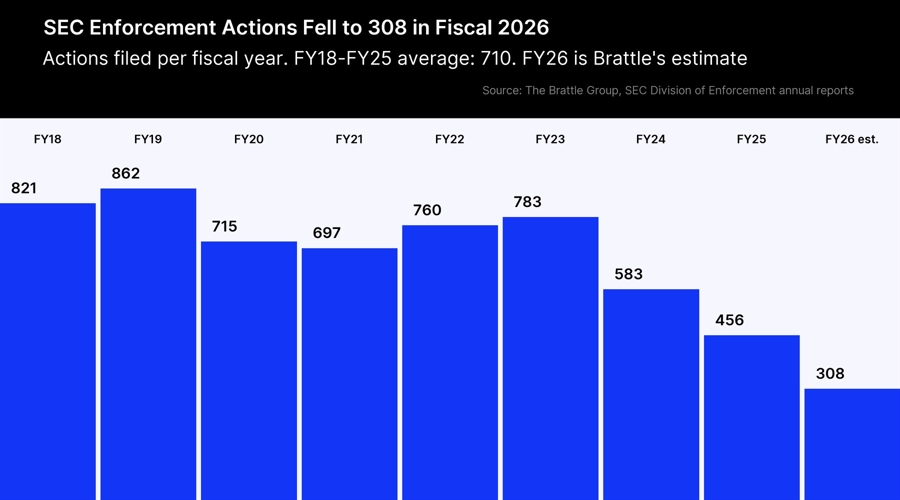
That is about a third below the regulator's own 456 a year earlier and less than half its 2018-2025 average.
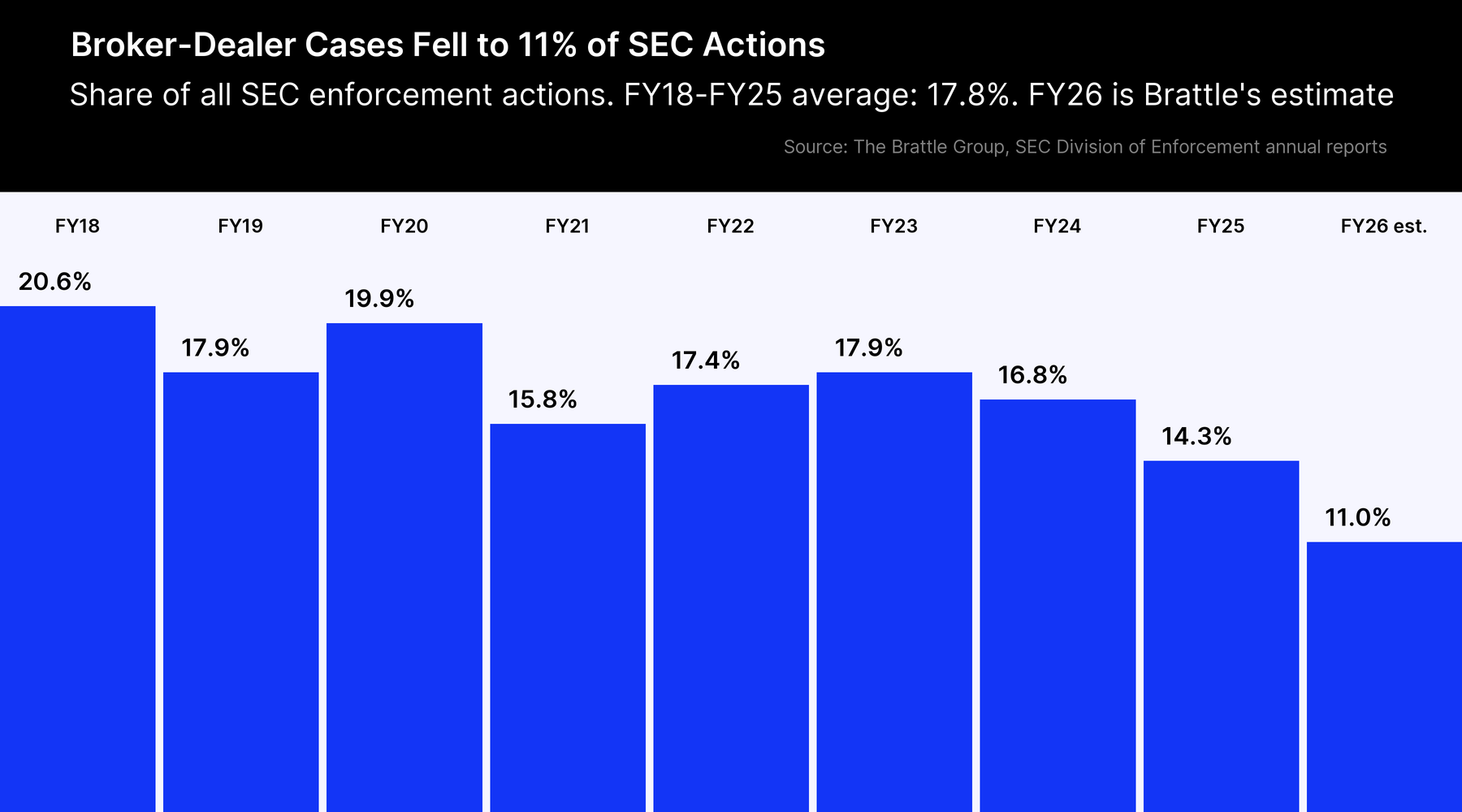
Broker-dealer actions made up 11% of the total, the lowest share in data going back to 2018.
The US Securities and Exchange Commission (SEC) filed an estimated 308 enforcement actions in fiscal 2026, its fewest since at least 2018. The Brattle Group published the estimate yesterday (Tuesday).
The SEC's fiscal year runs from October to September, and it has not yet published its own 2026 results. Its count for the prior year, published in April, was 456 actions. That puts the new estimate about a third lower.
Broker-dealers took a smaller share of what was left. Cases in that category made up 11.0% of the year's actions, the lowest share in Brattle's data, against 14.3% in fiscal 2025 and an average of 17.8%.
Activity was uneven. Brattle counted 93 actions in the first half and 215 in the second, including 99 in September alone. September is usually the busiest month, but this year it accounted for 32.1% of the total, against a historical share of 26.6%.
Jan Jindra, Principal, The Brattle Group, Source: The Brattle Group
Jan Jindra, a principal at Brattle and a former assistant director at the SEC, said second-half filings rose sharply but "the annual total remained far below historical levels."
Brattle linked the slow start to persistently low staffing and the government shutdown that ran from October 1 to November 12, 2025, the longest in US history. Even the second-half total was the second-lowest in its data, ahead only of the 144 actions filed in the same period of fiscal 2025.
The Enforcement Division also changed hands. Margaret Ryan resigned as director in March, and David Woodcock, who ran the SEC's Fort Worth office from 2011 to 2015, took over in May. The agency revised its Enforcement Manual and Wells process in February.
A draft agency plan released in June would tie enforcement to "policing fraud and manipulation" and move away from cases that stretch the agency's authority.
Broker-Dealer Cases Shrink to 11% of the Total
Brattle sorts each action into one of 10 allegation categories, following the SEC's own classification for earlier years. In the second half of fiscal 2026, the broker-dealer share was 9.8%.
Applied to the full-year total, the 11.0% share works out to about 34 cases, against roughly 65 a year earlier, according to FinanceMagnates.com calculations based on Brattle's figures.
The decline came even as the SEC revived a retail fraud working group in July, with a remit that covers brokers' breaches of duty to customers alongside offering fraud and pump-and-dump schemes.
Securities offerings and delinquent filings, cases against companies behind on their periodic reports, each accounted for 21.4% of actions. Delinquent filings made up 28.8% of second-half cases after 4.3% in the first half.
Insider trading reached 12.3% of actions, its highest share since fiscal 2018 and more than double its average. The number of such cases was only about 10% above the 2018-2025 average, Brattle said, so most of the rise in share came from the smaller total.
Criminal Charges Ran Alongside One in Six Cases
Releases from the SEC mentioned a parallel criminal indictment in 7.5% of fiscal 2026 actions, the lowest share in Brattle's data. A search of public court records raised that to 16.9%, or 52 actions, the highest share in its data but a total in line with fiscal 2024 and 2025.
Where the SEC's own release did not mention the criminal case, the agency typically filed its civil action 66 days after the indictment, Brattle found.
Adrienna Huffman, Senior Associate, The Brattle Group, Source: The Brattle Group
Adrienna Huffman, a senior associate at Brattle, forecast 350 to 450 actions in fiscal 2027. She said the coming year will show "whether September's pickup develops into a more sustained increase in filings."
Brattle expects Woodcock's division to bring more offering fraud, insider trading, market manipulation and investment adviser cases. It expects a slower result from the Financial Reporting and Accounting Unit, which the SEC set up only in August.
Even the top of that forecast range would leave the SEC 260 actions short of its 2018-2025 average.
Damian Chmiel is a Senior Analyst & Editor at Finance Magnates with more than 15 years of experience in the CFD and online trading industry. Active as both a trader and journalist since 2010, he focuses on broker coverage, fintech innovation, and regulatory developments across Europe, the Middle East, and Asia.
His work includes interviews with C-level leaders at major brokerages and fintech platforms, as well as co-authoring Finance Magnates’ quarterly industry benchmarking reports. Damian’s reporting is data-driven, market-aware, and grounded in direct industry engagement. His analysis and commentary have also been cited by external media outlets, including Investing.com, Binance, The Asset, Stockhead, and Dispatch.
Education:
MA in Finance and Accounting, Cracow University of Economics
After Analysing Markets, Trading Platforms Turn to Analysing Traders
Featured Videos
How Much Are CFD Industry Executives Making; Plus500 Buys Brazilian Broker
How Much Are CFD Industry Executives Making; Plus500 Buys Brazilian Broker
How Much Are CFD Industry Executives Making; Plus500 Buys Brazilian Broker
How Much Are CFD Industry Executives Making; Plus500 Buys Brazilian Broker
Today’s financial news recap covers FinTop Consulting shared its 2026 salary surveys for Dubai, London and Cyprus with Finance Magnates, Plus500 buys a Brazilian broker, and Google opens the door to CFD ads in Denmark and Chile.
Finance Magnates Daily Recap brings you the latest news from forex and CFD brokers, fintech, payments, cryptocurrency, digital assets, trading platforms, financial regulation and global markets.
Get the key company news, executive moves, deals, regulatory updates and market developments of the day, in just a few minutes. New episodes published every weekday.
Read more: https://www.financemagnates.com
#FinanceMagnates #ForexNews #FintechNews
Capital.com UAE Clients Trade $1T in H1; Saxo Signs Nine Athletes
Capital.com UAE Clients Trade $1T in H1; Saxo Signs Nine Athletes
Capital.com UAE Clients Trade $1T in H1; Saxo Signs Nine Athletes
Capital.com UAE Clients Trade $1T in H1; Saxo Signs Nine Athletes
Capital.com UAE Clients Trade $1T in H1; Saxo Signs Nine Athletes
Capital.com UAE Clients Trade $1T in H1; Saxo Signs Nine Athletes
Today’s financial news recap covers Capital.com’s trading data, Saxo Bank’s athlete campaign, Revolut’s Gibraltar crypto licence, and eToro’s new desktop terminal.
Finance Magnates Daily Recap brings you the latest news from forex and CFD brokers, fintech, payments, cryptocurrency, digital assets, trading platforms, financial regulation and global markets.
Get the key company news, executive moves, deals, regulatory updates and market developments of the day, in just a few minutes. New episodes published every weekday.
Read more: https://www.financemagnates.com
#FinanceMagnates #ForexNews #FintechNews
CXM Group to Buy TD Markets; Interactive Brokers Raises Dividend
CXM Group to Buy TD Markets; Interactive Brokers Raises Dividend
CXM Group to Buy TD Markets; Interactive Brokers Raises Dividend
CXM Group to Buy TD Markets; Interactive Brokers Raises Dividend
CXM Group to Buy TD Markets; Interactive Brokers Raises Dividend
CXM Group to Buy TD Markets; Interactive Brokers Raises Dividend
Today’s financial news recap covers CXM Group agrees to acquire TD Markets, Interactive Brokers raises its dividend, Your Bourse and 4XPORTAL formalise a technology partnership, and IC completes its rebranding from IC Markets.
Finance Magnates Daily Recap brings you the latest news from forex and CFD brokers, fintech, payments, cryptocurrency, digital assets, trading platforms, financial regulation and global markets.
Get the key company news, executive moves, deals, regulatory updates and market developments of the day, in just a few minutes. New episodes published every weekday.
Read more: https://www.financemagnates.com
#FinanceMagnates #ForexNews #FintechNews
Trade Nation Enters Poland; FCA Finds Gaps at Seven Brokers
Trade Nation Enters Poland; FCA Finds Gaps at Seven Brokers
Trade Nation Enters Poland; FCA Finds Gaps at Seven Brokers
Trade Nation Enters Poland; FCA Finds Gaps at Seven Brokers
Trade Nation Enters Poland; FCA Finds Gaps at Seven Brokers
Trade Nation Enters Poland; FCA Finds Gaps at Seven Brokers
Today’s financial news recap covers Trade Nation expands into Poland, the FCA finds surveillance gaps at seven UK retail brokers, perpetual futures on US stocks could launch within weeks, and Australia's crypto platforms face a new regulatory deadline.
Finance Magnates Daily Recap brings you the latest news from forex and CFD brokers, fintech, payments, cryptocurrency, digital assets, trading platforms, financial regulation and global markets.
Get the key company news, executive moves, deals, regulatory updates and market developments of the day, in just a few minutes. New episodes published every weekday.
Read more: https://www.financemagnates.com
#FinanceMagnates #ForexNews #FintechNews
FxPro Sells EU Clients to Capital.com; NAGA H1 Profit Revised
FxPro Sells EU Clients to Capital.com; NAGA H1 Profit Revised
FxPro Sells EU Clients to Capital.com; NAGA H1 Profit Revised
FxPro Sells EU Clients to Capital.com; NAGA H1 Profit Revised
FxPro Sells EU Clients to Capital.com; NAGA H1 Profit Revised
FxPro Sells EU Clients to Capital.com; NAGA H1 Profit Revised
Today’s financial news recap covers FxPro agrees to sell its European client book to Capital.com, NAGA raises its first-half profit estimate, Trade Republic prepares a fee-free pension account, and Interactive Brokers introduces Ether staking.
Finance Magnates Daily Recap brings you the latest news from forex and CFD brokers, fintech, payments, cryptocurrency, digital assets, trading platforms, financial regulation and global markets.
Get the key company news, executive moves, deals, regulatory updates and market developments of the day, in just a few minutes. New episodes published every weekday.
Read more: https://www.financemagnates.com
#FinanceMagnates #ForexNews #FintechNews