Bigger Client Accounts Bring 40% Less Revenue at One Online Broker

Friday, 27/11/2026 | 13:39 GMT by Damian Chmiel
  • Its clients hold more money on average, but that money trades less often.
  • A larger margin book has not closed the gap, and new Hong Kong signups deposit below the existing average.
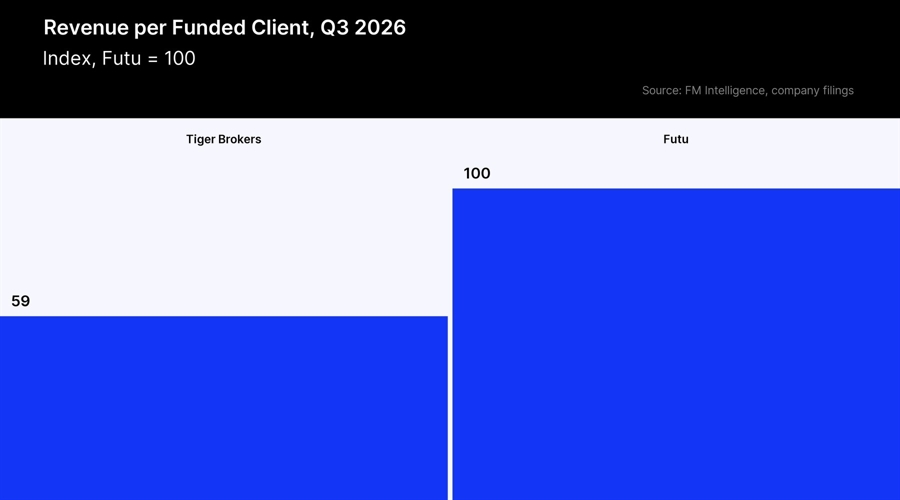
Bar chart: revenue per funded client Q3 2026, Tiger Brokers 59 vs Futu 100 (index), FM Intelligence

Clients of Tiger Brokers hold more money per head than clients of its larger rival Futu. They bring in about 40% less revenue per client, FM Intelligence analysis published today (Friday) shows.

The comparison, part of FM Intelligence's Featured Broker analysis of Tiger Brokers, divides each company's third-quarter revenue and client assets by its funded clients.

It cuts against a common reading of broker results, in which record client assets point to record revenue. UP Fintech, Tiger's Nasdaq-listed parent, reported record client assets for the third quarter on Tuesday, while revenue per client stayed well below Futu's.

Where the Revenue Gap Comes From

FM Intelligence split the gap by source. Most of it sits in two lines of the income statement, commissions and interest, with other revenue making up a small remainder.

On commissions, the difference lies mainly in how often client money trades. Each dollar held at Futu changes hands more often, even after its third-quarter trading volume fell from the previous quarter.

Price may explain part of the rest, but the two companies report their commission rates on different bases.

Interest is the less obvious half. Tiger lends more against its client assets than Futu does, yet earns less interest per client. Futu holds a larger share of client money as cash, which can earn interest for a broker without any lending.

Client balances drive the same line at bigger brokers. At Interactive Brokers, net interest income rose in the third quarter as balances grew and yields fell.

What the New Clients Bring

Most of Tiger's new clients in the quarter came from Singapore and Hong Kong, management said on the earnings call. Its mainland Chinese base is shrinking after UP Fintech disclosed fines and confiscated income from China's securities regulator in May.

Whether the newcomers change the picture depends on how they trade and borrow more than on how much they deposit. New Hong Kong clients brought in less money on average than the existing base holds, according to management figures cited in the analysis.

Futu faces a different pressure. Its revenue per client has fallen over the past year as it adds overseas accounts that hold less on average, in pursuit of the new-client target it set for 2026. The gap between the two brokers has narrowed over the year.

The arithmetic reaches beyond the two firms. A CFD or multi-asset broker adding stock trading for existing clients can grow deposits without growing revenue per dollar held, unless turnover or interest-bearing cash rises with them.

The comparison covers two brokers, so it gives a benchmark rather than an industry norm.

The full FM Intelligence analysis measures what each dollar of client assets earns at both brokers, splits the gap by revenue source and sets a scenario range for Tiger's fourth quarter.

UP Fintech is expected to report fourth-quarter results in March 2027.

About the Author: Damian Chmiel
Damian Chmiel
  • 4243 Articles
  • 120 Followers
About the Author: Damian Chmiel
Damian Chmiel is a Senior Analyst & Editor at Finance Magnates with more than 15 years of experience in the CFD and online trading industry. Active as both a trader and journalist since 2010, he focuses on broker coverage, fintech innovation, and regulatory developments across Europe, the Middle East, and Asia. His work includes interviews with C-level leaders at major brokerages and fintech platforms, as well as co-authoring Finance Magnates’ quarterly industry benchmarking reports. Damian’s reporting is data-driven, market-aware, and grounded in direct industry engagement. His analysis and commentary have also been cited by external media outlets, including Investing.com, Binance, The Asset, Stockhead, and Dispatch. Education: MA in Finance and Accounting, Cracow University of Economics
  • 4243 Articles
  • 120 Followers

More from the Author

Retail FX

!"#$%&'()*+,-./0123456789:;<=>?@ABCDEFGHIJKLMNOPQRSTUVWXYZ[\]^_`abcdefghijklmnopqrstuvwxyz{|} !"#$%&'()*+,-./0123456789:;<=>?@ABCDEFGHIJKLMNOPQRSTUVWXYZ[\]^_`abcdefghijklmnopqrstuvwxyz{|}