The Wisconsin tribe claims the prediction market platform violates federal gaming laws and tribal sovereignty.
Event contracts are drawing criticism from both the financial industry and the gambling sector.
Robinhood, source: Shutterstock
Kalshi and
Robinhood Markets were hit with a federal lawsuit this week from the Ho-Chunk
Nation, a federally recognized tribal nation in Wisconsin that operates
multiple gaming facilities under a state compact allowing sports betting on
tribal lands.
The
plaintiffs’ main objection seems to be that the gambling takes place not in
their casinos, but on smartphones.
Lawsuit Against Kalshi Over
Sports Betting on Tribal Lands
The 47-page
complaint, filed in the Western District of Wisconsin, accuses Kalshi
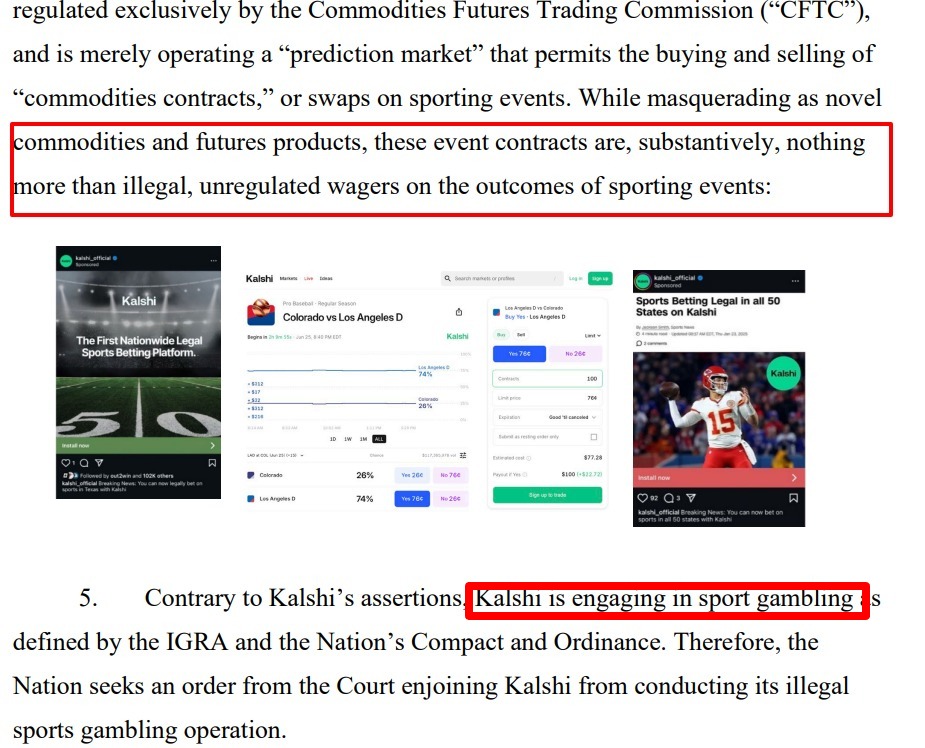
of disguising sports betting as "event contracts"
that allow users to buy "yes" or "no"
positions on sporting event outcomes. The Wisconsin-based tribe
argues this violates the Indian Gaming Regulatory Act, which
gives tribes exclusive authority to regulate gaming on their lands.
Kalshi
markets itself as a regulated derivatives exchange where users can
trade on real-world events, from sports outcomes to political
elections. The platform has gained attention for
allowing 18-year-olds to place what the tribe calls "bets"
on everything from NFL games to March Madness
basketball tournaments.
"Currently,
18-year-old high school students across the United States, including some that
are located on Indian reservations, are on their phones placing bets
on the outcome of virtually every sporting event occurring across the
globe," the complaint states.
Source: Court Documents
While it is
clear that the tribes are concerned about someone taking a share of their
profitable business, they may be right about one thing: event contracts are
largely sports bets. This
is evident even in the latest offering from CME Group, which this week
partnered with the online gaming company FanDuel, a provider of sports betting.
Event Contracts: Gamble or
Not?
The lawsuit
centers on whether
Kalshi's sports event contracts constitute gambling
under federal law. While Kalshi describes its offerings as
regulated commodities contracts overseen by the Commodity Futures
Trading Commission (CFTC), the Ho-Chunk Nation argues these are
simply sports wagers disguised with financial terminology.
The tribe
points to Kalshi's own marketing materials as evidence,
citing Instagram posts where the company promoted itself as
"The First Nationwide Legal Sports Betting
Platform" and advertised "Sports Betting Legal in all
50 States on Kalshi."
Wisconsin
law restricts sports betting to tribal casinos operating under
state compacts. The Ho-Chunk Nation operates three gaming
facilities and claims Kalshi's platform directly competes with
its regulated sportsbooks by allowing people to bet from
home instead of visiting tribal casinos.
Robinhood Also Hit
The
complaint also targets Robinhood, which partnered with Kalshi
in March to offer a "prediction markets hub" on its
investment platform. During March
Madness alone, Kalshi reported over $320 million in trading volume on
tournament-related contracts.
The timing
of Kalshi's expansion into sports markets has raised eyebrows.
The company filed to offer sports event contracts in January, just days
after Donald Trump Jr. announced he was joining Kalshi as a
strategic advisor. Trump's nominee to chair the CFTC, Brian
Quintenz, currently serves on Kalshi's board and owns stock in the
company.
The
Ho-Chunk Nation's case follows
similar litigation from three California tribes who sued Kalshi
and Robinhood earlier this year. These tribal nations argue that
unregulated online gambling undermines their exclusive gaming rights
and diverts revenue that funds tribal government services.
Kalshi and
Robinhood Markets were hit with a federal lawsuit this week from the Ho-Chunk
Nation, a federally recognized tribal nation in Wisconsin that operates
multiple gaming facilities under a state compact allowing sports betting on
tribal lands.
The
plaintiffs’ main objection seems to be that the gambling takes place not in
their casinos, but on smartphones.
Lawsuit Against Kalshi Over
Sports Betting on Tribal Lands
The 47-page
complaint, filed in the Western District of Wisconsin, accuses Kalshi
of disguising sports betting as "event contracts"
that allow users to buy "yes" or "no"
positions on sporting event outcomes. The Wisconsin-based tribe
argues this violates the Indian Gaming Regulatory Act, which
gives tribes exclusive authority to regulate gaming on their lands.
Kalshi
markets itself as a regulated derivatives exchange where users can
trade on real-world events, from sports outcomes to political
elections. The platform has gained attention for
allowing 18-year-olds to place what the tribe calls "bets"
on everything from NFL games to March Madness
basketball tournaments.
"Currently,
18-year-old high school students across the United States, including some that
are located on Indian reservations, are on their phones placing bets
on the outcome of virtually every sporting event occurring across the
globe," the complaint states.
Source: Court Documents
While it is
clear that the tribes are concerned about someone taking a share of their
profitable business, they may be right about one thing: event contracts are
largely sports bets. This
is evident even in the latest offering from CME Group, which this week
partnered with the online gaming company FanDuel, a provider of sports betting.
Event Contracts: Gamble or
Not?
The lawsuit
centers on whether
Kalshi's sports event contracts constitute gambling
under federal law. While Kalshi describes its offerings as
regulated commodities contracts overseen by the Commodity Futures
Trading Commission (CFTC), the Ho-Chunk Nation argues these are
simply sports wagers disguised with financial terminology.
The tribe
points to Kalshi's own marketing materials as evidence,
citing Instagram posts where the company promoted itself as
"The First Nationwide Legal Sports Betting
Platform" and advertised "Sports Betting Legal in all
50 States on Kalshi."
Wisconsin
law restricts sports betting to tribal casinos operating under
state compacts. The Ho-Chunk Nation operates three gaming
facilities and claims Kalshi's platform directly competes with
its regulated sportsbooks by allowing people to bet from
home instead of visiting tribal casinos.
Robinhood Also Hit
The
complaint also targets Robinhood, which partnered with Kalshi
in March to offer a "prediction markets hub" on its
investment platform. During March
Madness alone, Kalshi reported over $320 million in trading volume on
tournament-related contracts.
The timing
of Kalshi's expansion into sports markets has raised eyebrows.
The company filed to offer sports event contracts in January, just days
after Donald Trump Jr. announced he was joining Kalshi as a
strategic advisor. Trump's nominee to chair the CFTC, Brian
Quintenz, currently serves on Kalshi's board and owns stock in the
company.
The
Ho-Chunk Nation's case follows
similar litigation from three California tribes who sued Kalshi
and Robinhood earlier this year. These tribal nations argue that
unregulated online gambling undermines their exclusive gaming rights
and diverts revenue that funds tribal government services.
Damian Chmiel is a Senior Analyst & Editor at Finance Magnates with more than 15 years of experience in the CFD and online trading industry. Active as both a trader and journalist since 2010, he focuses on broker coverage, fintech innovation, and regulatory developments across Europe, the Middle East, and Asia.
His work includes interviews with C-level leaders at major brokerages and fintech platforms, as well as co-authoring Finance Magnates’ quarterly industry benchmarking reports. Damian’s reporting is data-driven, market-aware, and grounded in direct industry engagement. His analysis and commentary have also been cited by external media outlets, including Investing.com, Binance, The Asset, Stockhead, and Dispatch.
Education:
MA in Finance and Accounting, Cracow University of Economics
Italy’s Consob Tightens Net on AI-Fueled Scams With Fresh Website Bans
FP Markets Winner Spotlight 🏆 | Global Broker of the Year 2025 #Trading #Broker #Innovation #Shorts
FP Markets Winner Spotlight 🏆 | Global Broker of the Year 2025 #Trading #Broker #Innovation #Shorts
FP Markets takes the spotlight as Global Broker of the Year 2025 at the Finance Magnates Awards.
Martin Stoilov, Head of Client Experience, shares that trust, innovation, and people played a key role in the company’s success, supported by a strong foundation of integrity and client-centricity.
Following this milestone, FP Markets continues to focus on growth, technology investment, and its core values of transparency and excellence.
👉 Be part of FM Awards 2026: https://awards.financemagnates.com/#nominate
FP Markets takes the spotlight as Global Broker of the Year 2025 at the Finance Magnates Awards.
Martin Stoilov, Head of Client Experience, shares that trust, innovation, and people played a key role in the company’s success, supported by a strong foundation of integrity and client-centricity.
Following this milestone, FP Markets continues to focus on growth, technology investment, and its core values of transparency and excellence.
👉 Be part of FM Awards 2026: https://awards.financemagnates.com/#nominate
In this video, we review @HolaPrimeMarketsOfficial, a multi-asset forex and CFDs broker offering different account types, trading platforms, and flexible trading conditions.
We cover the broker’s overall offering, including account options, trading environment, platforms like MT4 and MT5, and additional services such as managed accounts and fast withdrawals.
Watch the full video to see if Hola Prime Markets fits your trading needs.
📣 Stay up to date with the latest in finance and trading. Follow Finance Magnates for industry news, insights, and global event coverage.
Connect with us:
🔗 LinkedIn: /financemagnates
👍 Facebook: /financemagnates
📸 Instagram: https://www.instagram.com/financemagnates
🐦 X: https://x.com/financemagnates
🎥 TikTok: https://www.tiktok.com/tag/financemagnates
▶️ YouTube: /@financemagnates_official
#HolaPrime #ForexBroker #CFDTrading #FinanceMagnates #Trading #Forex #BrokerReview
In this video, we review @HolaPrimeMarketsOfficial, a multi-asset forex and CFDs broker offering different account types, trading platforms, and flexible trading conditions.
We cover the broker’s overall offering, including account options, trading environment, platforms like MT4 and MT5, and additional services such as managed accounts and fast withdrawals.
Watch the full video to see if Hola Prime Markets fits your trading needs.
📣 Stay up to date with the latest in finance and trading. Follow Finance Magnates for industry news, insights, and global event coverage.
Connect with us:
🔗 LinkedIn: /financemagnates
👍 Facebook: /financemagnates
📸 Instagram: https://www.instagram.com/financemagnates
🐦 X: https://x.com/financemagnates
🎥 TikTok: https://www.tiktok.com/tag/financemagnates
▶️ YouTube: /@financemagnates_official
#HolaPrime #ForexBroker #CFDTrading #FinanceMagnates #Trading #Forex #BrokerReview
Hola Prime Review: What You Need to Know | Full Breakdown by Finance Magnates
Hola Prime Review: What You Need to Know | Full Breakdown by Finance Magnates
In this video, we review @HolaPrime_Global, a proprietary trading firm offering evaluation programs and performance-based payouts in simulated market environments.
We cover how the challenge model works, including account types, profit splits (up to 95%), trading rules, and what it takes to reach a funded account. You’ll also learn about available platforms like MT4, MT5, cTrader, and more, along with insights into payouts, support, and trading conditions.
Watch the full video to see if Hola Prime fits your trading style.
📣 Stay up to date with the latest in finance and trading. Follow Finance Magnates for industry news, insights, and global event coverage.
Connect with us:
🔗 LinkedIn: /financemagnates
👍 Facebook: /financemagnates
📸 Instagram: https://www.instagram.com/financemagnates
🐦 X: https://x.com/financemagnates
🎥 TikTok: https://www.tiktok.com/tag/financemagnates
▶️ YouTube: /@financemagnates_official
#HolaPrime #PropFirm #Trading #FinanceMagnates #Forex #FuturesTrading #TradingReview #PropFirmReview
In this video, we review @HolaPrime_Global, a proprietary trading firm offering evaluation programs and performance-based payouts in simulated market environments.
We cover how the challenge model works, including account types, profit splits (up to 95%), trading rules, and what it takes to reach a funded account. You’ll also learn about available platforms like MT4, MT5, cTrader, and more, along with insights into payouts, support, and trading conditions.
Watch the full video to see if Hola Prime fits your trading style.
📣 Stay up to date with the latest in finance and trading. Follow Finance Magnates for industry news, insights, and global event coverage.
Connect with us:
🔗 LinkedIn: /financemagnates
👍 Facebook: /financemagnates
📸 Instagram: https://www.instagram.com/financemagnates
🐦 X: https://x.com/financemagnates
🎥 TikTok: https://www.tiktok.com/tag/financemagnates
▶️ YouTube: /@financemagnates_official
#HolaPrime #PropFirm #Trading #FinanceMagnates #Forex #FuturesTrading #TradingReview #PropFirmReview
Axi Winner Spotlight 🏆 | Global Most Innovative Broker 2025 #Innovation #Trading #Fintech #Broker
Axi Winner Spotlight 🏆 | Global Most Innovative Broker 2025 #Innovation #Trading #Fintech #Broker
Axi takes the spotlight at the Finance Magnates Awards, winning Global Most Innovative Broker 2025.
Olivia Xenofontos and Ivanna Openko share how the team will feel: proud, motivated, and ready to keep delivering.
They also describe the night as well-organized, focused, and enjoyable for all.
👉 Be part of FM Awards 2026.
Axi takes the spotlight at the Finance Magnates Awards, winning Global Most Innovative Broker 2025.
Olivia Xenofontos and Ivanna Openko share how the team will feel: proud, motivated, and ready to keep delivering.
They also describe the night as well-organized, focused, and enjoyable for all.
👉 Be part of FM Awards 2026.
Recognition that matters.
Built on transparency.
Driven by the industry.
The Finance Magnates Awards 2026.
Nominations are now open.
🔗 https://awards.financemagnates.com/?utm_source=SM&utm_medium=social&utm_campaign=recognition-matters
Recognition that matters.
Built on transparency.
Driven by the industry.
The Finance Magnates Awards 2026.
Nominations are now open.
🔗 https://awards.financemagnates.com/?utm_source=SM&utm_medium=social&utm_campaign=recognition-matters