
E8 Markets, a prop trading firm that now describes itself as a "SaaS educational simulation platform for financial markets," issued a warning today (Tuesday) to retail traders about the risks of depositing money with FX, futures, and crypto brokers.
The company tied the campaign to US National Financial Literacy Month and used it to launch a loyalty program named after one of its top-earning users, Tom Gibbs.
While statistics showing that the vast majority of traders lose money on FX and CFDs are well known, E8 Markets did not disclose how many traders incur losses in prop firms offering trading on simulated rather than real markets. Here, too, the figures do not appear optimistic, according to industry data.
Singapore Summit: Meet the largest APAC brokers you know (and those you still don't!)
Warning Leans on ESMA and CFTC Loss Figures
The company pointed to a December 2024 Commodity Futures Trading Commission advisory stating that most individual traders lose money in futures and foreign currency after fees and taxes, along with CFTC figures suggesting two out of three retail forex traders lose money each quarter.
E8 also cited the European Securities and Markets Authority's disclosure framework showing that 74% to 89% of retail CFD accounts lose money, with average losses ranging from €1,600 to €29,000 per client.

"No one should have to lose $5,000 on a broker with little or no guidance or assurance of future success," E8 Markets Chief Executive Officer Dylan Elchami said in the announcement.
- PropAccount.com Adds Equities to White-Label Prop Stack, Entering a Crowded Race
- Scaling Prop Firms Without Burning Cash: Channels, Creatives and the Matrix That Ties Them
- Offshore Broker Firewood Joins Crowded Prop Trading Field With Firewood Funded Launch
Elchami argued that users can start on the firm's platform with as little as $36 in enrollment fees and access $5,000 in simulated capital, earning what the company describes as "performance-based payouts" without committing their own money to live markets.
The release characterizes brokers as profiting from customer losses through spreads, commissions, order routing, and pricing mechanics, presenting the deposit model as a series of small, compounding costs that erode trader capital.
Prop Firm Payout Rates Sit Below the Numbers E8 Highlights
The loss rates E8 uses to warn retail traders against brokers sit within the same band as retail CFD outcomes reported in regulated markets. FinanceMagnates.com industry data, however, suggests payout rates inside the prop trading sector itself run materially below those CFD benchmarks.
A proprietary dataset from technology provider FPFX Tech, covering more than 300,000 prop trading accounts from 10 firms, found that only 7% of participants ever received a payout, with the average withdrawal at about 4% of the funded account size.
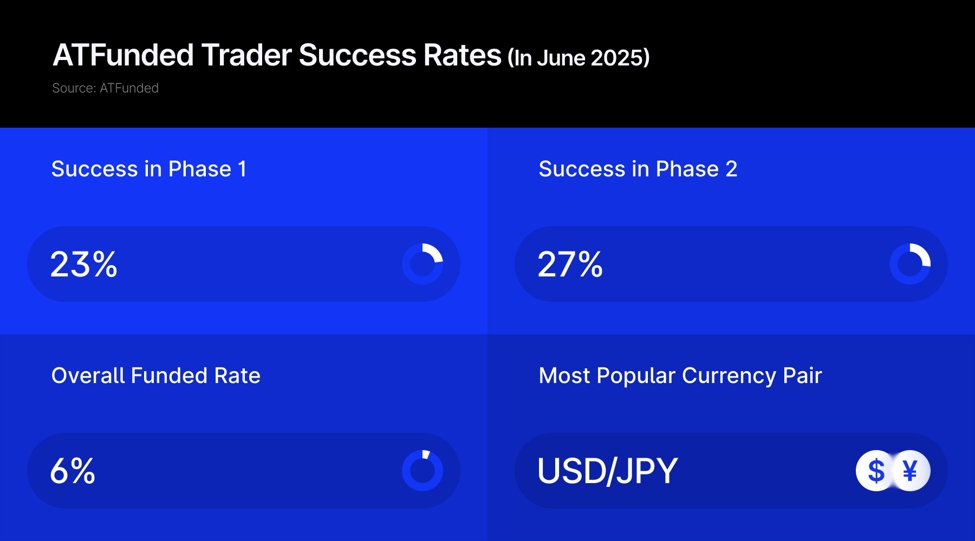
Statistics shared last year by The Funded Trader founder Angelo Ciaramello pointed even lower, with challenge pass rates of 5% to 10% and only around a fifth of funded accounts converting into actual payouts. A separate ATFunded disclosure placed funded status at roughly 6% of traders.
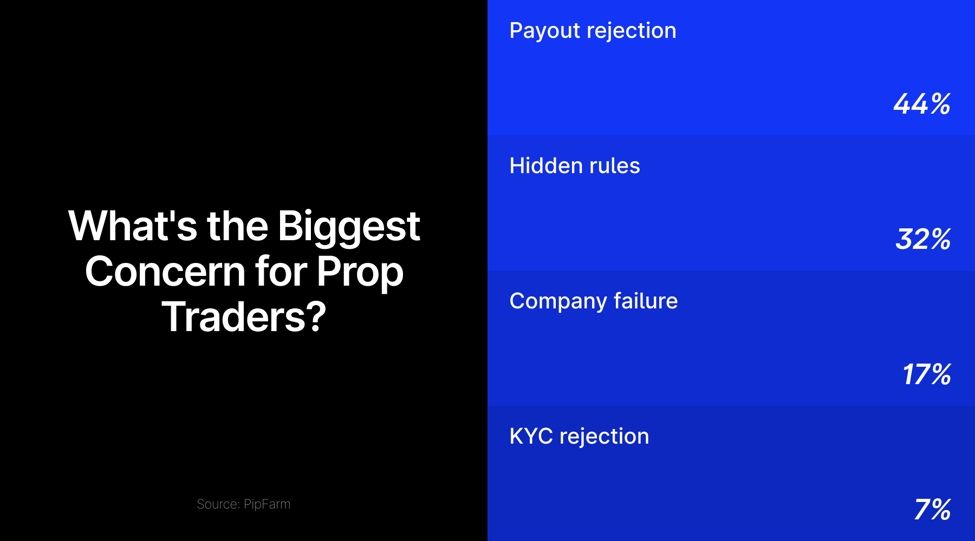
A survey of approximately 500 active clients of prop firm PipFarm put average participant spend at $4,270 on challenges, with close to 60% of respondents losing capital. A wider Swiset study of nearly 10,000 traders placed the global prop trading failure rate at around 80%.
In practical terms, a retail participant choosing between a CFD account carrying an ESMA-mandated risk warning and a prop challenge marketed as a lower-risk path is comparing a regulated disclosure of losing accounts with an unregulated sector whose own data show fewer paid participants.
On one hand, there are regulated CFD brokers. On the other, prop trading firms registered in exotic jurisdictions such as Saint Lucia. Regulation in this case is largely nominal, but it is sufficient for MetaQuotes to grant these companies licenses to use MetaTrader. E8 Markets is also registered there.
The "Simulated" Pivot Predates This Campaign
E8's positioning as an "educational simulation platform" is part of a broader industry shift in language that took shape after US authorities began scrutinizing the sector. In August 2023, the CFTC sued Traders Global Group, the operator of My Forex Funds, alleging fraud tied to a business that had generated roughly $310 million in fees.
A US court later threw out the regulator's case after flagging procedural failures, but the original complaint triggered a visible rewrite of product copy across the prop sector.
FTMO, one of the largest operators, states on its website that it "simulates real market conditions" using "demo trading accounts with virtual funds." Surgetrader rebranded its challenge as an "audition."
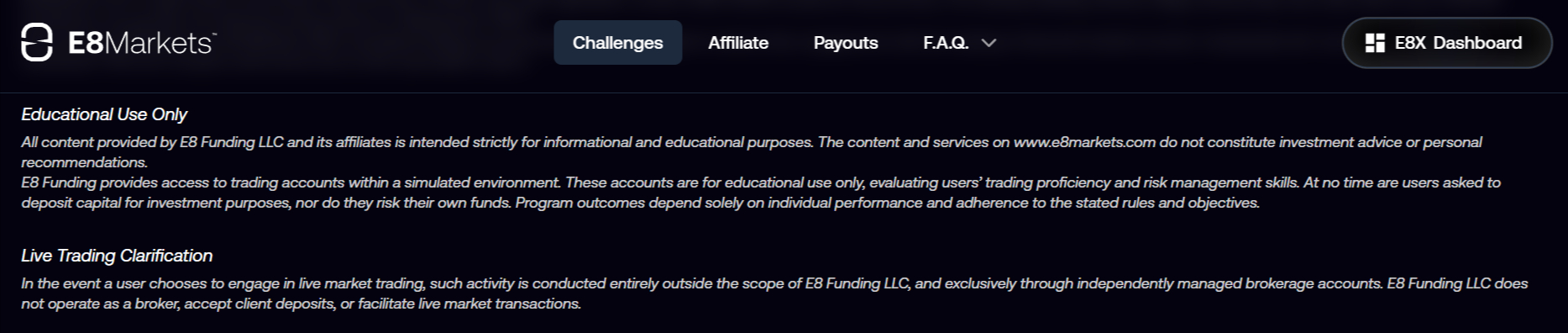
Across the industry, the terms "simulated" and "virtual" have effectively become the sector's safe words. E8's language goes further, describing a "SimFi Ecosystem" and stating explicitly in its disclosures that "E8 is not a broker and does not accept margin or deposits," while enrollment fees "do not purchase live capital, a brokerage account, a commodity interest, a security, or any investment opportunity."
The category distinction is the commercial point. It keeps most prop operators outside the licensing regimes that apply to CFD brokers, including the ESMA rules E8 cites in its release.
Between 80 and 100 prop firms shut down in 2024, according to FM Intelligence estimates, with MetaQuotes' decision to restrict platform access accelerating consolidation.
Against that backdrop, payout tracker Prop Firm Match recorded around $325 million in total payouts across tracked firms in 2025, with E8 accounting for about $19 million of that total. The release does not reconcile that tracker figure with the $70 million cumulative payout number the firm attributes to the platform since launch.
Regulators Are Watching the Framing
National regulators have been increasingly vocal. Italy's Consob described retail prop trading as online simulations that function more like "video games" than investment services. Authorities in Belgium, Spain, and Germany have raised similar concerns, ESMA has convened discussions on the model, and Australia's ASIC has warned financial influencers promoting prop offerings without risk disclosure.
The CFTC is separately weighing whether prop firms that offer exchange-traded derivatives should register as Commodity Trading Advisors, regardless of whether the underlying challenge is simulated.
At least one US operator, MyFunded Futures, is moving in the opposite direction, preparing to operate as a CFTC-regulated Introducing Broker under the National Futures Association.
When a firm has to iterate its category label from "prop firm" to "funded trader platform" to "SaaS educational simulation platform" to stay outside the rules applied to brokers, a fair question is whether the underlying business sits comfortably inside any category at all, or whether the naming exercise is what keeps it in the regulatory gray zone where national supervisors have started to push.
E8 does not publish a challenge pass rate or payout-conversion figure alongside the campaign. Under the firm's disclosures, the Gibbs case is presented as a single participant outcome that "does not, standing alone, describe or predict what other participants may achieve."
However, the prop firm’s website states that the pass rate over a period of more than a year between 2023 and 2024 was just under 18% for those who traded at least once during that time and obtained an E8 Trader Account.
The release also flags that simulated performance has "inherent limitations and does not represent actual trading."


