PipFarm CEO James Glyde uncovered a global network that was manipulating prop trading challenges.
The investigation revealed that adding more rules only hindered legitimate traders while scammers quickly adapted.
“I was actually making my company for the cheaters, not for the traders,” James Glyde, the CEO of PipFarm, candidly admitted in his latest interview, detailing how he uncovered an international ring of fraudsters. He stumbled upon an organized group of traders systematically exploiting proprietary trading firm challenges through coordinated hedging operations.
The scale, reach, and professionalism in their operations exceeded even the boldest expectations. As he acknowledged, it turned out that “what’s good for traders is often good for cheaters,” too.
Inside the 800-Member
Trading Cartel Bleeding Prop Firms Dry
The
investigation began when PipFarm noticed an unusually high pass
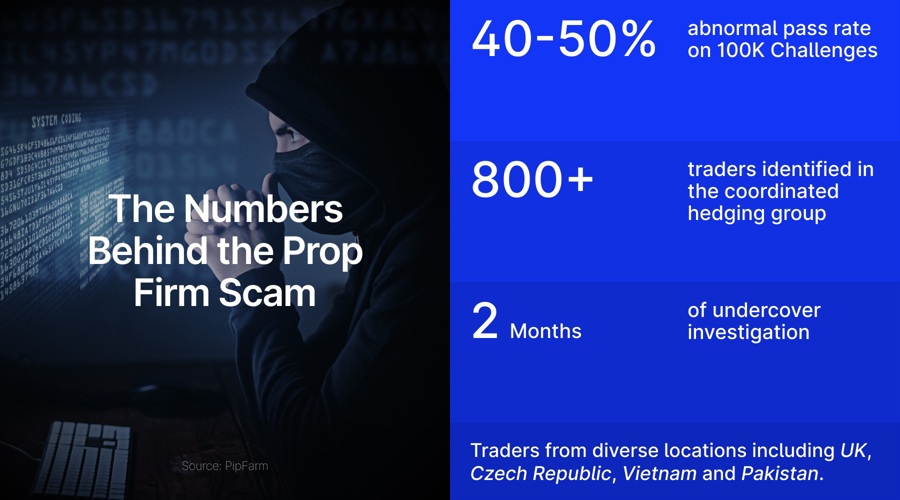
rate—approaching 50%—on their 100K two-stage challenges with static drawdown
parameters. This anomaly prompted Glyde to suspect coordinated manipulation
rather than legitimate trading success.
“We
had this incredibly high pass rate on the 100K accounts. Our pass rate was
above 40%, kind of like way too close to 50,” Glyde explained in a
revealing interview with Prop Firm Journal, “My first instinct was like,
these gamblers are so lucky. But it didn't make any sense.”
“They
were all working together to do their buys and sells on different firms. It's
crazy,” said Glyde. “This was not even a small group—it was like 800
traders inside.”
You can check the whole interview in the video below:
“They're From
Everywhere”
Contrary to
industry assumptions that such schemes originate from specific regions, Glyde
discovered participants came from diverse locations including the UK, Czech
Republic, Vietnam, Pakistan, and Canada.
“They're
from everywhere,” Glyde noted. “Banning countries doesn't make any
sense because there are cheaters everywhere.”
For two
months, PipFarm operated undercover within the group, identifying participants
and studying their methods. The hedging strategy typically involved taking
opposite positions across different prop firms to guarantee profits regardless
of market movements—essentially turning the 50/50 probability of market
direction into a near-certain win.
The
investigation revealed the groups employed sophisticated methods to avoid
detection, including:
Using time
delays between trades
Hedging
100K accounts against 250K accounts
Coordinating
across multiple prop firms
Adapting
quickly to rule changes
When
PipFarm implemented new rules to counter the manipulation, the group would
immediately adjust their strategies. After conducting a trader interview on a
Thursday, by Monday the group had issued warnings that “PipFarm is
suspicious” and instructed members to “be more random.”
“Changing
rules doesn't make any sense because by definition a cheater is going to
manipulate rules,” Glyde said. “Adding these rules only limited
normal traders and didn't do anything for the cheaters.”
When Scammers Demand KYC
In one of
the most surprising twists of PipFarm's undercover operation, the company's
team encountered an unexpected hurdle—the fraudsters had implemented their own
verification system to protect their operation.
"We
tried to join the group, but they could see that we used a VPN. For them that
was a red flag, just like how firms also don't like some traders using
VPNs," Glyde explained. "Then they wanted to do KYC—they wanted
passport, selfie holding up the passport next to his face."
The irony
wasn't lost on Glyde, whose team went to extraordinary lengths to circumvent
the scammers' verification process. "We turned off all the lights to make
it a dark room so that his face wouldn't be clear. Our KYC was rejected by the
scammers," he recounted with a hint of disbelief.
Industry-Wide Problem
After two months of undercover surveillance, PipFarm reached its limit. "In the end, we kicked everyone out and shut it down," Glyde stated. "It was painful, but necessary." The decision to terminate the operation wasn't taken lightly. "I had told myself that this will not go beyond the end of the year," Glyde explained. "Already two months of paying these people—that was my absolute tolerance."
The aftermath required significant rebuilding efforts for PipFarm, but the insights gained proved invaluable not just for the company but for the entire industry. Within 48 hours of Glyde's public disclosure, approximately 20 prop firm CEOs reached out to share similar experiences and collaborate on solutions.
"It
made me feel better about being taken advantage of because I knew that it
didn't just happen to me," Glyde said. "It's something that's
happened to the entire industry."
The
experience has led PipFarm to shift its approach from adding restrictive rules
to implementing behind-the-scenes monitoring systems. The company is now
removing restrictions added last year that primarily hindered legitimate
traders while doing little to stop coordinated manipulation.
For the
prop trading industry, which offers funded accounts to traders who pass
challenges, this type of manipulation represents an existential threat. Glyde
believes the solution lies in industry-wide vigilance rather than more
restrictive trading parameters.
"What
I need is a healthy industry," Glyde emphasized. "Traders need
stability."
“I was actually making my company for the cheaters, not for the traders,” James Glyde, the CEO of PipFarm, candidly admitted in his latest interview, detailing how he uncovered an international ring of fraudsters. He stumbled upon an organized group of traders systematically exploiting proprietary trading firm challenges through coordinated hedging operations.
The scale, reach, and professionalism in their operations exceeded even the boldest expectations. As he acknowledged, it turned out that “what’s good for traders is often good for cheaters,” too.
Inside the 800-Member
Trading Cartel Bleeding Prop Firms Dry
The
investigation began when PipFarm noticed an unusually high pass
rate—approaching 50%—on their 100K two-stage challenges with static drawdown
parameters. This anomaly prompted Glyde to suspect coordinated manipulation
rather than legitimate trading success.
“We
had this incredibly high pass rate on the 100K accounts. Our pass rate was
above 40%, kind of like way too close to 50,” Glyde explained in a
revealing interview with Prop Firm Journal, “My first instinct was like,
these gamblers are so lucky. But it didn't make any sense.”
“They
were all working together to do their buys and sells on different firms. It's
crazy,” said Glyde. “This was not even a small group—it was like 800
traders inside.”
You can check the whole interview in the video below:
“They're From
Everywhere”
Contrary to
industry assumptions that such schemes originate from specific regions, Glyde
discovered participants came from diverse locations including the UK, Czech
Republic, Vietnam, Pakistan, and Canada.
“They're
from everywhere,” Glyde noted. “Banning countries doesn't make any
sense because there are cheaters everywhere.”
For two
months, PipFarm operated undercover within the group, identifying participants
and studying their methods. The hedging strategy typically involved taking
opposite positions across different prop firms to guarantee profits regardless
of market movements—essentially turning the 50/50 probability of market
direction into a near-certain win.
The
investigation revealed the groups employed sophisticated methods to avoid
detection, including:
Using time
delays between trades
Hedging
100K accounts against 250K accounts
Coordinating
across multiple prop firms
Adapting
quickly to rule changes
When
PipFarm implemented new rules to counter the manipulation, the group would
immediately adjust their strategies. After conducting a trader interview on a
Thursday, by Monday the group had issued warnings that “PipFarm is
suspicious” and instructed members to “be more random.”
“Changing
rules doesn't make any sense because by definition a cheater is going to
manipulate rules,” Glyde said. “Adding these rules only limited
normal traders and didn't do anything for the cheaters.”
When Scammers Demand KYC
In one of
the most surprising twists of PipFarm's undercover operation, the company's
team encountered an unexpected hurdle—the fraudsters had implemented their own
verification system to protect their operation.
"We
tried to join the group, but they could see that we used a VPN. For them that
was a red flag, just like how firms also don't like some traders using
VPNs," Glyde explained. "Then they wanted to do KYC—they wanted
passport, selfie holding up the passport next to his face."
The irony
wasn't lost on Glyde, whose team went to extraordinary lengths to circumvent
the scammers' verification process. "We turned off all the lights to make
it a dark room so that his face wouldn't be clear. Our KYC was rejected by the
scammers," he recounted with a hint of disbelief.
Industry-Wide Problem
After two months of undercover surveillance, PipFarm reached its limit. "In the end, we kicked everyone out and shut it down," Glyde stated. "It was painful, but necessary." The decision to terminate the operation wasn't taken lightly. "I had told myself that this will not go beyond the end of the year," Glyde explained. "Already two months of paying these people—that was my absolute tolerance."
The aftermath required significant rebuilding efforts for PipFarm, but the insights gained proved invaluable not just for the company but for the entire industry. Within 48 hours of Glyde's public disclosure, approximately 20 prop firm CEOs reached out to share similar experiences and collaborate on solutions.
"It
made me feel better about being taken advantage of because I knew that it
didn't just happen to me," Glyde said. "It's something that's
happened to the entire industry."
The
experience has led PipFarm to shift its approach from adding restrictive rules
to implementing behind-the-scenes monitoring systems. The company is now
removing restrictions added last year that primarily hindered legitimate
traders while doing little to stop coordinated manipulation.
For the
prop trading industry, which offers funded accounts to traders who pass
challenges, this type of manipulation represents an existential threat. Glyde
believes the solution lies in industry-wide vigilance rather than more
restrictive trading parameters.
"What
I need is a healthy industry," Glyde emphasized. "Traders need
stability."
Damian Chmiel is a Senior Analyst & Editor at Finance Magnates with more than 15 years of experience in the CFD and online trading industry. Active as both a trader and journalist since 2010, he focuses on broker coverage, fintech innovation, and regulatory developments across Europe, the Middle East, and Asia.
His work includes interviews with C-level leaders at major brokerages and fintech platforms, as well as co-authoring Finance Magnates’ quarterly industry benchmarking reports. Damian’s reporting is data-driven, market-aware, and grounded in direct industry engagement. His analysis and commentary have also been cited by external media outlets, including Investing.com, Binance, The Asset, Stockhead, and Dispatch.
Education:
MA in Finance and Accounting, Cracow University of Economics
Retail Traders Can Now Access Prediction Markets Through Binance Wallet
Featured Videos
FP Markets Winner Spotlight 🏆 | Global Broker of the Year 2025 #Trading #Broker #Innovation #Shorts
FP Markets Winner Spotlight 🏆 | Global Broker of the Year 2025 #Trading #Broker #Innovation #Shorts
FP Markets Winner Spotlight 🏆 | Global Broker of the Year 2025 #Trading #Broker #Innovation #Shorts
FP Markets Winner Spotlight 🏆 | Global Broker of the Year 2025 #Trading #Broker #Innovation #Shorts
FP Markets takes the spotlight as Global Broker of the Year 2025 at the Finance Magnates Awards.
Martin Stoilov, Head of Client Experience, shares that trust, innovation, and people played a key role in the company’s success, supported by a strong foundation of integrity and client-centricity.
Following this milestone, FP Markets continues to focus on growth, technology investment, and its core values of transparency and excellence.
👉 Be part of FM Awards 2026: https://awards.financemagnates.com/#nominate
FP Markets takes the spotlight as Global Broker of the Year 2025 at the Finance Magnates Awards.
Martin Stoilov, Head of Client Experience, shares that trust, innovation, and people played a key role in the company’s success, supported by a strong foundation of integrity and client-centricity.
Following this milestone, FP Markets continues to focus on growth, technology investment, and its core values of transparency and excellence.
👉 Be part of FM Awards 2026: https://awards.financemagnates.com/#nominate
FP Markets takes the spotlight as Global Broker of the Year 2025 at the Finance Magnates Awards.
Martin Stoilov, Head of Client Experience, shares that trust, innovation, and people played a key role in the company’s success, supported by a strong foundation of integrity and client-centricity.
Following this milestone, FP Markets continues to focus on growth, technology investment, and its core values of transparency and excellence.
👉 Be part of FM Awards 2026: https://awards.financemagnates.com/#nominate
FP Markets takes the spotlight as Global Broker of the Year 2025 at the Finance Magnates Awards.
Martin Stoilov, Head of Client Experience, shares that trust, innovation, and people played a key role in the company’s success, supported by a strong foundation of integrity and client-centricity.
Following this milestone, FP Markets continues to focus on growth, technology investment, and its core values of transparency and excellence.
👉 Be part of FM Awards 2026: https://awards.financemagnates.com/#nominate
In this video, we review @HolaPrimeMarketsOfficial, a multi-asset forex and CFDs broker offering different account types, trading platforms, and flexible trading conditions.
We cover the broker’s overall offering, including account options, trading environment, platforms like MT4 and MT5, and additional services such as managed accounts and fast withdrawals.
Watch the full video to see if Hola Prime Markets fits your trading needs.
📣 Stay up to date with the latest in finance and trading. Follow Finance Magnates for industry news, insights, and global event coverage.
Connect with us:
🔗 LinkedIn: /financemagnates
👍 Facebook: /financemagnates
📸 Instagram: https://www.instagram.com/financemagnates
🐦 X: https://x.com/financemagnates
🎥 TikTok: https://www.tiktok.com/tag/financemagnates
▶️ YouTube: /@financemagnates_official
#HolaPrime #ForexBroker #CFDTrading #FinanceMagnates #Trading #Forex #BrokerReview
In this video, we review @HolaPrimeMarketsOfficial, a multi-asset forex and CFDs broker offering different account types, trading platforms, and flexible trading conditions.
We cover the broker’s overall offering, including account options, trading environment, platforms like MT4 and MT5, and additional services such as managed accounts and fast withdrawals.
Watch the full video to see if Hola Prime Markets fits your trading needs.
📣 Stay up to date with the latest in finance and trading. Follow Finance Magnates for industry news, insights, and global event coverage.
Connect with us:
🔗 LinkedIn: /financemagnates
👍 Facebook: /financemagnates
📸 Instagram: https://www.instagram.com/financemagnates
🐦 X: https://x.com/financemagnates
🎥 TikTok: https://www.tiktok.com/tag/financemagnates
▶️ YouTube: /@financemagnates_official
#HolaPrime #ForexBroker #CFDTrading #FinanceMagnates #Trading #Forex #BrokerReview
In this video, we review @HolaPrimeMarketsOfficial, a multi-asset forex and CFDs broker offering different account types, trading platforms, and flexible trading conditions.
We cover the broker’s overall offering, including account options, trading environment, platforms like MT4 and MT5, and additional services such as managed accounts and fast withdrawals.
Watch the full video to see if Hola Prime Markets fits your trading needs.
📣 Stay up to date with the latest in finance and trading. Follow Finance Magnates for industry news, insights, and global event coverage.
Connect with us:
🔗 LinkedIn: /financemagnates
👍 Facebook: /financemagnates
📸 Instagram: https://www.instagram.com/financemagnates
🐦 X: https://x.com/financemagnates
🎥 TikTok: https://www.tiktok.com/tag/financemagnates
▶️ YouTube: /@financemagnates_official
#HolaPrime #ForexBroker #CFDTrading #FinanceMagnates #Trading #Forex #BrokerReview
In this video, we review @HolaPrimeMarketsOfficial, a multi-asset forex and CFDs broker offering different account types, trading platforms, and flexible trading conditions.
We cover the broker’s overall offering, including account options, trading environment, platforms like MT4 and MT5, and additional services such as managed accounts and fast withdrawals.
Watch the full video to see if Hola Prime Markets fits your trading needs.
📣 Stay up to date with the latest in finance and trading. Follow Finance Magnates for industry news, insights, and global event coverage.
Connect with us:
🔗 LinkedIn: /financemagnates
👍 Facebook: /financemagnates
📸 Instagram: https://www.instagram.com/financemagnates
🐦 X: https://x.com/financemagnates
🎥 TikTok: https://www.tiktok.com/tag/financemagnates
▶️ YouTube: /@financemagnates_official
#HolaPrime #ForexBroker #CFDTrading #FinanceMagnates #Trading #Forex #BrokerReview
In this video, we review @HolaPrimeMarketsOfficial, a multi-asset forex and CFDs broker offering different account types, trading platforms, and flexible trading conditions.
We cover the broker’s overall offering, including account options, trading environment, platforms like MT4 and MT5, and additional services such as managed accounts and fast withdrawals.
Watch the full video to see if Hola Prime Markets fits your trading needs.
📣 Stay up to date with the latest in finance and trading. Follow Finance Magnates for industry news, insights, and global event coverage.
Connect with us:
🔗 LinkedIn: /financemagnates
👍 Facebook: /financemagnates
📸 Instagram: https://www.instagram.com/financemagnates
🐦 X: https://x.com/financemagnates
🎥 TikTok: https://www.tiktok.com/tag/financemagnates
▶️ YouTube: /@financemagnates_official
#HolaPrime #ForexBroker #CFDTrading #FinanceMagnates #Trading #Forex #BrokerReview
In this video, we review @HolaPrimeMarketsOfficial, a multi-asset forex and CFDs broker offering different account types, trading platforms, and flexible trading conditions.
We cover the broker’s overall offering, including account options, trading environment, platforms like MT4 and MT5, and additional services such as managed accounts and fast withdrawals.
Watch the full video to see if Hola Prime Markets fits your trading needs.
📣 Stay up to date with the latest in finance and trading. Follow Finance Magnates for industry news, insights, and global event coverage.
Connect with us:
🔗 LinkedIn: /financemagnates
👍 Facebook: /financemagnates
📸 Instagram: https://www.instagram.com/financemagnates
🐦 X: https://x.com/financemagnates
🎥 TikTok: https://www.tiktok.com/tag/financemagnates
▶️ YouTube: /@financemagnates_official
#HolaPrime #ForexBroker #CFDTrading #FinanceMagnates #Trading #Forex #BrokerReview
Hola Prime Review: What You Need to Know | Full Breakdown by Finance Magnates
Hola Prime Review: What You Need to Know | Full Breakdown by Finance Magnates
Hola Prime Review: What You Need to Know | Full Breakdown by Finance Magnates
Hola Prime Review: What You Need to Know | Full Breakdown by Finance Magnates
Hola Prime Review: What You Need to Know | Full Breakdown by Finance Magnates
Hola Prime Review: What You Need to Know | Full Breakdown by Finance Magnates
In this video, we review @HolaPrime_Global, a proprietary trading firm offering evaluation programs and performance-based payouts in simulated market environments.
We cover how the challenge model works, including account types, profit splits (up to 95%), trading rules, and what it takes to reach a funded account. You’ll also learn about available platforms like MT4, MT5, cTrader, and more, along with insights into payouts, support, and trading conditions.
Watch the full video to see if Hola Prime fits your trading style.
📣 Stay up to date with the latest in finance and trading. Follow Finance Magnates for industry news, insights, and global event coverage.
Connect with us:
🔗 LinkedIn: /financemagnates
👍 Facebook: /financemagnates
📸 Instagram: https://www.instagram.com/financemagnates
🐦 X: https://x.com/financemagnates
🎥 TikTok: https://www.tiktok.com/tag/financemagnates
▶️ YouTube: /@financemagnates_official
#HolaPrime #PropFirm #Trading #FinanceMagnates #Forex #FuturesTrading #TradingReview #PropFirmReview
In this video, we review @HolaPrime_Global, a proprietary trading firm offering evaluation programs and performance-based payouts in simulated market environments.
We cover how the challenge model works, including account types, profit splits (up to 95%), trading rules, and what it takes to reach a funded account. You’ll also learn about available platforms like MT4, MT5, cTrader, and more, along with insights into payouts, support, and trading conditions.
Watch the full video to see if Hola Prime fits your trading style.
📣 Stay up to date with the latest in finance and trading. Follow Finance Magnates for industry news, insights, and global event coverage.
Connect with us:
🔗 LinkedIn: /financemagnates
👍 Facebook: /financemagnates
📸 Instagram: https://www.instagram.com/financemagnates
🐦 X: https://x.com/financemagnates
🎥 TikTok: https://www.tiktok.com/tag/financemagnates
▶️ YouTube: /@financemagnates_official
#HolaPrime #PropFirm #Trading #FinanceMagnates #Forex #FuturesTrading #TradingReview #PropFirmReview
In this video, we review @HolaPrime_Global, a proprietary trading firm offering evaluation programs and performance-based payouts in simulated market environments.
We cover how the challenge model works, including account types, profit splits (up to 95%), trading rules, and what it takes to reach a funded account. You’ll also learn about available platforms like MT4, MT5, cTrader, and more, along with insights into payouts, support, and trading conditions.
Watch the full video to see if Hola Prime fits your trading style.
📣 Stay up to date with the latest in finance and trading. Follow Finance Magnates for industry news, insights, and global event coverage.
Connect with us:
🔗 LinkedIn: /financemagnates
👍 Facebook: /financemagnates
📸 Instagram: https://www.instagram.com/financemagnates
🐦 X: https://x.com/financemagnates
🎥 TikTok: https://www.tiktok.com/tag/financemagnates
▶️ YouTube: /@financemagnates_official
#HolaPrime #PropFirm #Trading #FinanceMagnates #Forex #FuturesTrading #TradingReview #PropFirmReview
In this video, we review @HolaPrime_Global, a proprietary trading firm offering evaluation programs and performance-based payouts in simulated market environments.
We cover how the challenge model works, including account types, profit splits (up to 95%), trading rules, and what it takes to reach a funded account. You’ll also learn about available platforms like MT4, MT5, cTrader, and more, along with insights into payouts, support, and trading conditions.
Watch the full video to see if Hola Prime fits your trading style.
📣 Stay up to date with the latest in finance and trading. Follow Finance Magnates for industry news, insights, and global event coverage.
Connect with us:
🔗 LinkedIn: /financemagnates
👍 Facebook: /financemagnates
📸 Instagram: https://www.instagram.com/financemagnates
🐦 X: https://x.com/financemagnates
🎥 TikTok: https://www.tiktok.com/tag/financemagnates
▶️ YouTube: /@financemagnates_official
#HolaPrime #PropFirm #Trading #FinanceMagnates #Forex #FuturesTrading #TradingReview #PropFirmReview
In this video, we review @HolaPrime_Global, a proprietary trading firm offering evaluation programs and performance-based payouts in simulated market environments.
We cover how the challenge model works, including account types, profit splits (up to 95%), trading rules, and what it takes to reach a funded account. You’ll also learn about available platforms like MT4, MT5, cTrader, and more, along with insights into payouts, support, and trading conditions.
Watch the full video to see if Hola Prime fits your trading style.
📣 Stay up to date with the latest in finance and trading. Follow Finance Magnates for industry news, insights, and global event coverage.
Connect with us:
🔗 LinkedIn: /financemagnates
👍 Facebook: /financemagnates
📸 Instagram: https://www.instagram.com/financemagnates
🐦 X: https://x.com/financemagnates
🎥 TikTok: https://www.tiktok.com/tag/financemagnates
▶️ YouTube: /@financemagnates_official
#HolaPrime #PropFirm #Trading #FinanceMagnates #Forex #FuturesTrading #TradingReview #PropFirmReview
In this video, we review @HolaPrime_Global, a proprietary trading firm offering evaluation programs and performance-based payouts in simulated market environments.
We cover how the challenge model works, including account types, profit splits (up to 95%), trading rules, and what it takes to reach a funded account. You’ll also learn about available platforms like MT4, MT5, cTrader, and more, along with insights into payouts, support, and trading conditions.
Watch the full video to see if Hola Prime fits your trading style.
📣 Stay up to date with the latest in finance and trading. Follow Finance Magnates for industry news, insights, and global event coverage.
Connect with us:
🔗 LinkedIn: /financemagnates
👍 Facebook: /financemagnates
📸 Instagram: https://www.instagram.com/financemagnates
🐦 X: https://x.com/financemagnates
🎥 TikTok: https://www.tiktok.com/tag/financemagnates
▶️ YouTube: /@financemagnates_official
#HolaPrime #PropFirm #Trading #FinanceMagnates #Forex #FuturesTrading #TradingReview #PropFirmReview
Axi Winner Spotlight 🏆 | Global Most Innovative Broker 2025 #Innovation #Trading #Fintech #Broker
Axi Winner Spotlight 🏆 | Global Most Innovative Broker 2025 #Innovation #Trading #Fintech #Broker
Axi Winner Spotlight 🏆 | Global Most Innovative Broker 2025 #Innovation #Trading #Fintech #Broker
Axi Winner Spotlight 🏆 | Global Most Innovative Broker 2025 #Innovation #Trading #Fintech #Broker
Axi Winner Spotlight 🏆 | Global Most Innovative Broker 2025 #Innovation #Trading #Fintech #Broker
Axi Winner Spotlight 🏆 | Global Most Innovative Broker 2025 #Innovation #Trading #Fintech #Broker
Axi takes the spotlight at the Finance Magnates Awards, winning Global Most Innovative Broker 2025.
Olivia Xenofontos and Ivanna Openko share how the team will feel: proud, motivated, and ready to keep delivering.
They also describe the night as well-organized, focused, and enjoyable for all.
👉 Be part of FM Awards 2026.
Axi takes the spotlight at the Finance Magnates Awards, winning Global Most Innovative Broker 2025.
Olivia Xenofontos and Ivanna Openko share how the team will feel: proud, motivated, and ready to keep delivering.
They also describe the night as well-organized, focused, and enjoyable for all.
👉 Be part of FM Awards 2026.
Axi takes the spotlight at the Finance Magnates Awards, winning Global Most Innovative Broker 2025.
Olivia Xenofontos and Ivanna Openko share how the team will feel: proud, motivated, and ready to keep delivering.
They also describe the night as well-organized, focused, and enjoyable for all.
👉 Be part of FM Awards 2026.
Axi takes the spotlight at the Finance Magnates Awards, winning Global Most Innovative Broker 2025.
Olivia Xenofontos and Ivanna Openko share how the team will feel: proud, motivated, and ready to keep delivering.
They also describe the night as well-organized, focused, and enjoyable for all.
👉 Be part of FM Awards 2026.
Axi takes the spotlight at the Finance Magnates Awards, winning Global Most Innovative Broker 2025.
Olivia Xenofontos and Ivanna Openko share how the team will feel: proud, motivated, and ready to keep delivering.
They also describe the night as well-organized, focused, and enjoyable for all.
👉 Be part of FM Awards 2026.
Axi takes the spotlight at the Finance Magnates Awards, winning Global Most Innovative Broker 2025.
Olivia Xenofontos and Ivanna Openko share how the team will feel: proud, motivated, and ready to keep delivering.
They also describe the night as well-organized, focused, and enjoyable for all.
👉 Be part of FM Awards 2026.
Recognition that matters.
Built on transparency.
Driven by the industry.
The Finance Magnates Awards 2026.
Nominations are now open.
🔗 https://awards.financemagnates.com/?utm_source=SM&utm_medium=social&utm_campaign=recognition-matters
Recognition that matters.
Built on transparency.
Driven by the industry.
The Finance Magnates Awards 2026.
Nominations are now open.
🔗 https://awards.financemagnates.com/?utm_source=SM&utm_medium=social&utm_campaign=recognition-matters
Recognition that matters.
Built on transparency.
Driven by the industry.
The Finance Magnates Awards 2026.
Nominations are now open.
🔗 https://awards.financemagnates.com/?utm_source=SM&utm_medium=social&utm_campaign=recognition-matters
Recognition that matters.
Built on transparency.
Driven by the industry.
The Finance Magnates Awards 2026.
Nominations are now open.
🔗 https://awards.financemagnates.com/?utm_source=SM&utm_medium=social&utm_campaign=recognition-matters
Recognition that matters.
Built on transparency.
Driven by the industry.
The Finance Magnates Awards 2026.
Nominations are now open.
🔗 https://awards.financemagnates.com/?utm_source=SM&utm_medium=social&utm_campaign=recognition-matters
Recognition that matters.
Built on transparency.
Driven by the industry.
The Finance Magnates Awards 2026.
Nominations are now open.
🔗 https://awards.financemagnates.com/?utm_source=SM&utm_medium=social&utm_campaign=recognition-matters